Home Blog Page 8930

NGCP turns over housing project for Valenzuela City residents

On October 15, NGCP, together with Gawad Kalinga, formally turned over to the City Government of Valenzuela the first batch of low-rise dwellings in Disiplina Village, Lingunan, Valenzuela City, a joint in-city housing project for informal settler families.

As the power grid operator, NGCP worked with the City of Valenzuela to relocate residents previously living within the transmission right-of-way corridor to prevent any accidents from happening due to their proximity to the high voltage power lines. This is also in line with the enactment of the Republic Act 11361 or the Anti Obstruction of Power Lines Act, which aims to ensure the uninterrupted flow of power by prohibiting construction of structures and conducting any activity within or along the power line corridor.

The entire housing project, which costs over PhP 282 million, is comprised of 22 three-storey low-rise buildings with 792 units, and is scheduled for completion by 2021.

Back in February 2019, NGCP, the Valenzuela City LGU, and Gawad Kalinga broke ground on the 2.5-hectare property of the city government for the establishment of the in-city relocation site. The entire housing project, which costs over PhP 282 million, is comprised of 22 three-storey low-rise buildings with 792 units, and is scheduled for completion by 2021.

Five buildings were completed in October and formally turned over in a simple ceremony at the Disiplina Village attended by representatives from NGCP led by Vice President and Head of Central Projects Office Mark Joseph Andeo, Gawad Kalinga led by Executive Director Daniel Bercasio, and LGU officials headed by Valenzuela City Mayor Rex Gatchalian. Congressman Wes Gatchalian, and Sec. Eduardo del Rosario of the Department of Human Settlements and Urban Development were also among the guests.
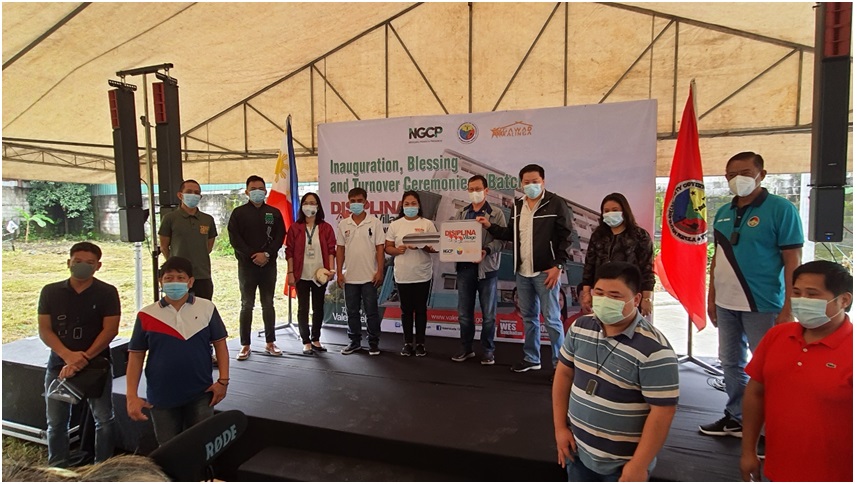
Five buildings were completed in October and formally turned over in a simple ceremony at the Disiplina Village attended by representatives from NGCP led by Vice President and Head of Central Projects Office Mark Joseph Andeo, Gawad Kalinga led by Executive Director Daniel Bercasio, and LGU officials headed by Valenzuela City Mayor Rex Gatchalian. Congressman Wes Gatchalian, and Sec. Eduardo del Rosario of the Department of Human Settlements and Urban Development were also among the guests.

“NGCP and the City of Valenzuela, together with Gawad Kalinga, worked hand in hand to give residents of the city a safer living environment, away from the dangers posed by living near or under high voltage transmission lines. Disiplina Village is the product of collaborative efforts to serve the community in order to protect them and give them a safer place to live in,” said NGCP.

Under the prevailing laws, the abatement of nuisances per se, such as buildings and structures underneath transmission lines, is primarily the obligation of the local government. “NGCP extended its help and its resources to Valenzuela City to expedite the relocation.  We felt that if our help was needed to make things happen and ensure the safety of the residents, we had to find a way to get this done,” the company said. “Hindi sa lahat ng pagkakataon, iaasa natin sa gobyerno ang lahat ng kilos. It’s simple good corporate citizenship.”
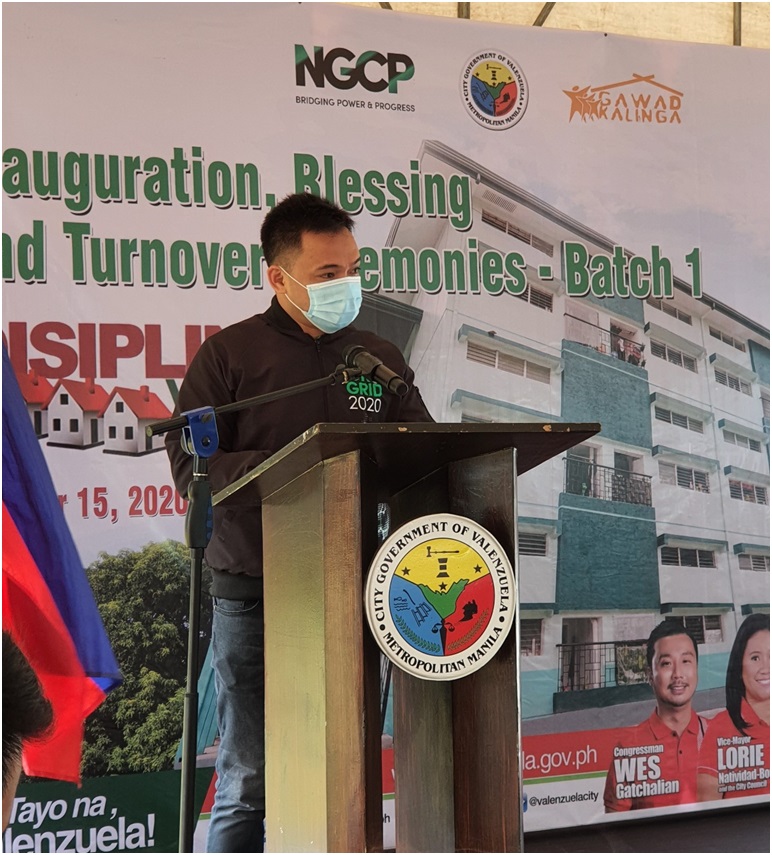
NGCP Vice President and Head of Central Projects Office Mark Joseph Andeo gives a message on behalf of NGCP President and CEO Anthony Almeda.

The five newly constructed buildings with a total of 180 units will be given to residents of Barangay Mapulang Lupa and Ugong previously residing along the transmission line corridor of NGCP’s San Jose-Quezon 230kV Line.

NGCP is a Filipino-led, privately owned company in charge of operating, maintaining, and developing the country’s power grid, led by majority shareholders and Vice Chairman of the Board Henry Sy, Jr. and Co-Vice Chairman Robert Coyiuto, Jr.


Valenzuela Mayor Rex Gatchalian gives his message of thanks to NGCP and Gawad Kalinga, and addresses the residents of Disiplina Village Lingunan.

The future of a post-pandemic workplace through Lorette Theron

Many would see a psychologist as someone who engages in talk therapy. They are indeed out there, but that’s not always the case.

People who work in the field of psychology specialize in different areas like consumer, engineering, community, to name a few. There’s also a study in psychology that focuses on workplace behavior — and industrial-organizational (I/O) psychologist Lorette Theron is one of them.

An I/O psychologist shares his or her expertise to make an organization grow through talent selection and workplace productivity, among others. For Lorette, an I/O psychologist is crucial in making companies move forward in uncertain times.

“He or she needs to be able to integrate many aspects, work with individuals, groups and organizations while putting on many hats,” Lorette shares.

According to Lorette, being updated with business and social environments, and developments in I/O systems are important qualities in the industry. In an email interview with The Philippine STAR, she shares about her career path, I/O psychology and tips on how companies can thrive amid the pandemic.

Getting into the I/O industry

Based in South Africa, Lorette has 20 years of experience under her belt. She has always been drawn to understanding people and how can they grow into the best version of themselves, especially in the workplace.

“I had quite an interesting journey. I initially studied clinical/counseling psychology and then qualified as a psychometrist,” she says, looking back.

In the early 2000s, psychometrists were still unfamiliar to the public. Many organizations at that time were looking for applicants with HR qualifications instead.

“So, I ended up teaching English in Taiwan for three years. Upon my returnto my home country, I worked as a psychometrist for an I/O psychologist in the medico-legal practice. During this time, I decided to change my career and studied toward I/O Psychology instead and then qualified as an I/O psychologist,” Lorette adds.

Compared to other psychologists, an I/O psychologist focuses more on the abilities of a professional. Lorette explains that it’s also about helping employees and organizations grow into the best version of themselves.

“In my view, the I/O psychologist focuses on the untapped potential of an individual and, overall, the field is more positive than looking for abnormalities in people,” she explains. “He or she needs to be able to integrate many aspects and work with individuals, groups and organizations. Other psychologists usually find a niche that they refine for individuals and groups.”

Moving forward in times of crisis

According to the American Psychological Association, I/O psychologists are crucial in helping organizations move forward in the new normal. Lorette echoes this thought, stating that it’s their responsibility to develop a more flexible working environment.

“The recruitment and selection of employees will change, new competencies will emerge, the psychological contract between employer and employee will change, there will be a bigger emphasis on work-life balance, the mental well-being of the employee will become a priority,” she explains. “Developing authentic leadership and instilling trust through supportive management can reduce stress and increase engagement and productivity.

For Lorette, an effective leader in times of crisis has the following qualities — making clear decisions, seeing opportunities in adversity, creating innovative solutions in ensuring the organization’s stability, providing structure to employees and responding adequately.

“Qualities that are deemed ineffective are impulsivity, over-emotional responses, irrationality, indifference or wishing the problem away,” she adds.

The pandemic can be considered as a test for leaders in companies worldwide. However, it’s also the time for companies to discover methods on how they can grow while ensuring the safety of every employee.

“There are immediate factors, such as the safety of employees and the appointment of decisive roles (such as crisis managers) that need to be in place based on logical-analytical reasoning,” Lorette says, as she discussed the factors of making effective decisions in times of crisis.

“There also needs to be the long-term impact and the transformation of the business in a time of crisis that needs to be taken into account. For instance, how can the organization grow and learn from this,” she adds.

At the same time, teamwork and employee engagement are key factors for workplaces to thrive amid difficult times. “By developing an understanding of oneself and others in your team, behaviors and thoughts become more transparent, criticism can be constructive, and each person can contribute their part towards the goal or overall strategy,” Lorette shares.

As we move towards an uncertain future, Lorette sees the office as an experience instead of a place to work. The workplace will also evolve as a balance between home, virtual and physical.

“Employees will be able to choose to work from home or go to the office, while the office needs to provide what the WFH does not provide,” she adds. “The physical office will still have a purpose for collaboration, learning, connection, socializing and essential roles. People will come together for high-intensity sessions and the design of the workspace will adapt.”

As organizations continue to evolve in this environment, Lorette is confident that leaders will come to master the essential mindsets and qualities needed to make the new workplace a significant contributor to the economy.

Catch Lorette Theron in “Leading in Turbulent Times – Discover and Develop an Effective Mindset,” a 60-minute webinar presented by The People at Work and BusinessWorld on Oct. 28. Register now at https://bit.ly/36wQP4f before all the tickets run out.


Irish regulator probes Facebook’s handling of children’s data on Instagram

Instagram’s profile and account settings will be the focus of an inquiry that examines whether the social media company is adhering to the regulator’s data protection requirements.

Ireland’s Data Protection Commission (DPC) has launched two inquiries into Facebook Inc. after concerns were raised about the social network giant’s handling of children’s personal data on Instagram.

The DPC, the main data privacy regulator in the European Union, received complaints from individuals and had identified “potential concerns” in relation to the processing of children’s personal data on Instagram, Deputy Commissioner Graham Doyle told Reuters in an e-mailed statement.

Both inquiries were launched last month, Mr. Doyle said in the statement.

Facebook did not immediately respond when contacted by Reuters on Sunday.

The Telegraph, which first reported the inquiry, said Instagram made the e-mail addresses and phone numbers of users under 18 public.

The Irish regulator launched its probe following a complaint by David Stier, a US data scientist, the Telegraph added.

The first inquiry looks to establish if Facebook has the legal basis to process the data and whether it employs adequate protections and/or restrictions on Instagram.

“This inquiry will also consider whether Facebook meets its obligations as a data controller with regard to transparency requirements in its provision of Instagram to children,” Mr. Doyle said.

Instagram’s profile and account settings will be the focus of the second inquiry, examining whether the social media company is adhering to the regulator’s data protection requirements.

Ireland hosts the European headquarters of a number of US technology firms, making the DPC the EU’s lead regulator under the bloc’s General Data Protection Regulation’s  “One Stop Shop” regime introduced in 2018.

The new rules give regulators the power to impose fines for violations of up to 4% of a company’s global revenue or 20 million euros ($22 million), whichever is higher. — Aishwarya Nair/Reuters

Healthcare workers, high-risk people will get priority for COVID-19 vaccine in New York — governor

NEW YORK — New York Governor Andrew Cuomo said on Sunday that healthcare workers and high-risk populations, including some long-term care residents, would get priority in his state to receive a COVID-19 vaccine when one is approved and available.

According to the five-phase preliminary plan for New York’s vaccine administration program, some details of which Mr. Cuomo announced at a news briefing, healthcare workers in patient-care settings, long-term care facility workers, and some long-term care residents would be among the first to receive a vaccine.

In the second phase of vaccine rollout, first responders, school staff, other public-facing frontline workers and people whose health conditions put them at extreme risk would get priority for the vaccine.

In Phase 3, it would be administered to people over 65. All remaining essential workers would receive the vaccine in a fourth phase, and healthy adults and children would receive it in a fifth phase.

Prioritization would also vary by geographic location based on the prevalence of the virus, Mr. Cuomo said.

“This is a larger operational undertaking, I would argue, than anything we have done during COVID to date,” he told reporters.

The program will likely seek to deliver some 40 million doses of a vaccine to state residents, as New York’s population is around 20 million and the vaccines in development may require two doses to be effective, Mr. Cuomo said.

He said the state had sent the drafted plan to the federal government, along with questions on what funding the federal government would provide for the effort.

“States cannot do this on their own,” he said.

A New York state task force will carry out its own review of coronavirus vaccines authorized or approved by the federal government due to concerns of politicization of the approval process, according to Mr. Cuomo, a Democrat who has blasted President Donald J. Trump’s handling of the coronavirus pandemic.

“I think that will give people added surety in the vaccine,” Mr. Cuomo said on Sunday. — Gabriella Borter/Reuters

China’s economic recovery quickens as consumption returns

BEIJING — China’s economic recovery accelerated in the third quarter as consumers shook off their coronavirus caution, although the weaker-than-expected headline growth suggested persistent risks for one of the few drivers of global demand.

Gross domestic product (GDP) grew 4.9% in July–September from a year earlier, official data showed on Monday, slower than the 5.2% forecast by analysts in a Reuters poll but faster than the second quarter’s 3.2% growth.

“China’s economy remains on the recovery path, driven by a rebound in exports. Consumer spending is also headed in the right direction, but we cannot say it has completely shaken off the drag caused by the coronavirus,” said Yoshikiyo Shimamine, chief economist at Dai-ichi Life Research Institute in Tokyo. “There is a risk that the return of lockdowns in Europe and another wave of infections in the United States will hurt consumer spending and trigger more job losses, which would be a negative for China’s economy.”

The weaker-than-expected headline figures weighed on China’s yuan and mainland stock benchmarks and capped broader market gains in Asia.

The world’s second-largest economy grew 0.7% in the first nine months from a year earlier, the National Bureau of Statistics (NBS) said.

Policymakers globally are pinning their hopes on a robust recovery in China to help restart demand as economies struggle with heavy lockdowns and a second wave of coronavirus infections.

China has partially emerged from a record slump caused by coronavirus shutdowns in the first months of the year.

NBS spokeswoman Liu Aihua warned that growth remained patchy.

“Internally, the economy is still in the process of recovery,” she told a brieing in Beijing. “Some or most of the indicators have not returned to the normal growth level, and some of the cumulative growth rate has also declined.”

On a quarter-on-quarter basis, GDP rose 2.7% in the third quarter, the NBS said, compared with expectations for a 3.2% rise and an 11.5% rise in the previous quarter.

But despite the headline disappointment, analysts were encouraged by a broader upturn in consumption and continued factory strength.

Retail sales grew 3.3% in September from a year earlier, speeding up from a modest 0.5% rise in August and posting the fastest growth since December 2019. Industrial output grew 6.9% after a 5.6% rise in August, showing the factory sector’s recovery was gaining momentum.

Fixed-asset investment rose 0.8% in the first nine months from a year earlier, returning to year-to-date growth for the first time this year.

In the property sector, investment rose 12% in September from a year earlier, the fastest pace in nearly 1-1/2 years, providing a key support for broader investment.

The government has rolled out a raft of measures including more fiscal spending, tax relief and cuts in lending rates and banks’ reserve requirements to revive the coronavirus-hit economy and support employment.

While the central bank stepped up policy support after widespread travel restrictions choked economic activity, it has more recently held off on further easing.

The International Monetary Fund has forecast an expansion of 1.9% for China for 2020, which is close to the central bank’s own projection of 2%.

That would make China the only major economy expected to report growth in 2020, albeit at the slowest annual pace since 1976, the final year of of Mao Zedong’s Cultural Revolution.

CONSUMERS STEP UP
China’s retail spending has lagged the comeback in factory activity this year as heavy job losses and persistent worries about infections kept consumers at home, even as restrictions lifted.

However, recent indicators suggest consumer activity is now turning around.

In the travel sector, domestic passenger flights in September beat their COVID-19 levels, a sign that that segment of the market is approaching a full recovery, even as international borders remain largely shut.

Auto sales marked a sixth straight month of gains in September while Ford Motor Co’s China vehicle sales jumped 25% in the third quarter from a year earlier.

The breakdown of GDP showed final consumption accounted for 1.7 percentage points growth, while capital formation accounted for 2.6 percentage points and net exports contributed 0.6 percentage points to the expansion, NBS said.

The coronavirus outbreak, which caused China’s first contraction since at least 1992 in the first quarter, is now largely under control in the country, although there has been a small resurgence of cases in the eastern province of Shandong.

“The single most important thing for the Chinese economy in the coming months is whether service consumption can catch up,” said Larry Hu, head of China economics at Macquarie Capital in Hong Kong. — Gabriel Crossley and Kevin Yao/Reuters

Global coronavirus cases surpass the 40 million milestone

Worldwide coronavirus cases crossed 40 million on Monday, according to a Reuters tally, as the onset of winter in the northern hemisphere fuelled a resurgence in the spread of the disease.

The Reuters tally is based on official reporting by individual countries. Experts believe the true numbers of both cases and deaths are likely much higher, given deficiencies in testing and potential under-reporting by some countries.

The Reuters data shows the pace of the pandemic continues to pick up. It took just 32 days to go from 30 million global cases to 40 million, compared with the 38 days it took to get from 20 to 30 million, the 44 days between 10 and 20 million, and the three months it took to reach 10 million cases from when the first cases were reported in Wuhan, China, in early January. Record one-day increases in new infections were seen at the end of last week, with global coronavirus cases rising above 400,000 for the first time.

There were an average of around 347,000 cases each day over the past week, compared with 292,000 in the first week of October.

The United States, India, and Brazil remain the worst affected countries in the world. COVID-19 cases in North, Central, and South America represent about 47.27% or nearly half of global cases.

Around 247 cases are seen per 10,000 people in the United States. For India and Brazil, those numbers stand at 55 cases and 248 cases per 10,000 people respectively.

New cases are growing at over 150,000 a day in Europe, as many countries including Italy, Netherlands, Germany, Austria, Poland, Ukraine, Cyprus, and the Czech Republic have reported record daily increases in the number of coronavirus infections.

Europe currently accounts for over 17% of the global cases and nearly 22% of the deaths related to the virus worldwide.

Parts of the UK were put into lockdown as Prime Minister Boris Johnson bid to contain a second wave of infections through local measures.

France imposed curfews while other European nations are closing schools, canceling surgeries, and enlisting student medics.

President Donald J. Trump called for a big economic stimulus as US infections surpassed eight million, with record spikes in several states.

States across the Midwest are seeing a rise in coronavirus cases, with new infections and hospitalizations rising to record levels.

India’s cumulative tally of coronavirus infections stood at 7.43 million on Saturday, with the number of active infections slipping below 800,000 for the first time in 1.5 months.

Iran, the Middle Eastern country hardest-hit by the coronavirus, extended restrictions and closures in the capital Tehran into a third week on Saturday as its death toll rose above 30,000.

Since the pandemic started, over 1.1 million people have died due to COVID-19, with the global fatality rate hovering around 2.8% of the total cases.

An official at the World Health Organization has said the global death toll from COVID-19 could double to 2 million before a successful vaccine is widely used and could be even higher without concerted action to curb the pandemic. — Shaina Ahluwalia and Roshan Abraham/Reuters

Philippines’ PXP Energy in talks with CNOOC on S.China Sea development 

PXP Energy Corp. said it was in ongoing negotiations with China National Offshore Oil Corp (CNOOC) relating to a memorandum of understanding between Manila and Beijing on joint oil and gas development in the South China Sea.

In a market disclosure, PXP said on Monday the talks were being handled by Forum (GSEC 101) Ltd, a subsidiary of its unit Forum Energy Ltd, but the parties had yet to agree on any disclosable definitive agreement.

In what it described as a unilateral decision, Manila has lifted a six-year-old moratorium on oil and gas exploration in the disputed waters believed to be rich in energy and marine resources, a move Beijing did not oppose. — Reuters

SM Foundation upgrades AFP Patient Watchers Lodge

Staying true to its commitment of upgrading health and wellness centers in its host communities, SM Foundation (SMFI) recently improved the Armed Forces of the Philippines (AFP) Patient Watchers Lodge in Quezon City.

This transient amenity was originally designed to cater to the family members of soldiers who are confined at the AFP Health Service Command facility. But in response to the COVID-19 pandemic, this will serve as a temporary lodging facility for military doctors, nurses, and other AFP frontliners.

The AFP Patient Watchers Lodge, which serves as the 169th wellness center of SM Foundation, is a 327 sqm. facility with 60-bed capacity, living room, kitchen, dining area, and a mini office. SM Foundation also provided the necessary furniture and equipment such as new beds and beddings, refrigerators, television sets, water dispensers, wall fans, and microwave ovens, among others.

The said wellness facility is set to be officially launched on October 16, 2020 at 4PM on SM Foundation’s Facebook and YouTube accounts (@SMFoundationInc).

SMFI, through its Health and Wellness Program, upgrades public health centers in its host communities, complemented by its medical caravans across the country. To date, it has renovated more than 160 health and wellness centers and served more than 1 million patients in medical missions.

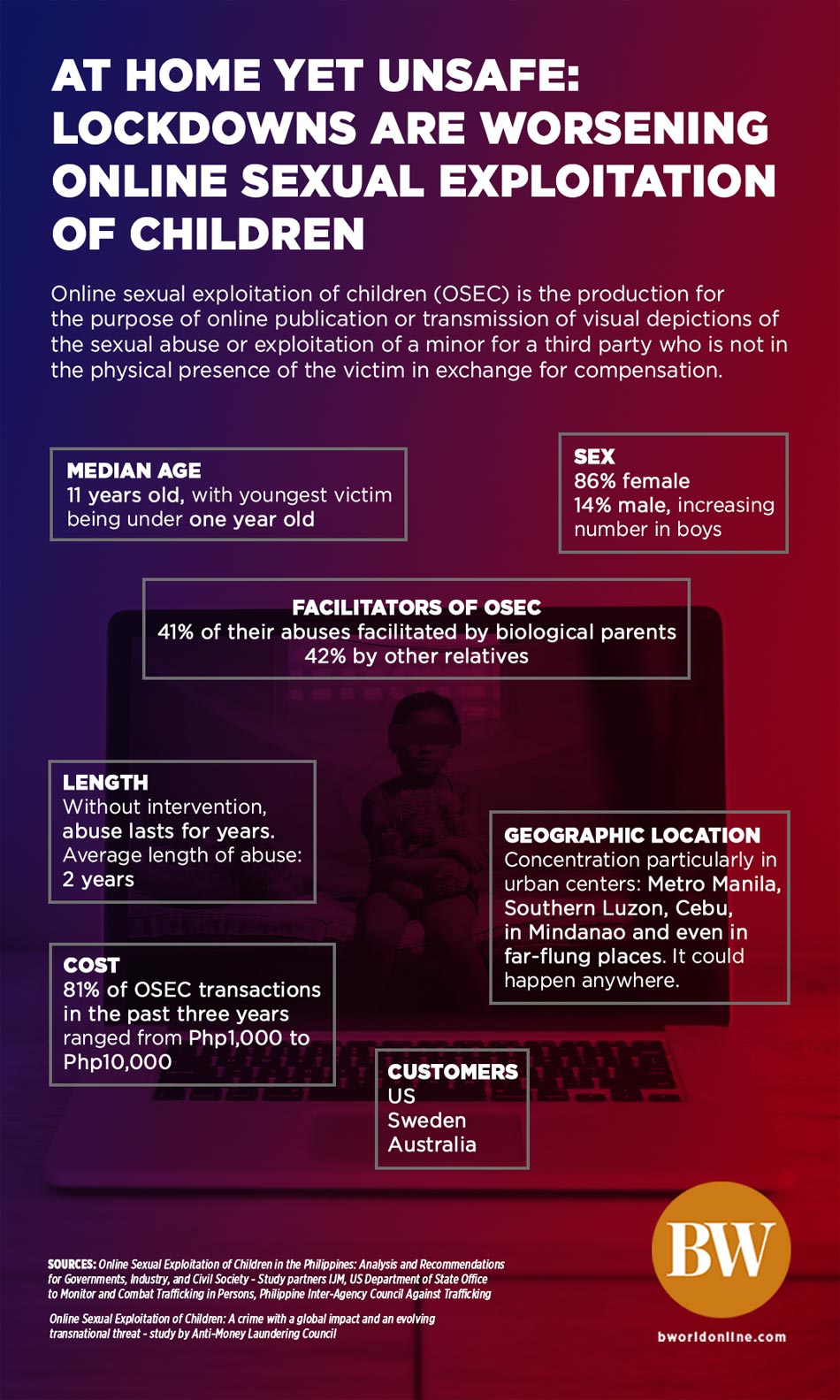
[B-SIDE Podcast] At home yet unsafe: lockdowns are worsening online sexual exploitation of children

Follow us on Spotify BusinessWorld B-Side

Online sexual exploitation of children (OSEC) is a crime that often happens at home at the hands of family, the very people who are trusted the most by the victims of this horrible crime.

This episode jumps off from a report from the Anti-Money Laundering Council on the surge of online child pornography transactions during the lockdown.  Reynaldo Bicol, Manila field office director of the International Justice Mission, tells BusinessWorld reporter Luz Wendy T. Noble why the Philippines is a global hotspot for this crime, how the pandemic is making it worse, and what we can do about it.

TAKEAWAYS

The Philippines is an OSEC hotspot for three reasons: English language proficiency;  widespread Internet access and cheap gadgets; and a robust money remittance infrastructure. 

English proficiency, which has long made the Philippines the darling of the Business Outsource Processing (BPO) sector, also makes it easier for traffickers to communicate with customers from Western countries. 

Internet penetration in the Philippines, as of January 2020, is at 67%, with Filipinos topping the ranking for Internet and social media use. According to an IJM report, most traffickers communicated and exchanged materials with customers on the Surface Web or searchable web (as opposed to the Dark Web). 

Finally, a robust remittance infrastructure—birthed by the Philippine economy’s reliance on overseas Filipino workers—also facilitates transactions with offenders, who are, as mentioned, from Western countries.

While there are laws in place, the government needs to further invest in its capacity to attend to the needs of the children.

“What is needed really is the implementation of these laws,” said Mr. Bicol, of the already existing laws that protect children from OSEC: there’s Republic Act No. 9208, or the Anti–Trafficking Persons Act; Republic Act No. 9775, or the Anti–Child Pornography Act; and Republic Act No. 10175, or the Cybercrime Prevention Act of 2005. 

There is a big gap in the aftercare services for survivors of OSEC.

Each survivor has his/her own unique story of abuse of exploitation which has given them massive trauma. Recovery is mapped out according to individualized intervention plans—there’s no uniform timeline or exact formula to restore them.

Where we can improve: finding safe placement facilities and families willing to take care of victims through a foster care system; enrolling victims into comprehensive mental healing programs that will help them with their trauma; and helping these children gain life skills to prepare them for their eventual reintegration into the community.

“As the saying goes, it takes a community to protect a child,” said Mr. Bicol.

Recorded remotely on October 2. Produced by Nina M. Diaz, Paolo L. Lopez, and Sam L. Marcelo.

Follow us on Spotify BusinessWorld B-Side

Ayala Malls honors ‘changemakers’ during the pandemic

Now on its 16th year, the Extra Mile campaign has taken a new direction at Ayala Malls by honoring everyday individuals as Changemakers—those who have shown exemplary acts of altruism amidst the pandemic.

“The story of each Changemaker is an example of what any person can do for a more optimistic future. No kind act is too small to make a difference. We hope that the Extra Mile campaign and its outstanding honorees will spark a desire for kindness in every Filipino’s life,” shares Ayala Malls president Jennylle Tupaz.

The 39 honorees are recognized for their selfless acts of kindness by initiating many efforts like fundraising and donations for the benefit of vulnerable communities. Here are the 39 Extra Mile Changemakers:

Marco Alejandro “Aldo” Panlilio: Sharing Hope through 200 Pesos

  • Enrique Prado: Promoting Mobility on Two Wheels
  • Tiger Garrido: Protecting the Front Lines
  • Carmaela Alcantara: Designing for Front Liners
  • Ismael Jerusalem: Crafting Protective Care
  • Janice Cuevas: Conducting Yoga Classes for a Cause
  • Gary Ramirez: Feeding Barangays One Meal at a Time
  • Paulina Clara Zulueta: Leading a Caravan of Care
  • Carla May Berina-Kim: Fueling frontliners with proper nutrition
  • Vincent Paul Olalia: Disseminating information and distributing protection
  • Aimee Nunez-Regala: Keeping others safe despite her own vulnerability
  • Malaya Genotiva: Lending learners a helping hand
  • Maria Gliceria “Ria” Valdez: Giving Gadgets to Get Students Online
  • Nini Andrada Sacro: Mobilizing Kindness
  • April Joy Cruz: Extending help where it is needed the most
  • Maxine Andrea Carasig: Connecting Farmers to the Consumers
  • Marvin Bagube and Renan Dela Cruz: Sustaining sweetness to pay it forward
  • Tracy Ampil: Moving healthcare forward through unconventional means
  • Marvin Caparros: Building a Foundation of Social Responsibility
  • Simon Fernan: Making more effective masks
  • Evelyn Nacario-Castro: Caring for farmer communities and frontliners
  • Jumax Morgia: Helping through Manufacturing and Distribution
  • Karl Arriola: Aiding Small Businesses in Cebu
  • Michael Arcilla: Empathizing with those Affected by the ECQ
  • Gian Dela Rama: Enabling Vital Communication
  • Theriza Lanche: Saving Her Funds to Protect Others
  • Marlon Pia: Championing the Marginalized Indigenous Communities
  • Manoling Francisco, SJ: Aiding Communities through the Tanging Yaman Foundation
  • Mary Lorraine Pingol: Helping a Homeless Woman Deliver a Baby
  • Mariko David, Marie Sol Bartolome, and Shiela Marie Borongan: The Wagi Project
  • Stanley Seludo: Helping Musicians and Businesses
  • Christine Remo: Provisions for Frontliners
  • Svethllana Patricia De Guzman: Aiding Drivers
  • Joel dela Paz: #BayanihanSaMontalban to support Jeepney Drivers
  • Dale James Ferrer: Donations for Musicians
  • Micaela Gavino: Aiding Students with WiFi
  • Renz Allan Lacorte: Providing Educational Materials at Davao del Norte
  • Sharra Crizel Elep: Distance Learning for Students
  • Dionicio Castro Jr.: Food Packs for Barangay

Kindness is a light that shines brightest in the dark. Although the pandemic changed the tide of the times, Ayala Malls remains dedicated to promote what every Filipino needs now: the spirit of bayanihan. Check out the full stories of the 39 Extra Mile Changemakers at ayalamalls.com/pasyal.

SM Supermalls marks milestone with the first-ever virtual ‘SuperKids Day’

SM Supermalls and its kiddie shoppers across the country recently made history with the celebration of the first-ever virtual SM SuperKids Day that was held at SM Supermalls’ official Facebook page.

On its fourth year, SuperKids Day continued the tradition of highlighting everything that Filipino children love at SM – shopping, eating, playing, and having fun – but this time, they enjoyed their “SM moments” with their families at the comforts of their homes.

“It’s been seven months since we last saw your smiles, heard your laughter, and felt your happiness while spending your fun SM moments with us,” said Jonjon San Agustin, SM Supermalls senior vice president for marketing. “We know that you miss your favorite SM malls. And please know that we miss you too. But your health and safety is and forever will be our priority. We really look forward to see your sweet smiles again, SuperKids.”

The Zoom-inspired #SMSuperKidsDay2020 featured kids from different parts of the country and SM Little Stars achievers namely, Marcus Cabais, Aleynah Redillas, Chunsa Jung, and NhikzyCalma. Live online viewers were treated to a feel-good musicale that depicted the lives of Pinoy kids while in quarantine and how their favorite SM malls delight them in different AweSM ways.

In partnership with Toy Kingdom, The SM Store, SM Kids, SM Accessories, SM Stationery, SM Snack Exchange, Baby Company, SM Markets, SM Shopmag, and SM Cyberzone, #SMSuperKidsDay2020 is part of the month-long Kids’ Month celebration of SM malls nationwide.

Along with the virtual event, the #AweSMLearning Online Workshops is currently ongoing until October 31 where they can enjoy dancing, singing, and digital art workshops at the comforts of their home. Completing Kids’ Month is the #FAMtasticHalloweenWithSM and a fun Tiktok Kiddie Challenge where all kiddie TikTokers can participate.

For more information about #SMSuperKidsDay2020 and #SMKidsMonth2020 visit smsupermalls.com of SM Supermalls’ official Facebook page.

Navigating the rapidly changing world of retail

It is no understatement to say that the world has changed forever because of COVID-19. Several months into a global lockdown, governments, businesses, and organizations all over the world have scrambled to adjust to what is now essentially a new way of life.

Retail is one of the industries most affected by this change. Because of the mitigation measures imposed globally aimed at slowing the spread of coronavirus, the supply, demand, and daily operations of the retail sector have been greatly disrupted. For many weeks in the Philippines, all malls were closed, social gatherings were discouraged, and only essential businesses were allowed to operate.

The overall impact of this on retail is massive. According to the Organisation for Economic Co-operation and Development (OECD), the retail sector is seen worldwide as an economic heavyweight: on average across OECD economies, about 1 in 12 workers are employed in retail, and the sector accounts for almost 5% of GDP. Moreover, it mainly serves final demand, and thus occupies an important position in value chains both as a provider to households and as an outlet for upstream sectors.

What’s more, retail also often complements activities in other sectors hard-hit by the pandemic, like tourism. The retail sector is very labor-intensive, and relies on low-wage and part-time, on-call and gig workers that are not well-covered by traditional social protection measures, which further strengthens the social consequences of the crisis in this sector.

At the same time, the behavior of consumers regarding their approach to retail has also changed during the pandemic. According to a research done by global professional services firm Accenture, changes to disposable income and available leisure time are influencing consumers’ attitudes, behaviors and purchasing habits. For example, 33% of consumers are finding themselves ‘financially-squeezed’, with less disposable income compared to before the crisis, and are shopping more cost consciously, whereas 26% (the ‘Resource-Rich’) have increased both their disposable income and free time, and are enjoying new leisure pursuits.

“In markets where the pandemic is stabilizing, economic concerns remain high, denting consumer confidence. And although fears about health are gradually subsiding, consumers remain uncomfortable about visiting public places, although they are relatively more comfortable with familiar places such as grocery and pharmacy stores,” Accenture noted in their report.

Moreover, the research found that with lockdowns in place and many stores shuttered, e-commerce has surged among consumers. From previously uninitiated users, adoption has accelerated, especially in under-penetrated categories such as grocery. Consumers have also increased their use of omnichannel services like contactless payment, social commerce, virtual consultations and curbside pickup.

All these factors combined make a perfect storm for retailers across the globe. Global professional services firm KPMG highlighted the need for retailers to readjust and reassess their priorities during the pandemic in order to move forward.

“The COVID-19 virus has already led to a number of workplace shutdowns and quarantines. Retailers must have a plan that ensures the safety of the employees while also trying to maintain business as usual activities. Beyond simply creating a crisis communications plan, retailers should be thinking about how they will manage their workforce under various different scenarios,” KPMG wrote on their website.

KPMG noted innovative companies in China that have managed to address the many challenges of this pandemic; during the height of the outbreak there, grocery operators temporarily hired thousands of restaurant employees who were idle due to restaurant closure to help meet spikes in demand. Other companies have been moving employees around the organization to fill gaps and relieve overworked departments.

Meanwhile, retailers in other sub-sectors are encouraged to talk to their key suppliers to assess their risks, identify any indirect exposures and create contingency plans.

“Retailers should also be thinking about the impact these massive changes will have on the customer and the customer relationship. How will you maintain trust in your brand and your products and services? How will you reset expectations for today? And how will you recover the customer experience in the future?” KPMG wrote.

Retailers should also take advantage of the surge in the adoption of digital platforms and technologies among consumers to increase their resilience to future shock. Brick-and-mortar retailers can diversify their sale channels by expanding their activity to online sales.

The OECD pointed out that in Korea, the government is strengthening its support for small businesses to enter online sale platforms, while in Japan, the government will provide a business continuity subsidy, which allows firms to diversify and expand their sales channels.

“Beyond financial support, governments should pay attention to regulatory barriers that hinder the participation of traditional retailers in online sales (e.g. permitting and zoning rules) and to framework conditions that affect demand for online sales (e.g. digital literacy, consumer protection, security and reliability of payment systems),” the organization suggested.

“Finally, as COVID-19 affects food and agricultural supply in complex ways, the retail sector should also consider the resilience of its supply chain where needed, notably by relying on more diversified sources of goods, by improving inventory management and by leveraging data analytics to improve forecasts on sales and supply chain tensions.”

The retail industry has weathered disruptions big and small in the past. This is no different. However, the convergence of digital technology, globalization, and increased consumer consciousness presents an entirely new playing field in the world of retail. How much it may change in the coming months and years, only time will tell. — Bjorn Biel M. Beltran