Home Blog Page 8922

Pope says same-sex couples should be covered by civil union laws

ROME — Pope Francis has said that same-sex couples should be protected by civil union laws in the clearest language he has used on the rights of gay people, prompting praise from liberals and calls for urgent clarification from conservatives.

He made his comments in a new documentary Francesco by Oscar-nominated director Evgeny Afineevsky that was released on Wednesday.

“Homosexual people have a right to be in a family. They are children of God and have a right to a family. Nobody should be thrown out or be made miserable over it,” he said.

“What we have to create is a civil union law. That way they are legally covered. I stood up for that,” he said.

The pope appeared to be referring to when he was archbishop of Buenos Aires and opposed legislation to approve same-sex marriages but supported some kind of legal protection for the rights of gay couples.

The Catholic Church teaches that homosexual tendencies are not sinful but homosexual acts are. It teaches that homosexuals should be treated with dignity but is opposed to gay marriage.

Papal biographer Austen Ivereigh told Reuters that the pope’s comments in the film were some of the clearest language the pontiff has used on the subject since his election in 2013.

“Pope Francis’ clear and public support for same-sex civil unions marks a new stage in the church’s relationship with LGBTQ people,” said Father James Martin, a Jesuit priest and author of Building a Bridge, a book about Catholic ministry to homosexuals.

“It shows his overall pastoral approach to LGBTQ people, including those who are Catholic, and sends a clear message to those bishops and Church leaders who have opposed such laws,” Fr. Martin told Reuters.

Conservatives demanded a clarification.

“The Pope’s statement clearly contradicts what has been the long-standing teaching of the Church about same-sex unions. The Church cannot support the acceptance of objectively immoral relationships,” Bishop Thomas Tobin of Providence, Rhode Island, said in a statement.

Ed Mechmann, director of public policy of the Archdiocese of New York, said in a commentary on its website that the pope was mistaken, adding “supporting the legal recognition of any kind of same-sex union is contrary to Church teaching.”

‘A VERY POSITIVE MOVE’

A spokesman for United Nations (UN) Secretary-General Antonio Guterres, who is a devout Catholic, described the pope’s remarks as “a very positive move.”

“The Secretary-General has spoken out very forcefully against homophobia in favor of LGBTQ rights, that people should never be persecuted or discriminated against just for who they love,” UN spokesman Stephane Dujarric said.

The pope, who early in his papacy made the now-famous “Who am I to judge?” remark about homosexuals trying to live a Christian life, spoke in a section of the film about Andrea Rubera, a gay man who with his partner adopted three children.

Mr. Rubera says in the film that he went to a morning Mass the pope said in his Vatican residence and gave him a letter explaining his situation.

He told the pope that he and his partner wanted to bring the children up as Catholics in the local parish but did not want to cause any trauma for the children. It was not clear in which country Mr. Rubera lives.

Mr. Rubera said the pope telephoned him several days later, telling him he thought the letter was “beautiful” and urging the couple to introduce their children to the parish but to be ready for opposition.

“His message and his advice was really useful because we did exactly what he told us. It’s the third year that they (the children) are on a spiritual path in the parish,” Mr. Rubera says in the film.

“He didn’t mention what was his opinion about my family so (I think) he is following the doctrine on this point but the attitude towards people has massively changed,” he said. — Philip Pullella/Reuters

‘Venice of the East’ revives canals to fix traffic snarls

BANGKOK — Until recently, Nuttanakul Somsak’s daily commute to work was unlike that of most residents in Bangkok: she hopped on a boat for about half the price of a train ticket, and taking just a fraction of the time that a taxi or bus did.

For three years, Ms. Nuttanakul boarded one of the passenger motor boats that ply the fetid canals in Bangkok, carrying about 30,000 of the city’s more than 8 million residents every day.

“It was cheap, and it was fast. If I had to take a taxi or bus, I would have had to wake up an hour earlier and it would have cost me more,” she said.

“The only downside is that the canal smells: one time, I got splashed by another boat, and had to buy a new skirt to change into for work. But I would still gladly take a boat if my new workplace was connected to a canal,” said Ms. Nuttanakul.

Bangkok, built on the floodplains of the Chao Phraya river, was once known as the Venice of the East for its sprawling network of canals, or klongs.

The canal and river network stretched hundreds of kilometers, connecting homes, temples and public spaces, serving as corridors of transport of goods and people, and as centers of commerce with scores of floating markets.

But from early in the 20th century, many canals were filled in and built over for roads. Others became clogged with trash and sewage, even as roads gradually choked with traffic, with the Thai capital rated among the most congested in the world.

Now, a plan to restore some of the canals and introduce electric ferries aims at easing traffic congestion, as well as creating a more liveable city with environmentally friendly public transport and less pollution.

“People in Bangkok see the canals as an eyesore, but we want them to be viewed as an asset,” said Niramon Serisakul, director of the Urban Design and Development Center (UddC), which has advised the Bangkok Metropolitan Administration (BMA) on improving mobility.

“Especially now, when people are concerned about taking public transport during the coronavirus, river and canal transport can be a pleasant alternative to driving if it is made more convenient,” she told the Thomson Reuters Foundation.

‘TURNED OUR BACKS’

From Rome to Tokyo, many of the oldest cities in the world grew around rivers that were key for trade, transport, culture and safety, besides supplying drinking water.

As road and air transport became more popular and as populations expanded, however, rivers and other waterways were largely ignored by policymakers and residents alike, often becoming heavily polluted from sewage and industrial waste.

But in recent years, cities from Chicago to Seoul have revitalised waterfront areas for economic and environmental benefits, with authorities even giving some rivers and lakes the same legal rights as humans to better protect them.

As climate-change impacts worsen, planners are keen to harness the cooling effect of rivers to combat the urban heat island effect, and their role in flood mitigation.

“Our homes once faced the klongs, but we then built walls and turned our backs to them and all the benefits they bring,” said Kanjanee Budthimedhee, chair of the design and planning program at King Mongkut’s University of Technology.

“If we revive the canal network, we can solve pollution, congestion, and environmental issues quite cheaply,” said Ms. Kanjanee, who backs a canal-and-cycling network to address last-mile connectivity in Bangkok’s public transport system.

Bangkok is forecast to be one of the urban areas hit hardest by warming temperatures, with nearly 40% of the city expected to be inundated each year as soon as 2030 due to more extreme rainfall, according to the World Bank.

The city is sinking by about 2 centimeters (0.8 inch) per year, according to climate experts, and flooding in many parts of Bangkok is already common during the annual monsoon.

Devastating floods in 2011, that killed more than 500 people in Bangkok, reiterated the threat to the city, said Ms. Niramon.

“The 2011 floods underlined the importance of canals for flood mitigation and drainage,” she said.

“The plan to upgrade them is part of a larger goal to regenerate Bangkok by improving mobility, the environment and quality of life, which can help strengthen the economy.”

UNIQUE IDENTITY

Streets cover 7% of Bangkok’s area, while water makes up 8%, according to UddC. But of the about 1,200 canals, more than three-fourths are inaccessible to the public, with only about 70 kilometers of the network in use today, said Ms. Niramon.

UddC estimates that by upgrading and connecting 28 klongs, the network can expand to 700 kilometres, reaching the city’s main commercial and residential areas and integrating better with the expanding train lines and buses.

The BMA, which has proposed to develop five canal routes initially, is also adding fleets of electric boat taxis to cut pollution, emissions and noise, and entice more riders.

“The ultimate goal is to encourage more public transport ridership and reduce private vehicles on the roads, and the canals will be key to the plan,” said Pongsakorn Kwanmuang, a spokesman at the BMA.

“The canals are a part of the unique identity of Bangkok. Their revitalization will also provide more public and recreational spaces for people, and help revive the communities who traditionally live along the canals,” he said.

It is still a fraught issue: an earlier proposal for a riverside promenade was halted by a Bangkok court in February after architects and environmentalists said it would worsen flooding and uproot hundreds of families reliant on the river.

The canal plan also fails to fully address the lack of last-mile connectivity, or actively discourage car use, critics say.

Ms. Niramon admits it is a challenge.

“We can’t make people do something just by saying: it’s good for the community or good for the environment. But with a little effort, we can make the canals appealing again,” she said.

“In cities such as Amsterdam and Venice, canals are integral to everyday life in the city. Bangkok was once like that, and has the potential to be that way again.” — Rina Chandran/Thomson Reuters Foundation

China and US economies diverge over coronavirus response

WASHINGTON — The United States and China dealt with the spread of the devastating coronavirus pandemic in vastly different ways, and that split is reshaping the global battle between the world’s two leading economies.

About 11 months after the Wuhan outbreak, China’s official GDP numbers this week show not only that the economy is growing, up 4.9% for the third quarter from a year earlier, but also that the Chinese are confident enough the virus has been vanquished to go shopping, dine and spend with gusto.

China’s total reported death toll is below 5,000 and new infections are negligible, the result of draconian lockdowns, millions of tests, and strict contact tracing that set the stage for an economic rebound.

“China’s success in containing the virus has allowed its economy to rebound more quickly, and with relatively less policy support, as compared with other large economies,” said former senior US Treasury official Stephanie Segal, a senior fellow at the US-based Center for Strategic and International Studies.

In the United States, 221,000 people are dead from COVID-19 after a delayed federal response, partisan battles over mask-wearing and lockdowns, and plenty of public events that do not follow public health guidelines. The country is in the midst of a new wave of infections.

Entertainment venues, restaurants and tourist spots are closed or only partially open, millions of people are out of work indefinitely, GDP is expected to shrink this quarter and the United States faces a gap in economic output that could last years.

“Obviously the US government bungled it,” said Harry Broadman, a former senior US trade official and managing director with Berkeley Research Group. The singular authority of China’s Communist Party helped Beijing enforce contact tracing and lockdowns, Mr. Broadman said. Other democracies, including New Zealand and South Korea, stamped out the virus as China did.

The real difference between the United States and China is Washington “has been arguing over stimulus issues on Capitol Hill and it’s still far too little and too late,” said Mr. Broadman, who has served under both Republican and Democratic presidents. “That has created more and more uncertainty on the part of business.”

Ahead of a Nov. 3 re-election bid, US President J. Donald Trump has blamed China for the spread of the virus and asserted his administration had done all it could to contain it. Asked during a town hall due to be broadcast on Sinclair Broadcast Group on Wednesday if he would have done anything differently, Mr. Trump said, “No, not much.”

White House spokesman Brian Morgenstern said on Wednesday that China does not accurately report anything, “let alone data regarding coronavirus infections and economic growth.” He said Trump was rebuilding a strong and inclusive economy with the expected arrival of new treatments and vaccines in what the spokesman called record time.

The US Federal Reserve on Wednesday released data that showed a slight to modest recovery in the US economy, although the picture varied greatly from sector to sector. ​

RIPPLE EFFECTS

Experts cite longer-term concerns about China’s economic prospects, including the high debt levels of its state-owned companies.

“Reliance on investment-led growth, fueled by credit expansion, builds up even further leverage and risks in an already weak financial system, and will further pull down efficiency and the sustainable growth rate,” said Mark Sobel, a former senior US Treasury official.

But for now, the divergent responses to the virus will have an impact on the fierce political and economic rivalry between Beijing and Washington with ripples felt around the world, experts said.

“China’s economy in 2021 is going to be 10% bigger than it was in 2019, and every other major economy is going to be smaller,” said Nicholas Lardy, an economist with the Peterson Institute for International Economics.

That means China’s “role in the global economy is going to continue to expand,” Mr. Lardy predicts, making any attempts by US policymakers to discourage other countries from deals with Beijing, or otherwise “decouple” China from the global economy, more difficult.

China’s exports have been stronger than expected, bolstered by demand for medical goods overseas. While the IMF projects global trade volume will fall by 10.4% in 2020, China’s overall share of global trade has grown.

Beijing is experiencing other benefits as well. “We see signs of China’s success in the exchange rate and equity market performance at a time when many other economies are under pressure,” Ms. Segal said.

China’s fiscal deficit for 2020 will expand by 5.6 percentage points to 11.9% of GDP—a smaller-scale increase than the massive stimulus that Beijing deployed during the 2008-2009 financial crisis, the IMF’s Fiscal Monitor shows.

By contrast, the United States will see a 12-percentage point increase in its 2020 fiscal deficit as a share of GDP, to nearly 19%.

While China’s consumption is improving, retail sales are still down 7.2% over the first three quarters, with urban residents’ disposable incomes down 0.3% over the same period. Strict lockdowns earlier in the year led to months of lost wages for many workers.

In Beijing, officials are highlighting their leadership role.

“China’s epidemic control and prevention is at the forefront of the world, and China’s companies are supporting the global resumption of work and production through their own resumptions,” said Liu Aihua, spokeswoman for the National Bureau of Statistics, at a news conference where she announced the third quarter GDP results.

Meanwhile, the United States still lacks a robust contact tracing system, or enough testing, Mr. Lardy said. These are things the US could have “done much better at without being an authoritarian single party state,” he added. — Andrea Shalal and Gabriel Crossley/Reuters

MotoDeal is now the number one motorcycle website in the Philippines

The year 2020 has brought about many changes to the lives of Filipinos and all over the world. A personal vehicle is an empowering asset, and there is none more personal than a motorcycle. Many motorists on the road ride on two wheels for transportation or for their livelihoods. It is the most common form of transportation in this country, whether in the city or in the provinces of the Philippines, motorbikes are a staple on any patch of asphalt or even dirt in our humble archipelago. Every day, countless motorcycles are sold for different reasons, whether it be for a small business, leisure riding, or even as a means to skip the traffic.

Rise of new opportunities

In the year 2019, the Philippines ranked 5th largest market in the world for Motorcycles, presenting ample opportunity for many businesses to set up shop in the country. Big brands like Honda, Kawasaki, Suzuki, Yamaha, KTM, and Kymco have already established production facilities here in the country. Other brands from India and even China are looking into establishing local assembly and production facilities to meet the growing demand for bikes. In the first half of 2020, however, total sales for motorcycles were at about 47.8% less than the first half of 2019 because of the COVID-19 Pandemic and government lockdowns. Physical distancing has become the new normal, necessitating the development of online platforms in order to reach consumers. Given that the Philippines was the fastest-growing market for motorcycles in the world from 2012 to 2019, according to motorcyclesdata.com, it seems that this trend will pick back up by 2021 with a quick and strong recovery expected according to analysts.

The power of AutoDeal, for Motorcycles.

Looking to enhance the buying experience of every Filipino in the country, and to replicate the success that AutoDeal.com.ph has garnered, the SirQo Group, Inc, launched MotoDeal.com.ph with the vision to provide a seamless customer-centric method for purchasing motorcycles online.

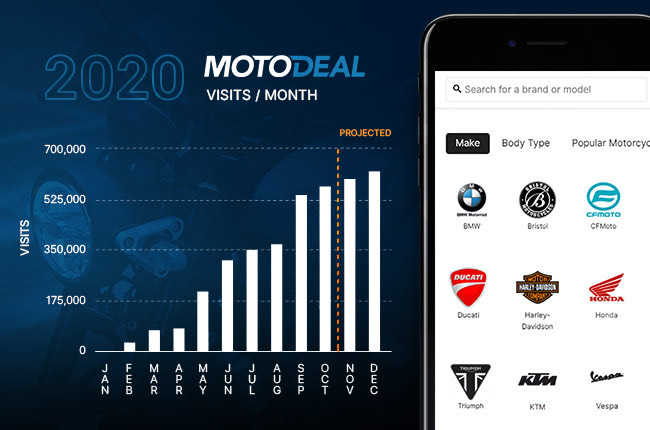
After launching in March of 2020, the MotoDeal platform has grown exponentially ever since. Coming from about 60,000 to over 500,000 site visits for the month of September alone, the brand is now the number 1 motorcycle buying website in the Philippines.

Key points in the site’s growth are during the month of February to March, where the number of visitors doubled and remained constant until April after the official launch of the website and its many features. Following this period, the month of May marked one of the biggest increases in site visits with a rate of over 250%.

The next big leap happened in the month of September, with up to 145% rate of growth from the month prior. This brings the total number of visits per month up to 542,539 visitors, a number which is still growing and growing allowed MotoDeal to be the most visited website for motorcycles in the Philippines.

“We’re extremely pleased with MotoDeal’s recent growth. By combining increased audience figures with a rapidly expanding partner network we aim to provide increased accessibility and convenience for consumers across the country. Whether you need a motorcycle for mobility needs, or for more of a lifestyle fit, MotoDeal will enable consumers to compare different models, find special offers and connect efficiently with dealers.” stated MotoDeal Co-Founder & CEO Daniel M. Scott

More with MotoDeal

On top of the site traffic and as an online marketplace, MotoDeal has been able to sign on more dealership groups and OEM brands to further enhance the customer experience when looking for their next motorcycle. With more than three dozen dealerships signed on, customers are assured that their inquiries for their desired rides will be met with competent and trained sales agents. Brands like KTM, Triumph, and Vespa are only some of the marques that are part of the MotoDeal platform, wherein buyers can research, inquire, and get a quote all in one place. News and reviews are also available to help buyers make the right choices in terms of what are the best bikes to buy and what are the best deals that can be had in the Philippines. Much like its sister brand, AutoDeal, MotoDeal features many pages that users can access like a comprehensive bike guide, an up-to-date news section, in-depth and honest reviews, motorcycle videos, how-to features, and even a dedicated promos section for buyers who are looking for the best possible deals for their hard-earned money.

Lighting the Way Forward

From a little-known region of China, the coronavirus has become the defining phenomenon of the new decade, spreading all over the world, ignoring geopolitical and socioeconomic barriers to infect even people as powerful as the President of the United States.

The COVID-19 pandemic has plunged the world into an economic downturn that most experts predict will rival that of the Great Depression. To prevent its spread, countries have scrambled to impose quarantine measures, to the detriment of business and large-scale industries. Millions of lives have been lost, and millions more have lost their livelihoods. Small and medium enterprises, which comprise the bulk of the Philippine economy, are at a loss. How can small businesses contend with a global catastrophe that has left much of the modern world reeling?

The Asian Institute of Management Rizalino S. Navarro Policy Center for Competitiveness and the Konrad-Adenauer-Stiftung Philippines Office aims to answer that question with its series of web conferences titled “Rethinking Small Business Strategy and Support Post-COVID 19”. “Many of these companies are not able to face the crisis in this way or to survive as well, especially if this is a long-lasting crisis, as large companies and corporations can do,” Prof. Dr. Stefan Jost, Konrad Adenauer Stiftung Philippines Country Director, said in his opening remarks.

“It is therefore a matter of taking a clear inventory of the sector and developing solutions together. There are certainly differences between the individual areas, but we can also learn from each other. A differentiated view of the various sectors is required for this and that is the goal of today.”

The first session of the web conference focused on the topic, “The Way Forward for SMEs: Insights from Small Business Owners,” pooling together a panel of business owners who have been affected by the COVID-19 pandemic to gather insight and information about how entrepreneurs can find a way through the challenges posed by this new, uncertain world.

Joel Martin Andrade, co-founder and creative director of Issy & Co. Cosmetics, was caught the least prepared, as the pandemic hit just as his brand was about to launch a massive expansion, complete with a planned marketing campaign.

“When the pandemic hit, it was a shock because we already paid for the endorsers, the ads, but we’re not able to sell. Our online hubs were not able to fulfill at the time, and we were supposed to expand to department stores. We all had to shut it down,” he said.

To recover, he said that they had to rethink, refocus, and reorganize what they had wanted for the brand moving forward. This included changing his mindset about growth.

“We were trying to go at a speed that wasn’t healthy for the brand. We realized that we weren’t ready to expand, and because of the pandemic we were able to restructure, reorganize,” he said, adding that it also gave them time to complete the transition to online platforms that they had begun prior to the pandemic.

Digital transformation is evident all over the country. Various industries are pivoting to online marketplaces to reach their customers, as well as using digital platforms to continue operations despite the government-imposed lockdowns.

Kirk Chester Damasco, co-owner and co-founder of Get Blued & Worship Generation, who had so far been operating physical retail stores, acknowledged the inevitable shift towards e- commerce.

“With COVID, it finally made it clear the direction of the retail market in the Philippines. While the mall will still be there, the shift has been continuous and steady for online platforms. Now that COVID has happened, it has fast-tracked the shift from brick and mortar stores to online,” he said.

“What is happening now is that even though the restrictions are slowly being loosened, people are still quite afraid to go to malls, and even if they do, one stark change in behavior is that the browsing and the window-shopping have diminished. People go to malls with fixed things in mind to buy. Browsing really happens now online. That is one of the, if not the most important, trend or change that we see in light of COVID.”

Embracing and adapting to change

This was further highlighted in the second session of the web conference, which was titled, “Crafting and Applying Pivot Strategies: Ideas from the Experts”.

Prof. Rene T. Domingo, retired associate professor from the Asian Institute of Management, pointed out that to survive, businesses have to reassess their strengths and their assets and innovate to adapt to the world their consumers live in.

“The idea is innovation. Pivoting is about innovation, looking at opportunities among the problems that beset us. This is the way entrepreneurs look at the economy: for every problem, there is a business that can be monetized,” he said.

He highlighted health, safety, convenience, and frugality as the current expectations of the consumer market. Pivoting, he says, means offering more value for consumers while adhering to those expectations.

Prof. Rebecca R. Ricalde, clinical professor from the Asian Institute of Management, added that months into the pandemic, we are past the phase where businesses can expect things to go back to the way they were.

“Shift your focus to how your products and services connect to customers to what is important to them now,” she said.

Indeed, Derya Tanghe, co-founder of farm-to-door delivery firm Future Fresh, saw the COVID- 19 pandemic as a wake-up call for both the public and private sectors to address gaps in the country’s infrastructure and food systems.

“No one really anticipated the global pandemic that happened. It proved the urgency of building a new food system that makes it easier to access high-quality nutritious food. What we saw at the beginning of COVID was that a lot of the infrastructure and the roads were closed. A lot of farms couldn’t actually deliver or reach stores. At least 30-50% of produce or vegetables are wasted upon travel. That was further exacerbated during the pandemic,” Mr. Tanghe said.

“For us, we saw that a lot of people moved towards online and e-commerce. We were kind of lucky that we had already shifted and planned to do that prior.”

A path to the future

Donn Carlo Gamboa, co-founder & CEO of White Cloak Technologies, advised businesses who were affected by the pandemic to look into accessible and affordable ways to transition their operations online.

“As a business, we also had our challenges when we had to transition from physical collaboration, which is one of the things that differentiate our business from our competitors into a remote setup. It has been a great challenge because our clients typically prefer face-to-face meetings and so on,” he said.

For many SMEs, Mr. Gamboa added, digital transformation is the only way forward. And while getting custom-fit digital solutions will be out of reach for many businesses cost-wise, he suggested looking into platform-based and subscription-based options, which are less risky and less expensive.

Yet while the country goes through accelerated digitalization, there are other issues that need to be highlighted. In the third session of the conference, titled “Policies to Support SME Recovery – Support for SMEs and Entrepreneurs: Discussions on Policy Options”, Dr. Lucia Cusmano, senior economist OECD Centre for Entrepreneurship, pointed out the inherent cybersecurity risk of so many businesses going online without much preparation.

“There is a huge mass of businesses that are not prepared to manage cybersecurity and digital risks, and are currently highly exposed to these risks. While this may look like a marginal issue today, we’ve already seen a big increase in digital harm suffered by the SME population. This is going to be one of the biggest challenges that we need to address,” she said.

In the same session, Ma. Flordeliza C. Leong from the Philippine Exporters Confederation Inc. had this to say, “The challenges are not really new, they are just being exacerbated. What is new is the intense pressure to adapt to these changes.”

While there is no end yet in sight for such challenges brought by the pandemic, the panelists urged entrepreneurs to keep learning about the new market environment, sticking true to their brand purpose, and discover new ways of serving their customers. What allows companies to survive and thrive in the pandemic will be the agility, innovation, and resilience it will take to assess the situation and make the decisions to move forward.

“It’s all about doing what you can. When you’re a small brand you don’t have the luxury of bringing in more people or on relying on somebody else. You know your customers the best,” Mr. Andrade said.


Del Monte Philippines, Inc. announces special offer for investors

Del Monte Philippines, Inc. announced special bond offers to investors available from Oct. 20 to 26. For more details visit www.delmontephil.com/investors/news-and-filings

Pandemic hits local poultry demand

United Broiler Raisers Association said demand for chicken has dropped significantly amid the pandemic. — REUTERS/ERIK DE CASTRO

By Revin Mikhael D. Ochave, Reporter

LOCAL POULTRY production is expected to plunge by as much as 40% this year as demand weakened due to the coronavirus pandemic, the United Broiler Raisers Association (UBRA) said on Wednesday.

UBRA President Elias Jose M. Inciong said in a mobile phone message the industry has seen a drastic drop in demand from institutional buyers such as hotels and restaurants, whose operations remain limited due to various lockdown restrictions around the country.

Hotels, restaurants and institutions account for  30% of the market. Mr. Inciong said there appears to be no signs of recovery with hundreds of local fastfood outlets having closed permanently and more are expected to follow.

However, Mr. Inciong said despite lower production, poultry supply is more than enough heading into the holidays.

Sobra ang supply. Pero mababa ang demand. (There is oversupply. But demand is weak.) Prices for poultry have been very volatile,” Mr. Inciong said.

“The average farmgate price of poultry recently reached P91 per kilogram. But in less than a week, farmgate prices have gone down by an average of P14 per kilogram and now ranges from P77 to P79,” he added.

Mr. Inciong said poultry imports have increased by 32% as of the end of September despite travel restrictions.

Citing data from the Bureau of Animal Industry, UBRA said the importation of chicken cuts as of September amounted to 31.78 million kilos. Imports of chicken leg quarters reached 54.5 million kilos, while imports of mechanically deboned meat of chicken reached 208.21 million kilos as of September.

Sought for comment, Bureau of Animal Industry Director Ronnie D. Domingo said that after strict lockdown measures were lifted, the government has tried to push excess poultry inventory in traditional and new local markets.

“The increasing pork prices have also influenced consumers to buy chicken instead,” Mr. Domingo said in a mobile phone message.

At a virtual briefing on Wednesday, Agriculture Secretary William D. Dar confirmed there is enough poultry supply in the country.

“If we compare data from the inventory last year to this year during the COVID-19 pandemic, there is a huge chunk of poultry products that were not sold, and resulted in 260% more inventory in chicken compared with a year ago,” Mr. Dar said.

He said he hopes that excess supply would be used as more restaurants resume operations, adding that chicken would serve as an alternative source of protein amid the projected deficit in pork supply.

“This is a good sign that our poultry industry is recovering. The projected lack of pork supply can be answered by excess chicken products,” Mr. Dar said.

The Department of Agriculture projected a local pork supply deficit of 231,030 metric tons (MT), equivalent to 45 days’ consumption, by yearend. Chicken supply is projected to have a surplus of 464,236 MT, good for 103 days’ worth of consumption.

Bruce J. Tolentino, former Agriculture undersecretary and current Bangko Sentral ng Pilipinas (BSP) Monetary Board member, said poultry raisers are correct in being worried about demand for their products.

“The tendency of people is to look for cheaper food. Even establishments such as hotels and restaurants, for them to cope with their production costs given the COVID-19 pandemic, they will search for cheap inputs,” he said in a mobile phone message.

However, Mr. Tolentino said local companies have to compete and should not expect the government to restrict the entry of imported products.

“How about the Filipino consumers? Will we burden the consumers by preventing them from getting access to cheaper food? The objective of the producers should be to improve their efficiency and capacity so that they compete with imported products,” Mr. Tolentino said.

Philippines’ trade recovery continues to lag

Lockdown restrictions have continued to hamper operations of companies in the Philippines. — BW FILE PHOTO

By Jenina P. Ibañez, Reporter

PHILIPPINE EXPORTS likely fell by 8.7% in the third quarter, the United Nations Conference on Trade and Development (UNCTAD) said, as lockdown restrictions continue to weigh on recovery.

In its Global Trade Update report released on Tuesday, UNCTAD said global trade showed a frail recovery as it dropped by 4.5% year on year in the third quarter, easing from the 19% drop in the second quarter.

“Global trade is expected to fall by 7% for 2020, with a lower bound of 9% due to persisting uncertainty,” UNCTAD said.

“The lower bound for 2020 is at about 9% and considers the possibility of a resurgence of the COVID-19 pandemic during the coming months and the prospect of a deteriorating policy environment, with sudden increases in trade restrictive policies.”

Out of 30 economies covered by the report, the Philippines likely recorded the 10th largest export decline in the third quarter, based on UNCTAD estimates.

In the eight months to August, Philippine exports fell by 16.6% to $39.29 billion compared with the same period last year, according to preliminary data from the Philippine Statistics Authority.

The decline i merchandise exports’ decline could continue to weigh on overall economic growth, as it accounted for 14.1% of gross domestic product last semester.

Philippine trade recovery is lagging behind because of the length of the lockdown, Department of Trade and Industry Export Marketing Bureau Director Senen M. Perlada said in a phone interview on Wednesday.

The country’s lockdown, which started in mid-March, is one of the longest and strictest in the world.

“Those economies that opened earlier or do not have as severe a lockdown as us… were able to fare better in exports,” Mr. Perlada said. “For those countries that opened earlier and have less stringent lockdowns — people can move, transportation is open, people can go to work, the retail establishments are okay, then they have recovered faster in exports.”

The Philippines continues to experience supply chain and logistics problems, even as lockdown restrictions were eased.

“Even the costs of logistics of transport, tumaas pa sa atin (went up here),” Mr. Perlada said, adding that exporters in the provinces that ask technicians to install imported equipment have to go through redundant quarantine and COVID-19 testing measures across local governments.

The delays have increased the cost of doing business, he added.

Mr. Perlada said the lack of available exports is an issue, where importers may choose to select the same goods from other countries if they cannot get them from the Philippines.

Kung sino ’yung available, ’yun ’yung makikinabang (whoever is available benefits),” he said.

Philexport President Sergio R. Ortiz-Luis Jr. in a phone interview also said that the longer and strict lockdown as well as high shipping costs in the country are holding back Philippine trade.

“Specifically, mabigat ang shipping costs natin dito at mabigat ’yung operations natin dito dahil aside from the lockdown, walang (public) transportation (The shipping costs are higher and the operations are more difficult because aside from the lockdown, there is no public transportation),” he said.

Meanwhile, the UNCTAD report showed the Russian Federation and Colombia likely had the biggest exports drop at 19% and 13.3%, respectively, during the third quarter.

Only Vietnam (10.9%), China (8.8%), Taiwan (6.4%) and Turkey (0.7%) showed growth in exports in the July to September period.

The report said that China’s trade trend diverges from other economies as it stabilized in the second quarter and rebounded by the third.

“Overall, the level of Chinese exports for the first nine months of 2020 was comparable to that of 2019 over the same period,” UNCTAD said.

UNCTAD said the decline in international trade in the second quarter was similar for both developing and developed countries, but the trade decline was faster in developed countries while trade between developed countries has been more resilient.

By sector, the automotive and energy industries’ trade in the second quarter was half of what was in the same period last year. Chemicals, machineries, metals and ores, and precision instruments trade have also decreased significantly.

In contrast, office machinery, textiles, and apparel imports increased, as they cover home office equipment and face masks.

Inbound int’l tourism may pick up starting late 2021

Hotels may now operate at 100% capacity in areas with relaxed lockdown measures, the Tourism department said on Wednesday. — PHILIPPINE STAR/ MICHAEL VARCAS

THE Philippines may only see a significant rise foreign tourist arrivals starting late 2021 or early 2022 as uncertainty over the pandemic continues, Fitch Ratings said.

Stephen Schwartz, head of Asia-Pacific Sovereign Ratings at Fitch Ratings, said gradual travel recovery next year would be led mostly by domestic tourism.

“While the Philippines and other countries may seek to build on existing travel corridors and adopt broader regional travel bubbles, a meaningful pickup in inbound international tourism flows may take time, perhaps not until late 2021 or 2022,” Mr. Schwartz said in an e-mail on Tuesday.

Some domestic travel has restarted as Boracay welcomed tourists and the Ilocos Region opened a “tourism bubble” exclusive to the region. Baguio City will start welcoming visitors from Metro Manila, Cagayan Valley and Central Luzon starting Oct. 22.

“The Philippines’ relatively low dependence on inbound tourism flows (compared, say to Thailand, which is closer to 12% of GDP) should limit the overall economic impact of a temporary loss of such spending, although businesses and workers in the tourism sector will still feel the hit,” Mr. Schwartz said.

Inbound tourism expenditure accounted for 3% of Philippine gross domestic product (GDP) last year, while domestic tourism expenditure accounted for 16%. In contrast, Thailand’s inbound tourism was 12% of its GDP.

Mr. Schwartz said Fitch Ratings expects tourism flows in the Asia-Pacific region to be subdued through 2021.

“Cross-border travel restrictions will be lifted slowly, as uncertainty lingers about the evolution of the pandemic and the eventual availability of effective vaccines and treatments. A resurgence of the virus remains an important downside risk to the outlook,” he said.

In a report released on Monday, Fitch Ratings said the pandemic would have a long-lasting impact on international tourism. Some Asia-Pacific economies like Macao and Maldives are more exposed because their GDP relies heavily on the sector.

But tourism-reliant economies that have strong public and external finances are “better placed,” the report said.

The Tourism department said inbound tourism revenues fell by 72% to P81 billion in the first seven months of 2020, with foreign arrivals falling by 73% to 1.3 million. The tourism sector employed 5.7 million people last year.

The Philippine Travel Agencies Association expects some recovery by the first quarter of 2021, as tourism corridors open. The association expects more travel through the Holy Week, Valentines Day and summer next year.

But Tourism Congress of the Philippines (TCP) President Jose C. Clemente III said businesses do not have a definite projection on when recovery will happen. Public reassurance of health safety as well as reasonable costs and ease of travel would help lead to recovery, he added.

Meanwhile, hotels may now operate at 100% capacity in areas under a relaxed lockdown, the Department of Tourism said on Wednesday.

Hotels, including those for “staycations,” can fully operate in areas under a modified community quarantine (MGCQ) and general community quarantine. The Tourism department will release guidelines on the expanded operating capacities.

“The decision to open at 100% operational capacity will be subject to the hotel management’s decision and compliance with the safety guidelines,” Tourism Secretary Bernadette Romulo-Puyat said.

Metro Manila is presently under GCQ, although business, travel and curfew restrictions have been relaxed. The region has been in lockdown since mid-March to curb the rise in coronavirus infections.

On Wednesday, the Health department reported 1,509 new coronavirus infections, bringing the total to 362,243.

Firms need to embrace sustainability for survival

More consumers are looking for products that are sustainable and green. — PHILIPPINE STAR/ MICHAEL VARCAS

By Angelica Y. Yang

BUSINESSES must embrace sustainability to survive amid the so-called new normal, experts said on Wednesday.

Department of Trade and Industry-Export Marketing Bureau (DTI-EMB) Director Senen M. Perlada said companies should adapt to the new global economy which is becoming digital, green and circular. Failure to do so, he said, would result in the closure of business.

“The movement of social, economic and environmental sustainability is destined to keep growing. For businesses to thrive, they must embrace this movement or face extinction,” said Mr. Perlada during the first episode of BusinessWorld Insights’ “Sustaining Sustainability” series.

Mr. Perlada cited 2019 statistics from independent market research provider Euromonitor International, which noted a rise in businesses that considered the United Nations’ (UN) 17 Sustainable Development Goals (SDGs) as well as supporting local communities as part of achieving sustainability.

The survey got the inputs of more than 600 professionals working across the globe in different industries. In its Voice of Industry: Sustainability survey, Euromonitor International showed that 50.6% of respondents believed that businesses valued the promotion of the environment the most. About half of the respondents said SDGs played a big role in creating strategies for corporate sustainability.

“COVID-19 continues to challenge the economy, the infrastructure, the routines and we have all been affected by that…The time is right now to ramp up a sustainable practice and sustainable business model,” Mr. Perlada said.

He said the coronavirus pandemic has spurred a change in consumer behavior, with consumers now placing more importance on sustainability.

“Consumers are changing very much and companies are moving production to the pursuit of greater good, ethical values… Health and beauty and fashion brands are investing more in locally produced goods than ever before. Quality of life is coming into focus and companies are keen into supporting local communities…You have to adjust to what the consumer needs right now,” Mr. Perlada said.

Timothy Daniels, an investor relations consultant for SM Investments Corp., said sustainability does not have to be “purely about spending money.”

“It’s about actually guaranteeing your own survival for the very long term because you’re focusing on all those elements of the externalities of your business that need to be in place for your own survival… It’s not just about spending money. It’s about stepping back and saying, if you have a responsibility to these stakeholder groups, and we need them to thrive for us to thrive and grow,” Mr. Daniels said.

The shift towards sustainability is happening now amid the global health crisis, according to United Nations Development Programme (UNDP) Philippines deputy resident representative Enrico Gaveglia.

“Many countries are embarking on a great reset, taking the painful lesson from COVID-19 to rebuild greener economies, promote greater collaboration between governments and private sectors,” Mr. Gaveglia said.

Based on UNDP estimates, achieving SDGs in the Philippines could open up market opportunities worth $82 billion in the food, agriculture, energy and health sectors, among others, he said.

“[SDGs] can also create 4.4 million new jobs by 2030. I think this makes a lot of business sense,” Mr. Gaveglia said.

Watch the first episode of BusinessWorld Insights’ “Sustaining Sustainability” series here.

Travel agencies still awaiting refunds for canceled flights

By Arjay L. Balinbin, Senior Reporter

MOST travel agencies are eager to offer their services again, but they still await airlines to provide full refunds for the canceled flights since March, the Philippine Travel Agencies Association (PTAA) said.

Citing the survey it conducted in September, PTAA , which has 439 members, said 87% of its member travel agencies intend to offer all their services again while 71% believe they will benefit from the travel bubbles.

However, 74% of them will only open “when there is enough business to sustain operations,” the association said in an e-mailed statement on Wednesday.

The government has allowed travel agencies, tour operators, reservation services and related activities to resume operations at 50% capacity for areas placed under general community quarantine (GCQ) and at 100% capacity for areas placed under the modified GCQ (MGCQ).

The ban on non-essential foreign travels by Filipinos has been lifted.

But travel agencies “might still be cautious in resuming operations until such time there is reasonable demand for travel that will allow them to sufficiently cover the overhead cost of their operations,” PTAA President Ritchie Tuaño said.

“We want our member travel agencies to have the ability to immediately refund their clients, whose flights were canceled while at the same time, have enough flexibility to slowly resume operations even as the country is still dealing with the pandemic,” he added.

Mr. Tuanio also noted many of the airlines that have yet to provide refunds fly the domestic routes.

“It gives us pause to evaluate the pending refunds further. We want our member travel agencies to have the financial capacity to resume their operations normally,” he explained.

Mr. Tuanio said that based on the group’s survey last month, airlines still owe P315.55 million.

“But with only close to half the members taking part [in the survey], the amount due is expected to be still on the high side, especially on domestic ticketing,” he noted.

Philippine Airlines did not give a comment on Wednesday, but in its statement on Sept. 19, it said: “We have so far refunded about 80% of the more than US$300 million (P15.9 billion) COVID-related refund requests.”

It said it had canceled 60,000 flights since March, affecting more than 1.3 million passengers.

Cebu Pacific has yet to issue a new statement on the matter.

Candice A. Iyog, Cebu Pacific vice-president for marketing and customer service, said in a statement last month that the high number of flight cancellations and refund requests continued to rise and pile up day by day.

The unprecedented volume had caused a backlog in the budget carrier’s system, she said, adding that refunds would take about five months from the date the requests were filed.

Philippines AirAsia and Emirates were also asked to comment.

Eating like the English?

French curfew puts early dinner on menu

PARIS — Restaurateur Pascal Mousset has a new menu he hopes will persuade his patrons to change the habit of a lifetime in response to Paris’s coronavirus curfew, by — perish the thought — eating dinner as early as the English.

They can order his 19-euro “After Work” offering of foie gras, boar pate, and calamari until 8 p.m., an hour before the lockdown takes effect in the capital and eight other cities — and just when they might normally be contemplating their starters.

Mousset, whose restaurant Chez Francoise is popular with lawmakers, throws in two glasses of beer or wine to help wash the food down.

“We said to ourselves we have two options: close in the evenings and turn off the lights or do something positive,” he said, after last week’s announcement of the new curbs gave the trade just 48 hours to adapt.

The French have long considered themselves more culinarily sophisticated than their British neighbors.

They tend to baulk at the prospect of having to eat their evening meal too early or rush their wine and, for some, the jury’s still out on whether such behavior might now be permissible.

“We’ll see if we can get used to the Anglo-Saxon habit of eating out at 7:30 p.m.,” said self-employed Denis Alexandre, 53, lunching with a friend in a favorite restaurant in the affluent 16th arrondissement.

Others like Xavier Denamur, who owns five bars and restaurants, are turning to takeout deliveries — permitted post-curfew — to make ends meet during the six weeks for which the night-time shutdown is scheduled to last.

He says his staff are struggling to adjust. “My barmen have become delivery-boys. Logistically, it’s a bit of a mess.”

But they still have at least one resolutely un-British touch of refinement to fall back on — delivering the meals on porcelain plates. — Reuters

ADVERTISEMENT
ADVERTISEMENT