

Home Blog Page 8912

Vietnam rising: Does being a ‘currency manipulator’ matter?
The great buzz in the COVID-19 pandemic era apart from the COVID-19 crisis itself, and one that we will recall long after the COVID-19 crisis has receded, is how Vietnam is doing it. R. Sharma writes in the New York Times (Oct. 13, https://www.nytimes.com/column/ruchir-sharma) the rhetorical question, “Is Vietnam the Next ‘Asian Miracle’?” In 2020, Vietnam is set to grow at 3% while the Philippines is set to contract at 7-9% along with other countries. But there is no mystery about how Vietnam is doing it. Sharma states it plainly: “For now, Vietnam looks like a miracle from a bygone era, exporting its way to prosperity.” Bygone because Vietnam’s recipe for success is the very same one that was ridden by the East Asian miracle economies: the East Asian model. In the wake of the 1998 Asian Financial Crisis, western pundits and the Western thinking-dominated multilaterals, notably the IMF and the World Bank, silently rejoicing at the stumble of East Asian exceptionalism, had declared it dead.

Now multinational corporations of every stripe and color are flocking to Vietnam’s export processing zones. Chinese multinational corporations (MNCs) — fleeing both the higher labor cost and US trade sanctions on China — have joined the frenzy. Ironic that Chinese MNCs are hardly a presence in the Philippines after all the courting of Xi by Malacañang. Vietnam knows China is the template and that means going big on slipstream industrialization as an export platform. Vietnam’s exports grew on average 16% a year for decades now, twice the growth of Philippine exports of 8.6%. Today about 80% of Vietnam’s exports come from companies with FDI elements. As late as 2005, about 50% of China’s own exports were produced by foreign investors finding export platform comfort in the People’s Republic of China! Salient among them was, and still is, Foxconn Corp., then a fledgling Taiwanese original equipment manufacturer that located in China in 1988 which is now the largest manufacturing company in the world. Even multinationals with a presence in Philippine economic zones are finding it congenial to expand in Vietnam. Philippine FDI contracted 33% from January to October while Vietnam’s rose by $9 billion from January to June this year!

More indications that the East Asian Model is alive and kicking: Vietnam’s infrastructure spending is 8% of GDP, which dwarfs the Philippines’ at hardly 5%. Foreign capital pouring into Vietnam largely finances durable export factories creating durable jobs in Manufacturing, rather than fickle portfolio capital and debt instrument-based dollar inflows often celebrated as newsworthy in the Philippines. Vietnam is rapidly growing while exhibiting a growing trade surplus — the unfailing footprint of East Asian miracle economies! Never had a trade surplus graced the Philippine economy in recent memory.

In the past, Western developed countries took offence over growing trade deficits against other developed countries but hardly against poor countries. Now, in the twilight of the West’s economic hegemony, retaliation is foisted even against poor countries. The US State Department has launched a currency manipulator inquiry against Vietnam (Financial Times, Oct. 3, https://www.ft.com/content/ec3c8461-09ce-47dc-91fc-2e1473422685) because of its persistent trade surplus against the USA. Proof unfailing that Vietnam is doing right by its people. Would that someday the Philippines too will earn the coveted mantle of currency manipulator! Judging by the monetary and fiscal policies being laid down in 2020, it will be a long wait.

We now have the longest COVID-19-related lockdown; we are now top of the heap in prospective economic contraction between 2019 and 2025; our farm sector is top of the region in producing poverty. We were the worst performing country in the last PISA (Program for International Student Assessment) math and science ranking. We seem to get great comfort from being top of the heap in the wrong things! Look at our exchange rate.

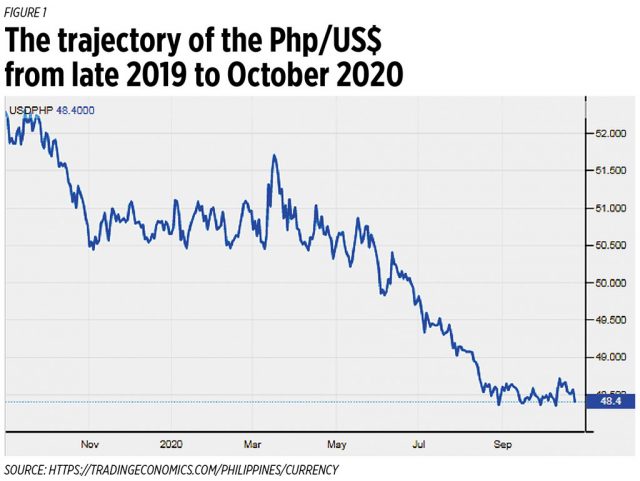
The Philippine peso leads the region in currency appreciation even as the economy confronts the worst economic contraction in history. Figure 1 shows the peso-dollar exchange rate falling from P52 per US$ in late 2019 to P48.5 per US$ in September 2020. The government spins this as spelling confidence in our economy. But it is just a simple case of the collapse in demand for dollars falling faster than its supply and resulting in a rising forex reserve (now at $100 billion): imports have collapsed but foreign borrowing has risen.

The stronger the domestic currency of an emerging economy, the weaker is its economic prospect. The stronger peso makes our exports less competitive; heftily rewards importers and smugglers, especially of basic products (chicken, luya (ginger), fruits); makes foreign investors sneer at our export platform drive.

By way of contrast, Figure 2 from the same source gives the trajectory of the Vietnamese Dong against the US$ during the same period. Despite the burgeoning trade surplus, the Vietnamese monetary authority not only kept the appreciation pressure of the Dong in check but even had a depreciation spell in April 2020. Reminiscent of what the Chinese did for the Yuan during much of the last two decades! Vietnam, following its mentor China, has now earned the “currency manipulator” label from the US — much coveted since it seems to predict subsequent success. Past currency manipulators according to the US State Department are South Korea, Taiwan, China, and India. Not for Vietnam is our Bangko Sentral’s and the US State Department’s beloved mantra: “market-determined exchange rate.” Like us, Vietnam enjoys monetary independence; but unlike us, it is aggressively deploying it to lift its poor from poverty!

Moreover, our economic authorities are about to hit foreign investors with higher income tax with the mandatory shift to corporate income taxation of 25% in CREATE for Philippine Economic Zone Authority (PEZA) locators: the equivalent of the 5% gross income tax currently enjoyed by PEZA locators is 17% corporate income tax (CIT). The noise from the political center on the rule of law only makes matters worse: the Philippine government keeps foisting expropriation threats upon private companies who, though playing by agreed rules, do not fit its arbitrary definition of populist corporate behavior.

Indeed the Vietnamese and Chinese successes with relatively fixed exchange rates may not be the exception. New evidence now strongly suggests that “less flexibility” in exchange rate regimes does better for long-term growth than the so-called “market determined exchange rate.” J. Frenkel et al. (2019, https://scholar.harvard.edu/frankel/publications/impact-exchange-rate-regimes-economic-growth-continuous-classification-de-facto) reports that relatively fixed exchange rate regimes perform better than more flexible regimes in economic growth for a large panel data starting from Bretton Woods era.

How sad that the Philippines will soon be huffing and puffing in Vietnam’s dust reprising the breathing problem we had when we moved into the rear-view mirror of Thailand and Indonesia. We still haven’t learned our lesson!


Raul V. Fabella is a retired professor of the UP School of Economics, a member of the National Academy of Science and Technology and an honorary professor of the Asian Institute of Management. He gets his dopamine fix from bicycling and tending flowers with wife Teena.

Debt at a time of coronavirus

It might have been death by coronavirus as the COVID-19 pandemic choked the economy and strangled many businesses to bankruptcy. But more than the abstraction that is the economy, or the corporate fiction that a business could be, the flesh and blood individual struggling with his threatened physical health even while anxious over dwindling material wealth is COVID’s ultimate victim.

The Bayanihan to Recover as One Act or Bayanihan II was passed by both houses of Congress and signed into law by President Rodrigo Duterte on Sept. 11. For the main aspects of Bayanihan II under his implementation, Bangko Sentral ng Pilipinas (BSP) Governor Benjamin Diokno said at a press conference, “the 60-day loan payment moratorium provides much-needed relief to consumers and businesses as they rebuild their way out of this crisis. The BSP supports bold measures meant to steer the country towards inclusive economic recovery.”

The BSP has ordered all supervised financial institutions — universal and commercial banks, thrift banks, rural banks, cooperative banks, savings and loan associations, and pawnshops, including credit card companies — “to implement this mandatory, one-time, 60-day grace period to all loans of individuals and entities that are existing, current and outstanding, falling due, or any part thereof, on or before Dec. 31, 2020.”

These institutions shall not charge or apply interest on interest, penalties, fees or other charges during the mandatory grace period to future payments or amortizations of the borrowers, and are likewise prohibited from requiring their clients to waive the application of the provisions of the Bayanihan II law, which aims to provide relief to various sectors of the economy reeling from the coronavirus pandemic. Loans that are considered past due as of Sept. 15, 2020 are not eligible for the mandatory grace period.

Regular interest will be charged per installment period, based on the outstanding principal balance of the loan, and shall continue to accrue during the grace period, payable on the new due date following the 60-day grace period, unless the borrower may voluntarily want to pay the accrued interest on a staggered basis until the end of this year.

The mandatory 60-day grace period, in effect, moves the payment due dates of the entire loan, thereby extending the loan maturity. This reprieve is certainly a blessing for borrowers, in this time when cash inflows have been drying up, and priorities are for health and survival. But what happens after Dec. 19, when payments mature and amortizations resume?

After tensions have been eased, and borrowings pushed back in memory, will there be the wherewithal to step up to fulfill financial obligations that then insinuate back into tight (or negative) budgets? Beneficiaries of the moratorium will have spent the money elsewhere that should have paid for loans in the reprieve. Will some dramatically improved economic scenario have presented itself in the 60 days of grace, to override the restraints of the coronavirus on productive activities? Will businesses have revived? Will the unemployed have found jobs?

The original proposed bill in the House of Representatives was for a year-long moratorium on loan payments but this was opposed by banks and government regulators, citing the potential risks to the banking system and the Philippine economy of a prolonged delay in loan payments. The Senate wanted a 45-day moratorium, until the 60-day compromise was reached during the bicameral conference committee meetings. Can the optimal duration of the loan moratorium as a reprieve for the suffering people ever be determined when it is not even known when a vaccine for COVID-19 will be found to ease anxieties and fears for health and survival, such opacity haranguing hopes for economic recovery in the foreseeable future?

Yet the BSP’s Diokno urges banks to lend to medium, small and micro-enterprises or MSMEs, which he said account for 63% of all employment and 99% of all firms in the country. A boost to the economy. But a check with an account officer in one of the biggest commercial/universal banks in the country said the interest rates for loans have not changed — the rates before the declaration of the COVID-19 pandemic in March are the same interest rates now, in the prevailing general community quarantine (GCQ).

Banks can lend to SMEs and MSMEs at 6% to 7% p.a., usually amortized over 10-15 years, at 80% of appraised collateral value, and based on projected income capacity. Personal loans (clean) are at 1.2% down to 0.98% per month, auto debited from deposit accounts. Unpaid credit card payables are to be charged 2% per month or 24% per annum all-in, now the maximum allowed effective Nov. 3. Auto loans are for five years effectively at 26.98% total interest paid for the five years. Housing loans are like business loans at 6%-7% at 0.8 collateral and amortized over 10-15 years, renewable.

Deposit rates have stooped to below 1% p.a. (to 1.3% for time) while lending rates stood firm even as the BSP dropped the key reference rate to 2.25%, the lowest in history, “to support the economy amid the ill effects of the COVID-19 crisis.” Government securities plunged to measly rates and yields of 1.0+%, not quite covering estimated inflation of 2.3%, which has been held down by lower world crude prices and a stronger peso.

The economy is officially in a recession following a steep 16.5% contraction in the second quarter that followed a 0.7% slide in the first three months of 2020, officials reiterated in October. “The Duterte administration expects to return to its old growth path of above 6% in 2021, but banks and development institutions are not as optimistic. The World Bank pointed out that the rebound will depend largely on the government’s ability to contain local COVID-19 infections,” a CNN Philippines news-analysis concluded (Oct. 1).

Banks are not as optimistic, it is said. Noblesse oblige it was, for the banks and financial institutions to accede to the 60-day loan moratorium orders of the BSP under Bayanihan II, for how could they have said no to the challenge to help out in the pandemonic coronavirus crisis? Good that the mandated moratorium was shortened from the original one-year that House representatives so magnanimously first proposed, so presumptively in their behalf. In August, before HB 6953 was decided, even Diokno was one with the Bankers’ Association of the Philippines (BAP) and the Management Association of the Philippines (MAP) that the then-proposed 365-day loan moratorium “will pose serious risks to the soundness of banks and financial stability in general” and will deter economic recovery.

MAP Chief Francis Lim noted that “based on available figures, at least P11 trillion, or roughly 78% of the total P14-trillion deposits have been loaned to the public. Around 70% of the depositors are nonborrowers.” In May, banks already worried about possible increase in the number of non-performing loans (NPLs — loans past due for 90 days) as businesses reel from the effects of the COVID-19 pandemic. Diokno said then that “banks’ NPL is just 2.1% of their total loan portfolio, and 5% will still be manageable… Our banking system remains adequately capitalized and stable and has adequate buffers to withstand the impact of the COVID-19 situation,” he said (ABS-CBN, May 7).

Comparatively, China’s pre-COVID NPL ratio was 1.8%; Hong Kong’s 0.6%; and Singapore’s 1.3%, according to the International Monetary Fund. The NPL ratio in India, the third-largest economy in the region behind China and Japan, was 8.9% at the end of last year’s first quarter, and in the United States, it was 0.9% before COVID. But way back in February, the South China Morning Post quoted credit ratings agency Moody’s Investor Service that NPLs will increase in the coronavirus pandemic, and banks will have to set higher provisions for higher risks of default.

Borrowers may not have “buffers” or relief, even with a 60-day loan moratorium. They will have to pay their debts and accrued interests anyway and anyhow on Dec. 19, just before the lost Christmas in the time of the coronavirus.


Amelia H. C. Ylagan is a Doctor of Business Administration from the University of the Philippines.

ahcylagan@yahoo.com

Lessons learned in innovation and intrapreneurship

Businesses were so complacent in the pre-COVID days that innovation was something done only when absolutely necessary. Most companies resisted innovation as it usually entailed large investments and required management to step out of their comfort zones. Innovation is always expensive and hard.

Only when businesses are desperate do they actively pursue innovation. We faced that desperation two years ago when a competitor entered the market with a new concept and grabbed market share from us. The threat of competition forced us to rethink our entire business model and compelled us to strengthen the areas where we were less competitive.

The pandemic accelerated the need for top to bottom innovation. Overnight, customer preferences reverted to the bare basics, concerns over hygiene became more important than price, government regulations turned more stringent, and channels of sales shifted from brick and mortar stores to online platforms. And because consumer demand weakened drastically, organizations needed to down-size and restructure.

In one fell swoop, business conditions took a 180 degree turn and companies had to figure out how to make their products align with the needs of customers today and how to make their services stay relevant. Our company was not exempt from the COVID-19 tidal wave. As most of my readers know, one of my businesses is a restaurant group and it was severely affected by the pandemic. It reached a point where the very survival of our business depended on how fast we could innovate and adapt to the new normal.

As the chairman of the company, I needed to ignite a culture of innovation within our organization — and there was no time to waste. Everyone had to participate in the effort. It was then that I decided to launch our own intrapreneurship program.

Champions of innovation within an existing organization are known as “intrapreneurs.” They are employees who think like entrepreneurs but work in an established organization rather than on their own. For them to thrive, they must be given the time and freedom to develop their projects as an entrepreneur would. They should also be given the liberty to leverage the company’s resources for testing their ideas.

Developing intrapreneurs requires a change in paradigm. See, most corporations, like ours, train their employees to follow rules, to be team players and to conform to standard procedures. Non-conformists are frowned upon and deemed not a match to the company culture. To create an environment conducive to innovation, we needed to change the people’s mindsets and encourage employees to question the status quo.

Promoting intrapreneurship is a way of unlocking the wealth of ideas among employees that otherwise remain untapped. On the employee’s side, it makes them feel empowered and trusted. It helps boost morale and retention. It is a win-win situation.

I knew I was treading a slippery slope when I first embarked on an intrapreneurship program. Done carelessly, the change in mindset could confuse our employees and/or drive them to act recklessly. This is why I was very deliberate from the get go as should anyone doing the same. Let me share some of the best practices that worked for us.

A safe environment. We made it a point to assure our employees that it is safe to think outside the box and challenge the norm. No one will be judged or castigated for it.

Transparency is key. We purposely conveyed our intent to break apart the present systems and spelled out the reasons why we needed to do so. We made sure that our employees understood the rationale of the program as well as our goals and desired outcomes.

Setting directions and parameters. New ideas are great, but we made it clear that our employees should focus their time and energies on ideas that enhanced the company’s core business. Our senior managers sat down with our intrapreneurial teams and discussed our problems and what needed to be solved. We described the types of ideas, solutions and changes we were looking for. This gave our people the direction and the baseline with which to work.

Work in teams. Intrapreneurs work best in teams, this is why we formed innovation clusters based on the complementary skill-sets of each member.

Islands of Freedom. The teams were given islands of freedom and the resources to conduct experiments to test their ideas. They were set free and not micro managed. Note, we realized that too much freedom could be dangerous. Since intrapreneurs do not own the resources they are working with, the likelihood of them being careless with it was high. This is why we instilled a sense of urgency among the teams to fix problems, large or small, before they escalate. The teams were made accountable for mistakes borne out of carelessness.

Competition is good. Like entrepreneurs, intrapreneurial employees need healthy competition to get motivated and do the best job they can. Thus, we made the teams compete with each other. We made it clear, however, that the success of one team is intertwined with the success of the entire organization.

Reward and remunerate. In any intrapreneurial program, the company will end up owning the intellectual property rights for all innovations or inventions. Similarly, the company has all the rights to the profits derived from the intrapreneur’s work. That said, we made a commitment to give both recognition and financial recognition to those whose ideas were implemented.

Our intrapreneurship program was a success. After three months, we were able to roll-out new menus for our restaurants, reposition our concepts to attract new customers, expand to an online platform and work with fewer staff on the back of more efficient systems. Although the pandemic is far from over, we are in a better position to see it through to the end than we were six months ago. We literally innovated our way out of the COVID-19 crisis and I believe we are a stronger company for it.

Establishing an intrapreneurship program to find creative solutions to complex problems is a powerful management tool which I highly recommend.


Andrew J. Masigan is an economist

Rays rally for two runs in 9th to stun Dodgers, 8-7, even series

BRETT Phillips singled to send home the game-winning runs in the bottom of the ninth inning as the Tampa Bay Rays rallied past the Los Angeles Dodgers 8-7 in Game 4 of the World Series on Saturday night at Arlington, Texas.

Phillips, who came on as a defensive replacement in the top of the inning, singled home Kevin Kiermaier with two outs. Randy Arozarena also scored on an errant throw from center that got away from the catcher, as Tampa Bay completed the comeback off Kenley Jansen (0-1) to knot the series at two wins apiece.

Game 5 will take place today.

Brandon Lowe hit a three-run home run for the Rays, and Arozarena, Hunter Renfroe and Kiermaier each hit solo shots. John Curtiss (1-0) earned the win in relief.

Corey Seager had given the Dodgers a 7-6 lead in the eighth. He finished with a home run and four hits, as did Justin Turner. All seven Los Angeles runs were scored with two outs.

The Dodgers led 4-2 entering the bottom of the sixth before Lowe hit his third homer of the series the opposite way off Pedro Baez for a one-run Rays lead.

Los Angeles wasted no time battling back as Seager singled and Turner doubled to start the seventh. After two strikeouts, Cody Bellinger was intentionally walked to load the bases for pinch-hitter Joc Pederson. Pederson’s two-run single off the glove of Lowe at second gave the Dodgers a 6-5 edge.

Kiermaier knotted the score at six with a homer off Baez in the bottom of the inning.

Turner homered in the first inning for the second straight game—a first in World Series history. The homer was his 12th as a Dodger in the playoffs, a new franchise record.

Seager slugged his eighth blast in the third to temporarily tie for the single postseason record, but Arozarena grabbed sole possession of the mark when he hit his ninth of the playoffs to lead off the fourth.

With three hits, Arozarena also tied Pablo Sandoval in 2014 for most hits in a postseason with 26.

Max Muncy’s RBI single in the fifth gave Los Angeles a 3-1 lead before Tampa Bay got back within one on Renfroe’s homer in the bottom of the inning. An Enrique Hernandez run-scoring double in the sixth made it 4-2 Dodgers.

Julio Urias started for Los Angeles, allowing two runs on four hits in 4 2/3 innings. He struck out nine. Ryan Yarbrough surrendered two runs on five hits in 3 1/3 innings for Tampa Bay.

AROZARENA SETS HR RECORD
Tampa Bay Rays rookie Randy Arozarena set an MLB record when he hit his ninth home run of the postseason in Game 4 of the World Series on Saturday night.

Arozarena went deep on the first pitch he saw from Los Angeles Dodgers left-hander Julio Urias to lead off the bottom of the fourth inning of the contest played at Globe Life Field in Arlington, Texas. Arozarena had tied the record shared by Nelson Cruz (2011), Carlos Beltran (2004) and Barry Bonds (2002) when he homered in the ninth inning of Game 3.

Arozarena, who singled in his first at-bat, also singled in the sixth to match Pablo Sandoval’s record for most hits in a single postseason at 26. Sandoval set the mark in 2014. Arozarena also holds the record for total bases in a postseason with 58.

Arozarena, 25, made his season debut for the Rays in late August after overcoming COVID-19. He hit .281 with seven homers in 23 regular-season games, carrying his success over to the postseason, where he entered Saturday batting .354 with his eight homers and 11 RBIs.

Earlier Saturday night, Dodgers shortstop Corey Seager hit his eighth homer of the playoffs to match the previous record held by Arozarena, Bonds, Beltran, and Cruz. — Reuters

Pagdanganan in 2nd place heading into final round of LPGA Driving On tourney

FILIPINO golfer Bianca Pagdanganan positioned herself to win a title in her maiden Ladies Professional Golf Association (LPGA) season heading into the final round of the LPGA Driving On Championship-Reynolds in Greensboro, Georgia, Monday (Manila time).

Ms. Pagdanganan, 22, shot a 3-under 69 in round three of the tournament on Sunday to take her total to 12-under 204, just as a rung below current leader Ally McDonald (13-under 203) of the United States, with one round left to play.

It was a continuation of her impressive showing in the first two rounds of the LPGA Driving On Championship, part of her debut campaign on the LPGA Tour.

In the previous two rounds, she tallied a 68 and 67 to be among the leaders.

She actually took the lead in the third round after birdying the second hole before bogeys in the third and fifth holes slowed her down.

But Ms. Pagdanganan regained her footing the rest of the way to stay within striking distance of the top spot.

If she gets to bag the LPGA Driving On, it would highlight an eventful last year for her, which includes her winning a gold medal for the Philippines in the 30th Southeast Asian Games.

Completing the top five heading into the final round are Danielle Kang (205)of the US, Carlota Ciganda (206) of Spain and Katherine Kirk (207) of Australia. — Michael Angelo S. Murillo

Another suspected coronavirus case hits PBA; adjustments on

THE Philippine Basketball Association (PBA) tournament “bubble” was hit by another suspected coronavirus case just as the league said the first reported case turned out to be negative.

In a short-noticed online press conference on Sunday, the league confirmed that another member of the PBA family inside the bubble in Clark City in Angeles, Pampanga — this time a player of the Blackwater Elite team — tested positive for the coronavirus and is now in the Athlete’s Village quarantine facility in Tarlac for observation.

The player, whose identity was not disclosed, is the second suspected case following that of a referee reported last week.

The PBA, however, shared that the referee turned out to be negative after undergoing antigen testing and concomitant reverse transcription polymerase reaction (RT-PCR) testing to confirm the previous result.

As part of league protocols though, the referee will not be allowed back to the bubble just yet and will finish the required quarantine period.

The Blackwater player, the PBA said, was extracted from his room at the Quest Plus Hotel inside Mimosa early morning on Sunday after his swab result came out positive.

He was set for antigen and RT-PCR testing later yesterday to ascertain the initial positive result.

While awaiting the results, the entire Blackwater team was put in isolation as well as those considered as close contacts of the player, including the Elite’s last opponents on Thursday, the TNT Tropang Giga.

They will be tested in the coming day pending the results of the tests of the new suspected case.

As an offshoot of the development, Blackwater’s game versus the Rain or Shine Elasto Painters scheduled for 4 p.m. on Sunday was postponed, but the “Manila Clasico” main game at 6:45 p.m. between the Barangay Ginebra San Miguel Kings and Magnolia Hotshots Pambansang Manok was set to proceed as of this writing.

The league said games of Blackwater and TNT are set to be affected and rescheduled, giving rise to more triple-header playdates down the line.

PBA Commissioner Willie Marcial moved to assure that everything is still under control in the bubble.

“The bubble has not burst. There is nothing to worry about. We are doing everything we can to address the situation,” he said.

But the PBA chief said they will now be stricter on the protocols to better guard against the coronavirus just as he enjoined all the participants to do their part in preserving the integrity of the bubble they long worked hard for to happen.

For Dr. Jose Canlas, PBA medical consultant, the incidents of coronavirus are “to be expected” but that they are on top of things.

“Everything’s working. The incidents right now are in a way bound to happen. I want to assure everybody that it is safe inside the bubble and we’re constantly trying to improve our methods,” he said.

Secretary Vince Dizon, Bases Conversion Development Authority president and CEO and Deputy Chief Implementer of the Government’s Response against COVID-19, as well as Maria Clemencita Dobles M.D., manager, Health and Sanitation Department Clark Development Corporation, joined Messrs. Marcial and Canlas in the press conference.

The PBA reopened its coronavirus pandemic-hit season on Oct. 11 after getting government nod under a bubble setup in Clark City, where all the participants are holed up for the duration of the tournament, lasting at least two months. — Michael Angelo S. Murillo

PBA lifts indefinite suspension of Phoenix’s Calvin Abueva

By Michael Angelo S. Murillo, Senior Reporter

“THE BEAST” is back.

The Phoenix Super LPG Fuel Masters welcome a key piece back as star forward Calvin Abueva has been reinstated by the Philippine Basketball Association (PBA) after a year and a half of suspension.

Suspended in July last year for conduct unbecoming of a professional and actions detrimental to the league, Mr. Abueva, 32, was given the go-signal to get back in action by the league at the weekend.

He is set to make his return on Monday when the Fuel Masters (3-2) play the NLEX Road Warriors (1-4) at the Angeles University Foundation Gym in Pampanga.

Mr. Abueva’s reinstatement came after he fulfilled the requirements set by the league as well as after getting his license to play back from the Games and Amusements Board, the government agency that regulates professional sports in the country.

His return was also given on the condition that he adheres to certain guidelines, including actively participating in counselling programs, which was thoroughly discussed with him, Phoenix manager Paolo Bugia, and coach Topex Robinson in a meeting on Saturday.

The Beast, as Mr. Abueva is monickered for his aggressive and physical style of play, was suspended indefinitely in July 2019 for his clothesline hit on TNT import Terrence Jones, which nearly caused a huge fight, and a verbal altercation against fellow player Ray Parks’ girlfriend.

PBA Commissioner Willie Marcial expressed hope that Mr. Abueva had learned his lesson and would conduct himself in a manner befitting his stature as a professional player from here on.

Mr. Abueva said he is relieved that his suspension is over and thanked his family and supporters for sticking with him when he was out.

Phoenix is currently sporting a 3-2 record, good for joint fourth place, in the PBA Philippine Cup. It won its last game versus the Magnolia Hotshots Pambansang Manok, 91-84, to halt a two-game losing streak.

Christmas start to NBA 2020-21?

A PUSH to start the 2020-21 National Basketball Association (NBA) season by Christmas is gaining momentum, multiple outlets reported on Friday.

A start date was just one item on the agenda at Friday’s meeting of the league’s Board of Governors, along with discussions about fan attendance amid the pandemic and the possibility of playing fewer than 82 games, ESPN reported.

The Athletic reported Friday that the NBA is targeting a Dec. 22 start date and a 72-game regular season that would finish before the start of the 2021 Summer Olympics, which are set to begin on July 23 in Tokyo.

Last month, NBA commissioner Adam Silver said his “best guess” was that the season wouldn’t start until early 2021.

The NBA has made a vow that players would get at least an eight-week notice before the start of the season. Oct. 30 would be exactly eight weeks before Christmas Day. — Reuters

PFL postpones fourth season kickoff

THE scheduled kickoff of the fourth season of the Philippines Football League (PFL) on Sunday did not push through as the league decided to postpone it because of inclement weather brought about by Tropical Depression “Quinta” and positive cases of the coronavirus.

In a statement shared on late Saturday, the PFL said it came to a decision to defer the start of its new season to “the next few days” as it feared heavy rains and wind because of Quinta could disrupt the three matches scheduled on Match Day 1 at the Philippine Football Federation (PFF) National Training Center in Carmona, Cavite.

It is also to give it time to deal with confirmed positive cases of the coronavirus among team personnel at the Seda Nuvali in Santa Rosa, Laguna, which is the official home of the league for the two-week duration of the PFL’s fourth season.

As per the statement of the league, five players and one coach among two clubs tested positive in the reverse transcription polymerase reaction (RT-PCR) tests conducted on Oct. 21. All have since been isolated.

Further tests were conducted on those with close contacts on said personnel on Oct. 24 and three returned positive.

Despite the development, PFL Commissioner Coco Torre assured there is nothing to worry about.

“We have anticipated this scenario, hence there is a set of health and safety protocols in place for incidents such as this. What is important is that all continue to adhere with the protocols, which are aimed to prevent or minimize the spread of the virus,” said Mr. Torre.

“We put emphasis on the safety of each and every individual in the bubble, whether player, staff, or match official,” PFF general secretary Atty. Edwin Gastanes, said for his part.

Adding, “We understand the current situation and with participants’ strict compliance with bubble-specific protocols, we hope to push through with kickoff in a few days.”

Scheduled to kick off the PFL proceedings on Sunday was a triple-header that had the Azkals Development Team going up against Mendiola FC 1991 at 9 a.m. to be followed by Stallion Laguna FC versus Kaya FC-Iloilo at 4:30 p.m. Capping off the opening day is the clash between Maharlika Manila FC and United City Football Club (formerly Ceres-Negros FC) at 8 p.m.

It was part of the reconfigured five match days for the league for the new season to adapt to the prevailing conditions with the coronavirus pandemic.

The team with the best record at the end of the match days is crowned as champion.

The tournament, presented by Qatar Airways, is to be conducted in a “bubble” setup in accordance with guidelines set by the government. — Michael Angelo S. Murillo

Talent tops tumult

Six months ago, Buccaneers head coach Bruce Arians was asked about the possibility of bringing in the controversial Antonio Brown. His reply then was the same as it was a year ago: No way. He told Tiki Barber on CBS Sports Network’s “Tiki and Tierney” that “it’s not gonna happen. There’s no room and, probably, not enough money. But it’s not gonna happen; it’s not a fit here.” His doubling down on his assessment that the wide receiver is “too much of a diva,” for the most part framed during their time in Pittsburgh, presumably closed the door on a reunion. Never mind the lobbying of newly signed greatest-of-all-time Tom Brady.

Over the weekend, however, Arians ostensibly made a 180-degree turn. News coming out of the grapevine has Brown inking a one-year deal with the Buccaneers, underscoring yet again an age-old truth in sports: talent tops tumult. It’s especially true in the National Football League, whose annals are littered with examples of troubled players being given second chances because their on-field gains are seen to outweigh their off-field missteps. In his case, the hope is that the fourth time’s the charm. Heck, they’re seemingly so bullish on what he will bring to the table as to allow him to first serve a standing suspension for his violation of the league’s personal conduct policy.

Arians wasn’t wrong to hitherto resist the lure and allure of Brown’s admittedly singular skill set. After all, he wasn’t guilty of just jaywalking; he had been accused of sexual misconduct in 2017, and is fresh off pleading no contest to a felony burglary with battery case and two misdemeanor charges. Unfortunately, the Buccaneers felt a pressing need for his services in the face of injuries to Pro Bowlers Mike Evans and Chris Godwin, as well as to sophomore sensation Scotty Miller. And, no doubt, they received enough guarantees from Brady on locker room control to believe they’ll come out on the plus side when the battlesmoke clears.

Brady has a cause to be bullish on the prospects of Brown being a productive target; they did play beautiful music together in their lone game as Patriots last year. On the other hand, there’s a reason the Steelers couldn’t wait to get rid of him in March last year, the Raiders subsequently didn’t even want to touch him, and the Patriots were then forced to go one and done with him. Don’t tell that to self-proclaimed “Tom Terrific,” though; oozing with California Cool, the quarterback is already anticipating his post-suspension contributions beginning on Week Eight against the Saints.

Will Brown be a boon or a bane? The answer is anybody’s guess. What isn’t: The Buccaneers are going all in. If it wasn’t evident when they strove to win the Brady sweepstakes in March, it is now. Their Win Now mode has them accepting an all-or-nothing proposition, initial impressions be damned, which is all well and good if their gamble winds up paying off in spades. If not, they’ll be spending much of their longer-than-planned off-season justifying their desperation.


Anthony L. Cuaycong has been writing Courtside since BusinessWorld introduced a Sports section in 1994. He is a consultant on strategic planning, operations and Human Resources management, corporate communications, and business development.

Samsung’s Lee, a titan who built a global tech giant

SEOUL — In February 1993, five years after taking over from his father at South Korea’s Samsung Group, 51-year-old Lee Kun-hee was frustrated that he wasn’t making his mark.

He summoned a group of Samsung Electronics executives to a Best Buy store in Los Angeles for a reality check on the Samsung brand. Covered in dust, a Samsung TV set sat on a corner shelf with a price tag nearly $100 cheaper than a rival Sony Corp model.

After a tense nine-hour follow-up meeting, Lee kick-started a strategic shift at Samsung — to gain market share through quality, not quantity.

Lee, who died aged 78 on Sunday after being hospitalized for a heart attack in 2014, was driven by a constant sense of crisis, which he instilled in his leadership teams to drive change and fight complacency. In the mid-1990s, Lee personally recalled around $50 million worth of poor quality mobile phones and fax machines, and set fire to them.

This focus on crisis, and his often abrasive manner, helped Lee grow his father Lee Byung-chull’s noodle trading business into a sprawling business empire with assets worth 424 trillion won ($375 billion) as of May 2020 in dozens of affiliates stretching from electronics and insurance to shipbuilding and construction.

Samsung Electronics developed from a second-tier TV maker to the world’s biggest technology firm by revenue — seeing off Japanese brands Sony, Sharp Corp and Panasonic Corp in chips, TVs and displays; ending Nokia Oyj’s handset supremacy and beating Apple, Inc in smartphones.

In a 1997 essay, Lee recalled his frustration at management inertia. “The external business environment was not good … but there was no sense of anxiety within the organization, and everyone appeared to be eaten up with self-conceit … I needed to tighten them up a bit and repeatedly reminded managers of the need to have the sense of crisis.”

In 2013, Forbes named Lee as the second most powerful South Korean, ranked only behind United Nations Secretary-General Ban Ki-moon.

FEARED AND REVERED
Four months after the Los Angeles meeting, Lee called his lieutenants to a Frankfurt hotel conference room, where he laid out his “New Management” plan, exhorting executives to “change everything except your wife and children.”

Executive meetings proved brutal, often stretching to 10 hours, with participants afraid to even drink water as they didn’t want to have to interrupt Lee’s flow by visiting the washroom.

Lee’s business acumen made him the object of endless fascination and speculation in Korea, but he and the empire he built have also been vilified by critics and activist shareholders for wielding such economic clout, hierarchical and opaque governance, and dubious transfers of the family wealth.

In 2008, Lee was accused of managing a political slush fund and of helping his children buy Samsung company shares on the cheap. Prosecutors failed to prove either charge, but Lee was convicted of tax evasion and embezzlement. He apologized and stepped down, only to return within two years following a presidential pardon.

He had since kept a lower profile and delegated to an army of managers, while promoting his son, Jay Y. Lee, to vice chairman, a grooming post for the eventual transfer of power.

As his health deteriorated Lee needed help in walking and was susceptible to respiratory diseases following lung cancer treatment — he was a less frequent presence at Samsung’s headquarters, spending long winter vacations in Japan or Hawaii.

But his hold over the group remained undimmed. Whenever he travelled overseas, at least four of Samsung’s top executives, along with company crew and security, would be at the airport to see him off.

At Samsung’s human resources development center, the tens of thousands of employees attending training sessions pay a silent vigil to a mock-up of the drab Frankfurt hotel conference room — with furniture specially imported from Germany. As most of Samsung’s staff are in their 20s and 30s and didn’t experience Lee’s managerial heyday first-hand, this homage serves to remind them of the need to ‘think crisis,” several people who have been trained at the center said.

JAPAN EXPOSURE
Lee was born in 1942 in the southern Korean village of Uiryeong, the third son of Samsung’s founder. He was sent to Japan at the age of 11, just after the Korean war ended. His father wanted his sons to learn how Japan was rebuilding from the ashes of World War II.

He has admitted to being a loner and found it tough to make friends when he returned home to a country riven with anti-Japanese sentiment. He went back to Japan to study economics at Waseda University, and then business management at George Washington University in the United States.

His early exposure to Japan’s advanced technology led him to establish the basis of Samsung Electronics by forming alliances with the likes of Sanyo, and adopting chip making and TV manufacturing technologies.

Lee began his Samsung career in broadcasting, working his way up to group chairman by 1987, breaking with the traditional Confucian practice of the eldest son taking over the reins. His older brother, Lee Maeng-hee, was initially chosen to lead Samsung in 1967 when his father retired, but his aggressive management style caused friction with the founder’s confidants, according to several books about Samsung.

The second son, Lee Chang-hee, severed family ties by telling the presidential office that his father had a $1 million slush fund overseas.

Lee senior exiled Chang-hee to the United States and returned as chairman himself. In 1976, diagnosed with cancer, he handed the business down to Kun-hee. Chang-hee died in 1991.

Kun-hee’s hunched posture, due to a traffic accident, soft voice, round eyes and often bemused expression were atypical for such a powerful character. Married to Hong Ra-hee, who runs a Samsung-affiliated art gallery called the Leeum — a combination of Lee and museum — Lee had a son and three daughters.

His youngest daughter died in New York in 2005, which Samsung said at a car accident but media reports said was a suicide.

Lee had been a member of the International Olympic Committee between 1996 and 2017. — Reuters

Murder hornet’s nest vacuumed out of tree in Washington state

A TEAM of entomologists in full-body protective gear vacuumed Asian giant hornets out of a tree in Washington state on Saturday, eradicating the first nest of the so-called murder hornets found in the United States.

The state’s agricultural department said it had spent weeks searching for and trapping the hornets, which attack honeybee hives and could pose a threat to humans, because they can sting repeatedly with venom that is stronger than a honeybee’s.

The state’s entomologists succeeded by attaching radio trackers to three hornets they had trapped earlier in the week, one of which they followed to the nest, located in a tree near Blaine, Washington, on Thursday.

They returned on Saturday to make the extraction.

“Got ‘em. Vacuumed out several #AsianGiantHornets from a tree cavity near Blaine this morning,” the agriculture department said on Twitter, adding that more details would be provided at a news conference on Monday.

The stinging hornet, the world’s largest, can grow as large as 2-1/2 inches (6.4 cm) in length and is native to Southeast Asia, China and Taiwan. It was first discovered in the United States in December by a homeowner in Blaine.

Aside from the danger to humans, the hornet presents a threat to agriculture and the apiary industry, officials have said, because it is a known predator of honey bees, with a few of the hornets capable of wiping out an entire hive in hours. — Reuters

ADVERTISEMENT
ADVERTISEMENT