Home Blog Page 8911

FDA says Chinese firm Sinovac has passed pre-vaccination screening

THE FOOD and Drug Administration (FDA) on Thursday said Chinese pharmaceutical firm Sinovac Biotech Ltd. is the only company so far to pass the pre-vaccination screening phase locally among three applicants and is expected to begin clinical trials soon.

FDA Director General Rolando Enrique D. Domingo, in a briefing, said out of the three applicants that approached the Department of Science and Technology’s vaccine expert panel, only Sinovac has completed the pre-screening process.

“They applied today with the FDA for clinical trial permission to conduct a clinical trial here,” he said in mixed Filipino and English..

The FDA official said the Sinovac vaccine for the coronavirus disease 2019 (COVID-19) will still go through the local regulatory process despite being already administered in China.

Mr. Domingo said the other two applicants in the pre-screening process, the Gamaleya Research Institute in Russia and Janssen Pharmaceutica of Johnson & Johnson from the United States, are still being studied by the panel.

Meanwhile, Philippine Ambassador to China Jose Santiago Santa Romana said November is the “optimistic” projection as to when China will mass produce vaccines for the COVID-19.

“Hopefully, mass production and distribution will happen in the near future, as early as November and December in terms of production. And it will depend on our capability to receive the vaccines in terms of our facilities, in terms of distribution. So, the prospects are bright in terms of a breakthrough in vaccine,” he said.

He added that even if the Philippines is one of the priority recipients, Chinese pharmaceutical firms will first be assessing the country’s capability to store the vaccines, especially given the tropical climate. — Gillian M. Cortez 

Group calls for independent task force to probe DPWH anomalies

THE GOVERNMENT should consider allowing independent experts to investigate the alleged corruption within the Department of Public Works and Highways (DPWH), an infrastructure think-tank said Thursday.

DPWH Secretary Mark A. Villar earlier this week formed a task force composed of department officials to probe anomalies inside the agency.

InfrawatchPH Convenor Terry L. Ridon, however, said an internal investigation would be regarded as merely for show after President Rodrigo R. Duterte lashed at the department last week for corrupt practices.

“The department’s anti-corruption task force requires independent views to ensure that its findings will be transparent and made with integrity,” he said, “Anything less will be perceived by the public as a ‘komite de abswelto’ if the task force will be composed of agency officials and personnel.”

Presidential Spokesperson Harry L. Roque said on Wednesday that it is not “inconceivable” that Mr. Duterte may create a separate task force for DPWH “in the same way he formed one for PhilHealth.”

Mr. Ridon said “legal bid rigging” of government contracts is the main problem in government projects.

“A review of infrastructure projects with only single bidders would show that its project prices offer no substantial variation from its approved budget, which is the ceiling price for all projects. In one of the more controversial DPWH projects in Metro Manila, the final contract price of P389-Million only had a 2.04% variance from the approved project budget of P398-Million,” he said.

This system, he said, allows private contractors and government employees to collude.

The Presidential Anti-Corruption Commission has previously listed DPWH as the most corrupt government agency. — Kyle Aristophere T. Atienza

Budget chief defends reduced allocation to Housing department

BUDGET SECRETARY Wendel A. Avisado on Thursday defended the reduced allocation of the newly-created Department of Human Settlements and Urban Development (DHSUD) for 20221, noting that the agency is not tasked with the actual construction of houses.

In a briefing on Thursday, Mr. Avisado said the DHSUD is mainly responsible for policy-setting, coordination, and monitoring while the National Housing Authority is in charge of building socialized housing projects.

“DHSUD has its own mandate. And if we look at the law itself, it says that it will be the sole and main planning and policy making regulatory, program, coordination and performance monitoring of all housing human settlement and urban development concerns,” he said.

Lawmakers on Wednesday questioned the P4 billion DHSUD allocation under the 2021 proposed budget, which is about half its P7.83-billion budget this year.

“Housing production is with the National Housing Authority and the National Housing Authority receives minimal subsidy from the national government because it has its own corporate funds. So that’s the reason why there’s not much funds that we can see at the department (DHSUD) itself because its function is not on housing production,” Mr. Avisado said. — Gillian M. Cortez 

Nationwide round-up (10/25/20)

PHL gets vice-chair post in ILO government group

THE PHILIPPINES has been elected as vice-chair for the International Labor Organization’s (ILO) sub-group on government, giving the country voting and speaking rights in making labor policies. The Philippine Overseas Labor Office in Geneva reported that Labor Secretary Silvestre H. Bello III will take on the role as vice-chair for government in the ILO starting next year. “This is the first time in the 100 years of the ILO that an observer nation is elected as vice-chair of its government group, the body that represents governments in the tripartite global labor organization,” the Department of Labor and Employment said in a statement on Sunday. Mr. Bello will also be sitting as chair for the government’s group during the International Labor Conference in 2022. — Gillian M. Cortez   

Former Bayan Muna representative dares Parlade to file charges

LAWYER Neri J. Colmenares, a former congressional member representing party-list Bayan Muna, dared a military general to stop red-tagging individuals and groups, and instead take legal action against alleged communist rebels. Mr. Colmenares challenged Lt. Gen. Antonio G. Parlade Jr., head of the Southern Luzon Command to file formal charges against them rather than resorting to “trial by publicity.” “(Mr.) Parlade’s statement that he will sue us during the official proscription (of alleged terrorists) proves the anti-terrorism law is meant to harass critics,” Mr. Colmenares told BusinessWorld. The military officer recently made controversial remarks against prominent female personalities over alleged involvement with leftist groups, for which he has been chided by a couple of Cabinet members. — Kyle Aristophere T. Atienza

Regional Updates (10/25/20)

Typhoon Quinta brings heavy rains, strong winds to Philippines

SEVERE TROPICAL storm Quinta intensified into typhoon category Sunday afternoon and was expected to make landfall over the eastern coast of Camariñes Sur or northeastern coast of Albay in the evening. In its 5 p.m. advisory on Oct. 25, weather bureau PAGASA raised typhoon alert levels in parts of Luzon and Visayas, and rainfall warnings were up in most areas of the country due to the storm’s wide trough. Emergency response and local government teams started preemptive evacuation in high-risk areas and sea travel along the storm’s path was also halted. The Philippine Coast Guard reported that as of Sunday morning, 649 rolling cargoes, 50 vessels, 10 motorbancas, and over 1,000 people were stranded in ports across the regions of Calabarzon, Mimaropa, Bicol, and Eastern Visayas. Quinta will continue to bring rains Monday as it moves over the West Philippine Sea. It is likely to exit the Philippine area on Tuesday afternoon, according to PAGASA’s forecast.

600-bed quarantine facility for Calabarzon patients ready by mid-November

DPWH

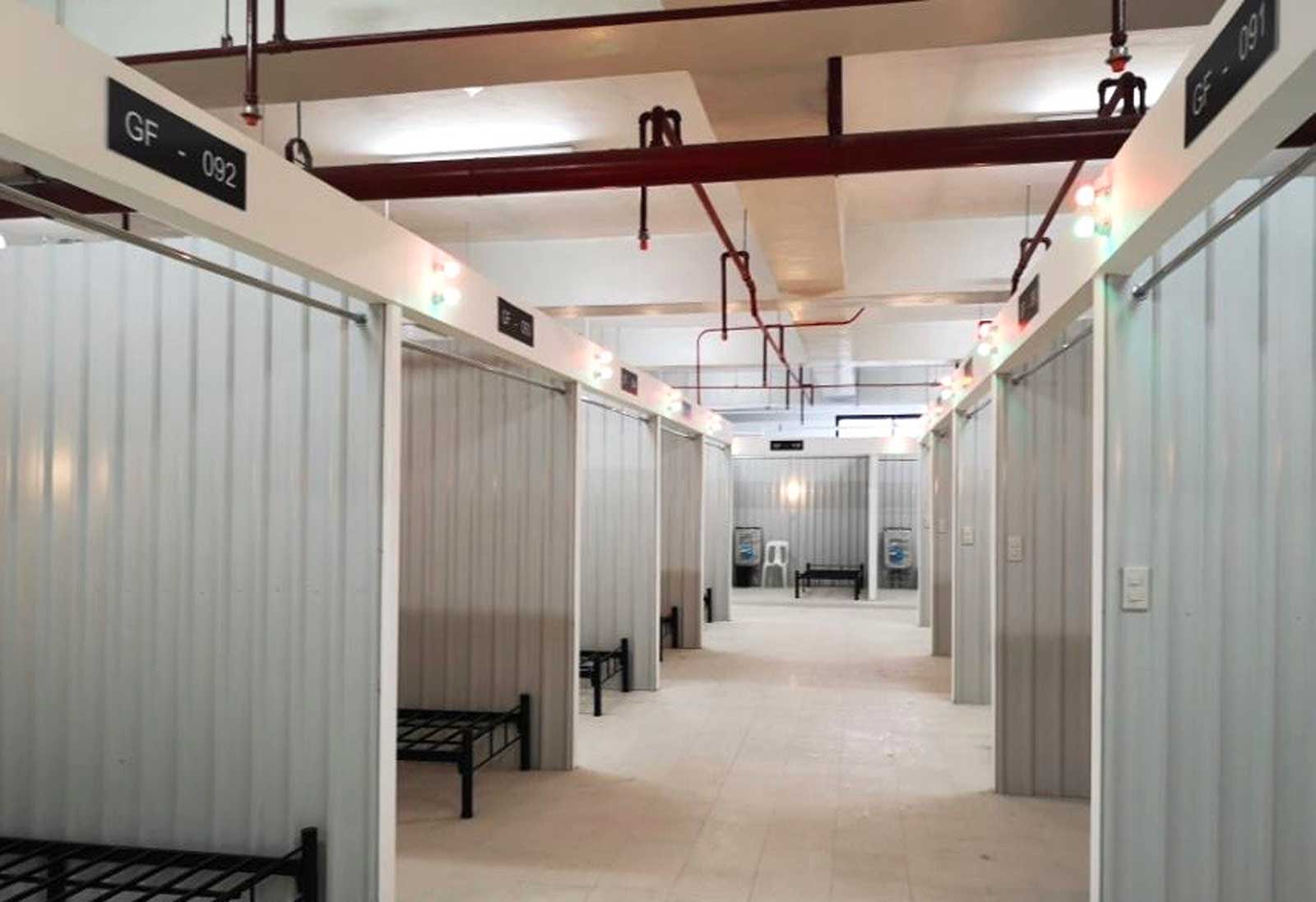
THE CONVERSION of the Calabarzon Regional Government Center in Calamba City into a 600-bed quarantine facility for coronavirus patients will be completed by mid-November, the Department of Public Works and Highways (DPWH) announced Sunday. The isolation facility will accommodate patients from the region, which is composed of the provinces of Cavite, Laguna, Batangas, Rizal, and Quezon. Calabarzon has the second highest number of coronavirus disease 2019 (COVDI-19) patients in the country, after the capital region Metro Manila, with almost 11,000 active cases as of Oct. 24. DPWH said the converted facility will have 50 beds allocated to healthcare workers and the rest for  mild and asymptomatic COVID-19 patients. It will be jointly managed by the Calamba City government, Department of Health, and Office of Civil Defense. DPWH has been fast-tracking the construction of additional isolation units nationwide using existing buildings, shipping containers, and other quick-build materials to augment limited healthcare facilities. Undersecretary Emil K. Sadain, who heads the task force in charge of facility augmentation, said 357 of the 695 target facilities have been completed as of Oct. 22, providing 15,608 additional beds out of the 24,707 target. “The added bed capacity for isolation and quarantine will be a big boost to the government’s effort in containing the COVID-19 pandemic,” Mr. Sadain said.

Peralta to ask court to fast-track resolution of Manila Water, Maynilad appeal

CHIEF JUSTICE Diosdado M. Peralta said he will ask the court to fast-track the resolution of the appeal of the two Metro Manila water concessionaires over the almost P2 billion fine imposed against them for allegedly violating Republic Act No. 9275 or the Philippine Clean Water Act of 2004. “I’ll check the records, and then I will advise the member-in-charge to fast-track the resolution of that,” he told reporters in an online briefing Friday. Mr. Peralta has inhibited from the case as his wife, Court of Appeals Associate Justice Fernanda Lampas-Peralta, is part of one of the rulings involving a fine on one of the parties involved. “But as  a chief justice because that is your concern, I will confer with the member-in-charge to fast track resolution of the motion for reconsideration,” he said. The high court last year held Manila Water Co., Inc. and Maynilad Water Services, Inc. jointly liable with regulatory agency Metropolitan Waterworks and Sewerage Systems for failure to connect sewage lines and install and maintain wastewater treatment facilities within five years after the law took effect in early 2004. The two companies have been ordered to pay P921.5 million each in liabilities, covering the period May 7, 2009 to Aug. 6, 2019. The water concessionaires asked the court to reverse its ruling, citing compliance. Mr. Peralta, chairperson of the Supreme Court Manila Bay Advisory Committee, said Environment Secretary Roy A. Cimatu has reported to him on wastewater treatment projects being undertaken by Manila Water and Maynilad, which he intends to visit. — Vann Marlo M. Villegas

Legislator asks power regulators to extend no-disconnection policy to end of January

A SENIOR PARTY-LIST legislator asked power-industry regulators to implement an installment-payment policy on power bills until Jan. 31, instead of allowing power companies to disconnect customers  who have fallen behind on their payments.

Representative Alfredo Garbin, Jr. of AKO BICOL, who co-chairs the House committee on justice, asked both the Energy Regulatory Commission and the National Electrification Administration to extend the no-disconnection policy, and also made a similar appeal to the government body managing the pandemic.

“I implore the Inter-Agency Task Force on Emerging Infectious Diseases (IATF-EID) to make no-disconnections its unequivocal policy so that no MSMEs (micro-, small-, and medium-sized enterprises) or retail consumers will have to needlessly suffer,” Mr. Garbin said over the weekend, noting that disconnections will affect countryside residents’ ability to engage in online learning or make contactless payments.

“We need more solar and wind power and mini-hydro power generation in the provinces. We need alternatives to coal, gas, and diesel-fueled power plants,” he added.

Separately, Albay Rep. Jose Maria Clemente S. Salceda said the new House leadership is working on measures that would lower energy costs.

“Most interested Japanese (investors) are in manufacturing, so if we can get energy costs down, we can amplify our other strengths, to attract them here and create well-paid jobs for Filipinos,” he said.

Mr. Salceda also urged Congress to pass the Corporate Recovery and Tax Incentives for Enterprises bill and investment liberalization measures such as the Public Service Act,  Foreign Investments Act, and Retail Trade Liberalization Act.

“The House has already approved them. All are pending in the Senate,” he said. “Unless we get all four items passed on time, we will remain among the most investment restrictive economies in the world.

The Organisation for Economic Co-operation and Development has ranked the Philippines as the most FDI-restrictive nation in ASEAN. — Kyle Aristophere T. Atienza

Makati passes right-of-way ordinance for subway project

THE Makati City government has passed an ordinance authorizing the acquisition of right of way covering the underground portions of nine roads affected by its subway project with Philippine Infradev Holdings, Inc.

The roads that will be affected by the project, according to Makati City’s Ordinance No. 2020-204 approved on Oct. 21, are: Sen. Gil Puyat Avenue, South Avenue, J.P. Rizal Avenue, J.P. Rizal Extension, Pablo Ocampo Sr. Extension (Vito Cruz Extension), Kalayaan Avenue, Epifanio de los Santos Avenue (EDSA), C-5 Road (Carlos P. Garcia Avenue), and San Guillermo Avenue.

The city ordinance said subsurface right of way needs to be acquired for the “staging, construction, operation, maintenance and development of the Makati Subway Project.”

It said the nine roads are in the road and bridge inventory of the Department of Public Works and Highways (DPWH) and fall under the jurisdiction of the department.

“Considering the importance of acquiring the easement of right of way of the subject roads for the benefit of the citizens of Makati, the City Government of Makati is constrained to acquire, through voluntary agreement or expropriation proceedings, an easement of right of way of the subject roads,” it added.

It cited Section 19 of the Local Government Code of 1991 or Republic Act No. 7160 as authorizing expropriations if needed.

Makati City said it has entered into negotiations with and made a “valid and definite offer” to the DPWH for the acquisition of right of way.

Philippine Infradev is building a $3.5-billion subway that will traverse the central business district of Makati City. The project will have 10 stations across a 10-kilometer line.

In September, the company signed a $1.21-billion engineering, procurement and construction contract with China Construction Second Engineering Bureau Co. Ltd. for the subway project.

Originally scheduled for completion in 2025, the subway is expected to carry about 700,000 passengers daily and reduce road traffic in the business district. — Arjay L. Balinbin

Insurers evaluating pay-per-use, small payments as users tighten belts

PHILSTAR/MICHAEL VARCAS

INSURERS said they are adjusting to the economic damage sustained by their clients during the pandemic by evaluating products like pay-per-use auto coverage and offering schemes that feature smaller payments.

The Philippine Insurers and Reinsurers Association (PIRA) said pay-per-use in auto insurance is a timely response to higher unemployment.

“With the domestic unemployment rate, fewer people can afford annual premiums. The premium may be smaller but the risks we’re going to cover are also reduced. With that the volume should also increase,” PIRA Executive Director Michael F. Rellosa said in a recent webinar.

The Insurance Institute for Asia and the Pacific (IIAP) said that the pay-per-use scheme also reflects the driving behavior of consumers.

“There are many ways to skin a cat. Consumes usually insure the most expensive car they’re going to use. In the Philippines, your most expensive cars are used only on Sundays, so just insure it for weekends,” IIAP Executive Director Francisco D. Papa, Jr. said in the webinar.

PIRA sees mobile applications like chatbots driving growth in pay-per-use auto insurance, saying the digital tool has the potential to “grow on you” over time.

Amir Shevat, the webinar’s guest speaker and a former Microsoft Corp. and Amazon.com, Inc. executive, said more chatbots are now designed to offer low-cost insurance in small transactions.

“In our study in India, the minimum amount for apps at that time was $1. We switched to 5 cents minimum and they were willing to pay but are willing to pay in small chunks. Look at how people are willing to spend less but transactions (that) will last for a long time,” Mr. Shevat said.

He said technology firms are upgrading chatbots to equip them not also with human-like intelligence but also feelings. He added chatbots can now detect stress or sadness in users, potentially helping insurers adjust their selling pitches.

“They give it human traits and so the user will not understand it’s a robot but just a service that is always polite and willing to listen to their long stories. We found a lot of people tend to have positive feelings toward chatbots which use emotions in the text,” Mr. Shevat said.

He said chatbots will likely attract younger clients.

“For young people, talking to software is more intuitive. For voice-enabled gadgets like Alexa and Siri, they tend to go to the young population,” Mr. Shevat said. — Kathryn Kristina T. Jose

Energy dep’t approves formation of new WESM compliance committee

A NEW committee overseeing the electricity spot market will be formed soon to monitor its operations and adjudicate rules breaches, the Department of Energy (DoE) said.

The DoE effected the changes via amendments to the Wholesale Electricity Spot Market (WESM) rules.

In a circular published in a newspaper over the weekend, the DoE approved a new provision that creates a compliance committee, to be supported by the existing Enforcement and Compliance Office.

The Philippine Electricity Market Corp., the governance arm of the WESM, will be appointing the committee members, who must not have ties to the power industry and are not in government.

The unit’s responsibilities include reviewing and monitoring the compliance of the Independent Electricity Market Operator of the Philippines, or the market operator, and the system operator in regard to their functions and obligations under the WESM rules and manuals.

The compliance committee will also preside over investigations into rules breaches after fact-finding by the Enforcement and Compliance Office, and will recommend sanctions.

It will also have the power to propose future amendments to the market’s rules and manuals.

Pending the formation of the committee, its responsibilities will be performed by the market surveillance committee.

The rule and manual changes in WESM are part of its transition to a new system that is targeted for launch in December. — Adam J. Ang

Energy committee chairman flags P2.5B in unliquidated subsidies to rural utilities

THE National Electrification Administration (NEA) violated its own policy of halting subsidies to rural utilities with a backlog of unliquidated previous funding, the chairman of the Senate energy committee said.

Senator Sherwin T. Gatchalian said P2.5 billion in subsidies remain unaccounted for between 2016 and 2019, citing reports from the Commission on Audit.

He said the NEA apparently violated its own 2016 order, which states that “no new subsidy fund will be released to the EC (electric cooperatives) for new Sitio Electrification Program or Barangay Line Enhancement Program projects unless the previously funded projects are completed and funds are fully liquidated.”

The NEA in its response said the bulk of the amount, or P2.3 billion, involves ongoing projects while the completed ones still require inspection prior to acceptance by the agency.

“Only around P200 million are due for liquidation,” said Milagros A. Robles, NEA’s Financial Services Department manager, during a Senate committee hearing on its proposed budget for 2021.

“There must be some end to this because this is a hanging issue,” Mr. Gatchalian said, noting that the agency kept lending to electric cooperatives despite unliquidated balances.

“In 2021, we need to make sure that this does not happen again, and you (will) have reforms implemented so these (unliquidated balances) will not grow,” he added.

Due to travel restrictions imposed during the pandemic, the agency cannot conduct physical inspections of completed projects. Earlier in the month, it adopted virtual checks of electrification projects in remote communities.

The NEA has yet to update the number of unaccounted subsidies issued to rural utilities.

In 2021, the government has allocated P1.6 billion for the electric cooperatives’ Sitio Electrification Program, sufficient for 1,085 sitios, according to NEA. There are still some 12,000 rural villages or 1.7 million households that are yet to be energized.

The agency initially requested P7.5 billion from the Budget department for the program next year, and has said it needs around P15 billion to achieve full electrification by 2022.

As of June, there were 13.85 million powered households out of 14.34 million still unenergized communities, based on data from the 2015 census. — Adam J. Ang

Digital transactions on the rise: Are they taxable?

(Second of two parts)

In last week’s article, we discussed the rise of digital transactions, House Bill No. 7425, and how it proposes to add another section in the Tax Code, which requires non-resident Digital Service Providers (DSPs) to collect and remit the VAT in transactions that go through its platform. We also defined DSPs as a provider of a digital service or goods to a buyer through operating an online platform for the purpose of buying and selling of goods or services, or by making transactions for the provision of digital services on behalf of any person.

In the second part of this article, we will discuss how a VAT-registered non-resident DSP may issue an electronic invoice or receipt to substantiate transactions; the proposed amended VAT exemption on the sale, import, printing or publication of books; and the state of our digital tax laws compared with neighboring ASEAN countries.

ELECTRONIC INVOICING
A VAT-registered non-resident DSP may issue an electronic invoice or receipt to substantiate a transaction. Note that the TRAIN Law requires taxpayers engaged in e-commerce, among others, to issue electronic receipts or sales invoices in lieu of manual receipts or invoices within five years from the effectivity of the TRAIN law (on or before Jan. 1, 2023, subject to the establishment of a reliable system capable of storing and processing the required data). The e-invoicing will effectively create a mechanism for the BIR to properly monitor transactions conducted over the internet and increase the efficiency of tax administration.1

The BIR is also required to establish a simplified automated registration system for nonresident DSPs. However, a transitory period of 180 days from the effectivity of the Act is provided to enable the BIR to establish implementation systems before VAT is imposed on the DSPs.

There may be challenges to ensure the proper monitoring and compliance of non-resident DSPs with the required BIR registration and payment of the appropriate tax. A similar challenge also applies to resident suppliers of electronic or online sale of services.

The BIR was given only 180 days to create a simple yet efficient automated registration system for non-resident DSPs.  Is this enough time for the BIR?

Without efficient monitoring, it may be very difficult to implement and properly collect taxes. We also note that although most of the amendments are seemingly focused on VAT, it is not the DSPs that are being taxed but the consumers with the DSPs acting as a medium to collect VAT from their buyers.

BOOKS SOLD ELECTRONICALLY OR ONLINE
Another provision that the House Bill seeks to amend is on VAT exempt transactions. Currently, the Tax Code provides VAT exemption on the sale, import, printing or publication of books, newspapers, magazines, reviews or bulletins. RMC No. 75-2012 clarified that to be exempt, these should be materials in hard copy. The VAT exemption does not cover those in digital or electronic format or computerized versions.

However, under the proposed House Bill No. 7425, it amended Section 109 (Exempt Transactions) to include books, newspapers, magazines, journals, reviews and bulletins that are sold electronically or online as VAT exempt.

With schools now conducting online classes as the new normal, both educators and learners will need more convenient access to e-books or other educational materials in digital format. The proposed amendment will greatly support the academe in providing affordable quality education.

ORGANISATION FOR ECONOMIC CO-OPERATION AND DEVELOPMENT (OECD)
It is also worth mentioning that over the years, there have been global developments in digital tax. In 2015, the OECD published the Base Erosion and Profits Shifting (BEPS) Action 1 Report which recognized the broader tax challenges of the digital economy, in relation to nexus, data and characterization.

In 2019, the members of the OECD or G20 released a Program of Work to Develop a Consensus Solution to the Tax Challenges Arising from the Digitalization of the Economy which focused on a Two-Pillar Approach. Pillar One covers the allocation of taxing rights and seeks to undertake a coherent and concurrent review of the profit allocation and nexus rules, while Pillar Two focuses on the remaining BEPS issues. A final report which will set out the technical details of the consensus-based solution is targeted to be released by the end of 2020. The Philippines may very well follow suit in the near future.

CATCHING UP WITH ASEAN MEMBER COUNTRIES
The additional tax compliance requirements will certainly have an impact on businesses involved in digital services, especially non-residents. These requirements may be daunting and may pose additional burdens to doing business in the Philippines. On the other hand, the proposed bill may be seen as setting the country out on the right track.  Our digital tax laws need to catch up with those of our ASEAN neighbors, which have started imposing either VAT or GST on digital transactions.

Indonesia introduced Reg 48/2020 in May which imposes a 10% VAT, effective July 1, 2020, on cross-border digital transactions. Singapore implemented a new Overseas Vendor Registration (OVR) system which requires foreign digital service providers to register and be charged 7% GST starting Jan. 1, 2020.

Malaysia imposed a 6% Digital Service Tax effective Jan. 1, 2020, on its foreign digital service providers. Laos has been implementing a 10% VAT on supplies of goods and services by electronic means since December 2018, upon effectivity of its amended VAT law.

In Thailand, a draft amendment to the Revenue Code has been approved by the cabinet which would require foreign electronic service providers to pay 7% VAT on digital services. The draft has yet to be approved by parliament.

In this evolving digital era where technology constantly transforms and businesses continue to innovate, the tax ecosystem may falter if its laws fail to adapt to the changing times. Modernization and digitization challenge antiquated tax laws. Progress dictates that such laws be revisited for the benefit of national development.

This article is for general information only and is not a substitute for professional advice where the facts and circumstances warrant. The views and opinions expressed above are those of the author and do not necessarily represent the views of SGV & Co.


Jan Kriezl M. Catipay is a Tax Senior Director from the Global Compliance Reporting Service Line of SGV & Co.


The long road to reform


Policy reform is a complex undertaking in our country. The weakness of our institutions and the bureaucracy’s vulnerability to political pressures often lead to constraints imposed on activists and reformers.

In recent years, circumstances surrounding reform have become more complicated. While President Rodrigo Duterte brands himself as a populist and, in the past, has supported bills enhancing social protection (universal health care and free tertiary education in state universities, for example), his authoritarian politics tells us a different story. Under his regime, there have been rampant human rights violations, attacks on truth and democracy, and an all-out war against the poor and vulnerable, to name a few.

Although many factors arising from Duterte’s presidency serve as opportunities and imperatives for reform, it can be challenging to push for transformative policy reform in the context of our struggling democracy and fragmented political arena.

It is within these political challenges that non-governmental organizations pursuing policy reform find themselves situated. In the book Thinking and Working Politically in Development: Coalitions for Change in the Philippines, Jaime Faustino and John T. Sidel narrate the story of The Asia Foundation’s Coalitions for Change (CfC) program from 2012-2018 and the political obstacles it faced in the long, winding, multiple paths to policy reform. CfC started in 2012 as a partnership with the Australian Embassy, in an effort to “do development differently” and “think and work politically.”

There is much insight to gain from the diverse policy reform initiatives, ranging from the sin tax reform campaign led by Action for Economic Reforms (AER), to pushing for education reform and classroom decongestion in partnership with the Department of Education, to electoral reform with Legal Network for Truthful Elections, Parish Pastoral Council for Responsible Voting (PPCRV), and other civil society organizations.

While the book highlights the genuine transformations and policy gains brought about by CfC and its diverse, committed coalitions, it also doesn’t shy away from discussing its failures.

For example, in 2012, CfC provided support to the PPCRV in re-registering Autonomous Region in Muslim Mindanao (ARMM) voters to reduce ghost voters and electoral fraud. They “cleansed” almost 600,000 fictitious or underage voters from ARMM. However, these gains were quickly reversed by 2016 when entrenched local political bosses were reelected, and suspiciously high voter turnouts prevailed in the region, implying that voters were still susceptible to vote buying and manipulation. Faustino and Sidel identify the problem with this engagement: CfC was responsive to the PPCRV initiative rather than proactive. They didn’t change the electoral process nor overcome the political obstacle of deeply entrenched warlordism. Thus, it was not as effective, sustainable, or impactful as their other projects.

Still, the bright spots in CfC outweigh the disappointments. It triumphed in reducing school congestion, releasing public school teachers from compulsory election day duties, enabling titling of land for public schools and government buildings, and creating new procedures for persons with disabilities  in elections, among others.

What the CfC program shows us is that transformational change is rooted in politically contextualized, independent, iterative, adaptive policy advocacy work. Faustino and Sidel noted that when CfC worked autonomously, rather than supporting a predetermined agenda, it was more likely to produce a greater impact.

In the case of its informal settler family relocation program, for example, it was limited by its role within the parameters of the pre-existing government program. It was not able to adapt and overcome the tense political dynamics involving the Housing and Urban Development Coordinating Council, Department of the Interior and Local Government, Department of Social Welfare and Development, and local government units, and thus did not succeed.

Rather, CfC succeeded when it was able to innovate and work autonomously. When it did innovative and adaptive policy work by revising the rules of the National Disaster Risk Reduction and Management fund in Republic Act (RA) 10121, it successfully led to more proactive funding to support local government units.

Faustino and Sidel stressed that in “thinking and working politically,” there is no one cookie-cutter approach nor one-size-fits-all. There are many disappointments and delays in the process of pushing for policy reform. Thus, the need for flexibility, adaptation and iteration — the openness to test, re-test, learn and respond accordingly.

What does it mean to think and work politically in development? Perhaps the key insight I picked up from the book was the need for compromise. Most reforms will receive opposition, like AER’s push for higher sin taxes, which was highly contested by the powerful tobacco industry and the politicians from the Northern bloc of tobacco-growing provinces.

With so many conflicting interests and political constraints, locking in policy reform often entails being realistic and picking one’s battles, knowing when to toe the line and compromise. The lessons from CfC emphasize the need to pursue initiatives that are, in Faustino and Sidel’s words, “technically desirable and politically feasible.”


Pia Rodrigois the communication officer of Action for Economic Reforms (www.aer.ph). The book Thinking and Working Politically in Development: Coalitions for Change in the Philippines can be downloaded here: https://asiafoundation.org/wp-content/uploads/2020/07/Thinking-and-Working-Politically-in-Development_Coalitions-for-Change-in-the-Philippines_Faustino_Sidel.pdf.

ADVERTISEMENT
ADVERTISEMENT