Home Blog Page 8769

To avoid extinction, companies must adapt to disruptive forces — author

Understanding disruptive forces such as artificial intelligence (AI), digital natives, and the gig economy will strengthen the future of any business, said entrepreneur, serial investor, and public speaker Maulik Parekh in his book, Futureproof Your Company and Career.

“In this rapidly changing world, we have a choice to make—either we future-proof ourselves or we risk becoming extinct,” Mr. Parekh said.

It was during his leadership in outsourcing companies like Inspiro and SPi Global that he began to recognize these disruptive forces and gleaned insights on how to future-proof companies and careers. 

At the virtual book launch, Mr. Parekh said that AI can do jobs that are repetitive, boring, predictable, and have defined objectives. Investing in becoming a better human by inspiring and leading, on the other hand, will insulate you from the risk of AI automation for the next 10 years at least.

Digital natives, meanwhile, have the potential to disrupt the status quo of any company. To partner with Gen Zers and millennials, it is important to know what their values and motivations are. Equally important is optimizing their skillsets.

Laura Butler, senior vice-president for people and culture at Workfront, an enterprise work management company based in Utah, said that purpose is the connective tissue that connects the four generations (from baby boomers to Gen Zers) in the workforce. “People are more engaged if they feel a purpose in their work,” she said. “That’s not something unique to millennials. Everyone feels that.”

Ms. Butler was a guest at the virtual launch along with Paula Vogliazzo, founder of management consulting firm Scale Up Business in Buenos Aires; and Manuel V. Pangilinan, managing director and chief executive of Hong Kong-listed First Pacific Co. Ltd.  

Being adaptable to changes in workforce trends was also a recurring theme throughout the event.

The rise of the gig economy is all about humanity’s innate desire for freedom, said Mr. Parekh. “I know some Harvard graduates who have left traditional employment and said ‘freedom is what I’m after’ … One left his law firm and became a freelancer servicing clients from around the world,” he added.

Ms. Vogliazzo advised companies to start planning their businesses to make them attractive to these professionals. “Freelancers will collaborate with your company but not on a full-time basis.”

A crucial point taken up at the aforementioned event was the reminder that the future belongs to those who are humble, curious, and learnable.  

Mr. Pangilinan quoted Winston Churchill’s aphorism: “Success is never final. You’re only as good as your last deal, your last quarterly results—and then the world expects more and more of you. Savor your success because guess what? Tomorrow, people expect more from you.” He said, too, that failure is part of the rich tapestry of life: “Failure is not fatal. Don’t feel impervious to failure. Know that it’s a fleeting moment—whether it’s success or failure.” — Patricia B. Mirasol

Dyson plans software lab in Alabang, eyes local technical people

BRITISH technology company Dyson Ltd. is planning to open a software lab in Alabang, Muntinlupa City, creating 400 software engineering jobs for research and development (R&D) work over the next three years.

The project is part of a global Dyson research expansion, in which £2.75 billion (P177 billion) will be invested into developing new technologies and products over five years.

Scott Maguire, Dyson chief operating officer, said in an online press conference on Thursday that the company plans to tap into the talent pool from local technical universities.

“The investment that we’re putting in there is very much around us growing our software engineering capability and up to 400 engineers. Hopefully in the next few years, we’ll be as aggressive as we possibly can and we’re confident there’s a lot of good talent in the Philippines,” he said.

Dyson has been operating in the Philippines to manufacture digital motors for some products like vacuums and hand dryers. The facility employs 600 people and produces 13 million motors a year.

Mr. Maguire said that the new facility will extend their Philippine operations from advanced manufacturing of technologies to engineering and inventing new technologies.

“So, it really is much more of the value chain that’s going into the Philippines for Dyson.”

Dyson software engineers, he said, work on sensor software, motor controllers, wireless, robotics, and cloud for new technologies.

The Philippine R&D center will also collaborate with other Dyson centers globally, including the United Kingdom, United States, Shanghai, Singapore, and Malaysia.

Through the global expansion, Dyson plans to double its product portfolio and enter new fields beyond home products.

“Dyson will invest further into research in the fields of robotics, next generation motor technology, intelligent products, machine learning, connectivity, and material science,” the company said in a press release on Thursday. — Jenina P. Ibañez

Tourism department condemns Boracay Halloween party

THE Department of Tourism (DoT) has condemned the party that took place in Boracay on Oct. 31, saying such irresponsible action compromises efforts to revive the tourism industry. The DoT, which serves as co-vice chair of the Boracay Inter-Agency Task Force for rehabilitation, said in a statement that it also “supports the recommendation of the Boracay Inter-Agency Rehabilitation Management Group to Malay Mayor Frolibar S. Bautista to close down the erring establishment in view of its lacking of business permit and necessary clearances as determined by the authorities.” Tourism Secretary Bernadette Romulo-Puyat also asserted that while the “halloween party” involved an establishment that does not require a DOT-accreditation, all stakeholders must observe guidelines as the industry aims to strike a balance between ensuring health safety and resuming economic activities. “The jobs and livelihoods that were recently restored in these sites will be affected once again if an outbreak occurs in the area due to the LGU’s negligence,” Authorities are currently investigating the incident and looking for at least 100 individuals who took part in the party, according to Lt. Col. Joem Malong, Western Visayas police spokesperson. “The attendees were not wearing face masks nor were practicing social distancing,” Ms. Malong said, citing a video clip of the event. One of the organizers, Jack Bates, said the activity was a private birthday party although an investigation revealed they collected P250 from each of the participants as entrance fee. Mr. Bates was slapped with a P5,000 fine. Two other persons, identified as Aaron Vega and Vanessa Claire, were charged for wearing police uniforms as costumes during the party, which is illegal under Article 179 of the Revised Penal Code. — with a report from Emmanuel Tupas/PHILSTAR

CREATE bill finally hurdles Senate

Economic managers are hoping the timely passage of the measure cutting corporate income tax and reforming the tax incentive system will help the economy bounce back faster. — REUTERS

By Charmaine A. Tadalan, Reporter

THE SENATE on Thursday approved on third and final reading a measure that will immediately lower the corporate income tax (CIT) to 25% from the current 30% rate as well as streamline fiscal incentives.

With 20 affirmative votes, one negative vote and zero abstentions, the chamber passed Senate Bill No. 1357, the “Corporate Recovery and Tax Incentives for Enterprises Act (CREATE),” which is also intended to capture investments of companies relocating out of China.

Acting Socioeconomic Planning Secretary Karl Kendrick T. Chua said the timely passage of the CREATE bill will help the economy bounce back faster from the recession.

“It will certainly help in our recovery and also to give all SME (small and medium enterprises) an incentive to be more productive and competitive,” Mr. Chua said in a Viber message on Thursday.

CREATE provides for a reduction of CIT to 25%, starting July 2020, and a reduction of one percentage point annually from 2023 to 2027.

Senator Pia S. Cayetano, chair of the Ways and Means Committee, said the bill’s current version provided to lower the CIT to 20% for businesses with income below P5 million.

“Just the other day, we also accepted a major change… 20% na lang ang CIT for those with income below P5 million,” she said during Thursday’s session. She noted the amendment was introduced by Senator Ralph G. Recto.

President Rodrigo R. Duterte had certified the bill as an urgent measure, allowing the chamber to do away with the three-day interval in passing measures on second and third reading.

Albay Rep. Jose M. Clemente S. Salceda, who chairs the House Ways and Means Committee, said there will be no need for a Bicameral Conference Committee since the House will adopt the version approved by the Senate.

“House will adopt the Senate version,” he told reporters via mobile phone message.

The CREATE bill forms part of the government’s economic stimulus package, along with the Bayanihan to Recover as One Act, under Republic Act 11494, that allocates up to P165 billion for assistance. The government will forego P40 billion in revenues for fiscal year 2020, and P650 billion in the next five years.

The CREATE bill will grant exporters and domestic industries between four to seven years of income tax holiday. They may later pay the 5% gross income earned (GIE) for 10 years.

The bill also increased the sunset provisions to 10 years from the initial proposal of four to nine years. A much earlier version, the Corporate Income Tax and Incentives Rationalization Act, provided a two- to seven-year period.

Ms. Cayetano also said the bill mandates the Fiscal Incentives Review Board (FIRB), chaired by Finance Secretary Carlos G. Dominguez III, to oversee incentives granted by investment promotion agencies (IPA) and other government agencies.

“There will be an FIRB, which based on the compromise version coming out of the period of amendments, investments P1 billion and below, IPAs will handle it.  But for (investments that are) P1 million above, FIRB will handle it, but it will still go through the IPA,” she said. “If it’s P1 billion and above then they submit it for the approval of the FIRB.”

Senator Richard J. Gordon, the lone senator to vote against the measure, had proposed to exclude the Subic Bay Metropolitan Authority, Clark Development Corp., Authority of Freeport Area of Bataan, Cagayan Economic Zone Authority, Zamboanga City Special Economic Zone Authority, and Tourism Infrastructure and Enterprise Zone Authority among others from the bill’s coverage.

The amendment, however, was rejected by a vote of 16-5. The chamber had planned to approve the bill on Wednesday evening, but was deferred until Thursday to accommodate Mr. Gordon.

Senate Majority Leader Juan Miguel F. Zubiri said he had called Mr. Dominguez on Thursday morning to find a compromise, but the secretary said the proposed exemption would be a “deal-breaker.”

“He was very firm that this is a deal-breaker, that they will veto it,” Mr. Zubiri said.

CREATE is among the priority measures President Duterte mentioned in his fifth State of the Nation Address. It is also among the bills listed down by 14 business groups as priorities in the opening of the session.

Its counterpart measure, House Bill No. 4157, was approved by the House in September 2019. — with Beatrice M. Laforga

Business leaders see need to focus on reinforcing PHL healthcare system

Hospitals were nearly overwhelmed with the number of coronavirus disease 2019 (COVID-19) cases at the start of the pandemic. Picture taken June 26. — REUTERS/ELOISA LOPEZ

By Denise A. Valdez, Senior Reporter

THE coronavirus pandemic is prompting companies to prioritize big investments in the healthcare sector, in preparation for any future outbreaks.

“People are saying, how does one learn from a crisis like this? I think one area that all of us must focus on is reinforcing our whole healthcare system… I think pandemics will be with us as a new form of crisis in the future,” Jaime Augusto Zobel de Ayala, chairman and CEO of Ayala Corp., said during the BusinessWorld Virtual Economic Forum on Thursday.

Noting that the whole world is getting denser and the Philippine economy relies heavily on exporting its workers, Mr. Zobel said it is imperative to prepare for any viral outbreak in the future.

“I believe all of us should have a renewed focus on our healthcare platforms, on what we need both from a government and from a private sector point of view, and make sure something like this doesn’t catch us unprepared in the future again,” he said.
The Ayala Group started investing in healthcare five years ago with the formation of Ayala Healthcare Holdings, Inc. (AC Health). Mr. Zobel said having a team of healthcare professionals within its group was a big help during this crisis.

Focusing on healthcare is also seen as key to reviving consumer confidence, which would help businesses recover faster.

Citing the government’s efforts on how to bring COVID-19 vaccines to the Philippines, Magsaysay Group of Companies President and CEO Doris Magsaysay-Ho said these developments help in improving market confidence that will spur more consumption.

“I think that in itself is hopeful that we’re on to that next step of how to ensure health is really addressed, and how fear can be overcome so that people can go back to their normal consumption and modes of living,” Ms. Magsaysay-Ho said.

The partnership between the public and private sector is also heightened during crises like this, which Mr. Zobel said should push companies to increase coordination with groups outside of its own.

“Solutions cannot be found by one entity by itself… The pandemic will not be the last thing that we have to tackle as a community. There are going to be so many other issues where we not only have to coordinate as a country, we have to coordinate with other countries as well,” Mr. Zobel said.

However, Ms. Magsaysay-Ho noted that businesses must also remember to remain competitive despite a shared crisis.

“The pandemic forces all to have a common purpose because we have a common enemy… (But) we have another (challenge), which is… competition. We have other countries that are competing with us,” she said.

She cited as example the companies that left China at the start of the pandemic, but which opted to go to other countries in Southeast Asia, and not the Philippines.

“We must be able to be in that picture of where people will come to invest,” Ms. Magsaysay-Ho said. “We must think a little more strategically to see how we can really build that prosperity.”

Mr. Zobel noted that the Philippines is full of very capable individuals in the medical field, which should serve as a competitive advantage against regional peers.

“I think we have the software, which are extraordinary nurses and doctors. We now have to support that with more capital infusion into some of the bricks and mortars side, the equipment side, and see if we can create the kind of infrastructure a country like ours would need for its healthcare space,” he said.

Jobless rate seen to remain high until mid-2021

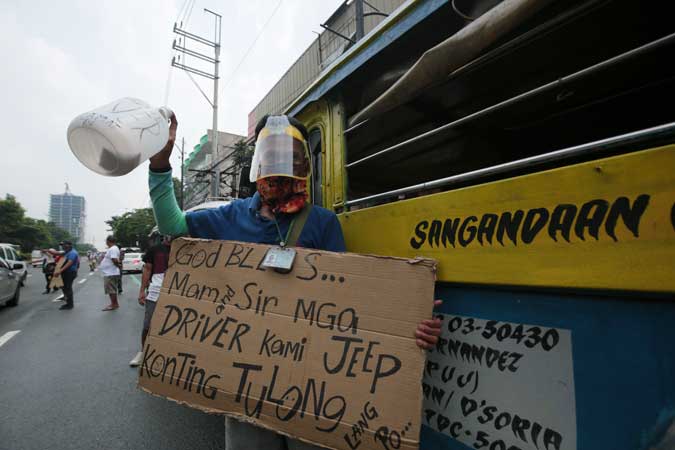
Jeepney drivers had to beg for money in the streets, after they were left unemployed as public transportation was halted during the strict lockdown earlier this year. — PHILIPPINE STAR/MICHAEL VARCAS

By Beatrice M. Laforga, Reporter

THE COUNTRY’S unemployment rate will likely remain at around 9-10%, roughly double its pre-pandemic level, until mid-2021, Asian Development Bank (ADB) Country Director for the Philippines Kelly Bird said.

Speaking at the BusinessWorld Virtual Economic Forum on Thursday, Mr. Bird said unemployment will remain high as scars from the coronavirus pandemic are expected to reduce the potential productive capacity of the economy in the medium term.

The unemployment rate stood at 5.1% at the end of 2019, but the strict lockdown imposed in mid-March caused joblessness to spike to a multi-year high of 17.7% in April.

The unemployment rate eased to 10% in July as the economy gradually reopened. The government’s economic managers project this to settle between 11% and 13% by year’s end.

Mr. Bird said increasing investments on skills development, apprenticeship, and workplace improvement can help workers keep their current jobs and new graduates find jobs as the economy recovers.

The ADB projected the country’s gross domestic product (GDP) will shrink by 7.3% this year.

“While we project a strong rebound of 6.5% growth in 2021, we still don’t expect the Philippine economy to reach its pre-COVID, inflation-adjusted GDP until 2022 and its per capita GDP by 2023. This recovery path is not unique to the Philippines; many other countries are likely to experience this path as well,” Mr. Bird said.

The ADB official noted the “worst is over” for the Philippine economy, citing signs of recovery in various economic data for September. For instance, goods exports grew by 2.2% in September after six months of decline, while the annual drop in imports easing to 16.5% that a month from 21.3% contraction in August. Remittances sent by overseas Filipinos rose by 9.3% year on year in September, while expansion in manufacturing was seen in the same month.

“This is very good news, but this recovery is going to be fragile and slow as the pandemic affects consumer and business confidence the most. The economic recovery will surely depend on the Philippines’ continued response to dealing with the virus over the next 12 months and the pace of opening up the economy safely,” he said.

In the same forum, Ndiamé Diop, World Bank country director for Brunei, Malaysia, the Philippines and Thailand, stressed the need for a coordinated response to the crisis, particularly on public health, fiscal and monetary policies, and structural reforms.

“By implementing agile fiscal, accommodative monetary policy and advancing structural reforms, the Philippines is really poised to really recover relatively well in the next two years to come,” he said.

Mr. Diop said the country entered the crisis with a 39.6% debt-to-GDP ratio as of end-2019, one of the lowest in the region and the world. This is projected to reach 53.9% by yearend as the government borrowed more amid the crisis.

“Such a strong fiscal position avails the Philippines the fiscal room to ramp up growth, fight the virus and save lives, without threatening fiscal sustainability,” Mr. Diop said.

ADB’s Mr. Bird said the government’s fiscal response was “appropriate” after focusing on direct income transfers through wage subsidies and emergency grants to poor families.

Coupled with a low interest rate environment to encourage lending, he said these measures have been proven to be the most effective response to help struggling companies, save jobs and stimulate spending.

Mr. Diop said a balanced fiscal strategy involves providing immediate support to households and the vulnerable sector in the short term, and making investments to boost economic growth, such as in infrastructure projects.

Messrs. Bird and Diop highlighted the importance of massive infrastructure spending because of its high multiplier effects, ability to create direct and indirect jobs, and support long-term growth.

After the pandemic, Mr. Diop said the Philippines, like Indonesia, can benefit from a favorable demographic dividend if key reforms on the supply side of the economy will be implemented, such as closing the infrastructure gap, investing in education and skills, and continuing structural reforms to improve business environment.

“What demographic dividend does, especially in countries where poverty is falling, is it energizes the demand side of the economy but if the demand side of the economy is moving, what we need is to reform the supply side to post a high growth,” Mr. Diop said.

“The Philippines will remain well-placed to bounce back but it will not be over for the Philippines, nor any other country in the world until it is over for the rest of the world,” he added.

‘Hot money’ reverses to net inflow

By Luz Wendy T. Noble, Reporter

MORE FOREIGN CAPITAL entered than left the country in October to yield a net inflow after seven straight months of outflows, the Bangko Sentral ng Pilipinas (BSP) said on Thursday.

Foreign portfolio investments — also known as “hot money” because of the ease by which these funds enter and exit the economy — posted a net inflow of $439.46 million, BSP data showed.

The October tally is a 320% surge from the $104.53-million net inflows in October 2019 and a reversal from the net outflows worth $493.65 million in September. This is also the highest net inflow since the $762.82 million seen in January 2019.

October was also the first time since February that hot money recorded a net inflow, suggesting signs of improving  sentiment in the local equities market.

“The large chunk channeled into securities was reflective of recent improvements in the local stock market. There are emergent signs that foreign investors have begun coming back with some risk-on tone,” Security Bank Corp. Chief Economist Robert Dan J. Roces said in a text message.

A few signs of normalization in the global economy lifted equity markets in general, said Nicholas Antonio T. Mapa, senior economist at ING Bank N.V. Manila.

In October, hot money inflows reached $1.352 billion, higher by 8% than the $1.252 a year ago and more than double the $594.02 million seen the prior month.

Meanwhile, gross outflows declined 20% to $913.49 million from the $1.148 billion recorded in October last year and by 16% compared with the $1.087 billion seen in September.

BSP data showed investments were mainly from the United Kingdom, the United States, Singapore, Luxembourg and Hong Kong, which altogether made up 80.9% of the total.

About 78.8% of these investments were funneled into securities of mainly information technology, banks, holding firms, real estate companies, and food, beverage and tobacco firms. Meanwhile, 21.2% of the investments during the month went into government securities.

For the first 10 months of the year, hot money continued to yield a net outflow of $3.943 billion, surging 221% from the net outflow worth $1.225 billion during the same period a year ago.

The BSP attributed the bigger outflows of hot money to the uncertainty arising from the coronavirus disease 2019 (COVID-19) pandemic’s impact on the world economy and financial system. It also cited “international and domestic developments such as geopolitical tensions, certain corporate governance issues and extended quarantine measures in select regions in the country.”

The BSP expects hot money to yield net inflows worth $2.4 billion this year and $3.5 billion by 2021, respectively.

“Going into the last few months of the year, positive sentiment will likely remain, this time brought about by positive trends in vaccine development and the now seemingly peaceful transition for US President-elect (Joseph) Biden,” Mr. Mapa said in an e-mail.

But there could still be risks to continued net inflows in the last part of the year, said Mr. Roces.

“The general direction of market sentiment may not yet be consistent with resurgence in virus cases globally and a still uncertain outlook; although positive news from the vaccine development front provides some upsides,” he said.

BSP approves regulatory framework for digital banks

THE MONETARY BOARD has approved a regulatory framework for digital banks, Bangko Sentral ng Pilipinas (BSP) Governor Benjamin E. Diokno said on Thursday.

“We see these [digital] banks as additional partners in further promoting market efficiencies and expanding access of Filipinos to a broad range of financial services,” Mr. Diokno told reporters via Viber.

Under the framework, digital lenders will be classified differently from universal, commercial, thrift, rural, cooperative, and Islamic banks.

The Monetary Board may also limit the number of digital banks that may be established, considering the total number of applications received and the current banking landscape in the country.

“Essentially, the BSP is looking to attract players with strong value proposition, sufficient financial strength, technical expertise of management and effective risk management,” Mr. Diokno said.

The latest draft of the framework was released last month. Among the proposed provisions was a minimum capital requirement of P1 billion for digital banks.

The approved framework has yet to be released.

BSP Deputy Governor Chuchi G. Fonacier confirmed in a text message on Thursday that the minimum P1-billion capital requirement was retained in the approved framework.

Digital banks need to pay the BSP a P250,000 application fee and a P12.5-million license fee, based on the latest proposal.

These lenders are also expected to maintain a main office for management and support operations for customer concerns and as a point of contact for the BSP and other regulators, the central bank said.

“Digital banks are also allowed to tap cash agents and other qualified service providers subject to existing regulations to complement the innovative delivery of financial services,” it added.

Mr. Diokno has said that digital banks could help the BSP achieve its goal to bring 70% of adult Filipinos into the financial system and to have at least 50% of payments by volume and value done digitally by 2023.

Only 29% of Filipino adults had accounts with financial institutions as of 2019, leaving some 51.2 million unbanked, BSP data showed.

Meanwhile, e-payments made up 10% of the total transaction volume in the country in 2018 from only 1% in 2013, data from the Better Than Cash Alliance showed. By value, online transactions made up 20% of the total in 2018 from just 8% in 2013.

“It is our long-term goal to see more digital-savvy Pinoys, such that it becomes second nature for them to perform routine financial transactions online — making payments and fund transfers, or availing of credit, insurance, and investments,” Mr. Diokno said in a forum on Thursday. — L.W.T. Noble

ICTSI raises nearly P5B in share sale

LISTED port operator International Container Terminal Services Inc. (ICTSI) said on Thursday it had entered into a placement agreement for the sale of its 40 million treasury shares to raise funds for general corporate purposes.

Proceeds will also be used to fund the company’s committed capital expenditure, ICTSI said in a disclosure to the stock exchange.

“Last night, ICTSI entered into a placement agreement to sell 40 million treasury shares at a price of P117 per share, representing a 3.9% discount to yesterday’s close for a total gross proceeds of P4.68 billion,” it added.

The company said its offering was “well-received and multiple times oversubscribed” by “high-quality” foreign and local institutional investors.

The move comes after the company reduced its capital expenditure plan for 2020 to around $160 million due to the pandemic crisis.

The company said recently it had spent $128.6 million in the first nine months of the year, mainly for its expansion projects at Manila International Container Terminal in Manila, Philippines; Contecon Manzanillo S.A. in Manzanillo, Mexico; Contecon Guayaquil S.A. in Guayaquil, Ecuador; Basra Gateway Terminal in Umm Qsar, Iraq; and ICTSI DR Congo in Matadi, Democratic Republic of Congo.

ICTSI saw its third-quarter net income attributable to equity holders grow by 23% to $69.2 million, after it benefitted from cost preservation measures to mitigate the effects of the pandemic.

It reported a 7% improvement in its gross revenues for the third quarter to $379.3 million.

The company’s EBITDA (earnings before interest, taxes, depreciation, and amortization) grew 13% to $226.8 million.

ICTSI shares on Thursday closed 4.11% lower at P116.80 apiece. — Arjay L. Balinbin 

ATN Holdings eyes P1-B sales until 2022 from infra projects

LISTED ATN HOLDINGS, Inc. is looking to generate P1 billion in the next two years from selling construction materials that will help it ride on the Philippines’ increased investments on infrastructure.

In a disclosure to the exchange on Thursday, the diversified company said it is positioned to grab a significant portion of the expected demand for construction materials through the government’s Build, Build, Build program.

It said it has a stockpile of about a million ton of finished goods, more than 200 million tons of rock reserves, hollow blocks to support the construction of 5 million mass housing units, and a facility that has an hourly capacity of 500 tons.

“We are initially setting a P1-billion sales target for 2021-2022 to be derived from a combination of rock aggregates, pre-mixed concrete and boulders,” ATN Chairman and CEO Arsenio T. Ng said in the statement.

“Our finished products meet the stringent criteria of quadruple A-rated contractors after passing rigorous multiple testing standards with specific gravity of 2.7 and above, for its premium basalt rocks as conducted by international technical experts on rock quality,” he added.

Among the projects ATN identified to support infrastructure build-out are the Metro Manila Subway project, the NLEX-SLEX Connector Road project, the Bulacan Airport project, and reclamation initiatives in Luzon island.

One project that the company had already committed to participate in is the Tutuban-Malolos segment of the North-South Commuter Railway, for which it will provide rock aggregates.

“Our regular discussions with notable industry stalwarts underpin the extensive demand for our core products. To our favor, most of them have firmly indicated their voluminous rock supply requirements and intention to work with us,” Mr. Ng said.

“Nonetheless, while we aspire to be the premier construction material brand in the country, we also deeply regard ourselves as an inclusive partner of the government in nation-building and climate change resiliency development,” he added.

The Philippines is looking at a P4.5-trillion national budget for 2021, from which about P1.107 trillion may be allocated to infrastructure projects. This is about 36% higher than 2020’s reduced P785.5-billion budget for infrastructure. — Denise A. Valdez

Subic expressway expansion 85% complete

NLEX CORP. said on Thursday its P1.6-billion Subic Freeport Expressway (SFEX) Capacity Expansion Project is now 85% complete.

“Now 85% complete, the capacity expansion of the 8.2-kilometer SFEX is aimed at improving traffic safety and easing travel to and from the Subic Bay Freeport Zone,” NLEX Corp. said in an e-mailed statement.

Public Works and Highways Secretary Mark A. Villar recently led the progress inspection of the project, which is expected to be fully completed by the first quarter of 2021, the company said.

The project involves the construction of a new tunnel that is seen to serve as a “vital link on this key road that connects Bataan and Zambales,” the company added.

New bridges are also being built. The objective is to “increase road capacity from one lane in each direction to two lanes,” NLEX Corp. said. LED lights are being installed to improve motorists’ visibility when driving at night, it added.

“The SFEX Capacity Expansion is seen to expedite the delivery of goods, support trade and tourism in Subic, and complement Subic Bay Metropolitan Authority’s infrastructure development,” the company noted.

The company said recently that it had partnered with the Subic Bay Metropolitan Authority to include in the project scope “the raising of elevation of the Maritan Highway-Rizal and Highway-Tipo Road Junction and enhancing its drainage system to improve flood management in the area.”

NLEX Corp. is a unit of Metro Pacific Tollways Corp. Its parent Metro Pacific Investments Corp. is one of three key Philippine units of Hong Kong’s First Pacific Co. Ltd., the others being Philex Mining Corp. and PLDT, Inc.

Hastings Holdings, Inc., a unit of PLDT Beneficial Trust Fund subsidiary MediaQuest Holdings, Inc., has a majority stake in BusinessWorld through the Philippine Star Group, which it controls. — Arjay L. Balinbin 

AgriNurture, PITC team up to import raw inputs for rice-corn production

LISTED agricultural firm AgriNurture, Inc. has partnered with the Philippine International Trading Corp. (PITC) on the importation of raw materials for the production of Bigas-Mais (BigMa) or rice-corn blend.

In a disclosure to the stock exchange on Thursday, the company said it signed a memorandum of agreement with PITC in preparation for the local production of the BigMa brand.

“The company is set to locally produce with its corn contract growers and include in its product portfolio the BigMa brand,” the disclosure said.

AgriNurture said the BigMa blend is a staple food alternative for Filipino consumers that is a low glycemic and dietary fiber rich.

It said that with its production of BigMa, its carbon footprint will be reduced, while also providing more livelihood to local farmers as the source of mais.

“The BigMa production will help the country achieve food-staple sufficiency faster, while providing a healthier and affordable option to the public,” the disclosure said.

The partnership came after the company ended the third quarter with an attributable net income of P37.52 million, 45% higher than the P25.88 million it had in the similar quarter last year. It also recorded a higher attributable net income for the first nine months of the year at P355.21 million, against P58.16 million in the same period a year ago.

On Thursday, shares of AgriNurture in the stock exchange rose 2.81% or 23 centavos to close at P8.41 per piece. — Revin Mikhael D. Ochave