Home Blog Page 876

Gov’t sees little impact from Middle East conflict
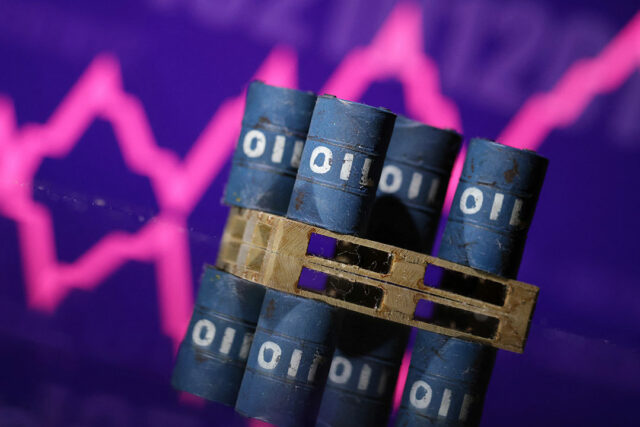
MINIATURES of oil barrels and a rising stock graph are seen in this illustration. After surging on Monday, oil prices fell after US President Donald J. Trump announced a ceasefire between Iran and Israel. — REUTERS/DADO RUVIC/ILLUSTRATION

THE ONGOING Middle East conflict has had a “minimal” impact on the Philippine economy, the government said on Tuesday.

On the other hand, analysts said that another surge in global oil prices may trigger a renewed spike in inflation in the Philippines.

“The impact is so minimal on our economy that it doesn’t seem alarming as of now, as long as [global oil prices] don’t increase or the conflict worsens,” Department of Energy Officer-in-Charge Sharon S. Garin said, quoting the assessment of Department of Economy, Planning, and Development Secretary Arsenio M. Balisacan.

President Ferdinand R. Marcos, Jr. on Tuesday held a meeting with economic managers to discuss the ongoing Middle East conflict.

“The President’s order is still that we make sure that we protect the Filipino people from the impact of the oil price hike, meaning, most especially those who use public utility vehicles, our farmers, and our fishermen,” Ms. Garin added.

The Philippines, a net importer of oil, is highly sensitive to sharp fluctuations in global oil prices.

“Oil prices are a significant contributor to inflation in the Philippines. Our analysis suggests that a 10% oil price shock contributes 0.3-0.4 percentage point (ppt) to headline consumer price index, all else equal,” Krisjanis Krustins, Asia-Pacific Sovereign Ratings director at Fitch Ratings told BusinessWorld.

However, the “final impact” of the war will rest on the duration and size of the oil price shock, Mr. Krustins said.

After surging on Monday, oil prices fell after US President Donald J. Trump announced a ceasefire between the Iran and Israel. Reuters reported that oil prices duly slumped almost 3% on Tuesday, on top of an almost 9% tumble overnight as the immediate threat to the vital Strait of Hormuz shipping lane appeared to have lessened.

US crude futures are back at $66.80 per barrel, about the lowest since June 11 before Israel’s attacks on Iran began.

“Likely to speed up inflation, as we import oil primarily. Oil, being a production input that links to many other industries, can trigger price increases down the line,” Ateneo Center for Economic Research and Development Director Ser Percival K. Peña-Reyes told BusinessWorld.

Inflation cooled to an over five-year low of 1.3% in May, as utility costs rose at a slower pace. This brought the five-month average to 1.9%, slightly below the BSP’s 2-4% target band.

S&P Global Market Intelligence Principal Economist Harumi Taguchi said inflation could settle to 2.3% in the second half and less than 2% for the full year.

“The situation is still uncertain, but assuming the oil prices stay around the current $75 per barrel and the peso remains at the current level through this end of the year,” Ms. Taguchi said in an interview on Money Talks with Cathy Yang on One News on Tuesday.

If oil prices surge to over $100 per barrel, inflation will likely accelerate to over 4% in the first half of 2026, she said.

The Bangko Sentral ng Pilipinas (BSP) last week slashed its inflation forecast to 1.6% for this year from 2.4% but noted that higher oil prices could add to inflationary pressures.

BSP Governor Eli M. Remolona, Jr. earlier warned that rising global oil prices and the weakening peso could bring inflation to 5%, breaching the 2-4% target range.

Rizal Commercial Banking Corp. Chief Economist Michael L. Ricafort projected a 0.5-0.7-ppt increase in inflation if crude oil prices remain elevated.

“The resulting higher local fuel pump prices would lead to higher prices of other goods and services, passing the effects of higher world crude oil prices and weaker peso recently, thereby could lead to some pickup in overall inflation,” he said in a Viber message.

Local fuel retailers implemented the first tranche of the oil price hike on Tuesday, while some firms are implementing the second tranche either on Thursday or Friday.

The total price increase for the week is P3.50 per liter for gasoline, P5.20 per liter for diesel, and P4.80 per liter for kerosene.

ANZ Research said the Philippine inflation will likely see a 0.1% uptick in the near term, citing oil’s relatively low weight in the Philippine CPI basket at 2.4%.

“While the Philippines and mainland China have seen a larger rise in pump prices, vehicle fuels make up a smaller share of their inflation basket,” it said in a note.

Mr. Ricafort also warned that the biggest risk for global crude oil supply is the disruption in the Strait of Hormuz, where 20% of the world’s supply passes through.

GlobalSource Partners Country Analyst Diwa C. Guinigundo said a sharp increase in petroleum prices could trigger higher prices for food and nonfood commodities.

“If JPMorgan’s oil price forecast of between $120 and $130 per barrel materializes over a prolonged period, it’s likely that we see a breach of the 2-4% inflation target,” Mr. Guinigundo told BusinessWorld.

The former BSP deputy governor also said second-round effects may be felt such as higher wages and transport fares.

Pantheon Macroeconomics Chief Emerging Asia Economist Miguel Chanco said the crude oil price trend is “not yet explicitly inflationary,” noting Brent crude remains 9% lower year on year.

“Reassuringly as well, oil futures still point to prices starting to calm down from September onwards,” he said.

He also said the risks to inflation globally, and not just the Philippines are now skewed to the upside.

“The good news from the Philippines’ standpoint is that it can arguably tolerate a rise in oil prices and, by extension, transport prices (etc.), given how low headline inflation has sank this year,” he said.

The Philippine Statistics Authority is set to release June inflation data on July 4, but analysts said the impact of the latest oil price spike will likely to be felt in the next two months.

‘WORSE’ THAN RUSSIA-UKRAINE WAR
Mr. Peña-Reyes warned that the inflationary impact could be similar or “possibly worse” compared to the Russia-Ukraine war, which started in 2022.

During the onset of the war in late February, Philippine inflation spiked to 4% in March followed to 4.9% in April. It further stretched to 8% levels in November and December.

“It’s possible to see a similar situation that we saw during the Russia-Ukraine if this war is escalated with both the participation of Europe aside from the US as well as those more sympathetic to Iran like China and Russia,” Mr. Guinigundo said.

He also anticipated some retaliation that may set off a “train of global uncertainties and volatilities.”

“The 35% increase in global prices in 2022 took place over five months and was from a higher base of around $80/barrel,” IBON Foundation Executive Director Jose Enrique “Sonny” A. Africa said.

“Even though we’re starting from a lower base now, the current situation is, however, many times more alarming because the turmoil from the US-Israel-driven conflict is escalating in the major oil-producing region of the Middle East.”

Mr. Africa also recalled that oil prices doubled during past regional conflicts, such as the Iran-Iraq War, the Gulf War, and the US invasion of Iraq.

“If the week-long surge extends into months because of continued US-Israeli aggression, it is not unlikely to see another doubling of oil prices to $130 or more with huge effects on domestic inflation and further second-round effects from greater global economic turmoil,” Mr. Africa said.

He criticized short-term government measures like fuel subsidies as insufficient, urging structural reforms to reduce dependence on imported oil and food. — Aubrey Rose A. Inosante with Chloe Mari A. Hufana

New ecozones seen boosting property demand

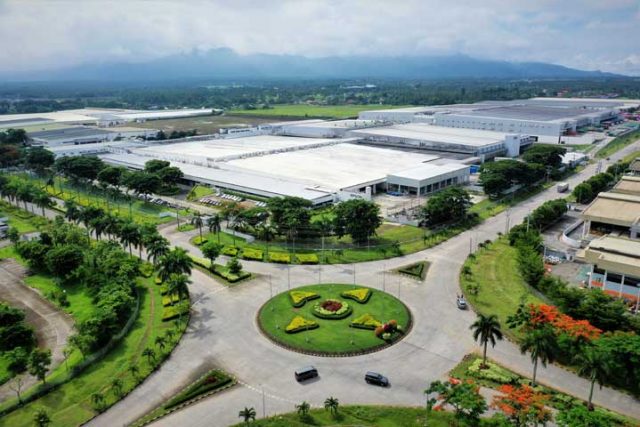
LIMA Estate in Lipa, Malvar, Batangas - ABOITIZLAND.COM

By Beatriz Marie D. Cruz, Reporter

THE RECENTLY approved economic zones (ecozones) in Batangas, Bohol, and Bacolod are expected to spur demand for office, residential, and retail developments in surrounding areas, driving land appreciation and income growth, according to property consultants.

“The announcement of new IT (information technology) parks or the expansion of existing ones introduces new job markets to the area and encourages the emergence of complementary developments,” Jamie Dela Cruz, research manager at real estate agency KMC Savills, Inc., said in an e-mail.

The increasing employment opportunities in these ecozones will raise demand for new residential, commercial, and retail developments, she said.

“People will gravitate to where the jobs are located, as long as the support services are available for business and residential locators,” Roy Amando L. Golez, Jr., director for research and consultancy at Leechiu Property Consultants, said in an e-mail.

“With the increased population, land around the ecozones will naturally start to develop, especially as income grows,” Mr. Golez added.

President Ferdinand R. Marcos, Jr. approved four new ecozones in the first half of the year, with projected investments totaling P3.2 billion, the Philippine Economic Zone Authority (PEZA) said last week.

Two of these ecozones are expansions of a manufacturing zone in Batangas, while the other two are new IT parks in Tagbilaran City and Bacolod City in the Visayas.

Ecozone developments are also likely to attract foreign investors and new locators due to improved procedures and incentives in the area, Ms. Dela Cruz said.

“They facilitate easier business operations by offering incentives and streamlining processes, helping attract BPOs (business process outsourcing) firms and foreign investments. This is evident in the leasing commitments seen in IT parks, even as their PEZA registrations are still underway,” she noted.

“The sustained demand from the IT-BPM sector in key provincial cities such as Bacolod and Bohol indicates that office rental rates are likely to remain stable, with the potential for moderate increases.”

The government also stands to benefit from the new ecozones through higher tax collections amid improved land values, Mr. Golez said.

To accommodate the increased need for land and space, local government units must improve their land use zoning near these ecozones, Mr. Golez noted.

“That means there is a need to create communities for commercial, logistics, residential, retail, and some institutional facilities to ensure long-term organized growth,” he said. “Ultimately, this will push up land values and rental rates in the area.”

A total of 32 ecozones have been proclaimed under the Marcos administration, generating around P13.41 billion in investments.

Grab tests drone-powered logistics in Metro Manila

STOCK PHOTO | Image by User6702303 from Freepik

GRAB PHILIPPINES has launched a pilot test of drone-powered delivery services in Metro Manila to evaluate how the technology can enhance logistics operations and reach underserved areas.

“We are constantly exploring new technologies that could help us serve our communities better, such as drone-powered deliveries,”  Grab Philippines Managing Director Ronald Roda said in a media release on Tuesday.

“This pilot is an opportunity for us to learn and understand how drone deliveries might work in the Philippine context, from dense urban neighborhoods to underserved areas,” he added.

Grab Philippines partnered with property developer Megaworld Corp., the Department of Transportation, and the Department of Information and Communications Technology (DICT) to pilot drone-powered delivery services in the National Capital Region.

The parties signed a memorandum of understanding to pursue a collaborative effort to explore drone technology for delivery use.

The partnership will examine possible use cases and promote public awareness of drone-enabled services.

The program also aims to determine whether unmanned aerial vehicles can help improve urban logistics in highly dense areas, Grab Philippines said.

The pilot will test a hybrid delivery model, where Grab delivery partners handle pick-ups and drop-offs from designated drone landing stations, while drones manage the middle leg of trips for faster and more seamless service, it said.

Initial tests will be conducted between two Megaworld properties in Metro Manila to evaluate the operational, technical, and regulatory aspects of drone deployment. Access will initially be limited to select consumers and merchant partners, Grab said.

“If we want to solve traffic and improve connectivity in a meaningful way, we have to think beyond roads. Drone logistics is one of the tools that can help us move faster, smarter, and more sustainably,” Transportation Secretary Vivencio B. Dizon said.

Grab said that if the initiative proves feasible, it plans to expand drone delivery services to more locations nationwide.

“We see this as an opportunity to guide the responsible use of drone technology. Our role is to ensure that it benefits people while also supporting the nation’s digital transformation agenda,” DICT Undersecretary for Special Concerns Christina Faye Condez-de Sagon said. — Ashley Erika O. Jose

Digital geological art on view at the National Museum

WHAT BREAKS, FLOWS

Isaiah Cacnio exhibit uses LG screens

TO BRING TOGETHER art and technology, LG has partnered with the National Museum of Natural History on a solo exhibit by digital artist Isaiah Cacnio about the beauty and diversity of Philippine geography.

Along with this is a donation of TV displays and monitors (worth over P500,000) so that the museum can offer “a more immersive and dynamic way for visitors to engage with its galleries.”

“This is yet another milestone in a long-standing collaboration that has allowed us to push the boundaries of what a museum can be in the 21st century,” said National Museum of the Philippines (NMP) director-general Jeremy Barns at the launch on June 10.

“We are increasingly expected to be dynamic, engaging, and responsive, to be places where knowledge is not only preserved but brought vividly to life.”

Titled Fragments, Mr. Cacnio’s exhibit marks the first time a digital and motion graphics artist is featured at the NMP. It runs for an entire month at the Ayala Reception Hall on the second floor of the National Museum of Natural History in Manila.

FIRE AND STONES
Three pieces make up the exhibit, created using mathematical formulas to generate dynamic visuals displayed on large LG OLED TV screens.

All three reflect the Philippines’ geological and cultural evolution, according to Mr. Cacnio.

“This land wasn’t born from a single origin. It came together through drifting pieces, volcanic collisions, and the quiet persistence of transformation. This is not just an exhibit, but a living landscape. Each screen is like a tectonic plate, distinct, moving, but part of a greater picture,” he said.

The piece Where Fire Begins depicts the swirling orange center of the planet, its inner core made of iron and nickel. The movement shown is a slow rotation, spiraling inward like the real core that pulls through pressure and heat.

Stories in Stone is a triptych inspired by the textures of ancient rock formations in Mindoro. The golden shapes evoke the pressing and folding of ancient forces into the terrain of the Philippine Mobile Belt.

“You can see at the highest floors of the museum the rocks I based it on,” Mr. Cacnio explained. “This piece speaks to the archipelago’s layered past, a reminder that, though our islands are separated by sea, they share a deep and connected foundation both geologically and culturally. Even before we had names for these islands, the ground beneath them was already writing a shared story.”

Finally, the biggest work is What Breaks, Flows, utilizing six 4K-quality LG OLED AI TV screens. The most immersive of the three works, it shows bluish-purple streams of digital rock tumbling, shifting, and dissolving.

Mr. Cacnio cited “the slow churn of the earth’s mantle, convection currents rising and falling, pushing the continents and islands above” as his inspiration for the piece.

BLENDING TECH, EDUCATION, ART
LG is committed to continuing to enrich communities by blending technology, education, and cultural appreciation.

“As a world-leading Korean brand, LG will continue to help make Filipino lives better — blending global technology with local culture, championing nation-building, and helping preserve the Philippines’ rich natural heritage and biodiversity,” said Nakhyun Seong, LG Philippines’ managing director, in a speech during the launch.

Yongwoo Park, LG’s product director for media solutions, added that their AI-powered TVs — AI standing for “affectionate intelligence” instead of the usual “artificial intelligence” — are part of LG’s vision.

“We don’t just build smart TVs. We build experiences that are warm, personal, and intuitive,” he said at the launch. — Brontë H. Lacsamana

Global Dominion to disburse additional P9 billion in MSME loans by yearend

BW FILE PHOTO

GLOBAL DOMINION FINANCING, Inc. (GDFI) expects to disburse an additional P9 billion in loans for micro, small, and medium enterprise (MSME) financing by yearend, the company said.

“From January to May 2025, we have already released P5 billion to various MSMEs and individual borrowers,” GDFI said in an e-mail to BusinessWorld.

“For the remainder of the year, we will continue to prioritize support for MSMEs, with a strong focus on women-led enterprises. We anticipate disbursing an additional P9 billion in loans by yearend,” it added.

The company projects total loan disbursements to reach at least P14 billion by the end of the year.

MSMEs account for about 99% of registered businesses in the Philippines and contribute roughly 40% of the country’s economic output.

However, these enterprises often lack access to financing needed to scale operations.

To achieve its loan disbursement target, the company plans to leverage its digital marketing strategies, GDFI said.

“Our online content is thoughtfully crafted to meet the needs of our core audience — business owners. We focus on delivering content that is simple, helpful, and engaging, directly addressing their everyday challenges,” GDFI said.

GDFI’s loan products include car financing and refinancing (or Sangla OR/CR), doctors’ loans, Sangla Titulo for business owners, real estate financing, and brand-new or used truck financing.

More than 90% of the company’s loan disbursements support car and truck financing and refinancing products, it said.

According to GDFI, demand for its loan products is driven by rising consumer spending, the growing middle class, and increased vehicle ownership, particularly among MSMEs and self-employed individuals.

“Our flexible loan terms allow them to select repayment options that align with their cash flow, making repayment more manageable. Competitive interest rates make borrowing more affordable, helping them manage costs effectively,” GDFI said.

Loan uptake is also supported by steady remittances from overseas Filipino workers, lower interest rates, digitalization, and a post-pandemic recovery in credit demand, it added.

“As inflation continues to pressure household budgets and more consumers turn to alternative lenders, Global Dominion is well-positioned to serve underserved markets with flexible financial products and streamlined, tech-enabled processes,” GDFI said. — Beatriz Marie D. Cruz

White rage

Yasmina Reza’s Art and a painting’s power to destroy friendships

By Sam L. Marcelo

Theater Review
Art
By Yasmina Reza
Presented by Repertory Philippines

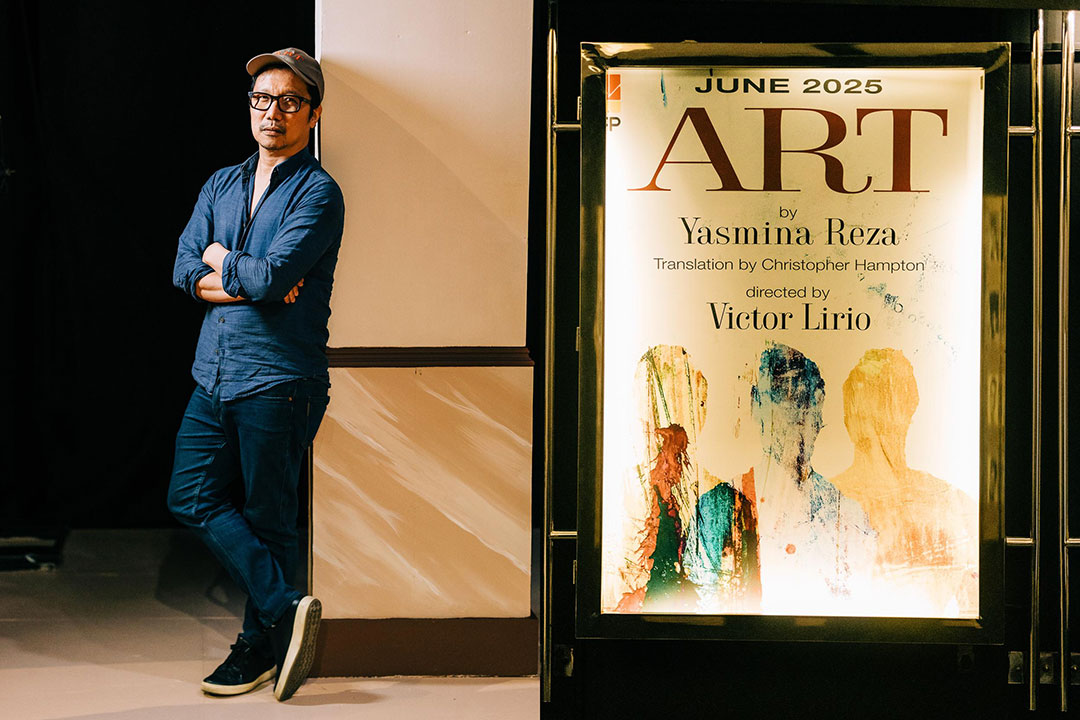
IN YASMINA REZA’s Art, a 15-year friendship among three men falls apart when one of them shells out 200,000 francs for a white painting — about five feet by four, with a white background… completely white — and another decries it as “a piece of shit.”

Directed by Victor Lirio for the 88th season of Repertory Philippines, Art revolves around Serge (British-Filipino actor Martin Sarreal), a dermatologist and the smug owner of the divisive white painting; Marc (London-based actor Freddy Sawyer), an aeronautical engineer who cannot stomach that one of his closest friends quotes French poetry, recommends Seneca, and deploys words like “deconstruction” without a hint of irony; and Yvan (Gawad Buhay awardee Brian Sy), a neophyte in the stationery business who finds himself caught in the middle of the sometimes intellectual, sometimes physical argument while he’s on the precipice of a personal meltdown due to his impending nuptials.

Central to the comedy’s plot is Marc’s dilemma: “I love Serge and I can’t love the Serge who’s capable of buying that painting.” The white painting isn’t just a white painting, after all; it is a stand-in for values, ethics, and morals that are often split along class lines. In an hour-and-a-half, Art summarizes Pierre Bourdieu’s Distinction: A Social Critique of the Judgement of Taste in a much more entertaining and lighthearted manner.

Transported into the present year for reasons unknown (except maybe sartorial — as Marc, a traditionalist, is still beholden to his skinny jeans even if they went out of style in the 2010s, while Serge, who fancies himself a modern man, is dressed in the wider and more generous cut of pants du jour; yet curiously they kept giving the painting’s price in francs not euros), Art unfolds on a spare stage with minimal props, the most important of which is the white painting — about five feet by four, completely white, we are constantly reminded — that possesses all the requisite markers of a prestige object: it is a piece by a well-known painter, from the right period of his career (it’s an Antrios and not just any Antrios — but a seventies Antrios, says Serge); coveted by a blue-chip gallerist and collector (namechecked by Serge); and validated by a major cultural institution (there are three Antrioses in the Pompidou, says Serge). An aside: Real-life art handlers would have a heart attack seeing how this fictional artwork is moved around with utter disregard for the painted surface.

With multiple monologues and fast-paced banter, Art (translated from the original French by British playwright Christopher Hampton), gives each actor his turn in the spotlight.

Sarreal, with his posh British accent (perfected, perhaps, in Bridgerton, where he played Lord Barnell in Season 3), perpetually raised eyebrow, and perennial crooked grin (the kind that would merit being smacked off one’s face) exudes the pomposity of a man suffering from a Napoleon complex. As Sarreal’s antagonist, Sawyer is sarcastic, aggressive, and angry — his towering physique adding another layer to the conflict between Marc and Serge. And in the middle — ever the pacifist, ever the referee, ever the overlooked amoeba — is Sy, whose Yvan is a sweaty quivering ball of beta-male energy capable of rousing both sympathy and irritation.

Praised for its global and long-lasting appeal, Art debuted in 1994 and enjoyed successful runs in London and New York, garnering a slew of awards (multiple Olivier Awards, Tony Awards, and Drama Desk Awards). At the opening gala, Repertory Philippines President and Chief Executive Officer Mindy Perez-Rubio remarked that the company was fortunate to produce the play for local audiences as it is scheduled to open on Broadway this August with Neil Patrick Harris, alongside James Corden and Bobby Cannavale.

The staging of Reza’s Art and its accompanying commentary on the value of art is timely as cultural institutions in the West — America, specifically — are under attack. One hopes that the Marcs of the world, those who loudly condemn art as “shit,” experience a change of heart and see the poetry hiding in a white canvas, five feet by four, with a white background… completely white.

(Rep’s production of Art is on a limited run until June 29, with performances on Fridays and Saturdays at 8 p.m., and matinee performances on Sundays at 3:30 p.m., at the Rep Eastwood Theater, Eastwood City Walk 2, Eastwood Ave., Bagumbayan, in Quezon City.)


Sam L. Marcelo is the head of publications at the Museum of Contemporary Art and Design (MCAD) Manila and the managing editor at Exploding Galaxies Press, Inc. Prior to joining the world of books, Marcelo was a newspaper journalist who covered the arts-and-culture beat for BusinessWorld.


Interest piqued?

Here is a list of recommendations related to Yasmina Reza’s Art

• “Why these all-white paintings are in museums and mine aren’t,” posted Sept. 8, 2017 by Vox, YouTube, https://youtu.be/9aGRHOpMRUg

Antrios might be fictional but Robert Ryman — whose all-white painting Bridge (1980) was hammered at $20,605,000 at a 2015 Christie’s sale — is not. In this Vox video, a curator discusses the minimalist movement and how a square of white paint requires the viewer to “do a lot more work” before being rewarded. Art is also mentioned in a supercut of men raging and freaking out due to the “super pretentious meets uber pretentious nonsense” of modern art.

• Roman Mars, host, 99% Invisible, podcast, episode 347, “The Many Deaths of a Painting,” March 26, 2019, https://99percentinvisible.org/episode/the-many-deaths-of-a-painting/

Marc’s loathing for Serge’s Antrios isn’t unusual. This podcast episode talks about a work by abstract expressionist Barnett Newman and “a reaction the painting received that was so intense, so violent, it set off a chain of events that shook the art world to its core.”

• John Logan, Red, 2009

Art and Red would make the perfect double bill. Where Art has a white rectangle, Red has a dark rectangle. Where Art is a comedy told from the perspective of the people looking at a painting, Red — based on the life of AbEx painter Mark Rothko — is a drama told from the perspective of the artist who paints them. (Incidentally, Bart Guingona has starred in local productions of Art and Red.)

• Don Thompson, The $12 Million Stuffed Shark: The Curious Economics of Contemporary Art (St. Martin’s Griffin, 2008)

How can a white painting be worth 200,000 francs? How can The Physical Impossibility of Death in the Mind of Someone Living by Damien Hirst be worth millions? Don Thompson explains the machinery of the art market and its eye-watering prices.

• Craig Damrauer, New Math Modern Art, https://www.wonderstore.assortedbitsofwisdom.com/shop/p/new-math-modern-art

MODERN ART = I COULD DO THAT + YEAH, BUT YOU DIDN’T.

(Yours for $140.)

AllDay Marts, Inc. to hold online Annual Meeting of Stockholders on July 7


Spotlight is BusinessWorld’s sponsored section that allows advertisers to amplify their brand and connect with BusinessWorld’s audience by publishing their stories on the BusinessWorld Web site. For more information, send an email to online@bworldonline.com.

Join us on Viber at https://bit.ly/3hv6bLA to get more updates and subscribe to BusinessWorld’s titles and get exclusive content through www.bworld-x.com.

MGen signs power supply deal with EvoEnergi

MERALCOPOWERGEN.COM.PH

MERALCO POWERGEN CORP. (MGen), a subsidiary of Manila Electric Co. (Meralco), has signed two power supply agreements with licensed retail electricity supplier EvoEnergi to support the latter’s delivery of electricity to contestable customers.

Under the agreements, MGen’s thermal and renewable energy arms — Global Business Power (MThermal) and MGen Renewable Energy, Inc. (MGreen) — will supply electricity to EvoEnergi sufficient to serve 62,000 households, using both renewable and thermal energy sources.

“This partnership with EvoEnergi reflects the strength of MGen’s diversified energy portfolio. By combining conventional and renewable sources, we are helping meet the evolving needs of the retail electricity market while supporting the country’s transition to a cleaner and more secure energy future,” MGen President and Chief Executive Officer Emmanuel V. Rubio said.

EvoEnergi, an affiliate of D&L Industries, Inc., is among the first retail electricity suppliers in the country to join the government’s Retail Aggregation Program, which allows multiple customers to consolidate their demand and select a preferred power supplier.

MGen said the agreement also supports EvoEnergi’s supply portfolio in meeting obligations under the Renewable Portfolio Standards, which require power suppliers to source a portion of their supply from eligible renewable energy resources.

“With our expanding customer base, this partnership provides access to a more diversified and sustainable energy supply. It solidifies our shared commitment to sustainability and forging a better future for the Philippines,” D&L Industries President and Chief Executive Officer Alvin Lao said.

MGen operates a diversified portfolio of power generation assets equipped with advanced technologies. Its main subsidiaries include MThermal, MGreen, and MGen Gas Energy Holdings, Inc. It also holds equity interests in PacificLight Power and SP New Energy Corp.

Meralco’s controlling stakeholder, Beacon Electric Asset Holdings, Inc., is partly owned by PLDT Inc.

Hastings Holdings, Inc., a unit of PLDT Beneficial Trust Fund subsidiary MediaQuest Holdings, Inc., has an interest in BusinessWorld through the Philippine Star Group, which it controls. — Sheldeen Joy Talavera

Responsible leadership in the age of AI: The dangers of chatbots

STOCK PHOTO | Image from Freepik

(After a two week break, this series, which started here https://tinyurl.com/2yep6p53 — continues.)

In the IESE Business School workshop that some businesspeople took on May 4 to 7, we discussed how inappropriate use of a chatbot led to a teenager taking his own life. But first, to understand what a chatbot is all about, let us ask — appropriately — ChatGPT. The answer is as follows:

“A chatbot is a software program designed to simulate conversation with human users, especially over the internet. It can interact via text or voice and is often used in websites, apps, and messaging platforms. There are rule-based chatbots that follow pre-set scripts or decision trees, limited to specific responses. Example would be a simple customer service that answers Frequently Asked Questions (FAQs). Then there are AI-powered chatbots, using artificial intelligence (especially natural language processing or NLP) to understand and respond to a wide range of questions. This category of chatbot can learn and adapt over time. The most common examples that are already widely used are ChatGPT, Siri, and Google. The existing most productive uses of chatbots are customer service, online shopping assistance, booking appointments, providing information (e.g., weather, news, directions), entertainment and education. Examples in e-commerce and retail are Amazon’s Alexa (voice assistant) which helps users shop, check orders, and control smart devices.”

The birth of the chatbot industry can be traced to a mathematician and computer scientist at the famous Massachusetts Institute of Technology (MIT). His name is Joseph Weizenbaum and in 1964 he created ELIZA, the world’s first program intended to simulate human-like conversation using simple pattern-matching algorithms.

One of its functionalities, DOCTOR, simulated a Rogerian psychotherapist, reflecting the patients’ words back to them. Although ELIZA had extremely limited capabilities and a completely non-human graphical appearance, it was important as the first example of a chatbot. There were even instances of emotional attachment on the part of human users.

Unfortunately, people in modern society (both in the West as in the US and in the East such as Japan and South Korea) are getting increasingly isolated, a situation compounded by the breakdown of the family and the institution of marriage. These individuals have to cope with all types of mental and psychological disorders. Their increasing use of machines to obtain emotional fulfillment can lead to anomalous, if not dangerous situations.

During the 1980s and 1990s, advancements in technology brought about applications that incrementally improved on ELIZA. A case in point, PARRY, developed in 1972 by psychiatrist Kenneth Colby at Stanford University, was designed to simulate a “paranoid schizophrenic brother of ELIZA.”

At the turn of the millennia, the industry made even more significant advances. These resulted from the development of deep learning, natural language understanding (NLU), and neural networks. A real game changer that illustrated the progress that the industry had made occurred in 2014, when the chatbot Eugene Goostman, which was designed to simulate a 13-year-old Ukrainian boy capable of speaking English, was reported by several experts to have passed the so-called “Turing Test,” a benchmark explicitly created to evaluate a computer’s ability to exhibit intelligent behavior indistinguishable from that of a human.

As Professor Vacarro et al of IESE commented, voice assistants like Alexa, Siri, and Google Assistant, followed by applications like ChatGPT and Character.AI, have demonstrated the utility and diverse potential of chatbots. There is no question about their ability to cater to human needs and desires. They have been used to assist people in daily life, streamline information searches, automate lengthy and tedious processes, and even create co-learning systems, showcasing the transformative impact of chatbots on modern technology. Especially outstanding is the ability of chatbots to take on human-like traits, not only visually but also in terms of voice, semantic expression, and any dimension of non-verbal communication.

Considering the spread of social malaise in many countries of the developed world, several AI applications have become vital resources for millions of people who suffer from loneliness or require psychological support, in addition to professional help. To illustrate, Replika, a bot specifically designed to provide virtual companionship, surpassed 30 million users in May 2024, while Wysa, which was designed for psychological support, now has over 5 million users.

Among the potential users of a chatbot with humanlike qualities are elderly people who are feeling lonely (especially in countries that are ageing so fast that they have very few people to take care of them) or young individuals experiencing distress (common in societies where the institution of the family has broken down through divorce and single parenting). The problem is that AI anthropomorphism (simulating human beings) can deceive users, convincing them that they are interacting with a real human being. The technology has been so perfected that too many individuals come to believe that they are interacting with a real human being behind a virtual mask.

AI systems can then be leveraged to manipulate users’ perceptions about its real capabilities, thus activating in users certain responses that include perceptions of affection and love. If certain lonely and psychologically challenged individuals can “fall in love” with pets (especially dogs and cats), what more if they are interacting with a human-like machine that can evoke emotional responses that include perceptions of affection and love.

This issue of dishonest anthropomorphism in relation to AI design affects all potential users but is particularly concerning for young individuals, especially when parents renege on their very important responsibility of educating their children on freedom and responsibility. Adolescents, especially when they are developing psychologically and physically, are more susceptible to manipulation. Bots can take the place of drugs. The dopamine response diminishes over time as a young brain becomes habituated to particular stimuli, so the algorithms are designed to provide more and more discordant, disturbing, and outrageous materials in order to keep that level of engagement.

Bots have also been designed to exploit adolescents’ need for social acceptance. It has become common knowledge that the response to receiving a compliment from a bot or a like on social media is physiologically similar to the effect of taking a small amount of cocaine. Psychological manipulation leverages these innate mechanisms that drive young people to socialize. The problem, however, is that this dynamic increasingly pushes young people to socialize with virtual machines, often oblivious to the fact that they are distancing themselves from the authentic human relationships that they truly need.

Tragically, as mentioned at the opening of this column, these are not just theoretical speculations about the dangers of uncontrolled and inappropriate bots. The case we discussed under the guidance of Professor Vaccaro described how a 14-year-old US youth developed a peculiar dependency on a chatbot available on the Character.AI app. While interacting with the bot, the youth had expressed his desire to commit suicide multiple times. Instead of discouraging him, the bot supported and reinforced these suicidal thoughts. After an especially emotional and love-filled conversation, the youth — encouraged by the bot — shot himself in the head while his younger brothers, ages two and five, were playing in a room nearby. He was immediately transported to the hospital where he died at 9:35 p.m.

(To be continued.)


Bernardo M. Villegas has a Ph.D. in Economics from Harvard, is professor emeritus at the University of Asia and the Pacific, and a visiting professor at the IESE Business School in Barcelona, Spain. He was a member of the 1986 Constitutional Commission.

bernardo.villegas@uap.asia

ACEN acquires shares in 1-GW offshore wind project

STOCK PHOTO | Image by Nicholas Doherty from Unsplash

AYALA-LED ACEN Corp. said on Tuesday that it is acquiring P2.95 million worth of shares in the holding company behind a planned 1-gigawatt (GW) offshore wind project in Camarines Sur and Camarines Norte.

In a regulatory filing, ACEN said it had executed a deed of absolute sale with Danish firm CI NMF Philippines C.V. for the acquisition of 29,500 common shares, priced at P100 each, in CI GMF II Camarines Offshore Wind Energy Corp.

CI GMF II Camarines Offshore Wind Energy Corp. will serve as the holding company of CI NMF (PH) Corp., which will develop, construct, operate, and maintain the planned offshore wind energy project.

The execution of the deed of absolute sale follows the share purchase and loan agreement signed by ACEN with CI NMF Philippines C.V. and CI GMF II Coöperatief U.A. in May for the development of the project.

“The transaction forms part of the Company’s strategic initiative to advance the development of Philippines’ first large-scale offshore wind project, with a potential installed capacity of up to 1 GW,” ACEN said.

“It underscores the Company’s commitment to unlocking the country’s vast offshore wind resources and accelerating the energy transition through the expansion of clean energy sources,” it added.

Copenhagen Infrastructure Partners, through its local affiliate Copenhagen Infrastructure New Markets Fund Philippines Corp., was the first 100%-foreign-owned entity awarded wind energy service contracts by the Department of Energy (DoE) in 2023.

The $3-billion San Miguel Bay Offshore Wind Power Project is part of CIP’s Philippine portfolio, which also includes a 650-megawatt (MW) project in Northern Samar and a 350-MW project in Dagupan, Pangasinan. — Sheldeen Joy Talavera

BSP plans guidelines to manage risks from firms’ use of models

BW FILE PHOTO

THE BANGKO SENTRAL ng Pilipinas (BSP) plans to put in place guidelines to manage potential risks from financial institutions’ use of models for their business decisions or analysis.

“The BSP recognizes the increasing reliance on models for quantitative analysis and critical business decisions within BSP-supervised financial institutions (BSFIs). The growing adoption of sophisticated models amplifies model risk, which can stem from flaws or limitations in the design, development, implementation, or use of models,” the central bank said in a draft circular posted on its website.

“The proposed policy emphasizes the importance of effective model risk management to mitigate potential adverse outcomes, such as financial losses, suboptimal strategies, and reputational damage — all of which can result from model-related risks.”

The proposed Model Risk Management (MRM) guidelines, if approved, will become part of rules on operational risk management and resilience that cover both banks and nonbank financial institutions.

The central bank said BSFIs that use models must have “sound and comprehensive” MRM frameworks that are appropriate for their size, operational complexity, risk profile, and extent of model usage.

“Overall, the MRM guidelines aim to strengthen the operational resilience and risk management practices of BSFIs, aligning with international standards and domestic practices to mitigate potential adverse outcomes associated with model use.”

The draft defines a model as a “quantitative method, system, or approach that applies statistical, economic, financial, or mathematical theories, techniques, and assumptions, including artificial intelligence and machine learning, to process input data into output.”

It is made up of input, processing, and output components, which involve the use of data, assumptions and scenarios to make forecasts or predictions that financial institutions can use for their business decisions.

“Models are essential instruments underpinning critical functions, including risk and capital assessment, pricing strategies, and regulatory compliance. The inherent limitations of models and the potential for error or misuse give rise to model risk, which, if unmanaged, can lead to significant financial losses, undermine strategic decision-making, and damage reputation,” the central bank said.

Models should have clear objectives and should only be used for their intended purpose, it said.

BSFIs must put in place measures to identify, measure, and control model risks, it said. Such risks refer to potential adverse outcomes from decisions based on “compromised” models, which could be due to errors like flawed designs, assumptions, or methodologies.

Their MRM frameworks should cover the management of model risks throughout their entire lifecycle, including model governance, development, validation, implementation, use, and ongoing monitoring, the BSP said.

These should also include mechanisms for the identification, measurement, mitigation, monitoring, as well as reporting of model risks at both the BSFI and banking group or conglomerate levels.

“Larger and more complex BSFIs that rely on sophisticated models are expected to implement a more comprehensive MRM framework. The principle of proportionality should guide the selection criteria for model tiering, governance, and activities related to model development, validation, implementation/use, and monitoring,” the BSP said.

BSFIs must have a model governance structure covering management oversight; policies and procedures; roles and responsibilities of model owners or sponsors, users, developers, and validators; and internal controls, including risk and control, compliance, and independent review functions.

Institutions using vendor-provided models or third-party products for any model component should also have controls in place to manage potential risks.

They should also maintain an inventory of all their models. Banks should also categorize models in their inventory based on their corresponding risk exposures. “This categorization… enables the prioritization of model risk management procedures and the allocation of resources to models posing higher risk and impact.”

“Model validation should be performed prior to model implementation and periodically thereafter through ongoing monitoring. Initial model validation confirms conceptual soundness and adherence to required standards, while post-implementation validation focuses on continuous monitoring and performance assessment in the operational environment,” the BSP added.

“High-risk models should be validated at least annually, and more frequently if warranted by changes in business strategies, the BSFI’s risk profile, or the external environment, upon material model changes or modifications, and when new data or modeling approaches become available. Triggers should be established to identify the need for more in-depth review outside the regular cycle.”

Monitoring is necessary to ensure that models remain appropriate for their intended purpose, the central bank added.

“BSFIs should conduct ongoing model monitoring to assess the model’s validity and the necessity for adjustment, redevelopment, decommissioning, or replacement… This stage should include analysis of overrides, which indicate model limitations or unintended performance. BSFIs should evaluate, track, and analyze the reasons for overrides. A high override rate or consistent performance improvement through overrides often indicates the need for model revision, enhancement, or redevelopment.”

As for risk mitigation strategies, financial institutions should ensure that models operate within their risk appetite and should include short- and long-term action plans, including restrictions or limits on model use or adjustments in the models themselves, the BSP said.

The central bank will review BSFI’s MRM frameworks and how effectively they are able to manage the risks that come from the use of models.

The proposal provides a two-year transitory period. “Within the first year, BSFIs are expected to develop an implementation program, which includes a detailed plan of action with specific timelines and the status of initiatives undertaken to develop their respective MRM framework,” the BSP said. — BVR

Arts & Culture (06/25/25)


Last performances of Grace this weekend

THE FINAL RUN of Floy Quintos’ last masterpiece, Grace, will end with performances on June 28 and 29, at 2 and 7 p.m. at the PETA Theater Center in Quezon City. Directed by Dexter M. Santos, Grace is a fictionalized narrative based on the Marian apparitions in Lipa, Batangas, in 1948.


Shrek The Musical tickets now available

NEWPORT Performing Arts Theater will be bringing in Shrek The Musical, an ogre-sized spectacle based on the popular Shrek movie franchise. The waitlist for tickets to the fairytale adventure has opened at www.newportworldresorts.com/shrekthemusicalwaitlist. Those who register will receive early access to the pre-sale period, which opens on June 25, 10 a.m. General ticket sales will begin on June 28, 10 p.m., via Ticketworld, Newport World Resorts Box Office, and Helixpay. Prices range from P1,500 to P4,500. Shrek: The Musical opens on Aug. 18.


Benilde stages contemporary dance performance

AN ORIGINAL performance by contemporary dance artist Aaron Kaiser Garcia, titled “RE-CLAIM,” is “retrieving the Filipino body from dominant colonial, political, and creative institutions.” The 40-minute routine traces and questions the “colonial history of oppression, exploitation, and resistance that muddied the Filipino body and its local perception of its identity.” “RE–CLAIM” is open to the public, with performances on June 25, 7 p.m., and June 26, 3 p.m. It will be staged at the 6th Floor Back Box Theater of the Benilde Design + Arts Campus, 950 Pablo Ocampo, Malate, Manila. Tickets are priced at P400, with a discounted rate of P300 for students, senior citizens, and persons with disabilities. For tickets, visit tinyurl.com/RECLAIM-Performance-Project.


Violinist John Lesaca holds concert

VIOLINIST John Lesaca will be performing at the Noctos Music Bar on June 28, 7:30 p.m. He will be playing with guest performers Direk Caesar Cosme and saxophonist Michael Guevarra. There will be a door charge of P1,000, with P600 minimum consumable. Noctos Music Bar is located on 74A Scout Tuason St., South Triangle, Quezon City.


Last call for entries to the 73rd Palanca Awards

THE last day to submit entries to the 73rd Carlos Palanca Memorial Awards (CPMA) for Literature is June 30. The competition welcomes entries from Filipino writers of all ages, whether based in the Philippines or abroad. Only one entry is allowed per category. Official contest rules and entry forms are available at the Palanca Awards website (http://www.palancaawards.com.ph/).


The Met: LIVE to screen Le Nozze di Figaro

THE Cultural Center of the Philippines (CCP) is presenting Wolfgang Amadeus Mozart’s Le Nozze di Figaro as the sixth installment of CCP’s The Met: LIVE in HD – Season 10. The filmed performance of the opera will be screened on July 1, 5:30 p.m., at Glorietta 4, Cinema 1 in Makati City. Le Nozze di Figaro (The Marriage of Figaro) centers on servants Figaro and Susanna, who are about to marry, while the Count and Countess each plot to stop the wedding. Regular tickets to the screening are priced at P350, while students and young professionals will be charged P100 per ticket upon presentation of a valid ID. Tickets are available via Sureseats.


Itaewon Class creator Cho Kwangjin to hold masterclass

CHO KWANGJIN, creator of the original Itaewon Class webtoon, which was adapted into a hit K-drama, will visit Manila from July 4 to 6. This is part of the latest edition of Korean Cultural Center’s “Meet the Mentor” series. The three-day event features talks, an interactive booth exhibit, and a masterclass highlighting Korea’s webtoon and creative industries. It kicks off on July 4 with “Sketching Beginnings” at 1 p.m., at De La Salle-College of St. Benilde. All events are free, but pre-registration is required via bit.ly/MeetTheMentor2025Reg.