Home Blog Page 8753

9 Boracay businesses charged with forestry, water violations

THE GOVERNMENT has charged nine Boracay establishments with illegally occupying protected forest land on the island, the Environment department said.

The violations involve rules laid down under the revised Forestry Code and the Philippine Water Code, Secretary Roy A. Cimatu said at a virtual briefing late Wednesday.

“Appropriate cases have already been filed against them. This proves that the rule of law is paramount and law enforcement is crucial and negotiable,” he said in a statement issued by the Department of Environment and Natural Resources.

The charges stem from inspections conducted over the past two months by the National Bureau of Investigation and the Boracay Inter-Agency Rehabilitation Management Group.

Mr. Cimatu added that the island’s coliform water contamination levels, as measured via the most probable number per milliliter, fell to a new low of 6.8 last month, based on readings taken at New Coast Boracay, Movenpick, Steve’s Cliff, and Front Beach Grotto.

Mr. Cimatu was speaking at a Boracay briefing conducted jointly with local government units and the Department of Tourism (DoT).

SUBSIDIZED RT-PCR TESTS
Boracay is among the major tourist destinations now open to domestic travelers.

In another statement, the DoT announced Thursday a partnership with the University of the Philippines-Philippine General Hospital (UP-PGH) to partly subsidize the cost of the COVID-19 RT-PCR test kits for domestic tourists.

At present, UP-PGH is offering its test kit for P1,800 each, which the DoT said was much lower than the ones sold by testing laboratory centers.

The DoT said that the test kit subsidy will be borne by its marketing arm, the Tourism Promotion Board.

According to the Boracay Interagency Task Force (BIATF), the DoT was given the lead role in implementing low-cost or free RT-PCR tests for Boracay-bound non-Aklan tourists; and secure at least 1,500 RT-PCR test kits for to implement expanded testing in the island.

The BIATF also tasked the DoT with facilitating the training of Aklan province and Malay municipality in case investigation, contact tracing, referrals and other COVID-19 related operations. — Angelica Y. Yang

Renewables seen as far cheaper than diesel generators for remote, island power grids

REMOTE power grids and those on small islands can be run more cost-effectively on renewable sources like solar and wind, compared with diesel generators, according to the Institute for Energy Economics and Financial Analysis (IEEFA), a US non-profit.

IEEFA energy finance analyst Sara Jane Ahmed released her estimates of peso costs of various energy options in a report issued this week.

“Diesel-powered generation prices range between P10.6 ($0.22) to P117.75 ($2.45) per kilowatt hour (kWh)… Both solar and wind prices can reach as low as P3.5 ($0.07) in the main grids and even if delivered at double or triple the cost in island and isolated grids, solar and wind can still undercut the price of diesel,” Ms. Ahmed said in a report.

“Based on IEEFA’s analysis of the small and isolated grids… solar PV (photovoltaic) plus lithium-ion batteries can now reliably deliver power at a significant discount to the price-performance potential of the current diesel-power fleet,” Ms. Ahmed said.

She said high diesel prices have “undermined the competitiveness of diesel power.”

“At a low price of $0.72 per liter and a high price of $0.9 per liter, not taking into consideration transportation costs, the savings from a shift to renewables can range between $66 million and $82 million,” she said.

She added that increasing the mix of renewables in small grids would translate to cost savings of between 17% and 29% over 20 years.

Ms. Ahmed called the National Power Corp.’s Small Power Utilities Group (NPC-SPUG) a “key player in the small and isolated grid policy dynamic.”

“While NPC-SPUG has been an important player in rural electrification in the Philippines, its ability to meet the government’s aggressive electrification goal is limited considering its current trajectory,” she said.

She noted that the high cost of the diesel lock-in strategy put forward by NPC-SPUG ignores the benefits of renewable energy which included affordability, price stability and improved energy security.

She said NPC-SPUG must freeze new diesel investment and focus on hybridization. — Angelica Y. Yang

Modified LRT-6 unsolicited proposal being evaluated by NEDA

THE Transportation department said an unsolicited proposal to build the Modified Light Rail Transit (LRT) Line 6 is currently being evaluated by the National Economic and Development Authority (NEDA).

“It’s now with NEDA. It’s an unsolicited proposal,” Transportation Undersecretary for Planning & Project Development Ruben S. Reinoso, Jr. told BusinessWorld in a phone interview Thursday.

The indicative project cost is P73.24 billion, according to a report by the Public-Private Partnership (PPP) Center.

The proponent is the Villar group’s Prime Asset Ventures, Inc. or PAVI, Mr. Reinoso said.

In its official website, the PPP Center said the phase 1 of the project involves “the construction, operation and maintenance of an approximately 23.5-kilometer Light Rail Transit System, consisting of nine stations that will extend the LRT-1 Extension Project from Niog in Bacoor to Governor’s Drive in Dasmarinas traversing Bacoor, Imus and Dasmarinas Cities, all in the Province of Cavite.”

Other unsolicited PPP projects that are for approval of various government bodies as of September, according to the PPP Center, are: the Fort Bonifacio-Makati Skytrain Project, the Ninoy Aquino International Airport Comprehensive Capacity Enhancement Project, the New Bohol International Airport Project, the Cavite-Tagaytay-Batangas Expressway Project, the Tarlac-Pangasinan-La Union Expressway Extension Project, and the C5 MRT-10 Project, among others.

The MRT-11 Project, the North Luzon Express Terminal Project, the Davao International Airport Development, Operation, and Management Project, the New Metro Manila Food and Transport Hub Project, the Cebu Monorail Transit System Project, the Davao People Mover Project, and the East-West Rail Project are also for approval at various government bodies. — Arjay L. Balinbin

BFAR raises red tide warning over parts of Leyte, Samar islands

THE Bureau of Fisheries and Aquatic Resources (BFAR) has raised the red tide warning over parts of Leyte and Samar and discouraged consumption of shellfish harvested from those waters.

The advisory covers shellfish from Calubian and the municipality of Leyte in Leyte province, the province of Biliran Islands, Guiuan, Eastern Samar, and Cambatutay Bay, Western Samar.

In its 26th shellfish bulletin of 2020, the BFAR said red tide warnings remain raised over Mariveles, Limay, Orion, Pilar, Balanga, Hermosa, Orani, Abucay, and Samal, Bataan; Honda and Puerto Princesa bays and Inner Malampaya Sound, Palawan; Milagros, Masbate; Dauis and Tagbilaran City, Bohol; and Tambobo Bay, Negros Oriental.

Warnings are also up over Daram Island, Zumarraga, Irong-irong, San Pedro, Maqueda, and Villareal Bays, Western Samar; Cancabato and Carigara Bays. Leyte; Matarinao Bay, Eastern Samar; Balite Bay, Davao Oriental; Lianga Bay and Hinatuan, Surigao del Sur; and Dumanquillas Bay, Zamboanga del Sur.

The BFAR also declared that Bislig Bay, Surigao del Sur to be clear of red tide contamination.

The BFAR said all types of shellfish and Acetes sp. or alamang harvested from the identified areas are not safe for human consumption.

However, other marine species captured in the area can be eaten by humans with proper handling.

“Fish, squid, shrimp, and crab are safe for human consumption provided that they are fresh and washed thoroughly, and internal organs such as gills and intestines are removed before cooking,” the BFAR said.

Red tide occurs due to high concentrations of algae in the water.

Eating contaminated shellfish can result in paralytic shellfish poisoning, which affects the nervous system.

Common symptoms of paralytic shellfish poisoning include headaches, dizziness, and nausea. Severe cases may include muscular paralysis and respiratory issues. — Revin Mikhael D. Ochave

Building approvals drop 65.5% in Q2 as lockdown halts construction

CONSTRUCTION STARTS, as measured by building permit approvals, fell 65.5% in the second quarter, during the strictest phase of the lockdown, the Philippine Statistics Authority said.

Approved building permits during the period totaled 16,004, against 46,453 a year earlier.

These projects involved 2.51 million square meters of floor space worth P25.02 billion, down 81.2% year on year.

Residential construction, which accounted for the bulk of approved permits during the three months to June, fell 65.3% year on year to 12,004. The decline was led by “other” residential properties (minus 95.7% to 3 applications), apartments/accessorias (minus 81.6% to 668), residential condominiums (minus 81.3% to 12), and single-detached homes (minus 65% to 10,469).

Permits for duplex/quadruplex construction, meanwhile, rose 0.4% to 852.

Non-residential permits likewise fell 64% to 2,265, led by the industrial category, which declined 71.4% to 183. Also posting declines were structures classified as institutional (minus 67.1% to 464), agricultural (minus 62.4% to 106), commercial (minus 61.9% to 1,441), and other non-residential buildings (minus 60.6% to 71).

Permits for additions to existing structures retreated 78.6% to 347, while those for alterations and repairs of existing structures fell 65% to 1,388.

Calabarzon — composed of the provinces of Cavite, Laguna, Batangas, Rizal, and Quezon — topped the regions with 2,641 approved construction permits. Central Visayas and Ilocos Region followed with 2,347 and 1,737, respectively.

ING Bank NV Manila Branch Senior Economist Nicholas Antonio T. Mapa said the decline seen nearly across the board was due to the lockdown that was imposed to contain the spread of coronavirus disease 2019.

“The drop-off in construction can be tied to two factors, the first being the strict lockdown period which led to the stoppage of overall construction activity as Filipinos were forced to hunker down to avoid transmission of the virus,” he said by e-mail.

“Second, construction activity was also iced as the overall economy plunged into recession with job losses mounting while households and corporations looked to protect cash flows given the uncertainty,” he added. 

In the second quarter, the economy entered recession as gross domestic product (GDP) growth fell by a record 16.9%.

Unemployment also spiked to a record 17.6%, according to the April round of the Labor Force Survey.

Going forward, Mr. Mapa expects a “modest pickup” in construction activity as projects resume with lockdowns easing in many parts of the country.

“But with the economic outlook very bleak, we are not expecting projects in the pipeline anytime soon with previously planned construction projects also likely relegated to the back burner for now,” he said.

“With construction likely sidelined by the pandemic, we are not optimistic for a quick rebound in overall GDP numbers as investors hold back on big-ticket items while preserving cash until sentiment improves,” he said. — Michelle Anne P. Soliman

FDA says COVID-19 vaccines could be available by March

VACCINES for COVID-19 (coronavirus disease 2019) could be available in the country as early as March after President Rodrigo R. Duterte’s formal approval of its emergency use.

Food and Drug Administration (FDA) Director General Rolando Enrique D. Domingo said on Thursday an emergency use authorization (EUA) can be granted by January to some vaccine manufacturers.

“It is possible by the first few weeks of January we can give an emergency use authorization,” he said in Filipino during the Palace daily briefing, “and maybe there is a chance that we can have the vaccine in the Philippines by March.”

President Rodrigo R. Duterte signed Executive Order No. 121 on Wednesday, which authorizes the FDA to issue an EUA to coronavirus drugs and vaccines.

With the EO, the approval process by the FDA will be shortened to 21 to 28 days from the usual period of six months.

The issuance of an EUA is already practiced in other countries.

Mr. Domingo said there is a good chance that pharmaceutical firms that already have an EUA from other countries will be granted a local emergency approval when they apply for one.

In a separate briefing on Thursday, Mr. Domingo said the FDA is finishing its guidelines on the EUA applications.

“The applicant for the EUA should comply with our conditions. The first is they should have an EUA from the countries they are from or have an approval from a foreign counterpart of the FDA with strict regulation or a World Health Organization pre-qualification,” he said in Filipino.

He added that even with the swift approval for the drugs and vaccines through the EUA, review on their available data will still be stringent.

He also said that the FDA will conduct a “post authorization monitoring” on those who received the vaccine to check for adverse effects.

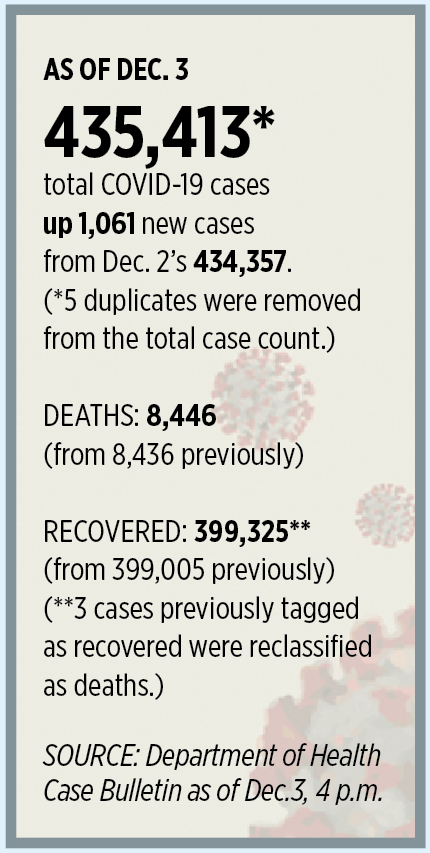
Meanwhile, the Department of Health (DoH) reported 1,061 coronavirus infections on Thursday, bringing the total to 435,413.

The death toll rose by 10 to 8,446. Recoveries reached 399,325 with 328 more patients who have gotten well, it said in a statement.

There were 27,642 active cases, 85.2%  of which were mild, 6.9% asymptomatic, 5% critical, 2.6% severe, and 0.28% were moderate.

Davao City and Quezon City reported the highest number of new cases at 92 each, followed by Rizal at 50, Pampanga at 44, and Quezon province at 43.

The DoH said five duplicates were removed from the total case count while three recovered cases were reclassified as deaths.

Around 5.5 million people have been tested for COVID-19, the DoH said on its tracker website. The coronavirus has sickened about 65 million and killed 1.5 million people worldwide, according to the Worldometers website, citing various sources including data from the World Health Organization (WHO). About 45 million people have recovered, it said. — Gillian M. Cortez and Vann Marlo M. Villegas

Metro Manila mayors keep stay-at-home policy for minors

PHILIPPINE STAR/MICHAEL VARCAS

MAYORS in the capital region have decided to maintain the stay-at-home policy for minors, or those up to 17 years old.

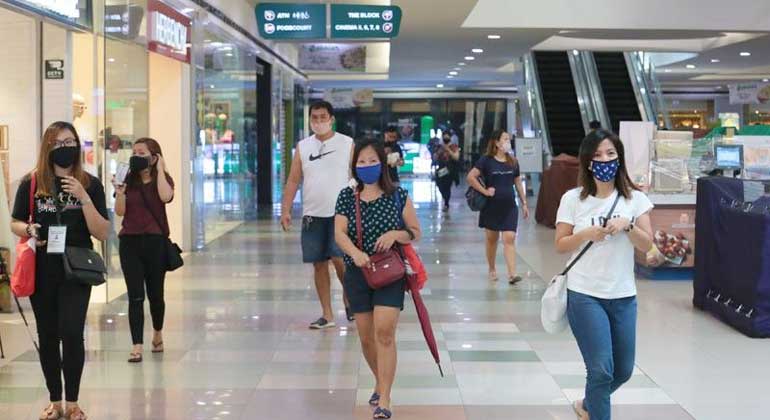
Metro Manila Development Authority (MMDA)General Manager Jose Arturo S. Garcia, Jr., in a virtual briefing on Thursday, said the 17 mayors unanimously agreed to keep the ban on minors in commercial establishments such as shopping malls and other outdoor areas.

The decision is based on the recommendation of Philippine Pediatrics Society and Pediatric Infectious Disease Society of the Philippines.

“Because of having high immune system, pediatrics experts said that minors who are infected of COVID-19 (coronavirus disease 2019) are usually asymptomatic carriers of the virus. They might be transmitting the virus unknowingly, especially to those vulnerable,” Mr. Garcia said.

He clarified, however, that essential travel such as medical and dental check-ups, and buying food and medicine are allowed for all ages in all places — with the observance of health protocols such as wearing of face mask and face shield. — Gillian M. Cortez

Telecom companies to give update on improvements on Dec. 8

TELECOMMUNICATION companies are scheduled to present the service improvements they have undertaken during the televised Palace briefing on Tuesday, Presidential Spokesperson Harry L. Roque announced.

“All of them are racing to send their explanations but we have decided that next Tuesday’s briefing will be exclusively on telcos,” Mr. Roque said during Thursday’s briefing.

Officials of regulator National Telecommunications Commission (NTC) will also be present, he said.

Earlier this year, as demand for better internet services became pressing amid the coronavirus-prompted restrictions, President Rodrigo R. Duterte ordered local governments units (LGUs) to ease the permit application process for the installation of cell towers and other infrastructure.

The Department of Interior and Local Government (DILG) reported earlier this week that 2,220 cell tower applications were already approved by LGUs while 712 are pending. — Gillian M. Cortez

MGB recommends lifting of quarrying suspension around Mayon Volcano

farmer at Mayon
PHILIPPINE STAR/KRIZ JOHN ROSALES

THE MINES and Geosciences Bureau (MGB) has recommended to lift the suspension order on 91 quarry operators around Mayon Volcano in Albay to support efforts in restoring the capacity of river channels in the area.

In a statement on Thursday, MGB Director Wilfredo G. Moncano said 91 of the 106 quarry operators were found to be compliant with permit regulations after a probe was conducted by the task force created by Environment Secretary Roy A. Cimatu.

Fifteen operators with violations will remain banned and subject to further review and possible sanctions.

Mr. Cimatu suspended quarrying activities after lahar flow during Typhoon Goni, locally named Rolly, killed residents and buried houses around the volcano.

“An increased rate of quarrying is needed to empty and restore the capacity of the river channels, so that when rain comes with eroded material from the slopes of Mayon Volcano, the restored river channel can serve as the pathway to accommodate and remobilize the eroded material,” Mr. Moncano said. — Revin Mikhael D. Ochave

Illegal drugs worth P7.5B destroyed 

OVER P7.5 billion worth of illegal drugs were destroyed by the government on Thursday, bringing the total value of drugs seized at more than P56 billion since the start of President Rodrigo R. Duterte’s term in 2016.

Mr. Duterte, in his speech during the ceremonial destruction held in Trese Martires, Cavite, said the seized drugs come from “more than 180,000 anti-illegal drug operations since the beginning of my administration.”

Earlier this year, he ordered the immediate destruction of the confiscated drugs after logging in with the courts to prevent reselling by rogue cops. 

The President also called on law enforcers to maintain vigilance in tracking illegal drug activities despite the coronavirus disease 2019 (COVID-19) outbreak.

“Let me emphasize to our law enforcement agents and operatives that, despite the extraordinary circumstances caused by the COVID-19 pandemic, these criminals do not cease in their nefarious activities. We must, therefore, remain steadfast in our campaign not only by intensifying our operations against drug trafficking, but also by reforming our criminal justice system and addressing the root cause of drug abuse and dependency,” he said.

The fight against illegal drugs was one of Mr. Duterte’s main campaign promises, but his drug war has become controversial with allegations of extra-judicial killings during police operations. — Gillian M. Cortez

Nationwide round-up (12/03/20)

Chief justice asked to leave ‘legacy’ of releasing political prisoners

Chief Justice Diosdado M. Peralta
WIKIPEDIA.ORG

SUPPORTERS and families of political prisoners have asked Chief Justice Diosdado M. Peralta, who announced early this week his plan to retire early in March, to grant the “extraordinary legal remedy” for their release to help address congestion in jails amid the coronavirus pandemic. In a letter addressed to Mr. Peralta, Fides M. Lim, spokesperson of support group Kapatid and wife of political prisoner Vicente P. Ladlad, asked the chief justice to “leave a lasting legacy” before his early retirement on March 27, 2021 by promulgating the Writ of Kalayaan. They noted that the Writ of Kalayaan proposed by Associate Justice Mario Victor F. Leonen in his opinion on the case of political prisoners is an “extraordinary legal remedy grounded on social justice and humanity to address the problems of jail congestion, subhuman prison conditions” while the coronavirus remains a threat. More than 20 political prisoners asked the court in April to allow their release on humanitarian grounds due to the pandemic. The court, however, referred their cases to the respective trial courts where they are pending, treating their petition as application for bail or recognizance. — Vann Marlo M. Villegas

Ressa faces 2nd cyber-libel case

Rappler Chief Executive Officer Maria A. Ressa is facing her second cyber-libel charge filed by businessman Wilfredo D. Keng, the same petitioner in the first case. Makati’s Office of the City Prosecutor, in a resolution dated Nov. 10, indicted Ms. Ressa of cyberlibel in connection with her social media posts on Twitter in February 2019. Ms. Ressa’s post read: “Here’s the 2002 article on the ‘private businessman’ who filed the cyber-libel case, which was thrown out by the NBI (National Bureau of Investigation) then revived by the DOJ (Department of Justice). #HoldTheLine.” Apart from the article, the post also contained images of the 2002 article of Philippine Star, which linked Mr. Keng to the death of a former Manila councilor. The article also stated that he was involved in smuggling of fake cigarettes and other illegal activities. The prosecutor’s resolution said Ms. Ressa “acted with malice” as she did not ask for the side of the complainant before publishing her twitter post and acted “with reckless disregard whether the contents of the Twitter post was false or not.” Ms. Ressa has asked the court to dismiss the second case, citing the Supreme Court’s ruling on the Cybercrime Act, which states that the law penalizes only the author of the libelous statement or article, and sharing over social media by another cannot be punished. — Vann Marlo M. Villegas

Pacquiao to lead ruling PDP-Laban in preparation for 2022 polls

RULING party Partido Demokratiko Pilipinas-Lakas ng Bayan (PDP-Laban) has named Senator Emmanuel D. Pacquiao as acting national president ahead of the 2022 national elections. Mr. Pacquiao will be replacing Senator Aquilino L. Pimentel III, who will now serve as the executive vice chairman of the party to which President Rodrigo R. Duterte belongs. “Senator Koko Pimentel has passed on the practical day-to-day leadership of the Party to one with new, ‘modern’ ideas and one who has the time, energy, and boldness to prepare the Party for the 2022 national and local elections,” PDP-Laban Executive Director Ron Munsayac said in a statement released Wednesday evening. Meanwhile, Speaker and Marinduque Rep. Lord Allan Jay Q. Velasco also took over as the new executive vice president. Mr. Munsayac said it is still too early to talk about the 2022 elections, when asked whether Mr. Pacquiao is being positioned to run as a presidential candidate. “What we can expect under a Manny Pacquiao-led PDP Laban is more activities and avenues to help our kababayans (countrymen) in the grassroots level,” he told reporters over phone message Thursday. Mr. Pimentel added that Mr. Pacquiao, a world boxing champion, will be able to discipline current members and instill principle-based politics as well as educate PDP-Laban about his advocacy on peace and economy. — Charmaine A. Tadalan

SolGen tracks hackers of its career portal

THE Office of the Solicitor General (OSG) is now tracking those who hacked its career portal on Dec. 1. In a statement Thursday, the OSG confirmed that an entity identified as Phantom Troupe uploaded several files on its online job application site. “The unauthorized access resulted in the introduction of an altered screen displaying the message ‘Stop blackmailing the NTC! Give ABS-CBN provisional authority!’,” it said. The OSG said it already improved security measures and is probing the matter as well as seeking assistance of intelligence and investigation agencies to identify those behind the incident. Hacking is a criminal offense under the Cybercrime Law, with penalties of up to 12 years of imprisonment. — Vann Marlo M. Villegas

Regional Updates (12/03/20)

Closed fishing season in effect in Zamboanga Peninsula

THE annual three-month closed fishing season in Zamboanga Peninsula is now in effect, the Bureau of Fisheries and Aquatic Resources (BFAR) announced. The temporary fishing ban from Dec. 1 to end-February covers the East Sulu Sea, Basilan Strait, and Sibuguey Bay. The closed season is in accordance with Bureau Administrative Circular (BAC) No. 255 series of 2014, which aims to conserve the population of sardines in the area. “The circular prohibits the catching of sardines using purse seine, ring net, bag net and scoop net within the conservation area covering the western municipal and national waters of Zamboanga Del Norte, the waters bordering south and eastern waters of Zamboanga City and the southern portion of Zamboanga Sibugay,” BFAR said. “Purchasing, selling, offering or exposing for sale, and possession of sardines caught during the closed fishing season is also prohibited during this time,” it added. BFAR data shows sardines accounts for 74% of all monitored landed catch from the Zamboanga Peninsula in 2019. There are at least 11 major sardine canning companies based in Zamboanga City. — Revin Mikhael D. Ochave

ADVERTISEMENT
ADVERTISEMENT