Home Blog Page 863

Devolution, not revolution

STOCK PHOTO | Image by Liravega from Freepik

Queen Elizabeth I is supposed to have remarked that she did not like wars as they have uncertain outcomes. Likewise, I do not like revolutions as they not only have uncertain outcomes but even catastrophic outcomes.

And yet so many of our country men, despairing of the numerous scandals plaguing our country, are advocating revolution and installing a revolutionary government.

They may not realize that we already had one, a revolution and a revolutionary government. Corazon C. Aquino did not become president constitutionally. The Batasan Pambansa proclaimed Ferdinand Marcos, Sr. the winner in the presidential election. The people power movement and the hastily crafted Freedom Constitution installed her as our president.

Like President Marcos before her, she exercised both executive and legislative powers. Her presidential decrees had the force of law. Her dictatorship ended when the 1987 Constitution was ratified and the 1st Congress convened.

We are fortunate that President Cory Aquino wielded and then yielded power peacefully. We may not be so fortunate the next time.

The revolutionary government of President Aquino declared two political reforms aimed at converting the Philippines into a real democracy: term limits and party list.

The term limits law puts limits to how many times an elected official can hold an elected office.

The aim was to give others a chance to serve the people. The term limits worked in the sense that others were given the opportunity to serve. Unfortunately, these others were the wives and siblings of the departing official. Thus, we had the spectacle of political revolving doors where two brothers alternate being mayor and congressman.

The party list was supposed to give representation to the marginalized sectors of society. Unfortunately, the Supreme Court ruled that a person who is not a security guard can lead a party that is supposed to represent security guards. The theory behind this decision is analogous to the relationship between a lawyer and his client. The representative, like a lawyer with his rigorous education and vast experience, could advance the interests of his clients or, in this case, his constituents far better than they ever could. The reality is we got Zaldy Co, a party-list member of Congress representing Ako Bicol.

We cite these cases to remind us that even a saintly revolutionary government motivated by the noblest of intentions can still make wrong decisions.

Finally, if despite the hope and promise ushered in by the Aquino revolutionary government, we still ended up in the present sorry state we are in now, why would another revolutionary government result in a better outcome?

Of course, some advocate less revolutionary measures such as converting our system of government from presidential to parliamentary. Those who advocate this reform dream that this will magically transform the Philippine Congress into the British Parliament. Sorry to disappoint — the Philippine Congress will transmogrify into the Pakistani Parliament. In that parliament, the honorable members continuously threaten the Prime Minister with a vote of no confidence resulting in the fall of the government unless he complies with their demands.

As to those who place their faith in technology such as Artificial Intelligence and Data Analysis to bring about better governance, we cite the bold prediction of President Bill Clinton that the internet will bring about democracy in China. Under the wrong hands the internet became an efficient tool of oppression.

By the way, the digitalization of our income tax returns has allowed our Bureau of Internal Revenue to be more efficient in its corruption. Using data analysis, they can now easily identify and target hapless taxpayers ripe for extortion.

We should heed the advice of Peter Drucker, a famous management guru who argued that managers should focus on their strength and not their weakness. We should not dwell on our failures but build on our successes. To illustrate, in business, let us say you have two companies, one unprofitable and the other profitable. Instead of devoting our resources to turning the unprofitable company around, we should instead marshal our resources on expanding the profitable company.

In governance, we should not focus on our failures — the Department of Education, the Department of Public Works and Highways, the Land Transportation Franchising and Regulatory Board, our Senators and Congressmen, etc.

We should focus on our successes, namely our local government executives, more specifically our Metro Manila mayors. Despite the limited powers granted them by our highly centralized government, they have performed admirably and, more importantly, their constituents appreciated and rewarded their performance by re-electing them by wide margins.

In the last election, Vico Sotto garnered 90% of the votes against Sarah Discaya. She, who had billions to spend, could not buy the voters of Pasig City. Filipino voters are discerning and appreciative of good performance. Seeing none in our legislators, they vote for celebrities who would at least entertain them.

We propose as an initial step devolving the powers of the failed national agencies to them.

Presently, the Metropolitan Manila Development Authority (MMDA) is merely an administrative body with no operational, regulatory, and legislative authority. We propose amending the MMDA Law (Republic Act 7924), devolving as a first step, the powers of the following government agencies in Metro Manila to MMDA:

1.) Department of Public Works and Highways (DPWH; no need for any comments)

2.) Department of Education (see our column, “Edcom II Year Two Report: Persistent misreading of the Philippine basic education situation,” BusinessWorld, March 3).

Education Secretary Angara, horrified that the DPWH is in charge of building our public schools and discovering that 1,000 classrooms turned over were not usable, called for devolving the building of public schools to local governments.

We should go further. We should devolve basic education to the MMDA. They will solve the school congestion problem in Metro Manila, which is the highest in the country. Secretary Angara estimates that it will take 30 years to solve our school congestion problem. And he is being optimistic.

3) Land Transportation Franchising and Regulatory Board (see our column, “LTFRB: cause of our traffic congestion,” BusinessWorld, Jan. 20)

Despite the growing population in Metro Manila, the LTFRB has cut by half the number of franchises that are presently in use, resulting in traffic congestion.

If this experiment in devolution succeeds, we can build on this success by replicating the model in Cebu, Davao, Iloilo, and other cities.

As possible models for a more responsive MMDA, we could look at two models, one international and the other domestic.

The international model would be the Greater London Authority. On Nov. 11, 1999, the British Parliament established the Greater London Authority. Prior to that, there was no single entity managing the entirety of London. Governance of the city was fragmented, and responsibilities for planning, transport, and other city-wide matters were divided between local boroughs and national authorities.

The Greater London Authority is a strategic regional authority, with powers over transport, policing, economic development, and fire and emergency planning. Three functional bodies —Transport for London, the Mayor’s Office for Policing and Crime, and the London Fire Commissioner — are responsible for delivery of services in these areas.

The domestic model is the Bangsamoro Autonomous Region in Muslim Mindanao (BARMM). BARMM is only region in the Philippines that has its own government. It has a Regional Governor, executive departments, and its own unicameral legislature, the Regional Legislative Assembly. The fact that BARMM is not in the news is an indication that it is doing relatively well.

Will devolution eradicate corruption?

In a previous column (“Fighting corruption the managerial way,” BusinessWorld, Jan. 20), we argued that corruption is not a sin to be cleansed but rather a management problem to be solved. One way of managing corruption is by making it local: “The manager would seek to devolve most government functions to the lowest level of government knowing that corruption on the local level is better managed.

“Corruption on the national level is more comprehensive. National Government officials can steal not only from the taxes collected but also from the loans obtained by the government through domestic borrowing, i.e., treasury bills, international borrowings, i.e., samurai bonds, and international agencies such as JICA, ADB and World Bank. In effect they are also stealing from future taxes that will be collected to pay off the loans. The capacity of the local governments to borrow is more restricted.

“Accountability on the local level is more demonstrable and so more effective. In the last election of 2022, the President who cannot run for re-election after his six years, is not held accountable by the voters while the mayors who serve three years and can be elected for three terms can be held accountable by the voters. In the Metro Manila local elections, the mayors who performed well won by landslide margins while those who performed badly lost to their challengers.

“When corruption is on national levels, citizens who despair of the situation can only emigrate to another country. Citizens who despair of corruption in their town or province can always move to another locality. By voting with their feet, they also exert pressure on their local officials to moderate their greed.”


Dr. Victor S. Limlingan is a retired professor of AIM and a fellow of the Foundation for Economic Freedom. He is presently chairman of Cristina Research Foundation, a public policy adviser and Regina Capital Development Corp., a member of the Philippine Stock Exchange.


US actress Diane Keaton, star of Annie Hall, 79

Diane Keaton in a scene from 1977’s Annie Hall.

DIANE KEATON, the quirky US actress who won an Academy Award and captured hearts with her performance as Woody Allen’s eccentric, insecure girlfriend in the 1977 romantic comedy Annie Hall, has died at the age of 79.

Rizzoli, a publishing company that released several of Ms. Keaton’s books, confirmed her death in a statement, calling her an “icon whose influence spanned film, fashion, and design.”

A representative for Ms. Keaton could not be immediately reached. Her death was first reported by People magazine.

Ms. Keaton, who appeared in more than 60 films, including The Godfather trilogy, The First Wives Club, and eight films with Mr. Allen, stood out in Hollywood with a personal style that favored androgynous looks, turtleneck sweaters, and her trademark hats.

ANNIE HALL ESTABLISHED KEATON
She earned Oscar nominations for best actress for her portrayal of US journalist Louise Bryant in the 1981 political drama Reds, as a caring aunt to Leonardo DiCaprio in the 1996 family saga Marvin’s Room, and opposite Jack Nicholson in the 2003 romantic comedy Something’s Gotta Give.

But it was Annie Hall, which Mr. Allen loosely based on his relationship with Ms. Keaton, that established her as a consummate actress and for which she won a Best Actress Oscar.

“It was an idealized version of me, let’s put it that way,” Ms. Keaton said about the film in an interview with CBS News in 2004.

Annie Hall and Ms. Keaton’s dramatic turn as a dedicated teacher by day and prowler of singles bars at night in Looking for Mr. Goodbar landed her on the cover of Time magazine in September 1977.

Rolling Stone magazine described her as “the next (Katherine) Hepburn” in its June 30th issue that year.

Forty years later, Mr. Allen paid tribute to his early muse when Ms. Keaton received the American Film Institute Life Achievement Award for her body of work.

“The minute I met her she was a great, great inspiration to me,” he said. “Much of what I’ve accomplished in my life I owe for sure to her. She’s really astonishing.”

Ms. Keaton was also a director, writer, producer, and photographer and had a passion for restoring California mansions. She detailed her life in two memoirs, Then Again in 2011, in which she revealed she had suffered from the eating disorder bulimia in her 20s, and Let’s Just Say it Wasn’t Pretty in 2014.

She was equally famous for high-profile romances with her leading men: Mr. Allen; Warren Beatty, her co-star and director in Reds; and Al Pacino, who played her boyfriend and husband in The Godfather films.

“Each man had a different decade,” she told The Telegraph in 2013. “Woody was my twenties, Warren was my thirties and Al was borderline: late thirties/early forties.”

‘LA-DEE-DA, LA-DEE-DA, LA-LA’
Ms. Keaton was born Diane Hall in Los Angeles on Jan. 5, 1946. The oldest of four children, she adopted her mother’s maiden name to avoid confusion with another actress with the same moniker.

Her father, a civil engineer, and her housekeeper mother moved the family to suburban Santa Ana when Ms. Keaton was a child.

After briefly attending college in California, Ms. Keaton moved to New York to study at the Neighborhood Playhouse. She landed a role in the original Broadway rock musical Hair in 1968. The shy actress, who spent years in therapy, refused to appear nude in the production.

But it was an audition with Mr. Allen for the stage production of Play It Again, Sam that changed her life.

“Nothing would have happened without Woody Allen. If I hadn’t been cast in that play…” Ms. Keaton said in an interview with Vanity Fair in 2011.

Ms. Keaton won a Tony nomination for the role that sparked their romance as well as a life-long friendship and a collaboration that included many of Mr. Allen’s best films such as Sleeper, Love and Death, and Manhattan.

In Annie Hall, she immortalized the phrase “la-dee-da, la-dee-da, la-la,” which was characteristic of her flighty, fluttered style.

Ms. Keaton stood by Mr. Allen years later after the filmmaker’s adopted daughter accused him of sexually assaulting her when she was a child. Mr. Allen has denied the allegations and has never been charged.

“I still love him — there are some people who stay in your life and it matters and they are in for the long haul,” she said about Mr. Allen in an interview with The Telegraph in 2013.

After seeing her in Lovers and Other Strangers and intrigued by her kooky, nervous demeanor, Francis Ford Coppola cast Ms. Keaton as Kay Adams, Mr. Pacino’s love interest in The Godfather. It was a major role for the actress in the film that won the Oscar for best picture in 1973.

As Ms. Keaton’s career progressed, she moved from ingenue roles to mature career women and mothers grappling with family issues. She credits director Nancy Meyers for her long-lasting career. They worked on four films together, including 1987’s Baby Boom, and the 1991 remake of the 1950s film Father of the Bride.

Ms. Keaton was also nominated for a lead actress Emmy in 1995 for Amelia Earhart: The Final Flight and directed several films, television episodes, and two music videos for singer Belinda Carlisle.

Despite her well-publicized romances, she never married.

“I think I was really afraid of men and also very attracted to extremely talented people that were dazzling,” she told Elle magazine in 2015. “I don’t think that makes for a good marriage with a person like me, someone who just didn’t adjust well.”

After adopting two children, Dexter and Duke, when she was in her 50s, Ms. Keaton said she found a real purpose in her life that she never had before.

“I was very heavily involved in myself forever. And this changes the whole landscape of your life. Your whole point of view in a good way,” she told CBS News. “In a nice way… I just think they are both miracles.”Reuters

ICTSI climbs on long-term Subic terminal deal

SUBIC BAY International Terminals — ICTSI.COM

RAZON-LED International Container Terminal Services, Inc. (ICTSI) shares surged last week after the company secured a 25-year renewal of its Subic New Container Terminals (NCT) 1 and 2 concessions.

Philippine Stock Exchange (PSE) data showed that ICTSI was the most actively traded stock last week, with a total of 7.06 million shares worth P3.68 billion changing hands from Oct. 6 to 10.

ICTSI closed at P526 per share, up 2.7% from the previous Friday’s P512 close, outperforming the services sector’s 0.6% growth and the Philippine Stock Exchange index’s (PSEi) 1.2% contraction.

Year to date, the stock jumped 36.3%, outperforming the 9.7% growth in its sector and reversing the PSE’s 7.5% decline.

Analysts attributed this surge to the market’s positive response to the company’s 25-year concession extension for its Subic terminals.

In a stock exchange disclosure on Oct. 6, ICTSI said its units Subic Bay International Terminals Corp. (SBITC) and ICTSI Subic, Inc. (ISI) received the extensions from the Subic Bay Metropolitan Authority (SBMA), allowing them to operate New Container Terminals 1 and 2 until 2058.

Under the extended concession, SBITC will invest over $130 million in civil infrastructure and additional equipment.

Juan Alfonso G. Teodoro, equity research analyst at Timson Securities, Inc., said that “this major, guaranteed plan for growth made investors optimistic, so they bought more shares, causing the price to easily outperform the rest of the Philippine stock market.”

He added that this news boosted investor confidence as it signaled a strong commitment to long-term growth and enhanced operational capabilities.

Jervin De Celis, equity trader at The First Resources Management and Securities Corp., said that “the 25-year extension granted by the Subic Bay Metropolitan Authority significantly reduces long-term regulatory risk for ICTSI while reinforcing its growth visibility.”

Michael Adrian O. Vergara, head of equities and global funds at Sun Life Investment Management and Trust Corp., said that New Container Terminals 1 and 2 contribute around 3% of the total twenty-foot equivalent units (TEU) capacity, and the planned increase in annual throughput from 600,000 to one million TEUs is expected to strengthen the company’s operations across Asia.

Looking ahead, Mr. Teodoro said that “investors must watch for signs of profit-taking to see if the stock can hold its new higher price levels.”

Moreover, analysts said that investors should closely monitor any updates on how the $130-million expansion will be carried out, while also tracking global trade indicators — such as oil prices — to assess whether conditions remain favorable for the company’s international port operations.

Analysts also advised investors to keep an eye on foreign exchange movements, as the company reports in US dollars.

ICTSI’s attributable net income rose 16% year on year to $244.31 million in the second quarter, bringing first-half attributable profit to $483.84 million, up 15%.

Mr. Teodoro said ICTSI’s third-quarter net profit could reach about $303.36 million, with full-year earnings around $952.73 million.

He placed support levels between P500 and P515, with short-term resistance between P536 and P540.

Mr. De Celis said ICTSI’s third-quarter net income may reach $270 million, with full-year 2025 earnings projected between $1 billion and $1.05 billion.

He pegged immediate support at P515, with stronger buying interest between P505 and P500. Meanwhile, he pegged resistance between P530 and P533, with breakout targets between P540 and P550.

Mr. Vergara said they “see volume recovery in its higher yielding ports and continued yield growth as a potential source of upside to our in-house forecasts.”

He estimated attributable net income for the next quarter between $240 million and $260 million, with full-year earnings between $960 million and $1.01 billion.

He identified support and resistance at P517 and P535, respectively. — Heather Caitlin P. Mañago

Lucena, Siquijor ports set for nearly P700M in upgrades

PHILIPPINE PORTS AUTHORITY

THE Philippine Ports Authority (PPA) said it allocated nearly P700 million to upgrade and expand ports in Lucena City and Siquijor.

The port regulator said it issued bid invitations for the P620-million expansion of Lucena Port in Quezon and the P58-million expansion of Lazi Port in Siquijor.

Interested parties can submit proposals until Nov. 4, according to the bid notice signed by Mark Jon S. Palomar, who chairs the PPA’s bids and awards committee for engineering projects. 

The contractor for the Port of Lucena will be given 720 days or 23 months to complete the project, the PPA said, adding that the winning bidder for the Lazi Port expansion project will be given 300 calendar days to finish the contract.

For this year, the PPA expects to complete at least four port projects valued at a combined P1.56 billion.

These include the P426.18-million Salomague Port expansion project in Cabugao, Ilocos Sur; the P155.96-million San Andres Port expansion and improvement project; the upgrade of Banago Port in Negros Occidental; and the expansion of Balingoan Port in Cagayan de Oro.

In 2024, the PPA said it earmarked up to P16 billion for infrastructure projects until 2028.

The funds will be allocated to enhance port efficiency and capacity, including 14 big-ticket projects targeted for completion within the period. — Ashley Erika O. Jose

Six exploration, development contracts under review for approval — Energy dep’t

BW FILE PHOTO

SIX POTENTIAL petroleum and hydrogen service contracts are currently being evaluated, with three  having reached the Office of the President (OP), the Department of Energy (DoE) said.

“There are three contracts that are being evaluated at the Office of the President. And in the department, there’s another three in the application and evaluation stage,” Energy Undersecretary Alessandro O. Sales said at a briefing.

One of the contracts with the OP is a development and production petroleum service contract — a type of agreement applied to expiring contracts where production is ongoing — and the other two involve hydrogen.

Under Presidential Decree No. 87, also known as the Oil Exploration and Development Act of 1972, any contracts resulting from public bidding must obtain the President’s approval.

The three contracts currently at DoE level involve petroleum.

“We’re continuing with the momentum of opening up the areas,” Mr. Sales said.

Last week, President Ferdinand R. Marcos, Jr. signed eight new petroleum service contracts with an investment commitment of around $207 million over the period of exploration.

The awarded service contracts are potential petroleum and hydrogen resources in the Sulu Sea, Cagayan, Cebu, Northwest Palawan, East Palawan, and Central Luzon.

Service contractors can commence their respective work programs, which include geological and geophysical studies, seismic surveys, and drilling activities, as appropriate, to assess the potential of the contracted areas.

“It’s a long process, but hopefully, when we look at all of these areas, we believe that one or two of these will proceed and… become a commercial field,” Mr. Sales said.

Noel M. Baga, co-convenor of think tank Center for Energy Research and Policy, said the awarded petroleum service contract support the Philippine goal of strengthening energy security and reducing dependency on imported energy. 

“Beyond energy security, this initiative demonstrates the government’s commitment to the petroleum sector, which will attract further investment in the industry,” he told BusinessWorld via Viber.

“Success in these exploration activities could create a multiplier effect, encouraging additional investments in infrastructure and technology while creating jobs and keeping energy revenues within our economy,” he added. — Sheldeen Joy Talavera

Yields go down on surprise cut

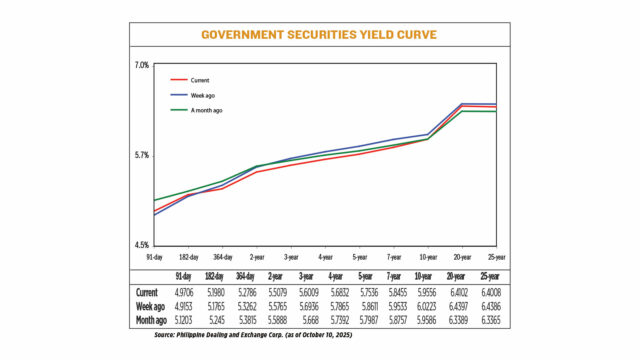
YIELDS on government securities (GS) ended mostly lower last week after the Bangko Sentral ng Pilipinas (BSP) surprised the market by delivering a fourth consecutive rate cut.

GS yields, which move opposite to prices, declined by an average of 5.32 basis points (bps) week on week, according to PHP Bloomberg Valuation Reference Rates data as of Oct. 10 published on the Philippine Dealing System’s website.

Rates at the short end were mixed as the 91- and 182-day Treasury bills (T-bill) rose by 5.53 bps and 2.15 bps week on week to end at 4.9706% and 5.198%, respectively, while the 364-day T-bill fell by 4.76 bps to yield 5.2786%.

Meanwhile, yields at the belly and the long end went down across all tenors. The two-, three-, four- five-, and seven-year Treasury bonds (T-bonds) dropped by 6.86 bps (to 5.5079%), 9.27 bps (5.6009%), 10.33 bps (5.6832%), 10.75 bps (to 5.7536%), and 10.78 bps (5.8455%), respectively.

Yields on the 10-, 20-, and 25-year bonds also declined by 6.67 bps (to 5.9556%), 2.95 bps (6.4102%), and 3.78 bps (6.4008%), respectively.

Total GS volume traded amounted to P148.2 billion on Friday, jumping from the previous week’s P24.28 billion.

Debt yields went down week on week after the BSP unexpectedly lowered benchmark borrowing costs, analysts said.

“The bond market welcomed the move as the local bond curve bull steepened, trading lower by 8-30 bps, with the belly of the curve benefitting the most,” said Dino Angelo C. Aquino, vice-president and head of fixed income at Security Bank Corp.

“The CPI (consumer price index) was higher versus the previous month but was lower than market consensus of 2%. The lower print likely was a factor in the BSP’s decision to unexpectedly cut rates to focus on growth as inflation remains below their target of 2-4%,” he added.

He said the bond auction last week was a non-event as the market’s focus was on the central bank meeting.

“Foreign flows were seen coming back to the GS market after the surprise cut. They were mostly sellers the past few weeks, and their full 180-degree turn helped fuel the market rally.”

A bond trader likewise said that “everything changed because of the rate cut.”

On Thursday, the Monetary Board cut benchmark borrowing costs by 25 bps for a fourth straight meeting, bringing the policy rate to 4.75%. Only six of the 16 analysts polled by BusinessWorld predicted the reduction.

It has now lowered rates by a total of 175 bps since it began its easing cycle in August 2024.

BSP Governor Eli M. Remolona, Jr. said their decision to cut came amid benign inflation and softening growth prospects due to weakening investor confidence due to a widening corruption scandal involving government infrastructure projects.

Inflation picked up to a six-month high of 1.7% in September from 1.5% in August, bringing the nine-month average to 1.7% — still below the central bank’s annual goal.

Mr. Remolona said another rate cut is possible at their last policy meeting for this year on Dec. 11, with more reductions beyond that also on the table.

For this week, Mr. Aquino said GS rates may continue to go down.

“With key resistance levels broken for the five- to 10-year tenors and levels touching new year-to-date lows, we expect this rally to have some legs and yields biased to move lower,” he said.

“We continue to see a downward trend as no fresh supply is expected [this] week,” the trader added.

“From our end, the BSP just confirmed our in-house call that growth might be overstated due to the recent corruption scandal. So, that will also affect the outlook as the government tries to clean up the mess.” — Matthew Miguel L. Castillo

PhilRice says drones to cut farming costs, downplays potential agriculture job losses

REUTERS

THE Philippine Rice Research Institute (PhilRice) said the use of drones in farming will cut costs, make agriculture more profitable, and help attract younger people to the profession.

Addressing queries about potential job losses due to the expanded use of drones, program leader Mark Angelo A. Abando said in an e-mail: “Our goal is to provide (farmers) with a combination of integrated digital and precision technologies — together with other best management technologies — that will support them in achieving rice yield increase and reducing the cost of production.”

The drone initiative is part of PhilRice’s Scaling, Modern, and Adaptive Rice Technologies for Better Rice-Farming Communities program.

He said agriculture suffers from low wages and stagnant careers, pointing to the need to incentivize the young to join the farming workforce.

“By integrating modern tools like drones, sensors, apps, and data-driven decision-making into farming, we’re transforming agriculture into a high-tech, innovative, and future-ready industry,” Mr. Abando said.

Mr. Abando said these measures are being undertaken “with long-term sustainability in mind,” adding that potential drone applications in farming include seeding and herbicide spraying. — Andre Christopher H. Alampay

Suzuki PHL, DES Strong Motors join Int’l Coastal Cleanup activity

More than 1,200 participants were engaged in separate activities: coastal cleanup, marine debris removal, and segregation and audit. — PHOTO FROM SUZUKI PHILIPPINES, INC.

SUZUKI PHILIPPINES, INC. (SPH), through the united efforts of its Marine, Automobile, and Motorcycle divisions, joined the International Coastal Cleanup (ICC) Drive 2025 held recently in Panglao, Bohol. In partnership with DES Strong Motors Corp., Suzuki’s authorized dealer of Suzuki Marine, Automobile, and Motorcycle products in the area, the initiative underscored Suzuki’s strong advocacy for environmental stewardship and sustainable community engagement.

This year’s ICC, spearheaded by The Bellevue Resort in Panglao, brought together more than 1,200 participants ranging from students, community groups, and local government units to other like-minded companies and organizations. “The strong presence of the youth highlighted the importance of environmental awareness and the need for collective action in safeguarding our natural resources,” said Suzuki Philippines.

Representing the company were Suzuki Philippines General Manager for After-Sales Service and Marine Division Yukio Sato and Suzuki Philippines Director and General Manager for Automobile Division Norihide Takei. They actively joined employees of DES Strong Motors during the cleanup, which was carried out through three focused efforts. The Doljo Beach Team conducted a two-kilometer shoreline sweep, the Underwater Team worked on marine debris removal, and the Segregation and Audit Team, led by Plastic Free Bohol, ensured proper waste classification.

The collective effort resulted in the recovery of 194 sacks of non-biodegradable waste weighing 954.38 kilograms, composed of plastics, glass, metal, and hazardous materials. Proper handling and disposal were facilitated with the support of the Panglao LGU.

Beyond being a cleanup, the event became a shared experience of responsibility and unity for the environment. Participants exchanged stories, took part in engaging activities, and received Suzuki merchandise as tokens of appreciation.

Massive corruption amidst ‘open government’

STOCK PHOTO | Image from Freepik

At the Open Government Partnership (OGP) Global Summit on Oct. 9, the Philippine government, represented by Budget Secretary Amenah Pangandaman, accepted an award “for its commitment to improve data availability, interoperability, and public participation in procurement” in the Asia and Pacific Region. The Philippines was also the winner in the OGP’s anti-corruption category.

This is the biggest irony, however — while the Marcos administration accepted these awards, it is also receiving massive backlash over the largest corruption scandal in Philippine history.

The OGP was launched in 2011 with the Philippines as one of eight government members of the steering committee. Nearly 15 years later, the Philippines has still failed to adequately meet two of four OGP “Core Eligibility Criteria” for membership — “Asset Disclosure” and “Access to Information.” A third eligibility criteria — “Fiscal Transparency” — has turned into a myth, too, given recent exposs on unprogrammed funds and congressional insertions used for corruption in flood control projects and perhaps other expenditure items. It has failed to inspire strong traction on the fourth eligibility criteria of “Citizen Engagement.”

On Sept. 16, 2011, before the OGP launch in New York, the Right to Know, Right Now! (R2KRN) Coalition had called out the Philippine government in a statement titled “Double Talk on FOI: Gov’t long on promises, short on political will.” In it, the R2KRN pointed out the striking irony of the Philippines committing to the OGP while refusing to pass a Freedom of Information (FOI) law. Years later in 2020, the Office of the Ombudsman put the asset records of senior public officials under lock and key. The irony and double talk on OGP linger to this day in the Philippines.

The OGP had the effect, perhaps unintended, of posing new challenges to the homegrown FOI movement. It disproportionately promoted Western-driven frameworks of open budget and open data. International support and technical assistance, at least in the Philippine case, shifted strongly toward fiscal openness and data platforms and ignored nationally grounded right-to-information advocacy and practice. It may well be the shared experience of other national FOI movements.

OGP’s stress on “open data” and “national action plans,” which are hardly vetted among broad numbers of citizens, are useful only to a limited extent. They have proffered them as the dominant frame for “openness,” or the visible and supposedly measurable proof of reform.

The downside is that the OGP has de-emphasized the hard political work of guaranteeing access to information by law and citizen practice. Supposedly strong performance on disclosure and budget scorecards has come with weak gains on legal rights and participatory practice. The outcome, therefore, has been uneven — governments claim star-performance reforms by OGP’s limited metrics, even as citizens have yet to see their real and meaningful impact, by the OGP’s “Grand Values” notably: Improving Public Services, Increasing Public Integrity, More Effectively Managing Public Resources, Creating Safer Communities; and Increasing Corporate Accountability.

Today, the Philippines ranks high in the Open Budget Survey on Oversight and Transparency, but dismally low on Public Participation. This confirms what we see on the ground: budgets may be disclosed, but governance is not truly open. Citizens still lack a fully operational legal guarantee of their right to information, and participation remains tokenistic.

From these, what emerges is a budget cycle with strong built-in safeguards, by law, but distorted and porous and systemically gamed and captured by crooks, in practice:

Preparation and authorization: congressional “insertions” and ballooning unprogrammed appropriations redirected funds away from public priorities. Even balances of government corporations like the Philippine Health Insurance Corp. or PhilHealth were swept away from their intended purposes, and likely diverted towards pork barrel allocations.

Execution: Procurement safeguards have collapsed into collusion. “In-house” contracting by Department of Public Works and Highways insiders, license-lending for royalty fees, and simulated bidding turned competition rules into farce.

Accountability: Oversight bodies have been compromised. Portions of project funds were allegedly set aside for auditors, and even a Commissioner of the Commission on Audit has been implicated in soliciting projects.

In short, every safeguard of the budget cycle has been bent by the very actors entrusted to enforce them. The checks and balances that have been touted by the OGP and the Department of Budget and Management — as the Philippines’ OGP steering committee chair — have become opportunities for plunder. This bantay-salakay dynamic, where watchmen turn raiders, has hollowed out the system.

Just as important, it is most concerning that amid this festering discourse on corruption, OGP Philippines has been silent, unable or unwilling to collectively confront the incessant public rebuke of how its member agencies from government may have had a role in the plunder.

The consequences are concrete: Ghost projects, substandard infrastructure projects, and wasted funds that directly endanger the safety and lives of citizens.

This is a danger we see for OGP as well: It might just serve governments as a convenient shield to flaunt that they are scoring quite well internationally, even while betraying true openness and accountability at home. We earnestly hope that this will not be the tragedy of OGP: Heroes elsewhere, heels in their home territory.

We share these reflections not to diminish the OGP’s value, but to exhort it to reflect once again its founding principles and promises.

Open government must begin with the people’s right to know. Open budgets and open data are valuable tools, but they cannot substitute for legally guaranteed and operational access to information and genuine citizen power in decision-making.

OGP’s value will be greatest when it deepens the power of citizens to hold institutions to account, not when it serves as an international certificate that paper and digital records exist while rights and participation remain weak.


Jenina Joy Chavez, Nepomuceno Malaluan, And Malou Mangahas are co-convenors of the Right to Know, Right Now! (R2KRN) Coalition.

Grandeur and good

THE RED CHARITY GALA 2025 featured renowned designer Rhett Eala (third from the left) with the co-founders Kaye Tinga (second from left) and Tessa Prieto (third from right), joined by Piolo Pascual (second from right), Ben Chan (rightmost), and model Jasmine Maierhofer (leftmost).

THE RED CHARITY GALA on Oct. 4 raised funds for the Assumption HS ’81 Foundation, Hope for Lupus Foundation and the Philippine Red Cross; and also for the survivors of the recent earthquake in Cebu. Jewelry, art, and vacations were auctioned off for several hundred thousands of pesos at The Manila Peninsula’s lobby, and guests were treated to a fashion show by Rhett Eala at the Rigodon Ballroom.

Rhett Eala celebrated 35 years in fashion at the show, showing off a few signatures and then a little bit of something new. Having studied in Europe and worked for a bit in New York, in the 1990s, he began a line at Rustan’s, and then started dressing celebrities, socialites, and beauty queens.

The show began with a feathered skirt, a ruffled trailing cape, and his signature tassels. There were hints of 1950s Balenciaga in a baby doll dress, followed by a white asymmetrical dress in a crumpled fabric, then ruched at the headline. This was followed by a black version — the initial palette was in black and white, inspiring visions from the Ascot scene in 1964’s My Fair Lady.

We saw a rather shapeless pinstripe jumpsuit on a man, a lovely pleated white dress with a pink sash, and a dress with a balloon-hem bodice paired with a wide skirt. There was definitely a touch of vintage here: think gold vines on a black drop-waist robe de style.

We could see his signatures — several of his gowns at the show featured his trademark fringe and tassels, showing verve and life with every movement. It’s remarkable — in a lot of Mr. Eala’s clothes, there’s life even in the drabbest grays (evident in a silk moire gown accented by a lime green sash). Mr. Eala also played a bit with yin and yang, seen in black and white mirrors of the same dresses, and as seen in cage dresses (an innovation for him).

We saw a lot of attention to detail, evident in all-over pleats and jackets shaped to look like roses.

The show moved on to brighter colors later, evident in a shiny peacock-colored tiered fringed flapper gown, as well as three strapless dresses accompanied by hooded cloaks, in the gradient colors of the sunrise. We particularly liked a red tiered fringe dress, accessorized with a red fan in the shape of lips.

There was a bit of commotion on the runway when actor Piolo Pascual walked out in a blue velvet jacket. Titas screamed, and even former Miss Universe and patroness of the arts Margie Moran had to crack a smile.

The show ended with a model in a gown almost like a qipao, with the mandarin collar and a slit down the bust, in red silk moire accessorized by puffed lilac gauntlets and a magenta hat. Mr. Eala came out on the runway to a trance-y remix of the Eraserheads’ “Alapaap.”

In an interview backstage, he said of his designs that night, “It’s about my past life, and my life now. My old silhouettes, which I was known for, and then I introduced new silhouettes.” — JL Garcia

SEC clears Megawide’s P2.97-B preferred shares offering

MEGAWIDE.COM.PH

THE Securities and Exchange Commission (SEC) has approved Megawide Construction Corp.’s follow-on offering of up to 20 million preferred shares.

In a meeting on Oct. 9, the Commission En Banc rendered effective the company’s registration statement, with an oversubscription option of up to 10 million additional shares, subject to Megawide’s compliance with certain remaining requirements, the SEC said in a statement on Friday.

The preferred shares are cumulative, non-voting, non-participating, non-convertible, redeemable, and perpetual, and will be offered at up to P100 apiece.

If fully subscribed, the offering is expected to generate net proceeds of up to P2.97 billion, which Megawide intends to use for debt refinancing, partially financing projects in the pipeline, and general corporate purposes.

The offer period is scheduled from Oct. 30 to Nov. 10, with listing on the Philippine Stock Exchange’s main board targeted for Nov. 19, according to the latest timetable submitted to the SEC.

PNB Capital and Investment Corp., RCBC Capital Corp., and Security Bank Capital Investment Corp. will serve as joint issue managers, joint lead underwriters, and joint bookrunners for the offering.

At the local bourse on Friday, Megawide’s shares rose by four centavos, or 1.33%, closing at P3.05 apiece. — Alexandria Grace C. Magno

Brazil green coffee exports fall 18% in September

REUTERS

SAO PAULO — Brazilian green coffee exports fell some 18% in September compared to the same month a year earlier, totaling 3.45 million 60-kg bags, exporters’ group Cecafe said, as the impact of US tariffs reduced shipments.

Brazil, the world’s top coffee producer and exporter, shipped 2.97 million bags of arabica beans abroad last month, down around 10% year on year, while exports of the robusta variety tumbled some 47% to near 489,700 bags.

Cecafe head Marcio Ferreira said in a statement a decline was already expected given the rough yearly comparison, as Brazil exported a record coffee volume in 2024.

“The decline was exacerbated by the 50% tariff imposed by US President Donald Trump on Brazilian coffee,” Mr. Ferreira added, noting the US was traditionally the main importer of Brazilian coffee.

The US however, which had already lost the lead to Germany in August, when the 50% tariffs imposed by Mr. Trump on the imports of most Brazilian goods took effect, was also outpaced by Italy in September, Cecafe said.

Brazil’s coffee exports to the US fell almost 53% from a year earlier in September, to around 333,000 bags, according to Cecafe data, including green and industrialized coffee.

Despite that, in the year through September, the US still holds the position as the main buyer of the Brazilian coffee. — Reuters