


Duterte signs EO lowering tariffs on pork imports for one year

Philippine President Rodrigo R. Duterte on Wednesday signed an executive order (EO) temporarily lowering tariffs on imported pork meat for one year, in order to address the current supply shortage due to the African swine fever (ASF) outbreak.
“There is an urgent need to temporarily reduce the Most Favored Nation tariff rates on fresh, chilled or frozen meat of swine to address the existing pork supply shortage, stabilize prices of pork meat, and minimize inflation rates,” Mr. Duterte said in EO No. 128, which was signed on April 7.
This, after the President asked Congress last month to increase the minimum access volume (MAV) for pork imports this year by 350,000 metric tons (MT) on top of the 54,210 MT under the current limit.
The EO temporarily lowered the import duties on fresh, chilled or frozen pork to 5% from 30% under the MAV quota for three months after order takes effect. The rate will be increased to 10% for the succeeding nine months.
The tariff rate for imported meat outside the existing quota, on the other hand, is reduced to 15% from 40% for the first three months. It will then be raised to 20% for the next nine months.
The order will take effect for one year as soon as it is published in the Official Gazette or a newspaper.
The prices of pure pork rose to 20.9% in March, according to the statistics authority.
Pork prices in the country’s capital region averaged P329 per kilo in March from P323 per kilo a month earlier, it said.
The 60-day price ceiling on selected pork and chicken products in Metro Manila is set to end on April 8.
Price ceiling on pork to be lifted

By Revin Mikhael D. Ochave, Reporter
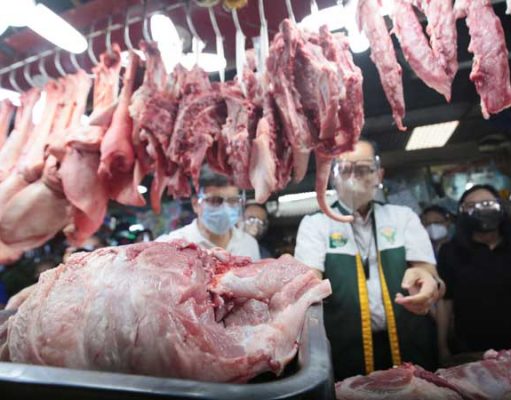
PRICE CAPS for selected pork and chicken products will not be extended, the Agriculture department said.
“April 8 will be the last day for the existing price cap and there will be no extension,” Agriculture Secretary William D. Dar said at a virtual briefing on Wednesday, referring to the 60-day price ceiling mandated by Executive Order (EO) No. 124.
Instead, Mr. Dar said the Department of Agriculture (DA) will implement suggested retail prices (SRP) for imported pork products as part of the ongoing effort to augment supply and stabilize market prices. There will be no new issued SRP for local pork products.
Starting April 9, the SRP for imported pork shoulder (kasim) will be set at P270 per kilogram, while imported pork belly (liempo) will be at P350 per kilogram, he said.
“The DA and the Department of Trade and Industry (DTI) will implement the SRP for imported pork and have agreed on the compliance for existing guidelines on hygienic handling of imported pork as prescribed by government guidelines such as proper packaging and labeling, and creation of a compliance monitoring team,” Mr. Dar said.
“We will also bring the help of the Department of the Interior and Local Government (DILG), the Philippine National Police (PNP), and other stakeholders,” he added.
Under EO 124, the price of pork kasim was capped at P270 per kilogram, pork liempo at P300 per kilogram, and whole chicken at P160 per kilogram.
Together with the new SRP for imported pork, the DA will require importers to package pork kasim and pork liempo into saleable packages of 500 grams and one kilogram.
Meanwhile, Mr. Dar encouraged local hog raisers to deliver surplus hogs from areas free from African Swine Fever (ASF) to Metro Manila, adding that transport assistance will still be given even beyond Thursday.
“This will be pursued until the higher minimum access volume (MAV) allocation for pork and lower pork tariffs are approved,” Mr. Dar said.
Mr. Dar said the imported pork will be distributed in groceries, supermarkets, and retailers in Metro Manila that have freezers and chillers.
He added that the DA and Metro Manila local government units will provide a grant for retailers that do not have the necessary equipment to store imported frozen pork.
Mr. Dar said the main issue remains the lack of local pork supply, which can only be addressed by the increase in MAV quota allocation, lower pork tariffs, and delivery of hogs from provinces with surplus supply.
On March 26, President Rodrigo R. Duterte sent a letter to Congress that endorsed to increase the MAV allocation by 350,000 metric tons (MT) in order to augment the DA’s projected supply deficit of 400,000 MT for the year due to ASF. Both the Senate and the House of Representatives are in recess and will resume session on May 17.
The allocation for MAV pork imports is currently at 54,000 MT.
Mr. Dar said that if there is no action taken by the two chambers of Congress, the next step would be for Mr. Duterte to issue an executive order to increase MAV allocation.
MAV is applicable to farm commodities that can be imported at lower tariffs under the World Trade Organization (WTO) system.
Currently, pork imports within MAV quota are charged with 30% tariff while those outside the quota pay 40%.
To recall, the DA also has a pending proposal to lower pork tariffs for in-quota imports at 5%-10%, and out-quota imports to 15%-20%.
Sought for industry comment, Meat Importers and Traders Association (MITA) President Jesus C. Cham said in a mobile phone message that it is not good for the DA to set an SRP for imported pork products.
“Capping imported pork price only makes local pork less competitive and consumers will go to imported pork. Without a reduction in tariff, imported pork supply will not be able to affect the market meaningfully,” Mr. Cham said.
Rosendo O. So, Samahang Industriya ng Agrikultura (SINAG) chairman, said in a mobile phone message that the DA’s decision to set an SRP for imported pork products poses food safety risk and public health concerns for consumers amid the coronavirus disease 2019 (COVID-19) pandemic.
“This action will not make pork more affordable for our countrymen, and it further cripples a hog industry that is already suffering from the DA’s mismanagement of the ASF outbreak,” Mr. So said.
“The pork shortfall can be imported at the current tariff level and MAV allocation without any additional burden to importers, as the current tariff rates already provide profits of P200 to P250 per kilogram for importers,” he added.
PEZA warns of investor exodus after key CREATE provision vetoed

REGISTERED INVESTORS’ inability to apply for new incentives could lead to their departure from the country, the Philippine Economic Zone Authority (PEZA) said on Wednesday.
While it welcomed the signing of Republic Act No. 11534 or the Corporate Recovery and Tax Incentives for Enterprises (CREATE) Act, PEZA noted one of the items vetoed by President Rodrigo R.Duterte may have a “big effect” on the existing foreign direct investors in the country.
The vetoed provision under CREATE would have allowed existing registered businesses to apply for extended incentives for the same activity, which Mr. Duterte called “fiscally irresponsible” and unfair to taxpayers and enterprises with no incentives.
Noting that only new activities should get fresh incentives, Mr. Duterte vetoed the section that would provide a 10-year extension, on top of the additional 14 to 17 years enjoyed by companies, even if they engage in the same activity. Exporters and domestic enterprises identified by the National Economic and Development Authority would be able to enjoy income tax holidays for 4-7 years, then special corporate income tax for 10 years for a 14- to 17-year total.
In a statement, PEZA said that the registered businesses would have “no choice but to make do” with the 10-year sunset period after their income tax holiday lapses, and then graduate to the regular 25% corporate income tax rate.
“This scenario could be a make or break for the Philippines as the affected ecozone locators, for example, might decide to retain their facilities and invest in new projects to be entitled to a longer ITH (income tax holiday) and SCIT (special corporate income tax) period,” PEZA Deputy Director General for Policy and Planning Tereso Panga said.
“Or worse, they might just pack up and transfer to a more willing host country that can offer better incentives for their investments as their availment of more advantageous incentives for sunk projects with the IPAs (investment promotion agencies) prior to CREATE were cut short by the mandatory sunset period for RBEs (registered business enterprises).”
But PEZA Director General Charito B. Plaza said that the agency recognizes a need to gradually reform the national tax system.
“Although CREATE may offer ‘win some, lose some’ opportunities for the different industries, we are glad that CREATE sustained our argument and has placed a high premium on export-oriented enterprises with their availment of superior fiscal incentives particularly for new projects,” she said.
“We believe that effective governance will be pivotal in our resolve to retain, expand and attract investments into the ecozones under the CREATE regime and in due time, our existing locators will be able to adjust to CREATE and continue to secure their investments in the Philippines.”
The Department of Trade and Industry had supported the signing of the law, which Trade Secretary Ramon M. Lopez said “modernized and improved the investment incentive regime to one that is performance-based, focused and innovation-oriented.”
FIRB MEETING
Meanwhile, Finance Secretary Carlos G. Dominguez III wants the Fiscal Incentives Review Board (FIRB) to have its first meeting as early as next week to discuss its expanded role under CREATE. Mr. Dominguez co-chairs the FIRB along with Mr. Lopez.
Since CREATE will only take effect on Monday (April 12), the meeting could be held as early as next week, according to Finance Assistant Secretary Juvy C. Danofrata
CREATE expanded the power of FIRB as the oversight committee in granting tax incentives to government-owned and -controlled corporations (GOCCs) and those approved by investment promotion agencies.
The FIRB is tasked to set the target performance metrics that businesses have to reach to avail of tax incentives and make sure these are being met, as well as monitor and assess the economic impact of investments that are enjoying perks.
For projects with capital of less than P1 billion, FIRB delegated the power to grant tax incentives to investment promotion agencies but the oversight committee still has the power to raise the threshold of minimum capital requirement.
CREATE’s implementing rules and regulations (IRR) is currently being finalized by the Department of Finance and National Tax Research Center (NTRC). — Jenina P. Ibañez and Beatrice M. Laforga
Most billionaires got richer amid pandemic — Forbes

MANY BILLIONAIRES around the world, including the Philippines, became richer even as many economies suffered due to the coronavirus pandemic, according to Forbes.
Forbes on Wednesday released its annual world’s billionaires list which had a record 2,755 billionaires, with 493 newcomers. Their combined wealth stood at $13.1 trillion, more than 60% higher than the $8 trillion a year ago.
“It was also the first time that the combined net worth of the world’s billions crossed into double-digit trillions. The pace at which huge fortunes have been created is astonishing,” Kerry A. Dolan, Forbes assistant managing editor-wealth, said in a statement.
Forbes, which takes a snapshot of the billionaires’ wealth using stock prices and exchange rates from March 5, 2021, said 86% of those on the list are richer than last year.
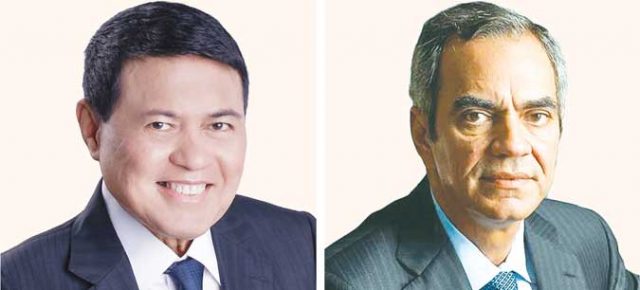
The Forbes list includes 17 billionaires from the Philippines, led by property tycoon and former Senate president Manuel B. Villar, Jr.
Mr. Villar, the Philippines’ richest man, ranked 352nd on this year’s Forbes list. Forbes pegged his net worth at $7.2 billion, 29% up from $5.6 billion in April 2020. He is the chairman of listed companies Vista Land and Lifescapes, Vistamalls, Inc., and Golden MV Holdings.
Enrique K. Razon, Jr., chairman of port operator International Container Terminal Services, Inc. (ICTSI), ranked 561st on the Forbes list with a net worth of $5 billion, 47% higher than the $3.4 billion net worth a year ago.
LT Group, Inc. Chairman and founder Lucio C. Tan is in 925th place on the Forbes list with a net worth of $3.3 billion, nearly double from last year’s $1.7 billion. LT Group is involved in banking, airline, property development, and tobacco.
SM Prime Holdings, Inc. directors Hans T. Sy and Herbert T. Sy are both in 1,008th place, with a net worth of $3 billion each, up from $2 billion in 2020. The Sys are the children of SM Group founder Henry Sy, Sr., who passed away in 2019.
Alliance Global Group, Inc. Chairman Andrew L. Tan is also in 1,008th place with $3 billion, higher than the $1.9 billion seen in 2020.
SM Investments Corp. (SMIC) Executive Director Harley T. Sy, SMIC Vice-Chairman and SM Prime Chairman Henry T. Sy, Jr and BDO Unibank, Inc. Chairperson Teresita T. Sy-Coson are ranked 1,174th — each with a net worth of $2.7 billion. In the 2020 list, the Sy brothers’ net worth stood at $1.9 billion, while Ms. Sy-Coson had a net worth of $1.8 billion.
SMIC adviser Elizabeth Sy shared 1,299th spot with Jollibee Foods Corp. founder Tony Tan Caktiong and family — with a net worth of $2.4 billion each. Mr. Tan Caktiong’s net worth stood at $1.7 billion in last year’s list.
Ramon S. Ang, president, chief operating officer, and vice-chairman at diversified conglomerate San Miguel Corp. (SMC), was at 1,444th place on the Forbes list with $2.2 billion, rising 57% from last year’s $1.4 billion.
Meanwhile, the net worth of SMC Director Iñigo Zobel (2,141st place with $1.4 billion) and JG Summit President and Chief Executive Officer (CEO) Lance Y. Gokongwei (2,378th place with $1.2 billion) were unchanged from last year’s list.
Alphaland Corp. Chairman Roberto V. Ongpin was in 2,378th place with a net worth of $1.2 billion, 30% lower than last year’s $1.7 billion.
Two billionaires returned to the Forbes list this year — Century Pacific Food, Inc. Chairman Emeritus Ricardo S. Po, Sr. and family and DoubleDragon Properties Corp. Chairman and CEO Edgar J. Sia II. They were in the 2,524th spot with $1.1 billion net worth each.
Amazon founder Jeff Bezos topped the world’s billionaires list for the fourth consecutive year with $177 billion, followed by Tesla CEO Elon Musk with $151 billion.
The rest of the top five includes LVMH Moët Hennessy – Louis Vuitton Chairman and CEO Bernard Arnault ($150 billion), Microsoft co-founder Bill Gates ($124 billion) and Facebook CEO Mark Zuckerberg ($97 billion).
The Asia-Pacific region has the most billionaires with 1,149, followed by the United States with 724 and Europe with 628. — K.C.G.Valmonte
Is that a good egg? How chocolate makers rate on social and environmental measures

EASTER is the biggest chocolate-buying time of the year. But who’s really paying for the cost of that chocolate?
The second annual report on the social and environmental performance of the world’s major chocolate makers show human exploitation and environmental degradation continue to be key ingredients in many chocolate products.
It is a collaboration between five advocacy groups — Be Slavery Free, German-based social justice organization INKOTA, and US environmental outfits Green America, Mighty Earth, and the National Wildlife Federation. (The Macquarie Business School has been working with Be Slavery Free on research into issues of modern slavery).
The report sorts 31 major chocolate makers into four bands — industry leaders, those showing improvement, those needing to do more, and the industry laggards — based on their written responses to questions about their polices in six key areas covering social, environmental, and governance practices.
Just four of the 31 received the highest “good egg” rating: US-based Alter Eco, Switzerland’s Chocolats Halba/Sunray, Netherlands-based Tony’s Chocolonely, and New Zealand’s Whittakers. These are all relatively small chocolate makers.
Thirteen makers ranked in the second category, includes most of the world’s 10 biggest confectionery companies — Mars Wrigley (US), Ferraro Group (Luxembourg/Italy), Mondelēz International (US, owner of the Cadbury, Toblerone and Milka brands), Hershey (US), Nestlé (Switzerland) and Lindt & Sprüngli (Switzerland).
Seven companies were in the third rank. Three were in the fourth — Meiji, Itochu, and Morinaga (all Japan-based).
Four companies failed to respond to the survey: Valrhona (France); Starbucks (US, a major seller of hot chocolate products); Unilever (UK); and August Storck (Germany, maker of Werther’s, Toffifay, and Merci chocolate brands).
The full list of rankings can be found here: Easter+Scorecard+2021.pdf (squarespace.com)
The principal ingredient for making chocolate is cocoa, the powder made from grinding the seeds of the cacao plant. About 70% of cacao is farmed in West Africa, with Côte d’Ivoire and Ghana being the big two producers.
Most cacao farmers make less than $1 a day (and women even less), well below the global poverty line of $1.90. An estimated 1.6 million children work in cocoa production in Côte d’Ivoire and Ghana alone.
Clearing land to farm cacao is estimated to be responsible for about one-third of the land cleared in Côte d’Ivoire and Ghana over the past 60 years. These countries have now lost more than 80% of rainforest cover. Such deforestation contributes to climate change.
The good news is that most companies and four producer governments (Côte d’Ivoire, Ghana, Colombia, and Cameroon) have committed to ending cocoa-driven deforestation through the Cocoa and Forest Initiative.
Some action is taking place through agroforestry, which involves farming a variety of crops while retaining natural vegetation. This has been shown to reduce the need for pesticides, increase carbon sequestration, and improve biodiversity. It is also better for farmers’ food and income security, as they can grow diverse crops rather than relying on just one.
Essential to addressing these social and environmental problems is achieving transparency in supply chains. If a company does not trace and track where products have come from, it cannot know if they have been produced through human exploitation or environmental destruction.
The report rates chocolate makers on two measures related to this — due diligence traceability and transparency. These are crucial as the foundation for all other reforms.
They are also key to Australia’s modern slavery act, which requires businesses with an annual turnover of A$100 million to publish a “modern slavery statement” reporting on the risks of modern slavery in their operations and supply chains, and on the actions they have taken to address these.
But such transparency alone will not be enough if consumers don’t act on that information, and put pressure on chocolate companies through their purchasing decisions.
So go with the good eggs, and avoid the bad.
John Dumay is a Professor in the Department of Accounting and Corporate Governance, Macquarie University. James Guthrie is a Distinguished Professor of Accounting, Macquarie University.
Pilipinas Shell eyes P20-B budget for next 5 years

New business model calls for more ‘mobility’ sites, import terminals
By Angelica Y. Yang, Reporter
PILIPINAS Shell Petroleum Corp. is looking at investing up to P20 billion in the next five years to fund, among others, the construction of oil import terminals and more “mobility sites” as the listed company shifts to a new business model.
“P15 to P20 [billion] over the five-year period… In terms of investment, we are hoping that we will be able to continue with our investment profile of anywhere between P3 to P4 billion per year for the next five years,” Pilipinas Shell President and Chief Executive Officer Cesar G. Romero said in a media briefing on Wednesday.
He said the company plans to infuse funds in creating new mobility businesses, which are considered to be “very profitable.”
Pilipinas Shell said in a press release issued on Wednesday that it is shifting its retail business model from gas stations to mobility sites, which have more customer-centric offerings.
“Alliances with international and local brands, coupled with full vehicle servicing such as car wash and oil change lounges, will turn each mobility station into a one-stop community hub,” the company said.
The mobility sites, which will not only cater to cars and vehicles, aim to offer e-mobility to cyclists and pedestrian customers.
Mr. Romero was quoted as saying that the firm plans to open up 60 to 80 new mobility sites per year to reach its target of 1,500 sites by 2025.
In the media briefing, Mr. Romero said that “around 60% of the planned investment” will typically go to its new mobility sites.
According to Reynaldo P. Abilo, Pilipinas Shell’s director, treasurer, vice-president for finance and chief risk officer, said that the P20-billion investment over the next five years will also cover the construction of new import terminals.
“We will be funding [the investment] through our own cash-generated funds from our operations,” Mr. Abilo said during the media briefing. He added that the firm recently disclosed that it had around P60 billion in borrowing capacity or untapped credit lines.
Pilipinas Shell has three import terminals — in Subic, Batangas and Mindanao — and hopes to add two more in five years’ time, Mr. Romero said.
The oil company, the country’s second-largest in terms of market share, earlier reported a P16-billion net loss last year due to one-off charges that came with the transformation of its Batangas refinery as well as the global decline in crude oil prices.
Mr. Romero previously said that turning the refinery into an import facility was a “difficult but crucial decision given the negative outlook for the refining sector, which was worsened by the global health emergency.”
Shares of Pilipinas Shell in the local bourse improved 0.99% or 20 centavos to close at P20.50 each on Wednesday.
Filipino Food Month goes virtual



IF THERE is one thing every Filipino loves its food, and they will celebrate the fact even when a pandemic ranges. So Filipino Food Month (officially celebrated over the entire month of April thanks to 2018’s Presidential Proclamation No. 469) will still go on — online, that is.
The month-long annual event — which is spearheaded by the Department of Agriculture, National Commission for Culture and the Arts, and the Philippine Culinary Heritage Movement — will be celebrated virtually this year via Philippines on a Plate, a series of online talks. They will be held every Tuesday and Thursday, 5 p.m., on the Facebook page of the Filipino Food Month (facebook.com/FilipinoFoodMonthOfficial). Some of the talks will be held on the Facebook page of the Department of Agriculture (facebook.com/dacentralphilippines/).
The webinars, which have the theme “Iba’t Ibang Luto, Pinoy ang Puso,” range from Meat Processing (Focusing on Alternative Protein Sources) to Beyond Buko, Exploring Coconut Products That Have Become Invaluable in Flavoring Philippine Cuisine; Produkto Mula sa Rehiyon Uno: Tupig at Puto, Panalo! to Lutong Manyaman: Burong Kapampangan; from Preserve the Bounty of Your Garden to Moringa, Queen of Philippine Vegetables. Many talks focus on singular dishes — Bibingkang Lalaki, Pinakbet, Pancit, and Binaki, among several others.
Other have a wider scope, like The Quest to Promote Filipino Food in the World, Understanding the Food: Muslim Mindanao and Its Power to Connect, Appetite for Freedom, and Kakaw Bean to Chocolatier Bar.
For the complete schedule, visit the Filipino Food Month Facebook page. — JLG
First Gen unit aims to complete two geothermal projects by next year

FIRST GEN Corp. said on Wednesday that its subsidiary Energy Development Corp. (EDC) plans to complete two of its geothermal projects by 2022, as the parent firm expressed its intention to expand into businesses that complement its power generation operations.
In its annual report, First Gen said that EDC is expecting to begin the construction of its 3.6-megawatt (MW) Mindanao 3 binary plant by the first quarter this year, and complete the project by the first half of 2022.
It added that it plans to complete its 28.9-MW ORC (organic rankine cycle) binary plant within the Bac-Man geothermal facility by the second half of 2022. The Palayan Bayan-based binary plant will produce power using residual brine from the existing steam field of the Bac-Man facilities.
In its regulatory filing, First Gen also said that it is in the process of developing a pumped-storage facility that will increase the capacity of the existing 132-MW Pantabangan-Masiway hydro plant in Nueva Ecija by 100 MW.
“The facility is expected to store and generate electricity by moving water between the Pantabangan reservoir and the Masiway reservoir, which are situated at different elevations,” the firm said.
It added that the project is meant to allow full-year operations “independent of the irrigation demands from the National Irrigation Administration.”
First Gen, which has a license to develop at least four hydroelectric projects, said that it was strengthening its expertise so it can begin the construction of its 32-MW Bubunawan run-of-river hydro power project in Mindanao, subject to the local market and regulations.
It also said it “expects to play a major role in the development of downstream natural gas transmission and distribution facilities, and other projects using renewable sources of energy.”
The company added that it is continuing to explore and assess growth prospects in Indonesia, Chile, Peru, and other countries in the Asia-Pacific and Latin American regions.
Last month, the Lopez group’s power generation arm said that its attributable net income to equity holders declined by 7% to P13.7 billion last year, citing a drop in electricity sales and lower earnings from its natural gas portfolio.
As of end-2019, the firm recorded a total installed capacity of 3,492 MW from its natural gas, geothermal, hydro, wind, and solar portfolios.
Shares of First Gen in the local bourse improved 2.65% or 80 centavos to close at P30.95 apiece on Wednesday. — Angelica Y. Yang
Hotel industry group wants bigger role for local gov’t in health management

A HOTEL INDUSTRY professionals group is advocating for improved local government health management as bigger hotels run larger overhead with limited operations during the lockdown.
Christine Ann Ibarreta, president of the Hotel Sales and Marketing Association, in phone interviews said that smaller hotels, including some of those run as quarantine facilities for Filipinos returning from abroad, have been able to “survive.”
But bigger hotels have larger expenses, including electricity costs, while occupancy pre-strict lockdown was at around 8%. Staycation hotels are not allowed to operate during the enhanced community quarantine (ECQ) imposed on Metro Manila and nearby provinces until April 11.
Tourism was one of the hardest hit industries during the lockdown as revenues last year dropped 83% to P81.4 billion after pandemic-related restrictions prompted a significant decline in foreign visitors, the Department of Tourism said.
Ms. Ibarreta said that immunization against COVID-19 should be sped up, and that local governments should improve public health management.
“Start from the local government units in taking care of the citizens in the area (close to hotels),” she said.
When more people have been vaccinated and the public health situation has been managed, she said that the government should consider allowing more airport arrivals and letting quarantine hotels operate their event venues.
“Siguro ‘yung arrivals sa airport baka pag-isipan na rin na i-increase ng — kasi ngayon 1,500 — at least dagdagan ng 1,000 para maging 2,500 and eventually tumaas.”
(Maybe airport arrivals should be looked into and possibly increased —from the current 1,500 — by at least 1,000 to reach 2,500 and eventually higher.)
The association in February asked the government to loosen its restrictions on events like weddings, noting that hosting such events would help make up for the weak rates the industry was charging.
Makati Shangri-La hotel in January announced that it was temporarily closing down operations as it yielded to financial pressures caused by the lockdown. — Jenina P. Ibañez