Home Blog Page 828

English winemakers counting on exports as warm weather improves growing conditions

JEFF SIEPMAN-UNSPLASH

WEST CHILTINGTON, England/OSLO — English winemakers are betting that surging exports can sustain their once novelty product after domestic sales growth slowed, hoping for a boost from Britain’s warmest summer on record this year as climate change optimized conditions.

Days before pickers started to harvest this year’s crop, sparkling wine from southern England beat french champagne to win one of the industry’s most prestigious awards, lifting its prospects in markets like Norway, Japan and China.

Foreign sales have become more important as a subdued economy at home weighs on demand for a premium product. International producers are snapping up the country’s increasingly attractive land to produce wine to sell home and abroad.

“Export is where the real growth is in the coming period,” said Brad Greatrix, senior winemaker at Nyetimber, the English company which became the first non-French winner of the International Wine Challenge sparkling wine award in September.

English wineries started to emerge in the 1990s as adventurous landowners took advantage of warmer summers. Now, on chalky slopes across southern England, vines are being planted on land once used for crops, apple orchards and golf courses.

Since 2000, English wine production has risen by an average 7% per year, and is set to keep growing after land dedicated to vines jumped by 30% between 2020 and 2024.

However, while British demand has driven growth so far, last year sparkling wine sales — which at 6.2-million bottles accounted for 70% of total wine sales — were flat, down from 11% growth the previous year. In September, Chapel Down, Britain’s biggest wine producer, cancelled plans to build a new winery.

Nicola Bates, chief executive officer of industry body WineGB, said steady sales were an achievement when restaurants and bars were struggling, and when champagne shipments to Britain fell 13% last year.

For many consumers English fizz is a luxury product, with the biggest brands Chapel Down and Nyetimber costing 30 pounds ($40) and 42 pounds respectively per bottle, similar to Champagnes.

With more vines being planted, Mr. Bates said, “we need to be growing sales at a faster pace for mid- to long-term health.”

Though some winemakers will not sell this year’s prized vintage for several years, exports are a bright spot they hope to build on. Export volumes grew 35% to account for 9% of total sales of English wine in 2024, and Bates said she was targeting doubling that figure by 2030.

Norway tops the list of buyers by volume. Its imports of English sparkling wine jumped to 111,639 liters last year from 451 liters in 2015, according to its wine monopoly, the single state body allowed to import wine and spirits.

That growth is far ahead of rises from other countries, said Arnt Egil Nordlien, the monopoly’s head of product.

Aleksander Iversen, a sommelier at Brasserie Coucou in Oslo, says Norwegians are open-minded and curious about wine. Some customers specifically request English wines while others discover it on recommendation.

“Most are surprised by the quality, they often remark that it rivals top Champagne, but with its own unique character,” he said.

This year, English vineyards have experienced “almost perfect growing season conditions,” said Alistair Nesbitt, chief executive at Vinescapes, a viticulture consultancy.

The average temperature in southern England during the spring to autumn grape growing season has increased by 1 to 1.5 degrees Celsius over the last 40 to 50 years, he said, but it’s not always straightforward.

Climate change means more unpredictable weather events and that is also affecting England. Persistent wet weather in 2024, for example, hit the grape harvest, cutting production by half compared to the previous year.

While climate change means more variability for wine producers globally, Mr. Nesbitt said cooler climates like England have the advantage over areas in southern Europe, which are being hit by more frequent droughts and heatwaves.

Wine producers from the US, France and Australia started buying English land around a decade ago, with french champagne house Taittinger acquiring a site in 2015 and California’s Jackson Family Wines establishing a presence in 2023.

“If you’re in a real climate-stressed area of the world, and you want to keep your wine production enterprise going, you look to cooler areas like the UK,” he said. — Reuters
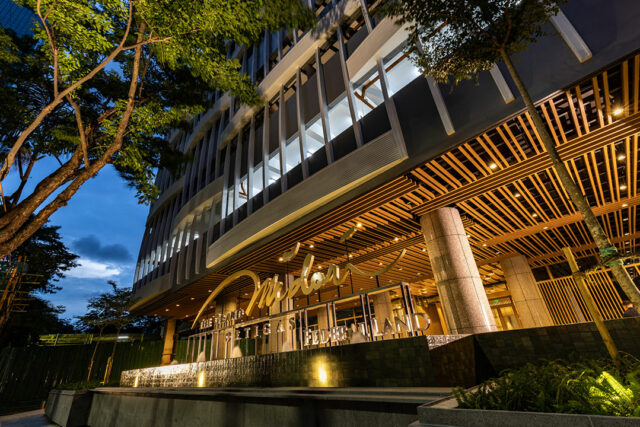

Federal Land eyes multiple residential launches next year

The Grand Midori Ortigas — FEDERALLAND.PH

FOLLOWING the inauguration of Grand Midori Ortigas Tower 1, Federal Land, Inc. (FLI) said the company plans several new residential projects in 2026, including a 21-hectare horizontal development in Biñan, Laguna, expanding its existing Meadowcrest community.

“This year, we’re done with project launches. But next year, we plan to launch the Biñan horizontal development, a sequel to Meadowcrest,” FLI President Jose Mari H. Banzon said on the sidelines of the Tower 1 opening on Friday last week.

Grand Midori Ortigas Tower 1, located in the heart of the Ortigas Central Business District along Exchange Road, stands 45 stories high with 482 units, over 80% of which are already sold.

The Japanese-themed development was designed with Tokyo-based Tange Associates and offers studio units (35.5-38 square meters [sq.m.]), one-bedroom (46-64 sq.m.), two-bedroom (70-107 sq.m.), and three-bedroom units (105-109 sq.m.).

Tower 2, still in pre-selling, is expected to be completed by late 2026 or early 2027, with additional amenities planned.

“Tower 1 offers nearly the same amenities as our Makati project, but with improvements. Our innovations have enhanced the living experience,” said Product Planning Senior Manager Coney Mirhan, highlighting features such as a fitness gym, lap pool, Jacuzzi, landscaped garden, and function rooms.

Federal Land also plans to launch the third phase of Grand Hyatt Residences in Bonifacio Global City next year, following the full sell-out of the first two phases.

A two-tower residential project near The Seasons Residences is also being prepared, while other potential projects in Marikina and the Bay Area remain on standby depending on market demand.

Federal Land is a subsidiary of GT Capital Holdings, Inc., a conglomerate with interests in automotive, banking, and real estate. — Alexandria Grace C. Magno

Picasso painting disappears en route to Granada exhibit

MADRID — A 1919 Pablo Picasso painting has disappeared in transit ahead of its display at a temporary exhibition in the southern Spanish city of Granada, prompting a police investigation, according to the foundation organizing the exhibit.

The CajaGranada Foundation said in a statement late on Thursday that the missing piece — a small framed gouache titled Still life with guitar — was part of a larger shipment of artworks moved from Madrid to the Andalusian city for the exhibition Still life. The eternity of the inert.

The foundation confirmed on Friday that the painting, owned by a private collector and measuring 13 x 10 centimeters (5 x 4 inches), was insured for an appraised value of €600,000 ($700,000).

The shipment was delivered to the CajaGranada cultural center on the morning of Oct. 3, a Friday.

The loss was not discovered until the following Monday, when the exhibit’s curator and the foundation’s head of exhibitions began unpacking the crates.

“As not all packages were properly numbered, it was not possible to carry out a thorough check without unpacking them,” the foundation added.

The CajaGranada Foundation said it had reviewed the security footage from that weekend and confirmed “no incident occurred” during that time.

After discovering the painting was missing, the foundation filed a complaint with Spain’s national police.

The organization said it has made all its resources available to investigators and expressed confidence in the authorities’ ability to resolve the case. — Reuters

Hongqi E-HS7, E-H7 get five-star safety rating from Euro NCAP

Hongqi E-HS7 — PHOTO FROM HONGQI PHILIPPINES

CHANGCHUN, JILIN-HEADQUARTERED auto marque Hongqi recently received five-star safety ratings for its newest flagship electric models, the E-H7 and E-HS7. The models were recognized by Euro NCAP following their performance in its standardized safety test. These models join the E-HS9, which previously also received five stars from the Euro NCAP.

For models to secure the highest rating, they must undergo and pass several extreme tests. To name a few, vehicles are subjected to a water submersion test to determine how well they can perform amid flooding, and are tested for leaks. Other tests include smoke, explosion, and fire — all passed satisfactorily by the vehicles. Collisions were also simulated for the front and rear at speeds of up to 100kph, followed by dedicated side-impact assessments which were hurdled with no significant deformation of the cars’ pillars and with air bags deploying as designed. Finally, a compression simulated a massive object falling onto the vehicle, equivalent to nearly 7.8 tons on the panoramic glass roof. This final test left minimal deformation, leaving ample survival space for occupants.

“As faithful Hongqi owners know, the moment you step into a Hongqi vehicle, you immediately enter a world of luxury both inside and out. But feeling comfortable and looking great on the road mean nothing when a vehicle isn’t safe,” said Hongqi Philippines and EVOxTerra President and TDG Co-CEO Rashid Delgado. “That’s why our ultimate priority has always been the protection of all passengers, drivers, and even pedestrians, whenever someone takes the wheel of an E-H7 or E-HS7.”

The E-H7 sedan starts at P2.28 million, and boasts a range of 650km; the E-HS7 (P2.58 million) can go up to 540km between charging sessions.

Hongqi showrooms are in BGC, Alabang, Manila Bay, and Quezon City. For more information, visit www.hongqi.ph, or follow Hongqi Philippines on Facebook (hongqi.philippines) and Instagram (@hongqi_ph).

GSIS net income hits P100B at end-August

GSIS FACEBOOK PAGE

THE GOVERNMENT Service Insurance System (GSIS) had posted a net income of P100.02 billion as of end-August, driven largely by robust investment performance, the state pension fund said on Sunday.

“This means that GSIS is not only protecting our members’ contributions but also growing them through strategic and responsible investing,” GSIS President and General Manager Jose Arnulfo A. Veloso said in a statement.

About half of the fund’s income during the period came from investments, according to its August financial records. The GSIS said total assets rose to a record P1.92 trillion.

Mr. Veloso said the fund’s solid performance in the first eight months of the year would support its 1.7 million members and pensioners. — A.M.C. Sy

A united community against influenza-like illness

STOCK PHOTO | Image by Benzoix from Freepik

Last week, many public and private schools across the country suspended face-to-face classes and shifted to alternative learning modalities amid a rise in influenza-like illness (ILI) cases among both adults and children.

ILI refers to a respiratory infection caused by various bacteria and viruses. A person is suspected of having ILI when they develop a fever of 37.8°C or higher and a cough that began within the past 10 days.

“ILI cases occur throughout the year in the Philippines, typically peaking from June to January, coinciding with the rainy season,” said infectious disease specialist Dr. Rontgene Solante during a special edition of the Philippine College of Physicians (PCP) Health Forum titled “Fighting Flu Together: Protecting Us All.”

Citing Department of Health (DoH) data, Dr. Solante reported 121,716 ILI cases from Jan. 1 to Sept. 27. Most cases (27%) involved children aged 5 to 14 years. Almost half (45%) were caused by the influenza A virus, followed by rhinovirus (14%) and enterovirus (12%). COVID-19 accounted for only 1% of ILI cases.

He noted that 9,649 cases were reported from Aug. 31 to Sept. 13, 17% higher than the 8,261 cases reported two weeks earlier. “This increase follows the usual seasonal trend and remains within expected levels,” he explained.

“The weekly national average of 4,000 to 5,000 ILI cases has reached the alert threshold but is still below the epidemic threshold of over 6,000. The DoH continues to closely monitor the situation,” he added.

Regions I, II, Calabarzon, and Mimaropa have exceeded the epidemic threshold at least twice in the past four weeks, accounting for 28% (33,856) of total cases. Regions V, VII, and BARMM also recorded the highest increases compared to the same period last year.

According to Dr. Solante, population density, reduced mask use, and low vaccination coverage particularly among vulnerable groups may have contributed to these trends.

He warned that older adults are at greater risk of complications such as pneumonia, cardiovascular problems, and worsening of chronic respiratory diseases. DoH data from 2013-2023 showed that Filipinos aged 60 and above consistently have the highest ILI case fatality rates. Fortunately, these have remained below 1%, except in 2021 when rates rose to 1.22% due to the COVID-19 pandemic.

Dr. Solante urged all Filipinos aged six months and older to receive annual influenza vaccination, ideally in March or April to ensure protection before flu season peaks in August or September. He also recommended the pneumococcal vaccine for those aged 15 to 49 and adults 50 and older with comorbidities, as well as the respiratory syncytial virus (RSV) recombinant vaccine for individuals 50 to 74 with comorbidities and everyone 75 and above.

“The pneumococcal vaccine helps prevent Streptococcus pneumoniae infection, a common secondary bacterial infection in influenza that can cause severe pneumonia and death. Meanwhile, the RSV vaccine protects against severe illness, especially in infants and older adults,” he explained. “Vaccines not only prevent disease — they reduce the risk of severe illness, life-threatening complications, and costly hospitalizations.”

Beyond vaccination, the PCP reminds the public to take simple but effective precautions. Wear a facemask if you are sick, caring for someone with respiratory symptoms, or in crowded indoor spaces. Cover your mouth and nose with a tissue when coughing or sneezing, and discard it immediately. If unavailable, use your upper sleeve or elbow, and never your hands. Wash your hands frequently with soap and water, or use alcohol-based sanitizer if needed. Avoid touching your face with unwashed hands.

Ensure good ventilation by opening windows and doors or using fans and air cleaners. Consider postponing large gatherings while ILI transmission is high. If you experience fever, cough, sore throat, or other symptoms, stay home and wear a mask around others, especially the elderly or immunocompromised. Seek medical attention early if symptoms worsen.

Influenza-like illness is manageable when communities act together. Through vaccination, responsible behavior, and care for one another, we can protect our families, neighbors, and the most vulnerable among us, proving once more that public health is strongest when the community stands united.


Teodoro B. Padilla is the executive director of Pharmaceutical and Healthcare Association of the Philippines, which represents the biopharmaceutical medicines and vaccines industry in the country. Its members are at the forefront of developing, investing and delivering innovative medicines, vaccines, and diagnostics for Filipinos to live healthier and more productive lives.

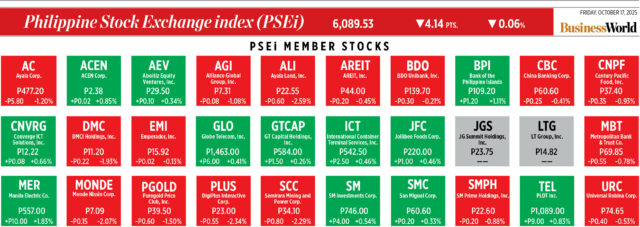
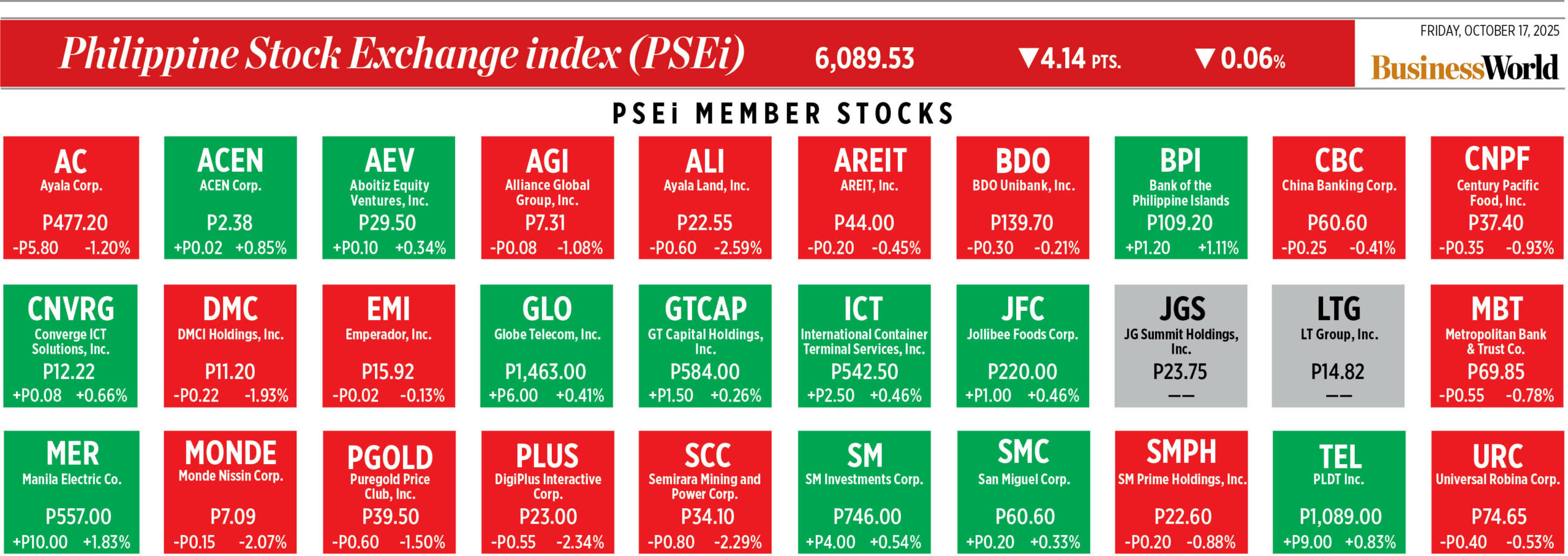
How PSEi member stocks performed — October 17, 2025

Here’s a quick glance at how PSEi stocks fared on Friday, October 17, 2025.


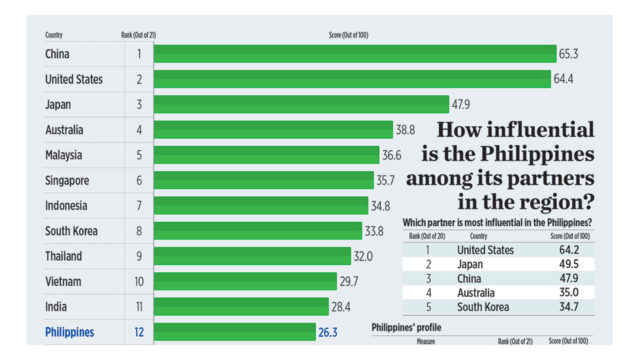
How influential is the Philippines among its partners in the region?

The Philippines was the 12th most influential partner in Southeast Asia, with an overall influence score of 26.3 out of 100, according to the latest data from the Lowy Institute’s Southeast Asia Influence Index. The country excelled in its defense networks but was moderate in economic relationships and cultural and diplomatic influence. The index measures the relative standing of external powers in the region based on four primary domains of bilateral influence: economic relationships, defense networks, cultural influence, and diplomatic influence.

How influential is the Philippines among its partners in the region?

PSEi may move sideways amid lingering risks

PHILIPPINE STAR/KRIZ JOHN ROSALES

By Alexandria Grace C. Magno

PHILIPPINE STOCKS might continue to trade sideways this week as investors weigh bargain-hunting opportunities against lingering macroeconomic and political risks, analysts said.

“For the last three weeks, the market has been moving sideways, reflecting investor indecision,” Japhet Louis O. Tantiangco, research manager at Philstocks Financial, Inc., said in a Viber message. While valuations are attractive, concerns over the Philippines’ tempered outlook, corruption issues and offshore headwinds pose risks, he added.

The benchmark Philippine Stock Exchange index (PSEi) shed 0.06% or 4.14 points to close at 6,089.53 on Friday, while the broader all-share index fell 0.19% to 3,665.08. Week on week, the PSEi rose 51.74 points as cautious optimism following recent rate cuts was tempered by the peso’s weakness against the dollar.

Online brokerage 2TradeAsia.com said activity remained “range-bound” amid a lack of strong catalysts. It added that sentiment could shift based on global policy cues, fiscal adjustments and corporate earnings results.

Mr. Tantiangco said the market might continue to track regional trends as it awaits “fresh leads” to establish a clear direction. A sustained recovery in the peso and lower local bond yields could help lift the market, he said.

The peso slipped 3.5 centavos to close at P58.16 a dollar on Friday, according to Bankers Association of the Philippines data posted on its website.

“Chart-wise, the local market managed to hold its position above its 10-day exponential moving average in last week’s trading, which is taken as a positive sign,” Mr. Tantiangco said. He sees immediate support at 6,000 and resistance at 6,150.

2TradeAsia.com said investors should remain cautious amid uncertainty in global monetary policy.

“Close monitoring of Fed communications and trade developments will be critical to adjusting allocations dynamically,” it said.

The brokerage placed the PSEi’s support at 6,000 and resistance at 6,200, adding that investors are likely to anchor decisions on 2026 earnings visibility as cash flow becomes increasingly relevant in a volatile rate environment.

Public trust in government fell in Q3 amid corruption scandal, says poll

Thousands of participants walk along the northbound lane of EDSA towards the People Power Monument in Quezon City while shouting and holding various placards condemning the corruption in the government during the Trillion Peso March, Sept. 21, 2025. — PHILIPPINE STAR/MIGUEL DE GUZMAN

PUBLIC APPROVAL and trust in government institutions plunged in the third quarter of 2025 as controversies over anomalous flood control projects continue to sap confidence in transparency and accountability, Publicus Asia, Inc said on Sunday.

The Department of Public Works and Highways (DPWH) saw the “steepest drop” after its approval rating fell to 12% from 33% in the second quarter and trust rating declined to 8% from 22%, according to a noncommissioned poll that surveyed 1,500 Filipinos from Sept. 27-30. It had an error margin of ±3 points.

The pollster said in a statement that this is largely due to the department’s “central role in the controversial flood control projects.”

Approval and trust in the House of Representatives likewise waned, with 10-point drops to 21% and to 11%, respectively. The Senate’s approval also slipped to 28% from 32%, while trust in the chamber declined to 16% from 22%.

“The declines in both legislative chambers are attributed to their involvement in the budget process, particularly amid allegations of illegal budget insertions and calls for greater transparency in national spending,” Publicus said.

The Philippines has been rocked by a multibillion-peso flood control scandal that has fueled street protests, exposed cracks in the government and clouded economic outlook.

The government has rolled out P545 billion worth of flood control projects since President Ferdinand R. Marcos, Jr. took office in July 2022. Of this, P100 billion worth of projects were cornered by only 15 contractors, Mr. Marcos said in August.

Investigations into the scandal have implicated politicians, government engineers and private contractors, all of which are accused of colluding to siphon off public funds meant for flood mitigation structures like dikes and flood walls in the disaster-prone country.

The Commission on Audit (CoA) also saw a sharp drop in its ratings, with approval dropping to 31% from 45% and trust to 21% from 33%, Publicus said. “The dip comes amid public concern over CoA’s role in auditing substandard or ‘ghost’ flood control projects.”

Approval and trust in the Budget department also slipped to 26% from 32% and to 18% from 23%, respectively, driven by allegations of “redundant allocations and questionable budget insertions.”

Fewer Filipinos also said they trust and approve of the Finance department in the third quarter, as its approval rating dipped to 30% from 35% and trust to 19% from 24%. This comes as concerns over rising debt and fiscal transparency weighed on public sentiment.

Last week, a separate poll showed trust ratings for Mr. Marcos and Vice-President Sara Duterte-Carpio fell in September.

The Social Weather Stations poll showed trust in Mr. Marcos fell to 43% from 48% in June, while Ms. Duterte’s rating dropped eight points to 53%, marking her sharpest decline this year.

Another survey, conducted by Pulse Asia, showed last week that nine of 10 Filipinos think there is collusion among politicians, contractors and other officials to defraud infrastructure funds, though opinions remain split on whether the government could be trusted to resolve the issue.

About 56% of respondents said they were uncertain whether they could trust the Independent Commission for Infrastructure (ICI) in solving the corruption scandal, according to the separate poll.

The Marcos administration has formed a fact-finding body to investigate anomalous flood control deals that has so far summoned key political figures including a former Speaker, senators, congressmen and the government’s Budget secretary.

The ICI, however, has opted to hold its hearings behind closed doors, compared with earlier televised congressional inquiries that brought the issue into limelight. — Kenneth Christiane L. Basilio

Slow fund recovery in infra scam may shake investor confidence, analysts say

PHILIPPINE STAR/EDD GUMBAN

By Erika Mae P. Sinaking

PERSISTENT irregularities and slow fund recovery from anomalous flood control projects could continue to disrupt infrastructure programs and weaken investor confidence, analysts said at the weekend.

Such delays negatively impact investor and donor confidence as it gives the impression that donations will just be wasted or that funds may not be recovered, Nathaniel “Dinky” von Einsiedel, chairman and principal urban planner of Consultants for Comprehensive Environmental Planning Inc. said.

“It’s worse when the scam involves high-level government officials,” Mr. von Einsiedel told BusinessWorld via Viber chat. “Issues in infrastructure projects affect long-term urban and economic growth in several ways.”

These disrupt continuity in the implementation, which could lead to discontinued projects and wasted investments. He also noted that the insufficient upkeep of essential flood control mechanisms, such as flood gates, further undermines project effectiveness.

Investigations into the flood control scandal have revealed that of 8,000 inspected projects nationwide, at least 421 were classified as “ghost” projects, either nonexistent or poorly executed. The schemes reportedly involved inflated costs and kickbacks, implicating lawmakers, contractors, and government officials.

This prompted the ad hoc Independent Commission for Infrastructure (ICI) to convene an interagency meeting last Thursday to coordinate fund recovery and restitution for affected projects.

The Anti-Money Laundering Council (AMLC) has reportedly frozen between P4.6 billion and P5 billion across nearly 2,800 bank accounts tied to the investigations.

The Department of Health, briefing the ICI on Friday, said its probe into government-funded Super Health Centers (SHC) now spans 878 facilities, including 300 inactive ones.

Costs have ballooned in several cases, such as Marikina’s Concepcion Dos SHC (P21.5 million to P201 million) and Antipolo’s SHC (P11.4 million for construction, P7 million for equipment).

Mr. von Einsiedel added that these failures lead to a loss of confidence in government and increase in the perception that projects just foster corruption, “which discourages civic participation in development planning.”

Joy Aceron, convenor-director of Government Watch (G-Watch), said that such fund scandals could jeopardize the Philippines’ reputation with investors and development partners, which could have broader implications.

“Worse if we are not confronting the truth about the extent of corruption… it is crucial that accountability and justice are delivered and reforms are made — to arrest the likely negative effects of this plunder,” she said.

Ms. Aceron flagged systemic weaknesses in accountability despite reforms and government monitoring efforts.

“Infrastructure corruption persists because accountability measures — regulation and monitoring — are not effective,” Ms. Aceron said in a Facebook Messenger chat.

She explained that oversight is often weakened or compromised by powerful vested interests embedded in multilevel corruption and patronage networks, with insufficient resources and political support to enforce regulations effectively.

“In the case of this flood control plunder, there was an ecosystemic breakdown of state accountability,” she added.

G-Watch, a civil society organization focused on citizen monitoring and government accountability, called for stronger transparency, participation, and accountability in infrastructure by giving citizens access to project information, consultation, and feedback, while holding agencies and contractors accountable for compliance.

The organization also urged the creation of independent multisectoral monitoring bodies with clear mandates, sufficient budgets, and technical support to strengthen oversight, improve project outcomes, and curb mismanagement and plunder in infrastructure initiatives.

Tropical Storm Ramil to bring heavy rains to Luzon, PAGASA says

FACEBOOK.COM/PAGASA.DOST.GOV.PH

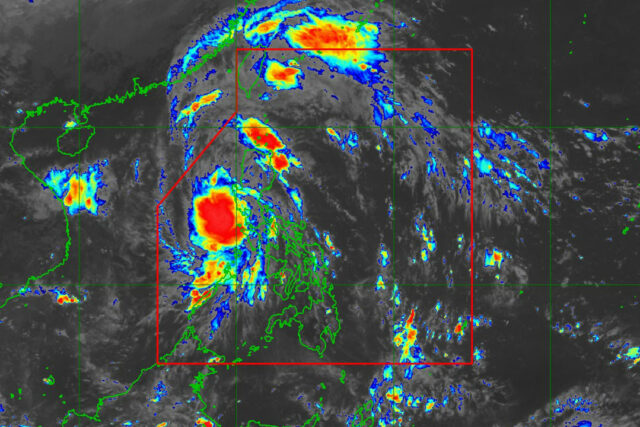
LARGE PARTS of Luzon are expected to experience heavy to torrential rainfall through Monday afternoon, the state weather bureau said on Sunday, as it expects Tropical Storm Ramil (international name: Fengshen) to exit the Philippine area of responsibility (PAR).

In a 5 p.m. advisory on Facebook, the Philippine Atmospheric, Geophysical and Astronomical Services Administration (PAGASA) said 100 to 200 millimeters of rain could fall over Zambales, Bataan, Pangasinan, Tarlac, Pampanga, and Batangas.

Another 50 to 100 millimeters is expected in Occidental Mindoro, Palawan, Antique, Cavite, Aurora, Isabela, Bulacan, La Union, Ilocos Sur, Ilocos Norte, Cagayan, Benguet, Quirino, Nueva Vizcaya, Nueva Ecija, Ifugao, Mountain Province, Kalinga, Abra, and Apayao.

In a 5 p.m. bulletin, PAGASA said “Ramil will continue moving west northwestward or northwestward over the West Philippine Sea.” It is expected to exit PAR on Monday morning.

PAGASA said it may intensify and reach severe tropical storm category outside PAR.

As of 4 p.m., the tropical storm was estimated 85 kilometers west northwest of Iba, Zambales.

It has maximum sustained winds of 65 km per hour (kph) near the center and gustiness of up to 80 kph. It is moving west northwestward at 35 kph.

This has prompted the state weather bureau to raise a tropical cyclone wind signal (TCWS) No. 2 over the central and southern portions of La Union, the western and central portions of Pangasinan, Zambales, Tarlac, the western portion of Pampanga, and the northern portion of Bataan.

PAGASA also placed Cagayan including Babuyan Islands, Isabela, Quirino, Nueva Vizcaya, Apayao, Abra, Kalinga, Mountain Province, Ifugao, Benguet, Ilocos Norte, Ilocos Sur, the rest of La Union, the rest of Pangasinan, Aurora, the rest of Bataan, the rest of Pampanga, Nueva Ecija, Bulacan, Metro Manila, Rizal, the northern and central portions of Quezon including Polillo Islands, Laguna, Cavite, Batangas, Occidental Mindoro including Lubang Islands, Oriental Mindoro, Marinduque, and the northern and western portions of Camarines Norte under TCWS no. 1.

Power distributor Manila Electric Co. (Meralco) said on Sunday that it is prepared to respond to any possible electricity service concern as Ramil continues to affect parts of Luzon.

In a statement, Meralco said that it continues to closely monitor the weather situation to be able to immediately respond amid tropical cycle wind signals raised in parts of its franchise area.

“Our crews and personnel are strategically positioned and remain on standby 24/7 to address any power-related issues. We urge our customers to prioritize safety and stay alert, especially in areas prone to flooding,” said Meralco Vice-President and Head of Corporate Communications Joe R. Zaldarriaga.

The power distributor has advised its customers to practice electrical safety measures, such as turning off the main power switch or circuit breaker, unplugging all appliances, and turning off permanently connected devices.

Meralco’s controlling stakeholder, Beacon Electric Asset Holdings, Inc., is partly owned by PLDT Inc. Hastings Holdings, Inc., a unit of PLDT Beneficial Trust Fund subsidiary MediaQuest Holdings, Inc., has an interest in BusinessWorld through the Philippine Star Group, which it controls.

Meanwhile, President Ferdinand R. Marcos, Jr. urged the public to remain vigilant and enhance disaster preparedness following a series of earthquakes in Cebu, Baguio, Surigao, Davao, Zambales, and Metro Manila.

“Because the Philippines lies along what is known as the Pacific Ring of Fire, the country is highly prone to disasters and natural calamities such as these,” he said in a video blog posted on Sunday in Filipino, citing the importance of family evacuation plans, maintaining emergency “go bags,” and verifying information only from official government sources such as PAGASA and Philippine Institute of Volcanology and Seismology.

He emphasized the need for compliance with building safety standards and local government coordination, noting that government agencies, including the Department of Social Welfare and Development, have prepositioned relief packs and emergency supplies.

The Pacific Ring of Fire is known for frequent earthquakes and volcanic eruptions caused by shifting tectonic plates.

As part of this region, the Philippines is highly vulnerable to seismic and volcanic hazards, making disaster preparedness essential. — Chloe Mari A. Hufana and Sheldeen Joy Talavera

ADVERTISEMENT
ADVERTISEMENT