Home Blog Page 8268

Starbucks to end disposable cup use in Korea by 2025

STARBUCKS CORP. plans to eliminate disposable cups from its cafes across South Korea by 2025, the first such measure in a major market by the coffee giant, as it seeks to curb landfill waste and cut its carbon footprint.

The Seattle-based chain will launch a “cup circularity” program in South Korea, starting July, as it begins tackling its global refuse, which accounted for about 9% of its 16 million-ton carbon footprint in 2018. Under the program, customers will be served beverages in reusable cups that require a “small deposit,” which is refunded on return to contactless kiosks, the company said in a statement Tuesday.

South Korea, which has pledged to zero out planet-warming gases by 2050, revised a set of laws in February further limiting the use of plastic and other disposable items from retailers, food-delivery services and hotels. The revision came after the Asian nation imposed a ban on the use of plastic cups for in-store customers at all cafes in 2018.

The Starbucks move is a shift after global retail giants put sustainability efforts into reverse last year amid health concerns due to the coronavirus, undermining years of work by governments and environmentalists to wean consumers off single-use plastics.

Starbucks, which last year temporarily suspended reusable cups over fears of transmission, will allow customers in South Korea to bring their own tumblers again, the statement said. The country is the coffee chain’s fifth-biggest market with more than 1,500 stores and it plans to expand its current workforce there about 30% by adding more than 5,500 new jobs with a focus on young graduates, elderly citizens and people with disabilities by 2025.

Under the founder and former Chief Executive Officer Howard Schultz, Starbucks focused on sustainability including by purchasing renewable energy and giving discounts to customers who brought their own tumblers. — Bloomberg

Indian states seek widening of vaccinations amid 2nd wave

NEW DELHI — Many Indian state leaders have asked Prime Minister Narendra Modi to open up vaccinations to most of the country’s hundreds of millions of adults, following a second surge in infections that has eclipsed the first wave.

India breached the grim milestone of 100,000 daily infections for the first time on Monday, and cases are likely to stay high again when fresh figures are released later on Tuesday.

The country, the world’s biggest vaccine maker, this month expanded its vaccination programme to include everyone above the age of 45. So far it has vaccinated only about 1 in 25 people, compared with nearly 1 in 2 in the United Kingdom and 1 in 3 in the United States.

“If a larger number of young and working population is vaccinated, the intensity of the cases would be much lower than the treatment that they need today,” Uddhav Thackeray, chief minister of India’s worst affected Maharashtra state, wrote in a letter to Mr. Modi late on Monday.

Delhi Chief Minister Arvind Kejriwal and many other states have also asked for faster and wider vaccinations, with some flagging tightness in vaccine supplies even for the prioritized groups.

The federal government has said it will widen the vaccination campaign in the “near future” to include more people, and that vaccine supplies are being stepped up.

With 12.6 million cases, India is the worst affected country after the United States and Brazil. Deaths have gone past the 165,000 mark.

The country’s daily infections have risen many fold since hitting a multi-month low in early February, when authorities eased most restrictions and people largely stopped wearing masks and following social distancing.

India has recorded the most number of infections in the past week anywhere in the world. More infectious variants of the virus may have played a role in the second surge, some epidemiologists say. — Reuters

The need for global ‘maximum suppression’

New COVID variants have changed the game, vaccines will not be enough

At the end of 2020, there was a strong hope that high levels of vaccination would see humanity finally gain the upper hand over SARS-CoV-2, the virus that causes coronavirus disease 2019 COVID-19. In an ideal scenario, the virus would then be contained at very low levels without further societal disruption or significant numbers of deaths.

But since then, new “variants of concern” have emerged and spread worldwide, putting current pandemic control efforts, including vaccination, at risk of being derailed.

Put simply, the game has changed, and a successful global rollout of current vaccines by itself is no longer a guarantee of victory.

No one is truly safe from COVID-19 until everyone is safe. We are in a race against time to get global transmission rates low enough to prevent the emergence and spread of new variants. The danger is that variants will arise that can overcome the immunity conferred by vaccinations or prior infection.

What’s more, many countries lack the capacity to track emerging variants via genomic surveillance. This means the situation may be even more serious than it appears.

As members of the Lancet COVID-19 Commission Taskforce on Public Health, we call for urgent action in response to the new variants. These new variants mean we cannot rely on the vaccines alone to provide protection but must maintain strong public health measures to reduce the risk from these variants. At the same time, we need to accelerate the vaccine program in all countries in an equitable way.

Together, these strategies will deliver “maximum suppression” of the virus.

Genetic mutations of viruses like SARS-CoV-2 emerge frequently, but some variants are labelled “variants of concern”, because they can reinfect people who have had a previous infection or vaccination, or are more transmissible or can lead to more severe disease.

There are currently at least three documented SARS-CoV-2 variants of concern:

  • B.1.351, first reported in South Africa in December 2020
  • B.1.1.7, first reported in the United Kingdom in December 2020
  • P.1, first identified in Japan among travellers from Brazil in January 2021.

Similar mutations are arising in different countries simultaneously, meaning not even border controls and high vaccination rates can necessarily protect countries from home-grown variants, including variants of concern, where there is substantial community transmission.

If there are high transmission levels, and hence extensive replication of SARS-CoV-2, anywhere in the world, more variants of concern will inevitably arise and the more infectious variants will dominate. With international mobility, these variants will spread.

South Africa’s experience suggests that past infection with SARS-CoV-2 offers only partial protection against the B.1.351 variant, and it is about 50% more transmissible than pre-existing variants. The B.1.351 variant has already been detected in at least 48 countries as of March 2021.

The impact of the new variants on the effectiveness of vaccines is still not clear. Recent real-world evidence from the UK suggests both the Pfizer and AstraZeneca vaccines provide significant protection against severe disease and hospitalizations from the B.1.1.7 variant.

On the other hand, the B.1.351 variant seems to reduce the efficacy of the AstraZeneca vaccine against mild to moderate illness. We do not yet have clear evidence on whether it also reduces effectiveness against severe disease.

For these reasons, reducing community transmission is vital. No single action is sufficient to prevent the virus’s spread; we must maintain strong public health measures in tandem with vaccination programs in every country.

Each time the virus replicates, there is an opportunity for a mutation to occur. And as we are already seeing around the world, some of the resulting variants risk eroding the effectiveness of vaccines.

That’s why we have called for a global strategy of “maximum suppression.”

Public health leaders should focus on efforts that maximally suppress viral infection rates, thus helping to prevent the emergence of mutations that can become new variants of concern.

Prompt vaccine rollouts alone will not be enough to achieve this; continued public health measures, such as face masks and physical distancing, will be vital too. Ventilation of indoor spaces is important, some of which is under people’s control, some of which will require adjustments to buildings.

Global equity in vaccine access is vital too. High-income countries should support multilateral mechanisms such as the COVAX facility, donate excess vaccines to low- and middle-income countries, and support increased vaccine production.

However, to prevent the emergence of viral variants of concern, it may be necessary to prioritize countries or regions with the highest disease prevalence and transmission levels, where the risk of such variants emerging is greatest.

Those with control over healthcare resources, services, and systems should ensure support is available for health professionals to manage increased hospitalizations over shorter periods during surges without reducing care for non-COVID-19 patients.

Health systems must be better prepared against future variants. Suppression efforts should be accompanied by:

  • genomic surveillance programs to identify and quickly characterize emerging variants in as many countries as possible around the world
  • rapid large-scale “second-generation” vaccine programs and increased production capacity that can support equity in vaccine distribution
  • studies of vaccine effectiveness on existing and new variants of concern
  • adapting public health measures (such as double masking) and re-committing to health system arrangements (such as ensuring personal protective equipment for health staff)
  • behavioral, environmental, social, and systems interventions, such as enabling ventilation, distancing between people, and an effective find, test, trace, isolate and support system.

COVID-19 variants of concern have changed the game. We need to recognize and act on this if we as a global society are to avoid future waves of infections, yet more lockdowns and restrictions, and avoidable illness and death.


Susan Michie is Professor of Health Psychology and Director of the UCL Centre for Behaviour Change at University College London.

Chris Bullen is Professor of Public Health at the University of Auckland.

Jeffrey V. Lazarus is Associate Research Professor at Barcelona Institute for Global Health (ISGlobal).

John N. Lavis is Professor and Canada Research Chair in Evidence-Informed Health Systems at McMaster University.

John Thwaites John Thwaites is Chair of the Monash Sustainable Development Institute & ClimateWorks Australia at Monash University.

Liam Smith is Director of BehaviourWorks, Monash Sustainable Development Institute, at Monash University.

Salim Abdool Karim is Director of the Centre for the AIDS Program of Research in South Africa (CAPRISA).

Yanis Ben Amor is Assistant Professor of Global Health and Microbiological Sciences, Executive Director – Center for Sustainable Development (Earth Institute) at Columbia University.


‘Stay out of politics,’ Republican leader McConnell tells U.S. CEOs, warns of ‘consequences’

WASHINGTON – U.S. Senate Republican Leader Mitch McConnell lashed out at corporate America on Monday, warning CEOs to stay out of the debate over a new voting law in Georgia that has been criticized as restricting votes among minorities and the poor.

In a sign of a growing rift in the decades-old alliance between the conservative party and U.S. corporations, McConnell said: “My advice to the corporate CEOs of America is to stay out of politics. Don’t pick sides in these big fights.”

McConnell warned companies there could be risks for turning on the party, but he did not elaborate.

“Corporations will invite serious consequences if they become a vehicle for far-left mobs to hijack our country from outside the constitutional order,” McConnell told a news conference in his home state of Kentucky.

Big business ties with Republicans began fraying under former President Donald Trump’s leadership and the party’s focus on voting restrictions has soured businesses embracing diversity as key to their work force and customer base.

Major Georgia employers Coca-Cola and Delta Air Lines have spoken out against the law signed by Governor Brian Kemp, and Major League Baseball pulled the 2021 All-Star Game out of the state over the law strengthening identification requirements for absentee ballots and making it a crime to offer food or water to voters waiting in line.

“I found it completely discouraging to find a bunch of corporate CEOs getting in the middle of politics,” McConnell said.

Trump spent months after losing his re-election bid falsely claiming that his defeat was the result of widespread fraud. He failed in dozens of legal challenges. Nonetheless, lawmakers in 47 states this year have introduced 361 bills imposing new restrictions on voting, according to the Brennan Center for Justice.

The Georgia law brought a backlash from some U.S. companies with strong ties to the state.

Coca-Cola Co Chief Executive James Quincey called the law “unacceptable” and a “step backwards.” Delta Air Lines CEO Ed Bastian said: “The entire rationale for this bill was based on a lie: that there was widespread voter fraud in Georgia in the 2020 election.”

Independent reviews have repeatedly shown that voter fraud is rare in the United States, and state and federal probes found no evidence of widespread fraud in the 2020 election which the Republican Trump lost to Democrat Joe Biden.

Corporate America has long thrown its political muscle behind Republican candidates and office-holders, often funneling more campaign contributions to conservative candidates than Democratic ones. – Reuters

Biden says no evidence higher corporate taxes will drive companies abroad

WASHINGTON – President Joe Biden on Monday defended his proposal to raise corporate taxes to help pay for his infrastructure spending plans, saying he was not worried the hike would harm the economy and that there was no evidence it would drive business abroad.

Speaking to reporters in Washington after spending Easter weekend at the Camp David presidential retreat in Maryland, Biden again took aim at the 50 or 51 corporations on the Fortune 500 list that paid no taxes at all for three years, saying it was time for them to pay their share.

Asked if raising the corporate tax rate to 28% from 21% would drive away corporations, Biden said: “Not at all … there’s no evidence of that.”

Biden’s predecessor, Donald Trump, and Republican lawmakers cut the corporate rate to 21% in 2017 from 35%. Trump repeatedly promised to tackle the nation’s crumbling infrastructure during his presidency but never delivered on that.

Biden’s plans have drawn criticism from both Republicans and Democrats, including Democratic Senator Joe Manchin, whose support could be critical to ensuring passage in a Senate split evenly between the two parties.

White House press secretary Jen Psaki told reporters the Democratic president was open to discussions with Republicans and Democrats about how to fund the proposed investments.

Asked if the administration had analyzed the cost of agreeing to a lower corporate tax rate of 25%, the highest Manchin says he would accept, Psaki noted the 28% rate would be lower than it was at any time since World War Two.

“Combined with the other tax proposals, it would pay for the totality of the package. That’s why he felt it was a responsible proposal to make,” Psaki said of Biden.

“There will be different ideas for pay-fors, there will be different ideas for tax proposals. That will all need to be weighed … with leaders in Congress.”

Japan fears COVID-19 variants are behind possible fourth wave

TOKYO – Japanese health authorities are concerned that variants of the coronavirus are driving a nascent fourth wave in the pandemic with just 109 days remaining until the Tokyo Olympics.

The variants appear to be more infectious and may be resistant to vaccines, which are still not widely available in Japan. The situation is worst in Osaka, where infections hit fresh records last week, prompting the regional government to start targeted lockdown measures for one month from Monday.

A mutant COVID-19 variant first discovered in Britain has taken hold in the Osaka region, spreading faster and filling up hospital beds with more serious cases than the original virus, according to Koji Wada, a government adviser on the pandemic.

“The fourth wave is going to be larger,” said Wada, a professor at Tokyo’s International University of Health and Welfare. “We need to start to discuss how we could utilize these targeted measures for the Tokyo area.”

Japan has twice declared a state of emergency that covered most of the country in the past year, most recently just after New Year as the pandemic’s third and most deadly wave struck. Officials are now opting for more targeted measures that allow local governments to shorten business hours and impose fines for noncompliance.

Osaka city cancelled Olympic Torch relay events there, but Prime Minister Yoshihide Suga has insisted Japan will carry out the Games as scheduled. Suga said on Sunday that measures employed in the Osaka area could be expanded to Tokyo and elsewhere if needed.

There were 249 new infections in Tokyo on Monday, still well below the peak of over 2,500 in January. In Osaka, the tally was 341, down from a record 666 cases on Saturday.

The true extent of the mutant cases is unknown, as only a small fraction of positive COVID-19 cases undergo the genomic study necessary to find the variants.

A health ministry report last week showed 678 cases of variants from Britain, South Africa, and Brazil had been discovered nationwide and at airports, with the biggest clusters in Osaka and nearby Hyogo prefecture.

Those three all have the N501Y mutation, and the latter two also have the E484K mutation. Authorities in Japan have found more than 1,000 cases that only have E484K.

That variant was present in about 70% of coronavirus patients tested at a Tokyo hospital last month, Japanese public broadcaster NHK said on Sunday.

The rebound in cases came within weeks of the government lifting state of emergency measures, and the priority measures being rolled out now are intended to halt an unexpected rise in mutant cases, said Makoto Shimoaraiso, a Cabinet Secretariat official for Japan’s COVID-19 response.

“Even though we looked at (various scientific) indicators before lifting the state of emergency, there is some possibility of criticism that we should have forecasted the status of variants.”

Worst COVID surge in Southeast Asia hammers Philippine hospitals

As hospitals in the Philippine capital reach capacity from a new surge of coronavirus cases, increasingly desperate Filipinos are stocking up on oxygen tanks and touting unapproved medications amid fears the health care system may collapse.

Daily infections rose to a record last week in the Southeast Asian nation, where one in nearly five COVID-19 tests comes back positive and vaccination rates lag its neighbors.

The Philippines is at risk of a “humanitarian crisis that will overwhelm the country and wipe out families” unless the government steps up testing, tracing and treatment efforts, opposition Senator Francis Pangilinan said in an April 3 statement.

The country is behind neighbors in vaccinations, according to World Bank data, having administered 0.2 doses per 100 people as of mid-March, compared to Indonesia’s 2.4 doses and Malaysia’s 1.1 doses.

The strain on hospitals has even hit one of the country’s ex-presidents.

Former President Joseph Estrada spent the night in an emergency room after being rushed to a Manila hospital with Covid-19 complications on March 28, since the regular beds were occupied. Estrada was later admitted to the intensive care unit, where he is in stable condition, his son said.

Others don’t make it into the hospital at all.

“Many have already died inside tents outside hospitals, waiting to be admitted to the ERs, in ambulance while in transit, at home without receiving any medical help,” Vice President Leni Robredo, who leads the political opposition, said in a Facebook post last week.

A spike in cases since the middle of March prompted President Rodrigo Duterte to put Metro Manila and nearby provinces in lockdown for at least two weeks through April 11. The Philippines, with 803,398 infections as of April 5, has the most active cases in Southeast Asia. Deaths have risen to 13,435 or about 1.7% of total cases.

Duterte, in a March 29 briefing, warned of bleak months ahead. “I’m grappling with the issue of Covid,” he said. “It takes most of my time actually.”

HOME SERVICE
Unable to accept new patients, some private hospitals are offering home care. The Medical City, an 800-bed hospital in Metro Manila, has three- to 10-day programs costing as much as P65,000 ($1,340) which includes infection control, virtual monitoring, swabbing and blood extraction services. On March 22, the hospital said its COVID-19 emergency, floors and ICU units reached full capacity.

On social media such as Twitter, users are touting Ivermectin, an anti-parasitic veterinary drug, as a possible COVID-19 cure. The Philippines’ Food and Drug Administration is processing an application for the use of Ivermectin on humans, the health department said on April 5.

Filipinos like Manila resident Jomarlo Moreno have resorted to buying oxygen tanks. After a relative with asthma tested positive for the virus and had difficulty breathing but could not be accommodated in a hospital ward, Moreno shelled out P3,500 for the equipment.

“We are lucky that we have the resources,” he said. “What about others who do not?”

Nearly 80% of intensive-care capacity in Metro Manila is filled, 60% of ventilators already in use and 70% of isolation beds are occupied, according to the health department. Occupancy of health facilities has increased since the agency started reporting data two weeks ago.

Health Undersecretary Maria Rosario Vergeire blamed the surge on the spread of variants. From October to February, fewer than 3,500 people tested positive daily but infections climbed to a record 15,298 on April 2. The daily tally was at 8,355 on April 5 as many laboratories closed during the Easter break.

At the Philippine Orthopedic Center in Manila, 117 of 180 staff tested positive last week, forcing it to shut its outpatient department that serves as many as 450 patients a day. Manila’s Lung Center of the Philippines, with its emergency room at 200% capacity, is not accepting walk-in patients.

The government will transfer recovering patients to isolation facilities and hotels, Vergeire said, and move health workers from provinces with fewer infections to Manila.

“It’s not that we aren’t prepared,” she said on Monday. “The increase in the number of cases was something not expected. Unfortunately, the variants have spread faster, and the increase has been tremendous.” — Bloomberg 

New Yorkers rally outside court where man faces anti-Asian hate crime charge

NEW YORK – Asian Americans and community activists rallied against anti-Asian hate crimes on Monday outside a New York courthouse where a man charged with assaulting a 65-year-old Asian woman in a hate crime was due to face his first hearing before a Manhattan Criminal Court judge.

Police have identified Brandon Elliot, 38, as the man seen in a video kicking the woman to the ground and then kicking her head several times on March 29 near Times Square.

Mr. Elliot was on lifetime parole since 2019 after serving a prison term for murdering his mother in 2002, according to local media citing court records. He was arraigned last week on two charges of second-degree assault as a hate crime and one count of first-degree attempted assault as a hate crime.

“This attack would not have happened if he was not released,” said Phil Wong, president of the Chinese American Citizens Alliance of Greater New York, standing in front of the courthouse, where demonstrators raised signs to “speak up against Asian hate” and to support the police.

The New York Times identified the victim as Vilma Kari, an immigrant from the Philippines, citing a law enforcement source.

Hate crimes reported against Asian Americans increased 149% annually in 2020 in 16 major U.S. cities, according to the Center for the Study of Hate and Extremism at California State University, San Bernardino.

Concern over such crimes was heightened when six Asian women were among eight people shot dead last month at Atlanta-area spas.

In California, Orange County prosecutors on Monday charged a man with hate crimes for throwing rocks at an Asian woman and her 6-year-old son as they drove, cracking their car’s windshield.

“The man later told police Koreans in the area were trying to control him,” the District Attorney’s office said.

A 28-year-old man was charged with felony violation of civil rights and vandalism with a hate crime enhancement, plus a misdemeanor count for throwing the rock, prosecutors said. – Reuters

PHL inflation slows in March

Headline inflation eased in March following five consecutive months of picking up, the government’s statistical agency reported earlier this morning.

Preliminary data from the Philippine Statistics Authority (PSA) showed headline inflation at 4.5% in March, slowing from the year-on-year rate 4.7% in February. However, this was still above the 2.5% recorded in March last year.

The latest headline figure is lower than the 4.8% median in a BusinessWorld poll conducted late last week and falls within the 4.2%-5% estimate given by the Bangko Sentral ng Pilipinas (BSP) for March.

Year-to-date inflation settled at 4.5%, already beyond the BSP’s 2-4% target range as well as the 4.2% forecast for 2021.

Core inflation, which discounted volatile prices of food and energy items, stood at 3.5%. This was unchanged from the rate recorded in the previous month, but faster than the 3% in the same month last year.

The PSA attributed the easing in March to the slower increase in prices of heavily-weighted food and non-alcoholic beverages at 5.8% from 6.7% in February. Food and non-alcoholic beverages account for 38.3% of the theoretical basket of goods that an average Filipino household consumes.

The PSA also noted slower annual rates in alcoholic beverages and tobacco (12.1% from 12.2% in February); furnishing, household equipment and routine maintenance of the house (1.9% from 2.4%); communication (0.2% from 0.3%); and restaurant and miscellaneous goods and services (3.1% from 3.2%).

Meanwhile, the inflation rate for the bottom 30% of income households stood at 5.5% in March, steady from the rate recorded in the previous month, but still faster than the 2.4% in March 2020.

The inflation rate for the bottom 30% takes into account the spending patterns of this income segment. Thus, its consumer price index differs from that of the average household with the former assigning heavier weights on necessities. — Ana Olivia A. Tirona

Security Bank Corporation sets stockholders’ meeting via remote communication

~ai-268c3d41-8196-405d-8a44-c2b525c4bd7b_

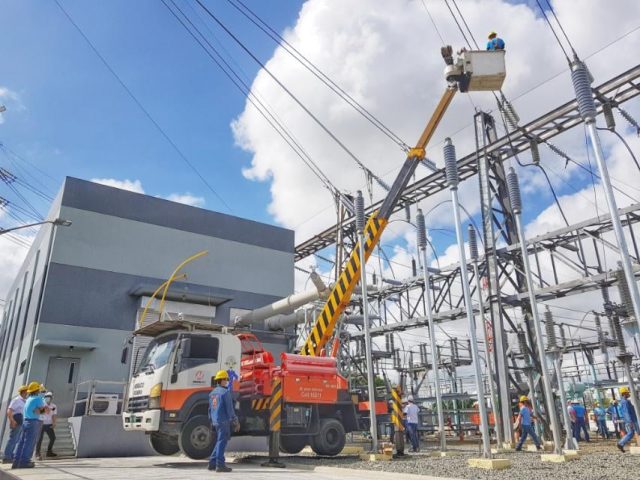
Meralco commissions new LIIP substation GIS

Seen in the photo are linemen and engineers from Meralco and Miescor during the ongoing commissioning of a new double bus indoor Gas-Insulated Switchgear (GIS) of LIIP Substation located at Binan, Laguna.  This project will ensure the continuous power supply of the customers served by the said substation even during contingency, preventing possible power outages to many industrial customers in the area of Sta. Rosa and Binan, Laguna.Despite the heightened community quarantine measures due to the recent surge of COVID-19 cases, Meralco and its subsidiaries are continuously working hard to improve its distribution system in order to provide its customers with the highest level of service.

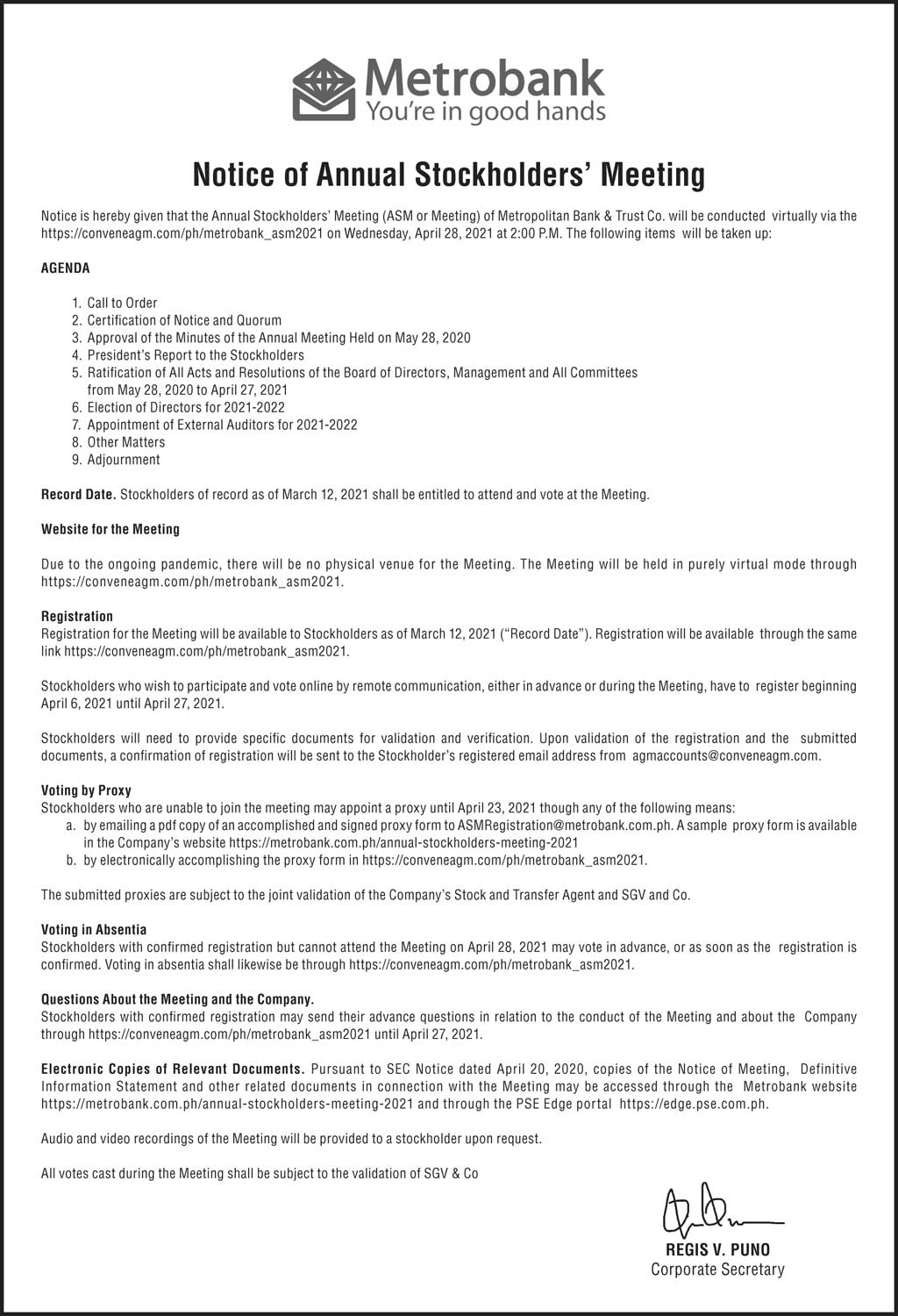
Metropolitan Bank & Trust Co, sets schedule of virtual stockholders’ meeting

ADVERTISEMENT
ADVERTISEMENT