Home Blog Page 8262

Singapore becomes a global cruise leader, for now

SINGAPORE – Singapore currently accounts for a third of the world’s cruises its tourism body said on Wednesday, owing to the roaring success of its “cruises to nowhere” at a time of crisis in the industry globally.

Cruises have yet to restart in many parts of the world after taking a beating from the coronavirus pandemic, with some of the earliest big outbreaks found on cruise ships.

The city-state launched what it called “round trips” on luxury liners in November, which have no port of call and last only a few days. Singapore has seen relatively few domestic COVID-19 cases since last year.

The Singapore cruises are open only to its 5.7 million residents, who have been unable to leave the tiny country for leisure and have settled instead for activities like staycations and even indoor camping.

The cruises recorded about 120,000 passengers, according to the Singapore Tourism Board, and run at lower capacity, with stringent health protocols.

The tourism board said it calculated its share of global cruises by using data from the Cruise Lines International Association (CLIA).

Some cruises from the Caribbean are expected to resume from June while the U.S. Centers for Disease has retained tight curbs on resuming cruises from the United States.

Some cruises have operated in parts of Europe, Asia and the South Pacific, according to the Cruise Lines International Association.

Royal Caribbean said this month that it was extending the season in Singapore for its Quantum of the Seas ship due to “overwhelming demand” through October.

Genting Cruise Lines and Royal Caribbean launched their pilot cruises late last year.

STB Chief Executive Keith Tan said Singapore did not expect to be leading in cruises for long.

“Over the next few months, I certainly believe there will be more resumption of cruise business in the Caribbean, and in the Mediterranean as well,” Tan said.

Singapore’s tourism industry has been hit hard by the pandemic, with visitors dropping nearly 86% to 2.7 million last year. – Reuters

What you need to know about the coronavirus right now

April 8, 2021 – Here’s what you need to know about the coronavirus right now:


NZ temporarily suspends entry to travellers from India

New Zealand on Thursday temporarily suspended entry for all travellers from India, including its own citizens, for about two weeks following a high number of positive coronavirus cases arriving from the South Asian country.

The move comes after New Zealand recorded 23 new positive coronavirus cases at its border on Thursday, of which 17 were from India. The suspension will start from 1600 local time on April 11 and will be in place until April 28.


AstraZeneca rollout to continue in Australia

Australia has no current plans to change the rollout of the AstraZeneca COVID-19 vaccine, Prime Minister Scott Morrison said on Thursday, after Europe’s drug regulator found possible links between rare blood clots and the vaccine.

Australian authorities have ordered an urgent inquiry into findings from Europe’s drug regulator with Morrison expecting updates later on Thursday from the medicines regulator and the immunisation advisory group.


Mixed guidance in the EU on AstraZeneca shot

European Union health ministers failed on Wednesday to agree a common guidance on the use of the AstraZeneca COVID-19 vaccine, despite calls for coordination across member states to combat public hesitancy over taking the shot.

Italy and Spain recommended on Wednesday that it only be used on those over 60 and Britain that people under 30 should get an alternative, due to possible links between the vaccine and very rare cases of blood clots.


If approved by EU, Germany wants to buy Sputnik vaccine

Germany is about to start bilateral negotiations with Russia to obtain its Sputnik V COVID-19 vaccine, a source told Reuters on Wednesday, adding that any final agreement depended on Russia providing key data to the European Medicines Agency (EMA). In the preliminary talks, Germany first wants to determine which quantities Russia can deliver and when, the source said.

In any case, Germany will only buy the Russian vaccine once it has been approved by EMA and for this it is paramount that Russia provides the necessary data, the source added.


After detecting UK variant, Thailand braces for infections

Thailand has detected at least 24 cases of the coronavirus variant B.1.1.7 first identified in Britain, a government health expert said on Wednesday, its first known domestic transmission of the highly contagious variant. The UK variant was found in a cluster of 24 visitors to entertainment venues in Bangkok, which were detected at the weekend. Nearly 200 such venues have been closed for two weeks.

Thai Prime Minister Prayuth Chan-ocha instructed authorities to prepare field hospitals in anticipation of a spike in infections. Ten of his ministers and dozens of lawmakers were self-isolating on Wednesday due to exposure to positive cases. – Reuters

Passive vaping: an impending threat to bystanders

Disclaimer: This asset – including all text, audio and imagery – is provided by The Conversation. Reuters does not guarantee the accuracy of, or endorse any views or opinions expressed in, this asset.

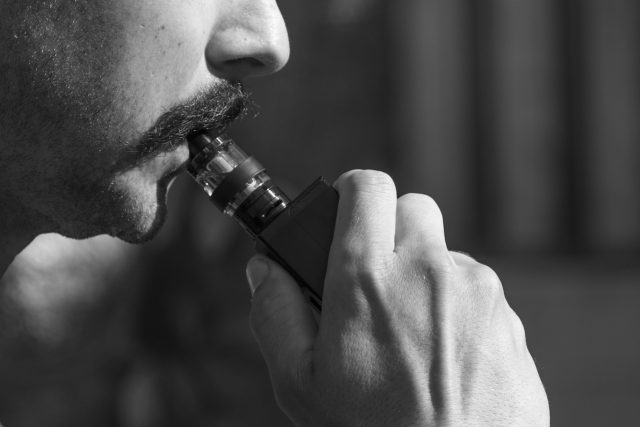
Electronic cigarettes (e-cigarettes), also known as vapes, are gaining popularity among youths in many parts of the world, including the US and Europe.

These young vapers are often unaware their e-cigarettes contain nicotine, an addictive substance that is also present in tobacco cigarettes.

Little do vapers know that their habit may also endanger non-vapers. Vapers may expose others to e-cigarette emissions.

Passive vaping, or secondhand exposure, is a condition where bystanders, usually non-vapers, are exposed to the exhaled aerosol from e-cigarette use.

Unlike passive smoking, which includes the smoke released from the end of the burning cigarette (side stream), passive vaping only comes from the exhaled e-cigarette aerosol since the device does not yield side stream.

Passive vaping is as concerning as passive smoking for at least two reasons.

1. E-cigarette aerosol from passive vaping contains dangerous toxins

Vaping aerosols do not only contain water vapour as commonly believed.

The toxins include, among others, fine and ultra-fine particles (also known as particulate matter), nicotine, volatile organic compounds like formaldehyde and acetaldehyde, as well as metals. The latter was found in e-cigarette aerosol at a higher level than in tobacco smoke.

Formaldehyde and acetaldehyde can cause cancer in humans . Nicotine may cause impaired brain function, especially in young people.

The particulate matter is smaller in e-cigarette aerosol than is found in cigarette smoke. This makes it easier for these particles to penetrate the lungs and induce diseases such as cardiovascular and respiratory diseases and diabetes.

Many studies show levels of particulate matter and nicotine increase in an indoor environment during and after vaping, suggesting it creates indoor pollution.

For example, in homes of e-cigarette users, the concentration of indoor airborne nicotine was more than six times higher than in non-users’ homes.

People who lived with vapers also absorbed the nicotine from the aerosol into their system.

Airborne nicotine and fine particulate matter from passive vaping may also contaminate other rooms or spaces as they can travel to neighbouring areas and outdoor environments.

The aerosol from passive vaping also contains other chemicals not present in regular cigarettes, such as propylene glycol and glycerol, which serve as the solvent in vape liquid, and flavourings.

Although propylene glycol and glycerol are considered safe for ingestion, they have not proved safe for inhalation.

Short-term exposure to e-cigarette aerosol has been shown to irritate eyes and airways and worsen respiratory conditions, such as asthma and chronic obstructive pulmonary disease, like chronic bronchitis.

This COVID-19 pandemic may put bystanders exposed to e-cigarettes at higher risk of contracting or having poor outcomes for COVID-19 since the aerosol may compromise lung function and immunity.

2. Passive vaping may endorse social acceptance of vaping and renormalise smoking

Studies found that youth seeing someone else vaping or exposed to the vaping aerosol were likely to initiate vaping or even smoking combustible cigarettes.

They even tend to perceive vaping or passive vaping as safe.

This raises concern about the gateway effect for non-smokers who may become smokers at a later stage or become dual users who vape and smoke.

The magnitude of passive vaping is not negligible. Exposure to e-cigarette aerosol has been pervasive, especially in countries where e-cigarette use is prevalent, like Greece and England .

In 2017-2018, 16% of adult bystanders in 12 European countries were exposed to e-cigarette aerosol in indoor settings.

In the US, passive vaping in indoor or outdoor public places was reported by nearly one in three middle and high-school students in 2018.

Indeed, passive vaping disproportionately affected youth, men and former vapers.

In Europe, passive vaping commonly occurred in places where smoking was already banned, including the indoor areas of bars, restaurants and workplaces or education facilities.

Vaping was even observed in locations where kids are likely around, such as children’s playgrounds and school gates.

To mitigate the negative impacts of passive vaping on bystanders, we must closely monitor the trend of passive vaping in the population, especially among vulnerable groups such as children and people with threatening diseases.

Policymakers should consider including vaping in smoke-free policies to simplify communication and implementation of the regulations.

The WHO Framework Convention on Tobacco Control has advised countries to forbid vaping in enclosed spaces or at least in smoke-free places.

However, less than 60% of WHO European region countries had national laws on e-cigarette use by 2018.

This lack of regulation of e-cigarette aerosol occurs because European countries still focus more on other e-cigarette regulatory domains, such as marketing, retailing, pricing and product standards.

Fortunately, people are mainly in favour of vaping bans in public places, particularly in smoke-free areas. This implies an opportunity for authorities to adopt vaping regulations as part of the country’s tobacco control strategy.


2020 PHL GDP drop faster than initially estimated

THE PHILIPPINE ECONOMY in 2020 declined at a slightly faster pace than previously reported, the Philippine Statistics Authority (PSA) reported on Thursday.

Gross domestic product (GDP) — the value of all finished goods and services produced in the country at a given period in time — fell by 9.6% last year, inching up from the 9.5% drop initially reported on Jan. 28.

Meanwhile, GDP for the fourth quarter of 2020 was unchanged at 8.3% from its initial estimate. — A. O. A. Tirona

PHL factory output continues losing streak in February

THE COUNTRY’S FACTORY output extended its streak of decline to 12 months in February, as well as posting the steepest fall in five months, the government reported this morning.

Preliminary results of the Philippine Statistics Authority’s Monthly Integrated Survey of Selected Industries for February showed factory output, as measured by the Volume of Production Index, fell by 43.6% year on year in February. This was faster than the revised 12% drop in January, but a reversal of the 0.4% growth a year earlier.

The February decline marked the steepest in five months, or since the 56.7% year-on-year drop recorded in September 2020.

The index has been on a decline since March last year, around the time when strict lockdown restrictions were implemented to contain the spread of the coronavirus outbreak.

The PSA noted annual decreases in 19 out of 22 industry divisions in February. Of these, 14 posted double-digit annual declines led by the manufacture of coke and refined petroleum products (-85.4%); machinery and equipment, except electrical (-48.5%); textiles (-32.6%); and furniture (-30.3%).

Capacity utilization — the extent to which industry resources are used in producing goods — averaged 53.8% in February, down from 56.7% in January. Of the 22 sectors, 15 averaged a capacity utilization rate of at least 50%. — Jobo E. Hernandez

‘Hindi ako nagsisisi, magpalit na po kayo ng SIM’: Baler local praises Globe 4G LTE SIM benefits

Globe customers in Baler, Aurora are now experiencing significant improvements in their call, SMS and data browsing services after upgrading to 5G-ready 4G LTE SIM cards from the old 3G SIMs.

By using the 5G ready 4G LTE SIM cards, customers are now taking advantage of Globe’s network migration to 4G LTE – the new standard of mobile data, in  the capital town of Aurora province.

“Mabagal po internet noong nakaraan, pero ngayon mas malakas na po yung signal. Hindi ako nagsisisi. Magpalit na po kayo ng SIM para ma-experience nilang lahat  ang malaking diperensya,” said Novelith Erjas, a Globe customer in Baler as she urged kababayans to make the switch now.

Erjas, who is also a student, added the improved  internet connectivity gave her opportunities to accomplish more compared to her 3G SIM card use.  She also admitted that it took her sometime to make the upgrade which she regretted.

“Noong una ayoko pang magpalit ng SIM. Pero nung nalaman ko na mas maganda  yung 4G, na-appreciate ko na. Mas na-e-enjoy na ngayon ang pag i-internet at hindi na hassle sa signal. Dati ang akala ko mahina ang signal ng Globe. Yun pala kailangan ko pa lang magpalit, from 3G to 4G LTE,” she said.

Globe has made 13 site upgrades in four towns of Aurora province namely Baler, Dipaculao, Maria Aurora and San Luis in the past few months and is looking to modernize its entire network in the province.

“We are happy to inform our customers in Baler, Aurora that they now have access to clearer calls, real time sending and receipt of SMS and lower latency in browsing their favorite sites by simply upgrading their SIM cards and ensuring that the devices they are using are 4G LTE capable ones,” said Joel Agustin, Globe Senior Vice President for Program Delivery, Network Technical Group.

In order to help customers in Baler migrate faster and with ease, Globe has designated the following establishments to help them upgrade their SIM cards for FREE:

Maricel Store in Barangay Buhangin

Grace Store in Barangay Suclayin

Flora Store in Barangay Sabang

Customers will still keep their old numbers when they switch to 4G LTE SIM cards. If quarantine protocols in their respective areas will allow, customers can also go to the nearest Globe Store to change their SIM cards.   For more information, please go to  https://www.globe.com.ph/help/mobile-internet/lte/faqs.html#gref.

Customers who wish to upgrade their mobile devices who are outside Baler can also check any Globe store to see the affordable and available 5G-ready 4G/LTE capable mobile devices.

Globe’s aggressive and sustained network builds and upgrades are showing enhanced overall customer data experience as the telco emerged as the most improved in mobile average download speed across all technologies to 16.44 Mbps in Q4 2020 from 13.50 Mbps in Q4 2019, a 22% improvement according to Ookla data.

Globe supports the United Nations Sustainable Development Goals (UN SDG), specifically UN SDG No. 9 which emphasizes the roles of infrastructure and innovation as crucial drivers of economic growth and development. Globe is committed to upholding the 10 United Nations Global Compact principles and 10 UN SDGs.

Trade gap widens as imports increase for first time in 22 months

THE COUNTRY’S trade-in-goods deficit widened in February as imports grew for the first time in 22 months and exports contracted albeit at a slower pace that same month.

Merchandise imports grew by 2.7% to $7.60 billion in February following a 12.1% annual decline in January, preliminary data by the Philippine Statistics Authority showed.

The import tally for February was bigger than $8.4 billion and $7.4 billion in January 2021 and February 2020, respectively. However, the value of imports that month was the lowest since June 2020’s $7 billion.

Nevertheless, February marked the first expansion in imports in 22 months or since April 2019 when it posted an annual growth of 2.9%.

Meanwhile, merchandise exports declined by 2.3% to $5.31 billion, lower than the 4.8% contracted recorded in January.

This brought the trade deficit to $2.29 billion for February, bigger than the $1.97-billion gap in the same month last year, but smaller than the $2.9-billion gap posted in the previous month.

Year to date, imports of goods amounted to $16 billion, down by 5.6% compared with the $16.96 billion in 2020’s comparable months.

Likewise, exports were down 3.6% to $10.83 billion on a cumulative basis compared with $11.23 billion the previous year.

These figures were below the Development Budget Coordination Committee’s growth targets of 5% and 8% for exports and imports this year.

That brought the year-to-date trade balance to a $5.17-billion deficit, smaller than the $5.72-billion shortfall in the same two months last year.

The country’s total — the sum of export and import goods — was $12.91 billion in February, up 0.6% year on year. For the first two months of the year, total trade amounted to $26.83 billion, down 4.8% from $28.19 billion a year ago. — L. O. Pilar

First Metro Investment Corporation announces schedule of virtual stockholders’ meeting

NOTICE OF ANNUAL MEETING OF THE STOCKHOLDERS


TO: ALL STOCKHOLDERS:

Notice is hereby given that the Annual Stockholders’ Meeting of FIRST METRO INVESTMENT CORPORATION (First Metro) will be conducted virtually on Friday, April 30, 2021 at 2:00p.m. via Zoom.  Due to the COVID-19 situation, there will be no physical venue for the Meeting.  The following items will be taken up:

AGENDA

1. Call to Order

2. Certification of Notice and Quorum

3. Approval of the Minutes of the previous Annual Stockholders’ Meeting held on June 1, 2020

4. Confirmation of the Minutes of report on the result of the Stockholders approval through Written Assent on February 22, 2021

5. Annual Report to the Stockholders

6. Ratification of Corporate Acts including Related Party Transactions

7. Amendment to the Articles of Incorporation to amend the following:

i. Amendment of Article VII to (1) increase the par value from PHP10 to PHP500 per share, and (2) decrease the number of authorized common shares from 800,000,000 to 16,000,000 common shares.

Amendment of the Primary Purpose in the Articles of Incorporation to delete the provisions pertaining to quasi-banking and trust activities in view of the recent approval of the BSP of the surrender of the quasi-bank license. 

8. Election of the Members of the Board of Directors

9. Appointment of External Auditor

10. Other Matters

11. Adjournment

Record Date.  Stockholders of record as of March 15, 2021 shall be entitled to attend the Meeting.

Pre-Registration. Stockholders intending to participate by remote communication should pre-register by sending an email to asmregistration@firstmetro.com.ph on or before Tuesday, April 20, 2021. The requirements for the registration can be found on www.firstmetro.com.ph/asm-2021. 

Successful registrants will receive an electronic invitation via email with a complete guide on how to join the Meeting and how to cast votes. For any registration concerns, please get in touch with asmregistration@firstmetro.com.ph.

Proxy.  If you will not be able to join the virtual Meeting, you may send an authorized representative on your behalf. Download, fill out and sign the sample proxy form found on www.firstmetro.com.ph/asm-2021, and send a scanned copy to asmregistration@firstmetro.com.ph.on or before Tuesday, April 20, 2021.

Questions About the Meeting and the Company.  You may send your questions regarding the conduct of the Meeting and the Company to corpcom@firstmetro.com.ph.

Electronic Copies of Relevant Documents.  Pursuant to SEC Notice dated April 20, 2020, copies of the Notice of Meeting, Definitive Information Statement and other related documents in connection with the Meeting may be accessed through the Company’s website (www.firstmetro.com.ph).

There will be audio and virtual recording of the Meeting. All votes cast shall be subject to the validation of Metrobank-Trust Banking Group.

City of Makati, Metro Manila, April 7, 2021.


                                                          ALESANDRA T. TY

Corporate Secretary

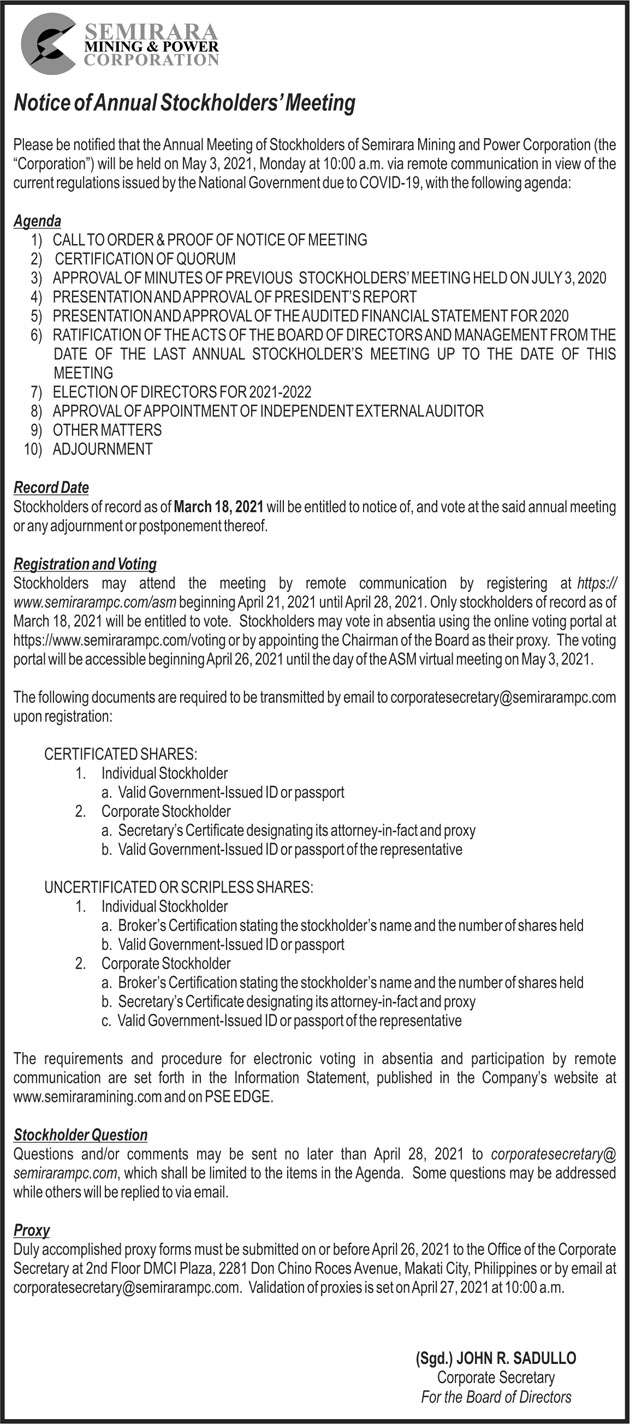
Semirara Mining and Power Corporation announces schedule of annual stockholders’ meeting

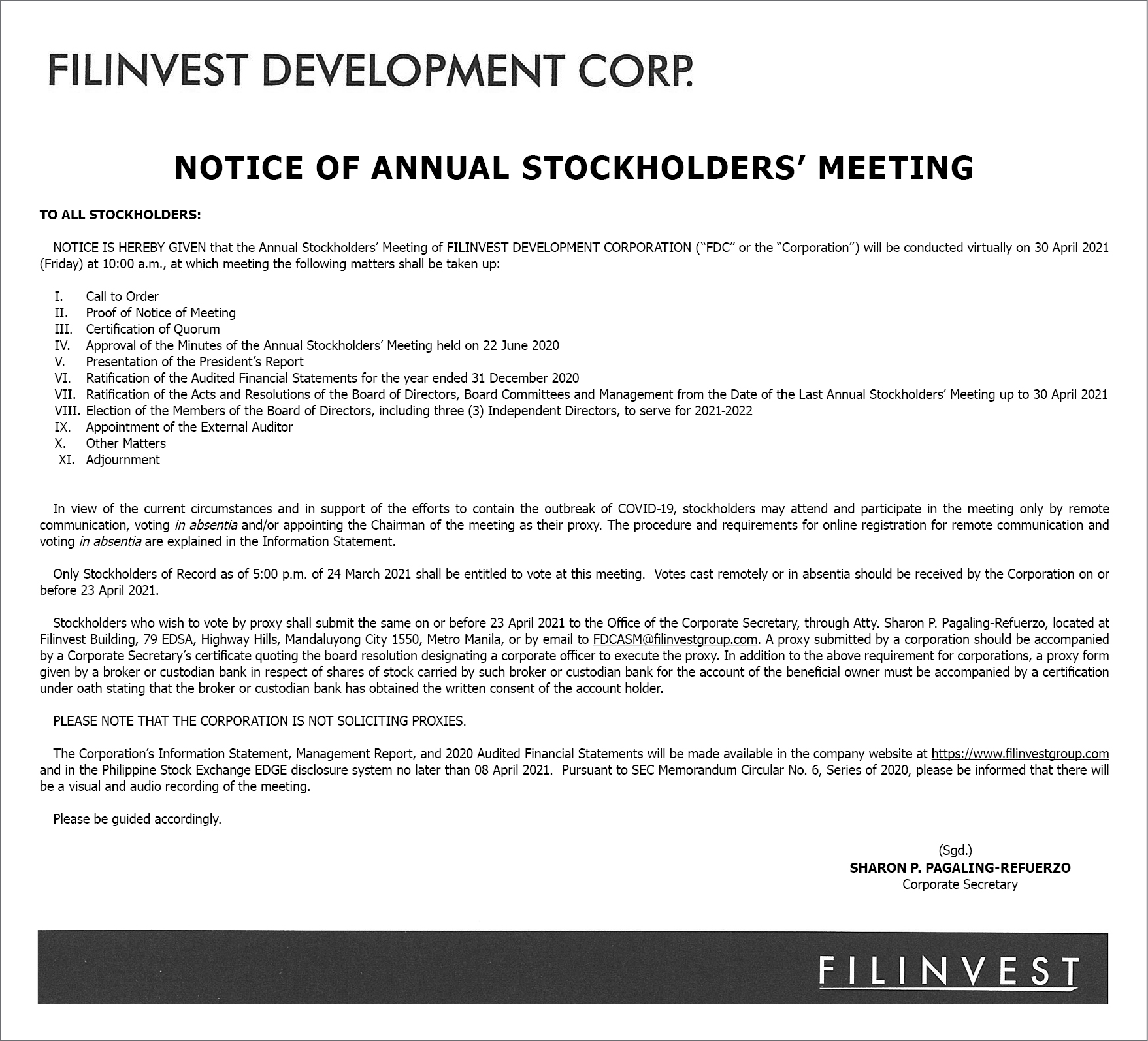
Filinvest Development Corporation announces schedule for virtual stockholders’ meeting

Duterte signs EO lowering tariffs on pork imports for one year

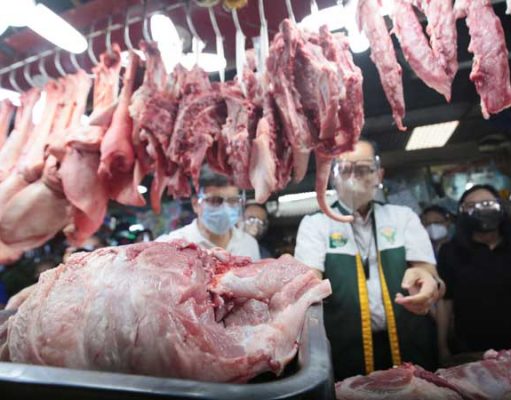
Philippine President Rodrigo R. Duterte on Wednesday signed an executive order (EO) temporarily lowering tariffs on imported pork meat for one year, in order to address the current supply shortage due to the African swine fever (ASF) outbreak.

“There is an urgent need to temporarily reduce the Most Favored Nation tariff rates on fresh, chilled or frozen meat of swine to address the existing pork supply shortage, stabilize prices of pork meat, and minimize inflation rates,” Mr. Duterte said in EO No. 128, which was signed on April 7.

This, after the President asked Congress last month to increase the minimum access volume (MAV) for pork imports this year by 350,000 metric tons (MT) on top of the 54,210 MT under the current limit.

The EO temporarily lowered the import duties on fresh, chilled or frozen pork to 5% from 30% under the MAV quota for three months after order takes effect. The rate will be increased to 10% for the succeeding nine months.

The tariff rate for imported meat outside the existing quota, on the other hand, is reduced to 15% from 40% for the first three months. It will then be raised to 20% for the next nine months.

The order will take effect for one year as soon as it is published in the Official Gazette or a newspaper.

The prices of pure pork rose to 20.9% in March, according to the statistics authority.

Pork prices in the country’s capital region averaged P329 per kilo in March from P323 per kilo a month earlier, it said.

The 60-day price ceiling on selected pork and chicken products in Metro Manila is set to end on April 8.

Price ceiling on pork to be lifted

THE Department of Agriculture will implement suggested retail prices (SRP) for imported pork products on April 9. — PHILIPPINE STAR/ MICHAEL VARCAS

By Revin Mikhael D. Ochave, Reporter

PRICE CAPS for selected pork and chicken products will not be extended, the Agriculture department said.

“April 8 will be the last day for the existing price cap and there will be no extension,” Agriculture Secretary William D. Dar said at a virtual briefing on Wednesday, referring to the 60-day price ceiling mandated by Executive Order (EO) No. 124.

Instead, Mr. Dar said the Department of Agriculture (DA) will implement suggested retail prices (SRP) for imported pork products as part of the ongoing effort to augment supply and stabilize market prices. There will be no new issued SRP for local pork products.

Starting April 9, the SRP for imported pork shoulder (kasim) will be set at P270 per kilogram, while imported pork belly (liempo) will be at P350 per kilogram, he said.

“The DA and the Department of Trade and Industry (DTI) will implement the SRP for imported pork and have agreed on the compliance for existing guidelines on hygienic handling of imported pork as prescribed by government guidelines such as proper packaging and labeling, and creation of a compliance monitoring team,” Mr. Dar said.

“We will also bring the help of the Department of the Interior and Local Government (DILG), the Philippine National Police (PNP), and other stakeholders,” he added.

Under EO 124, the price of pork kasim was capped at P270 per kilogram, pork liempo at P300 per kilogram, and whole chicken at P160 per kilogram.

Together with the new SRP for imported pork, the DA will require importers to package pork kasim and pork liempo into saleable packages of 500 grams and one kilogram.

Meanwhile, Mr. Dar encouraged local hog raisers to deliver surplus hogs from areas free from African Swine Fever (ASF) to Metro Manila, adding that transport assistance will still be given even beyond Thursday.

“This will be pursued until the higher minimum access volume (MAV) allocation for pork and lower pork tariffs are approved,” Mr. Dar said.

Mr. Dar said the imported pork will be distributed in groceries, supermarkets, and retailers in Metro Manila that have freezers and chillers.

He added that the DA and Metro Manila local government units will provide a grant for retailers that do not have the necessary equipment to store imported frozen pork.

Mr. Dar said the main issue remains the lack of local pork supply, which can only be addressed by the increase in MAV quota allocation, lower pork tariffs, and delivery of hogs from provinces with surplus supply.

On March 26, President Rodrigo R. Duterte sent a letter to Congress that endorsed to increase the MAV allocation by 350,000 metric tons (MT) in order to augment the DA’s projected supply deficit of 400,000 MT for the year due to ASF. Both the Senate and the House of Representatives are in recess and will resume session on May 17.

The allocation for MAV pork imports is currently at 54,000 MT.

Mr. Dar said that if there is no action taken by the two chambers of Congress, the next step would be for Mr. Duterte to issue an executive order to increase MAV allocation.

MAV is applicable to farm commodities that can be imported at lower tariffs under the World Trade Organization (WTO) system.

Currently, pork imports within MAV quota are charged with 30% tariff while those outside the quota pay 40%.

To recall, the DA also has a pending proposal to lower pork tariffs for in-quota imports at 5%-10%, and out-quota imports to 15%-20%.

Sought for industry comment, Meat Importers and Traders Association (MITA) President Jesus C. Cham said in a mobile phone message that it is not good for the DA to set an SRP for imported pork products.

“Capping imported pork price only makes local pork less competitive and consumers will go to imported pork. Without a reduction in tariff, imported pork supply will not be able to affect the market meaningfully,” Mr. Cham said.

Rosendo O. So, Samahang Industriya ng Agrikultura (SINAG) chairman, said in a mobile phone message that the DA’s decision to set an SRP for imported pork products poses food safety risk and public health concerns for consumers amid the coronavirus disease 2019 (COVID-19) pandemic.

“This action will not make pork more affordable for our countrymen, and it further cripples a hog industry that is already suffering from the DA’s mismanagement of the ASF outbreak,” Mr. So said.

“The pork shortfall can be imported at the current tariff level and MAV allocation without any additional burden to importers, as the current tariff rates already provide profits of P200 to P250 per kilogram for importers,” he added.

ADVERTISEMENT
ADVERTISEMENT