Home Blog Page 8255

New league Pilipinas VisMin Super Cup successfully rolls out

THE start of new basketball league Pilipinas VisMin Super Cup was successfully held at the weekend in Cebu. (Pilipinas VisMin Super Cup)

OPENING weekend of new regional basketball league Pilipinas VisMin Super Cup was successfully held with the Visayas leg in the municipality of Alcantara in Cebu.

Geared towards renewing the push to spotlight basketball talents in the south, the tournament, which has roast chicken chain Chooks-to-Go as title sponsor, kicked off with four matches held under strict monitoring on Friday and Saturday at the Alcantara Civic Center.

MJAS Zenith-Talisay City Aquastars were big opening-day winners, pounding on the Tubigon Bohol Mariners (104-66) in the first game of the Visayas leg.

Patrick Cabahug was on fire all game long as he led the way for the Aquastars with 22 points on 9-of-16 shooting. The former Adamson Falcon also had two rebounds, an assist, and a block in a game that was decidedly over by halftime after Talisay City blitzed Tubigon Bohol in the first half for a massive 58-32 lead.

Pari Llagas, meanwhile, paced the Mariners with 19 points, six rebounds, four assists, and three blocks.

In the second game last Friday, KCS Computer Specialist-Mandaue topped the Siquijor Mystics (66-46). 

Mandaue led by 20 early, but saw its lead dwindle to as little as five, 42-37, late in the third canto. However, KCS got its act together in the payoff period where it held the Mystics to a mere five points to snatch the win.

Far Eastern University products Gryann Mendoza and Al Francis Tamsi led Mandaue with 17 and 12 points, respectively.

Miguel Castellano was the lone player to score in double-figures for Siquijor with 14 points to go with eight boards and two assists.

On Saturday, the ARQ Builders-Lapu Lapu City Heroes got their VisMin Super Cup campaign off to a good start with a 75-61 victory over the Tabongon Voyagers.

ARQ was up by just eight early in the third canto but turned it on late in that stretch, uncorking 11 unanswered points to build a huge 25-point lead, 63-38, heading to the final period.

The Voyagers could not recover from there.

Big man Dawn Ochea and veteran wingman Reed Juntilla led the way for ARQ with 12 points each, with the former also chipping in seven rebounds and two assists while the latter contributed six assists and three steals.

Jethro Sombero and Peter de Ocampo had nine points each for Tabogon.

In the main game on Saturday, Siquijor bounced back from its opening day loss with a 105-100 win over the Dumaguete Warriors.

Ryan Buenafe, who was held scoreless in their first game loss, stepped up for the Mystics, scoring eight of his total 24 points in the fourth quarter to tow his team to the victory.

The former Ateneo player also had six rebounds and six assists.

Ronald Roy and James Regalado led Dumaguete in scoring with 18 points apiece.

VisMin Super Cup action resumes on April 13.

The tournament, conducted within a Modified General Community Quarantine area, is being held under a “bubble” setup as required by authorities to guard against the spread of the coronavirus.

Only essential personnel are allowed inside the game venue. — Michael Angelo S. Murillo

Work continues for SEA Games preparation despite challenges

2019 SEA GAMES WEBSITE

NOTWITHSTANDING the uncertainties presented by the pandemic, officials of Team Philippines for the Southeast Asian (SEA) Games later this year are still hard at work, making sure they get to cover all the bases for any eventuality.

Following their working group meeting on Friday, Philippine SEA Games chef de mission and Philippine Sports Commission (PSC) commissioner Ramon Fernandez shared that they are continuously coordinating with all stakeholders to make sure the country comes up with the best representation possible for the biennial sporting meet happening in Vietnam in November.

“Despite many uncertainties, the national team can be certain that we are working very hard to make sure they are prepared to defend our title,” said Mr. Fernandez in a statement.

The Philippines was the overall SEA Games champion in 2019 where the event was held here.

Mr. Fernandez shared that planning amid these trying times is not easy considering how fluid the situation is with the pandemic.

Among the top concerns they are dealing with is the training of the national teams, with health and safety issues rendering venues limited.

The chef de mission said the PSC board is now open to partnering with local government units which would be willing to “adopt” teams to train in their areas.

The idea, he said, was based on the successful “bubble” training of the fencing and archery teams in Ormoc and Dumaguete, respectively.

He went on to say that they acknowledge that doing such would not be easy as training preparations still need the approval from the Inter-Agency Task Force on Management of Emerging Infectious Diseases, but something the PSC is willing to go through to ensure the health and safety of every participant.

Present in last Friday’s working group meeting were deputies chef de mission Pearl Managuelod and Atty. Al Agra, Philippine Olympic Committee Secretary-General Karen Caballero, PSC doctor Janis Ann de Vera, PSC Executive Director Atty. Guillermo Iroy, Jr., and National Training Director Marc Velasco. — MASM

Hope for the Lakers

Depending on the fans’ leanings, the outcome of yesterday’s featured matchup in the National Basketball Association was either a big win for the Lakers or a big loss for the Nets. Those with no skin in the game, however, saw it as neither, and for a good number of reasons. For one thing, both sides were missing marquee names; LeBron James, Anthony Davis, and James Harden were at the Barclays Center, but in street clothes, convalescing from injuries that figured to keep them on the sidelines for a while. For another, whatever star power remained dwindled even more after Kyrie Irving and Dennis Schröder were ejected with still 9:41 left on the third quarter. And certainly it didn’t help that Kevin Durant was on a minutes restriction that limited his time on the court to 24 minutes.

Which, in a nutshell, meant that the Lakers and Nets played a significant portion of the set-to with complementary players on the floor. It proved to be a bummer for hoops diehards who were already reeling from the absence of the usual starters, and reduced the proceedings to a veritable scrimmage. That said, it showed who managed to stay focused and who could not adjust accordingly. Up until the referees sent Irving and Schröder to the showers, the scores had been close. Following the turn of events, the visitors found momentum; their lead stood at 15 heading into the payoff period, and at 26 five minutes and change later, enabling them to cruise to victory.

To contend that the Lakers were ecstatic in the aftermath would be an understatement. They had been struggling without Davis and James, tumbling from second to fifth in Western Conference standings and, given a tough schedule, prepped for further swooning in the near term. Meanwhile, the Nets were riding a wave of success despite having been able to see Durant, Harden, and Irving on the court for only six outings to date. Despite the two-day rest, though, and notwithstanding a 10-game win streak in familiar confines, the hosts could not muster enough fight to take the measure of the opposition.

If there’s anything the outcome underscored, it’s that the Lakers have stellar coverage to turn to as a saving grace. Without James and Davis, their offense has tumbled to worst in the league. Even without the two, meanwhile, their defense has held up — and to a point where decent shooting percentages can keep them competitive. True, the worst is not over; they are compelled to hold the fort for three more weeks. At the same time, the Nets gave them exactly what they needed yesterday: hope.


Anthony L. Cuaycong has been writing Courtside since BusinessWorld introduced a Sports section in 1994. He is a consultant on strategic planning, operations and Human Resources management, corporate communications, and business development.

Wrongheaded: Private import of vaccines ‘at will’

FREEPIK

“I ordered Secretary Galvez to sign any and all documents that would allow the private sector to import at will.”

President Rodrigo Duterte delivered said statement on March 29, 2021 to accommodate the lobby of some corporations to procure and import their own vaccines.  Soon after, an organization called Act As One issued a position paper as follows:

“We humbly call on Congress to revisit Section 5 of Republic Act No. 11525, otherwise known as the ‘COVID-19 Vaccination Program Act of 2021.’ The requirement in said law for a multiparty agreement with the Philippine government before private entities may procure COVID-19 vaccine is just another bureaucratic layer that prevents the urgent influx of authorized vaccines here in the Philippines.

“Government regulations and monitoring should still be in place but there should be minimal government intervention in the procurement stage. Allowing the private sector to import vaccine without burdensome restrictions will also be in consonance with the President’s directive that the private sector should be allowed to import vaccines ‘at will.’”

One thing is clear:  For the private sector to “import at will,” the law will first have to be amended.  But this is a wrong policy, which this article will try to show.

Immunization against COVID-19 of the whole population is a public good. To be accurate, it is not just a public good; it is a global public good. The vaccination of all peoples in all countries is necessary for the realization of herd immunity.

Two basic characteristics define a public good. First, a public good is non-excludable. Second, it is non-rivalrous.

Towards achieving herd immunity, no adult person can be excluded from the benefits of vaccination. The governments must ensure that everyone, including those who are poor or who cannot afford vaccines, will get inoculated. The risk of a person getting COVID-19 is vastly diminished when almost everyone is immunized.

Further, one person’s immunization neither rivals nor prevents the immunization of others. Further, the vaccination of many even enhances the benefits for one individual (the gains from herd immunity). Thus, immunization is non-rivalrous or even anti-rivalrous.

Another way to look at immunization as a public good is that it addresses what is called an externality. A communicable disease like COVID-19 is harmful and costly not only to the infected individual but to the rest of society. The infection exponentially spreads.  The cost to the many others is the negative externality.

Immunization on the other hand is a positive externality. That is, it protects not only the health of an infected individual but also gives benefits to other members of society by stemming the further spread of the disease.

That immunization is a public good makes a strong case for governments to freely provide the population the vaccines.

It is most unfortunate though that the early failure of the Philippine National Government to immediately procure the vaccines compelled the private sector and the local government units (LGUs) to act on their own.  They took the initiative of trying to get the vaccines for their workers and constituents.

As a result, a second-best solution emerged in which the National Government allowed the private sector and the LGUs to procure vaccines by way of a tripartite agreement. Through this agreement, the National Government, the LGUs, and the private corporations will pool their resources to procure the vaccines. Certainly, the negotiations and procurement will be done by the National Government.

But President Duterte’s statement that the private sector can “import at will” undermines the tripartite agreement. It likewise contradicts the underlying principle that treats immunization as a public good.

We can cite many reasons why “import at will” is misguided and injurious.

First, all vaccines are for emergency use authority (EUA). The vaccines are still undergoing trials and therefore cannot be deemed commercial.

Second, precisely because vaccines are all subject to EUA, vaccine manufacturers will only deal with the government. They want legal guarantees. They require indemnification clauses. Which government, not the private sector, can provide.

Third, some argue that the government is not doing a good job in the vaccination rollout, but this needs a more nuanced treatment. It assumes that the private sector can do better.

But the rollout itself faces objective constraints, regardless of who is involved.  To wit:

The majority of the people, including many health workers, do not want to be vaccinated.

Global supply is limited, and the rich countries have taken a disproportionately big share of the scarce supply.

The health system is currently overwhelmed by the new virus wave, which further impedes the vaccination implementation.

Private sector procurement of vaccines will not solve the major constraints cited above.

Fourth, having a “free market” for the vaccines undermines the prioritization program for vaccination. Some think that the prioritization is meant to satisfy equity. Yes, equity matters.  But that’s not all to it.

Giving priority to the health workers, the elderly, those with comorbidities, and the poor will also result in efficient outcomes. Those being prioritized are the most vulnerable to infection. They, too, are a main source of spreading infection.

Fifth, still in line with the argument for efficiency, the government can negotiate lower prices. The government has the monopsony power to bring down vaccine prices. Letting the private sector do its own procurement will result in variable prices that cannot approximate what the government can get. The tripartite agreement that enables the pooling of resources for procurement is thus sensible.

Sixth, in pricing the vaccines, the parties need to internalize the myriad costs. The price in doing immunization is not limited to the vaccines. Take into account the transaction costs. Take into account the other costs for the immunization pathway.

Other costs include the hiring of workers who will administer the vaccines, the training of these workers, the transportation and communications expenses, the storage costs, etc. In a word, private sector procurement will be costlier, and probably less efficient because this kind of process is not its specialization.

Seventh, precisely because the cost consideration is not just limited to buying the vaccines, the substantial costs should compel the private sector to think about the opportunity costs.

Given that the government will anyway spend for a public good (that is, the vaccines), wouldn’t it be much better for the private sector to allocate their additional funds to interventions that will put in place the health and safety standards in the offices and factories toward containing the pandemic? Shouldn’t the private sector be spending on benefits for sick workers (thus giving incentives to symptomatic workers to stay at home), installing filtration or ventilation systems, and redesigning workplaces to deal with airborne virus transmission?

As one young smart health professional told me: “Can’t the private sector think of funding instead the vaccination itself rather than the purchase of the vaccines? We need more hands (literally and figuratively) injecting doses as we receive the bulk of vaccines in the coming months.” And if resources are still available, the private sector could help fund the minimum public health standards.

Vaccination, too, is not a one-off activity. That the vaccines are all undergoing trial signifies activities beyond administering the jabs. Immunization entails a pathway for a longer-term program.

In this regard, the vaccination strategy has to be done in conjunction with building primary healthcare. The vaccination program is an opportunity to put Universal Health Care (UHC) into action by way of strengthening primary care.

This, of course, necessitates cooperation and partnership with LGUs and the private sector.

The government and the private sector must know what their respective comparative advantages are. Immunization is a public good. The private sector cannot supplant the government in providing a public good.

Allowing the private sector to import vaccines “at will” does not lead to efficient and equitable outcomes. Instead, it results in less bang for the buck.


Filomeno S. Sta. Ana III coordinates the Action for Economic Reforms.

www.aer.ph

EO 128 is not that bad for producers

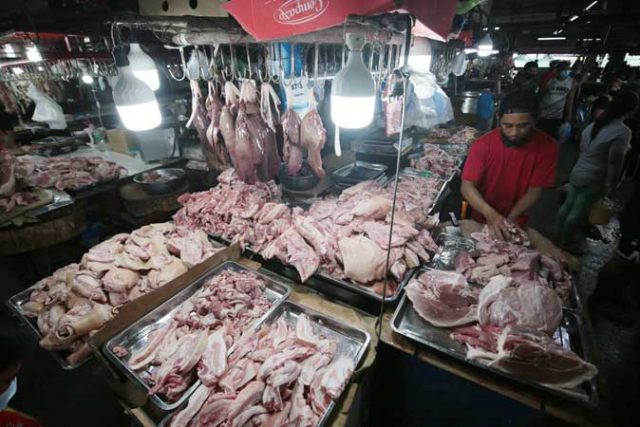
PHILIPPINE STAR/ MICHAEL VARCAS

Here we go again! Those who disagree with allowing more pork imports during this ongoing African Swine Fever (ASF) outbreak in our country are shouting “betrayal” by President Duterte of the interests of the hog producers.

This is 2019 all over again, except that this time no legislators have joined the reformers in keeping pork affordable to the Filipinos.

On April 7, the President issued Executive Order (EO) 128 lowering the tariff rate on pork imports, from 30% to 5% on pork imported under the minimum access volumes, and from 40% to 15% for out-of-quota imported pork.

The lastiko (elastic) EO did not appease the critics. The lower tariffs will be kept down for only three months. After three months, the tariff rates go up to 10% and 20%. In a year’s time, they revert back to their old rates.

This EO, even if it permanently lowered the tariff reform, which I hoped it should have been, will not “kill the industry” for two reasons. One is that the world pork market is itself affected by the ASF disease. Even if the world can supply all the pork that we need, the other reason why it cannot flood the local market is that we have limited cold chain capacity to receive all the imported pork. With this EO, imports are expected to increase. According to the President of the Meat Importers and Traders Association, Jess Cham, pork imports may double their present scale.

The world’s pork market has its own supply constraints, particularly during these years that ASF is affecting not just the Philippines but also most of the countries in the Asia and Pacific region. China, which had its first outbreak in 2018, is getting the biggest share of the import market. Because of the virus, we can only import from ASF-free countries.

We also have our constraints. Receiving additional frozen imported pork requires cold chain capacity, which we don’t have. According to a national cold chain road map study which the Board of Investments commissioned, cold chain capacity in the country is at 400,000 tons. About a third of that is exclusive for onions, tuna, sardines, and bananas. The rest is general warehousing for which meats, other seafood, dairy, other fruits, and other vegetables compete for space.

According to Anthony Dizon, President of the Cold Chain Association of the Philippines, their services cover only 40% of all food traffic along the country’s food supply chains. Without cold chain capacity, imported pork offers weak competition to local producers. International food safety standards on meats require that the product be sold off in no more than two hours under ambient temperature. Longer exposure makes the meat vulnerable to microbial contamination, which goes from bad to worse exponentially. Mr. Dizon estimates that the country needs another 300,000 metric tons of capacity from the present level.

With the rubber-band EO, additional cold chain investments because of it would only be limited, likely made by the more risk-taking members of the cold chain industry. Projected Increase in Imports Supply and use statistics of the Philippine Statistics Authority indicate that in the last five years where data is available, 2015-2019, the average import penetration was 12% of gross supply (see Figure 1). In 2019, 286,502 tons of pork were imported and the average for the last five years (2015 to 2019), was 260,602 tons.

Suppose we simulate what might happen because of this EO. With the current world market supply constraints and our cold chain capacity limitations, let us take Mr. Cham’s projection that imports would double to 500,000 tons.

Average production in the last five years, following PSA’s supply and use statistics, was placed at about 1.895 million tons. Because of ASF and the time it takes to arrest the disease so the country can re-herd and make up for lost inventory, Girag & Associates Sarl projects that local production would go down by 50% from 2020 to 2021, or about 537,000 tons.

The expected imports would just make up for the loss of local output due to the ASF virus. The import penetration would have more than tripled from 12% to 38% of gross supply due to, 1.) the doubling of imports to 500,000 tons, and, 2.) the decline of production by about 500,000 tons. This is no reason to be alarmed, even for local producers. The displacement of local production is not due to imports but because of our current problem with the ASF disease.

We should be alarmed if we did not expand our imports. Without this lastiko EO, we would have a shortage of about 200,000 tons, the difference between the expected decline of production of 500,000 tons and the current imports now of about 300,000 tons. In that situation, pork prices will increase, encouraging more substitution away from expensive pork to other sources of protein. This may sound ironic but imports will be helping producers keep the market for them while they are rebuilding their inventory.

It is possible, but improbable, that the other regions not currently hit at all or just mildly hit by the ASF virus can expand their pork production and export their surplus to the NCR, Metro Cebu, and other densely populated cities. That is not likely to happen, since ASF is still spreading and the culture of biosecurity has yet to sink in not just among producers but to all of us. Bringing pork or processed pork from one region to the other can spread the virus, and that is just part of our practice of pasalubong (bringing gifts home after a trip). Backyard farmers will have to cluster to rebuild their production in closed farms, which can more easily be defended from the virus.

That culture will take some time to sink in. In the meantime and in an environment with the ASF virus still spreading throughout the country, investments in added capacity in the regions now lightly hit or not at all by the virus, are not expected to grow as fast as the demand for pork in population centers.

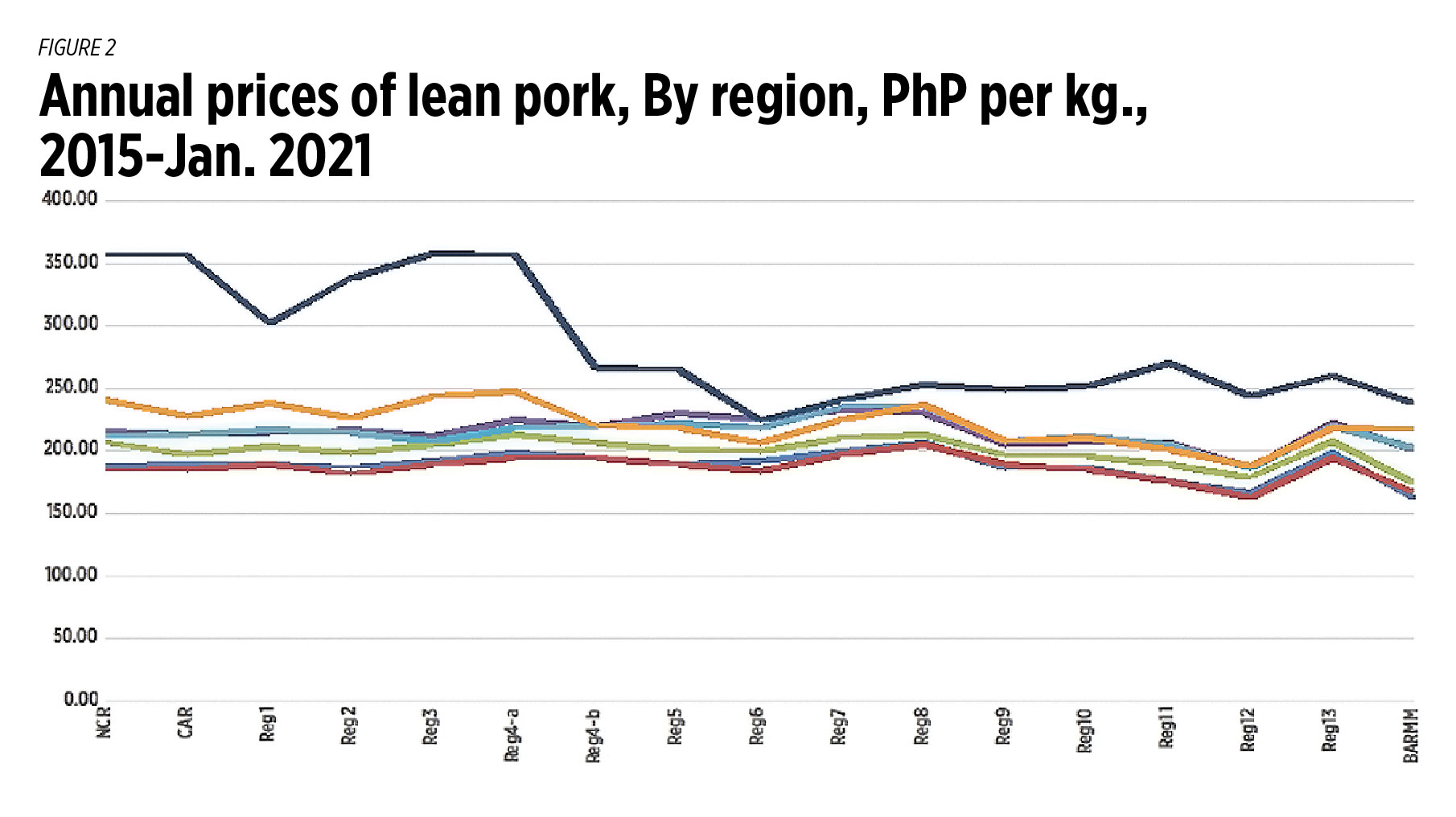
Without this EO, prices are expected to increase further. The trend towards higher prices is illustrated in Figure 2. In January 2021, the last data on prices in PSA’s website, one can see the prices to be significantly higher than the annual prices from 2015 to 2020. Higher pork prices can be avoided if imports would temporarily make up for lost production due to ASF. To me this is the benefit that EO 128 is offering all of us, not just consumers, but even pork producers. To me the benefit to producers is that the prices, if kept reasonably low, maintain the market for pork producers and dampen the substitution of pork with other sources of meat.


Ramon L. Clarete is a professor at the University of the Philippines School of Economics.

A pork crisis averted… for now

The local hog raising industry is in bad shape. From maintaining an inventory of some 13 million hogs back in 2019, the industry’s stocks have plummeted to just 8 million heads as of the beginning of 2021. The industry is going through a bloodbath, literally.

The reason for this is the aggressive spread of the African Swine Fever (ASF). The ASF virus entered our shores in 2019 through smuggled swill feed imported from mainland China. Swill feed is composed of food scraps or food waste that may contain or may have come into contact with meats infected with viruses and other pathogens. In theory, the use of swill feed is illegal, but it is still widely used in the hog raising industry. How container loads of swill feed passed the Bureau of Customs is something Commissioner Rey Guerrero has to answer for.

The spread of ASF has forced hog raisers to kill and dispose of infected hogs by the thousands. It has been the worst crisis the industry has seen in recent memory. Not only has this caused an acute shortage of pork to sustain the country’s needs, it has also caused financial havoc for our hog raisers. As a result of the hog cull, many have declared bankruptcy. Those that are still in business are operating at a loss. The majority are already in the wind-down-close-down stage since there is no relief in sight. Without financial assistance from the government, it is only a matter of time before a large chunk of the industry is decimated.

Unfortunately, there is still no viable vaccine to eliminate ASF. Although veterinary pharmaceuticals are in various stages of testing, vaccine production is still years away. All our hog raisers can do, at this point, is to continue disinfecting their pig pens in the hopes that their animals do not get infected. Without a vaccine, we will just have to wait until the virus dies out on its own. This can take anywhere from one to five years.

As one would expect, ASF has caused a massive shortage in the local pork supply. The acute shortage has put pressure on prices. We already saw prices escalate sharply last year. For instance, the wholesale price of pork bellies was only P220 per kilo, pre-ASF, as compared to P330 per kilo today.

The shortage of pork has left meat processors with no choice but to import their needs. Last year, a total of 256,000 tons of pork were imported, 30% of which came from Spain, 18% came from Canada, 17% from the US, and the rest from various countries in the EU, plus Brazil. All pork imports are subject to 30% duties if they fall under a trade quota privilege and 40% if they do not.

To ease pressure on pork prices and augment the shortage, the Office of the President handed-down Executive Order (EO) 128 on April 7. The EO effectively lowers the tariff rates of pork imports from 30% to 5% for imports within the import quota, and from 40% to 15% for imports outside the import quota. This rate applies from the day the EO takes effect to three months thereafter.

The new tariff rates will become effective as soon as the EO is published in newspapers of nationwide circulation. We expect this to happen some time this week.

Further, pending an official order from the tariff commission, import quotas were also expanded from 54,000 tons to 408,000 tons.

The Philippine Association of Meat Processors, Inc. (PAMPI) welcomes Executive Order 128. With the expansion of meat quotas and lowering of tariff rates, food processors can now import their requirements and pass them on to consumers at lower prices.

But as expected, hog raisers cried foul, claiming that a flood of imports will eat into their market. This is a fallacy. The truth of the matter is that even with tariff protection, the hog raising industry was already unable to meet local demand. And now that ASF threatens the viability of hog raising, new investments to expand capacities are few and far between.

Executive Order 128 was a timely and correct move since it arrests the steady rise of pork prices and obverts a food shortage. On this count, we congratulate the Office of the President for its decisive action.

With the proverbial fire extinguished, Malacañang must now focus on containing the spread of the ASF virus and help the hog raising industry recover.

The transport of live animals is the principal cause for the rapid spread of the virus. Since 60% of all our hog raisers are micro and small enterprises without their own slaughter or cold storage facilities, they have no choice but to transfer them, by truck, to hog consolidators or the nearest slaughterhouse. The practice exposes infected hogs not only to other animals but to the general public.

This is a practice that must be controlled. Since the transfer of hogs cannot be avoided at this time, the Department of Agriculture must impose the strictest hygiene and disinfection protocols (the protocols exist but many exceptions are made). Trucks with live animals that traverse national highways must be subject to inspection by the Philippine National Police.

For the long term, the Department of Agriculture (DA) must invest in common use slaughter houses in strategic areas around the country. There are just too few of them. It must also establish a logistics cold chain that is accessible to small hog raisers. And when a virus outbreak occurs again, the DA must act decisively to impose zoning and quarantine protocols on infected animal farms. It did not act quick enough in 2019.

As for the recovery of the industry, small hog raisers must be consolidated into cooperatives or encouraged to merge. Further, a financial lifeline and/or fiscal incentives must be granted to existing hog raisers so as to discourage them from ceasing operations altogether.

We dodged a food crisis with EO 128. Let us hope that DA does not relax and prepares for the next viral spread which is sure to come.


Andrew J. Masigan is an economist

andrew_rs6@yahoo.com

Twitter @aj_masigan

Do you love me?

Jesus said to Simon Peter, “Simon, son of John, do you love Me more than these?” He said to Him, “Yes, Lord; You know that I love You.”

(John 21:15)

Why does the Lord have to ask me three times if I loved Him, the embarrassed Peter might have muttered? And Peter remembered the words which Jesus had said, “Before a rooster crows, you will deny Me three times.” (Matthew 26:75). Three times too, Jesus found Peter and the apostles asleep when He had expressly asked them to stay awake and guard Him that night while He agonized and prayed — just before one of them, Judas Iscariot, betrayed Him to His captors.

“Let us not love with word or with tongue, but in deed and truth” (1 John 3:18).

That is the message of Lent and Easter for Christians — love is action. “By this the love of God was manifested in us, that God has sent His only begotten Son into the world so that we might live through Him.” (1 John 4:9). So is Love an act, not just a word for human love, in all its gradations and radiations.

Through two seasons of Lent and Easter under the unabating scourging of the COVID-19 pandemic, the message of Christian love for God and for one another is clear in theology but can be muddled in practicum. Of course, the restrictive isolation under quarantine is conducive to introspective examination of conscience and contrition. The very real fear of viral infection and possibly passing from this life to the next urges repentance for whatever lapses might be humbly acknowledged — for “the dread of the loss of Heaven and the fear of Hell.”

And in diffident conversion, one can go overboard in loving and giving, at the chill of some voice crying out in the wilderness — “Repent!”

Notice how easy it is now to append “Love you,” or “Labyu” in the vernacular, to almost anything posted on Viber or Facebook via the hypnotic internet, in the claustrophobic confinement to quarters. Has “love you” insinuated its way into social media communications because the ubiquitous “beso-beso” (“kiss-kiss,” the two cheek kisses of greeting and leave-taking) of the pre-COVID reality is now forbidden because of the safety rules in place to curb the coronavirus spread? “Love” and “Like” icons and GIFs, inspirational mini-posters, pass-around prayers, true and fake news are generously forwarded and sometimes go full circle back to the original sender. Pop-up birthday reminders for forgotten contacts in the directories of one’s gadgets bring lost friends together — how sweet! Love you!

But as in the gospel, love must be proven by action. A convenient excuse, this COVID-19 quarantine is, to postpone giving on time, real time proof of all those carefree “Love-yous” posted. After COVID, would there be time and capacity, for example, to respond to the physical, emotional, and spiritual calls of friendship and of love? When the hurly-burly of the day-to-day in the New Normal is grinding away, personal presence and time shared would be the active profession of one’s love with one another. A friend in need is a friend indeed. How could the Apostles, Jesus Christ’s closest friends, have slept when He was in such danger? “Are you not the Galilean, the disciple of Jesus,” asked some in the blood-thirsty mob that cried “Crucify Him!” “No, I am not,” Peter said three times. Are we ready for the serious responsibility of another’s trust and confidence in the love we can so flippantly profess?

But Peter and the disciples soon realized and repented their betrayal of Jesus. And the God-Man Jesus forgave the betrayal in the Garden of Gethsemane and restored His absolute and encompassing trust and love in all men, as He did even when Adam and Eve first betrayed Him in the Garden of Eden. Peter, the simple, feisty fisherman from Galilee, was anointed leader (the first Pope) of the community (the Church) on Earth. “Follow Me” Jesus said to him and to all (Matthew 4:19).

The sociological aspect of Love urges that it manifests and thrives in a community. Love is about relationships of trust and confidence. It is the moral fiber that weaves together individual concerns into the common good. It is born in the nucleus of the family, and grows centripetally in enlarging circles of the community, the nation, the world. Pierre Teilhard de Chardin (1881–1955), the French Jesuit priest, mystic, and paleontologist, says “love is the most universal, the most tremendous and the most mysterious of the cosmic forces… Love is both human and divine. Divine love is the energy that brought the universe into being and binds it together. Human love is whatever energy we use to help divine love achieve its purpose…” (Chardin’s Human Energy).

Alas that the COVID-19 pandemic has forestalled Chardin’s vision of Love’s unstoppable free spin towards the utopian “Omega Point” of pure and complete harmony in the universal and cosmic community — for how can this happen in the seeming fragmentation and compartmentalization of societies into basic families and even the more basic individuals, in the lockdowns, quarantines, and limited social contacts dictated by the pandemic?

The sense of community has perceptively thinned, diluted by the tears and fears of physical and economic survival. The altruism of the leadership in communities may have been overruled in some by the perhaps unfair temptations to perpetuity in power — where autocracy can be justified by the necessary centralization of controls against the spread of the virus amid the opacity of options to end the dismal situation.

And the people are perhaps too distracted and diverted to exact accountability and responsibility from leaders. Attention is on this virus, and how to survive physically and economically through perhaps another year more (most probably many more years!) of anxious fear and actual lack and deprivation of many needs and wants, the decimation of status and wealth, the foregoing of some human rights. In the social isolation in the pandemic, there can be a dramatic loss of identity and quite surely, the desensitizing of the sense of community. Add to that the proliferation of fake news and manipulative propaganda, and the people cannot really know the truth and what is going on.

Can the wavering over whether or not to be vaccinated and the near-riot clamor for a yet-unendorsed and -untested alternative prophylaxis/treatment medicine be hard proof of a deeper distrust of the leadership, in a country that has terrifyingly plunged into having one of the fastest-increasing COVID-19 cases per day? Knowing how exuberantly our President has declared publicly “I love you Xi Jinping!,” why is there such a fear — even abhorrence — of the Chinese vaccine which Duterte was supposed to have been promised by the Chinese president? Amid the fanfare over its recent (delayed) arrival, the Sinovac vaccine was nevertheless one of the first, and the most widely used vaccine among healthcare workers (the first priority), and administered last week to selected individuals below 60 years of age with comorbidities. But there is no comprehensive COVID-19 control and eradication plan yet by the IATF (Inter-Agency Task Force) at this late date.

There is no sense of urgency.

“Do you love me?” The question has not been seriously asked of the leadership by a pathetically intimidated community. Many serious issues on good governance and ethics/basic principles have arisen in the past five years, and hot-and-cold reactions from the public, mostly in the hippy social media, have quieted down as the deteriorating COVID-19 situation shouted for attention. But remember that Jesus Christ had to ask His lead apostle Peter, “Do you love me? three times, to pound into his thick head that there are responsibilities to a bond of loving trust.

The national elections are coming soon, in May 2022. By your vote, choose well the candidates who by their exhibited integrity and sincerity will answer well the question, “Do you love me?”


Amelia H. C. Ylagan is a Doctor of Business Administration from the University of the Philippines.

ahcylagan@yahoo.com

Britain races toward elusive milestone in quest to curb COVID

PEOPLE embrace each other by the National COVID Memorial wall beside St Thomas’ hospital set as a memorial to all those who have died so far in the UK from the coronavirus disease 2019 (COVID-19) in London, Britain, April 8. — REUTERS

THE UK’s increased COVID-19 immunity raises prospects of moving on from the worst of the pandemic, with some scientists saying the country could cross a key threshold as soon as Monday.

According to researchers at University College London (UCL), that’s when so-called herd immunity could be achieved in the UK Almost three-quarters of the population will have antibodies against the virus, either through vaccination or past infection, they estimate.

Britain has already seen a plunge in new cases and deaths, and the government will relax restrictions, including on outdoor dining, on Monday. Those developments have fueled hopes that the nation will soon shake off its Covid shackles.

Many other scientists think the UK is much further from herd immunity than UCL’s model suggests. It’s come under fire from some who say it overestimates the strength of vaccines and doesn’t adequately account for waning immunity and new virus variants. No more than 44% of the country has protection from COVID-19 (coronavirus disease 2019), according to estimates by Imperial College London.

“There’s a lot of uncertainty about the length of immunity, both vaccine immunity and natural immunity,” said Anne Cori, a lecturer at Imperial. “If immunity is waning, you might lose herd immunity after you reach it.”

Still, the progress marks a milestone for the European country hardest hit by the pandemic, with more than 127,000 fatalities, and for Prime Minister Boris Johnson, who was criticized for a slow response to the crisis.

In the early days, his government’s chief scientific adviser suffered a backlash after speaking about the UK’s apparent ambition to “build up some degree of herd immunity” — exposing a proportion of the population to the virus — but he has since insisted this was never official policy and claims he was misinterpreted.

Virologists describe herd immunity as the point at which a virus struggles to make inroads into a society because of high immunity levels, either through vaccination or previous exposure to the pathogen. If it’s elusive for the UK, for most of the rest of the world it’s still a distant dream. Experts agree that speeding up vaccinations is the surest way to bring the virus under control, and in that regard Britain is out in front of most other nations.

Almost half of Britons have received at least one vaccine dose, compared with just over a third of Americans and 14% of EU residents, according to Bloomberg’s Vaccine Tracker. Still, after becoming an epicenter of a fresh Covid surge, there are tentative signs that Western Europe is turning the corner.

On Thursday, France hit a target of giving a first jab to 10 million people, a week ahead of schedule. Germany vaccinated 720,000 people that day, a record for the nation, and aims to comprehensively inoculate its population by mid-summer. As supplies ramp up, Europe’s largest economy could administer 3.5 million doses a week, according to Health Minister Jens Spahn.

Even so, European nations will likely lag behind Britain in fully vaccinating 75% of their populations, according to analysis by Airfinity Ltd., a London-based research firm. While the UK is set to reach that level by early August, Germany won’t get there until September and France until October, the firm’s current estimates show.

The European Commission is looking to ensure a steady supply of vaccines in coming years, to avoid the shortages that have hobbled immunization campaigns in the bloc.

Shots may be needed for years to come, especially if the virus continues to mutate and circulates at lower levels, much like the flu.

“Longer-term, it’s going to be more like an epidemic where there are sometimes outbreaks and you’ll need to manage that,” said Matt Linley, a senior analyst at Airfinity. -— Bloomberg

South African variant can ‘break through’ Pfizer vaccine, Israeli study says

REUTERS

JERUSALEM  — The coronavirus variant discovered in South Africa can “break through” Pfizer/BioNTech’s COVID-19 vaccine to some extent, a real-world data study in Israel found, though its prevalence in the country is low and the research has not been peer reviewed.

The study, released on Saturday, compared almost 400 people who had tested positive for COVID-19, 14 days or more after they received one or two doses of the vaccine, against the same number of unvaccinated patients with the disease. It matched age and gender, among other characteristics.

The South African variant, B.1.351, was found to make up about 1% of all the COVID-19 cases across all the people studied, according to the study by Tel Aviv University and Israel’s largest healthcare provider, Clalit.

But among patients who had received two doses of the vaccine, the variant’s prevalence rate was eight times higher than those unvaccinated — 5.4% versus 0.7%.

This suggests the vaccine is less effective against the South African variant, compared with the original coronavirus and a variant first identified in Britain that has come to comprise nearly all COVID-19 cases in Israel, the researchers said.

“We found a disproportionately higher rate of the South African variant among people vaccinated with a second dose, compared to the unvaccinated group. This means that the South African variant is able, to some extent, to break through the vaccine’s protection,” said Tel Aviv University’s Adi Stern.

The researchers cautioned, though, that the study only had a small sample size of people infected with the South African variant because of its rarity in Israel.

They also said the research was not intended to deduce overall vaccine effectiveness against any variant, since it only looked at people who had already tested positive for COVID-19, not at overall infection rates.

Pfizer and BioNTech could not be immediately reached for comment outside business hours.

The companies said on April 1 that their vaccine was around 91% effective at preventing COVID-19, citing updated trial data that included participants inoculated for up to six months.

In respect to the South African variant, they said that among a group of 800 study volunteers in South Africa, where B.1.351 is widespread, there were nine cases of COVID-19, all of which occurred among participants who got the placebo. Of those nine cases, six were among individuals infected with the South African variant.

Some previous studies have indicated that the Pfizer/BioNTech shot was less potent against the B.1.351 variant than against other variants of the coronavirus, but still offered a robust defense.

While the results of the study may cause concern, the low prevalence of the South African strain was encouraging, according to Ms. Stern.

“Even if the South African variant does break through the vaccine’s protection, it has not spread widely through the population,” said Ms. Stern, adding that the British variant may be “blocking” the spread of the South African strain.

Almost 53% of Israel’s 9.3 million population has received both Pfizer doses. Israel has largely reopened its economy in recent weeks while the pandemic appears to be receding, with infection rates, severe illness and hospitalizations dropping sharply. About a third of Israelis are below the age of 16, which means they are still not eligible for the shot. — Reuters

Philippines records 401 coronavirus deaths, highest daily increase

MANILA – The Philippines’ health ministry on Friday reported 401 new coronavirus deaths, the highest single-day spike in fatalities since the start of the pandemic, and 12,225 additional infections.

In a bulletin, the ministry said total confirmed cases had risen to 840,554, while confirmed deaths had reached 14,520. It said 213 cases previously tagged as recoveries were reclassified as deaths after final validation. – Reuters

US, Philippine top diplomats express concerns over Chinese militia boats

WASHINGTON – U.S. Secretary of State Antony Blinken and Philippine Foreign Affairs Secretary Teodoro Locsin, in a phone call on Thursday, expressed their shared concerns about Chinese militia vessels in the South China Sea, the U.S. State Department said in a statement.

Blinken also reaffirmed that a U.S.-Philippine Mutual Defense Treaty applied to the South China Sea, the statement said.

The Philippines has described the presence of hundreds of Chinese boats inside its 200-mile exclusive economic zone at Whitsun Reef in the South China Sea as “swarming and threatening.”

Chinese diplomats have said the boats were sheltering from rough seas and no militia were aboard.

Brunei, Malaysia, the Philippines, Taiwan, China and Vietnam have competing territorial claims in the South China Sea, through which at least $3.4 trillion of annual trade passes. – Reuters

Speed up your game with the new vivo
Y20s [G]

vivo’s newest budget smartphone can be pre-ordered on April 10-15, with free True Wireless Earphones

Playing games like Mobile Legends or League of Legends on smartphone has become one of the ways Filipinos pass time, especially with the lockdown still keeping many at their homes most of the time. As smartphones get more upgraded and enhanced, users can enjoy playing more sophisticated games for hours without compromise on the stability and performance of their phones.

Global technology brand vivo continues to upgrade its industry-leading gaming technology packed in its smartphones, and it will launch this April its latest upgrade – the vivo Y20s [G], a budget smartphone loaded with features that will provide users a smooth and high-performing gaming experience.

Enabling its capacities for gaming, the Vivo Y20s [G] is powered by a MediaTekHelio G8O gaming processor that optimizes performance as well as effectively manages all of the budget smartphone’s resources.

This high-octane processor also gives vivo’s leading AI camera technology a boost, perfectly utilizing the smartphone’s triple camera setup which consists of a 13MP Main, 2MP Bokeh, and 2MP Macro lenses.

Complementing this processor is the smartphone’s 6GB RAM and 128GB ROM, which eliminates lag and provides enough space for all the user’s gaming needs.

All of these notable features are supported by a powerful 5000mAh battery with 18W fast charge technology, allowing users to keep playing and winning the games they want whenever they want.

Set to speed up users’ gaming experiences, the new vivo Y20s [G] is priced at a budget-friendly price of P9,999.

vivo Y20s [G] will soon be enjoyed by Filipino gamers as it will be available for pre-order from April 10 to 15 in vivo stores and kiosks nationwide. Customers who pre-order on those dates will get a free pair of vivo True Wireless Earphones, which are originally worth P2,499.

For more information about the new vivo Y20s [G], visit www.vivoglobal.ph or www.facebook.com/vivo.philippines.

ADVERTISEMENT
ADVERTISEMENT