Home Blog Page 8237

Apple to hold special event on April 20

APPLE, Inc. said on Tuesday it was holding a special event on April 20, with many expecting the tech giant to launch new iPad Pro models and other products ahead of its annual developers’ conference in June.

Apple’s cryptic invitation for the media did not give much away and read: “Spring Loaded.” The event will be live-streamed on the company’s website from its campus in Cupertino, California, it added.

Earlier, Apple’s virtual assistant Siri, which is known for stonewalling curious Apple fans quizzing it about new products and upcoming events by directing them to the company’s website, prematurely revealed the iPhone maker’s plan to hold an event next Tuesday.

When asked by Reuters reporters about Apple’s next event on their iPhones, Siri responded by displaying a message that said, “the special event is on Tuesday, April 20th, at Apple Park in Cupertino, CA. You can get all the details on Apple.com.”

Apple typically launches new hardware in March before releasing the latest version of its iOS software at its annual developers’ conference later in the summer.

This year, the company is yet to host any product-launch events although technology news websites have speculated that the company may unveil new iPad Pro models and the long-awaited device tracker, dubbed AirTags, at the upcoming event.

Known for splashy launches packed with hundreds of journalists at its sprawling campus, Apple has turned to virtual events since last year because of the COVID-19 pandemic. —  Reuters

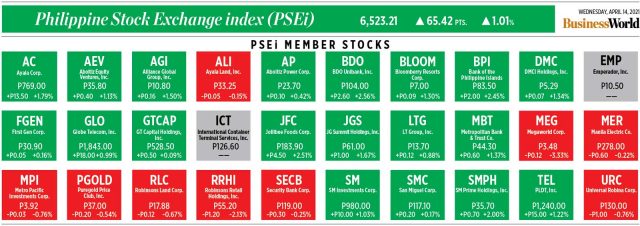
How PSEi member stocks performed — April 14, 2021

Here’s a quick glance at how PSEi stocks fared on Wednesday, April 14, 2021.


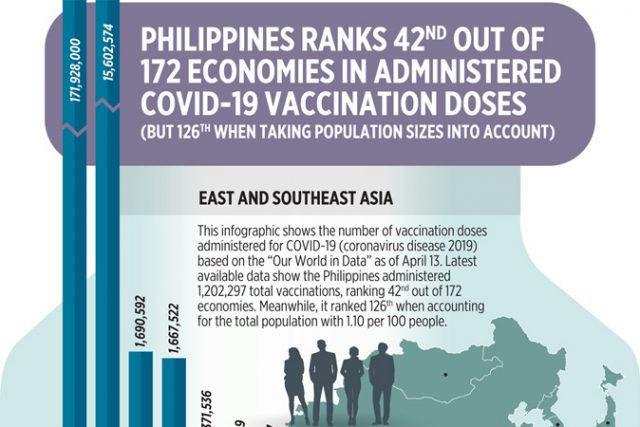
Philippines ranks 42nd out of 172 economies in administered COVID-19 vaccination doses

Philippines ranks 42<sup>nd</sup> out of 172 economies in administered COVID-19 vaccination doses

Peso gains vs dollar on improved outlook for PHL banking sector

BW FILE PHOTO

THE PESO strengthened against the greenback on Wednesday after Moody’s Investors Service raised its outlook on the local banking industry.

The local unit closed at P48.499 versus the dollar on Wednesday, gaining 5.6 centavos from its previous finish of P48.555, based on data from the Bankers Association of the Philippines.

The peso opened the session at P48.52 per dollar. Its weakest showing was at P48.53 while its intraday best was at P48.46 against the greenback.

Dollars exchanged rose to $664.35 million on Wednesday from $451.9 million on Tuesday.

Rizal Commercial Banking Corp. Chief Economist Michael R. Ricafort said the peso gained versus the dollar after Moody’s upgraded the country’s banking system’s outlook to stable from negative.

Moody’s on Tuesday raised its outlook on the banking sector, saying it expects an improvement in lenders’ operating environment amid a “mild economic recovery.”

The ratings agency in April 2020 revised the sector’s outlook to negative when the country was in a lockdown that was expected to put pressure on banks’ profitability and asset quality.

Meanwhile, a trader said the peso climbed following the release of US inflation data.

“The peso strengthened anew from easing inflationary concerns decline after US core inflation remained relatively muted from February levels,” the trader said in an e-mail.

US consumer prices rose by the most in more than 8-1/2 years in March as increased vaccinations and massive fiscal stimulus unleashed pent-up demand, kicking off what most economists expect will be a brief period of higher inflation, Reuters reported.

The report from the US Labor department on Tuesday also showed a firming in underlying prices last month as the broader reopening of the economy bumps against bottlenecks in the supply chain, capacity constraints and higher commodity prices.

The consumer price index (CPI) jumped 0.6% last month, the largest gain since August 2012, after rising 0.4% in February. A 9.1% surge in gasoline prices accounted for nearly half of the increase in the CPI. Gasoline prices rose 6.4% in February.

Excluding the volatile food and energy components, the CPI increased 0.3% after nudging up 0.1% in February. The largest gain in seven months in the so-called core CPI was driven by a rise in rents as well as hotel and motel accommodation prices, which rebounded 4.4% after falling 2.7% in February.

The core CPI increased 1.6% on a year-on-year basis after rising 1.3% in February. The Federal Reserve tracks the core personal consumption expenditures (PCE) price index for its 2% inflation target, a flexible average. The core PCE price index is at 1.5%.

For today, Mr. Ricafort gave a forecast range of P48.45 to P48.54 per dollar, while the trader expects the local unit to move within P48.40 to P48.60. — L.W.T. Noble with Reuters

PSEi up on bargain hunting, slowdown in cases

STOCKS inched up on Wednesday after the country logged lower coronavirus disease 2019 (COVID-19) cases the day prior and as investors went bargain hunting following days of decline.

The 30-member Philippine Stock Exchange index (PSEi) improved by 65.42 points or 1.01% to close at 6,523.21 on Wednesday, while the broader all shares index gained 30.81 points or 0.77% to end at 3,984.62.

“Market moved up today on bargain hunting after a lower infection [rate] of [four digits] was reported yesterday that somewhat created a positive sentiment among investors,” Diversified Securities, Inc. Equity Trader Aniceto K. Pangan said via text message on Wednesday.

The Health department reported 8,571 new COVID-19 infections on Tuesday, which brought the country’s tally to 884,783.

The PSEi also rose “due to aggressive buying at the closing auction, particularly in index heavyweights such as AC (Ayala Corp.), SM (SM Investments Corp.), SMPH (SM Prime Holdings, Inc.), BDO (BDO Unibank, Inc.), BPI (Bank of the Philippine Islands) and JGS (JG Summit Holdings, Inc.),” China Bank Securities Corp. Research Associate Zoren Philip A. Musngi said via e-mail.

“Notable events that may have driven the bullish sentiment today are the prioritization of several economic bills for foreign investment and the strong March figures for car sales,” Mr. Musngi said on Wednesday.

All sectoral indices posted gains on Wednesday. Financials went up by 24.71 points or 1.8% to 1,390.93; holding firms improved by 77.47 points or 1.17% to close at 6,677.70; property increased by 21.93 points or 0.69% to 3,201.14; services gained 7.68 points or 0.53% to 1,434.56; industrials rose by 35.86 points or 0.41% to 8,696.43; and mining and oil inched up by 22.19 points or 0.26% to end at 8,353.18.

Value turnover declined to P4.68 billion on Wednesday with 1.73 billion shares switching hands, from the P6.1 billion with 1.93 billion issues seen the previous day.

Diversified Securities’ Mr. Pangan said this is below average and is “indicative of most investors [being] cautious and staying on the sidelines.”

Advancers beat decliners, 111 to 81, while 55 names closed unchanged.

Net foreign selling slowed to P710.73 million on Wednesday from the P1.42 billion in net outflows seen on Tuesday.

Mr. Pangan said the upside momentum of the index may continue if “infection rates sustain their downside trend.”

Meanwhile, China Bank Securities’ Mr. Musngi expects the PSEi to finish between 6,440 to 6,650 in the near term.

“[This is] due the lack of meaningful upside catalysts and multiple headwinds from concerns around COVID-19 and lockdown developments, high inflation, economic growth, unemployment, rising bank NPLs (nonperforming loans), and geopolitical tensions with China,” he said. — Keren Concepcion G. Valmonte

Moody’s warns of risks in rolling back QE

REUTERS

MOODY’S INVESTORS Service said emerging markets face risks in the timing of their unwinding of quantitative easing (QE) measures as economies recover.

“Extending quantitative easing when an economic recovery is already underway would make it more difficult to roll back, especially if not supported by strong institutional frameworks. On the other hand, prematurely withdrawing quantitative easing could tighten financial conditions and jeopardize a nascent recovery,” Moody’s said in a note Wednesday.

It added that risks from quantitative easing and the unwinding process will depend on institutional frameworks and macroeconomic fundamentals, noting that emerging economies have varying debt servicing capacities.

“Prolonged use of (QE) also heightens the risk that a government will use monetary policy to monetize debt. The erosion in central bank independence, and escalation of inflation expectations and loss of investor confidence, would have a destabilizing effect on the exchange rate,” it said.

Moody’s noted the Bangko Sentral ng Pilipinas (BSP) implemented QE through its repurchase agreement with the National Government and bond purchases in the secondary market.

BSP Governor Benjamin E. Diokno has said the bank has extended the maturity of the P540-billion zero-interest loan it granted to the National Government by another three months. It was originally supposed to have been repaid in March, although another three-month extension is allowed by the Bayanihan II economic stimulus law.

Mr. Diokno also said the bank will carefully assess the timing of the QE exit in order to maintain financial stability.

“So far we have not seen core inflation in emerging markets accelerating as a result of these programs, because of the wider effects of a shortfall in overall demand,” Moodys said.

Philippine gross international reserves hit $105.16 billion at the end of February, sufficient to cover 12 months’ worth of imports of goods and payments for services. It can also cover 7.5 times short-term foreign debt based on original maturity and 5.2 times based on residual maturity.

Inflation was 4.5% in March, above the 2-4% target but lower than the 4.7% in February. Core inflation, which strips out volatile items like food and oil, was at 3.5%.

Central bank officials have said the recent uptick in inflation is not demand-driven and is caused by price pressures from low supply which are better addressed by non-monetary measures. — Luz Wendy T. Noble

SEC to exempt financial, multilateral institutions from registering securities

THE Securities and Exchange Commission (SEC) has proposed to exempt from registration securities offered by financial and multilateral institutions, which it deems to be sufficiently regulated by other entities.

The current registration requirements are detailed in Sections 8 and 12 of the Securities Regulation Code (SRC).

Securities offered by government financial institutions will also be exempt from Section 12, which outlines the registration procedures.

“Any evidence of indebtedness issued by a financial institution that has been licensed by the BSP (Bangko Sentral ng Pilipinas) to engage in banking or quasi-banking shall be exempt from registration under Section 8.1 of the Code,” the SEC said.

These also include those issued to the BSP through open market or rediscounting operations, and bills from the sale of goods and services.

Securities issued by multilateral financial entities (MFEs) via any agreement involving the Philippines will also be exempt.

MFEs planning to issue securities are required to publish an offering circular in the SEC-stipulated format, which must include details on the issuer and the security, the background of the MFE, and information on the guarantee.

Exemptions will also apply to other items indicating evidence of indebtedness, as long as these meet the following requirements: issued to not more than 19 non-institutional lenders, payable to a specific person, not negotiable nor assignable and held until maturity, and not exceeding P150 million.

Meanwhile, the purchase, sale, and distribution of these securities and other post-trade activities should still comply with the provisions of the Code.

“The purchase and sale of such security shall not be exempt from the coverage of the provisions of the code on civil and other related liabilities, and other applicable provisions of the code on fraud,” the SEC said.

Issuers may also be asked to disclose information on their business operations, financial condition, and use of proceeds, among others.

Registration requirements will also not apply to securities issued and sold to a registered securities dealer, accounts managed by registered brokers, licensed investment companies, government-maintained funds, trust corporations, and unit investment trust funds established under the rules and regulations of the BSP.

Securities sold to BSP-licensed quasi bank entities, pre-need companies, authorized collective investment schemes, listed professional fund managers will also be exempted from Sections 8 and 12 of the SRC.

The SEC is accepting comment on the proposal until April 20 through its Markets and Securities Regulation Department. — Keren Concepcion G. Valmonte

Legislators declare intent to oppose higher pork import quota

PHILIPPINE STAR/ MICHAEL VARCAS

LEGISLATORS are gearing up for a fight after the government announced plans to expand the allowable quota of pork imports, saying that allowing more pork into the country at lower tariff rates will cost the government billions of pesos in revenue.

The opposition was coalescing following a proposal to drastically increase the minimum access volume (MAV), the quota within which imports are charged low tariffs.

Senator Franklin M. Drilon said in a radio interview Wednesday that based on data presented at a hearing of the Senate Committee of the Whole on April 12, pork imports in the last 10 years averaged 125,000 metric tons (MT), a level of imports sufficient to keep pork prices in a range of P180 to P200 per kilogram.

“This is why we cannot see the reason why pork tariffs should be lowered and the MAV allocation of pork imports to be increased. The government can potentially lose P11 billion… (from) lower tariffs,” Mr. Drilon said.

As a result, Mr. Drilon said a proposed joint resolution will be filed, supported by Senators Cynthia A. Villar and Francis N. Pangilinan, to revoke Executive Order (EO) No. 128, which lowered the tariff rate on pork imports.

He added that if Congress fails to act on President Rodrigo R. Duterte’s recommendation to increase the pork import MAV quota within 15 days, it will be deemed approved under Republic Act No. 8178 or the Agricultural Tariffication Act.   

“We cannot act on the recommendation since it was given to us during the Senate’s last session day on March 26. It is impossible. But this shows that the power to determine the number of pork imports is with Congress,” Mr. Drilon said.

“The remedy we see is to create a joint resolution to reset the MAV allocation to its previous volume, or approve an allocation under the 125,000 MT average import level for the last 10 years,” he added. 

Mr. Duterte has recommended that Congress increase the MAV allocation by 350,000 MT, adding to the current quota of 54,210 MT, in order to address the supply deficit projected by the Department of Agriculture of 400,000 MT.

On April 7, Mr. Duterte issued EO 128 which lowered the tariff on pork imports within the MAV quota to 5% in the first three months, increasing to 10% in the following nine months.

The EO also reduced the tariff on out-of-quota pork imports to 15% in the first three months, rising to 20% in the succeeding nine months.

Previously, pork imports within the MAV quota paid 30%, while out-of-quota imports were charged 40%.

Meanwhile, the MAV scheme applies to farm commodities that can be imported with lower tariffs in order to facilitate trade, and is part of the commitment of the Philippines to the World Trade Organization.

Agriculture Secretary William D. Dar has also a suggested retail price (SRP) for imported pork products, with imported pork shoulder (kasim) at P270 per kilogram, and imported pork belly (liempo) at P350 per kilogram.

Mr. Dar said no new SRP will be issued for domestic pork products.

The new SRPs for imported pork replaced EO 124, which lapsed on April 8. It had capped the price of kasim at P270 per kilogram, liempo at P300 per kilogram, and whole chicken at P160 per kilogram.

Pork supply is tight because of the impact of African Swine Fever on domestic growers, leading to rising prices and threatening another inflation crisis.

Marikina City Rep. Stella Luz A. Quimbo said in a statement Wednesday that the reduction of pork import tariffs is premature because importers can price their products without concern for competition, reducing the possibility that lower tariffs will help bring down retail prices.

Ms. Quimbo added: “If the government is allowed to import pork at the new reduced tariffs and sell directly to consumers, then importers will face competition. This is one way to ensure that reduced tariffs will translate to lower prices in the markets.”

“Otherwise, importers can simply purchase low and continue to sell high in the market, especially if they engage in anti-competitive practices such as price fixing,” she added.

Seventeen House legislators filed a joint resolution Wednesday seeking the termination or withdrawal of EO 128, and the rejection of the planned increase in the pork MAV.

Signatories to the proposed joint resolution were Rep. Carlos Isagani T. Zarate; Rep. Jose Christopher Y. Belmonte; Rep. Argel Joseph T. Cabatbat; Rep. Eufemia C. Cullamat; Rep. Sarah Jane L. Elago; Rep. Jonathan Keith T. Flores; Rep. Janette L. Garin; Rep. Edcel C. Lagman; and Rep. Noel L. Villanueva; Rep. Geraldine B. Roman; Rep. Rico B. Geron; Rep. Ferdinand R. Gaite; Rep. Edgar R. Erice; Rep. Lorenz R. Defensor; Rep. France L. Castro; Rep. Arlene D. Brosas; and Rep. Rose Marie J. Arenas.

“EO 128 would (cause) irreparable damage to the pork industry and to the agricultural sector as a whole,” according to the resolution.

“The further decline of the pork industry will also affect many allied industries, including poultry, corn farmers and coconut farmers, and other such industries using or dependent on pork products will likely impact on the country’s agricultural development,” it added. — Revin Mikhael D. Ochave


IC orders new pricing system for catastrophe cover by next year

PHILSTAR FILE PHOTO

THE Insurance Commission (IC) said all non-life insurance companies must adopt and implement new rates and a new rating structure for all their catastrophe risk policies starting April 2022.

Insurance Commissioner Dennis B. Funa issued Circular Letter 2021-27 dated April 12 asking the non-life industry to implement the sustainable catastrophe insurance premium rates and formally establish the Philippine Catastrophe Insurance Facility (PCIF).

He also announced a consultation with the sector to determine the rates, inviting companies to send representatives to the technical working group for the PCIF and help draw up the structure, governance and other implementation details of the facility.

“(The process will include) the commitment of the participating non-life insurance companies to adhere to the established sustainable catastrophe insurance premium rates through the compulsory cession to the PCIF,” according to the circular.

It said in surrendering the right to set rates for the facility, the industry will charge a “reasonable percentage or maximum limit” per risk and per policy as agreed by the non-life insurance sector, led by the Philippine Insurers and Reinsurers Association.

The cessions to the PCIF should start by April 2022, the IC said, in consideration of active reinsurance agreements of non-life insurers.

The facility was established to help non-life insurance companies better manage disaster-related exposure and expand the sector’s capacity to take on more risk.

It allows nonlife insurers to share the risks associated with catastrophe insurance products by pooling them in the facility.

Prior to the PCIF, insurance companies with natural disaster-related insurance products entered into reinsurance agreements overseas.

Pooling resources in the PCIF and keeping them within the country will help the nonlife sector boost its premium base and eventually expand the catastrophe insurance products these companies offer.

The Philippines is one of the most disaster-prone countries in the world, frequently hit by typhoons, flooding, landslides, volcanic eruptions and other extreme climate patterns such as El Niño and La Niña. — Beatrice M. Laforga

Finland sees potential in PHL digitalization, climate change projects

REUTERS

THE Finnish ambassador has conveyed interest in possible collaboration with the Philippines in climate change mitigation and digitalization projects, the Department of Finance said in a statement Wednesday.

Finnish Ambassador to Manila Juha Pyykkö made the remarks in a recent video meeting with Finance Secretary Carlos G. Dominguez III, according to the statement. He also listed smart city development, education, and digital healthcare as possible areas of investment.

Mr. Pyykkö said he would like Finnish investors to “have another look at the Philippines,” citing its stable economy and strong medium-term outlook.

Mr. Pyykkö was the first resident ambassador dispatched by Helsinki since Finland reopened its diplomatic mission in January. It had shut down its embassy in Manila in 2012.

He said the reopening of the embassy should facilitate closer business ties. — Beatrice M. Laforga

Faster takedowns sought for sites with pirated material

THE intellectual property office will work with the National Telecommunications Commission (NTC) to effect faster blocking of websites carrying pirated material.

The Intellectual Property Office of the Philippines (IPOPHL), in a statement Wednesday, said it will partner with NTC to develop streamlined protocols for rapid site blocking.

IPOPHL has been asking Congress for power to issue take-down orders for the NTC to immediately block websites, foregoing a review process. Bills on the proposed amendments to the intellectual property code are being consolidated by the House of Representatives.

For now, IPOPHL can review piracy complaints from intellectual property rights holders and request the NTC to order internet service providers (ISPs) to take down the websites.

In a meeting with the agency, ISPs said collaboration between IPOPHL and NTC will prevent the shutdown of law-abiding websites.

IPOPHL Rights Enforcement Officer-in-Charge and Director Ann N. Edillon said that the agency makes sure to weigh the evidence of piracy before referring websites to the NTC for blocking.

“The duration of IPOPHL’s investigations will depend on the merits of the case and evidence submitted, but we always ensure a speedy and thoroughly validated decision,” she said.

IPOPHL recently partnered with the Asia Video Industry Association (AVIA) to develop site blocking measures for pirated content.

AVIA will provide information on piracy, conduct training on piracy matters, and make recommendations for IPOPHL’s online piracy monitoring and rolling site blocking. IPOPHL in turn will review piracy issues and will act on piracy reports and tips from AVIA. — Jenina P. Ibañez

Tax residency issues: Gateway to tax assessments

Through the years, countries have developed a network of tax treaty agreements which provide tax residents of treaty countries income tax exemption or preferential tax treatment on foreign-sourced income. As a minimum requirement to avail of tax treaty benefits, an income earner must prove that it is a tax resident of the treaty country. This is done by presenting a tax residency certificate (TRC) issued by the tax authority of the home country.

In 2019, the Bureau of Internal Revenue (BIR) issued Revenue Memorandum Order (RMO) No. 51-2019 providing guidelines and procedures for Philippine taxpayers who wish to secure a TRC. Among the objectives of the RMO is to monitor the reporting and declaration of foreign-sourced income in the tax returns of the applicant-taxpayers since they are taxable on their worldwide income. In 2020, the BIR issued RMO No. 43-2020 to further streamline the process of securing TRCs. Under these rules, domestic corporations or resident citizens requesting a TRC must submit their annual income tax return (ITR) for the immediately preceding year. In practice, Audited Financial Statements (AFS) and VAT returns are also requested by the tax authority.

According to the RMO, the International Tax Affairs Division (ITAD) acts as the repository of documents, substantiating the foreign-sourced income of Philippine taxpayers and furnishing the Revenue District Office (RDO) or Large Taxpayers Division (LTD) with all documents submitted by the applicant. The RDO or LTD is tasked to verify whether the foreign-sourced income was properly declared by the taxpayer and if the corresponding tax was paid. If not, the RDO or LTD, following the procedures for conducting tax investigation, must assess the deficiency tax and enforce its collection, including penalties. This is where the challenge comes in. Assessment of deficiency tax solely on the basis that the foreign-sourced income was not reported in the tax returns or AFS submitted during the application was filed seems unjustified primarily because of the chronology of events as well as different rules for declaring the revenue.

The ultimate purpose of requesting a TRC is for the Philippine taxpayer to avail of treaty benefits for its foreign-sourced income. Without a TRC, the foreign income payor may not be able to apply the reduced withholding tax rate or exemption to its payment to the Philippine income earner. To ensure compliance with the TRC requirements of the foreign tax authority and considering the usual processing time for TRC issuance by the BIR, Philippine taxpayers prudently opt to file the TRC application much earlier than the date the income is expected to be earned and/or received. Consequently, the AFS and the tax returns available at the time the application is filed with the BIR may not yet reflect the foreign-sourced income.

For instance, take the case of anticipated dividend income from a foreign company by a Philippine taxpayer. The foreign company may hold off declaration and payment of dividends until the TRC is secured. The TRC is necessary for the foreign company to be able to apply the preferential tax rate to which the Philippine taxpayer is eligible. Until the dividends are declared and received, the Philippine taxpayer may have no basis to report such foreign-sourced dividend income in its AFS and tax returns.

On the other hand, in the case of foreign-sourced service income, following the VAT rules, such income should only be reported upon collection of the payment. Thus, while the income may have already been earned, the gross receipts would not be reflected in the VAT returns until the TRC is secured and the service fees can be remitted to the Philippines.

In both scenarios, the AFS and tax returns do not reflect the foreign-sourced income, but this should not warrant issuance of an assessment notice to the taxpayer. Instead, the rules can be adjusted to recognize such timing/reporting discrepancies, or at the very least, to give the taxpayer an opportunity to clarify its side before responding with a full regular tax audit and eventual assessment of deficiency taxes which may only be refuted by the taxpayer with factual and legal basis.

In addition, assessment issues that sprout from a Philippine taxpayer’s request for TRC to avail of tax treaty benefits negate, to some extent, the purpose of the tax treaty — to avoid double taxation and give relief to the taxpayer from paying the undue amount of taxes on foreign-sourced income.

The process and requirements may also leave taxpayers with little recourse but to forego the treaty benefit at the outset, so that the foreign income can be remitted (albeit without the benefit of the preferential treaty rate or exemption) and reported in the Philippines for tax and financial reporting purposes, and the TRC secured. Recovery of the overpaid tax may then be through a refund from the foreign tax office, which may or may not be feasible.

Supposedly, if the taxpayer does not secure a refund from the foreign tax authority, the taxpayer should be able to recover the foreign tax withheld as a foreign tax credit or deduction in its ITR which is allowed under the Tax Code. However, unfortunately, this also raises issues with the BIR during an audit as examiners are instructed to disallow the foreign tax credit claimed on the ground that the taxpayer should have availed of treaty relief. Instead of claiming a tax credit, RMO 43-2020 suggests that the taxpayer secure a TRC and file a claim for tax refund in the foreign country. Something that the current TRC procedures have made rather difficult. In fact, one could say, it has devolved into a chicken or egg situation.

It may also be a good time to revisit the rules given that under the recently enacted Corporate Recovery and Tax Incentives for Enterprises (CREATE) law, foreign-sourced dividends may already be subject to exemption provided conditions are met. At least for dividends, checking compliance with the conditions for exemption should now be considered before issuing any potential deficiency tax assessment.

One hopes that these procedural issues are revisited to make it easier to secure a TRC, so that the intention of entering tax treaties with other countries is not undermined and so the BIR can also achieve its objective of not losing out to other countries on its share of the international tax pie. I suspect that given the choice, Philippine taxpayers would choose to pay tax to the Philippine government instead of to a foreign country.

The views or opinions expressed in this article are solely those of the author and do not necessarily represent those of Isla Lipana & Co. The content is for general information purposes only, and should not be used as a substitute for specific advice.


Donabel M. Villegas  is a tax manager at the Tax Services Department of Isla Lipana & Co., the Philippine member firm of the PwC network.

+63 (2) 845-2728

donabel.m.villegas@pwc.com

ADVERTISEMENT
ADVERTISEMENT