Home Blog Page 8193

Peso to rise on flows from tax payments

BW FILE PHOTO

THE PESO is likely to appreciate against the greenback this week amid flows from tax payments and improved sentiment due to better global corporate earnings.

The peso finished at P48.38 a dollar on Friday, gaining six centavos from its P48.44 close on Thursday, based on data from the Bankers Association of the Philippines.

It also strengthened by 16 centavos against its P48.54 finish on April 8. The market was closed on April 9 for the Day of Valor.

Rizal Commercial Banking Corp. Chief Economist Michael L. Ricafort attributed the peso’s strength last week to positive sentiment after the announcement of a new priority group for vaccination that includes economic frontliners.

Risk appetite also improved last week on the back of upbeat remittances data, UnionBank of the Philippines, Inc. Chief Economist Ruben Carlo O. Asuncion said. 

Cash remittances rose 5.1% to $2.477 billion in February from $2.358 billion a year earlier, data released by the Bangko Sentral ng Pilipinas on Thursday showed. This was the quickest monthly pace of growth in inflows since the 9.3% seen in September and ended two straight months of annual contractions.

For this week, Mr. Ricafort said the expected seasonal increase in volume due to the April 15 income tax payment deadline could affect peso-dollar trading.

Meanwhile, Mr. Asuncion said better-than-expected earnings of global firms could support the peso this week.

Mr. Ricafort sees the peso trading within P48.25 to P48.55 per dollar while Mr. Asuncion expects the local unit to move within the P48.30 to P48.60 levels. — LWTN

PSE index to move sideways on income reports

COURTESY OF PHILIPPINE STOCK EXCHANGE, INC.

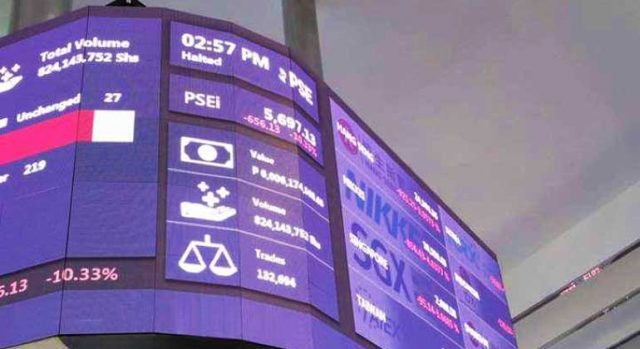
SHARES are expected to move sideways this week as earnings reports from companies at home and abroad are released and as investors continue to monitor the government’s coronavirus disease 2019 (COVID-19) vaccination program.

The Philippine Stock Exchange index (PSEi) went down by 45.15 points or 0.69% to end at 6,494.81 on Friday. Week on week, the PSEi lost 50.36 points from its 6,545.17 close on April 8.

The previous week saw an average of 3.43 billion shares switching hands, with Tuesday recording the lowest at 1.93 billion issues traded. Friday saw the most number of trades at 6.77 billion.

“This week’s market move is likely due to persistent investor disinterest in the local market, as evidenced by soft trading volumes,” China Bank Securities Corp. Research Director Rastine Mackie D. Mercado said in an e-mail on Sunday.

“One bright spot in the last trading week was the energetic activity in mining stocks following the surprise gov’t announcement on the easing of mining restrictions,” Mr. Mercado said. “We expect this development to drive fund flows into the sector in the near term, buoying further rallies.”

Mining stocks improved last week after President Rodrigo R. Duterte finally lifted the nine-year moratorium on new mineral agreements, in a bid to boost revenues as the country recovers from the pandemic.

Executive Order (EO) No. 130, signed by Mr. Duterte on April 14, allows the government to enter into new mineral agreements and review existing mining deals for possible renegotiation.

The new EO amends the one issued by then-President Benigno S. Aquino III in 2012 which prohibited the grant of new mining deals in several protected areas, while awaiting the passage of a law that would increase the government’s share in mining revenues.

Republic Act No. 10963 or the Tax Reform for Acceleration and Inclusion Act doubled the excise tax on minerals, mineral products and quarry resources to 4%, starting 2018.

Timson Securities, Inc. Trader Darren Blaine T. Pangan, meanwhile, said the market could continue trading sideways this week.

“Investors across the globe [will] continue to monitor the upcoming earnings and guidance reports from companies both local and abroad, to somehow get a sense of the pace of recovery of the economy,” Mr. Pangan said in a Viber message on Sunday.

“Lack of catalysts will keep PSEi on a tight volatility band,” Ms. Cristina S. Ulang, head of research at First Metro Investment Corp., said in a Viber message on Friday.

China Bank Securities’ Mr. Mercado said he expects the PSEi to trade within the 6,440 to 6,650 range.

“We do see some opportunity in accumulating index issues at prevailing prices, especially as the recovery story picks up over the coming weeks as more COVID-19 vaccines arrive,” Mr. Mercado said.

Meanwhile, Timson Securities’ Mr. Pangan pegged 7,300 as a major resistance for the index. — Keren Concepcion G. Valmonte

AFP dismisses rumors of military discontent

THE PHILIPPINE military on Sunday dismissed rumors that retired and active soldiers have withdrawn support for  President Rodrigo R. Duterte due to his inaction on Chinese incursions in the South China Sea.

AFP Chief Cirilito E. Sobejana dismissed the existence of a Viber group whose members include both active and retired senior and junior officers and who are reportedly unhappy with the President.

Mr. Sobejana said he “disavows the presence or association of officers and enlisted personnel” to such a group if it will be formed in the future.

“The Armed Forces of the Philippines (AFP) is a professional organization committed to safeguard democracy and protect its democratic institutions,” he said in a statement posted on AFP’s twitter account.

“We will focus on our mission and continue to perform our constitutional mandates. We will veer away, as we appeal to all quarters to spare your AFP from partisan politics.”

The AFP also refuted the circulation of a message online about various foreign “warplanes” taking off and landing in Clark Airbase, dismissing it as fake.

“No such landings or taking off of aircraft from other countries are taking place. The AFP is on normal alert as opposed to the claim of that spurious sender,” the AFP chief said, adding that the malicious posts were meant to “create panic and confusion.”

The AFP said it would focus on its constitutional mandate and said all soldiers, airmen, sailors and marines are “firmly behind the chain-of-command.”

Meanwhile, Defense Secretary Delfin N. Lorenzana also denounced the rumor.

“This is fake news,” he said in a statement sent by his spokesman on Viber. “I am not, and will never be, a part of any such group — neither are the officials at the Department of National Defense, many of whom are also retired military officers.”

“We call on these destabilizers to cease from propagating malicious statements especially at a time when our people should all be coming together in the face of the challenges that we are all currently facing. You are not helping our country and people at all,” he added.

The Philippines through the Department of Foreign Affairs (DFA)  last week fired off another diplomatic protest against China after authorities spotted a swarm of Chinese vessels, including six war ships within its waters in the South China Sea.

The Philippine task force also said more than 200 Chinese ships were scattered in waters within its exclusive economic zone. About 15 vessels either manned by Chinese militia, the People’s Liberation Army Navy or the Chinese Coast Guard had also been spotted at the Scarborough Shoal.

The Philippines last month and early this month filed diplomatic protests against China over the presence of fishing boats, suspected to be manned by Chinese maritime militia, at a Philippine-claimed reef in the South China Sea.

Mr. Duterte sees no need to use force against the Chinese vessels occupying Whitsun Reef, his spokesperson Herminio “Harry” L. Roque, Jr. told an online briefing early this month.

Mr. Duterte thinks the sea dispute could be resolved through peaceful means, he said. The Philippines would continue to assert its legal victory at an international tribunal in 2016, he added.

DFA this month also summoned China’s ambassador to convey its “utmost displeasure” over the continued presence of the Chinese vessels at the reef.

Whitsun Reef, which the Philippines calls Julian Felipe, is within its exclusive economic zone, Foreign Affairs acting Undersecretary Elizabeth P. Buensuceso had told Chinese Ambassador Huang Xilian, the Department of Foreign Affairs (DFA) said in a statement on Tuesday.

FISHERFOLK
Meanwhile, a group of  farmers joined calls for China to leave areas in the waterway within the Philippines’ exclusive economic zone.

“Our call is based on the principles of sovereignty, food security and livelihood that are critical to our agriculture and fisheries sectors,” the Agrifisheries Alliance said in a statement on Sunday.

The group said the country’s fish supply is threatened by Chinese illegal fishing, adding that about three million metric tons (MT) of fish worth P300 billion a year are being lost.

“This severely depletes our fish supply, which we need for our own food security,” the group said.

They also said China had used water cannons, ramming small boats and allowing its Coast Guard to fire on Filipino vessels within the Philippines’ exclusive economic zone. 

“The stakeholders across the different sectors of agriculture vehemently protest the illegal and threatening presence of the Chinese maritime militia in our seas. Our cherished principles of sovereignty, food security and livelihood are violated by their continued illegal stay.”

Mr. Lorenzana on April 3 urged the remaining 44 Chinese vessels to leave. He said the Chinese had no reason to stay there since the weather had improved.

The Chinese Embassy reiterated the reef is part of China’s Nansha Island, adding that the waters around the reef had been “a traditional fishing ground for Chinese fishermen for many years.”

It also said it hopes authorities would make constructive efforts and avoid “unprofessional remarks which may further fan irrational emotions.”

Mr. Lorenzana last week discussed the situation in the South China Sea and regional security developments with his US counterpart, his spokesman said..

He and US Secretary of Defense Lloyd J. Austin III are both looking forward to war games that got canceled last year because of a coronavirus pandemic, military spokesman Arsenio R. Andolong said.

During the teleconference, Mr. Austin also reiterated the importance of the visiting forces agreement “and hopes that it would be continued.” Mr. Lorenzana committed to discuss the matter with President Rodrigo R. Duterte. — Vann Marlo M. Villegas and Revin Mikhael D. Ochave


DoH reports 10,000 more virus infections and 150 more deaths

PHILSTAR

By Vann Marlo M. Villegas and Kyle Aristophere T. Atienza, Reporters

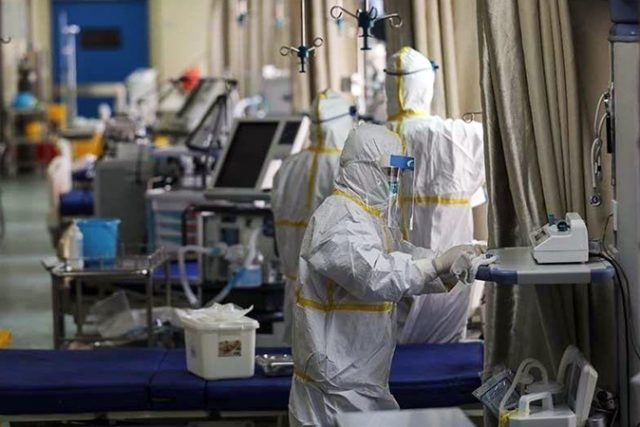
THE DEPARTMENT of Health (DoH) reported 10,098 coronavirus infections on Sunday, bringing the total to 936,133.

The death toll rose by 150 to 15,960, while recoveries increased by 72,607 to 779,084, it said in a bulletin.

There were 141,089 active cases, 96.7% of which were mild, 1.7% did not show symptoms, 0.5% were critical, 0.7% were severe and 0.43% were moderate.

The Health department on April 2 reported the highest daily tally at 15,310 cases since the pandemic  started last year.

The agency said 17 duplicates had been removed from the tally and 48 recovered cases were reclassified as deaths. Seven laboratories failed to submit data on April 17.

About 10.4 million Filipinos have been tested for the coronavirus as of April 16, according to DoH’s tracker website.

The coronavirus has sickened about 141.3 million and killed three million people  worldwide, according to the Worldometers website, citing various sources including data from the World Health Organization.

About 120 million people have recovered, it said.

Meanwhile, DoH reported 617 cases infected with the more contagious variants first detected in South Africa and the United Kingdom.

In a statement, the agency  said 351 more people had gotten the variant first detected in South Africa, bringing the total to 695.

A total of 266 more people got  infected with the variant first found in the United Kingdom, raising the total to 658.

It also said 25 people had been infected with the variant first detected in the Philippines, bringing the total to 148.

DoH, the University of the Philippines-Philippine Genome Center and UP National Institutes of Health reiterated that the variant from the Philippines was still not a variant of concern, “since current data is insufficient to determine whether the variant will have significant public health implications.”

Meanwhile, the state health insurer’s new payment method that facilitates the settlement of only about 60% of accounts payable to healthcare facilities could force hospitals to cut their resources and manpower amid a fresh spike in coronavirus cases, according to a group of private hospitals.

The presidential palace on April 15 said the Philippine Health Insurance Corp. (PhilHealth) had created a debit-credit payment method in line with President Rodrigo R. Duterte’s order to fast-track the payment of hospital claims in relation to the health crisis.

In a circular released on April 8, the state health insurer said it “shall pay 60% of the total amount of applicable healthcare facility receivables subject to 2% expanded withholding tax.”

“The debit-credit payment scheme for 60% of good claims in the National Capital Region is only an inadequate response to boost the participation of more hospitals,” Jaime A. Almora, president of the Philippine Hospitals Association, said in an email.

“The possible denial of 40% of the claims only strengthen the mistrust of hospitals in Philhealth,” he added.

“It can create apathy and discouragement of hospital managers in expanding their capability. It can cause closure of hospitals that will further aggravate the present crisis.”

The DoH earlier said hospitals in Metro Manila and nearby provinces had failed to increase their beds for coronavirus patients due to late payments from the state insurer.

With the new order, the agency said it was able to secure more than 1,000 private and public hospital beds for coronavirus patients. About 142 ward beds that could be used for patients with severe cases were also secured.

“We would like to expect the government to pay the private hospitals for services rendered to COVID patients so that hospitals can expand their capability and help more patients,” Mr. Almora said. “It should instruct PhilHealth evaluators to stop arbitrary reasons in denying claims.

“The hospitals are also sick and anemic. They need their life blood back.”

Nationwide round-up (04/18/21)

QUEZON City residents wait to receive their cash aid. — @QCGOV

Senator wants law that will give each Filipino a financial account

A SENATOR plans to file a bill that will give every Filipino a bank account or an online payment access that can be used for a more efficient distribution of cash aid from the government. Senator Sherwin T. Gatchalian said the government should provide the account, which can be tied up with the national ID system. “I call this the ‘One Filipino, One Bank Account.’ It should be mandatory for the government to give all Philippine residents a bank account. It is important that we start tapping technology,” Mr. Gatchalian said in Filipino. The senator, who chairs the committee on banks, financial institutions, and currencies, also noted that contactless and cashless payments is another option with over 74 million Filipinos owning smartphones as of 2019. He said owning a bank account should be considered as a “basic requirement among Filipinos, regardless of the individual’s socio-economic class.” He noted the problems that have surfaced in the distribution of financial subsidy for those most affected by the coronavirus pandemic, with both beneficiaries and government agents put at risk. “In situations such as now where there is a pandemic, government can simply remit (the cash aid) to the bank account,” he said. Mr. Gatchalian also noted that records from the Philippine Statistics Authority show that 82% of the 10.5 million initial registrants for the national ID system stated that they do not have bank accounts. He also cited a financial inclusion survey conducted by the Philippine central bank in 2019 indicating that 51.2 million adult Filipinos do not have a bank account due to lack of enough money to open one as primary reason, followed by perceived lack of need for an account, and lack of documentary requirements. — Vann Marlo M. Villegas

Judges to get P5,000 monthly communications allowance for videoconference hearings

JUDGES and clerks of court nationwide will get a P5,000 monthly communication allowance starting May to pay for stable internet services that will ensure the smooth conduct of online hearings. Supreme Court Chief Justice Alexander G. Gesmundo, in a resolution released on April 16, granted the allowance that will not be subject to liquidation rules. “Judges and the Clerks of Court of the Office of the Clerk of Court shall ensure that the internet service procured has sufficient bandwidth to enable them to conduct videoconferencing hearings and electronically receive and transmit court documents,” the resolution states. The resolution is in line with the implementation of the Guidelines on the Conduct of Videoconferencing authorized by former Chief Justice Diosdado M. Peralta “in order to avoid any further delay of court action on pending cases before them” amid restrictions due to the coronavirus pandemic. First level courts refer to Municipal and Metropolitan Trial Courts  while second level trial courts are Regional Trial Courts. The Supreme Court reported last week that it recorded an 87.75% success rate in hearings held by courts nationwide via videoconference from May 5, 2020 to April 9, 2021. — Bianca Angelica D. Añago

Filipino workers in South Korea given 1-year permit extension

FILIPINO workers in South Korea with work permits expiring within this year have been granted a one-year automatic extension by the Labor department in line with the Republic of Korea’s (ROK) recent policy allowing the continuation of foreign workers’ stay in the region in consideration of the coronavirus pandemic. The Department of Labor and Employment (DoLE) said on Sunday that overseas Filipino workers (OFWs) under the Employment Permit System (EPS) are qualified for the extension. “The issuance provides that the stay and employment period of foreign workers (E-9 and H-2) under the EPS and whose employment period (3 years or 4 years and 10 months) expires from 13 April 2021 to 31 December 2021, is extended for one (1) year,” DoLE said in a statement. The extension will also apply to EPS workers who were given a 50-day visa extension by the government as long as the 50-day period falls within the year starting April 13. Labor Secretary Silvestre H. Bello III welcomed the South Korean government’s issuance, saying, “The preservation of jobs of our OFWs everywhere in the world is our primordial concern, and this development highlights the value of our 15 years of continuing bilateral cooperation on labor with the ROK.”— Gillian M. Cortez

Regional Updates (04/18/21)

REP. LOREN LEGARDA FB PAGE

Antique gets 4 sea ambulances to serve far-flung island communities

FOUR sea ambulances were delivered last week to Antique and will soon be turned over to four government hospitals across the province. The fiberglass boats, funded under the Department of Health’s (DoH) Health Facilities Enhancement Program, have a speed of up to 18 knots. Antique Rep. Loren B. Legarda, in a post on her Facebook page, said the vessels will enable “faster and more efficient delivery of medical services,” especially in the island communities. She cited as an example that travel between the island village of Mararison to the mainland town of Culasi will be only five minutes. The Culasi District Hospital is one of the recipients of the boats. Ms. Legarda also said that the medical vessel is crucial amid the coronavirus pandemic. DoH Provincial Team Leader Feman Rene M. Autajay, in an interview with government news agency PNA, said the boats are also useful as majority of the province’s 18 towns are coastal areas. The boats are currently in basic transportation form, but Mr. Autajay said it would eventually be fitted with medical equipment through DoH funding.

BFAR lifts red tide warning in Cancabato Bay

THE BUREAU of Fisheries and Aquatic Resources (BFAR) declared the area of Cancabato Bay in Leyte province as officially free from red tide contamination.

In its 10th shellfish bulletin, BFAR said all types of shellfish harvested from the area are now safe for human consumption after testing negative for red tide toxins. However, red tide warnings are still implemented in the areas of Dauis and Tagbilaran City, Bohol; Tambobo Bay, Negros Oriental; Calubian, Leyte; Dumanquillas Bay, Zamboanga del Sur; Balite Bay, Davao Oriental; and Lianga Bay and Hinatuan in Surigao del Sur. All types of shellfish and Acetes sp. or alamang sourced from the red tide affected areas are unfit for human consumption. However, other marine species can be eaten with proper handling. Red tide happens due to high concentrations of algae in the water. Human consumption of contaminated shellfish may result in paralytic shellfish poisoning, which affects the nervous system. Usual symptoms of paralytic shellfish poisoning include headaches, dizziness, and nausea. Severe cases may include muscular paralysis and respiratory issues. — Revin Mikhael D. Ochave

Typhoon Bising weakens on Sunday afternoon, but heavy rains still expected until Monday

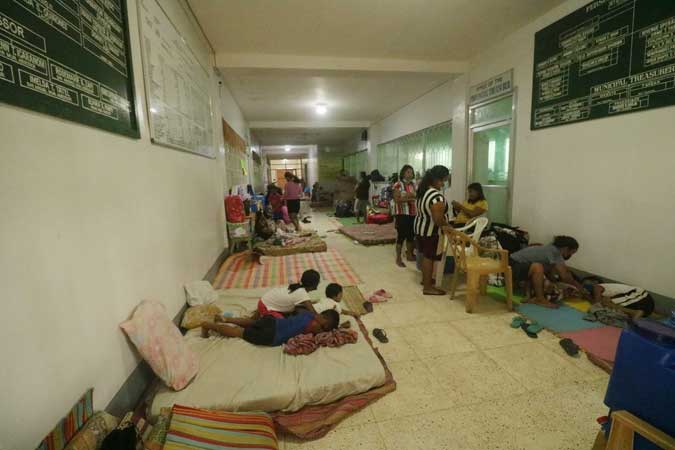
SOME residents of coastal areas in Catanduanes take temporary shelter at the provincial capitol building on April 18 after preemptive evacuation was ordered by the local government in preparation for typhoon Bising. Storm signal #2 was up in Catanduanes on Sunday.
— @PLGUCATANDUANES

TYPHOON Bising, with international name Surigae, weakened and slowed down on Sunday afternoon, but storm signals 1 and 2 in a five-level warning system remained up in several provinces on the eastern side of the country. State weather bureau PAGASA, in its 5 p.m. bulletin, said Bising’s maximum sustained winds dropped to 205 kilometers per hour (km/h) near the center and gustiness of up to 250 km/h from 215 km/h and 265 km/h, respectively earlier in the day. As of 4 p.m., the typhoon’s eye was located 290 km east of Virac, Catanduanes, which was among the provinces under storm signal #2. “Tomorrow (19 April), moderate to heavy with at times intense rains will be experienced over Bicol Region and Northern Samar,” PAGASA said. “By Wednesday early morning, the typhoon is forecast to turn northeastward or east northeastward away from the landmass of Luzon,” it said. Local governments along the typhoon’s wide radius braced for strong winds and rains, with provinces like Catanduanes ordering preemptive evacuation in high-risk areas. Presidential Spokesperson Herminio “Harry” L. Roque, Jr., in a statement on Sunday, said the Office of Civil Defense has been conducting pre-disaster risk assessments at the national level since Wednesday and has issued guidance and advisories to regional councils and local government units. The typhoon is seen to remain within the Philippine area until Friday. — with a report from Kyle Aristophere T. Atienza

Outsourcing industry recovery could be starting, survey indicates

BW FILE PHOTO

OPERATIONS of outsourcing companies have started to stabilize as companies bounce back from the lockdown-induced slump of 2020, advisory firm Outsource Accelerator (OA) said in a report.

The company, in a survey of 25 firms representing almost 40,000 employees, found that the shift to remote work caused a “huge operational challenge” for the respondents, which lost 20-30% of revenue or clients during the strictest phase of the lockdown last year.

“After three months, operations stabilized and clients’ businesses stabilized,” OA said, with respondents reporting that they have received new inquiries.

Around 84% of the respondents saw revenue growth in the 12 months to February, while 8% reported flat revenue and another 8% experienced declines.

In terms of profits, 72% reported growth, 20% had flat profits while 8% contracted.

“Some old clients have left, or have been questioning the pricing model or costs, but overall these have been outweighed by new growth and new revenue,” OA said, noting that the survey does not represent a comprehensive picture of the industry.

Meanwhile, 76% of respondents grew their headcount, while 16% retained the same number of employees and 8% posted declines. The 25 firms created 9,000 jobs over the 12-month period, growing their headcount 30%.

While 73% of firms have high expectations for growth in the next 12 months, 92% said their expectations are high over the next five years.

The outsourcing industry association in November reduced its 2022 employment compound annual growth rate projection to 2.7-5%, which translates to 1.37-1.43 million full-time employees, lower than the previous goal of 3-7%.

The Information Technology and Business Process Association of the Philippines (IBPAP) also cut its revenue projection to a 3.2-5.5% compound annual growth rate to between $27.88 billion and $29.09 billion for 2022, compared to the already lowered 3.5-7.5% set in 2019.

Overall industry revenue was flat in 2020, IBPAP Chairman Manolito T. Tayag said. — Jenina P. Ibañez

FIRB targets May 17 to pass CREATE IRR

THE FISCAL Incentives Review Board (FIRB) aims to sign by May 17 the implementing rules and regulations (IRR) of the Corporate Recovery and Tax Incentives for Enterprises (CREATE) Act, the Department of Finance (DoF) said Sunday.

In a statement, the DoF said the FIRB agreed during its first meeting last week, April 14, that it will sign the IRR covering the expanded functions of the board on the target date.

The board also discussed the possible industries eligible to apply for the new tax incentive system.

Republic Act No. 11534 or the CREATE Act took effect on April 11. It lowered the corporate income tax and reformed the fiscal incentives system.

Government agencies have 90 days from a law’s effectivity to release IRRs.

The draft IRR for provisions covering the FIRB and revised tax incentives should be done by May 10, the DoF said.

Consultation among the DoF and the Trade department, which co-chairs the FIRB, and investment promotion agencies (IPA), will take place on April 26.

IPAs involved are the Aurora Pacific Economic Zone and Freeport Authority (APECO), Authority of the Freeport Area of Bataan (AFAB), Bases Conversion and Development Authority (BCDA), Board of Investments (BoI), Subic Bay Metropolitan Authority (SBMA), Cagayan Economic Zone Authority (CEZA), Clark Development Corporation (CDC), John Hay Management Corporation (JHMC), Philippine Economic Zone Authority (PEZA), Phividec Industrial Authority (PIA), Poro Point Management Corporation (PPMC), Regional Board of Investments – Autonomous Region in Muslim Mindanao (RBoI-ARMM), Tourism Infrastructure and Enterprise Zone Authority (TIEZA) and Zamboanga City Special Economic Zone Authority (ZCSEZA).

The 2020 Investments Priorities Plan (IPP), signed in December, will serve as the temporary list of priority sectors eligible for tax perks while the new SIPP is being finalized, the DoF said.

Activities and sectors currently eligible for perks under the IPP include those related to the pandemic response; investment activities identified by the BoI; those that spur jobs outside urban areas; qualified manufacturing activities such as agro-processing, fishery, and forestry; and other strategic services like integrated circuit design, creative industries, and the maintenance, repair and overhaul of aircraft.

The list also includes healthcare and disaster risk reduction management services; mass housing; infrastructure and logistics; innovation drivers; inclusive business models; environment or climate change-related projects; energy; export activities; those covered by special laws and the list from the Bangsamoro Autonomous Region in Muslim Mindanao (BARMM).

The FIRB is tasked to set the target performance metrics that businesses have to hit to avail of tax incentives and ensure these are met. It must also monitor and assess the economic impact of investments enjoying incentives.

Its members also include Executive Secretary (ES), the Secretary of the Department of Budget and Management (DBM), and the Director-General of the National Economic and Development Authority (NEDA). 

CREATE is projected to result in P251 billion in foregone revenue for the government in the first two years of implementation, providing a combined P1 trillion worth of tax relief to companies over the next 10 years. — Beatrice M. Laforga

Further amendments to charter needed, legislator says

PHILSTAR

MORE AMENDMENTS to the 1987 Constitution could still be needed beyond the economic measures certified as urgent by President Rodrigo R. Duterte, a senior legislator said.

In a message to BusinessWorld Sunday, House Committee on Constitutional Amendments Chairman Alfredo A. Garbin, Jr. said the amendments to the Public Service Act, Foreign Investment Act and Retail Trade Liberalization Act can only do so much to effect an economic recovery, even though they are expected to improve foreign direct investment (FDI).

“The passage of the bills, while definitely needed, can only do so much. A look into the restrictive provisions of the 1987 Constitution which have hampered the inflow of FDIs is also warranted. The investment-to-GDP ratio is still very low and FDI is one of the lowest in the region,” he said.

Speaker Lord Allan Jay Q. Velasco filed Resolution of Both Houses No. 2 in January, proposing to add the phrase “unless otherwise provided by law” to economic restrictions in the Constitution.

The measure was approved at committee level on Feb. 2 and was brought to the plenary for debate. Mr. Garbin has said the House aims to pass the measure once Congress resumes session next month. Congress went on break starting March 27.

“With the contraction of our economy, we owe it to the Filipino people to enact all necessary legislation to improve and stimulate our economy including the timely lifting of restrictive provisions in the Constitution,” Mr. Garbin added.

Passage of the proposed economic provisions have been opposed by business groups questioning the timing of the proposals. Amending the Constitution will require a lengthy process of information campaigns and plebiscites.

Last week, the President certified Senate Bills 2094 (Public Service Act), 1156 (Foreign Investments Act) and1840 (Retail Trade Liberalization Act) as urgent, citing the need to boost economic growth and generate jobs. The House counterparts of these bills had been passed prior to the certification.

Research house IBON called the government’s priorities “misplaced,” adding that attention should be given to immediate assistance to millions affected by the lockdowns to contain the virus.

“(A) real stimulus package that prioritizes emergency cash subsidies, support for small businesses and farmers, and strengthening the health system should be top of lawmakers’ legislative priorities. This is more critical… than the bills lifting limits on full foreign ownership in certain economic sectors which the President recently certified as urgent,” IBON said in a statement.

IBON proposed that the government approve a P1.5-trillion package of social amelioration payments for poor and affected families, relief to distressed businesses, and address the needs of displaced workers.

A P370-billion economic relief package in the form of the proposed Bayanihan to Arise as One Act is currently backed by 224 members of Congress. Mr. Velasco has said that the target for approving the measure is before Congress resumes session. — Gillian M. Cortez

Senate bill seeking to impose net neutrality on internet industry

PHILIPPINE STAR/ MICHAEL VARCAS

A BILL has been filed in the Senate seeking to impose net neutrality on the internet industry, to create a “level playing field” for all content sources.

Senator Maria Imelda Josefa R. Marcos filed Senate Bill No. 2103, which imposes the net neutrality standard as well as norms for reliability and affordability on internet providers and telecommunications companies.

“This bill… aims to espouse the principle of net neutrality, to ensure that the internet remains a level playing field, where a tiny blog can reach readers just as well as the social media giants,” according to the measure’s explanatory note.

Ms. Marcos also noted that consumers have variable access to connectivity and content, with some having more freedom while others relying on free data encountering more restrictions or exposed to more fake news and false advertising.

“This bill aims to enact measures to protect the internet end-user, by imposing obligations of transparency and reliability on ISPs (internet service providers), telecommunications providers, and the industry players,” according to the explanatory note.

Ms. Marcos noted that the internet in the Philippines remains “slow, unreliable, and expensive, citing Ookla’s Speedtest Global Index in which the Philippines ranked 110th out of 139 countries in terms of mobile data speed. It also “ranks in the lower part of the global index in terms of average broadband.”

The Philippines also landed 82nd out of 85 in the Digital Quality of Life Index 2020 in terms of internet affordability, the senator noted.

Under the bill, Data Transmission Industry Participants are obliged “to treat all internet traffic equally,” providing internet access services without discrimination, restriction or interference.

They should also not impede internet users’ right to access and distribute information and content regardless of their location.

Internet providers will also be required to ensure that any contract that includes internet access services specifies information on traffic management, explanations of volume limitations, speed, and other quality of service parameters, and the impact of services on internet access services.

Minimum, normally available, maximum and advertised download and upload speed in case of fixed networks, and speed in case of mobile networks should be explained, as well as the remedies available in case of discrepancies between actual performance and the performance indicated in the contract.

Traffic management measures should be conducted only when needed to preserve the integrity and security of data transmission industry participants’ network, to prevent impending network congestion or mitigate its effects, and to preserve integrity and security of the terminal equipment of the users, according to the bill. — Vann Marlo M. Villegas

Hydrogen power touted for emissions-reducing potential

REUTERS

THE ECONOMIC Research Institute for ASEAN and East Asia (ERIA) said Southeast Asia stands to benefit from hydrogen, which it said holds the potential for helping countries hit their net zero emissions targets within 30 years.

“We need hydrogen, that is (for) decarbonization and also the net zero emissions. Many OECD (Organisation for Economic Co-operation and Development) countries set the target for the net zero emissions around 2050,” ERIA Special Advisor on Energy Affairs Shigeru Kimura said during a virtual briefing Wednesday.

The Philippines stands to benefit from using hydrogen power since coal and renewable energy (RE) technologies can be used to produce it, he said. He said hydrogen can be made from coal gasification or electricity generated from renewables.

“I think (the) Philippines is a rich coal mining country so (it can use) gasification technologies with CCS (carbon capture and storage) to produce the hydrogen. It is also rich in geothermal, which is an RE. It can use electricity from geothermal to… produce the hydrogen,” Mr. Kimura said.

If the country becomes a hydrogen power producer, it can export to Japan as well as other neighboring countries, he said.

The Department of Energy (DoE) has signed a memorandum of understanding with Tokyo-based Hydrogen Technology, Inc. to explore the potential of hydrogen as a possible source of power. Earlier this year, the DoE signed a similar agreement with Australian research and development company Star Scientific Ltd.

Gerry C. Arances, executive director of environmental think tank Center for Energy, Ecology, and Development, said that while hydrogen is not among the greenhouse gases which directly contribute to the rise of global temperatures, there is “much concern” about the way it is produced.

“Hydrogen can be produced from either low-carbon or carbon-intensive electricity, but it is also a fact that today, hydrogen from renewable energy processes are minimal compared to those from fossil fuel-based ones. In Europe, where the hype around hydrogen has been around longer, only less than 0.1% of hydrogen produced is in fact ‘green’,” Mr. Arances told BusinessWorld in an e-mail.

He said the DoE needs to address the climate crisis by focusing on tapping into the country’s potential for renewables.

“We do not have the luxury to devote years pursuing technology that may or may not be a solution, especially when it provides fossil fuel industries (a) reason to operate as usual and even expand… Hydrogen is but another deviation from tapping this vast RE potential and pursuing 100% renewable power systems in the Philippines,” Mr. Arances said.

Public policy think tank Infrawatch said the government should support any technology which can help the country wean itself from fossil fuels but hydrogen technology should be further examined to see if it can contribute to carbon neutrality.

Infrawatch Convenor Terry L. Ridon said price should also be considered a factor.

“Due to prohibitive costs, there are only 20 CCUS (carbon capture, usage and storage) projects operating commercially around the world, which is certainly not enough to tackle the global climate crisis,” he told BusinessWorld in an e-mail on Wednesday. CCUS technology extracts hydrogen from fossil fuels.

He added that hydrogen produced from RE sources is even more “cost-prohibitive.”

“There are no large-scale power plants utilizing green hydrogen to power cities due to the high costs of electrolyzer technology,” Mr. Ridon said. If hydrogen producers cannot compete with other technologies, the Philippine market will have a difficult time adopting it, he said. — Angelica Y. Yang

Redefining Philippine Taxation: CREATE

Second of four parts

Said to be the first-ever revenue-eroding tax reform package and the largest economic stimulus program in the country’s history, Republic Act No. 11534 or the Corporate Recovery and Tax Incentives for Enterprises (CREATE) Act was signed by the President on March 26. It amends our tax and incentives laws with the goal of helping businesses move into their post-pandemic recovery while encouraging foreign investment.

In the first part of this series, we discussed the passing and goals of the CREATE Act and how it reduces Corporate Income Tax. In this second part, we continue by discussing additional changes: the exemption of foreign-sourced dividends, the repeal of improperly accumulated earnings tax (IAET), tax-free exchange, additional provisions to consider and provisions that were vetoed.

EXEMPTION OF FOREIGN-SOURCED DIVIDENDS
To better compete within ASEAN, the CREATE Act adds a new provision on foreign-sourced dividends for domestic corporations with outbound investment. Generally, dividends received by domestic corporations from their subsidiaries abroad are subject to tax. This new provision states that these dividends are now exempt from income tax, provided that the domestic corporation directly holds at least 20% of the outstanding capital stock of the foreign subsidiary for at least two years at the time of dividend distribution. The funds must also be reinvested in the working capital, capital expenditure, dividend payments, investment in domestic subsidiaries, and infrastructure projects of the domestic corporation within the next taxable year from the time when the dividends were received. All these conditions must be met, otherwise the foreign-sourced dividends are subject to Philippine tax.

This falls within the objective of encouraging businesses — particularly domestic corporations — to reinvest in the Philippines all profits earned here and overseas to help our economy recover from the downturn caused by the pandemic.

REPEAL OF IMPROPERLY ACCUMULATED EARNINGS TAX
There will be no more IAET from 2021 onwards, which is great news for corporations that accumulate earnings beyond the reasonable needs of their business or paid-up capital. The imposition of IAET, ironically, compels the distribution of profits to investors or shareholders, or to repatriate the foreign investor’s money out of the Philippines instead of reinvesting or spending it locally. To address this, the CREATE Act now encourages investors to keep their money in the Philippines and potentially reinvest it in business expansion and generate employment.

Since the repeal does not provide any retroactivity, it will follow the general effectivity date of the CREATE Act. As such, any excess retained earnings in 2020 and prior years will still have to be dealt with by the taxpayers and be appropriated or declared as dividends. Otherwise, it will be penalized through the imposition of 10% IAET on excess retained earnings.

TAX-FREE EXCHANGE
The CREATE Act now expressly provides that a prior Bureau of Internal Revenue (BIR) confirmatory ruling will not be required to avail of the tax exemption in the case of business reorganizations, including mergers or consolidations, further control, recapitalization, and reincorporation. It likewise reiterates the TRAIN Law provisions that the sale or exchanges of property used for business for shares of stock are exempt from VAT and any gain or loss may not be recognized for tax purposes. This, however, only defers the payment of taxes since any subsequent transfer/s will be subject to applicable taxes on a substituted-cost basis. This new provision will ultimately reduce the problematic and long-running backlog of the BIR.

One notable wording added to the CREATE Act is on “further control” under Section 40 (c)(2). It has put to rest the further control issue, a gray area in the past, by expressly stating that an exchange is tax-free when the “transferor or transferors, collectively, gains or maintains at least 51% of the total voting power of all classes of stocks entitled to vote of the issuing corporation.”

ADDITIONAL PROVISIONS
The CREATE Act includes more provisions surrounding exemption from VAT. Upon effectivity of the Act, the sale, importation, printing or publication of educational reading materials, including those in digital or electronic format not principally used for advertisements, are exempt from VAT. Additionally exempted beginning Jan. 1, 2021 are the sale of medicines for cancer, mental illness, tuberculosis, and kidney diseases. Moreover, the sale or importation of COVID-19 drugs, vaccines and medical devices, COVID-19 treatment drugs for use in clinical trials, and the capital equipment, spare parts and raw materials for the production of personal protective equipment components are exempt from Jan. 1, 2021 to Dec. 31, 2023.

VETOED PROVISIONS
The President vetoed the increase of the VAT-exempt threshold for the sale of real property by real estate developers, the 90-day period for the processing of general tax refunds, the definition of investment capital and the special corporate income tax incentive for domestic enterprises. Also vetoed were new incentives for same activity of existing registered enterprises, limitations on the power of the Fiscal Incentives Review Board, specific industries under the activity tiers, the power to exempt any investment promotion agency from the reform, and the automatic approval of applications for incentives.

With the veto of the VAT-exempt provision on sale of real property, the sale of house and lot and other residential dwellings with a selling price of more than P2 million, along with residential lots regardless of the selling price, shall continue to be subject to 12% VAT beginning Jan. 1, 2021 except those qualified as socialized housing (based on price ceilings set by the Housing and Urban Development Coordinating Council) which remain VAT-exempt, pursuant to the TRAIN Law.

Originally, Congress proposed to increase VAT-exempt thresholds to P2.5 million for the sale of house and lot and other residential dwellings, and to P4.2 million for the sale of residential lots which could have benefitted those who can actually afford proper housing. However, the President vetoed it to avoid potential revenue losses of about P155.3 billion.

REDEFINING PHILIPPINE TAXATION FOR RECOVERY AND INVESTMENT
The passage of CREATE is certainly welcome to aid businesses during these challenging times, while also serving as a sign to investors that the Philippines is a worthwhile investment destination. Government efforts to redefine Philippine taxation by developing more globally competitive tax incentives and improving the current corporate tax system through wider tax bases, lowered tax rates and reduced tax leakage will hopefully progress the economy further along the path of post-pandemic recovery.

In the third and fourth parts of this series, we continue our discussion on the CREATE Act by covering the rationalization of incentives.

This article is for general information only and is not a substitute for professional advice where the facts and circumstances warrant. The views and opinions expressed above are those of the authors and do not necessarily represent the views of SGV & Co. 


Karen Mae L. Calam And Aiza P. Giltendez are a Tax Senior Manager and Manager, respectively, of SGV & Co.