Home Blog Page 8192

Kindness stations and community pantries

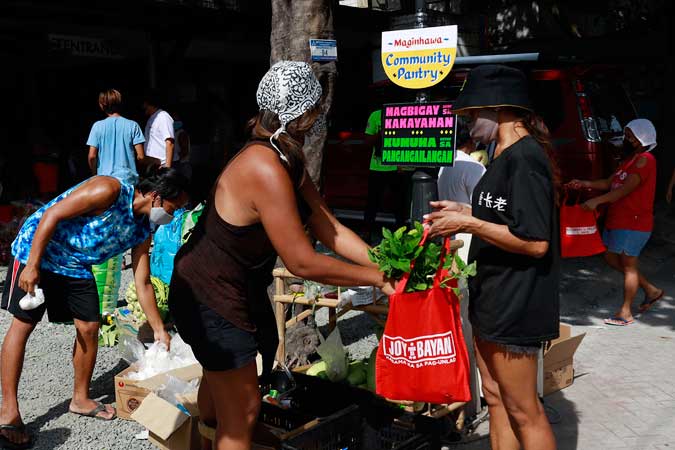
A COMMUNITY PANTRY set up along Maginhawa St., Quezon City, April 18. — PHILIPPINE STAR/MICHAEL VARCAS
PHILIPPINE STAR/ MICHAEL VARCAS

“Then, taking the five loaves and the two fish and looking up to heaven, He said the blessing, broke the loaves and gave them to His disciples to set before the people; He also divided the two fish among them all. They all ate and were satisfied. And they picked up 12 wicker baskets full of fragments and what was left of the fish. Those who ate were 5,000 men.”

— Mark 6: 41-44

“The Feeding of the Multitude” in Tabgha, Galilee is among many miracles in the gospels performed by Jesus to show Jews and Gentiles His divinity as Son of God made Man, the awaited Messiah. Its parallel miracle in the Old Testament is the “Manna from Heaven,” the food that God provided for the Israelites led by Moses in the desert during the 40 years that they crossed over from Egypt to Canaan. “This is what the Lord has commanded: Everyone is to gather as much as they need” (Exodus 16:16). Is there a meaning to “taking only as much as you need” required of the bountiful food in the deprivation of the Judean desert, and complied with, at Tabgha with the 12 wicker baskets of leftovers? No one took home a “doggie bag”!

The message is communal sharing, according to Fr. James Martin S.J., in his book, Jesus: A Pilgrimage: “The sharing of food is a communal event, underlining the community aspect of faith… Food is also about giving, sacrificing and sharing; someone must labor to grow it and expend time and effort to prepare it. Food requires work and sacrifice. Someone also needs to do the feeding, in this case, Christ. Overall, it is a gift.”

Food for the poor is the most urgent need in the veritable desert that the COVID-19 pandemic has made of the world, parched for more than a year now of its accustomed bounty of capitalist production and supply of wants and needs. According to the World Food Program in May 2020, about 230 million people were at risk of starvation, 130 million more than in 2019. Projections show that the world is not on track to achieve Zero Hunger by 2030 and, despite some progress, most indicators are also not on track to meet global nutrition targets. The food security and nutritional status of the most vulnerable population groups is likely to deteriorate further due to the health and socio-economic impacts of the COVID-19 pandemic (http://www.fao.org).

As early as April 2020, Caritas Philippines and the National Secretariat for Social Action (NASSA) worried about the more than 100 million Filipinos to be greatly affected by lockdown enforced due to COVID-19, as announced by the Philippine government. (NASSA/Caritas Philippines is the humanitarian, development and advocacy arm of the Catholic Church in the Philippines. It was created by the Catholic Bishops’ Conference of the Philippines in 1966 and mandated to accompany the poor and marginalized in the just and legitimate struggle for social justice and transformation.)

Caritas Philippines set up Alay Kapwa (Offering of Oneself), the fundraising program of the Philippine Catholic Church to serve as an emergency fund during calamities and other major social concerns. For its self-funded community food program, Caritas has set up “Kindness Stations” in communities in 30 dioceses across the Philippines, benefitting some 122,000 families. The concept of the “Kindness Stations” is to “decentralize giving and sharing by mobilizing parishes, community organizations, and individuals. This is unlike the relief operations we are so used to doing in the past. Soon, resources from the government and aid organizations will run out, aid will cease and our collection boxes will be emptied. But we will always have more than enough supply of people with generous hearts and selfless souls. We will always be doing the multiplication of loaves and fish,” Caritas Philippines said (https://reliefweb.int May 9, 2020).

Kindness Stations have been set up in villages, town plazas, parish churchyards, where neighbors, farmers in the area, store owners, and whoever else had some small donation in kind can deposit their contribution (of course, seeking no payment or exchange for it), and those in need of whatever was available from donations would pick up what they needed, without having to pay for it. There is just the instruction, honor system, to “take what you need, leave some for others, and give what you can.”

“Take only what you need” is the perfection of communal sharing, as in Moses’ and the Galileans’ times.

And it works, to this day. While the Kindness Stations have fluctuated in exuberance and interest through the seesawing between GCQ (general community quarantine, a less strict quarantine level) and ECQ (enhanced community quarantine, the strictest quarantine level), a young woman’s heart bled for her hungry poor neighbors who have been waiting for the government’s long-promised P1,000 cash assistance to 22.9 million low-income earners affected by the ECQ in Metro Manila, Bulacan, Cavite, Laguna, and Rizal. On April 14, Ana Patricia Non put out in front of her residence a rolling cart of canned goods, vegetables, and various other food items from her own pantry and offered these free to those who lacked food. Something like the Kindness Stations, only, it was a one-woman show.

Now called the Maginhawa Community Pantry, her single cart of donated food has become a row of stalls heavy with donations of rice, canned goods, and other food from the neighborhood and beyond, fresh vegetables from backyard farmers and real farmers, and whatever else — some even high-end food. Donations have come from poor and middle-income individuals more than the rich, Patricia says.

Magbigay ayon sa kakayahan, kumuha batay sa pangangailangan,” or “Give whatever you can, take only what you need.” (Sounds familiar!) This is the motto of the Community Pantry. which has replicated in hundreds of community pantries around the country — in just over a week! It has been encouraged by excited exchanges among like-minded netizens on social media. The idea is not new (the Caritas Kindness Stations started it). The Straits Times reported that “Sharing pantries” also caught on in Thailand last year, where the initiative spread to at least 43 provinces. Similar “Food banks” proliferated in the United States when the COVID-19 outbreak there peaked and millions suddenly found themselves without jobs when their companies had to shut down due to shelter-at-home restrictions (The Straits Times, April 20, 2021). It must be a spontaneous spiritual elevation in the collective (community) consciousness. But it is probably “only in the Philippines” where organizers of community pantries are red-tagged (suspected of being communists) and profiled (with their dossiers placed on watch lists) or called Satanists (really evil) by military authorities out for blood on their “terrorist watch.” Policemen and other military men, in the guise of checking on social distancing compliance and curfew transgressions have arrested and hauled some to jail from the long queues for the free food. Originally, the local officials asked for business permits.

Then denials of harassment were issued on national TV and social media by the military and related officials who said that there is no red-tagging, no warrantless arrests, no nothing. Suddenly, the government factotums are profuse with praises for such a noble groundswell of the bayanihan (community) spirit in this trying time of the COVID-19. Might it be that they want the “looking good” thing, riding on the current hype for this unforeseen sensation? Some government offices and local government units (LGUs) have even organized their own look-alike community pantries — free this and that for everyone, anyone, no matter that they, the government, would not get any donations for the free food and goods given. But local governments have money to allocate for the food security of their constituents. Setting up a community pantry by LGUs “would be redundant because we already shoulder the taxes,” Ms. Non points out (NikkaINQ, April 18, 2021). Greed for glory?

The Israelites did as they were told; some gathered much, some little. And when they measured it by the omer, the one who gathered much did not have too much, and the one who gathered little did not have too little. Everyone had gathered just as much as they needed (Exodus 16:17-19).

However, some of them paid no attention to Moses; they kept part of it until morning, but it was full of maggots and began to smell. So Moses was angry with them (v. 20).

Ugly greed and personal gain have no place in noble community sharing.


Amelia H. C. Ylagan is a Doctor of Business Administration from the University of the Philippines.


ahcylagan@yahoo.com

Some rays of light

PHILIPPINE STAR/ MICHAEL VARCAS

It’s quite natural and understandable to be very pessimistic and depressed at this time. There seems to be no end to this pandemic and no coherent government plan to end it. Instead, we are seeing another surge, deadlier than the initial one. While I have friends who died in the first wave last year, I know of many more acquaintances and relatives who have recently gotten infected, a number of whom have died.

The government seems to be at a loss. Having imposed the strictest lockdown in the world last year with not much to show for it, the Duterte administration is caught between a rock and a hard place:

Continue the ECQ and other severe forms of mobility restrictions and risk multibillion losses to the economy, or relax the restrictions and risk overwhelming the hospitals and letting the virus go unchecked.

Between the “hammer” and the “dance,” the government has only resorted to the “hammer” of lockdowns. The government has wasted one year because measures to contain the virus more smartly — mass testing, tracing, isolation and treatment — have still not been done. There are as many tracing apps as there are LGUs. Surge hospital and isolation capacity hadn’t been built even as the government started loosening the restrictions to perk up the economy.

Moreover, the IATF keeps making decisions not based on evidence and data. It restricted outdoor exercise to 6 to 9 a.m., when evidence has shown that when there’s outside natural ventilation, the risks are much lower. Extended curfews were imposed, giving commuters a small window to get home, risking crowding in public transportation. The result has been messaging that people were unlikely to follow because they lacked common sense.

All the while, the government’s vaccination program has been a mess. The government has been late to procure vaccines. It first tried to monopolize procurement and deny the private sector the right to procure on its own. It tried to erect one bureaucratic hurdle after another at the private sector, including mandating that the private sector must follow the Department of Health (DoH) protocols for prioritizing who may get the vaccine. The result is that the country is way behind other countries in vaccination per capita. Consequently, the government is left with no option but to impose another lockdown to contain the virus surge.

Contributing to the air of public pessimism is a president who seems tired and out of ideas.

What is worse is that he keeps the same team which had clearly failed in managing the pandemic.

Instead of giving people hope, all President Duterte does is double down on criticizing Leni Robredo and Leila de Lima and perpetuating a reign of human rights abuses.

That said, some rays of light are showing through the dark clouds. If one wallows only in pessimism, one will miss several important things happening. I refer to structural changes which will foster sustainable economic growth in the long run. To wit:

EO 127 which classified satellite broadband as a value-added service. This means that accessing satellites would no longer be confined to those which have telco franchises. Under the new EO, ISPs (Internet Service Providers) and VAS (Value-Added Service) providers registered with the National Telecommunications Commission can now access more than 15 high throughput satellites, including Elon Musk’s Starlink, which have the Philippines under their respective footprints. Broadband speeds of as fast as 150 mbps can be made available anywhere in the Philippines where one can put up a satellite dish. This will make internet service accessible even in remote areas, and promote distance learning and financial inclusion.

The Department of Environment and Natural Resources (DENR) DAO 2020-18. This DAO liberalized tree plantation. The previous DAO, issued under former President Aquino’s DENR Secretary Ramon Paje, mixed natural forests and planted forests and essentially killed the tree plantation and wood processing industry with regulatory overreach. The new DAO will revive the tree plantation industry once again. Being a mountainous tropical country, the Philippines has a competitive advantage in forest production but it had wasted its opportunity to develop the forestry sector because of over-regulation and uncertain property rights.

The Public Service Act (PSA) is finally moving in the Senate after President Duterte certified it as urgent together with amendments to the Retail Trade Liberalization and the Foreign Investment Act. As I keep saying, the PSA is the most consequential economic legislation since the founding of the Republic. Nay, perhaps since the Commonwealth era because nationalist protection of “public utilities” started in the 1935 Constitution and is the reason why the Philippines has retrogressed economically compared to its once backward but now more progressive neighbors.

The PSA will redefine public utilities so that only natural monopolies are deserving of the nationalist protection of a 40% foreign ownership limit in the Constitution. If the PSA is passed, the transport and telecommunications sectors will be open to 100% foreign investment. This will increase competition and break the back of the monopolies strangling these strategic industries. We will see more investments, increased competition, more innovation, technology transfer, lower prices, and better service in transportation and telecommunications that will have positive ripples throughout the economy.

More than ever, there is a great chance that the PSA will, after eight years, be finally passed.

Sometimes, a crisis forces the mind.

There is, however, another recent EO that will also be a huge boon to economic development.

Two weeks ago, President Duterte issued EO 130, which lifted the ban on new mining development imposed by former President Ninoy Aquino. The previous EO halted the issuance of new mining licenses until the institution of a new fiscal regime.

EO 130 justified the lifting of the ban because the excise tax on mineral products had already doubled in 2017 from 2% of Gross Sales to 4% under RA 10963 or TRAIN. It also said that with new regulations, environmental safeguards are in place.

Government estimates that the proposed contribution of new Mineral Agreements will amount to P5 billion in royalty fees, P20 billion in annual government revenues, P57 billion in exports, and generate 41,000 jobs in the countryside.

More than the activation of shovel-ready projects, the new EO provides a regulatory environment where the mining industry in the Philippines can reach its full potential.

The Philippines is one of the five most mineralized countries in the world. Valuable minerals, such as gold, copper, nickel, manganese, chromite as well as non-metallic minerals like marble and limestone, lie abundantly in its domain. Mining development has never reached its full potential because of legal, regulatory, and public relations issues. Environmental disasters of a long time ago, such as the Marcopper tailings disaster, turned the public against mining and spurred anti-mining activist fervor. Unregulated small-scale mining, which doesn’t adhere to any environmental standards, also contributed to mining’s negative public image.

However, if mining is properly regulated and the industry self-regulates in accordance with international environmental standards, there’s no reason why the Philippines can’t use mining to increase the people’s living standards, in much the same way that Australia and Canada do.

Why do I say that mining is an industry of the future?

There are two main trends that are driving increased demand for metals worldwide. First is the increased demand for computer and tech equipment which started during the pandemic and is expected to last for years. In fact, the demand has been so high that this has led to a global chip shortage, affecting industries such as car manufacturing. Minerals such as copper, lithium, cobalt, and nickel are needed to produce cell phones, computers, smartwatches, and the Internet of Things (IoT).

The other huge demand driver is the coming shift to electric cars. By 2035, GM expects its line-up to be all electric. The other carmakers won’t be far behind. Presently, electric cars constitute only about 2% of all car production but that will grow to 80% in 20 years.

However, the core of electric cars is the EV or electric car battery, which is mostly made of lithium, cobalt, nickel, manganese and other minerals. Elon Musk is already foreseeing a shortage of nickel, and Tesla is being wooed by the Indonesian government to put up a plant in Indonesia, a major source of nickel. The Philippines is rich in nickel and cobalt too.

In other words, what Saudi Arabia, Kuwait, and Venezuela were to the oil industry (which is expected to decline with the shift toward renewables), minerals-rich countries, such as Bolivia, Congo, Australia, Canada, and perhaps the Philippines could be on top of the new global energy order. And because the United States doesn’t want to be dependent on China, it would seek to develop a supply chain from among friendly countries. Therefore, mining is the industry of the future and the Philippines could be a superpower in mining.

That is the dream. In the meantime, there’s this pandemic to defeat.


Calixto V. Chikiamco is a board director of the Institute for Development and Econometric Analysis.

idea.introspectiv@gmail.com

www.idea.org.ph

Is it fair to describe government as ‘incompetent’?

I rolled my eyes when the Presidential Spokesman and COVID-19 protocol breaker (say hello to the dolphins!) declared that the government’s COVID response is “excellent.”

While most of our regional neighbors have put the pandemic behind them and are well on their way towards rebuilding their economies, the Philippines finds itself in the midst of a more violent infection surge, far worse than what we experienced in 2020. This has left the government with no choice but to impose an Enhanced Community Quarantine (ECQ, the strictest quarantine level) over Metro Manila and surrounding provinces all over again.

The ECQ comes as a painful blow to the micro-, small-, and medium-sized enterprises (MSMEs) which are just now recovering from the losses of 2020. Now, they must absorb more losses (if they can) which significantly shortens their cash runways to stay open. Thousands more MSMEs are expected to fall into insolvency and this means more job layoffs. As far as the welfare of our people are concerned, the ECQ has made their sad plight even more unbearable.

One out of every 11 Filipinos are unemployed and one out of every six are underemployed. Worse, one in every 6.6 Filipinos are living in abject poverty.

While Malacañang pats itself on the back for a job well done, the international press has declared President Duterte’s government’s COVID response as the most incompetent in the region. This was written not only by Nikkei Asia but also by The Diplomat, The Straits Times, Time.com and many other respected media channels.

“Incompetent” is a harsh word that carries serious implications. Certainly, it should not be dispensed without serious consideration, especially when said toward a government.

As a Filipino, the words of the international press were offensive — but I am finding it difficult to disagree with them. As I reviewed the events that led up to the recent surge of infections and the second ECQ, I cannot help but think that indeed, the government’s actions were laced with distorted personal biases, simplistic thinking, political considerations, and, yes, downright incompetence. Let me look back….

When news that a highly infectious virus from China threatened to trigger widespread infections in the Philippines, President Duterte responded by belittling the situation. He said, and I quote, “there is nothing to be afraid of with this Corona thing”…. He also said “maliit na bagay ito sa buhay natin” (This is a small thing in our lives). These statements tell me that the President did not bother to consult expert virologists or epidemiologists as due diligence would dictate. Neither did Health Secretary Francisco Duque raise red flags on the gravity of the threat. The President maintained a cavalier attitude towards the virus even if what was at stake was the very health and wellbeing of our people.

This cavalier attitude was exemplified again when the President refused to close our borders to Chinese visitors even if the rest of the region did so already. More weight was given on not offending the “feelings” of his Chinese demigods rather than safeguarding the health and wellbeing of our people. Sec. Duque even defended the President’s position in a Senate hearing. True enough, the first two COVID cases recorded in the country were a Chinese couple who arrived as tourists.

When infections escalated in March 2020, the government responded by fear mongering and enforcing a militaristic lockdown that affected the entire island of Luzon and key cities in the Visayas and Mindanao. The move turned out to be disastrous as it immobilized the economy for at least four months. It consigned a multitude of businesses to bankruptcy and instigated the massive layoff of workers. All these caused the economy to register the largest economic contraction since World War 2. In retrospect, a surgical lockdown (confined to our smallest political units, the barangays) would have been more effective, but the government could not establish a tracking and tracing mechanism to permit this.

What is truly regrettable is that the lockdown was not maximized to bolster testing capacities. Even today, testing remains localized among a few LGUs and private corporations. Neither did the government put a tracking and tracing system in place. That too was left to the LGUs to do. The government tracing app was only rolled out this month, a whole year after the first ECQ was declared (it is not even certain if the app has been debugged yet). As for medical capacities, although quarantine centers were established, little was done to increase the number of intensive care unit (ICU) beds in anticipation of a succeeding case surges. Instead of focusing on the anti-COVID response, Malacañang squandered the precious time in lockdown inflicting political revenge against ABS-CBN. It was a reckless and selfish move that Congress kowtowed to.

Upon passage of the Bayanihan laws, the disbursement of financial assistance to indigents was fraught with corruption. Financial aid for struggling tourism enterprises was diverted to “tourism infrastructure” instead, which is another word for congressional pork barrel.

As if the economy had not been clobbered enough by the 9.5% contraction in 2020, the government organized the smallest stimulus package in the region at only 5.88% of GDP. This, compared to 25.35% for Singapore, 22.73% for Malaysia, 15.96% for Thailand, 10.94% for Indonesia, and 10.12% for Vietnam. It was more important for the government to maintain its “investment grade” rating than give the economy the financial stimulus it needs to recover quickly.

Vaccination is the silver bullet to end this pandemic. But as has become the usual story, the government dropped the ball in the vaccine order procedure. Someone (name withheld from the media) forgot to remind the President that vaccine makers require an Indemnification Law to be in place before vaccines can be shipped out. Congress had to rush the passage of the Indemnification Bill last February, but not without delaying the vaccine delivery.

As for the Department of Health (DoH), it’s cold logistics chain was still not in place as of end-March due to a failed bidding process for third party logistics providers. The bidding was declared a failure since bidders “failed to comply with all the requirements” of the DoH. In truth, it was the DoH who dropped the ball since its request for quotation (ROQ) did not disclose the number of vaccines to be received, stored, and deployed, the schedule of vaccine delivery and location of drop-off points. These details are vital for the formulation of accurate quotations. Naturally, the bidding exercise failed.

The national vaccination program is way behind schedule. As of April 17, the National Vaccination Operations Center reported that only 1,264,811 people have received their first jab of the vaccine. At this rate, it will take the DoH 12 years to achieve herd immunity.

Notwithstanding multiple missteps on the government’s part and especially the DoH, Health Undersecretary Maria Rosario Vergeire had the temerity to blame the Filipino people for the recent surge in infections, accusing us all of violating safety protocols. Three points: First, she forgets that the biggest violators are her colleagues in government — Debold Sinas, Harry Roque, Koko Pimentel, and Benjamin Magalang, among many others who weren’t caught on camera. Second, Vergeire prefers not to take responsibility and instead, blame others for the disaster her department is partly responsible for causing. Third, her hubris reflects the general attitude of government in that they cannot see beyond their own blunders. It is painful for me to think that my hard earned taxes pay this woman’s salary.

So — Is it fair to describe government as “incompetent”? Can I dispute the international press? I cannot. With everything that has happened in the last 12 months, the international press is justified for their harsh assessment. The situation we are in today is painfully self-inflicted.


Andrew J. Masigan is an economist

andrew_rs6@yahoo.com

Twitter @aj_masigan

EU blames China for endangering peace in the South China Sea

A PHILIPPINE FLAG is seen perched on a Philippine Coast Guard-manned vessel as it conducts patrols at Whitsun Reef, South China Sea, in a handout photo distributed by the Philippine Coast Guard, April 15. — PHILIPPINE COAST GUARD/HANDOUT VIA REUTERS

BEIJING — The European Union (EU) called out China on Saturday for endangering peace in the South China Sea and urged all parties to abide by a 2016 tribunal ruling which rejected most of China’s claim to sovereignty in the sea, but which Beijing has rejected.

The EU last week released a new policy aimed at stepping up its influence in the Indo-Pacific region to counter China’s rising power.

The Philippines on Friday protested to China over its failure to withdraw what it called as “threatening” boats believed to be manned by maritime militia around the disputed Whitsun Reef, which Manila calls the Julian Felipe Reef.

“Tensions in the South China Sea, including the recent presence of large Chinese vessels at Whitsun Reef, endanger peace and stability in the region,” a EU spokesperson said in a statement on Saturday. 

EU reiterated its strong opposition to “unilateral actions that could undermine regional stability and international rules-based order”.

It urged all parties to resolve disputes peacefully in accordance with international law, and highlighted a 2016 international arbitration that had ruled in favor of the Philippines while invalidating most of China’s claims in the South China Sea.

China rejected EU’s accusation that its ships at Whitsun Reef, which China calls Niu’E Jiao, had endangered peace and security.

The Chinese Mission to the EU in a statement on Saturday reiterated that the reef is part of China’s Nansha Islands, or Spratly Islands, and that it was “reasonable and lawful” for Chinese fishing boats to operate there and shelter from the wind.

The Chinese statement also insisted that China’s sovereignty, rights and interests in the South China Sea were formed in the “long course of history and consistent with international law” and rejected the 2016 tribunal ruling as “null and void”.

“The South China Sea should not become a tool for certain countries to contain and suppress China, much less a wrestling ground for major-power rivalry,” the Chinese statement said.

China is increasingly worried that Europe and other countries are heeding US President Joseph R. Biden’s call for a “coordinated approach” towards China, which had so far materialized in the form of sanctions over its security crackdown in Hong Kong and treatment of Uyghur Muslims.

US Secretary of State Antony Blinken last month said Washington “stands by its ally, the Philippines,” in the face of China’s massing maritime militia at Whitsun Reef. — Reuters

Myanmar people slam ASEAN-junta consensus to end violence, but no immediate protests

FLOWERS hang during a nationwide flower campaign against the military coup in Yangon, Myanmar, April 2, 2021. — REUTERS
REUTERS

People in Myanmar on Sunday criticised an agreement between the country’s junta chief and Southeast Asian leaders to end the violence-hit nation’s crisis, saying it fell short of restoring democracy and holding the army accountable for hundreds of civilian deaths.

There were no immediate protests in Myanmar’s big cities a day after the meeting of the Association of Southeast Asian Nations (ASEAN) with Senior General Min Aung Hlaing in Jakarta, Indonesia, that agreed to end the violence but gave no roadmap on how this would happen.

But several people took to social media to criticise the deal.

“ASEAN’s statement is a slap on the face of the people who have been abused, killed and terrorised by the military,” said a Facebook user called Mawchi Tun. “We do not need your help with that mindset and approach.”

According to a statement from group chair Brunei, a consensus was reached on five points – ending violence, a constructive dialogue among all parties, a special ASEAN envoy to facilitate the dialogue, acceptance of aid and a visit by the envoy to Myanmar.

The five-point consensus did not mention political prisoners, although the chairman’s statement said the meeting “heard calls” for their release.

ASEAN leaders had wanted a commitment from Min Aung Hlaing to restrain his security forces, which the Assistance Association for Political Prisoners (AAPP) says have killed 748 people since a mass civil disobedience movement erupted to challenge his Feb. 1 coup against the elected government of Aung San Suu Kyi.

AAPP, a Myanmar activist group, says over 3,300 are in detention.

“Statement doesn’t reflect any of people’s desires,” wrote Nang Thit Lwin in a comment on a news story in domestic Myanmar media on the ASEAN deal. “To release prisoners and detainees, to take responsibility for dead lives, to respect election results and restore democratic civilian government.”

Aaron Htwe, another Facebook user, wrote: “Who will pay the price for the over 700 innocent lives.”

The military has defended its coup by alleging that the landslide win by Suu Kyi’s party in November’s election was fraudulent, although the election commission dismissed the objections.

The ASEAN gathering was the first coordinated international effort to ease the crisis in Myanmar, an impoverished country that neighbours China, India and Thailand and has been in turmoil since the coup. Besides the protests, deaths and arrests, a nationwide strike has crippled economic activity.

Myanmar’s parallel National Unity Government (NUG), composed of pro-democracy figures, remnants of Suu Kyi’s ousted administration and representatives of armed ethnic groups, said it welcomed the consensus reached but said the junta had to be held to its promises.

“We look forward to firm action by ASEAN to follow up its decisions and to restore our democracy,” said Dr. Sasa, spokesman for the NUG.

Besides the junta chief, the leaders of Indonesia, Vietnam, Singapore, Malaysia, Cambodia and Brunei were at the meeting, along with the foreign ministers of Laos, Thailand and the Philippines. — Reuters

National team action

THE national men’s basketball team will be seeing action in the third and final window of the FIBA Asia Cup Qualifier in June to be held here at Clark City in Angeles, Pampanga while the men’s 3x3 team shoots for a spot in the Tokyo Olympics in the qualifiers in Austria in May. — FIBA AND SBP PHOTOS

Gilas plays Asia Cup Qualifiers in June; 3×3 team in OQT in May

By Michael Angelo S. Murillo, Senior Reporter

IF SCHEDULES push through, the Philippine national basketball team will be having a busy next couple of months competing in international competitions.

The national men’s basketball team will be seeing action in the third and final window of the FIBA Asia Cup Qualifier in June to be held here at Clark City in Angeles, Pampanga; the schedule of which was released by FIBA last week.

The men’s 3×3 team, meanwhile, shoots for a spot in the Tokyo Olympics in the qualifiers in Austria in May.

Gilas Pilipinas looks to formalize its entry into the FIBA Asia Cup by winning at least a game in their scheduled three-match assignment in the qualifiers in Clark.

The Philippines leads Group A with an unblemished record of 3-0 and six points. Second-running is Korea (2-0), followed by Indonesia (1-2) and Thailand (0-4).

In the schedule released by FIBA, Gilas plays Korea on June 16, then Indonesia on June 19, and closes its assignment with a re-engagement with the Koreans on June 20.

All the matches in Clark, which will also host games in Groups B and C, will be played behind closed doors as part of health and safety protocols to guard against the coronavirus.

The window was supposed to take place in February before the Samahang Basketbol ng Pilipinas (SBP) decided to cancel the proceedings weeks before the event with the spike in coronavirus cases in the country.

Doha, Qatar, stepped in as replacement host but it, too, had to call things off at the last minute because of coronavirus concerns as well.

International Basketball Federation (FIBA) opened the hosting anew to those who were willing and SBP grabbed on the opportunity and is now looking to do well to have the June 16-20 competitions staged successfully.

For the third window, Gilas will go all-cadet so as not to disrupt the calendar of the Philippine Basketball Association (PBA), which is still grappling with how it will go about its delayed Season 46.

The local federation is also using the tournament as an opportunity for Gilas to develop its young players in preparation for future competitions, including the 2023 FIBA World Cup where the country is one of the hosts.

“It’s really developing this young core of players and making them battle-ready… If we can develop that pool of players, we have more options, we have more choices, and we’re also increasing our pool…” said SBP President Al S. Panlilio in his recent appearance on the Power & Play radio program.

As to the hosting, Mr. Panlilio said they have been coordinating with the government to make sure all plans are in line with protocols placed.

He, however, said that all concerned, including FIBA, are aware of how fluid the situation is with the pandemic and are bracing for any possible changes, including another postponement in a worst-case scenario.

Also up for Gilas later this year is the FIBA Olympic Qualifying Tournament (OQT) in Serbia at the end of June and the FIBA Asia Cup in Indonesia in August.

3X3 TEAM
Meanwhile, the Philippine 3×3 team is angling to be one of the teams seeing action in the Tokyo Olympics, where the sport will make its Games debut.

An all-PBA crew will be representing the country in the qualifiers in Graz, Austria, where three Olympic tickets are at stake.

Two of the top 3×3 players in the Philippines, namely: Joshua Munzon (Terrafirma) and Alvin Pasaol (Meralco) banner the team, along with PBA stalwarts CJ Perez and Mo Tautuaa of San Miguel. Also part of the pool are Rain or Shine rookie Santi Santillan and free-agent Karl Dehesa.

The PBA and the SBP have thrown its full support for the team, which is scheduled to enter its training bubble at the INSPIRE Sports Academy in Calamba, Laguna, this week.

The Philippines is grouped in the tough Pool C, which also has Slovenia (Europe Cup 2016 winner), France (second at Europe Cup 2019), Qatar (2014 World Champ), and the Dominican Republic.

Team Philippines admits it is going to be a tough road for it, compounded by the limitations presented by the pandemic, but is forging ahead and will try to come up with a competitive showing.

“The last time we played 3×3 was before lockdown and that was last year, so it’s been a while. We are not able to play, that’s the hard thing for us,” Mr. Perez was quoted as saying by the official FIBA website.

“We are doing our best to be in shape. Our coaches never stopped working for the program for us and they keep pushing every day,” he added.

The PBA scoring champion admitted height will be a challenge for them but they will try to compensate for it with quickness and hustle.

Usman, Namajunas score KO title fight wins at UFC 261

THUG ROSE FB PAGE
AMERICAN Rose Namajunas pulled off a stunning first-round head kick knockout to dethrone strawweight champ Zhang Weili of China at UFC 261 in Jacksonville, Florida, on Saturday. — THUG ROSE FB PAGE

KAMARU Usman knocked Jorge Masvidal out cold to retain his Ultimate Fighting Championship (UFC) welterweight belt while Rose Namajunas pulled off a stunning first-round head kick knockout (KO) to dethrone strawweight champ Zhang Weili at UFC 261 in Jacksonville, Florida, on Saturday.

In the third title fight on the bill, women’s flyweight champion Valentina Shevchenko dominated Jessica Andrade as she coasted to a second-round technical knockout victory to retain her crown.

Famed for his powerful wrestling, 33-year-old Usman came into the main event on Masvidal’s home turf on a 17-fight winning streak, and he won the first round comfortably before bringing the fight to a sudden halt in the second.

Usman uncorked a thunderous right hand a minute into the second frame to deck Masvidal, who looked out before he hit the canvas, silencing the boisterous home crowd and extending the longest winning streak among active fighters in the UFC.

“Been a while since I’ve been extremely nervous for a fight. But he elevated me. He made me go to the workshop and sharpen all my tools to put on a performance like that,” Usman said in his post-fight interview, his daughter in his arms in the octagon.

“I am the pound-for-pound best fighter on the planet right now,” he added.

In the co-main event, Namajunas, who won the title in 2017 and had one successful defense before losing it to Andrade in 2019, landed a left high kick flush to the jaw to put the lights out for Zhang after just a minute and 18 seconds of their title fight.

Namajunas dove in to finish off her opponent, but referee Keith Petersen was quick to wave it off as the American snapped her opponent’s 21-fight winning streak and became the first woman in the UFC to reclaim a title. — Reuters

Knicks defeat Raptors for ninth straight win

THE New York Knicks extended their winning streak to nine games with a 120-103 victory over the Toronto Raptors on Saturday. — NEW YORK KNICKS FB PAGE

JULIUS Randle totaled 31 points and 10 rebounds as the host New York Knicks extended their winning streak to nine games with a 120-103 victory over the Toronto Raptors on Saturday afternoon.

It is the longest streak for the Knicks (34-27) since winning 13 straight from March 18-April 9, 2013.

RJ Barrett scored 20 of his 25 points in the second half and collected 12 rebounds for New York. Derrick Rose added 19 points and seven assists and Reggie Bullock chipped in 16. The Knicks shot 56%, made 16 three-pointers and won their seventh straight home game, earning a standing ovation from the limited capacity crowd.

Fred VanVleet and OG Anunoby scored 27 apiece for the Raptors (25-35), who saw a four-game winning streak stopped and lost to the Knicks for the second time this month. Pascal Siakam added 26 as Toronto shot 43.4%. VanVleet dished 11 assists.

While Randle’s latest big game helped the Knicks to another win, he was on the bench when New York began pulling away before it withstood a late Toronto comeback try.

After taking an 88-83 lead into the fourth, the Knicks started the final period on a 14-3 run to get a 102-86 lead when rookie Obi Toppin’s uncontested three-pointer rolled in the hoop with 9:14 left.

Toronto was within 110-103 on a three-pointer by Siakam with 3:18 remaining but Barrett’s 3-pointer made it 115-103 with 1:24 left and essentially sealed it.

Randle shot 10 of 17 from the floor and scored 30 points for the 11th time this season and sixth time in seven games. The All-Star forward also posted his 38th double-double this season.

Randle hit three 3-pointers and scored 13 as the Knicks shot 60% and held a 30-26 lead after the first quarter. His 20-footer capped an 11-4 run to give the Knicks a 57-48 lead with 2:48 left, and New York held a 64-59 lead at half time after Anunoby hit a 3-pointer with 2.8 seconds left. — Reuters

Manchester United fans protest against Glazer family’s ownership

Manchester United

Manchester United

HUNDREDS of Manchester United supporters gathered outside Old Trafford on Saturday to demonstrate against the Glazer family’s ownership after the club was involved in plans to join the now-failed European Super League, British media reported.

Manchester United was among six Premier League clubs which signed up for the breakaway league before withdrawing on Tuesday amid a storm of protest from fans, players and the British government.

The club was bought by the American Glazer family for $1.1 billion in 2005. Although it has been listed on the New York Stock Exchange since 2012, the Glazers retain majority ownership.

Club supporters assembled by the Trinity Statue outside the ground on Saturday and set off yellow and green flares — colors synonymous with fan protests against the Glazer family, the Manchester Evening News reported.

Protest signs read “United against greed” and “Glazers out,” according to Sky Sports.

Manchester United executive vice-chairman Ed Woodward, one of the leading figures in the breakaway project, said on Tuesday he would step down from his role at the end of 2021.

Liverpool, owned by Fenway Sports Group (FSG) and another of the English clubs involved in the Super League, also saw around 150 fans protest on Saturday before a match with Newcastle United.

Banners saying “Enough is enough, FSG out” and “Our game, our club: thanks but no Yanks” were unfurled outside Anfield. American owner John Henry has apologized for the club’s involvement in the project.

Manchester United, who is second in the Premier League, visits Leeds United later on Sunday. — Reuters

Para athletes focus of next PSC online summit session

ADZ DUMAPONG FB PAGE
BEMEDALED paralympic athlete Adeline Dumapong-Ancheta will be the guest in the 11th session of the online Philippine Sports Commission (PSC) summit this week and will spotlight para athletes and inclusivity in sports. — ADZ DUMAPONG FB PAGE

BEMEDALED paralympic athlete Adeline Dumapong-Ancheta will be the guest in the 11th session of the online Philippine Sports Commission (PSC) summit this week and will spotlight para athletes and inclusivity in sports.

Happening on Wednesday, April 28, powerlifter Dumapong-Ancheta will share her experiences as a long-time member of the Philippine Paralympic Committee (PPC) advocating the rights of differently abled athletes like her.

One of the pioneering athletes in the para sports scene in the country, Ms. Dumapong-Ancheta has always been pushing the paralympic movement locally and for para athletes to be given their fair due.

“She is one of our most accomplished athletes who never relinquished their causes, especially in the area of inclusivity and disability. It is a must for this sports summit to include our para athletes who play a big role in Philippine sports,” said PSC Chairman William Ramirez of the upcoming session.

Ms. Dumapong-Ancheta is a four-time Asian Para Games silver medalist and seven-time ASEAN Para Games gold medalist.

She is also the first-ever Filipino to earn a medal in the Paralympic Games in 2000 in Sydney, and represented the country further in Athens (2004), Beijing (2008), London (2012), and Rio (2016).

Ms. Dumapong-Ancheta also figured prominently in lobbying Republic Act 10699, or the National Athletes and Coaches Benefits and Incentives Act, signed in 2015.

Apart from doing well in sports, Ms. Dumapong-Ancheta is musically inclined and heads the musical performing group, Rondalla On Wheels, and is a board member of Tahanang Walang Hagdanan in Cainta, Rizal. 

The PSC summit is aimed at taking insights of different sports stakeholders and using those as foundations in crafting a sustainable and workable short to long-term plan for Philippine sports.

All data gathered from the web series will be processed and studied to create a new set of resolutions to be presented to sports leaders for action.

Session 11 of the National Sports Summit starts at 1 p.m. via Zoom. — Michael Angelo S. Murillo

Advanced football talent development software launched in PHL

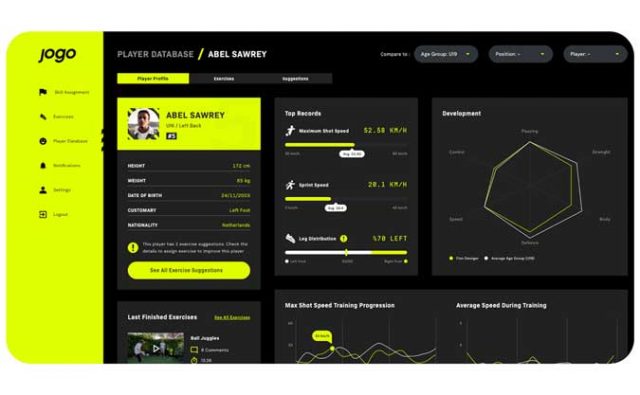
THE JOGO app, which can be downloaded for free on the Apple App Store (iOS) or Google Play (Android), provides an entire database of proven, tested, and optimized skill assignments, training, and development videos. (jogo.ai)

A NEWLY developed talent development software was recently launched in the country by its Dutch makers through a local football foundation.

JOGO, a football talent development app, has made its way to the Philippines and is being angled to augment the development of the sport here especially during this time of the pandemic.

The app, which can be downloaded for free on the Apple App Store (iOS) or Google Play (Android), provides an entire database of proven, tested, and optimized skill assignments, training, and development videos.

The platform allows trainers to select and assign exercises to their players quickly. The players can check their assignments directly on the app, perform them and send them back to their club or trainer. This process, its makers said, ensures a better optimization of their development and more efficient training.

While general for free, those looking to add more features in their app can choose to do so but for a certain fee.

The app had been up and running for a year before the actual product launched in November last year and has seen steady pickup in different parts of the world.

In the country, the first to test the app is Football for Humanity Foundation, a sport for peace and development charity established in 2017.

“When JOGO reached out to me and offered free use of the app to our beneficiaries, it was an exciting opportunity for our young players who had been prevented from practicing and playing due to the pandemic. Now, in the comfort of their own backyard, and armed with a mobile phone, they can follow a program that I’ve set and they can upload their progress and get feedback,” said Chris Thomas, Football for Humanity founder and president, in the app’s online launch.

“Our players instantly upgraded their skills, and tried harder each time. It’s really like having your own trainer every day,” added Mr. Thomas, who is currently in the United Kingdom.

It is precisely what the makers of the JOGO app hope to bring to those who want to experience what the software can do.

“With JOGO we want to change the way football develops young footballers; it should become more data-driven and tech-savvy, and accessible to anyone who wants it, as we strive for the perfect design for our users. The Philippines is a great market for JOGO. We see so many football fans and players and we think that our technology, due to its accessibility, can really help ambitious young players reach their goals,” said JOGO CEO David Dwinger, who was joined in the launch by JOGO COO Frank Zaal in the Netherlands.

The JOGO officials said more innovations are in store for their company and the app, including “sensors” that are embedded in the player’s football boots which will supply a more detailed reading of a player’s development curve and improvement needs.

For more information on the JOGO app and company, check jogo.ai. — Michael Angelo S. Murillo

Making strides

When supposed unicorn Kristaps Porziņģis was sent packing in February 2019, not a few quarters believed the Knicks got the better end of the deal that netted them Dennis Smith, Jr., DeAndre Jordan, Wesley Matthews, and two first-round picks. And even as they had to part ways with Tim Hardaway, Jr. and Courtney Lee in the process, massive contracts went along with the move. In other words, the stage was set for a bright future. Gone was a disgruntled, injury-prone, would-be star, and in his place stood promising assets seen to jump-start a long-in-coming rebuild.

Fast forward to the present, and it’s clear that the Knicks have runner-up honors in the two-way trade. Smith was a bust, and now plies his trade for the Pistons. Jordan bolted for the Nets. Matthew’s played a grand total of one game in blue and orange. And who knows how draft picks will ultimately fare? For all the continued brittleness of Porziņģis’ body and the price tag that Hardaway commands, the outcome cannot be questioned: the Mavericks cannot but be happy with what they got, and continue to get. They competed strongly in the bubble last year, and now appear to be in a good position to avoid the dangerous and unpredictable play-in tournament.

The Knicks aren’t crying over spilled milk, however, because they like where they are — which is where they most certainly would not be had they held on to Porziņģis. They may have taken a step backward with the daylight fleecing, but they’re definitely two steps ahead in the face of their outstanding showing heading into the last sixth of the 2020-21 season. At fourth in the East and holders of a remarkable nine-outing win streak, they stand a good chance of formalizing their status as the biggest surprise of the National Basketball Association.

Not that the Knicks consider their performance to be out of the ordinary. To the contrary, they’ve had reason to hold their heads high; under the tutelage of head coach Tom Thibodeau, they sport a brand of defense that is relentless in purpose, not to mention a style of offense that is deliberate by nature. The latter is anchored on the sterling showing of first-time All-Star Julius Randle, whose significant improvement in shooting range and accuracy — and, most importantly, playmaking — propels their competitiveness.

Whether or not the Knicks’ in-your-face approach from start to finish is sustainable remains to be seen. Thibodeau has a well-deserved reputation as a turnaround artist, but is also bogged down by diminishing returns over time. Nonetheless, there can be no discounting the strides they have made, with such proven disciples as Derrick Rose and Taj Gibson making solid contributions. If nothing else, they’ll be a tough out in the playoffs, their unique mix of self-assurance and resolve making them greater than the sum of their parts.


Anthony L. Cuaycong has been writing Courtside since BusinessWorld introduced a Sports section in 1994. He is a consultant on strategic planning, operations and Human Resources management, corporate communications, and business development.

ADVERTISEMENT
ADVERTISEMENT