Home Blog Page 8189

PSEi declines on virus concerns, earnings data

Philippine Stock Exchange index

Local shares closed the week in the red as coronavirus disease 2019 (COVID-19) concerns continued to cloud market sentiment and as investors anticipate first- quarter corporate earnings reports.

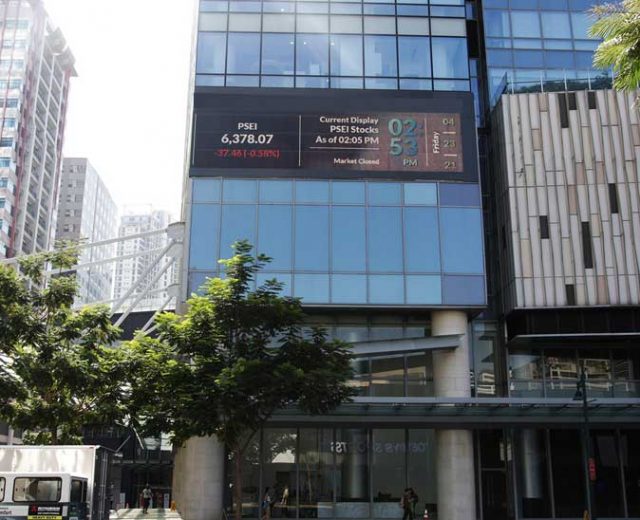
The 30-member Philippine Stock Exchange index (PSEi) dropped by 37.46 points or 0.58% on Friday to close at 6,378.07, while the broader all shares index lost 20.22 points or 0.51% to end at 3,927.19.

“The index failed to stay above the 6,400 support level for this week as investors continued to have a cautious stance given sustained high positivity rate and daily COVID-19 cases despite the stricter measures imposed this April,” Lance U. Soledad, junior equity analyst at AB Capital Securities, Inc., said in a Viber message.

The Health department logged 8,719 new COVID-19 infections on Friday, which brought the country’s overall tally to 979,740. Active cases are now at 102,799.

For Timson Securities, Inc. Trader Darren Blaine T. Pangan, investors remained on the sidelines as they anticipated for first-quarter corporate financial results.

“In the international scene, economic threats of the COVID-19 pandemic continue to weigh on investor sentiment,” Mr. Pangan said in a separate Viber message.

Majority of PSE’s sectoral indices closed in the red on Friday, except for financials, which gained 1.99 points or 0.14% to finish at 1,384.02.

Meanwhile, mining and oil shaved off 144.88 points or 1.63% to 8,727.77; holding firms declined by 58.19 points or 0.89% to 6,448.55; property gave up 21.2 points or 0.67% to 3,108.51; services went down 9.72 points or 0.67% to close at 1,435.99; and industrials lost 17.9 points or 0.2% to 8,620.77.

Value turnover increased to P5.87 billion with 2.04 billion issues traded on Friday from the P5.65 billion with 3.66 billion shares switching hands seen on Thursday. Decliners bested advancers, 132 against 64, while 47 names closed unchanged.

Net foreign selling inched up to P1.31 billion on Friday from the previous trading day’s P1.12 billion.

For next week, First Metro Investment Corp. Head of Research Cristina S. Ulang said in a Viber message she expects “technical recovery on bargain hunting,” while AB Capital Securities’ Mr. Soledad placed the index support level at 6,200. — Keren Concepcion G. Valmonte

Rak of Aegis goes online

http://rakofaegis.com/

After running seven seasons onstage, Philippine Educational Theater Association (PETA)’s hit juke-box musical Rak of Aegis will soon stream online.

Shot live from a previous performance, Rak of Aegis will stream for pay-per-view on ticket2me.net on July 31, Aug. 1, 7, and 8.

Written by Liza Magtoto, the musical features songs by the rock band Aegis. The musical follows Aileen who dreams of becoming famous by posting song covers online. As she pursues her dreams she also helps her perennially flooded urban community. The musical opened on Jan. 31, 2014 and its most recent run closed on Sept. 29, 2019.

Directed by PETA Artistic Director Maribel Legarda, with musical direction, arrangement, and vocal direction by Myke Salomon, principal cast members from the past seven seasons include Aicelle Santos, Jerald Napoles, Pepe Herrera, Isay Alvarez Seña, Robert Seña, Kakai Bautista, Myke Salomon, Poppert Bernadas, and Ron Alfonso.

The online stream is the banner project of PETA’s #TakePETAbeyondCOVID fundraising campaign.

For more information, visit https://www.facebook.com/PETATHEATER/. — MAPS

Smart unveils Unli 5G as its most powerful offer on its fastest technology

As a big step forward in its 5G push, leading mobile services provider Smart Communications, Inc. has introduced Unli 5G, its most powerful offer on its fastest technology yet.

Unli 5G provides customers with non-stop data access at selected Smart 5G-covered areas – with absolutely no data-capping or speed-throttling for a superior and reliable 5G experience.

To give convenience and flexibility to customers, Unli 5G also comes with additional data for non-5G use so subscribers can stay connected even when they move from a 5G-covered area to a non-5G-covered site.

Smart subscribers can avail of Unli 5G valid for 7 days plus 2 GB data for non-5G use for only Php299. Customers can also avail of Unli 5G valid for 30 days plus 12 GB data for non-5G use for Php599. For even more data, customers can get Unli 5G valid for 30 days plus 24 GB data for non-5G use for only Php799.  

Smart subscribers can avail of Unli 5G exclusively via GigaLife App, which is downloadable on Google Play and the Apple App Store.

GigaLife App also features Smart’s other innovative data products, including All Data, which offers shareable data for all sites, and Magic Data, which offers non-expiring data for all sites.

Fastest 5G network in PH

The launch of Unli 5G comes on the heels of Smart’s recognition for having the fastest 5G network in the Philippines by Ookla®, the global leader in internet testing and analysis.

Based on consumer-initiated tests taken using Speedtest® by Ookla, Smart has consistently posted the fastest 5G speeds for Q1 2021, with median download speeds of 190 Mbps, more than double the competition’s speeds for the same period*.

“Unli 5G is our most powerful offer on our fastest technology yet, and we specially designed it so more Filipinos can enjoy firsthand the differentiated digital experience that only Smart 5G can deliver,” said Jane J. Basas, SVP and Head of Consumer Wireless Business at Smart.

“In the same way that Smart pioneered LTE in the Philippines back in 2013, we are now driving 5G forward by continuously expanding our 5G footprint and introducing innovative products like Unli 5G so our customers can make the most of this game-changing technology.”

Areas to experience Unli 5G

Unli 5G is initially available at strategic urban centers for an optimal experience. These areas include Metro Manila, Angeles City, Baguio City, Cavite City, Cebu City, Clark City, and Davao City.

To enjoy Unli 5G, subscribers should have a Smart 5G-certified device and Smart 5G-ready SIM and in a Smart 5G-covered location.

With Unli 5G, subscribers can take their favorite online activities to whole new level – from streaming Ultra-HD videos seamlessly, playing high-bandwidth games without lag, making crystal-clear video calls without buffering, and uploading and downloading heavy files in seconds.

Most extensive 5G network

Smart continues to expand its 5G network, which now has over 2,500 sites nationwide – the most extensive in the country.

Smart 5G sites have been fired up at strategic locations nationwide including in all of Metro Manila’s cities and municipalities, and in the provinces of Benguet, Bulacan, Cavite, Laguna, Pampanga, Rizal, Cebu, Iloilo, Aklan, Misamis Oriental, Zamboanga Sibugay, and Davao.

Along with its continuous 5G roll-out, Smart has also widened its array of Smart 5G-certified devices to make 5G easier to access and enjoy.

Recently, Smart launched Rocket WiFi, the country’s first and fastest 5G Pocket WiFi. Smart also introduced Smart Signature 5G Plans, the country’s first postpaid plans that feature generous data allocations so customers can make the most of Smart 5G.

Smart 5G complements Smart’s continuous expansion of its 4G/LTE network, which has been recognized by Ookla as the fastest mobile network in the country for three years in a row starting in 2018.

To know more about Smart 5G, visit http://5g.smart and follow Smart’s official social media accounts.

Reinforcing connections among the Filipino people

Globe commits to improve digital connectivity in PHL and data experience for Filipinos

By Bjorn Biel M. Beltran

Though far from a complete panacea to the country’s troubles during the COVID-19 crisis, digital technology and connectivity have been instrumental in minimizing the pandemic’s impact. In fact, the rapid adoption of digital technologies was recommended by the World Bank to help the Philippines overcome the impact of the COVID-19 pandemic, recover from the crisis, and achieve its vision of becoming a middle-class society free of poverty.


A joint report released by the World Bank and the National Economic and Development Authority (NEDA) in October last year, titled “A Better Normal Under COVID-19: Digitalizing the Philippine Economy Now,” found that the use of digital technologies such as digital payments, e-commerce, telemedicine, and online education, has risen in the country, softening the pandemic’s blow to individuals, businesses, and the government.

“This pandemic has caused substantial disruptions in the domestic economy as community restrictions have limited movement of people and reduced business operations nationwide. As we are now living with the new normal, the use of digital technology and digital transformation have become important for Filipinos in coping with the present crisis, moving towards economic recovery, and getting us back on track towards our long-term aspirations,” NEDA Undersecretary Rosemarie G. Edillon said in the report.

However, the present “digital divide,” which separates those who have access to the internet and those without, is hindering the potential of digital technology to give Filipinos equal opportunities.

“Internet connectivity — the foundation of the digital economy — is limited in rural areas, and where they are available, services are relatively expensive and of weak quality,” said Ndiame Diop, World Bank country director for Brunei, Malaysia, Philippines and Thailand, during the BusinessWorld Virtual Economic Forum.

“Upgrading digital infrastructure all over the country will introduce fundamental changes that can improve social service delivery, enhance resilience against shocks, and create more economic opportunities for all Filipinos,” he added.

Bridging the digital divide

As one of the country’s major telecommunications providers, Globe Telecom, Inc. is all too aware of this digital divide. The company launched a three-pronged strategy in 2020 to improve digital connectivity and data experience for Filipinos.

“We are committed to doing aggressive cell site builds which is why our capex has been increasing since last year,” Globe President and Chief Executive Officer Ernest L. Cu said.

“In addition, we are upgrading our mobile network to 4G/LTE and 5G using many different frequencies since 3G technology for mobile data is already obsolete. With the newer technologies, we will be able to deliver better data and faster browsing speeds to our customers,” he added.

Globe built close to 1,300 new towers in 2020 or 18% more than 2019. In addition, the company said that it has upgraded over 11,500 sites with 4G/LTE, resulting in an improved network experience for its customers.

On the home connectivity front, Globe is also investing in more fiber lines to Filipino homes nationwide, as well as upgrading the lines of existing qualified customers still using copper lines to fiber at no additional cost to the customer.

“Our commitment in 2021 is to build an additional 2,000 sites and one million fiber lines for home broadband,” Mr. Cu said, noting the considerable challenge this commitment requires.

Building more towers or sites requires the availability of strategically located property to put them up, Mr. Cu pointed out, and such locations are necessary to improve access to connectivity in the country.

“We still encounter difficulty in entering some gated subdivisions and villages, and securing the approval of homeowners. Vertical building developments like condominiums must also include broadband connectivity during the planning stage of development instead of post-development. This mindset has to change. Today, connectivity is an essential need just like light and water. So Internet connection has to be treated on the same level as other utilities and not just a ‘nice to have’,” Mr. Cu said.

Regardless, the company remains confident that five years down the line it can equip more homes with increased fiber connectivity and see a bigger 5G footprint across the country.

5G is the next generation of wireless technology that promises mobile data speeds of up to 100 times faster than 4G and a substantial reduction in latency, or a measure of delay or the amount of time required for data to get to its intended destination.

“With these two capabilities, the Filipino will be able to enjoy better video streaming, downloading and surfing, but also a new range of future technologies and uses like self-driving cars, connected cities and so much more,” Mr. Cu said.

“We believe that the country is now ready for a digital transformation because the level of adoption across all market segments has been tremendous. The use of new technologies like 5G is crucial because of its capabilities and overall better experience. The continued reduction in the prices of 5G-capable smartphones and the rapid deployment of the 5G network across the country augurs well for the country as more Filipinos will enjoy the benefits of this technology,” Mr. Cu added.

A more connected path for the nation

How PHL telcos respond to the increasing demand for connectivity

By Adrian Paul B. Conoza, Special Features Writer

Last year, in an effort to control the spread of the coronavirus disease 2019 (COVID-19) pandemic, businesses, offices, and schools were forced to close, causing work and classes to continue at home using online means.

With the rise of remote work and e-learning amid the lockdown, the demand for connectivity was thus observed to have intensified. Yet, along with this increased demand, the lapses in the country’s connectivity were further revealed.

Last October, in their “Philippines Digital Economy Report 2020”, the World Bank and the National Economic and Development Authority observed that the country’s digital infrastructure remains weak and internet speeds are among the slowest and most expensive in the world.

“Digital infrastructure is limited in remote and rural areas, and where they are available, the internet services are relatively expensive and of poor quality,” the report read.

Data cited by the report showed that the Philippines has much room for improvement in terms of connectivity. Compared to its Southeast Asian neighbors, fixed broadband average download speed is at 26 megabits per second (mbps), compared to 59 mbps of its ASEAN peers. 3G/4G mobile average download speed is tallied at 7 mbps, nearly half short of ASEAN’s 13 mbps. 4G/LTE mobile broadband network coverage, meanwhile, is at 72% in the Philippines, compared to ASEAN’s 82%.

Add to that the higher cost of internet in the country in contrast with some of its ASEAN peers, with entry-level fixed broadband found to be priced at 6.5% of gross national income per capita in the country. This exceeds the 2% recommended threshold by the United Nations Broadband Commission.

The call for improved connectivity even reached the government, to the point that President Rodrigo R. Duterte, in his State of the Nation Address, urged telecommunications players to improve their services before 2020 ends.

In response, the leading telco players have ramped up their expansion efforts, which have been made much easier with the Bayanihan to Recover As One Act granting the government the power to simplify the permit process for building cell towers.

Telcos’ responses
In a press briefing of the Presidential spokesperson last December, telco firms — both existing and new ones — were gathered to give updates on how they were improving their services in the past months.

For PLDT and Smart Communication’s part, Smart President and Chief Executive Officer Alfredo S. Panlilio shared that upon ramping up its services after the lockdown, it is covering 96% of the country with wireless and 95% of cities and municipalities with fiber broadband. The firm was also to put on service about 10,069 cell sites, 58,538 base stations, 29,526 4G base stations.

Globe Telecom’s President and CEO Ernest L. Cu, meanwhile, said that it was able to secure a record number of 1,857 permits from July to November. “This has allowed us to actually exceed our rollout targets for the year,” Mr. Cu said, adding that amid the lockdown restrictions, it was able to catch up and would be able able to reach its target of 1,300 additional sites.

Converge has put in place about 3.5 million fiber ports, and it plans to add 1.8 million more in 2021, its Chief Operating Officer Jesus Romero said. Mr. Romero added that the capacity of Converge’s international backbone was expanded to 1.4 terabits, using eight cable systems and seven cable landing stations.

As shared by its Chief Administrative Officer Adel A. Tamano, new player DITO Telecom built over 1,900 towers, and laid over 12,000 kilometers of cables. The firm also announced that it completed its 5G test in the National Capital Region and has made its first 5G call.

Entering the consumer market
Another player, Radius Telecoms, Inc., also joins these players in addressing the country’s connectivity issues.

As its Chief Executive Officer and President Exequiel C. Delgado shared in an e-mail to BusinessWorld, the wholly-owned Meralco subsidiary has invested in expanding its capacity as it anticipates the increase in traffic from home users.

“We ended the year with more than 5,200 km of fiber optic footprint and have expanded our presence in Clark, Pampanga, and in Cebu,” Mr. Delgado said. “We have commissioned ten Optical Line Terminals distributed within Metro Manila which are now ready to provide broadband connections for SMEs and residential customers.”

Aside from ramping up its fiber rollout, Radius also starts offering RED Fiber, a bundle of the company’s broadband services and Cignal TV’s cable content package. Mr. Delgado considers this solution as its response to the government’s call for better internet connectivity.

In spite of a perceived lagging performance of internet connections in the country, Radius Chief Operating Officer Jenevi L. Dela Paz recognized that there are marked improvements in the last five years. What lies ahead for providers like theirs, nonetheless, is to continue rolling out its services in emerging cities and the countryside.

“While the wireless option is a quick fix, there is still a need to make available reliable fiber connection to every Filipino home due to its stability and higher bandwidth capacity,” Mr. Dela Paz shared in the same e-mail.

Addressing persisting concerns
Mr. Delgado observed that the national government’s concern on internet connectivity in the past months caused a huge improvement among stakeholders, with different local government units rising to the President’s call.

The CEO stressed that this momentum should be continued by succeeding administrations. He also recommends that the government consider investing in a national fiber backbone network that will interconnect Luzon, Visayas, and Mindanao.

“This move will allow a new player like us to compete head-on with the big boys and eventually encourage more ISPs to put up shop in the process. This would mean lower capex for new providers and faster rollout of internet services to more Filipino homes in the countryside,” Mr. Delgado said.

Aside from low speeds and affordability, the digital divide remains an issue to be addressed as connectivity gets improved.

Mr. Delgado recognized that this pronounced divide, which proves that internet access is no longer a luxury but a basic utility, must be collaboratively addressed.

“In these trying times, the private sector and government should work together to close the gap and lower the cost to gain access,” he said. “More than the affordable connection, the cost of the gadgets and tech refresher for the teachers and parents should also be given attention and priority.”

As telcos exert effort in improving connectivity in the country, one can only hope for fewer interrupted connections to happen more sooner.

Nonetheless, the Radius CEO sees hope in the availability of fiber facilities becoming mandatory for up-and-coming business districts and residential developments.

“If this becomes a reality, new homeowners and locators can easily request reliable internet connections which can be installed and activated more quickly than before,” Mr. Delgado said.


Better connectivity at home through fiber technology

Radius Telecoms brings fiber-powered service closer to homes

By Adrian Paul B. Conoza

As the pandemic kept people in their homes and so forced them to continue their work or classes virtually, the demand for internet connectivity has increased. At the same time, the realities about internet connections in the country were stressed more deeply, and the call for improved connections have apparently rung louder.

While leading telcos respond to these amplified concerns, there are new players that are expected to provide fresh and timely solutions for Filipino homes and businesses.

Among these new players is Radius Telecoms, Inc., a wholly-owned Manila Electric Co. (Meralco) subsidiary that delivers data, internet, managed, and cloud services on an end-to-end full fiber optic network. Seeing the increasing need for connectivity among homes, Radius is optimizing fiber technology in order to provide services that households will enjoy.

Initially, the telco player entered the market as a carrier’s carrier providing the last mile requirements of both local and foreign telcos. It then expanded its offering to businesses, catering to corporate and large enterprises. Aside from its strongholds in Metro Manila and economic zones around Central Luzon, Radius has already reached enterprises in Clark and Cebu.

“Business customers choose Radius because of our ‘higher-than-industry’ standard SLA and our shorter installation lead time,” Exequiel C. Delgado, chief executive officer and president of Radius, said in an e-mail.

Now, from primarily supporting wholesale, corporate, and large enterprise markets for two decades, Radius is stepping up to bring its reliable services to Filipino homes at a time when connectivity is a necessity.

Mr. Delgado shared that last year, Radius has started building a new fiber ring topology that utilize the Gigabit Passive Optical Network (GPON) technology, a shared infrastructure that allows Radius to deliver a cost-effective internet broadband service.

“We have powered up key locations in the metro and we expect to end the year with more than 500 plus lit buildings and over 100 villages, with a total port capacity of almost two hundred thousand,” Mr. Delgado said.

The CEO finds the positive feedback it received from its current customers as a welcome development, especially for a new player. He also recognized that Radius is jumping in at a very opportune time when many home users are subscribing to an additional internet link as an active backup, which is only being done previously by business customers.

A big edge of Radius among the competition is its network that runs on 100% pure fiber. For the company’s chief operations officer, Jenevi L. Dela Paz, fiber technology is “the way to go and will continue to be the gold standard in wired deployments.”

“Its flexibility and capability to offer higher bandwidth allows the provider to deliver a better customer experience for the consuming public,” Mr. Dela Paz explained in the same e-mail. “This can be complemented further by the ability of the provider to effectively haul the traffic of the end-users to the world wide web through multiple peering partners, a sound caching strategy, and reliable IP transit providers.”

Fiber-powered connectivity at home

Powered by these enhancements, Radius is bringing its service closer to consumers as it partners with direct-to-home satellite provider Cignal TV to deliver a dual-play service to Filipino homes.

In February last year, the pay TV service and the fiber broadband provider inked a partnership that rolls out RED Fiber. This newest bundle brings together the great services from Cignal TV and Radius for every household to enjoy at prices that will suit every household budget. RED Fiber is offering consumers its unlimited fiber internet + pay TV plan for as low as P1,299 per month.

“This kind of package showcases the technological capability of fiber, which allows the delivery of internet and content using the same link, without affecting each other’s performance,” Mr. Delgado shared.

With RED Fiber, the CEO added, product manipulations, upgrades, and additional IPTV HD channels can be completed quickly. Add to these Radius’ responsive customer relationship management and reliable platforms, RED Fiber subscribers can enjoy a vastly improved customer experience.

In addition to this powerful bundle, RED Fiber also offers a higher service-level agreement (SLA) as it meets increased bandwidth requirements brought by the ‘now normal.’

“Radius has invested heavily on a superior network architecture and all-digital customer platforms to effectively offer superior customer care that will result in a longer customer lifecycle value,” Mr. Delgado said.

With the launch of RED Fiber, he added, Filipino customers now have a reliable option to choose from for their internet connectivity needs at home.

As it upgrades its network and provides wider access to more consumers, Radius aims to be a more active telco player that delivers its brand of delightful customer experience. With its entry to a bigger yet more demanding market, consumers are given an additional choice for their intensified connectivity needs.

“The more choices consumers have, the better it is for them since providers will be trying to outperform each other in the area of service quality to attract and retain customers,” Mr. Delgado said.

PHL raises P122B from euro bond sale

REUTERS
An employee shows 50 euro notes in a bank in Sarajevo in this March 19, 2012 file photo. — REUTERS

THE Philippine government raised €2.1 billion (P122.4 billion) from a triple-tranche offering of euro-denominated bonds, the Bureau of the Treasury (BTr) reported.

The Philippines took advantage of the low interest rates in the euro bond market, as it sold €650 million (P38 billion) worth of four-year global bonds, another €650 million (P47 billion) worth of 12-year notes, and €800 million worth of 20-year debt papers.

Proceeds will be used to support this year’s national budget, as the country continues to struggle to contain the coronavirus disease 2019 (COVID-19) pandemic.

The BTr said in a statement on Thursday total tenders reached €6.5 billion (P379 billion), or three times as much as the initial offer.

This was the country’s biggest and the first long-end euro bond sale ever. It previously issued only three-year, eight-year and nine-year papers.

Broken down, the four-year papers fetched a coupon of 0.25% or 75 basis points (bps) above the tenor’s euro mid swap, the 12-year papers were priced at 1.2% rate or mid swap +105 bps, while the 20-year notes yielded a coupon of 1.75%, 135 bps higher than the euro mid swap.

“All tranches tightened by 25 bps from the initial price guidance backed by a strong order book which allowed the republic to revise its price guidance twice across all three tranches,” the Treasury said.

The bonds will be settled on April 28.

The Treasury’s latest euro bond sale was bigger than the €1.2 billion it raised via the dual-tranche issuance in January 2020, which received €4.3 billion in bids.

“The Philippines’ successful return to the international capital market for the second time this year reflects the investor community’s confidence in the country’s prospects for a strong recovery from the prolonged pandemic, given that its financial readiness has allowed the government to do whatever COVID-19 response measures are necessary to save lives and revive the economy,” Finance Secretary Carlos G. Dominguez III said in a statement.

The latest borrowing was rated Baa2 by Moody’s Investors Service, BBB+ by S&P Global Ratings and BBB by Fitch Ratings.

BNP Paribas S.A., Credit Suisse, Goldman Sachs, JPMorgan, Nomura and Standard Chartered Bank acted as the joint lead managers and joint bookrunners for the issuance.

“The success of this euro deal, being already our fourth offering since the pandemic, serves as affirmation that we are on track to emerge from this crisis as a stronger and more resilient economy. Further, the ability to stretch our maturities to the 20-year tenor at tight pricing underscores that investors are indeed taking a long view on our return prospects,” National Treasurer Rosalia V. de Leon said.

Mr. Dominguez earlier said the country would tap the US bond market soon before “rates skyrocket.”

On March 30, the Philippines raised ¥55 billion (P24.2 billion) from the issuance of three-year Japanese yen-denominated “Samurai” bonds.

The government runs on a budget deficit as it spends more than the revenue being generated to fund programs that will drive economic growth.

It plans to raise P3 trillion this year both from local and foreign sources to plug its budget deficit seen hitting 8.9% of gross domestic product. About P286 billion is estimated to come from global bond issuances. — Beatrice M. Laforga

Banks keep stricter credit standards in Q1

REUTERS

MOST BANKS maintained stringent lending standards in the first quarter, but there are signs these may be further tightened due to the uncertain economic outlook, a survey by the Bangko Sentral ng Pilipinas (BSP) showed.

The latest Senior Bank Loan Officers’ Survey (SLOS) released by the BSP showed most respondent banks kept their lending standards for loans disbursed to both enterprises and households, based on the modal approach.

“In the survey, most of the respondents attributed their tightening of standards to the following factors: deterioration in profiles of borrowers, reduced tolerance for risk and also less favorable economic outlook,” BSP Department of Economic Research Director Dennis D. Lapid said at a virtual briefing.

Based on the diffusion index approach, the survey showed a net tightening of lenders’ credit standards in the January to March period, mirroring results in the fourth quarter of 2020.

Since the start of the coronavirus pandemic, SLOS results have shown overall credit standards have become stricter as banks became more risk averse.

Majority (66%) of surveyed banks maintained overall credit standards, based on the modal approach.

On the other hand, the diffusion index showed a net tightening of lending standards for all borrowers — ranging from top companies to microenterprises. This meant reduced credit line sizes; stricter collateral requirements and loan covenants; and increased use of interest rate floors.

Some forms of easing were also observed through narrower loan margins and longer loan maturities.

In terms of retail loans, the modal approach also showed 75% of respondent lenders left overall credit standards unchanged, the central bank said.

However, the diffusion index showed lenders’ credit standards for households generally tightened, reflected by lower credit line sizes and stricter loan agreements and collateral requirements. This was particularly evident in housing, auto, and personal or salary loans.

For the second quarter, banks are expecting to further tighten credit standards for businesses and households, based on the diffusion index approach.

The BSP said banks attributed this to the more uncertain economic outlook, the deterioration in borrowers’ profiles, and banks’ lower tolerance for risk.

BSP data showed outstanding loans by big banks continued to shrink for the third straight month in February by 2.7%, reflecting lenders’ risk aversion and lower demand from borrowers.

This contraction in lending also coincided with the rise of nonperforming loans. The NPL ratio reached 4.08% in February — the highest since the 4.09% in October 2009.

Despite indications of caution in lending, banks are bullish that loan demand will improve in the second quarter.

“Most of the respondent banks anticipate broadly steady overall loan demand from both enterprises and households indicating an optimistic view from firms and consumers amid the anticipated availability of the vaccine,” the central bank said.

The study found banks are expecting business loan demand to pick up due to improved outlook of corporate clients, along with higher financing needs from companies.

Retail loan demand is also expected to improve due to a rise in household consumption, lack of funds and higher housing investments.

The SLOS was conducted from March 1 to April 8. Questions were sent to a total of 64 banks, of which 51 or 79.7% responded. — L.W.T.Noble

Monetary policy remains appropriate — Diokno

PHILIPPINE STAR/ MICHAEL VARCAS
The consumer price index rose 4.5% last month, slower than the 4.7% in February but beyond the central bank’s 2-4% target. — PHILIPPINE STAR/ MICHAEL VARCAS

THE Bangko Sentral ng Pilipinas’ (BSP) accommodative monetary policy stance remains appropriate to support the economy’s recovery, officials said, vowing to keep a close eye on inflation.

“Looking ahead, the BSP will continue to look closely in the near term for signs of inflation becoming broader based in order to safeguard the public’s inflation expectations,” BSP Governor Benjamin E. Diokno said at a virtual briefing.

“The overall stance of monetary policy will remain oriented towards preserving ongoing policy support and helping to ensure the sustainability of economic recovery, while also guarding against emerging threats to the BSP’s price and financial stability objectives,” he added.

BSP Deputy Governor Francisco G. Dakila said the March inflation figures were in line with the central bank’s baseline projection.

The consumer price index rose 4.5% last month, slower than the 4.7% in February but beyond the BSP’s 2-4% target.

The central bank expects inflation this year to average 4.2%, but stressed major upside risks were mainly due to low supply of some commodities such as meat.

“We don’t see inflation going beyond 5% at any time during that [inflation] path [for 2021],” Mr. Dakila said.

BSP Department of Economic Research Senior Director Zeno R. Abenoja said upside risks to inflation include tighter supply of meat products and the improving global economic prospects.

On the other hand, factors such as the increase in coronavirus infections and the challenges to the vaccination program could slow inflation, Mr. Abenoja said.

In March, the BSP kept the key policy rate steady at a record low of 2%.

The Monetary Board’s next policy-setting meeting is set on May 13. — Luz Wendy T. Noble

Palace appoints Chua as NEDA secretary

Acting Socioeconomic Planning Secretary Karl Kendrick T. Chua

PRESIDENT Rodrigo R. Duterte has officially appointed Karl Kendrick T. Chua as Socioeconomic Planning secretary and director-general of the National Economic and Development Authority (NEDA), after a year of holding the positions in an acting capacity.

Presidential Spokesperson Herminio “Harry” L. Roque told reporters via Viber that Mr. Duterte approved Mr. Chua’s appointment on Thursday.

“Secretary Chua has served the Duterte administration with professionalism, competence and integrity as Undersecretary of the Department of Finance (DoF) and Acting Secretary of the NEDA,” Mr. Roque said.

“With the aforesaid traits we are confident that Sec. Chua would continuously and consistently perform well in his present but crucial task of jump-starting our economic recovery amid the COVID-19 pandemic,” he added.

Mr. Chua was named acting NEDA chief on April 17, 2020, after the resignation of Ernesto M. Pernia at the height of the coronavirus pandemic.

As Socioeconomic Planning secretary, he pushed for the fast-tracking of the rollout of the national ID program, creation of an economic recovery plan and acceleration of the infrastructure program.

Mr. Chua was previously undersecretary at the DoF and the country economist for the World Bank. — Beatrice M. Laforga

Virus resurgence threatens strong growth momentum

REUTERS

THE RENEWED SURGE in coronavirus disease 2019 (COVID-19) infections is threatening to further divide the world economy between the rich and poor, potentially damaging overall global growth if the fresh outbreaks spread or if key sources of demand falter.

More people were diagnosed with COVID-19 last week than any other since the pandemic began. The World Health Organization this week warned that new infections are increasing everywhere except Europe, led by rocketing numbers in India with cases also rising in Argentina, Turkey and Brazil.

That’s casting a shadow over a previously vigorous global economic rebound given that failure to control the virus or get vaccines distributed evenly risks driving new mutations, first in emerging markets and then on to developed nations that had been beating the pandemic back.

Even if that doesn’t happen, a two-speed recovery will restrain even inoculated countries by limiting foreign demand for their goods and destabilizing supply chains. The International Monetary Fund (IMF) said last month that the recovery will miss out on a $9-trillion bump by 2025 unless faster progress is made in ending the health crisis.

Emerging and developing economies accounted for two- thirds of global growth before the pandemic and around 86% of the world’s population. The World Bank told them just this week that they must prepare for the possibility of their recoveries losing steam. A nascent economic revival in India — the world’s sixth largest economy — is being threatened by renewed movement curbs across provinces to stem a new wave of infections that have topped 200,000 daily for the last week.

“The new case spikes represent a reality check for the world economy as it is clear that the pandemic is nowhere close to being over,” said Tuuli McCully, head of Asia Pacific economics at Scotiabank. “Many lower-income economies continue to face severe Covid-19 related challenges and have a long road ahead before they are back to ‘normalcy.’”

More than 944 million vaccinations have been administered across 170 countries, according to data collected by Bloomberg — enough doses for 6.2% of the global population. But the distribution is lopsided with the highest income countries getting vaccinated about 25 times faster than those with the lowest.

“I see it as a race between virus mutations and vaccine rollout,” said Rob Subbaraman, head of global markets research at Nomura Holdings, Inc. “Many people are not aware that while the 1918 Spanish flu is believed to have started in the US and then spread to Europe, in the end the countries that suffered most were in emerging markets. It’s an ominous sign of history repeating itself.”

Markets are showing signs of jitters. A gauge of stocks in Asia has lagged global peers this month, while the Indian rupee is this week’s worst-performing currency in the region. Investors have sought out traditional havens like the Japanese yen, and rewarded those with better track records of managing the outbreak such as the Israeli shekel, Taiwanese dollar and the British pound.

Companies most reliant on a reopening of the global economy are especially vulnerable and the latest infection surge is overshadowing a “priced to perfection re-open trade,” Stephen Innes, chief global market strategist at Axicorp Financial Services Pty Ltd. in Sydney, wrote in a note to clients.

Nestlé SA, the world’s largest food company, said in a statement on Thursday that “there is an urgent need to advance equitable access to vaccines, particularly in low-income countries.” The Swiss firm pledged more than 6 million francs ($6.6 million) to accelerate the delivery of shots to underserved communities.

GREAT EXPECTATIONS
“The glaring problem is that despite strenuous efforts by the medical community around the globe, we are not even close to calling it a day so that people can start again or continue with things more productively,” according to Mr. Innes.

The spread of cases threatens what’s forecast to be a V-shaped recovery for global growth, led by the US and China. The IMF currently expects the world economy to grow 6% this year, the most in four decades of data. But it knows the longer the pandemic runs the harder it will be to meet that forecast.

“The window of opportunity is closing fast,” IMF Managing Director Kristalina Georgieva said. “The longer it takes to speed up vaccine production and rollout, the harder it will be to achieve these gains.”

The IMF modeled a downside scenario in which supply bottlenecks in vaccine supply and other logistical problems allow existing virus variants to become entrenched and new mutations to occur, leading to delays for reaching herd immunity of six months in advanced economies and nine months in emerging markets.

Under such a scenario — with persistently high infection rates and deaths slowing the normalization of mobility — global growth could be 1.5 percentage points less than in the base case scenario in 2021 and a further 1 percentage point below the baseline in 2022.

The pace of vaccinations over coming months and their ability to withstand new variants will dictate the recovery from here, according to Ben Emons, managing director of global macro strategy at Medley Global Advisors in New York.

“It will take most of the second quarter to get visibility if the global roll out is truly succeeding against the variants,” Mr. Emons said. — Bloomberg

SEC exempts more entities from registering securities

ALEXES GERARD-UNSPLASH

List of qualified buyers of securities also expanded in SRC implementing rules

THE Securities and Exchange Commission (SEC) has approved the proposed exemption of securities offered by financial and multilateral institutions from registration under the Securities Regulations Code (SRC), and has expanded the list of qualified buyers of securities.

In a memorandum circular released on Thursday, the agency said that the Commission En Banc on April 20 had approved the proposed amendments to SRC Rules 9 and 10.

“The law provides for certain exceptions to the registration requirements laid down under Sections 8 and 12 for securities issued or guaranteed by, among others, the Philippine government, the government of any country with diplomatic relations with the Philippines, banks except their own shares of stock, multilateral financial entities established through a treaty or any other binding agreement involving the Philippines,” the commission said.

SRC Rules 9 and 10 were amended to reflect the changes.

Section 8 of the SRC requires securities sold and distributed in the country to be registered and approved by the SEC, while Section 12 outlines the procedures for registration.

Under the amended rules, securities issued by financial entities authorized by the commission and the Bangko Sentral ng Pilipinas (BSP), and those issued to the BSP through its open market or through rediscounted operations are included in the exemption.

Multilateral financial entities looking to sell securities are still required to issue an offering circular detailing information on the issuer and the security, background on the institution, and details on the guarantee.

Other evidence of indebtedness will be exempt from registration requirements, as long as these meet the following criteria: issued to not more than 19 non-institutional lenders, payable to a specific person, not negotiable nor assignable and held on to maturity, and securities not exceeding P150 million.

“The commission may, by rule or regulation after public hearing, add to the foregoing any class of securities if it finds that the enforcement of the Code with respect to such securities is not necessary in the public interest and for the protection of investors,” the SEC said.

However, provisions on the purchase, sale, distribution, and settlement of securities will still be implemented. Provisions on fraud, and civil and other liabilities will also apply.

Meanwhile, securities issued and sold to qualified buyers listed under SRC Rule 10.1.3 will also be exempt from Sections 8 and 12 of the Code.

“The SEC will now consider as qualified buyers registered securities dealers, accounts managed by a registered broker under a discretionary arrangement, and registered investment companies, such as mutual fund companies,” the corporate watchdog said.

The exemption covers provident funds or pension funds of a government agency or by government or private corporations, which are managed by an entity authorized by the commission or the BSP, and unit trust corporations established according to the BSP’s rules and regulations.

Other exempt qualified buyers are the following: funds established and covered by a trust or investment management agreement with qualified buyers, authorized pre-need companies, authorized collective investment schemes, listed entities engaging in professional fund management services, and foreign entities matching aforementioned descriptions.

“The commission may also determine as qualified buyers, by rule or order, such other persons on the basis of such factors as financial sophistication, net worth, knowledge, and experience in financial and business matters, or amount of assets under management,” the SEC said. — Keren Concepcion G. Valmonte

ADVERTISEMENT
ADVERTISEMENT