Home Blog Page 8188

Philippines reports 24 deaths after vaccination

PHILIPPINE STAR/ MICHAEL VARCAS

More than 24,000 so-called adverse events had been reported among the more than a million Filipinos who got vaccinated against the coronavirus, 24 of whom died, the local Food and Drug Administration (FDA) said on Friday.

FDA Director-General Rolando Enrique D. Domingo told an online news briefing most of the 24 people who died had other serious illnesses.

Of the 24 who died, 11 got infected with the coronavirus, eight had cardiovascular or cerebrovascular illnesses, three had other infectious diseases and two were still pending review.

He said 24,698 adverse events after immunization were reported, 7,044 of whom received Sinovac Biotech Ltd.’s CoronaVac, while 17,654 got vaccinated with the shot from AstraZeneca Plc.

Aside from the 24 deaths, Mr. Domingo said 24,330 were not serious and 344 were serious. Serious adverse events refer to those that require admission to a hospital, death or life-threatening events, significant disability and birth defects, he added.

He said the most common adverse events reported from those who got the CoronaVac were increased blood pressure, headache, pain in the vaccination site, dizziness and fever.

For the AstraZeneca vaccine, adverse events were fever, headache, pain in the vaccination site, chills and body pains.

He said 10 of those who died got the CoronaVac and 14 got AstraZeneca shots. “Most of them are not related to the vaccination,” he said of the deaths, adding that the benefits of the vaccine outweigh the risks.

As of April 20, about 1.4 million had received their first dose and 209,456 got their second dose, according to the Health department. — Vann Marlo M. Villegas
DTI to propose P10-B livelihood subsidy for micro businesses

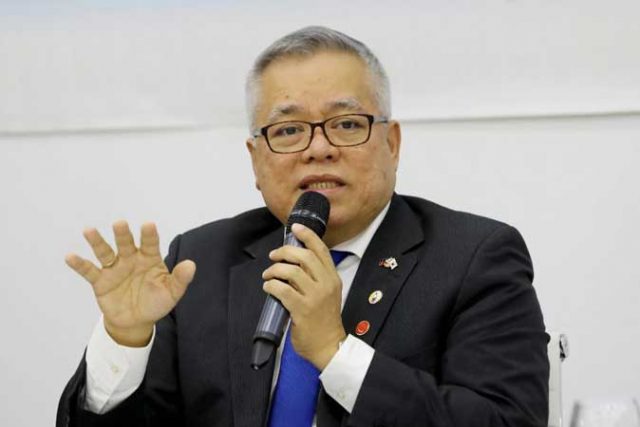
The Trade department said Friday that it is considering making a proposal to establish a livelihood subsidy assistance fund for micro enterprises of at least P10 billion from money authorized under the pending third Bayanihan stimulus law.

“P10 billion livelihood subsidy for micro enterprises (formal and informal) would be a good start,” Trade Secretary Ramon M. Lopez told reporters by Viber Friday.

The quarantine, currently at a setting known as modified enhanced community quarantine (MECQ), has significantly affected the operations of micro, small and medium enterprises and cost the economy an estimated P120 billion, according to Mr. Lopez.

“Based on an average improvement of around 30% in jobs and firms operating in MECQ compared with ECQ, the rough estimate of GDP (gross domestic product) loss during MECQ can be around P120 billion,” he said.

Mr. Lopez has said the two-week ECQ implemented in Metro Manila and nearby provinces before the easing to MECQ cost the economy about P180 billion.

He said in an ANC interview on Friday that increased hospital bed and intensive care unit capacity and an improved contact-tracing system are necessary before Metro Manila and nearby provinces can be placed under the more relaxed general community quarantine (GCQ).

“We believe… if we are able to really ramp up the ICU beds… and at the same time really have an efficient contact tracing… before the end of May, it’s possible that we move to GCQ and have granular lockdowns,” he said.

The government launched on Friday a safety seal certification program for establishments as a pandemic containment measure.

The Trade department has said certified establishments will be provided with a certification sticker, which should be displayed at each entry point.

An establishment with a safety certification signifies compliance with the required safety protocols.

Safety certification, however, is not mandatory, according to Mr. Lopez.

Also on Friday, Mr. Lopez said there are ongoing discussions among government agencies and private institutions to simplify the procedure for the entry of vaccine companies.

“We had a meeting with the Anti-Red Tape Authority, Food and Drug Administration and other agencies to work on the instructions of the President to provide a green lane procedure in the processing of the entry of vaccine manufacturers,” he said.

Asked how much the government can procure from the vaccine makers, he said: “It will depend on the future requirement of the government for its vaccination program.” — Arjay L. Balinbin

Budget reform bill filed in House to deter unfunded mandates

PHILSTAR FILE PHOTO

A BILL has been filed in the House of Representatives seeking to better align budget items with national government priorities and to deter proposed uses of public money with no identified funding sources.

House Bill No. 9214, which if passed will go into the books as the Budget Modernization Act, was filed by Representative Jose Ma. Clemente S. Salceda, a vice-chairman of the House Committee on Appropriations.

“As the most important guiding document of national policy for the year, the budget must be prepared, discussed, and enforced in a manner that upholds national interest and the Constitution. It must be prepared and implemented with a view towards national objectives for the year,” Mr. Salceda said in statement Friday.

Mr. Salceda cited the need to avoid waste in allocating funds and to discourage unfunded mandates, in which spending proposals are made without identifying the sources of the funds.

“There is urgent need for a framework that clarifies the management of public resources, especially in view of the pressures our public resources face during and in the aftermath of the COVID-19 pandemic,” he said.

The Budget Modernization Bill “clarifies the processes and regulations for budget preparation, management, and reporting…(and) institutionalizes the Budget Priorities Framework to ensure that the national budget is allocated towards clear national priorities,” he added.

He said it is important to set clear ground rules for budget preparation, management of fiscal resources, and reporting on how budget funds were spent. — Bianca Angelica D. Añago

Energy efficiency incentive rules nearing approval

PIXABAY

THE department circular that will set guidelines for endorsing energy efficiency projects to the Board of Investments (BoI) for fiscal incentives is nearing approval, according to the Department of Energy (DoE).

The DoE said in a statement Friday that a third public consultation on the draft circular was conducted on April 15, attended by industry representatives and other stakeholders.

According to the DoE, the consolidated and final version of the proposed circular will be sent to Energy Secretary Alfonso G. Cusi for approval.

“I look forward to receiving the final copy of the department circular so we can release it at once. This will be a big boost in our efforts to attract investors as more fiscal incentives are given to energy efficiency projects,” Mr. Cusi said.

The circular contemplates incentives such as income tax holidays.

“The DoE will evaluate energy efficiency projects and determine the total effect in consideration to energy savings that will lead to the reduction of greenhouse gas emissions, and lowered operational costs,” it said.

Energy Undersecretary Jesus Cristino P. Posadas said on April 12 that the BoI has determined that a substantial income tax holiday is needed to ease the cost burden of capital-intensive projects being undertaken during a global economic slump.

“Pioneers… stand to reap greater rewards, especially in terms of immediate lower operational costs, (and) the possibility of short-term cost recovery for upgrading systems with energy efficient technology. Industry-wide participation can greatly reduce greenhouse gas emissions especially when done at a large scale,” Mr. Posadas said.

Once approved, the proposed department circular will serve to further operationalize Republic Act No. 11285 or the Energy Efficiency and Conservation Act, passed in 2019. — Revin Mikhael D. Ochave

Job opportunities seen opening up in Cebu, Iloilo, Davao

PHILSTAR

Job seekers in Cebu, Iloilo, and Davao are being offered more positions nearer home, according to online employment service JobStreet, which has launched microsites in those provinces.

“Many Filipinos recently returned to their provinces because of layoffs or the new work from home arrangements and this caused a shift in the labor market. We’ve also observed that candidates from major provinces have increased their activities in terms of platform website visits, which is why we really targeted to promote local employment and provide them valuable support in their career through their own dialect,” JobStreet Philippines Country Manager Philip Gioca said in an online launch event for the microsites Friday.

Mr. Gioca also said that with changes in work arrangements brought about by the pandemic, he now sees a “multitude and variety of jobs.”

The microsite for Cebu offers places in industries such as Information Technology Services and Business Process Outsourcing (12.5%), manufacturing and production (7.6%), healthcare (6.5%), education (5.5%), and construction and engineering (5.2%), with the average salary reported at P31,487.

Job seekers from Davao may also apply through the Davao microsite, which has listings for Information Technology Services and Business Process Outsourcing jobs (8.7%), healthcare (7.8%), education (7.2%), food (5.6%), and retail and merchandise industries (5.3%), with an average salary of P28,500.

The Iloilo microsite lists jobs in healthcare (13.6%), Information Technology Services and Business Process Outsourcing industries (9.2%), education (8.3%), construction and engineering (5.6%), and food (5.3%) with salaries averaging P27,370.

Mr. Gioca said results of the Global Talent Survey revealed that 96% of Filipino respondents want to continue working remotely even after the pandemic.

As such, JobStreet and selected Department of Labor and Employment (DoLE) Regional Offices will organize a virtual career fair on May 1-3 which will feature work-from-home options or a combination of home and office work. — Bianca Angelica D. Añago

BSP to ensure smooth Citi exit as rivals circle loan book

REUTERS

The Bangko Sentral ng Pilipinas (BSP) said it will closely monitor Citigroup, Inc. exit from retail banking in the Philippines to ensure a smooth transition as Philippine banks express interest in acquiring the US bank’s loan book.

“Citi Philippines, in its report to the BSP, clarified that there will be no immediate change in its retail business operations and its retail customers shall be serviced in a business-as-usual manner until further notice,” the central bank said in a statement Friday.

Citi announced last week that it will be exiting the consumer banking business in 13 Asia-Pacific markets including the Philippines, but it will keep its corporate banking business.

“The BSP is coordinating with Citi Philippines to ensure a smooth transition, including putting in place appropriate mechanisms to timely respond to any queries and concerns of its depositors and other stakeholders,” the central bank said.

Citi is also planning to exit the consumer business in Australia, Bahrain, China, India, Indonesia, South Korea, Malaysia, Poland, Russia, Taiwan, Thailand and Vietnam, while retaining its institutional clients group.

Various Philippine banks have expressed interest in acquiring Citi Philippines’ assets, most recently BDO Unibank, Inc. and East West Banking Corp. (EastWest Bank).

“We will likely take a look at it. It’s a good business franchise that any bank will be interested in so it’s not something that you can ignore,” Nestor V. Tan, BDO’s president and CEO, said during the BDO shareholder meeting Friday.

“However, we have to be cognizant that because of our size, the overlaps and the stickiness of the business for sale may be a factor,” he added.

EastWest Bank President and CEO Antonio C. Moncupa, Jr. said Citi Philippines, which has the largest credit card business in the country by issuance and also a significant wealth management operation, controls businesses where EastWest Bank “wants to grow.”

“We are certainly very interested to know more about the opportunity and see how it fits our strategic intent towards our growth and profitability that is sustainable. We’ll see what happens, let’s wait for developments,” Mr. Moncupa said when asked at his bank’s shareholder meeting Friday.

On Thursday, Bank of the Philippine Islands (BPI) also expressed interest in bidding for Citi’s portfolio.

“While we confirm our interest, we are in no position to comment on Citibank’s plans. There is no other material information to disclose at this time,” BPI told the stock exchange Friday.

Citi established operations in the Philippines in 1902. It currently has over 8,000 employees across its corporate and retail businesses, as well as in service centers. — Beatrice M. Laforga

BDO Q1 net profit rises 19% on non-interest income

BW FILE PHOTO

BDO Unibank Inc., said it booked a P10.4 billion net profit in the first quarter, up 19% from a year earlier, buoyed by a strong non-interest income performance.

Nestor V. Tan, the bank’s president and CEO, said at the bank’s annual meeting Friday that net interest income fell 3% year-on-year to P32 billion due to weak loan demand and lower net interest margins.

This was offset by the 21% increase in non-interest income to P15.4 billion. The bank also booked a 31% rise in insurance premiums from its life business as well as trading gains posted this period, following a year-earlier trading loss.

Loans fell 1% to P2.218 trillion, with the non-performing loan ratio at 2.81% in the first quarter, rising from the 2020 level of 2.65% but below the industry average of 3.67%, Mr. Tan said.

BDO had a bad loan coverage ratio of 107% at the end of March, against 110% in 2020 but above the industry average of 95%, he added.

Operating expenses rose to P31.1 billion from P30.5 billion a year earlier.

The bank set aside P2.9 billion in loan loss provisions in the first quarter, up 30% from a year earlier.

“Compared to our current NPL level of only 2.3% the bank’s capital base is strong enough to withstand shocks,” Mr. Tan said.

Deposits totaled P2.63 trillion in the first three months, up 2% from a year earlier.

Low-cost CASA deposits rose 11% to P2.179 trillion at the end of March, accounting for 83% of the total.

Overall capital rose 8% to P401 billion.

The capital adequacy ratio was 14.5%, while the common equity tier-one ratio was 13.4% at the end of March, both above the regulatory minimum.

Mr. Tan said the bank is continuing to pursue its goal of serving the unbanked segment of the population over the next five years. BDO will also ramp up its digital transformation by launching new products, processes and platforms.

He said NPLs are expected to peak at 4-5% this year before ending 2021 at around 3%.

“We are below that. So I think we’re trending quite better than what we anticipated. But having said that, the challenge… is not in the NPL ratio,” he said.

“The second thing that we need to do is to protect the balance sheet and in 2020, we did pre-emptive provisioning and our NPL cover is in excess of 100%. Given the loss default that we’ve experienced, which is about 50%, I think the balance sheet is adequately protected, and more for potential increases in delinquencies, if (that) should happen,” he added.

BDO shares rose P2 or 1.94% to P105 on Friday. — Beatrice M. Laforga

UnionBank Q1 net profit rises 78% amid improving risk profile

Unionbank of the Philippines, Inc. said its net profit rose 78% year-on-year in the first quarter to P4.7 billion as the bank improved its risk profile with stronger capital buffers.

The bank posted a strong performance in terms of net revenue and non-interest income, UnionBank President and CEO Edwin R. Bautista said at the bank’s annual shareholder meeting Friday.

UnionBank said in a statement that return on equity rose to 18% from 11% a year earlier.

“Our strong financial performance in the first quarter puts us on track to achieve our 2021 targets. We’re also starting the year with strong capital ratios, better margins, and improving credit risk. Nonetheless, we shall continue to monitor developments from the recent reinstatement of (lockdowns) and adjust our business plans accordingly to achieve our financial targets and
protect our balance sheet,” Jose Emmanuel U. Hilado, chief financial officer and treasurer, said.

UnionBank’s net interest income rose 6% year-on-year to P7.2 billion.

Non-interest profit rose 163% to P7.1 billion following strong trading gains.

Net revenue rose 50% year-on-year to P14.3 billion. This total was up 39% from the preceding quarter.

Loans and receivables fell 12% year-on-year to P345 billion due to weak demand from corporate clients.

High-cost deposits fell 22% to P222.8 billion while low-cost CASA deposits rose 29%.

Assets hit P747.3 billion at the end of March, against P754.8 billion a year earlier.

Mr. Bautista said the bank saw an influx of new clients using its digital products and services, with 470,000 new customers in the first three months of the year.

Mobile application users are currently ato2.4 million, with digital transaction volume averaging six million per month.

UnionBank was also among the top banks in terms of PESONet and InstaPay transactions, according to Mr. Bautista.

“Union Bank is going full throttle in its digital transformation strategy. We have decided to compress our five-year plan into two years by accelerating the onboarding digitally for new customers,” Mr. Bautista said.

“We will continue to use data science and Artificial Intelligence to churn out best offers and develop alternative scoring models. To support our aspiration to hyperscale, we are also beefing up our backend infrastructure. Our cloud transformation program now aims to migrate 100% of our applications to a hybrid public cloud system to gain scalability (and) increase efficiency,” he added.

UnionBank shares rose 10 centavos or 0.14% to P71.70 on Friday — Beatrice M. Laforga

EastWest to omit dividends to raise expansion funds

East West Banking Corp

East West Banking Corp. (EastWest Bank) said it will not pay dividends until next year assuming progress is made in containing the pandemic, citing the need to retain capital to internally fund its expansion.

At the shareholder meeting Friday, EastWest Bank President and CEO Antonio C. Moncupa, Jr. said its board and management remain committed over the long term to a dividend policy of about 20-30% of earnings, as per the bank’s five-year plan.

However, Mr. Moncupa said the bank will resume payouts next year as it puts together funding for its expansion.

“[In 2015], we said the bank will come back for one last time for another stock rights (offer), as we expected to ramp up growth. In 2019, the stock rights (offering did) not push through, the bank was earning enough to finance its growth and it decided to internally finance the needed growth capital,” he said.

“That, unfortunately, meant that it has to accumulate earnings to finance the planned growth, an accumulation that is supposed to be sufficient by end-2021 so we start a dividend payout in 2022. The plan is still on and if the virus behaves well, we may start dividends in 2022,” he added.

The last time the bank launched a rights offer was in April 2015, raising P8 billion. It announced in 2018 plans to pursue another rights offer, which did not materialize.

A long pandemic may delay the return of dividends further, he said.

“The virus and the pandemic are still playing out. If it turns out worse than expected, we may possibly review the policy in order to preserve capital and face the challenges of the pandemic. The plan is really to start, now that our common equity tier 1 capital has reached a level that will allow us to declare dividends safely,” Mr. Moncupa said.

He said the bank is expecting to continue with its expansion moving forward to improve sales and marketing across all its businesses, especially in digital, and less so in the bricks and mortar side of operations.

He said the priority is to upgrade the bank’s information and technology (IT) infrastructure as the bank moves towards a balance sheet level of at least P1 trillion.

EastWest is expecting profits to be muted this year in line with the overall industry, he said, with reduced earnings from trading activity, the unfolding impact of slower credit growth, and interest rate margins likely declining.

He said the bank could see non-performing loans (NPL) and provisioning for loan losses ease off this year, improving further in 2022, on the back of a pick up in vaccination and a broader economic rebound.

“The banking industry is very strong, regulatory adjustments like the full implementation of Basel III have made sure of that. We expect the industry to recover from this pandemic in relatively good shape even if profitability in 2021 may have a temporary setback,” he said.

The bank’s net profit rose 4.8% to P6.5 billion in 2020 on the back of high interest income and strong trading gains.

Mr. Moncupa said the bank was able to post growth even during the pandemic and increased loan loss reserves because it is among the most consumer-focused universal banks, where margins are high.

Return on equity (RoE) was 12.3%, against 14% in 2019.

EastWest shares shed 2 centavos or 0.21% to P9.50 on Friday. — Beatrice M. Laforga

Peso strengthens after euro debt issue

BW FILE PHOTO

The peso closed stronger Friday after the government shored up its fiscal position by issuing 2.1 billion euros worth of bonds.

The peso closed at P48.381 against the dollar Friday, against its P48.41 close on Thursday, according to the Bankers Association of the Philippines.

The peso opened the session at P48.39, with the intraday low at P48.40 and the high at P48.36.

Dollar volume rose to $666.47 million Friday from $595.5 million Thursday.

The peso was little changed from its week-earlier close of P48.38.

Also boosting sentiment was the expansion of the available vaccine supply, according to Michael L. Ricafort, chief economist at Rizal Commercial Banking Corp., in a Viber message.

The government on Thursday raised 2.1 billion euros from a euro debt issue, according to the Bureau of the Treasury.

It sold 650 million million euros worth of four-year global bonds, another 650 million euros in 12-year notes, and 800 million euros worth of 20-year debt paper. Total tenders for the issue amounted to 6.5 billion euros.

The euro debt was issued less than a month after the government tapped the Japanese bond market on March 30, raising 55 billion yen from an issue of three-year notes.

“The peso was also stronger against the dollar on possible extension of MECQ (modified enhanced community quarantine in the National Capital Region) in NCR Plus as new coronavirus cases remained relatively high despite the hard lockdowns that started on March 29, 2021, as this could still result in a slower recovery in imports and in the broader economy,” Mr. Ricafort added.

The NCR and the adjoining provinces of Bulacan, Cavite, Laguna and Rizal were placed under ECQ for two weeks until April 11 amid surging case counts. Lockdown restrictions were eased to MECQ until April 30, with no word on further extensions.

The Health department reported 8,767 new cases Thursday, bringing the total to 971,049. Deaths have totaled 16,370 after 105 new deaths were recorded that day. — Beatrice M. Laforga

Ayala Corp. to boost core businesses, explore fundraising

Listed conglomerate Ayala Corp. said it would focus on optimizing existing businesses, adopting “a highly disciplined approach” to capital deployment, and exploring fundraising activities for future ventures.

“We will fully support continued expansion of our core value drivers Ayala Land, Inc., BPI (Bank of the Philippine Islands), Globe Telecom, Inc., and AC Energy [Corp.] and scale up our emerging businesses in healthcare, education and logistics, “ Fernando Zobel de Ayala, incoming president and chief executive officer of Ayala Corp., said during the virtual stockholders’ meeting on Friday morning.

The Ayala group has allotted P196 billion in combined capital expenditures (capex) this year and expects to make “economic revival” by mid-2023.

Majority of the company’s 2021 capex will be funding Ayala Land’s residential launches and to support Globe Telecom’s infrastructure rollout.

“We are cautiously optimistic about the business environment and will continue to prepare for a post-pandemic economic recovery,” Mr. Zobel said.

Meanwhile, stockholders of Ayala Corp.’s real estate investment trust AREIT, Inc. have approved the increase in its authorized capital stock to P29.5 billion from P11.74 billion.

“The increase in capital stock would provide the company an opportunity to acquire property in exchange for shares and will allow us to further grow AREIT,” Elaine Marie F. Alzona, chief financial officer and chief compliance officer of AREIT, said in the company’s virtual stockholders’ meeting on Friday afternoon.

Stockholders also gave the go signal to approve Ayala Land’s subscription to 483.25 million primary common shares of AREIT in exchange for assets valued at P15.46 billion.

Ayala Corp. shares at the stock exchange went up by 1.28% or P9.50 to close at P754.50 each, while AREIT stocks improved by 0.15% to finish at P34.05 apiece. — Keren Concepcion G. Valmonte

Filinvest Land unveils growth initiatives

Filinvest Land-logo

Filinvest Land, Inc. (FLI) is looking into new initiatives such as entering the real estate investment trust (REIT) market, logistics and e-commerce warehouses, and developing co-living spaces this year.

“These initiatives address new trends that will define our future and will widen the base of our investment properties for recurring income,” Josephine Gotianun-Yap, president and chief executive officer of FLI, said in an online briefing on Friday.

Existing investments and projects under constructions total to P190 billion in market value, the company said.

Filinvest Land is allotting P16 billion for its capital expenditures this year. Some P6.4 billion will be spent on residential developments, P5.8 billion for office spaces, and P3.8 billion for the company’s retail logistics, innovation parks, and for land acquisition.

FLI’s residential property business is planning to penetrate four new provinces this year.

“We are continuing to expand our business presence geographically,” FLI Chief Strategy Officer and Residential Business Head Tristaneil D. Las Marias said. “We are also making our products address different lifestyles and different income segments,” he added.

Meanwhile, the company said the pandemic “affirmed” its strategy of focusing on the office leasing business.

“We are a pioneer and we grew with the BPO (business process outsourcing) industry since its infancy. An industry that has brought employment to over a million Filipinos and a key driver to our country’s GDP (gross domestic product),” Ms. Gotianun-Yap said.

FLI’s office portfolio includes 31 buildings and around 524,000 square meters (sq.m.) of gross leasing area. In the next two years, the company expects to add 239,000 sq.m. to its portfolio after an additional 11 office buildings are completed.

Two more buildings will join the 19 operational buildings in FLI’s Muntinlupa Northgate Cyberzone development, bumping its leasable area by 78,000 sq.m. FLI is also planning to issue a REIT this year with 17 buildings in its portfolio.

“These buildings have a roster of quality tenants substantially composed of prime BPO and traditional businesses,” Cyberzone Properties, Inc. President Maricel Brion Lirio said.

Proceeds from the listing will allow FLI to fund its ongoing and future projects. FLI shares at the stock exchange went down by 0.90% to close at P1.10 apiece from P1.11. — Keren Concepcion G. Valmonte

ADVERTISEMENT
ADVERTISEMENT