Home Blog Page 816

South Korea says Samsung, SK Hynix will not be subject to 100% US chip tariffs

REUTERS

 – South Korea’s top trade envoy Yeo Han-koo said on Thursday that Samsung Electronics and SK HynixS will not be subject to 100% U.S. tariffs on chips.

Yeo said on radio that among various countries, South Korea will face the most favorable U.S. tariff rates on chips under the trade deal between Washington and Seoul.

He did not elaborate.

U.S. President Donald Trump said on Wednesday the United States will impose a tariff of about 100% on semiconductors imported from countries not producing in the U.S. or planning to do so. But it would not apply to companies that had made a commitment to manufacture in the U.S. or were in the process of doing so.

Mr. Trump’s comments were not a formal announcement and much remains unclear.

Samsung has invested in two chip fabrication plants in Austin and Taylor, Texas, while SK Hynix has announced plans to build an advanced chip packaging plant and research and development facility for artificial intelligence products in Indiana.

“While both Samsung and SK Hynix have made U.S. investments, there are doubts about whether SK Hynix’s packaging plant alone would fully qualify for tariff exemptions,” said Baik Gil-hyun, an analyst at Yuanta Securities.

“Samsung, on the other hand, appears to be benefiting not only from that but also from news that it has joined Apple’s supply chain.”

Apple said on Wednesday that Samsung Electronics will supply chips from its production plant in Texas for Apple products including iPhones.

Shares in Samsung Electronics climbed 2.6% while shares in SK Hynix were trading up 0.6% in line with the broader market.

Both companies declined to comment on Mr. Trump’s remarks. – Reuters

July was Earth’s third-hottest on record, included a record for Turkey, EU scientists say

VECTORJUICE-FREEPIK

 – Last month was Earth’s third warmest July since records began and included a record national temperature in Turkey of 50.5 degrees Celsius (122.9 Fahrenheit), scientists said on Thursday.

Last month continued a trend of extreme climate conditions that scientists attribute to man-made global warming, even though there was a pause in record-breaking temperatures for the planet.

According to the EU’s Copernicus Climate Change Service (C3S), the average global surface air temperature reached 16.68 C in July, which is 0.45 C above the 1991-2020 average for the month.

“Two years after the hottest July on record, the recent streak of global temperature records is over – for now,” said Carlo Buontempo, director of C3S.

“But this doesn’t mean climate change has stopped. We continued to witness the effects of a warming world in events such as extreme heat and catastrophic floods in July.”

While not as hot as the record-setting July 2023 and second-warmest July 2024, Earth’s average surface temperature last month was still 1.25 C above the 1850-1900 pre-industrial period, when humans began burning fossil fuels on an industrial scale.

Moreover, the 12-month period from August 2024 to July 2025 was 1.53 C warmer than pre-industrial levels, exceeding the 1.5 C threshold that was set as a maximum in the Paris Agreement that sought to curb global warming and entered into force in 2016.

The main cause of climate change is the release of greenhouse gases from burning fossil fuels.

Last year was the world’s hottest year ever recorded.

The world has not yet officially surpassed the 1.5 C target, which refers to a long-term global average temperature over several decades.

However, some scientists argue that staying below this threshold is no longer realistically achievable. They are urging governments to accelerate cuts to CO2 emissions to reduce the extent of the overshoot and curb the rise in extreme weather events.

The C3S has temperature records dating back to 1940, which are cross-referenced with global data reaching as far back as 1850. – Reuters

Trump says US will levy 100% tariff on some chip imports

 – The United States will impose a tariff of about 100% on semiconductor chips imported from countries not producing in America or planning to do so, President Donald Trump said.

Mr. Trump told reporters in the Oval Office on Wednesday the new tariff rate would apply to “all chips and semiconductors coming into the United States,” but would not apply to companies that had made a commitment to manufacture in the United States or were in the process of doing so.

“If, for some reason, you say you’re building and you don’t build, then we go back and we add it up, it accumulates, and we charge you at a later date, you have to pay, and that’s a guarantee,” Trump added.

The comments were not a formal tariff announcement, and Mr. Trump offered no further specifics.

It is not clear how many chips, or from which country, would be impacted by the new levy. Taiwanese chip contract manufacturer TSMC 2330.TW – which makes chips for most U.S. companies – has factories in the country, so its big customers such as Nvidia are not likely to face increased tariff costs.

The AI chip giant has itself said it plans to invest hundreds of billions of dollars in U.S.-made chips and electronics over the next four years. An Nvidia spokesperson declined to comment for this story.

“Large, cash-rich companies that can afford to build in America will be the ones to benefit the most. It’s survival of the biggest,” said Brian Jacobsen, chief economist at investment advisory firm Annex Wealth Management.

Congress created a $52.7 billion semiconductor manufacturing and research subsidy program in 2022. The Commerce Department under President Joe Biden last year convinced all five leading-edge semiconductor firms to locate chip factories in the U.S. as part of the program.

The department said the U.S. last year produced about 12% of semiconductor chips globally, down from 40% in 1990.

Any chip tariffs would likely target China, with whom Washington is still negotiating a trade deal.

“There’s so much serious investment in the United States in chip production that much of the sector will be exempt,” said Martin Chorzempa, senior fellow at the Peterson Institute for International Economics.

Since chips made in China won’t be exempt, chips made by SMIC or Huawei would not be either, Mr. Chorzempa said, noting that chips from these companies entering the U.S. market were mostly incorporated into devices assembled in China.

“If these tariffs were applied without a component tariff, it might not make much difference,” he said.

Chipmaking nations South Korea and Japan, as well as the European Union, have reached trade deals with the U.S., potentially giving them an advantage.

The EU said it agreed to a single 15% tariff rate for the vast majority of EU exports, including cars, chips and pharmaceuticals. South Korea and Japan said separately that U.S. agreed not to give them worse tariff rates than other countries on chips, suggesting a 15% levy as well. – Reuters

Trump threatens takeover of Washington, D.C., with National Guard to fight crime

REUTERS

 – President Donald Trump on Wednesday suggested he may use the National Guard to police the streets of Washington, D.C., in his latest threat to take over running the city that serves as the seat of the U.S. government.

“We have a capital that’s very unsafe,” Mr. Trump told reporters at the White House. “We have to run D.C. This has to be the best-run place in the country.”

Mr. Trump, who has threatened a federal takeover of the city multiple times, renewed those threats after a young staffer who was part of Elon Musk’s Department of Government Efficiency was assaulted over the weekend.

Mr. Musk, the billionaire former adviser to Mr. Trump who once spearheaded the DOGE effort, said the man was beaten and received a concussion. “It is time to federalize DC,” he wrote.

Asked if he was considering taking over the D.C. police, Mr. Trump responded affirmatively.

“We just almost lost a young man, beautiful handsome guy that got the hell knocked out of him,” Mr. Trump said.

The president posted a picture of the victim, Edward Coristine, known by the nickname “Big Balls,” on social media, with blood on his face, arms, torso and legs.

“We’re going to beautify the city. We’re going to make it beautiful. And what a shame, the rate of crime, the rate of muggings, killings and everything else. We’re not going to let it. And that includes bringing in the National Guard, maybe very quickly, too,” Trump said.

A spokesman for D.C. Mayor Muriel Bowser declined to comment.

Violent crime in the first seven months of 2025 was down by 26% in D.C. compared to last year while overall crime was down about 7%, according to records on the police department’s website.

Overall crime was down 15% in 2024, compared to 2023, the website showed.

The District of Columbia was established in 1790 with land from neighboring Virginia and Maryland. Congress has control of its budget, but resident voters elect a mayor and city council, thanks to a law known as the Home Rule Act. For Mr. Trump to take over the city, Congress likely would have to pass a law revoking that act, which Trump would have to sign.

The president said on Wednesday that lawyers were already looking at overturning the Home Rule Act. – Reuters

Philippine economy grows 5.5% annually in second quarter

PHILIPPINE STAR/WALTER BOLLOZOS

MANILA – The Philippine economy grew by 5.5% in the second quarter of 2025 from a year earlier, official data showed on Thursday, compared to the previous quarter’s 5.4% expansion.

Economists in a Reuters poll had expected growth of 5.4%.

On a seasonally adjusted basis, the economy grew 1.5% quarter-on-quarter, compared to the median forecast of 1.3% in a Reuters poll of economists.

“With this performance, we maintain our place among the fastest growing economies in emerging Asia,” Department of Economy, Planning, and Development Secretary Arsenio Balisacan told a press conference. — Reuters

Sy siblings, Razon, Villar lead 2025 Forbes list of PHL’s 50 richest

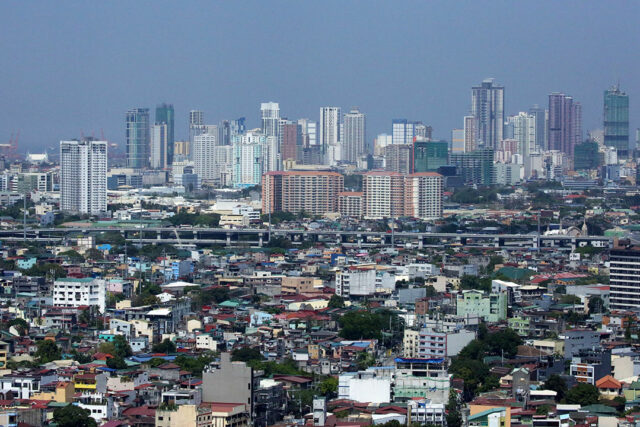
High-rise buildings dominate the Metro Manila skyline. — PHILIPPINE STAR/EDD GUMBAN

The Sy siblings have once again topped the Forbes list of the Philippines’ 50 Richest for 2025, with a combined net worth of $11.8 billion, according to Forbes Asia.

The heirs to the SM Group empire held their top position despite a $1.2 billion dip in their wealth.

Ports and casino tycoon Enrique K. Razon, Jr., chairman of International Container Terminal Services, Inc. and Bloomberry Resorts Corp., retained the No. 2 spot with $11.5 billion.

Former senator and property magnate Manuel B. Villar, Jr. stayed in third place with a fortune of $11 billion.

San Miguel Corp. Chairman and Chief Executive Officer Ramon S. Ang ranked fourth with a net worth of $3.75 billion, followed by Isidro A. Consunji & siblings of DMCI Holdings, Inc. at No. 5 with $3.7 billion.

The Que Azcona family, taking over from the late Mercury Drug Corp. President Vivian Q. Azcona who passed away in April, debuted at No. 6 with $3.6 billion. The drugstore chain is now led by her son, Steven Azcona.

Jaime Zobel de Ayala & family of conglomerate Ayala Corp. came in seventh with $3.4 billion.

At No. 8 is airline and liquor magnate Lucio C. Tan, who holds a net worth of $3.2 billion.

Puregold Price Club, Inc. founders Lucio and Susan Co were listed ninth with $3 billion, while Jollibee Foods Corp. Chairman Tony Tan Caktiong rounded out the top ten with $2.9 billion.

The minimum net worth to make the 2025 list was $185 million, up from $170 million the previous year.


The full list appears in the August issue of Forbes Asia and on forbes.com/philippines.— Arjay L. Balinbin and Revin Mikhael D. Ochave

How a viral TikTok video boosted Merced Bakeshop’s sales tenfold

A TikTok video of a content creator recalling her childhood memories went viral, driving a tenfold increase in sales for Merced Bakeshop, a 53-year-old business known for its signature “Beehive” pastry.

“We had social media before but TikTok is something else,” Max Gana, vice president of Merced Bakehouse, told BusinessWorld in an interview. “We didn’t expect that kind of reach.”

Interview by Almira Martinez
Video editing by Arjale Queral

#ViralMarketing
#TikTokEffect
#SmallBusinessGrowth
#PhilippineMSMEs
#BusinessWorldPH

Agri grows 5.7%, fastest since 2017

A farmer plows a small rice field in Quezon City, Feb. 18, 2025. — PHILIPPINE STAR/MIGUEL DE GUZMAN

AGRICULTURAL OUTPUT expanded by an annual 5.7% in the second quarter — the fastest pace in eight years — as better weather conditions enabled high-value crops such as rice and corn to post double-digit growth, the Philippine Statistics Authority (PSA) said on Wednesday.

Data from the PSA showed the value of production in agriculture and fisheries at constant 2018 prices increased by 5.7% to P437.53 billion in the April-to-June period, faster than the 2% growth in the first quarter.

This was a reversal of the 3.2% contraction in the second quarter of 2024 when the agriculture sector was affected by drought and dry spells caused by the El Niño weather phenomenon.

Performance of Philippine AgricultureThis was also the fastest growth in agricultural output since 6.4% in the second quarter of 2017.

“Crops and poultry recorded expansions in the value of production, while livestock and fisheries registered declines during the period,” the PSA said.

At current prices, the value of production in agriculture and fisheries rose to P606.794 billion.

For the first half, the value of farm output expanded by 3.8% to P875.56 billion, a reversal of the 1.5% decline a year earlier.

“We know that we still have to do a lot more to realize the vision of President Ferdinand R. Marcos, Jr. for a modern agricultural sector, where farmers and fisherfolk reap the full benefits of their hard work. But this result — and that of the first quarter — are a clear indication that we are on the right track,” Agriculture Secretary Francisco P. Tiu Laurel, Jr. said in a statement.

Agriculture accounts for about a tenth of gross domestic product (GDP) and about a quarter of all jobs. The PSA will release second-quarter GDP data today (Aug. 7).

Crop output, which accounted for 56% of total agricultural production, rose by 11.3% to P244.9 billion in the second quarter. Palay and corn posted double-digit growth of 13.9% and 27.3%, respectively.

“Palay and corn and poultry are expected to rebound because of good weather and high prices,” former Agriculture Undersecretary Fermin D. Adriano said in a Viber message.

Other crops that saw double-digit expansion include sugarcane (341%), onion (77.5%), coffee (14.5%), cabbage (11.7%) and cacao (11.4%).

On the other hand, declines were seen in the value of production of abaca (18.2%), tomato (16%), mongo (13.6%), mango (8.6%), sweet potato (8%), potato (5.5%), banana (2.6%), and pineapple (1.1%).

Raul Q. Montemayor of the Federation of Free Farmers said better performance of the agriculture sector this year was expected since 2024 was an “abnormal year” due to the El Niño weather phenomenon.

For the first half, crop output grew by 5.9% to P494.5 billion, reversing the 4.4% contraction last year.

At the same time, poultry, which made up 17.2% of total farm output, went up by 7% to P75.07 billion in the second quarter. However, this was slower than 9.8% in the first quarter, and 8.7% in the second quarter of 2024.

The value of production for chicken grew by 8.2%, while chicken eggs rose by 4.8%. However, duck production fell by 1.1%, while duck eggs dipped by 0.7%.

For the first six months of the year, poultry production jumped by 8.4% to P150.57 billion. This was an improvement from the 7.3% growth in the same period in 2024.

LIVESTOCK, FISHERIES
Meanwhile, the value of production for livestock declined by 5.9% to P59.6 billion in the April-to-June period, worsening from the 0.3% drop in the same quarter a year ago and the 2.8% decline in the first quarter. Livestock accounted for 13.6% of total agricultural output.

In the second quarter, hog output contracted by 7.5%, while carabao production also fell by 2.9%.

On the other hand, dairy production grew by 9.6%, while cattle and goat rose by 2% and 1.3%, respectively.

For the first six months, the value of livestock production declined by 4.4% to P117.43 billion, worse than the 1.9% drop in the same period a year ago.

On the other hand, the value of fishery output declined by 4.2% to P57.96 billion in the second quarter, reversing the 2.4% growth in the same quarter in 2024 and the 1.5% growth in the first quarter.

Fisheries accounted for 13.2% of total farm output.

Double-digit declines were seen for skipjack (35.6%), bigeye tuna (28.8%), P. Vannamei (22.4%), bluecrab or alimasag (19.6%), Bali sardinella or tamban (15%), mudcrab or alimango (11.9%), fimbriated sardines (11.2%), and roundscad or galunggong (10.4%).

Higher production was seen for grouper or lapu-lapu (25.6%), Indian mackerel or alumahan (20.7%), slipmouth or sapsap (17.9%), yellowfin tuna or tambakol (12.5%), threadfin bream or bisugo (12.1%), and big-eyed scad or matangbaka (9.1%).

Seaweed production grew by 6.1% in the April-to-June period.

In the January-to-June period, the value of fishery output slid by 1.5% to P113.05 billion, reversing the 1.1% growth a year ago.

Analysts said the agricultural and fishery production in the third quarter would likely post a contraction due to the heavy rains that caused floods around the country.

“The prospects for the third quarter are very challenging due to the presence and impact of extreme weather events like typhoons, flooding and soil erosion,” former Agriculture Secretary William Dar said in a Viber message.

The Department of Agriculture (DA) said in late July the agricultural damage due to monsoon rains and recent tropical storms reached P3 billion, affecting 93,070 farmers and fishers.

“The government must continue to make the needed investments to make the agriculture sector more climate resilient,” Mr. Dar said.

Mr. Adriano expects palay production to decline in the third quarter.

“Corn will contract as it is the rainy season, and corn does not like too much water,” he said.

Mr. Adriano said livestock production will continue its “lackadaisical” performance due to the African Swine Fever (ASF).

The Food and Drug Administration has yet to approve a Vietnamese vaccine against ASF for commercial rollout.

“Poultry is expected to grow unless hit by bird flu because of higher demand as it is the cheapest source of protein particularly for the poor,” Mr. Adriano said.

“As for fishery, performance will depend on whether we will be hit by destructive typhoons or not,” he added. — KATA


Marcos suspends rice imports for 60 days

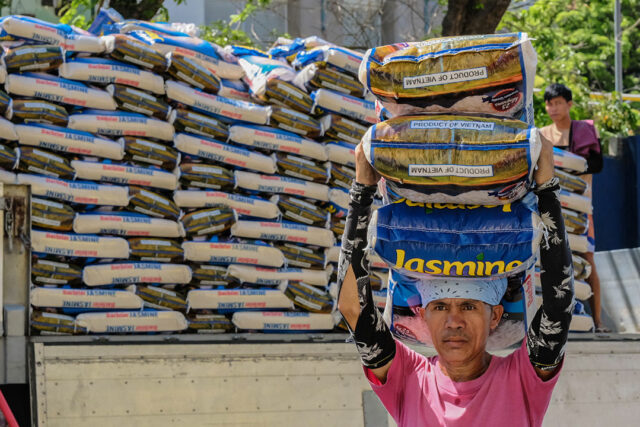
Workers unload sacks of rice from a truck along Dagupan St. in Manila. — PHILIPPINE STAR/RYAN BALDEMOR

By Chloe Mari A. Hufana, Reporter

PRESIDENT Ferdinand R. Marcos, Jr. has ordered a 60-day suspension of rice imports starting Sept. 1, in a move aimed at protecting Filipino farmers affected by low rough rice prices during the harvest season.

The President acted on the recommendation of the Department of Agriculture (DA) after consultations with his Cabinet while on a five-day state visit to India, acting Presidential Communications Secretary Dave M. Gomez told reporters on Wednesday.

“[The move is] to protect local farmers reeling from low palay prices during this current harvest season,” he said.

Mr. Gomez said there are no plans to act on the DA’s recommendation to hike the rice tariff to 25% from the current 15%.

“We will still see if we need to resort to that. Right now, the decision is to suspend all rice importation for 60 days beginning Sept. 1,” he added.

The Philippines is the world’s biggest rice importer, having brought in 2.44 million metric tons (MT) as of end-July, based on Bureau of Plant Industry data. The country imported 4.7 million MT last year and is projected to exceed that volume this year. 

In June, Agriculture Secretary Francisco P. Tiu Laurel, Jr., told the House of Representatives he had recommended gradually restoring the rice import tariff to its original 35% rate from 15%, which was set under Executive Order (EO) No. 62 signed by Mr. Marcos in June 2024.

The 35% rate, valid until 2028, is subject to review every four months.

The debate comes as Philippine inflation slowed to 0.9% in July, the lowest since October 2019, according to data released on Tuesday by the Philippine Statistics Authority.

Food prices dropped, including a 15.9% year-on-year decrease in rice prices, helping ease overall price pressures.

“The suspension is a more calibrated action — one that we can quickly reverse if needed… It gives us the flexibility to act fast to protect both our farmers and our consumers. A premature tariff hike, on the other hand, could backfire and would take much longer to undo,” Mr. Tiu Laurel said in a separate statement.

He said the two-month pause on rice imports would allow the DA to assess the impact on palay prices and the market.

“If this strategy leads to higher farmgate prices and better income for our farmers, we may no longer need to raise the tariff,” he said.

Former Agriculture Secretary William D. Dar said the temporary suspension of rice imports is expected to benefit Filipino farmers by allowing them to secure better prices during the harvest season.

Since imported rice typically arrives 60 days after ordering, the timing supports the local market without disrupting supply, he added.

“The 60-day suspension is good enough to achieve meaningful impact on our rice industry and market,” Mr. Dar said via Viber.

“Inflation will be at very low levels, [and] we are also able to manage enough supply,” he added. “It will always be necessary to pursue a balanced strategy for a win-win arrangement — the farmers getting [a] fair price [for] their produce and the consuming public for a fair price as well.”

Samahang Industriya ng Agrikultura Executive Director Jayson H. Cainglet said the 60-day halt on rice imports offers little real benefit to Filipino farmers, as rice tariffs remain at 15% and unmilled rice prices are expected to stay low.

He argued that EO 62 failed to protect local producers or stabilize the market, with importers able to time shipments around the suspension. With warehouses already full, there is no urgent need for new imports.

“Given these realities, the most effective and urgent course of action is to revert rice import tariffs to their previous levels: 35% for Association of Southeast Asian Nations (ASEAN) imports [and] 50% for non-ASEAN imports,” Mr. Cainglet said via Viber.

Fermin D. Adriano, a former undersecretary at the DA, called the initiative a “political move.”

“If I am [a] trader, having huge stocks in my warehouses, I will just wait for the two months to lapse before I resume importation,” he said via Viber.

“It takes around two months for [negotiations] with Vietnamese sellers and [the] actual arrival of rice imports. This is obviously just a political move.”

Inflation may pick up again in coming months

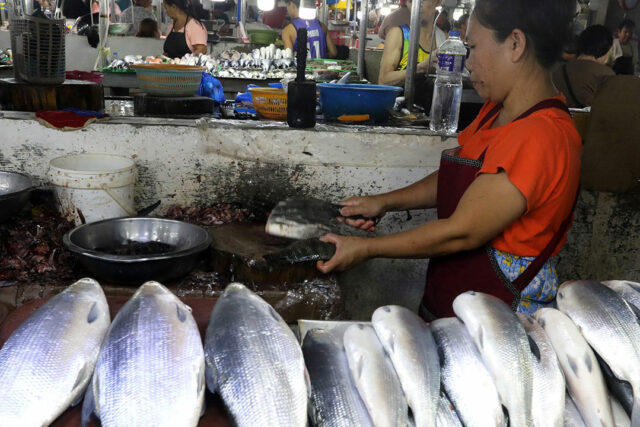
A vendor prepares fish for sale at a market. Headline inflation sharply eased to a near six-year low 0.9% in July from 1.4% in June and 4.4% a year ago, the Philippine Statistics Authority (PSA) reported on Tuesday. — PHILIPPINE STAR/EDD GUMBAN

HEADLINE INFLATION could pick up again in the remaining months after hitting a near six-year low in July but still remain within target, which would still give way to further policy easing by the Bangko Sentral ng Pilipinas (BSP).

“Looking ahead, we think July inflation is the floor of the Philippines’ inflation outlook,” HSBC Global Research economist for ASEAN Aris D. Dacanay said in a report.

“Headline inflation is likely to accelerate in the months ahead as the base effects of the rice tariff rate cut in 2024 fade,” he added.

Nomura Global Markets Research analysts Euben Paracuelles and Nabila Amani said that inflation could rise close to 2% in the coming months.

“We maintain our forecast for CPI (consumer price index) inflation to average 1.8% in 2025, penciling in a gradual climb towards 2% by yearend, in part due to low base effects and the impact of weather disruptions that are still likely to materialize in the near term,” they said in a report.

Headline inflation sharply eased to a near six-year low of 0.9% in July from 1.4% in June and 4.4% a year ago, the Philippine Statistics Authority (PSA) reported on Tuesday.

It also marked the fifth straight month that inflation settled below the central bank’s 2-4% target range.

“Still, our full-year forecast remains below BSP’s 2-4% target, reflecting a combination of factors, including a still-negative output gap and an economy facing downside risks,” Nomura said.

For the first seven months of the year, inflation averaged 1.7%. This was a tad higher than the central bank’s 1.6% forecast for 2025.

“This implies pass-through effects from easing supply-side drivers are likely to accentuate the impact; we still see low crude oil prices and the government maintaining supply-side measures to keep food prices, particularly rice prices, low,” Nomura said.

Meanwhile, Mr. Dacanay flagged risks to watch out for, including proposed changes to rice policies. 

President Ferdinand R. Marcos, Jr. announced on Wednesday a 60-day suspension of rice imports, effective Sept. 1, to protect local farmers amid declining farmgate prices. The government is also still discussing the possibility of raising tariffs on rice imports.

“We have written previously that curbing the supply of rice risks stoking inflation by 1.2 to 1.4 percentage points (ppts),” Mr. Dacanay said.

Despite the likelihood of inflation picking up in the months to come, the BSP can still continue its rate-cutting cycle.

“Will this derail the BSP’s easing cycle? We do not think so since we expect inflation to peak at around 2.9% year on year in the second quarter of 2026. This implies that inflation will still be well within the BSP’s 2-4% target range,” Mr. Dacanay said.

BSP Governor Eli M. Remolona, Jr. told Bloomberg on Tuesday that they can deliver two more 25-basis-point (bp) cuts this year and potentially continue its easing cycle until next year.

The central bank has lowered borrowing costs by a total of 125 bps since it began easing in August last year, bringing the policy rate to 5.25% when it last reduced rates in June.

“Nonetheless, the soft inflation numbers will likely give the central bank more confidence that it can proceed with its easing cycle with or without the Fed,” Mr. Dacanay said.

“Our baseline scenario is for the BSP to pause its easing cycle during the August rate-setting meeting, but the soft inflation outlook increases the risk of a rate cut,” he said.

Second-quarter gross domestic product (GDP) data, scheduled to be released today (Aug. 7), will also support further rate cuts.

“Any soft GDP figure will likely strengthen the conviction of the BSP of loosening the monetary reins without the Fed or deepening its monetary easing cycle throughout the year,” Mr. Dacanay added.

A BusinessWorld poll of 17 analysts showed that the Philippine economy likely grew 5.5% in the second quarter, slower than 6.5% a year ago.

For its part, HSBC expects the benchmark to end at 5% by yearend.

“But since the US tariff rate on the Philippines was less favorable than expected, the risk of a deeper easing cycle by the BSP is increasing,” Mr. Dacanay said.

Meanwhile, Nomura projects the Monetary Board to deliver a 25-bp cut at the Aug. 28 meeting, followed by another 25 bps in October.

“This would take the policy rate to 4.75%, which we think puts BSP’s monetary stance slightly below its estimate of neutral. BSP continues to emphasize its assessment of the inflation outlook as the main driver of policy decisions,” it added. — Luisa Maria Jacinta C. Jocson

PSA keeps Q1 GDP growth unchanged

Shoppers visit Divisoria Market in Manila. — PHILIPPINE STAR/RYAN BALDEMOR

THE Philippine Statistics Authority (PSA) said on Wednesday it had kept the country’s gross domestic product (GDP) growth rate at 5.4% for the first quarter.

The gross national income — the sum of the nation’s GDP and net primary income from the rest of the world — for the first three months was revised downwards to 7.2% from the 7.5% initially reported.

Similarly, net primary income from the rest of the world for the first quarter was lowered to 22% from 24.6%.

The statistics agency also noted some changes in some components of the national accounts, particularly on the supply side.

“Downward revisions were noted in electricity, steam, water and waste management (2.7% from 3.8% initially reported), financial and insurance activities, (6.9% from 7.2%) and information and communication (4.7% from 5.6%),” the PSA said in a report.

Meanwhile, the following sectors saw upward revisions: manufacturing (4.3% from 4.1%), real estate and ownership of dwellings (3.7% from 3.3%) and professional and business services (5.2% from 5%).

On the demand side, gross capital formation growth — the investment component of the economy — was raised to 4.8% from the 4% initially reported.

Growth in exports of goods and services was revised upward to 7.1% from 6.2%, while growth in imports was raised to 10.3% from 9.9%.

Private consumption (5.3%) and state spending (18.7%) were unchanged for the January-to-March period from initial estimates.

The revision came ahead of the second-quarter GDP data that will be released on Aug. 7.

A BusinessWorld poll of 17 economists late last week showed a median estimate of 5.5% GDP growth in the April-to-June period, which would be slower than the 6.5% expansion in the same period last year.

National account revisions are based on approved revision policy, which is consistent with international standard practices, the PSA said. — Abigail Marie P. Yraola

Ayala Land sees ‘busy’ second half with P57-B project launches

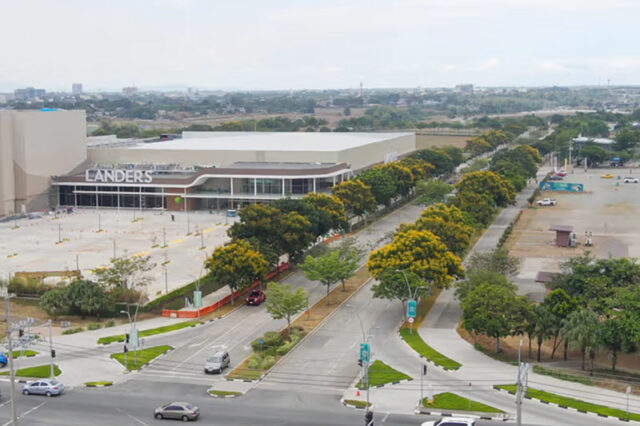
Landers Vermosa, which opened in April, is now the largest Landers branch in the Philippines and the first in Cavite.— AYALALAND.COM

AYALA LAND, INC. (ALI) said it plans to launch P57 billion worth of property development projects in the second half of the year, including the completion of upgrades to its malls and hotels.

“Our sales momentum is improving, and we are preparing for a busy second half with P57 billion in new property development launches, and the completion of reinvention works of malls and hotels,” ALI President and Chief Executive Officer Anna Ma. Margarita Bautista-Dy said in a regulatory filing on Wednesday.

“These initiatives will support our growth aspirations for 2025 and beyond,” she added.

ALI launched P42.9 billion worth of property development projects in the first half, led by Laurean Residences in the Makati Central Business District, commercial lots in Areza in Lipa City, Batangas, and industrial lots for sale in Cavite Technopark.

The target comes as ALI posted an 8% increase in first-half net income to P14.2 billion.

Consolidated revenue fell by 1% to P83.1 billion.

Property development revenue improved by 1% to P52.3 billion on the back of strong commercial and industrial lot sales, as well as resilient bookings in the premium residential segment, the company said.

Residential revenue declined by 5% to P41.3 billion, as growth in the premium segment was offset by lower core bookings.

Commercial and industrial lot revenue rose by 42% to P9.1 billion, driven by sales of lots in Arca South in Taguig City, Circuit Makati, and Arillo in Batangas.

Total sales reservations reached P73.7 billion, equivalent to P12.3 billion in average monthly sales during the first six months.

This was a 4% increase from the average monthly sales of P11.8 billion for the full year of 2024.

The premium residential segment accounted for the highest share of sales, at P40.6 billion, while sales of commercial and industrial lots increased by 7% to P8 billion.

The core residential business generated P25.1 billion in first-half sales.

ALI said revenue from its leasing and hospitality group rose by 5% to P23.2 billion.

Shopping center revenue increased by 5% to P11.6 billion, led by rising contributions from core and new malls.

Office leasing revenue grew by 5% to P5.9 billion, supported by a solid single-digit vacancy rate across the portfolio.

Hospitality revenue reached P4.9 billion on the back of healthy occupancy, while industrial real estate revenue rose by 60% to P762 million due to incremental income from new facilities.

ALI said capital expenditure for the first semester reached P40.2 billion.

Of the total, 42% was spent on the build-out of residential projects, 25% on the completion of leasing and hospitality assets, 23% on the priming and development of mixed-use estates, and 10% on continuing payments for land acquisition commitments.

ALI shares fell by 2.60% or 70 centavos to P26.20 apiece on Wednesday. — Revin Mikhael D. Ochave