Home Blog Page 8011

Central banks keep lid on rate bets as prices soar

REUTERS
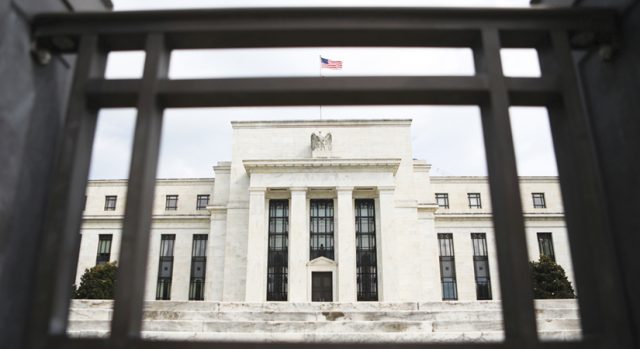
CENTRAL BANK policy makers have consistently doubled down on lower-for-longer rates and projections for “transitory ” inflation. — REUTERS

THE SURGE In commodity prices is failing to trigger some of the traditional responses in bonds and currencies.

Unlike recent commodities rallies in 2008 and 2011, yields on Treasuries and currencies of major exporters like Australia have barely budged. Likewise, the Federal Reserve’s favored measure of inflation expectations has disconnected from moves in raw materials.

The biggest buffer: Central bank credibility. Led by the Federal Reserve, policy makers have consistently doubled down on lower-for-longer rates and projections for “transitory” inflation. That’s left investors wary to bet against commitments to keep policy loose for the foreseeable future.

“The big change this time around is central bank policy,” said Kerry Craig, global market strategist at JPMorgan Asset Management in Melbourne. Ultra-easy monetary policy is now “weighing down currencies that would have naturally risen a lot more during a cycle where commodity prices are rising.”

The Australian and New Zealand dollars — two major currencies whose fates usually rely heavily on trends in commodities consumed by China’s booming economy — are indisputable laggards. Each has increased less than 0.5% over the past three months.

The Canadian dollar, meanwhile, has surged more than 5% as the central bank signaled it may dial back stimulus. The loonie’s rapid rise could give way to pressure on officials to slow development and curb capital inflows, as is usually the case during commodities booms in Canada.

Last week, both the US consumer and producer price index (PPI) reports surprised to the upside, adding fuel to the global inflation debate on the heels of strong Chinese producer price data. Yet the market reaction was relatively muted after the PPI figures — with 5-year and 10-year yields easing alongside a weaker greenback.

The Fed’s own new “common inflation expectations” quarterly gauge, which aggregates a range of such measures, is hovering around 2%, a level that officials want to see overshot for some time.

Meanwhile, prices have accelerated for materials as disparate as copper, cotton, rubber and lumber, as well as semiconductors, amid supply disruptions and surging demand.

The disparity is a sign of the times amid an evolution — perhaps revolution — of central banking. The Fed’s commitment to run the economy hot has rattled markets in part because it means abandoning what has long been a core of their strategy: to act preemptively to curb inflation.

In this brave new world, market participants are still grappling with whether to trust that officials will act before price surges get out of control and do more harm than good — balanced against the full-employment mandate.

That message is getting through to traders of the Australian and New Zealand currencies, while for others, hints of monetary policy tightening are giving reason to pile in.

“The Bank of Canada and Norges Bank are the only central banks in the developed world to give an unambiguous signal that they’re contemplating withdrawing monetary accommodation,” said Stephen Miller, Sydney-based investment consultant at GSFM, a unit of Canada’s CI Financial Corp. “The RBA (Reserve Bank of Australia) has been so aggressively beating the drum on keeping the pedal to the metal that it’s worked in terms of keeping the Aussie lower despite iron ore prices soaring.”

A closer look at breakeven rates offers further evidence that investors largely aren’t acting on any inflation worries. The US 10-year breakeven, which has jumped to an eight-year high, isn’t sending a clear runaway-inflation message when viewed against long-term trends.

If potential for runaway inflation were the trigger, the spot and forward breakeven curves would be upward-sloping, Cornerstone Macro analysts, led by ex-Fed official Roberto Perli, said in a May 11 report. Yet both are inverted, implying a market bet that inflation is temporary.

To be sure, some of the usual correlations have broken down due to other pandemic-related worries.

The Philippine peso, which usually moves in inverse with oil prices, is relatively stable given that inflation is damped by weak economic growth — rising more than 1% over the past three months, the most across a dozen Asian currencies. That relationship underscores the central banking mantra these days that growth and employment should remain a greater focus than prices.

Looking ahead, persistence in materials prices and further hints of wage gains could start to sway the Fed’s message — and build momentum for investors to respond.

“Recent record highs in metal prices are probably just the beginning,” Howie Lee, an economist at Oversea-Chinese Banking Corp., said in a May 11 report. Chinese demand and green-economy investment should keep iron ore and copper, especially, on the upswing, he said. — Bloomberg

A Brown earnings fall 41% on lower property sales

A BROWN Co. Inc., said that its attributable net income for the full-year 2020 slid by 41% to P294.13 million, from P494.95 million in 2019, amid lower real estate revenues.

In its annual report shared with the local bourse, A Brown said that its real estate sales dropped 19% to P76.54 million last year from P942 million in 2019. Earnings from real estate made up majority or around 88% of the firm’s total revenues last year.

However, sales from agricultural goods rose 24% to P79.09 million in 2020 from P63.72 million a year before. Meanwhile, the company’s water services improved by 10% to P23.42 million year on year.

Agricultural goods and water services make up 9% and 3%, respectively, of the firm’s total earnings in 2020.

A Brown is mainly engaged in the business of real estate development in Cagayan de Oro, Misamis Oriental, Rizal, Bukidnon and Agusan del Norte. The company’s subsidiaries have ventured into hotels, palm oil milling and power generation, among others.

Last month, the Department of Energy allowed A Brown’s wholly owned unit Vires Energy Corp. to proceed with its planned gas-fired power plant, which will be integrated with a liquified natural gas storage and regasification facility, in Batangas.

Shares of A Brown in the local bourse remained unchanged at P0.92 apiece on Tuesday. — Angelica Y. Yang

Study ranks the most popular pandemic exercises on TikTok 

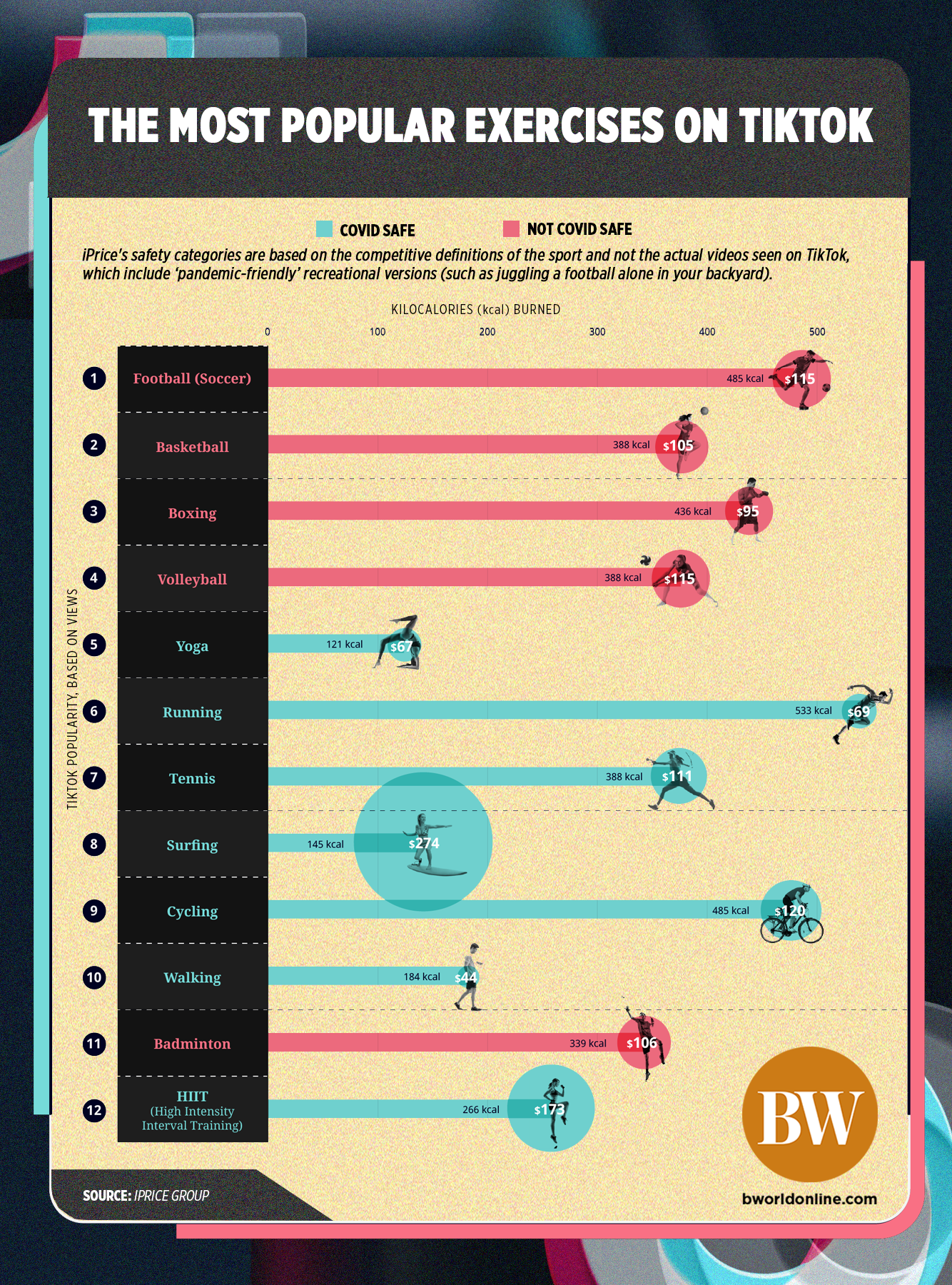
FOOTBALL (SOCCER), basketball, boxing, and volleyball top the list of popular pandemic exercises on video-sharing platform TikTok, according to a May 2021 study by meta-search website iPrice Group. 

 The list of exercises was generated through Apple Watch usage and their popularity was ranked based on Tiktok hashtag views worldwide recorded on May 10. Excluded were those with inaccurate price information  how much one has to invest to do these exercises (excluding trainer fees)  and those that were irrelevant to the Southeast Asian market (such as snowboarding). The number of calories burned by each exercise per hour was taken from the fitness app MyFitnessPal. Data on price were taken from iPrice’s database of 6 billion products. 

 According to iPrice, the top four exercises on the list are “not COVID safe”  although this categorization is based on the competitive definition of the sport and not the TikTok videos, which include pandemic-friendly variations (such as juggling a football alone in your backyard). 

Competitive football, basketball, and boxing involve contact; volleyball is played indoors, with a shared ball.  

 Seven out of the twelve exercises that make up the list, meanwhile, were classified “COVID safe” by iPrice. Of these safe exercises, running, cycling, and tennis burn the most calories.  These exercises were deemed safer than others because they are individual activities (with the exception of tennis), that are non-contact, and done outside (for the most part). 

Meanwhile, badminton (ranked 11 in popularity) is a gray area since it is played on courts that are smaller than tennis courts, with some located in enclosed, air-conditioned quarters. 

Those who want to gain TikTok views and keep safe should engage in the exercises listed below.  

  1. Running (533 kcal burned/hr., cost of entry: P3,331) — a high-impact exercise that can raise good cholesterol levels and increase lung function and use 
  2. Cycling (485 kcal burned/hr., cost of entry: P5,793) — an alternative to running that can build muscles in the lower extremities  
  3. Tennis (388 kcal burned/hr., cost of entry: P5,358) — a sport that can reduce the risk of cardiovascular disease by 56% when played three hours a week 
  4. HIIT (266 kcal burned/hr., cost of entry: P8,351) — an anaerobic exercise (or an exercise that breaks down glucose  one of the body’s preferred source of fuel  for energy without using oxygen) that can increase bone strength and density 
  5. Walking (184 kcal burned/hr., cost of entry: P2,124) — slower than running and other gaits, which can help with weight maintenance and balance  
  6. Surfing (145 kcal burned/hr., cost of entry: P13,227) — an outdoor activity that can boost one’s mood, among other things 
  7. Yoga (121 kcal burned/hr., cost of entry: P3,234) — a practice consisting of slow movements and deep breathing that can relieve back pain and arthritis symptoms  

SHIFT TO ONLINE 
Seventy-nine percent of Filipinos interviewed in The Economist Intelligence Unit’s Pulse of Asia: The Health of Asia Barometer, a 2020 Asia-wide benchmarking tool, already use digital health platforms and personal health technologies such as smartwatches and fitness trackers.  

The coronavirus pandemic hit the fitness industry hard, Gabriel Pangalangan, marketing manager of UFC Gym Philippines, told BusinessWorld in July 2020. He said that fitness coaches have since adapted by strengthening their online presence and boosting their personal brands through podcasts, live-stream workout classes, and YouTube videos.   

An earlier 2020 iPrice study found that the Philippines was ranked 11th among countries with the most TikTok downloads.  Patricia B. Mirasol 

Bersong Euro-Pinoy goes to Zamboanga

Anne Gauthier

THE ANNUAL festival of European culture, Viva Europa, couples European verses with Chavacano and other languages from Southern Philippines as it brings the poery festival Bersong Euro-Pinoy to Zamboanga on May 21.

European Union Ambassador Luc Véron, a patron and lover of literature himself, said that Bersong Euro-Pinoy will provide a platform for European and Filipino poets and literary enthusiasts to better understand and appreciate each other’s culture and to strengthen people-to-people links between and among Europeans and Filipinos.

The European Union (EU) Delegation to the Philippines has worked in tandem with the Embassies of Belgium, Czech Republic, Denmark, Germany, Spain and Instituto Cervantes Manila, France, the Philippine-Italian Association, Austria, Poland, Finland, and with Ateneo de Zamboanga University for this festival.

A brainchild of Instituto Cervantes, Bersong Euro-Pinoy used to be held under the framework of Dia del Libro, gathering all diplomats and literary enthusiasts from among the members of the EU Delegation to the Philippines, EU member states’ embassies and cultural institutes.

As part of the festival, a poetry recital —  Verses Versus the Virus —  will be streamed live at the FB page of the EU Delegation to the Philippines (facebook.com/EUDelegationToThePhilippines).

In a partnership between the EU and Ateneo de Zamboanga University, literary luminaries from Zamboanga and Mindanao will read their pieces in their mother tongue: M.J. Cagumbay Tumamac, a poet in Hiligaynon, Southern Mindanao, Awardee of Makata ng Taon 2019; Sigrid Gayangos, a poet in Chabacano, Zamboanga City/Dumaguete City, Awardee of Palanca Award 2018; and Errol Merquita, a recipient of Carlos Palanca Memorial Awards (2011, 2015, 2017) and the Satur Apoyon Writing Contest (2010) for fiction in Cebuano and poetry for children in Filipino.

These poets were mobilized by the Ateneo de Zamboanga University, this year’s academic partner along with De La Salle University.

“The Ateneo de Zamboanga University is very grateful to be part of the European Union Delegation to the Philippines’ Poetry Recital this year. In these trying times, we need words that build, words that bring comfort, words that heal, and this literary event provides that. Let us continue to seek inspiration from friendships that flourish, and celebrate our freedom to collectively rise above difficulties,” said Fr. Karel San Juan, President of Ateneo de Zamboanga University.

Mr. Merquita will read his original poem Pangamuyo sa Brgy. Diatagon, Lianga (sa padayong pagbakwit ug kagubot)” with English translation by Ralph Semino Galán, (Entreaty from Brgy. Diatagon, Lianga [On the continuing evacuation and chaos]; Mr. Gayangos will read his poem Cuando ya busca yo con el maga palabra, with English translation by Floraime Oliveros Pantaleta (When I was searching for the words); while Mr. Tumamac will read his poem Pabay-an nga magbalhas sang nana ang ginasugba nga indangan which Eric Nebran translated into English (Let pus drip from the surgeonfish sweating on the grill).

Aside from the Filipino poets, members of the EU community will also be reading poetry.

Carl Norac, Belgium’s fourth National Poet and a prize-winning poet and author of children’s books, will join this year’s festival. He will recite his original works: Pour Marcel Moreau and Pour Mustafa, pour Mustafa Kör.

Dora Šedivá, daughter of Czech Ambassador Jana Šedivá, and her friend Marika Štěpková, daughter of Czech Deputy Ambassador Jana Peterková, will read Fortune (Štěstí) by Adolf Heyduk, both in Czech and in English. Hans Christian Andersen’s Det er Liv et Reise or To Travel is to Live will be read by Danish Ambassador Grete Sillasen.

German actress Luisa Katharina Davids will recite the German translation of Mi Ultimo Adios as 2021 is the year when the German Embassy also unveils an exhibition with José Rizal’s former furniture from Heidelberg, Germany, and an official marker with the German translation of Mi Ultimo Adios at the Museo ni José Rizal in Intramuros.

Luis Garcia Montero,  poet and director of Instituto Cervantes in Madrid, will recite his original work Magallanes for Bersong Euro-Pinoy. Victor Hugo’s poem Amis, Un Dernier Mot (Friends, one last word) will be read by French actress Anne Gauther Das Neves. Rima LII, a sonnet on friendship by Dante Alighieri, will be read by Alessandro Milani, General Manager of the Philippine-Italian Association, in celebration of Dante Alighieri’s 700th death anniversary.

Austrian poem Love by Erich Fried will be read by Tajna Platzer of the Embassy of Austria, while Labirynt or Labyrinth by Nobel Peace Prize Winner Wistawa Szymborska will be rendered by Chargé d’Affaires of the Embassy of Poland Jaroslav Roman Szczepankiewicz. Nocturne, a Finnish poem by Eino Leino and translated by Keith Bosley, will be read by Finnish Ambassador Juha Pyykkö.

After Zamboanga, the Bersong Euro-Pinoy will head to Manila through the De La Salle University on May 28. The festival will be hosted by journalist and EHEF goodwill ambassador Danie Laurel, PhD, and Floraime Oliveros Pantaleta of the Western Mindanao — National Committee on Literary Arts at National Commission for Culture and the Arts.

UnionBank set to launch innovation campus to boost digital capabilities

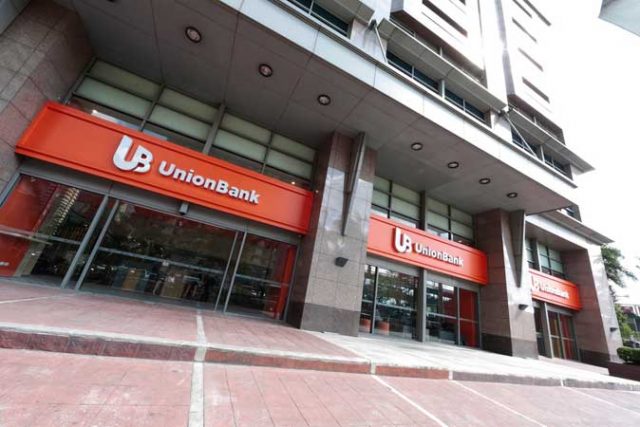
UNIONBANK of the Philippines, Inc. will launch its innovation campus in Laguna to boost its digital capabilities and hone its employees’ skills.

The Aboitiz-led lender is set to launch the research and development facility on May 26 in San Pedro, Laguna, it said in a statement on Tuesday.

The structure forms part of the bank’s digital transformation, which it has embarked on since 2016.

“As part of its innovation mandate, one of the priorities of the campus will be the development of talent that will fuel its innovation initiatives,” the bank said.

The facility will also serve as the bank’s satellite office in the Southern Greater Manila Area.

This is seen to benefit employees living nearby, giving them convenience in accessing their workplace while also adding an operations hub for the benefit of customers in the area.

The bank’s campus will likewise be used for business continuity measures in times of disasters and other unforeseen events that might affect its operations.

UnionBank Senior Executive Vice-President and Chief Technology and Operations Officer Henry Rhoel R. Aguda said in January that the project was inspired by Silicon Valley infrastructures.

He said the campus will be home to institutes on data science and blockchain and an accelerator.

Developments done in the campus are expected to benefit banking, fintech and other industries.

“It will be home not only to highly talented individuals who will help the bank in creating solutions toward a fully digital future, the UnionBank Innovation Campus will also be home to some of the best educators and mentors who will help mentees unlock their full potential as solutions thinkers,” the lender said.

UnionBank’s net income climbed 78% to P4.7 billion in the first quarter. This was attributed to better risk profile and stronger capital buffers.

The listed lender’s shares closed at P75 apiece on Tuesday, gaining five centavos or 0.07% from its previous finish. — L.W.T. Noble

Apex Mining income surges as gold prices rise

APEX MINING Co., Inc. posted a 401% increase in attributable net income to P1.53 billion last year on the back of higher gold prices and better revenues, it told the stock exchange on Tuesday.

“We were able to optimize the high prices of gold with higher ore grades and higher recovery,” Apex Mining President and Chief Executive Officer Luis R. Sarmiento said in the disclosure.

In 2019, the listed mining company recorded P305.16 million in net income attributable to parent equity holders.

Revenues of Apex Mining in 2020 reached P6.32 billion, a 27.4% increase from the P4.96 billion it had the previous year, carried by improved gold sales and higher prices.

For 2020, the company said it sold 66,576 ounces of gold, a 2.8% improvement from the 64,763 ounces the year earlier.

It added that the average realized price of gold last year was at $1,798 per ounce, higher by 29.5% than $1,389 per ounce in 2019.

“The higher ore grades, averaging 3.61 grams of gold per tonne, coupled with higher recovery at 87.63% contributed to the higher gold sales,” the company said.

Meanwhile, the company’s silver sales fell 1.2% to 365,212 ounces in 2020 from 369,616 ounces the year earlier.

Apex Mining’s milling throughput reached 664,363 tons in 2020, 6.7% lower than the 711,787 tons the previous year.

“The continuing investments in capital expenditures — amounting to P1.6 billion in 2020 — brought noncash charges for depreciation and amortization to P674 million. These investments were in relation to the continuing development of the mines in preparation for higher grade and larger tonnage operations,” the company said.

Apex Mining noted that the Sangilo mine of its wholly owned subsidiary Itogon-Suyoc Resources, Inc. started commercial operations on July 31 last year.

However, its production remains a challenge as a result of quarantine restrictions caused by the coronavirus disease 2019 (COVID-19) pandemic, which has affected the movement of manpower and supplies.

The company added that exploration and resource validation work in the Suyoc mine in Mankayan, Benguet continues.

On Tuesday, shares of Apex Mining at the stock exchange improved 3.73% or six centavos to end at P1.67 apiece. — Revin Mikhael D. Ochave

Call for sound economic policies to improve medicines access

The Foundation for Economic Freedom (FEF) called on the government to consider a more market-oriented, competition-based, and economically sound approach to improving access to medicines in the country, and lowering medicine out-of-pocket health expenditures of Filipinos.

FEF said that the Universally Accessible Cheaper and Quality Medicines Act of 2008 recognizes effective competition policy as the primary instrument in ensuring access to affordable quality drugs and medicines for all.

“Since its enactment, competition in the pharmaceutical industry has been fierce, providing options to patients available at a wide variety of prices. A 2017 study by Dr. Ramon Clarete and Dr. Gilbert Llanto found that competition has effectively reduced medicine prices, with the influx of generic medicines driving originators to lower their prices,” the FEF noted.

It added that the Universal Health Care (UHC) Act and the National Integrated Cancer Control Act (NICCA) laid out economically sound policies aimed at improving access to medicines.

“Pooled procurement, framework contracting, multi-year obligations, and central price negotiations create economies of scale and lowers transaction costs, putting the government in a better position to negotiate medicine prices. Competition among suppliers/bidders brings prices further down. Outpatient drug benefit packages will reduce out-of-pocket spending on medicines,” FEF added.

According to the FEF, this is the approach used by members of the Organization for Economic Co-operation and Development (OECD) — including Australia, Canada, and the United Kingdom — to enhance competition and fully implement UHC as strategies to improve access to medicines. The advocacy group pointed out as well that non-OECD countries such as Thailand and China are successfully implementing such mechanisms. Thailand maximizes the benefits from pooled procurement while price negotiations on innovative medicines have expanded access in China. For the latter, it led to significant reduction in prices of up to 71% for cancer medicines.

“Price capping — its expansion and the creation of a price board — is not the answer to making medicines affordable and accessible to the poor. Several studies have shown that such measure had little effect on socioeconomic classes D and E. Price capping is anti-competitive as it distorts the market, leading to price convergence among competitors,” the FEF stressed.

FEF proposed the following measures that the government may consider pursuing:

• Institutionalize pooled procurement and price negotiations as the primary measures to reduce prices of medicines. The experience with price reductions for oncology medicines trastuzumab and basiliximab of up to 50% and 74%, respectively, attests that the system works.

Implement UHC in phases by mapping primary care providers with priority groups first. The SAP list, Senior Citizens, and Persons with Disabilities are excellent starting points for UHC rollout.

• Develop outpatient drug benefit packages, and expand its reach through accreditation of private drugstores.

• Increase investments for health.

• Provide special access schemes in partnership with the private sector.

• Enable greater participation of the Philippine Competition Commission to review whether price capping policies adversely affect market competition.

“We believe that we can do more for Filipino patients without the negative impact of price regulation. With market-oriented, competition-based, and economically sound policies, we can improve medicines access in the country,” the FEF stated.

As a matter of sound economic policy, the imposition of price control is retrogressive and may discourage highly needed investments critical to economic recovery. Price regulation disincentivizes innovation, and serves as a barrier to the entry of new, lifesaving medicines in the country. There are more sustainable and viable ways of reducing medicine prices in the country, which FEF highlighted in its position statement.

As FEF rightly noted, the measures provided in the UHC Act and NICCA such as pooled procurement, price negotiations, expanded medicine reimbursements, coupled with greater investments in health, are exactly what other countries with UHC in place implement to bring medicine prices down.

Partnership with private sector initiatives is also embedded in these laws, providing a holistic approach to improving healthcare in the country.  The pharmaceutical industry operating in the Philippines looks forward to closely collaborating with the government and other stakeholders in finding sustainable ways to improve Filipinos’ access to medicines especially in this time of the pandemic and silent epidemics.


Teodoro B. Padilla is the executive director of the Pharmaceutical and Healthcare Association of the Philippines (PHAP). PHAP represents the biopharmaceutical medicines and vaccines industry in the country. Its Members are in the forefront of research and development efforts for COVID-19 and other diseases that affect Filipinos.   

Arts & Culture (05/19/21)

Revelation 21:1A; 4B:5A by Raymundo Francia in Our Lady of Mount Carmel Parish Church — YOUTUBE.COM/AYALAMUSEUMTV/

Kisame: Visions of Heaven on Earth goes online

IN CELEBRATION of National Heritage Month and in commemoration of the 500 years of Christianity in the Philippines, Ayala Museum and the Filipino Heritage Festival, Inc. present a video of the exhibit Kisame: Visions of Heaven on Earth through the Ayala Museum’s YouTube page (https://www.youtube.com/watch?v=3kZ7xV6qYlM). The exhibit features photographs of ceiling paintings from 17 churches in the province of Bohol. Co-curated by Fr. Ted Torralba and Ken Esguerra, the exhibit’s photographs were taken by Paquito Ochoa, Jr. The video is on view until Aug. 31.

MCAD Manila’s interactive exhibit ‘do it’

THE MUSEUM of Contemporary Art and Design (MCAD) Manila, in collaboration with Independent Curators International (ICI) New York, launches “do it (MCAD Manila)” online, an exhibition where written instructions by artists are interpreted. How this project reimagines the exhibition format as flexible and open-ended is a result of a 1993 conversation in Paris among curator Hans Ulrich Obrist and artists Christian Boltanski and Bertrand Lavier, and has become the world’s longest running curatorial project. MCAD partners with local artists, community groups, and its online audience on the exhibit. As a response to global stay at home orders, “do it (MCAD Manila)” will run both online and on-site. The public is invited to participate by responding to instructions from artists. Local artists MM Yu, Russ Ligas, Madge Reyes, Lourd de Veyra, Manix Abrera, Manny Montelibano, Mark Salvatus, and chef Miko Calo will do a special presentation in interpreting instructions by artists Cao Fei, Jerome Bel, Rivane Neuenschwander, Liam Gillick, Hannah Weinberger, and Robert Ashley. To participate, visit https://www.mcadmanila.org.ph/online-launch-do-it-mcad/.

PHL revolution in ballet film Plaza Libertad

THE ROLE of the Ilonggos in the Philippine Revolution and the symbolism of the historic Plaza Libertad in Iloilo City are the subject of a contemporary ballet film entitled La Libertad de Iloilo. The two-part showcase brings the audience to the onset of the Tagalog War in 1896 and the crucial participation of Iloilo City and its Battalion de Voluntarios, a unit of 500 soldiers shipped to Manila in 1897, leading up to the signing of the Pact of Biak-na-Bato. Hosted by the Dance Program of the De La Salle-College of Saint Benilde, the film was directed by Dance Major Joanne Therese Sartorio under the guidance of dramaturg and former Virgin Labfest director Armando “Tuxqs” Rutaquio, Jr., the Chairperson of Benilde Production Design. La Libertad de Iloilo will be livestreamed on May 21, 5 p.m., on the official Facebook page of Benilde Arts and Culture Cluster (https://www.facebook.com/benildearts).

‘Above the Headwinds’ exhibit at Robinsons Galleria

ROBINSONS Land ARTablado is hosting an art exhibit featuring the works of Carlos “Totong” Francisco II and MarPolo Cabrera. EntitledAbove the Headwinds,” the exhibit is a collaboration between the grandson of Angono’s renowned muralist Carlos “Botong” Francisco and an aspiring lad from Nagcarlan, Laguna with a common love for abstract. The two turned to their canvas as a beneficial tool for stress relief amidst the COVID-19 pandemic and have found the quarantine to be the time to focus on their art. “Above the Headwinds” will run from May 16 to May 31 at ARTablado Level 3, Veranda of Robinsons Galleria. For more updates, visit www.robinsonsmalls.com or like and follow ARTablado on Facebook and @artablado on Instagram.

Webinar on San Sebastian Basilica cultural heritage, preservation

IN LINE with the 400th founding anniversary of San Sebastian Basilica, a National Cultural Treasure, cultural practitioners from diverse disciplines will discuss its continuing preservation and its current state in the country in a free public webinar. Entitled Beyond the Basilica: Heritage Conservation and Appreciation, it will provide in-depth understanding and diverse perspectives on the subject. The webinar will feature educator Brenson Andres who will share his insights on teaching heritage appreciation in K-12 as well as a glimpse into its curriculum and pedagogy; De La Salle-College of Saint Benilde (DLS-CSB) Architecture Program Chairperson architect Harvey Vasquez will impart the best practices in heritage architecture and conservation; and San Sebastian Basilica Conservation and Development Foundation, Inc. (SSBCDFI) Communications and Fundraising Officer Samantha Pacardo will introduce the #SaveSanSebastian Campaign and the mission of the foundation to champion its restoration and all of its original features following the international standards. The webinar will conclude with an online tour of San Sebastian Basilica, Asia’s lone all-steel metal Gothic Revival church, to be facilitated by SSBCDFI Education Head Ysabel de Dios. The audience is transported into an accurate 3D model of the church created through photogrammetry. Complete with historical facts and videos of a Recollect friar, the project aims to bring the beauty of the Basilica to the people even amid the social distancing protocols due to the pandemic. The webinar, hosted by the Arts Management Program of the DLS-CSB, will be conducted in partnership with the SSBCDFI with the support of the National Commission for Culture and the Arts (NCCA). The talk will be moderated by Benilde Arts Management Program Chairperson Alain Zedrick Camiling. Beyond the Basilica: Heritage Conservation and Appreciation is on May 20, 2:30 to 5 p.m. Interested participants may register through bit.ly/BeAMBTB.

Writer, painter, actress, theater designer Celia Diaz-Laurel to launch book

HOW does one celebrate her 93rd birthday in this time of pandemic? For mother, wife, philanthropist, writer, painter, thespian, theater production and costume designer Celia Diaz-Laurel, the best way would be to launch her latest coffee table book, aptly titled My Lives Behind the Proscenium, on May 29 via Facebook Live. The book chronicles the life that Celia Diaz-Laurel led with chapter titles: Stage-struck at Five, Wartime Years, Dramatic UP Days, Yale Years, Back to the Stage at Repertory Philippines. “Celia has written an entertaining story about her theatrical life in a straightforward, simple, style that not only will give the curious reader an insight into her life and the social milieu of her time but is a historical narrative of the early years of Manila theater and the personalities who were part of it. She writes about her early personal life as the background for the successful career she carved out for herself — not only as an actress but as a set and costume designer,” wrote Joy Virata in the foreword of the book. The book is edited by Suzie Laurel-Delgado and Cocoy Laurel. For book reservations and inquiries, contact Jenn Tejada at 8869-7298 Monday to Friday from 1- 5 p.m.

PhilPlans to extend its cash programs after benefit payouts hit P6.55 billion as of March

PHILPLANS FIRST, Inc. (PhilPlans) released P6.55 billion in benefits to 51,951 beneficiaries since the start of the coronavirus pandemic last year up to end-March, the pre-need firm said in a statement on Tuesday.

PhilPlans said P4.93 billion of the total was distributed at more than 23,000 recipients under its “Special Cash Programs,” which gave planholders affected by the prolonged crisis financial support without the need to wait for the maturity or scheduled payouts of their plans.

It also released P919 million in benefits to 19,821 education planholders, and P696 million to 9,670 clients with pension and life plans.

The cash programs consist of the CARE program, ECQ Emergency Fund, Education Lump Sum Payment, and Plan Termination Value program.

The pre-need firm has extended its cash programs until the end of June following the recent virus surge and renewed lockdowns.

“The pandemic has already been hard on individuals, families, and businesses. In spite of these challenges, we remain committed to serving our planholders immediately by responding to their needs,” PhilPlans President and CEO Monico V. Jacob was quoted as saying.

“Our Special Cash Programs form part of our commitment to help them not just survive, but even thrive in this crisis,” he added.

Moving forward, PhilPlans Chairman Eusebio H. Tanco said the company is working on putting its products and services online to make these more accessible to clients. — BML

How PSEi member stocks performed — May 18, 2021

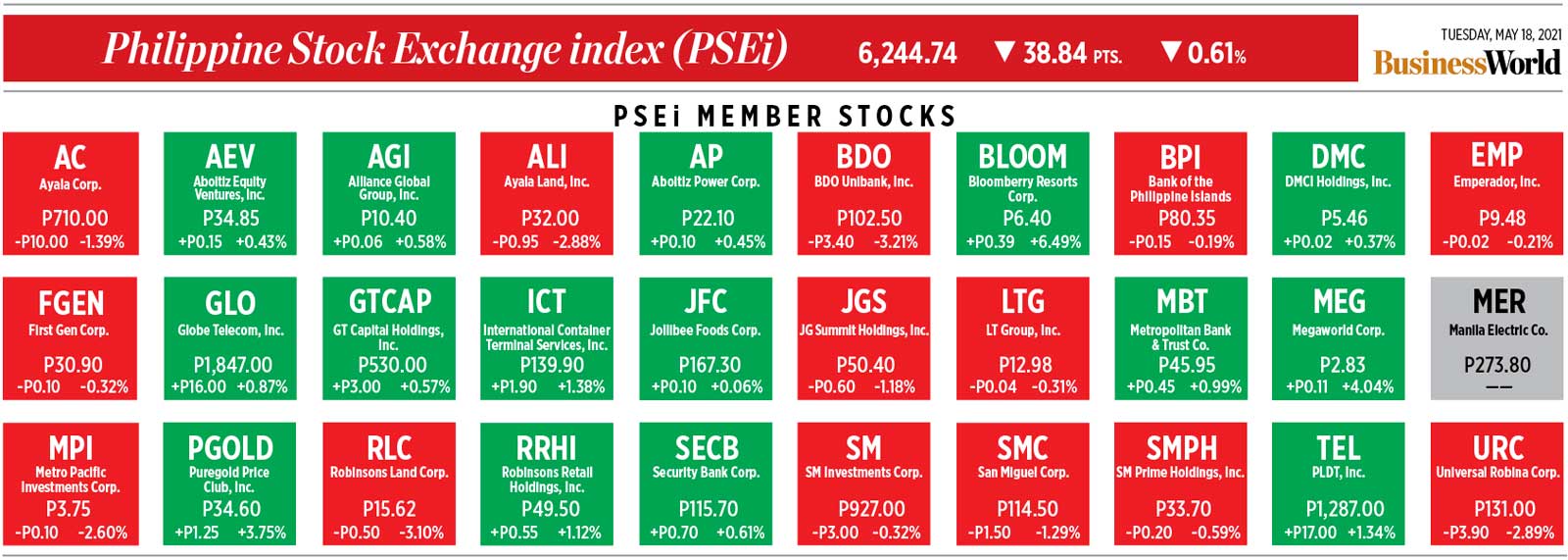
Here’s a quick glance at how PSEi stocks fared on Tuesday, May 18, 2021.


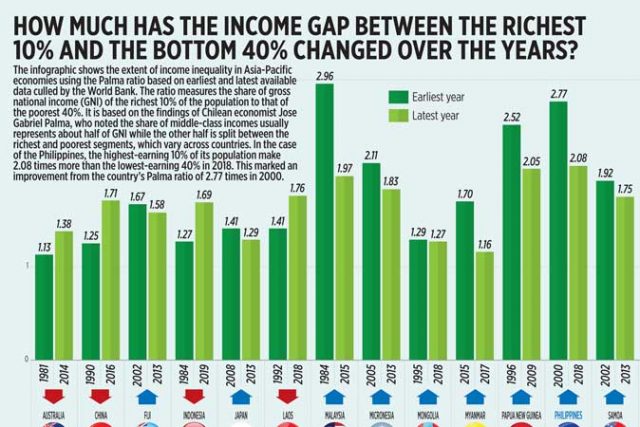
How much has the income gap between the richest 10% and the bottom 40% changed over the years?

How much has the income gap between the richest 10% and the bottom 40% changed over the years?

PHL stocks drop on lingering concerns over virus

SHARES dropped on Tuesday as market sentiment remained clouded as more cases of the coronavirus disease 2019 (COVID-19) variant originally from India were detected in the country and as foreigners continued to exit the market.

The benchmark Philippine Stock Exchange index (PSEi) declined by 38.84 points or 0.61% to close at 6,244.74, while the broader all shares index lost 14.02 points or 0.36% to 3,847.39.

Philstocks Financial, Inc. Senior Research Analyst Japhet Louis O. Tantiangco said COVID-19 woes weighed on investor sentiment.

“After two straight trading days of staging a last-minute comeback, the local market finally gave in completely to selling pressures… on the back of the entry of the coronavirus variant from India in the Philippines,” Mr. Tantiangco said in a Viber message.

On Saturday, the Health department said it detected 10 more cases of the B.1.617 variant first reported in India, bringing the total to 12. Four are said to be confined in a hospital, while five are isolated in a facility.

Trading volume improved, but Mr. Tantiangco noted it remained “lethargic… in comparison to the year-to-date average of P8.12 billion.”

Value turnover climbed to P6.19 billion on Tuesday with 2.63 billion shares switching hands, from the P5.02 billion seen on Monday with 2.31 shares traded.

Meanwhile, China Bank Securities Corp. Research Associate Zoren Philip A. Musngi said the main index ended lower on Tuesday “as selling from foreign funds continued.”

“Bullish investor sentiment remains elusive despite signs of recovery in corporate earnings for [the first quarter], better remittances data, continuing improvement in the domestic COVID-19 situation, and ramp up in vaccination efforts,” he added.

Most sectoral indices closed in the red on Tuesday except for services, which improved by 23.03 points or 1.59% to 1,464.15, and mining and oil which gained 88.28 points or 0.97% to end at 9,183.81.

Meanwhile, property went down by 40.95 points or 1.34% to 3,013.77; financials decreased by 15.61 points or 1.11% to finish at 1,379.58; industrials lost 94 points or 1.09% to 8,479.98; and holding firms dropped by 37.49 points or 0.59% to 6,224.77.

Decliners beat advancers, 139 against 70, while 50 names closed unchanged. Net foreign selling increased to P549.72 million on Tuesday from the P354.07 million logged on Monday.

Mr. Musngi said the 6,500 support level for the index remains strong, while AB Capital Securities, Inc. Junior Equity Analyst Lance U. Soledad said the 6,200 and 6,000 support levels may be retested “if bargain hunting fails to lift the market.”

“We expect the weakness in the market to persist amid the lack of buying catalyst to reverse the negative sentiment brought about by the string of negative news that has been coming out such as the growth downgrades and MSCI rebalancing,” Mr. Soledad said in a separate Viber message. — K.C.G. Valmonte