Home Blog Page 801

VITRO seeks wider Visayas, Mindanao region footprint

STOCK PHOTO | Image by Wirestock from Freepik

VITRO, INC., the data center unit of PLDT, Inc., is expanding its footprint in the Visayas and Mindanao through a partnership with Alliance End-to-End Solutions, Inc. (AEES) to strengthen enterprise connectivity and digital infrastructure in the regions.

The partnership, signed through PLDT’s corporate business unit PLDT Enterprise, brings Alliance into the VITRO Partner Network (VPN) — a group of carrier and technology partners that aims to accelerate digital transformation for businesses across the Philippines.

“Through this collaboration, VITRO and Alliance aim to accelerate innovation and deliver advanced enterprise technology and connectivity solutions, leveraging the resilience and robustness of VITRO’s world-class data centers,” the company said in a statement on Sunday.

Under the agreement, both companies will promote digital adoption in the Visayas and Mindanao by providing enterprise clients with enhanced access to cloud-ready data infrastructure and connectivity solutions.

VITRO’s data centers will now be integrated into Alliance’s expanding information and communications technology (ICT) portfolio, allowing its customers — which rely on Alliance for IT services and software solutions — to access co-location and server hosting services at VITRO Cebu 2.

Alliance’s suite of software products will also be hosted within VITRO’s infrastructure to ensure business continuity and operational resilience. “Enterprises benefit from a professionally managed environment for business-critical systems, enhancing efficiency and reducing risk,” VITRO said.

VITRO operates 11 data centers nationwide with a combined capacity of almost 100 megawatts (MW). VITRO Sta. Rosa, its biggest facility, has a 50-MW capacity and serves as the company’s premier hyperscale-ready hub. Other VITRO sites are located in Makati, Taguig, Pasig, Parañaque, Subic, Clark, Cebu and Davao.

The company said the Alliance partnership supports its strategy to expand outside Metro Manila and strengthen its regional presence, particularly as more enterprises pursue digitalization and cloud migration. The collaboration also aligns with PLDT’s broader goal to boost the Philippines’ digital competitiveness by enhancing data infrastructure nationwide.

The partnership is expected to open opportunities for enterprises in emerging regional hubs to access secure, scalable and locally hosted digital solutions — a key factor for business continuity and compliance.

Hastings Holdings, Inc., a unit of the PLDT Beneficial Trust Fund subsidiary MediaQuest Holdings, Inc., holds a majority stake in BusinessWorld through the Philippine Star Group, which it controls. — Ashley Erika O. Jose

Fishport modernization seen unlocking enterprise potential

Buckets of fish are sold at the Navotas fish port in this file photo. — PHILIPPINE STAR/MICHAEL VARCAS

AGRICULTURE Secretary Francisco P. Tiu Laurel, Jr. said the Department of Agriculture’s (DA) bid to modernize major fishports under the Philippine Fisheries Development Authority (PFDA) has the potential to transform traditional fishing hubs into modern agri-fishery business centers.

Speaking at the Navotas Business Conference, Mr. Laurel was quoted in a DA statement as calling the city “the fishing capital of the Philippines” whose entrepreneurship and innovation can be replicated in other regions.

Mr. Laurel said modernization will upgrade ports, cold storage facilities, and logistics systems to make fish landing sites more competitive. Each improvement opens opportunities for local businesses while improving incomes of fisheries workers.

The modernization will ensuring that landed fish is properly handled, preserved, and sold at competitive prices.

The PFDA manages regional ports and oversees the development of 136 sites under the Municipal Fish Ports Program.

Mr. Laurel said the program’s priorities are building climate-resilient infrastructure, promoting science-based practices, and stabilizing logistics and supply chains.

“Resilience means having systems that can adapt and recover quickly. We want every port, especially Navotas, to not just bounce back after a disaster, but to forge ahead stronger and smarter,” he said.

Mr. Laurel said that investments in newer facilities should be aimed at empowering food producers, streamlining supply chains, and ensuring safe, affordable, and nutritious food.

Plan V

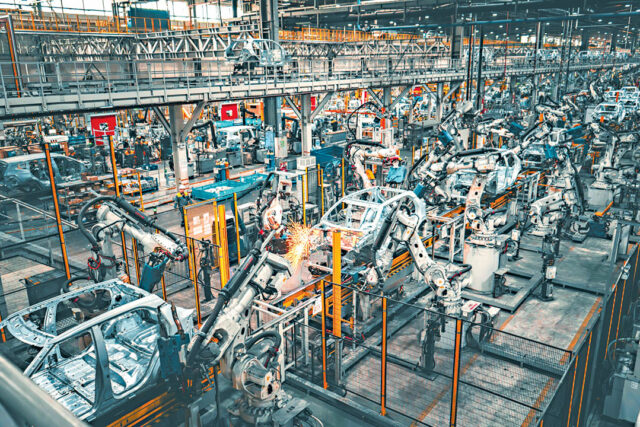
One of the heavily robotized production lines at the VinFast Haiphong Manufacturing Complex in Vietnam — PHOTO BY KAP MACEDA AGUILA

How Vietnamese BEV specialist VinFast is aiming to replicate its success outside its mother country

AMID AN embarrassment of automotive riches in the Philippines — more than 50 brands of which about half are accounted for by Chinese marques alone — VinFast is working quite hard to get customers to look its way. Aside from being widely seen to be a friendly neighbor, dealing with Vietnam also allows Philippine customers to benefit from the ASEAN Free Trade Area (AFTA) agreement. This trade bloc pact, forged in 1992, effectively creates a single market by removing tariffs and other barriers to trade and investment among member states toward lowering cost.

While having a competitive advantage in this regard, VinFast was, admittedly, off to a rather shaky start in the Philippines. Yes, it had made a splash owing to well-designed battery electric vehicles, but there was also a view that it wasn’t adequately ready to compete in our market just yet — whether as a result of past executives’ unfamiliarity with the market’s inner workings or just simply misfortune with some products. I leave it to those with a more direct interaction with the brand — at least through the latter — to make their conclusions. I did ask an owner of the VF 3, the marque’s entry-level model, for an honest assessment of this vehicle. He is happy with it and, despite some minor hiccups, swears by his car’s reliability.

And personally, I have driven VinFast vehicles without issue, at least for the short instances I was behind the wheel during a trip in Ho Chi Minh in the middle of the year, and just recently for a media/content creator trip to Hanoi — where VinFast officials also took us on what can be described as a short tour of the Vingroup kingdom where it belongs to.

Vingroup is a Hanoi-headquartered conglomerste chaired by its founder Pham Nhat Vuong. With vast interests in various sectors from technology, real estate, infrastructure, healthcare, to energy and social enterprise, belonging to this massive empire is arguably VinFast’s biggest value proposition. It deigns to move in big ways because, well, it can.

In Vietnam, VinFast is not only the largest BEV (battery electric vehicle) brand but the leading mobility marque, period. After three quarters of 2025, the company reported it had moved more than 100,000 units in the country — becoming the first auto brand there to notch the feat. “The milestone follows 11 consecutive months as the nation’s best-selling car maker, underscoring VinFast’s unchallenged leadership in the domestic automotive market,” it added in a release.

Its local success notwithstanding, the future of VinFast is predicated on how well it does on the world stage. In this regard, there is still a lot of work that needs to be done. Establishing a foothold in overseas markets is not a cakewalk.

If a tour of its company’s institutional “trophies” is meant to inspire confidence in VinFast, the hiring of the right people should, in a manner of speaking, help ensure last-mile delivery.

To this end, VinFast recently tapped the services of Antonio “Toti” Zara III to help realize its aspirations. “The story of VinFast goes beyond the product,” he said recently as he met with a delegation of media and content creators in Hanoi. “It’s about the ownership experience.” Mr. Zara steps into the role of VinFast CEO for Southeast Asia — overseeing not just the Philippines but crucial markets of the region, including Thailand, Malaysia, and Indonesia.

Mr. Zara is no stranger to the industry where he has assumed various leadership positions in the past. He was last seen with ACMobility, handling new energy vehicle specialist BYD. Over the many years I’ve had a chance to interview Toti, he’s always harped on the inevitability of electrified mobility — even in the Philippines — owing to a range of benefits and advantages. For him, BEV dominance is just a matter time.

At VinFast, he gets to double down on his vision as a newly minted executive. Not only will he lead the Vietnamese full-electric auto brand’s charge in the region, but make sure that an ecosystem supports its rollout. Plenty of things are keeping the executive busy: One is checking on VinFast’s US$200-million production facility in Indonesia, expected to open by next year. Another similar factory in India is already open, and VinFast intends to scale up its initial US$500-million investment there to US$2 billion.

“So today, we’ve explained to media our strategy on how we would use the Vingroup ecosystem to really redefine and change the ownership experience,” he told a number of reporters right after a formal Q&A session with himself and VinFast Chief Engineer for the VF 6 and VF 7 Vincent John Pendlebury.

Amid a glut of so-called new energy vehicle marques and offerings in the Philippines today, the aforementioned girth of what constitutes VinFast’s ecosystem is among the brand’s main unique selling propositions (USPs), according to Mr. Zara.

“We are actually better, if not the same, as other brands in terms of range — which is critical,” he continued. “But again, I’d like to stress (that) it’s not about the car itself. It’s not about range, it’s not only about the technology, but the entire BEV ownership experience.”

For Toti, it’s about getting behind the brand to inspire confidence in buyers. Obviously cognizant of a need to improve in this crucial area, Mr. Zara revealed plans to launch “special programs” unique to VinFast.

A particular one intends to show that VinFast is willing to bet on its vehicles. The so-called “Residual Value Guarantee Program” will see VinFast Philippines guaranteeing 90% value for products that are six months old, with promises also in place for older products. For Mr. Zara, it makes perfect sense.

“It eliminates that barrier of BEV ownership. Let me say that this is an offer that ICE (internal combustion engine) brands would not be able to do. How can we do this? It’s because of the ecosystem within the Vingroup. We are not only a car company, we are a mobility provider, and it’s the ecosystem that would generate that benefit.”

In the Philippines, Mr. Zara wants to continue making inroads for VinFast by rolling out brand-exclusive charging points — toward realizing a dream of being the top BEV brand (yes, you read that correctly) in the country. “We have clear line of sight on how to do that, and I’d like to think that it will happen very soon, (the) exact timing of which I dare not say,” he posited.

“Are we competing against other BEVs? Not directly, no. All the other EV brands (are) doing the same thing. We are advocating the transformation to green mobility. So while we are competing, we are complementing each other… as other brands become strong, as we become stronger. That’s good, because then we would accelerate the transformation towards electrified mobility.”

Another program, launched recently, “Pili Pilipinas.” Disclosed Mr. Zara, “It will be highlighting our future products, and we will ask people to vote instead of having these designs confidential, like all the other brands. We’ll make these designs public, and ask people to vote on their preferred design that will be critical inputs as we finalize future projects.”

Part of moving forward also means accepting that boxes need to be ticked. “We’re in a startup phase,” he conceded. We’re building the network. Right now, we have 10 showrooms that are not yet 100% in terms of facility readiness, in terms of people.

The key is to build brand awareness, and to that end VinFast is gearing up for a relaunch “in a big way.” At the end of the day, Toti Zara wants people to test-drive VinFast vehicles and remove doubts and misgivings over the brand and the powertrain format. “Everyone knows about the practicality of owning a BEV, right? Our task now is to bust the myth surrounding its ownership. We will bust the myth on range anxiety through the expansion of our partner V Green network.

Part of removing that particular pain point is to roll out charging points in destination areas and transit points. The V Green network, serving the growing fleet of full-electric GSM taxis, will also lend itself to private VinFast owners. “Most of the infrastructure is not used at nighttime,” said Mr. Zara in response to this writer during another Q&A session. “Our taxis will be utilizing those EV chargers during those lean hours. This would allow us to build a healthier business case for the infrastructure investment we will make.”

VinFast in Vietnam, according to the executive, boasts more than 150,000 charge points. In the Philippines, V Green has “about 1,000.” Mr. Zara added, “Our first milestone is to get to 15,000 charge points (and) we’re working together with other infrastructure companies, which also have aggressive plans.”

Additionally, VinFast Philippines will also restore the battery subscription program it originally offered when it was launched, but was subsequently scrapped. “Velocity” asked why the company is bringing it back, and why the business model now makes sense.

“It was a key program that (led to) VinFast’s success in Vietnam. That’s why you find VinFast in Vietnam as the number-one car brand. As we launch in other markets, we would like to cut and paste the success story,” posited Mr. Zara. “What’s the difference with the program that we will launch and the one we had (here) for a short time? First, we have more aggressive price gaps between buying a car with a battery and buying one without. Also we have very aggressive subscription fees.”

As an example, the executive said that the entry-level VF 3 BEV bears a standard retail price of P746,000 with a high-capacity battery. Without a battery, the price would be trimmed to “more or less P600,000… even cheaper than an equivalent ICE (internal combustion engine) vehicle. Subscription fees will be less than P2,000 a month.” For a car of similar size, the owner can usually expect to fork over P5,000 to P6,000 for fuel cost.

“That means considerable savings on fuel and cash outlay,” Mr. Zara declared.

There’s more. “We will bust the myth on accessibility of service through our third-party workshops… again, we want to make that jump to electrified mobility an easier decision for the Filipino consumer to make.”

Toti Zara is not coy about the company’s aspirations. “Again, we want to be the number-one BEV brand by next year,” he stated. The Philippine auto industry is expected to close the year with a BEV share of 4% to 5% — around 20,000 to 25,000 vehicles in absolute terms. VinFast is therefore eyeing to register 8,000 units in sales by next year — helped along by small and subcompact categories, along with an MPV model it will launch in the future. The taxi/TNVS (transportation network vehicle service) market and PUV use might also propel the number to more lofty levels.

Laying out a more comprehensive plan is always a good start — or, in this case, restart. Let’s see if VinFast can manifest its destiny this time.


Debt yields end mixed amid market volatility

YIELDS on government securities (GS) were mixed last week amid broad market volatility due to developments at home and overseas, with the peso hitting a new record low and the US Federal Reserve adopting a cautious tone.

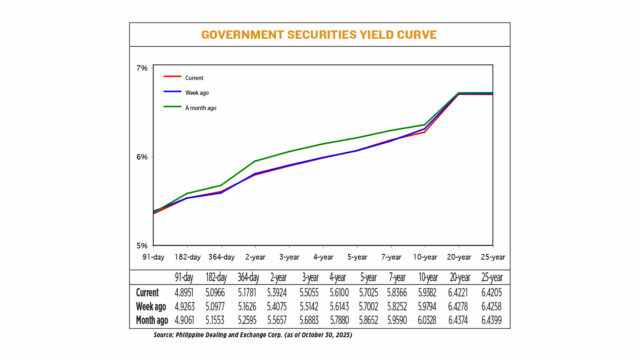
GS yields, which move opposite to prices, declined by an average of 0.76 basis point (bp) week on week at the secondary market, according to data from the PHP Bloomberg Valuation System Reference Rates as of Oct. 30 published on the Philippine Dealing System’s website.

Philippine financial markets were closed on Oct. 31 for a holiday.

At the short end, yields on the 91- and 182-day Treasury bills (T-bills) went down by 3.12 bps (to 4.8951%) and 0.11 bp (5.0966%) week on week, respectively. Meanwhile, the rate of the 364-day T-bill rose by 1.55 bps to 5.1781%.

At the belly of the curve, rates of the two-, three-, and four-year Treasury bonds (T-bonds) dropped by 1.51 bps (to 5.3924%), 0.87 bp (5.5055%), and 0.43 bp (5.6100%), respectively. Meanwhile, the five- and seven-year bonds climbed by 0.23 bp (to 5.7025%) and 1.14 bps (5.8366%), respectively.

Rates at the long end declined, with the 10-, 20-, and 25-year T-bonds falling by 4.12 bps (to 5.9382%), 0.57 bp (6.4221%), and 0.53 bp (6.4205%), respectively.

GS volume traded surged to P70.02 billion as of Oct. 30 from P28.52 billion a week prior.

“[The] volatility with regards to the foreign exchange moves spilled over in the local bond markets as well, especially when the peso hit all-time low levels,” Dino Angelo C. Aquino, vice-president and head of fixed income at Security Bank Corp., said in an e-mail.

“Rates are relatively elevated at current levels, with the 10-year bond still trading at around 5.9% as recent political noise along with the weakness of the local pair added premium to current GS yields, especially in the longer-dated maturities.”

On Oct. 28, the peso logged a new historic low of P59.13 against the dollar. It also fell to an intraday low of P59.26 during the Oct. 29 session but managed to recoup its losses.

The local unit closed at P58.85 on Oct. 30, down by 16 centavos from the prior day and by 22.5 centavos from its Oct. 24 finish.

“The Fed cut was highly anticipated and priced in by both the bond and the foreign exchange markets. Hence, despite the perceived ‘hawkish cut’ by the Fed, it drew very minimal reaction in the aftermath of the event,” Mr. Aquino added.

“The Fed’s 25-bp cut provided some strength to the local currency despite reaching historic lows [last] week. However, bond yields mostly moved in mixed directions on further rate cuts and upward risks to domestic inflation,” a bond trader said in an e-mail.

On Wednesday, after the Fed’s policy-setting committee voted 10-2 to lower its benchmark interest rate to the 3.75%-4% range, Fed Chair Jerome H. Powell delivered an unusually clear warning to markets: given “strongly differing views” about how to proceed in December, he said, a rate cut was “not a foregone conclusion, far from it,” Reuters reported.

Financial markets pared what had been near-certain pricing for a December rate cut after Mr. Powell’s remarks, although bets still reflect twice as high a chance of a rate cut as none.

A clutch of Federal Reserve bank presidents on Friday aired their discomfort with the US central bank’s decision to cut interest rates, even as influential Fed Governor Christopher Waller made the case for more policy easing to shore up a weakening labor market.

This yawning divide within the Fed’s policymaking ranks poses a challenge for Mr. Powell in forging a consensus in his final six months as the chair.

While it is not unusual for Fed policymakers to differ on policy, particularly when the economic data is mixed, the frank expression of that disagreement and the explicit focus on what the Fed ought to do at its next meeting, on Dec. 9-10, was striking.

Despite the US central bank’s cautious tone, both analysts said they still expect the Bangko Sentral ng Pilipinas (BSP) to continue its easing cycle, with another cut likely next month as domestic inflation remains low and amid fragile growth prospects.

“The BSP has been moving independently from the Fed as of late,” Mr. Aquino said.

“However, the magnitude and timing of these cuts might be influenced more by the incoming third-quarter Philippine gross domestic product (GDP) data,” the trader said.

The Monetary Board last month cut benchmark borrowing costs by 25 bps for a fourth straight meeting, bringing the policy rate to 4.75%.

It has now lowered rates by a cumulative 175 bps since it began its easing cycle in August 2024.

BSP Governor Eli M. Remolona, Jr. said further policy easing is possible until next year as they want to help stimulate the economy as they expect a widening corruption scandal involving state flood control and infrastructure projects to affect both public and private investments.

The release of October Philippine inflation data on Wednesday (Nov. 5) and the third-quarter GDP report on Friday (Nov. 7) will be key drivers for the market this week, both analysts said.

“More emphasis will be on the GDP print, as a weaker print could spark a rally on local bonds. Inflation on the other hand still remains well below the BSP’s target; hence, it would not play a big factor,” Mr. Aquino said.

“The GDP report will likely provide more clarity to the BSP regarding the amount of monetary support it needs to deliver in order to sustain local economic growth momentum despite headwinds from the corruption probe and the potential adverse impact of dimming business and investor sentiment on the capital formation and household spending portions of the GDP,” the trader added. — Pierce Oel A. Montalvo with Reuters

‘Give us back our jewels,’ Count of Paris urges Louvre thieves

A TIARA adorned with pearls worn by French Empress Eugenie, which was among the items stolen by thieves during a heist at Paris’ Louvre Museum on Oct. 19, on display in this undated still frame from a video. — LOUVRE MUSEUM/HANDOUT VIA REUTERS

THE Count of Paris, whose great-grandmother once wore the sapphire tiara stolen from the Louvre Museum, has pleaded with the robbers to return the stolen jewels intact for the sake of France’s heritage — and for his family.

This as a “chronic, structural underestimation of the risk of intrusions and theft” left the Louvre exposed for over 20 years to the kind of heist the museum experienced this month, French Culture Minister Rachida Dati said on Friday.

“Give us back our jewels, there’s still time,” said Jean d’Orleans, a direct descendant of French kings, speaking to Reuters at the royal domain of Dreux, 70 kilometers southwest of Paris.

“It’s both personal and intimate,” said d’Orleans, 60, as he leafed through family photographs showing his great-grandmother, the Duchess of Guise, wearing the Ceylon sapphire and diamond tiara in 1931. “These jewels were worn on special occasions, family events, sometimes also to create a specific portrait.”

Another picture showed the tiara being worn by d’Orleans’ grandmother Isabelle d’Orleans-Bragance for the last time at Princess Astrid of Belgium’s 1984 wedding, before it was sold to the museum by his grandfather in 1985 for 5 million francs.

$102-MILLION HEIST
The heist in broad daylight has stunned France and left the nation reeling at its audacity, and at the security failures that allowed the intruders to make off with national treasures worth more than $100 million in an operation that lasted just a few minutes.

It was the biggest robbery at the Louvre since the Mona Lisa was stolen in 1911. Police have made multiple arrests.

The eight stolen items were from the 19th century and once belonged to French royalty or the country’s imperial rulers.

They included the tiara, a necklace and a single earring from the sapphire set that belonged to Queen Marie-Amelie and Queen Hortense.

A tiara and brooch belonging to Empress Eugenie as well as an emerald necklace and a pair of emerald earrings gifted to Empress Marie Louise by Napoleon for their marriage were also among the thieves’ loot.

The sapphire set, acquired in 1821 by King Louis-Philippe from Queen Hortense, remained in the Orleans family for more than a century before going on public display.

‘PRICELESS HERITAGE’
The count urged the thieves to return the jewels intact.

“For our family, for the French people, it’s important that these jewels return to their display case at the Louvre,” he said in a grand living room lined with portraits of French monarchs including Henri IV, Louis XIII, Louis XIV and Marie-Antoinette. A renovated, more secure room should be used, he added.

The count, who implored the authorities to hold accountable anyone found to have been negligent in the theft, likened the public reaction to the heist to the outpouring of emotion after the Notre-Dame Cathedral blaze in 2019.

“It’s priceless heritage,” he said, “we need to recover that.”

CHRONIC UNDERESTIMATION OF RISK
Security gaps contributed to a brazen daylight heist on Oct. 19, in which four hooded thieves made off with eight precious pieces from the museum’s Apollo gallery, home to the French Crown Jewels.

A preliminary report into the theft found inadequate safety equipment, poor organization and obsolete protocols at the museum, Ms. Dati told TF1 TV.

“The devices as they were installed, the alarm and security devices as they were installed on the day of the theft at the Louvre Museum, functioned properly,” but that wasn’t enough to prevent the robbery as security “was not a priority,” Ms. Dati said.

She said that the museum will introduce additional security by the end of the year, including anti-intrusion devices and anti-vehicle ramming barriers on nearby public roads.

Louvre director Laurence des Cars told senators last week that she had offered her resignation after the heist, but Ms. Dati refused it.

Ms. Des Cars spoke of her “disappointment and surprise” at the state of the Louvre, the world’s most visited museum, when she moved there from the Musee d’Orsay — home of the French Impressionists.

Seven suspects have been arrested so far in connection with the robbery, but none of the stolen jewels have so far been recovered. — Reuters

Is corruption inborn in democracy?

STOCK PHOTO | Image from Freepik

(Part 2)

Part One of this column* looked into how acutely vulnerable Philippine democracy to corruption. And explored this colossal corruptibility of liberal democratic institutions, a century old in this country, to then ask whether there is in fact something about democracy that yields easily — or actually produces — its own corruption.

The proposed answer: No, but.

Which is to recognize that the freedom guaranteed by democracy guarantees it for the entire citizenry; but that, therefore, also guarantees it for bad actors who have increasingly upped their ability to usurp the legal system that should have curtailed greed.

Democracy’s guarantee of freedom unexpectedly guarantees the freedom to think to subvert freedom. This sentence, particularly in the case of the Philippines’ democratic project, is no mere semantic curlicue. The corrupt and corrupted political landscape is very real indeed — concrete, as the Marxists will say. (Today’s United States is an even more horrific example.)

Still, as the previous column observed, democracy managed to sustain its idealisms and restrain its innate corruptibility through most of the 20th Century. Despite the century-old, incrementally more awful histories of criminal leaders using democracy against itself, the threat was not existential until this past decade of the 21st Century.

Today it is clear that democracy may not hold as majority culture and politics globally. In the Philippines as in the US, Turkey, Hungary, Venezuela, even Austria, Italy, and also India, Pakistan, Bolivia, Brazil, Nicaragua, and many others, at least one of three pillars of a democratic state is listing badly.

They lack adequate representation, or strong enough protection of human rights, and the constant ascendance of the vaunted rule of law. Either one, two, or all three have been thrashed (however differently and unevenly) by corrupting agents arrogating the freedom to foist impunity on the weak.

New data from the Global State of Democracy Indices “documents a troubling trend: more than half of all countries assessed have declined in at least one key aspect of democratic performance over the past five years.”

The conservative Brookings Institute writes: “…there are more closed autocracies than liberal democracies in the world. Nearly three-fourths of the world’s population lives in an autocracy.”

SURVIVING PREJUDICE
Why this is happening now and not sometime earlier in the 20th Century — why democracy’s weakness, indeed democracy’s suspicious intimacy with corruption, did not succumb to ruin decades ago in different parts of the world — gives political scientists and historians wide berth for analysis.

One or the other specialist points to the vastly increased human migration as a possible tipping point. Still others take up a new elitism that survives from old forms of racisms, suprematicisms, and nostalgically remembered castes. Of late, the concentration of power in top executive (top of the food chain) personae appears to be driven by wishful thinking of a return to a world where some are simply thought superior to majorities.

In fact, increasing migration as contributory to democratic decay may be recognized for its core idea of white suprematism.

Surviving prejudice also manifests in other explanations. Incremental voter disenfranchisement — which is the other side of sweepstakes vote buying — at core pivots on the idea that the multitudes are not fit for self-governance. The old colonial attitude seems truly hard to kill off.

Then again, some explanations emerge from new political phenomena. Terrorism operating globally is one obvious dynamic to point to. Fear on the ascendant, many societies start to pray to strongmen.

Then again, there is the success of China, an unapologetically autocratic world, in raising hundreds of millions of its citizens from poverty to constitute a vast middle class. To many in the world, Deng Xiao Ping’s and even Xi Jin Ping’s China is worth emulating.

Anti-elitisms — such as Donald Trump’s promise to drain the swamp or French anti-Macron, populist sentiment — cluster around the willingness to let go of democratic guardrails to knock down the establishment. With this establishment are, unfortunately, the institutions of a free press, an above-board and august judiciary, and guardians of rigorous education.

Populist sentiment can be and is in fact often anti-democratic. Ironically enough. The multitudes have been known to choose political alternatives inimical to their welfare. And this historical matter-of-course is now a gargantuan phenomenon made possible by digital technology.

ALTERNATIVE REALITIES
All of the above explanatory approaches to figuring out democratic decay are fed by the one totalizing change that human beings have never before had to face. The alternative to organic intelligence — machine intelligence, even in its “infancy” — has already overdetermined the outcomes of cultural clashes.

What is true is now every bit contestable and impeachable, nearly always exposed to attack by weaponized alternative realities. What is true is usually whatever the disinformation campaigns succeeded in forcing on target demographics.

Study after study, of recent vintage and of consistent integrity, maintain that democracy is being battle-rammed big time by autocrats. Democracy’s degradation is deliberate; at the largest scale that can be bought by the dirtiest, biggest monies; sophisticated in the deployment of digital architectures; and incessant.

Yet even without the massive disinformation campaigns, digital technology by its very character will mitigate against democracy.

To the question posed by The New York Times about ChatGPT “hijacking democracy,” only a couple of weeks after this app was launched, the answer zeroed in on the changes imminent in lobbying. At the time of the Opinion piece by Nathan E. Sanders, a data scientist, and Bruce Schneier, a security technologist, in January 2023, the authors wrote: “Generative AI threatens three central pillars of democratic governance: representation, accountability, and, ultimately, the most important currency in a political system — trust.”

According to the present issue of The Journal of Democracy (October 2025), the situation is much more dire.

“The most problematic aspect of generative AI is that it hides in plain sight, producing enormous volumes of content that can flood the media landscape, the internet, and political communication with meaningless drivel at best and misinformation at worst. For government officials, this undermines efforts to understand constituent sentiment, threatening the quality of democratic representation. For voters, it threatens efforts to monitor what elected officials do and the results of their actions, eroding democratic accountability.

“A reasonable cognitive prophylactic measure in such a media environment would be to believe nothing, a nihilism that is at odds with vibrant democracy and corrosive to social trust. As objective reality recedes even further from the media discourse, those voters who do not tune out altogether will likely begin to rely even more heavily on other heuristics, such as partisanship, which will only further exacerbate polarization and stress on democratic institutions.”

All this was unexpected, except by the most prescient information technologists. The imminent reorganization of bodies of knowledge and experience — not the least of which is democracy — is changing what it is to be human.

Whether democracy will remain an order for a particular kind of humanity, is by no means certain.

*Part 1 can be read here: https://tinyurl.com/272s4w3b


Marian Pastor Roces is an independent curator and critic of institutions. Her body of work addresses the intersection of culture and politics.

Equinix eyes higher utilization as co-location demand rises in PHL

BW FILE PHOTO

GLOBAL DIGITAL infrastructure firm Equinix, Inc. is targeting a higher utilization rate in its Philippine data centers as demand for co-location and interconnection services continues to grow.

“The utilization is relatively low right now,” Equinix President for Asia-Pacific Cyrus Adaggra told reporters last week. “But as we fill it with customers, it will obviously grow over time. As soon as we acquired the data centers, we started talking with both our international and local customers about locating here.”

Equinix launched its Philippine operations in October, marking the opening of three data centers in Cavite and Makati. The facilities were acquired last year from Total Information Management Corp. (TIM), signaling the company’s entry into the country’s fast-growing data infrastructure market.

Mr. Adaggra said Equinix is focusing on increasing the use of its existing facilities before pursuing further expansion. “We are focusing on the three data centers that we have here, and then we will continue to expand as this data center continues to be fully utilized.”

He added that the company has room to grow within its existing Cavite site. “The good news is that on this piece of land, we’ve got the ability to build our next data center. We don’t need to look for new land, and we know the local utility can provide us with more power at this location,” he said.

Equinix’s data centers provide high-speed interconnection services, giving enterprises direct access to cloud platforms, artificial intelligence (AI) providers and major network ecosystems through secure private links. The company operates more than 260 data centers globally across 70 markets.

The Philippines is a key part of Equinix’s broader Southeast Asian expansion strategy, which includes new projects in Malaysia and Indonesia. The company said it sees strong growth potential in the country’s digital economy and a rising need for secure, scalable data infrastructure.

The Department of Information and Communications Technology (DICT) projects that the Philippines’ data center capacity could reach 1.5 gigawatts (GW) by 2028 as both local and foreign operators ramp up investments. — Ashley Erika O. Jose

As US federal food aid lapses, most states unable to fill the void

STOCK PHOTO | Image from Freepik

WASHINGTON — For Roma Hammonds, of Chattanooga, Tennessee, food stamps have been a lifeline since taking custody of her grandchildren five years ago.

Ms. Hammonds, 60, who cannot work because of a physical disability, has relied on her $563 in monthly Supplemental Nutrition Assistance Program (SNAP) benefits to feed her family of four and to afford other bills like rent, she said.

But her November benefits may not be issued by the US government due to the ongoing federal shutdown, and Tennessee is among the vast majority of states that have said they cannot pay for the aid themselves.

“I don’t know what I’ll do,” Ms. Hammonds said.

Ms. Hammonds is one of the roughly 41 million SNAP recipients wading into a potential historic lapse of the 60-year-old food aid program, which sends roughly $8 billion each month to low-income Americans in every state.

Neither Congress nor the administration of President Donald Trump has acted to fund benefits. Two federal judges ruled that the administration cannot block November SNAP benefits and must use about $5 billion in agency contingency funds to pay for them, requiring updates by Monday on compliance with their rulings.

The US Department of Agriculture did not respond to questions about how it will react to the ruling or share any details of a plan to pay benefits.

In the meantime, just five states, Delaware, New Mexico, Louisiana, Virginia and Vermont, and the District of Columbia have said they will pay for some or all of the November food aid, according to a Reuters review of state websites and public statements. The rest have said they will not pay for the benefits due to technical or cost barriers, or provided no explanation.

The USDA said in an Oct. 24 memo that it will not reimburse states if they cover the cost of benefits.

Most states balance their budgets annually or biennially, and the increased uncertainty of federal funding for healthcare, education and other key resources has added layers of risk to state finances, according to the Pew Charitable Trusts.

“Every year we have significant budget shortfalls and are working to balance the budget,” said Christine Woody, food security policy manager at Empower Missouri, a social justice organization. “We don’t have $130 million to put towards this without any assurance.”

A USDA spokesperson called the shutdown an “inflection point for Senate Democrats.” The agency has repeatedly blamed the aid lapse on Democrats, most of whom have withheld their votes on a spending bill in an effort to keep healthcare costs from spiking for many Americans. Democrats have criticized the USDA for not using agency contingency funds to partially fund the November benefits.

States receive monthly sums from the federal government for SNAP benefits, ranging from $4.9 million for Wyoming to more than $1 billion for California, according to USDA data.

To distribute those benefits, states contract with third-party processors who add the money to recipients’ Electronic Benefit Transfer cards. Some states have said they cannot make the technical changes needed to get money to recipients themselves.

“Tennessee is unable to utilize state dollars to provide the benefit, as states do not have a mechanism to load benefits onto customer cards,” said Governor Bill Lee in an Oct. 24 statement.

Others said the sums are simply too large to accommodate. “SNAP brings in more than $210 million monthly in federal funding. The state budget cannot absorb even one month of federal failure,” said a notice on the Massachusetts Department of Transitional Assistance website.

Virginia is drawing on a budget surplus for its stop-gap program that will issue weekly benefits through at least November, Governor Glenn Youngkin said this week. Virginia SNAP benefits cost about $143 million per month, according to USDA data.

Delaware on Wednesday said it would fund week-by-week benefits through November if needed. Louisiana, Vermont and New Mexico are making funds available for partial benefits.

Some states, including Connecticut, New Mexico and West Virginia, have said they will send additional money to food banks. Food banks are already under strain from rising US hunger rates and have said they are unlikely to be able to meet surging demand during the benefit lapse.

Many states encouraged SNAP recipients to budget and visit food pantries, and others to donate time and money during the benefit lapse.

“Let’s do everything we can to support one another so that no family goes hungry,” said the Arkansas Department of Human Services website.

Some Democratic-led states have blamed the Trump administration for the lapse, while some Republican-led states blamed Democrats in Congress.

North Carolina Governor Josh Stein, a Democrat, said the administration is at fault because of its decision not to use the emergency funds.

“The administration’s refusal to use these available funds as temperatures cool and the Thanksgiving holiday approaches is a cruel abdication of the responsibility to support families and communities,” Mr. Stein said in an Oct. 27 statement.

The website of Louisiana Governor Jeff Landry, a Republican, blamed Democratic Senators for withholding their votes on a spending bill.

“Our US Senators representing Louisiana have voted over and over again to re-open the government. They are doing their part. Now it is time for those US Senators, voting under Democrat Senate Leader Chuck Schumer, to vote yes and re-open the federal government,” the website said.

Thirteen Senate votes to fund the government have failed. — Reuters

Toyota flexes new vehicles, recommits to decarbonization

The Century Coupe Concept takes center stage at Century’s Japan Mobility Show area. — PHOTO BY KAP MACEDA AGUILA

Something old, something new at the Japan Mobility Show 2025

By Kap Maceda Aguila

THE RECENT Japan Mobility Show (JMS) 2025 once again proved how much it is an important showcase of what is and what’s to come in mobility. The biennial show was held once more at the Tokyo Big Sight or Tokyo International Exhibition Center in the Ariaki Minami district of the Tokyo Waterfront City.

Toyota Motor Philippines sent a huge contingent of media and content creators to Tokyo where key executives of the brand mapped out the aspirations of the world’s leading automobile maker — particularly with regard to its operations and presence in the ASEAN region.

Toyota, Lexus, Daihatsu, Gazoo Racing, and the new ultra-luxury marque Century remain committed to the multi-pathway approach of the group, and continue to espouse the notion that carbon is the enemy, not any one powertrain. The clear message from its JMS stint — as elucidated by Toyota executives — also remains to be the continuing effort of the group in providing mobility for all; empowering even the differently abled to be able to lead mobile, more enabled lives.

Toyota Motor Asia Executive Vice-President Pras Ganesh reminded how the focus, as defined in JMS 2023, has continued to evolve from actual cars to mobility, and — in parallel — the “many ways to decarbonize at speed and scale.” A battery electric vehicle is not the single answer because the world’s various markets have various needs and state of readiness to full electric. Decarbonization can take the form of the use of e-fuels or biofuels, and the many powertrains that indeed cut the emission of carbon: battery electric, plug-in hybrid electric, low-carbon internal combustion engines, and hydrogen fuel cell electric.

For Toyota in the ASEAN region, widely touted to be the next growth area, Mr. Pras mentioned a so-called “30 x 30” mission: to realize 30% of vehicle sales comprised of electrified vehicles by 2030. A majority of these electrified vehicles will be hybrid electric vehicles (HEVs). Taken as a whole, the effort to decarbonize, maintained the Toyota executive, will redound in benefit equal to the planting of 25 million trees.

That’s certainly something to write home about — and we’ll have more reportage coming your way in the weeks ahead.

Pacquiao launches MannyPay e-wallet

MANNYPAY.PH

FORMER SENATOR Emmanuel “Manny” D. Pacquiao has launched MannyPay, an electronic wallet that promises lower transfer fees and will eventually feature remittance and cryptocurrency services.

The e-wallet was launched on Thursday through tech and business process outsourcing (BPO) company 7th Pillar Integrated Systems Corp., which is also chaired by Mr. Pacquiao and began operations in 2023.

The company also signed a memorandum of agreement with Prime Electric Holdings, Inc. to use the e-wallet across its distribution network.

“MannyPay is not just an app or a payment gateway. Ito ay simbolo ng tiwala at katapatan. We built this platform for everyone — para sa mga negosyante, online sellers, riders, freelancers, at bawat Pilipinong araw-araw nagsusumikap para sa pamilya,” Mr. Pacquiao said in a speech at the launch.

He said their target is to have one million customers.

7th Pillar Integrated Systems President and Chief Operating Officer Marc Hussein P. Bundalian told reporters on the sidelines of the event that the e-wallet will feature fees at least P2 lower than those of competitors. He added that the e-wallet is supported by Amazon Web Service’s cloud systems and will feature better security.

“We are not rushing this so we can ensure the security of our users. Our top priority is to have no scams… Hopefully we do not have any problems,” he said.

The Bangko Sentral ng Pilipinas has issued the company a temporary license and was allowed a test period of 30 days, Mr. Bundalian said.

The app currently only functions as a payment gateway, but they expect to have all services available before the end of the year, he said.

“Other features such as fund transfers will be available after the official launch. This is like a pre-launch to show that the app is there. You can download it on both iOS and Play Store… The ultimate goal of MannyPay is to first start as a payment gateway, and then an e-wallet, and then remittances.”

Mr. Bundalian added that the company plans to apply for an electronic money issuer license by the second quarter of next year.

He said they expect to onboard up to 100,000 users by yearend. — Aaron Michael C. Sy

Disney networks go dark on YouTube TV after failed talks

DISNEY’S networks went dark on Google’s pay-TV platform YouTube TV after negotiations to reach a licensing deal failed, the companies said in separate statements late on Thursday.

The affected Disney networks include ESPN, ABC, FX, Nat Geo, Nat Geo Wild, Disney Channel, ABC News Live and others.

A source told Reuters that Disney’s channels were removed from YouTube TV ahead of the contract lapsing. YouTube TV issued its statement on X at 11:16 p.m. ET on Thursday, while the deal was originally set to expire only at midnight.

YouTube TV, one of the largest pay-TV distributors in the US, has been locked in a series of negotiations this year with firms threatening to pull their media networks from the platform.

Earlier this month, the company, after a difficult negotiation period, struck a deal with Comcast-owned NBCUniversal to keep NBC shows such as Sunday Night Football and America’s Got Talent on YouTube TV. The platform also struck similar deals with Fox and Paramount earlier this year after difficult contract negotiations.

YouTube TV, which has over 10 million subscribers, said Disney’s proposed offer terms would raise prices for its subscribers and benefit Disney’s own live TV services such as Hulu + Live TV, while Disney accused YouTube TV of being unwilling to pay fair rates.

“Our contract with Disney has reached its renewal date, and we’ll not agree to terms that disadvantage our members while benefiting Disney’s TV products,” YouTube TV said in a post on social media platform X.

A Disney spokesperson said the company was committed to working toward a resolution as quickly as possible.

“With a $3-trillion market cap, Google is using its market dominance to eliminate competition and undercut the industry-standard terms we’ve successfully negotiated with every other distributor,” the spokesperson said in a statement.

YouTube TV will offer its subscribers a $20 credit if the Disney networks remain unavailable on the platform for an extended period of time.

The pay-TV platform had dropped Spanish-language network Univision last month after a failed contract deal. — Reuters

A united front against counterfeit medicines

STOCK PHOTO | Image from Freepik

Counterfeit medicines continue to pose serious threats to people around the world, including Filipinos. Recent reports have confirmed the presence of fake medicines and vaccines in the country across various disease categories, putting patients’ lives and public trust at risk.

These counterfeit products have been detected in multiple channels, from government bidding processes and private retailers to e-commerce platforms, social media advertisements, and unauthorized clinics or agents. Some are even illegally compounded using unapproved Active Pharmaceutical Ingredients (APIs) or the components in a drug that produce the intended therapeutic effect.

According to the World Health Organization (WHO), substandard medical products fail to meet required quality standards due to poor manufacturing or weak quality control. Falsified medical products, on the other hand, are intentionally misrepresented in terms of their identity, composition, or source, usually produced and sold to deceive consumers for profit. Both forms of counterfeit medicines pose grave global health risks. They may be ineffective in treating diseases if they contain the wrong ingredients or incorrect dosages. Some can be directly harmful due to toxic substances or contamination, while others contribute indirectly to antimicrobial resistance.

Patients have reported treatment failures, serious side effects, and even life-threatening complications caused by counterfeit medicines. Beyond the physical harm, these fake products also erode public confidence in hospitals, healthcare professionals, and legitimate manufacturers undermining the credibility of the entire health system.

A related concern is the unauthorized distribution of genuine medical products that were illegally imported or mishandled, bypassing proper distribution, storage, or tax regulations. Such practices endanger patients, undercut legitimate businesses, and weaken both the public health system and the national economy.

The Pharmaceutical and Healthcare Association of the Philippines (PHAP) and its member companies remain steadfast in ensuring that all medicines made available to Filipino patients are safe, effective, and compliant with local, regional, and global standards. As a long-standing partner of government, PHAP has consistently supported policies and programs that protect the integrity of the supply chain and uphold patient welfare.

PHAP member companies actively implement anti-counterfeit measures such as conducting test buys and local intelligence gathering upon reports of suspected counterfeit medicines, performing laboratory verification, and submitting detailed reports to the Food and Drug Administration (FDA).

However, the fight against counterfeit medicines cannot be won by one sector alone. It requires a comprehensive, multi-sectoral strategy that brings together government agencies, the private sector, the medical community, civil society, and the public.

To this end, PHAP is exploring further collaboration to strengthen collective action against counterfeit medicines in the Philippines. Among the proposed measures include imposing administrative sanctions on legally registered establishments found to knowingly engage in unauthorized distribution of genuine or counterfeit products, including suspension or revocation of licenses. Also crucial is shortening the turnaround time for investigations and the issuance of public advisories that identify perpetrators. Moreover, it will be important to establish collaborative mechanisms for information exchange between government and industry to fast-track enforcement. Finally, creating a counterfeit medicines reporting hotline to encourage the public to report suspicious products or activities will be necessary.

This collaboration also extends to patients, healthcare professionals, and hospitals, encouraging vigilance and proactive reporting of suspected fake medicines. Pharmaceutical companies, in turn, are called upon to provide verified information to regulators, strengthen supply-chain monitoring and workforce integrity, and advocate for stronger enforcement and transparency.

These actions reflect our joint commitment to integrity, accountability, and transparency. Ahead of the National Consciousness Week Against Counterfeit Medicines, PHAP is also planning a nationwide public information campaign to raise awareness about the dangers of fake medicines and the legal consequences of counterfeiting.

Counterfeit medicines remain a serious and evolving threat to patient safety, industry integrity, and public confidence in the healthcare system. Now more than ever, collective and sustained action through stronger regulation, public education, and shared accountability is needed to ensure that only genuine, quality-assured medicines reach Filipino patients.

PHAP reaffirms its commitment to work closely with the FDA and all stakeholders to protect the integrity of the country’s medicine supply chain and safeguard public health.


Teodoro B. Padilla is the executive director of Pharmaceutical and Healthcare Association of the Philippines, which represents the biopharmaceutical medicines and vaccines industry in the country. Its members are at the forefront of developing, investing and delivering innovative medicines, vaccines, and diagnostics for Filipinos to live healthier and more productive lives.

ADVERTISEMENT
ADVERTISEMENT