Home Blog Page 7985

What 16th Century Venice teaches us about crypto
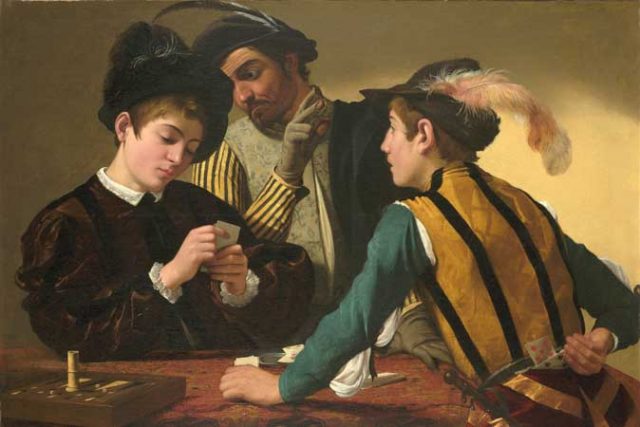
CARAVAGGIO’s The Cardsharps — GOOGLE ART PROJECT

ON FEB. 18, 1522, a secondhand clothing merchant named Geronimo Bambarara in the crowded Rialto district of Venice came up with a new way of clearing out stock.

Instead of selling his goods directly for money, he decided to enter customers in a draw. In exchange for a 1 lira ticket, they might win more than 1,000 times that amount in cash or take-home prizes of carpets, cloth of gold, fabric, amber, or animals. The promotion was a success. Within a week, the numbers chancing their odds resembled the crowds at the Ascension Day religious festival, according to one contemporary diarist: “At present, in this Rialto district, nothing is done except put money on the lottery.”

It didn’t last. Just 10 days after the game began, alarmed Venetian authorities banned private lotteries. Their next move was equally predictable. Having eliminated a lucrative private business, the city turned it into a public one, and started issuing tickets to raise state revenue.

That’s a lesson for how cryptocurrencies may develop over the years ahead, as more widespread usage magnifies the potential for negative public consequences.

Falling and rising by double-digit amounts in a matter of hours, Bitcoin has largely given up any pretense that it can offer a challenge to the greenback as a form of currency. Even the hyperinflating Venezuelan bolivar and Zimbabwean dollar exhibit less price volatility. As the $1.7 trillion invested in digital currencies attests, though, crypto remains immensely popular as a speculative investment, just as Bambarara’s lottery tickets were five centuries earlier.

If Bitcoin and its ilk are to survive an era when their downsides are becoming ever more apparent — from carbon emissions to ransomware attacks — they will need to find a way to betray their libertarian roots and cut their own deals with the state.

Gambling and the financial state are intimately bound up together. It’s little accident that the first modern lotteries originated in Venice, the city that issued the first sovereign bonds. Much of the Venetian economy turned on speculation about the fortunes of shipping ventures. A key plot point of Shakespeare’s play The Merchant of Venice occurs when one of the titular trader’s ships is “wrecked on the narrow seas,” causing him to default on a loan.

The gambling craze spread through Europe as incomes rose, often deprecated by religious authorities but tolerated or co-opted by governments. When the world’s first casino opened at the Ridotto in Venice in 1638, it was sanctioned by the governing Great Council as an attempt to regulate and oversee the numerous private card clubs that had sprung up. So many great fortunes were won and lost at the gaming tables that the inventor of basset, the poker-style game played at the Ridotto, is said to have been exiled to Corsica as punishment. 

None of that deterred players. The Italian artist Caravaggio, Flemish Theodoor Rombouts, and French Georges de la Tour all painted celebrated scenes of card playing, often emphasizing the amount of cheating that went on. There was clearly a ready market for such scenes, as both art and gambling were popular pastimes for the rich in 17th century Europe. That situation, too, has parallels in the current craze for NFT art.

The same pattern played out in northern Europe. Before it was funded by issuing sovereign bonds, Britain’s national debt was paid for in the late 17th century via the proceeds of lotteries and tontines. An early attempt to consolidate those borrowings and pay them off via proceeds from the slave trade resulted in the creation of the South Sea Company, leading to one of the first great speculative financial bubbles.

The lesson of all this is that the modern state can be remarkably tolerant of people winning and losing fortunes, so long as it gets some benefit. That can come in the form of a cut of the takings; a measure of control over otherwise chaotic risk-taking; or even the capital allocation functions provided by financial markets. Where those benefits are absent, however, governments grow impatient with the turmoil of unrestricted speculation, and crack down hard.

What’s unique about cryptocurrencies is the way their resistance to the nexus of traditional political and financial power is inscribed in their code. Bitcoin is “very attractive to the libertarian viewpoint,” its pseudonymous creator Satoshi Nakamoto wrote in a 2008 post. Anonymous and divorced from the state-sanctioned banking system, crypto got one of its early boosts as an untraceable way to buy illegal drugs on the internet. To this day its most useful function, outside of a simple gamble on its price, is as a currency for illicit activities.

That allergy to government control makes it fundamentally different than the many other speculative activities that have been tolerated over the centuries, as they showered riches on a lucky few and bankrupted others. For digital libertarians, that’s long seemed like a key feature of the technology. As the social and economic costs of tolerating crypto mount up, though, it may look more and more like a bug.

The moment governments decide the nuisance and destabilization caused by digital currencies is too great, they will ban financial institutions from exchanging them for fiat currencies as vigorously as the US enforces sanctions on its geopolitical enemies. That possibility, once remote, seems more and more likely in an era when America’s fuel supplies can be held hostage for $5 million in crypto.

By establishing a relatively efficient payments system for illicit activity, digital currencies have drastically reduced the cost of crime. That’s not the sort of challenge that the modern state can be expected to take lying down. If crypto doesn’t find a way to make its peace with the governments it was set up to circumvent, it will eventually find itself crushed.

BLOOMBERG OPINION

Why are imported goods more expensive in the Philippines?  

VECTORJUICE-FREEPIK

Malaysia-based information aggregator, iPrice, recently published a report that ranked Manila as the third most expensive city to live in in Southeast Asia. According to iPrice, the cost of living in Manila is only a fraction lower than in Bangkok but 28% more expensive, on average, than in Jakarta, Kuala Lumpur, and Ho Chi Minh. Singapore tops the list. The report says that it takes P50,800 to live decently in Manila (and key cities of the Philippines), about three times the salary of an average worker who earns P18,900.

There are two contributory reasons why the cost of living in the Philippines is inordinately expensive. The first is due to our import dependence. Unfortunately, the country’s manufacturing sector has eroded so severely in recent years that we now import the majority of our needs. These include basic food products (including rice), consumer goods, construction materials, machinery and equipment, etc. The second is due to expensive inbound freight cost.

See, international shipping lines have found a loophole to extract more revenues from local traders and manufacturers. They do this by charging what is called, “destination charges.” On top of being exorbitant, destination charges are unilaterally manipulated and controlled by the international shipping lines themselves. There are approximately 50 types of destination charges including bunker price adjustments, import release fees, container cleaning fees, and many more which the shipping lines levy upon the Filipino trader at its own discretion. None of these destination charges are transparent to the importer or the authorities.

Importers from the Philippines have no choice but to pay these destination charges, however unreasonable they may be. Not to do so will cause the shipping lines to withhold the release of their shipment. Don’t forget, the longer the cargo stays in the port with fees unpaid, the more demurrage charges accrue.

This practice is both immoral and illegal. It is immoral because it is extortive and designed to take advantage of the importer’s desperation. It is illegal because the terms, conditions, and fees that govern international shipping are standardized and enshrined in an international agreement called the International Commerce Terminology (Incoterms). Whatever costs are indicated in the Incoterms must be followed, no more, no less.

For instance, if the Incoterms indicate that the shipping arrangement is on a CIF (pre-paid cost of insurance and freight) or CFR (pre-paid cost and freight) basis, the consignee (the Filipino importer) should not be made to pay for any other charges since all costs relating to freight have been prepaid in the country of origin.

But this is not the case for cargo destined for the Philippines. When the shipment arrives at our ports, the local consignee (the Filipino importer) is made to a pay a bevy of destination charges which are arbitrarily levied upon him. So excessive are the destination charges that it is sometime exceeds the cost of freight itself. In effect, our importers pay the cost of freight twice. This is one of the reasons why landed cost of imported goods are more expensive in the Philippines than they are elsewhere in the region. This is also why locally manufactured goods that utilize imported raw materials often cost more than their imported counterparts.

Industry insiders say that it is not uncommon for international shipping lines to pay commissions or rebates to the shipper (the foreign exporter) using funds derived from the destination charges. The shipper, in effect, is able to recoup part or the whole of the cost of freight even if on a CIF or CFR basis. The scheme is manipulative in that it transfers the burden of payment to the Filipino importer whereas the shipper is contractually bound to pay for the freight cost and/or insurance.

Moreover, the freight contract, in a CIF or CFR arrangement, is between the shipper and the shipping line. To levy destination charges on the local importer is a violation of the Privity of Contract Principal.

Government is losing out on its rightful taxes too. Since destination charges are not indicated on the bill of lading, the landed cost of imported goods become undervalued. This leads to a misdeclaration in customs duties.

Exacerbating matters are the undue demurrage charges consignees must pay if they do not collect their containers within the grace period allowed. Consignees are also charged detention charges for failure to return the empty containers to the shipping line within 72 hours from time of pick up. Both charges are computed on a daily basis. They are “undue” because by law, demurrage and detention charges are forms of compensatory damage. But shipping lines charge these as a matter of course even without proving that they suffered loss or damage.

As usual, the beleaguered consignee has no power to question the demurrage and detention charges. Shipping companies impose liens or hold the release of the consignee’s other shipments unless all charges are settled. They also withhold the refund of container deposits for past transactions. These acts are illegal and akin to extortion.

It is government’s duty to curb these abuses inflicted by international shipping lines on the Filipino importer. But the problem is that no government agency has been given the mandate to oversee and regulate the charging schemes of foreign shipping lines. They basically do what they want, to the detriment of the Filipino trader.

Two bills have been filed in Congress to rectify this. House Bill 4316 sponsored by Rep. Bernadette Herrera-Dy and House Bill 4462 sponsored by Rep. Ronnie L. Ong. Although the Transport Committee in the House is already conducting hearings on the matter and a technical working group has been formed, the process is still painfully slow.

We urge congress (and eventually the Senate) to hasten the passage of these bills since it has an impact on the cost of goods for our citizens and diminishes the competitiveness of our manufacturing sector.


Andrew J. Masigan is an economist

andrew_rs6@yahoo.com

Facebook @AndrewJ. Masigan

Twitter @aj_masigan

First post-COVID cruise ship leaves Venice amid protest

REUTERS
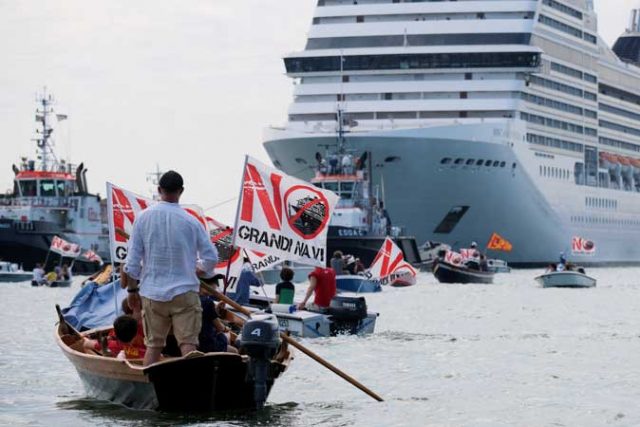
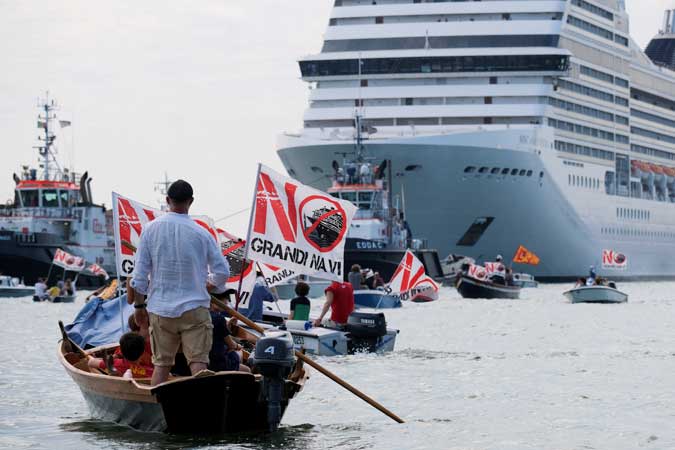
VENICE RESIDENTS hold a protest to demand an end to cruise ships passing through the lagoon city, as the first cruise ship of the summer season departs from the Port of Venice, Italy, June 5. — REUTERS

VENICE — The first cruise ship to leave Venice since coronavirus restrictions were eased set sail on Saturday, but some local residents protested over the return to normal, unhappy about the passage of giant liners through the historic lagoon city.

Hundreds of people rallied on land and small boats fluttering flags saying “No big ships” surrounded and followed the 92,000-ton MSC Orchestra as it departed Venice port en route for Croatia and Greece. “We are here because we are against this passage but also against a model of tourism that is destroying the city, pushing out residents, destroying the planet, the cities, and polluting,” said Marta Sottoriva, a 29-year old teacher and Venice resident.

But port authorities, workers and the city government welcomed the departure of the Orchestra, operated by MSC Cruises, seeing it as a symbol of business kicking off after the health crisis that hit hard at the cruise industry and the wider travel sector.

“We are happy to be back… to restart the engines. We care a lot about Venice and we’ve been asking for a stable and manageable solution for ships for many years,” said Francesco Galietti, national director for the trade group Cruise Lines International Association (CLIA).

Some residents have been urging governments for years to ban large cruise ships and other big vessels from passing through the lagoon and docking not far from the famed St. Mark’s Square.

Campaigners worry about safety and the environment, including pollution and underwater erosion in a city already in peril from rising sea waters.

“The struggle is very long, I think we are against very big financial interests,” Marco Baravalle, a 42-year old researcher, and member of the No Grandi Navi (No big ships) group.

He and other protesters were worried that “everything will go back to what we had before the pandemic,” he added.

Italy’s government ruled in April that cruise ships and container vessels must not enter Venice’s historic center but rather dock elsewhere.

But the ban will not take effect until terminals outside the lagoon have been completed, and a tender for their construction has not been launched yet. Part of the traffic might be diverted to the nearby port of Marghera starting from next year.

WHERE JOURNEYS BEGIN OR END
The Orchestra was escorted outside the port not just by small vessels protesting but by tugboats that saluted it with water sprays, a sea tradition reserved for special occasions.

The 16-deck ship can carry over 3,000 passengers and 1,000 crew but for this voyage will be sailing at only half capacity due to COVID-19 social distancing rules.

“It’s an important day for us, for 4,000 workers and many others who work in this sector. We are starting again after over 17 months, finally there is light at the end of the tunnel,” said Alessandro Santi, chairman of the Federlogistica business group.

He said the port community favored the bans but alternatives had to be found given the importance of tourism for the city.

The CLIA estimates that the cruise business represents more than 3% of Venice’s gross domestic product (GDP).

“Venice is where many itineraries begin or end, the economic impact on Venice is huge,” said Mr. Galietti. “If Venice is taken off the itineraries all the Adriatic (Sea) will suffer the consequences … it would be a huge impact.”  Reuters    

Gen Z now spending more than it did before pandemic

REUTERS

OK BOOMER, you may have money, but you’re not spending it.

Younger consumers, even though they have less saved than older Americans, are the ones opening their wallets as the US economy recovers. Millennials and members of Generation Z are spending even more than they did before the pandemic as vaccines proliferate around the world, American Express Co. (AmEx) Chief Executive Officer Steve Squeri said during a virtual investor conference Friday.

“We assumed there was such pent-up demand — not only for travel, but such a pent-up demand for consumer goods — that the US recovery would be like it is right now,” Mr. Squeri said. “When you look at your millennials and your Gen Zs right now,” they’re at “125% spending of what their pre-COVID levels were in 2019.”

That’s helped revive overall spending on AmEx’s cards, which nevertheless remains down this quarter compared with pre-pandemic levels. COVID-19 forced the company, long known for its cards that provide special perks for travel and dining, to reshape its business and focus its rewards on things like wireless and streaming services. As vaccines abound, AmEx is benefiting as consumers get back to vacationing and eating out.

While consumers have returned to the skies for domestic travel, businesses have yet to get their workers back on the road, Mr. Squeri said. AmEx now believes corporate travel won’t return to its pre-pandemic levels until 2023, he said.

The company is eyeing whether it can offer debit cards in markets outside China, Mr. Squeri said. Still, he cautioned, the firm is wary after a previous experiment offering prepaid debit cards to unbanked individuals ended with the division being dismantled less than a decade after its inception.

Mr. Squeri said that American Express is “very conscious about the brand” and needs to decide whether offering a debit card would fit in with the company’s largely high-end and aspirational products.

“It really didn’t work for us — the unbanked was really not our customer, and the prepaid market was not our customer, and we learned that,” Mr. Squeri said. “But is there something in between our everyday credit card and the prepaid card? And that potentially could be a debit card. That all needs to be worked out.” — Bloomberg

US boosts Taiwan’s COVID-19 fight with donation of 750,000 vaccine doses

TAIPEI — The United States will donate 750,000 COVID-19 vaccine doses to Taiwan as part of the country’s plan to share shots globally, US Senator Tammy Duckworth said on Sunday, offering a much-needed boost to the island’s fight against the pandemic.

Taiwan is dealing with a spike in domestic cases but has been affected like many places by global vaccines shortages. Only around 3% of its 23.5 million people have been vaccinated, with most getting only the first shot of two needed.

Speaking at Taipei’s downtown Songshan airport after arriving on a three-hour visit with fellow Senators Dan Sullivan and Christopher Coons, Ms. Duckworth said Taiwan would be getting 750,000 doses as part of the first tranche of US donations.

“It was critical to the United States that Taiwan be included in the first group to receive vaccines because we recognise your urgent need and we value this partnership,” she said at a news conference after the group arrived from South Korea.

She did not give details of which vaccines Taiwan would get or when.

Taiwan has complained about China, which claims the democratically-ruled island as its own, trying to block the island from accessing vaccines internationally, which Beijing has denied.

Standing by Duckworth’s side, Taiwan Foreign Minister Joseph Wu thanked the United States for the donation.

“While we are doing our best to import vaccines, we must overcome obstacles to ensure that these life-saving medicines are delivered free from trouble from Beijing,” he said.

China has offered Taiwan Chinese-made vaccines, but the government in Taipei has repeatedly expressed concern about their safety, and in any case cannot import them without changing Taiwanese law, which bans their import.

The senators also met with President Tsai Ing-wen at the airport, who said the vaccines, along with those Japan donated last week, would be a great help in their fight against the virus.

“The vaccines are timely rain for Taiwan, and your assistance will be etched on our hearts,” Ms. Tsai told the senators, in footage released by her office.

US senators and congressmen visit Taiwan routinely in normal times, but coming in the middle of an upswing in infections on the island when its borders remain largely closed to visitors is a strong show of support.

Unusually, they also arrived on a US Air Force C-17 Globemaster III freighter, rather than a private jet as is generally the case for senior US visitors.

Taiwan’s vaccine arrivals have been gathering pace.

Japan delivered to Taiwan 1.24 million doses of AstraZeneca Plc’s coronavirus vaccine on Friday for free, in a gesture that more than doubled the amount of shots the island has received to date. — Reuters

Saso slips to second in US Open

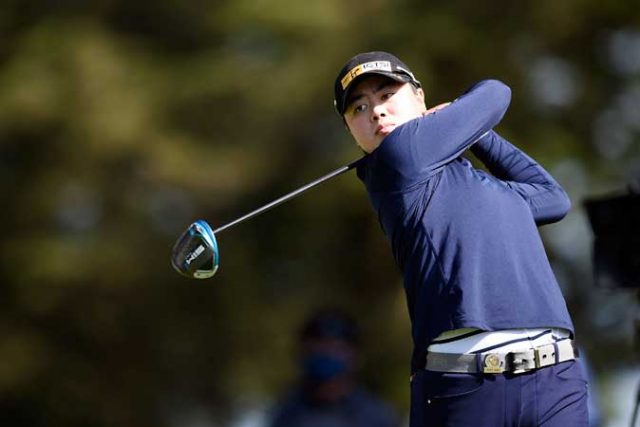
YUKA SASO plays her shot from the 12th tee during the third round of the US Women’s Open golf tournament at The Olympic Club. — REUTERS

Lexi Thompson shoots 66 to lead Saso by a stroke

SAN FRANCISCO — A relaxed Lexi Thompson fired a flawless 66 at the Olympic Club on Saturday to vault to a one-stroke lead heading into the final round of the US Women’s Open in San Francisco.

All facets of Thompson’s game were working as she carded her lowest round at the major in 15 appearances, sinking five birdies and gamely scrambling to avoid any bogeys to sit seven-under 206 for the tournament, one clear of Yuka Saso.

The popular American smiled and signed autographs as she walked the sloping Olympic Club’s Lake Course on a sunny day and said the work she has put in to improve her mental fitness was making a difference in her game.

“I haven’t played to my standards and I realized that I needed to change my mind-set,” she told reporters.

“It was only hurting me. Obviously, I needed to work on some technical things in my game and everything, but the mental side, I think, was really getting to me,” she said.

“I was just taking it way too seriously.”

Overnight leader Saso, 19, looked poised to run away with the tournament when she jumped out to a three-stroke lead but back-to-back bogeys on 13 and 14 opened the door for Thompson.

The Filipino player with an sharp short game pulled even with Thompson after completing a tough up-and-down on 17 but a bogey on the last left her in solo second place.

In the hunt at three-under were high school student Megha Ganne and 2019 champion Lee6 Jeong-eun, with the dangerous Shanshan Feng of China one shot further adrift.

Saso said she enjoyed the vocal support she received from the limited number of fans in attendance and said she was looking forward to her final round grouping with Thompson and friend Ganne.

“I’ll be rooting for her too,” Saso said with a laugh when she was told that Ganne had said that if she was not in the tournament, Ganne would be pulling for her fellow teenager.

“We have known each other for years, we played together in junior tournaments and she’s really nice.”

Ganne, the amateur turned talk of the tournament after she finished the first round as an unexpected co-leader, received rock star treatment from the fans in San Francisco and said she relished the spotlight.

“It was so fun,” she said.

“I’ve always imagined myself engaging with the fans like that because when I was younger and watching events, I loved it when I would see the pros just even look at the crowd or smile or do anything like that.

“So I really wanted to embody that today and I got a chance to on a few holes, which was nice.”

The 76th edition of the major marks the first time that it has been played at the iconic Olympic Club, a course that has hosted five men’s US Opens.

The men’s US Open will also be held in California this month at Southern California’s Torrey Pines. — Reuters

Kiefer Ravena’s Japan B.League stint on hold

PBA STAR Kiefer Ravena of the NLEX Road Warriors has to put his targeted stint in the Japan B.League on hold with the local league rendering it a no-go. — PBA IMAGES

BASKETBALL star Kiefer Ravena’s targeted stint with the Japan B.League is on hold as the parties concerned, including the local professional league, try to further sort out the matter.

In a virtual press conference on Saturday, the Philippine Basketball Association (PBA) Board of Governors reiterated its stand that Mr. Ravena is not allowed to play in the Japanese league as he has an existing contract with the NLEX Road Warriors and the league.

“The PBA has decided that Kiefer has to honor his contract,” said PBA chairman Ricky Vargas in the hurriedly organized press conference following the board’s meeting.

The league official shared that they looked at all possible scenarios and all the risks involved in the situation before making the decision.

The PBA was made to decide after news broke out last week that the Shiga Lakestars signed Mr. Ravena to play for the team in the B.League’s 2021-22 season.

No sooner after the Shiga Lakestars announced that they had signed versatile guard Ravena, the PBA came out and said it is not going to be possible.

The league said that Mr. Ravena is bound by the Uniform Players’ Contract (UPC) he signed with NLEX and the PBA which he must honor and adhere to.

“Kiefer has a UPC which he has to abide by. It’s the player’s contract. So he’s not allowed to play in other leagues,” PBA Commissioner Willie Marcial told BusinessWorld in a phone interview.

Mr. Ravena signed a three-year extension with the Road Warriors last year following a solid outing in the league’s “bubble” tournament where he averaged 19.4 points, 5.5 rebounds, 4.6 assists, and a steal throughout their run.

Earlier this year, however, news of Mr. Ravena getting a “good offer” to play in Japan broke out.

No less than NLEX coach Yeng Guiao confirmed the news. The coach said they support Mr. Ravena’s desire to pursue the opportunity presented to him, but admitted it was going to be easier said than done as a number of requirements had to be met for it to be a reality.

The PBA said after the press conference it was to communicate its decision to Mr. Ravena, the Lakestars and the B.League, and the Samahang Basketbol ng Pilipinas just as it asked local fans for understanding.

“I know the fans want him to play there. We also want that. But there’s a contract that should be followed. It’s basic. We really can’t let this pass,” Mr. Marcial said.

The league also deemed the Ravena situation as a “difficult precedent” not only for the PBA but also for world basketball governing body FIBA, whose approval is also needed for such kinds of transfer.

“FIBA is also very strict on contracts. FIBA deems the contracts of the players sacrosanct as well,” Mr. Vargas said.

So as not to complicate the situation further, Shiga said it was postponing the formal announcement of Mr. Ravena as a member of the Lakestars set for Monday.

“We have decided to postpone the press conference until a more appropriate time, as holding a press conference with Ravena and us at this time may add more confusion to the situation,” the team said in a statement.

“We will continue discussions to resolve this issue.”

Playing in Japan would make Mr. Ravena the second Filipino player to play in the league following his younger brother Thirdy, who plays for the San En NeoPhoenix team. — Michael Angelo S. Murillo

PHL Azkals return to pitch for FIFA-AFC qualifiers

THE Philippine Azkals play China on Tuesday set for 1 a.m. (Manila time) at the Sharjah Stadium in the United Arab Emirates which will mark the resumption of their pandemic-hit joint FIFA-AFC qualifier campaign. — THE AZKALS FB PAGE

By Michael Angelo S. Murillo, Senior Reporter

THE one-a-half-year wait for the Philippine national men’s football team ends as they make their return to the pitch for the joint 2022 International Federation of Association Football (FIFA) World Cup and the 2023 Asian Football Confederation (AFC) Asian Cup Qualifiers early on Tuesday morning.

The Azkals play China in a match set for 1 a.m. (Manila time) at the Sharjah Stadium in the United Arab Emirates which will mark the resumption of their qualifiers campaign which has been hit by the pandemic.

November 2019 was the last time the currently third-running Philippine squad (2-1-2, seven points) played in the FIFA-AFC qualifiers where it lost to Syria, 1-0.

The nationals are hoping to produce favorable results in their remaining three matches in the qualifiers to earn spots in the prestigious FIFA and AFC tournaments.

In the lead-up, the Azkals set up a training camp in Doha, Qatar, gathering some 25 players for the pool from which the final roster will be drawn from.

Veteran and team captain Stephan Schröck led the players called up for national team duty, along with the likes Patrick Reichelt, Martin Steuble, Jarvey Gayoso, Carlie de Murga, Mark Hartmann, Angel Guirado, Mike and Manny Ott, Luke Woodland, Kenshiro Daniels and Alvaro Silva.

The team, however, was also hit by player pullouts, notably top goalkeeper Neil Etheridge, who had to undergo surgery.

Preparations of the team were also rattled by the sudden change in venue from Suzhou, China, to the UAE as Chinese officials at the last minute decided to cancel hosting of the event over coronavirus concerns.

But the team remained steadfast and continued to further strengthen the squad.

“It has been a challenge for us preparing, but we are confident of putting up a good showing,” said Azkals coach Scott Cooper in the lead-up.

The Philippines trails Syria (6-0-0) with 18 points, and China (3-1-1) with 10, in Group A of the qualifiers.

Maldives (2-0-4) and Guam (0-0-6) round out the group.

The Azkals held China to a nil-nil draw in their first encounter on Oct. 15, 2019 at the Pana-ad Park and Football Stadium in Bacolod.

The Chinese, however, are coming off a huge 7-0 victory over Guam last May 30 in Suzhou entering their match against the Azkals.

After the China contest, the Philippines takes on Guam at 10 p.m. on June 11 and Maldives at 10 p.m. on June 15.

All the Azkals matches in the qualifiers can be seen on One Sports and One Sports+.

KAYA A STEP AWAY FROM ACL
Meanwhile, in local club scene-related news, Kaya-Iloilo FC moved a step away from making it to the group stage of the AFC Champions League (ACL).

With Football Australia deciding to pull out all Australian clubs seeing action in the ACL over the COVID-19 concerns, the AFC, in a statement at the weekend, approved the cancelation of Kaya’s scheduled match against Brisbane Roar and push the Filipino club to an East Region win-or-go home clash with China’s Shanghai Port on June 23 in Thailand for the last spot in Group F of the AFC Champions League.

Kaya is looking to join reigning Philippines Football League champion United City Football Club, which plays Group I, in the ACL group stage.

Brooklyn Nets defeat Milwaukee Bucks in Game 1 despite James Harden’s early exit

BROOKLYN Nets power forward Kevin Durant (7) controls the ball against Milwaukee Bucks power forward P.J. Tucker (left). — REUTERS

KEVIN Durant scored 29 points as the Brooklyn Nets survived an injury to James Harden and pulled away late for a 115-107 victory over the Milwaukee Bucks in Game 1 of the Eastern Conference semifinals on Saturday in New York.

Game 2 is Monday in Brooklyn, and it could be played without Harden, who injured his right hamstring in the opening minute of the first quarter and did not return.

Kyrie Irving added 25 points and eight assists as the Nets shot 46.9 percent and had enough other scoring to compensate for Harden’s absence.

Joe Harris chipped in 19 and five of Brooklyn’s 15 3-pointers. Blake Griffin contributed 18 points and 14 rebounds, and matched a playoff career-high with four 3-pointers. Mike James added 12 points and seven rebounds.

Giannis Antetokounmpo led all scorers with 34 points. He shot 16 of 24 from the field and helped Milwaukee score 72 points in the paint.

Former Net Brook Lopez added 19 points and Jrue Holiday contributed 17. Khris Middleton was held to 13 points on 6 of 23 from the floor and 0 of 5 from 3-point range.

Milwaukee’s potent offense in the paint was negated by an awful 3-point shooting display. The Bucks finished six of 30 (20 percent) from behind the arc and shot 44.6 percent overall.

Without Harden, the Nets still gradually took control, taking the lead for good a little over three minutes into the second quarter before building a 14-point lead through three quarters.

Durant shot 12 of 25, and two of his biggest baskets occurred after Antetokounmpo’s 18-footer and 3-pointer made it 103-93 with 7:01 remaining. He converted a seven-footer in the lane, and following a missed layup by Middleton, Durant threw down a dunk off a no-look feed from Irving to make it 107-93 with 6:24 left.

Brooklyn clinched the win when Irving hit Harris with a bounce pass from underneath the rim for a corner 3-pointer that made it 115-96 with 3:41 remaining.

Antetokounmpo scored 10 points as the Bucks took a 32-30 lead after the opening quarter. The Nets used a 20-8 spurt to open a 59-48 lead on a layup by Irving with 3:22 remaining, and Milwaukee ended the half with a 13-4 run to get within 63-61 by half time.

Irving’s layup around Middleton gave the Nets their second double-digit lead at 83-73 with 4:21 remaining in the third, and Brooklyn ended the quarter with a 12-4 run to take a 98-84 edge into the fourth. — Reuters

Gauff eases through to last 16 as Brady retires

PARIS — Teenager Coco Gauff reached the last 16 of the French Open for the first time after fellow American Jennifer Brady quit with a foot injury having lost the first set (6-1) on Saturday.

The 17-year-old was in complete command as she won the first set in 23 minutes, with only one unforced error to her name.

Australian Open runner-up Brady then asked for medical assistance and decided that she could no longer continue.

“I have been struggling since Rome. I pulled out of the tournament there second round because I have a pretty bad foot injury, playing in a lot of pain,” she said.

“I actually was considering not even playing here. Just up until the day before. I was, like, might as well give it a shot. Today, I woke up and it was just worse. I couldn’t really play my game. Moving about 20%.”

Gauff, who has now reached the last 16 of three of the four Grand Slams, will next face Tunisian 25th seed Ons Jabeur, like herself a former French Open junior champion.

“I played her, I think, twice now. This will be my third time. Obviously, she’s a difficult player to play on any surface, but especially clay,” Gauff told reporters.

“I have to be ready to run a lot. We all know she loves dropshots and doesn’t really give you much of a rhythm.

“I think I just have to be ready for anything with her.”

Gauff, seeded 24, is yet to drop a set so far and is looking supremely confident on the clay having won the title in Parma, the second of her career, in the buildup.

“I move well on the clay, and I just feel comfortable with it,” Gauff who has trained extensively at the Mouratoglou Academy, said. “I think the most important thing on clay, at least in my perspective, is just your movement.

“If you feel comfortable moving, everything else will kind of come along with it.”

Gauff’s win means there are four American women in the fourth round, with Serena Williams, Sloane Stephens and last year’s runner-up Sofia Kenin also through. — Reuters

Federer slogs past Koepfer in late night battle

PARIS — Roger Federer reached the last 16 of the French Open but needed all of his fighting qualities to scrap his way past Germany’s Dominik Koepfer on an empty and eerie Court Philippe Chatrier in Saturday’s night match.

The 39-year-old 20-time Grand Slam champion was ragged at times and lacked his usual zip against the tenacious Koepfer but the eighth seed slogged his way to a (7-6(5), 6-7(3), 7-6(4), 7-5) victory with the time approaching 1 a.m. local time.

It was Federer’s first taste of a Grand Slam match played without fans, courtesy of Paris’s 9pm COVID-19 curfew, and it was not an experience he seemed to enjoy as he was given a torrid time by the 27-year-old left-hander.

Federer was rattled by the heavy hitting of the world number 59 but dug deep to win the night’s opening tiebreak, helped by a Koepfer double fault at a crucial moment.

Federer piled on the pressure at the start of the second set and secured an early break. But Koepfer broke back and after breaks were traded again, the set reached a tie-break.

Koepfer moved 6-2 ahead as mistakes flowed off Federer’s racket and he leveled the match thanks to another unforced error from the Swiss who was playing only his sixth match in 17 months following knee surgery.

Federer, the 2009 champion, was wobbling when he dropped serve early in the third but battled back from 2-4 down and after missing a set point in the 12th game he reeled off the last three points of the night’s third tiebreak.

Sensing his chance of taking the biggest scalp of his career was slipping away, Koepfer’s temper boiled over when his service was broken at 1-1 in the fourth and he was docked a point for spitting on the court after a close call went against him.

The former American college player was not done though and Federer could not find the extra gear to shake off his man, dropping serve in the next game.

Federer showed amazing reflexes to return a smash when Koepfer served at 5-5 and pounced for a crucial break as Koepfer struck a forehand over the baseline.

He then held serve to claim victory, albeit an ugly one, and set up a clash with Italian Matteo Berrettini. — Reuters

Magic Johnson on Dennis Schröder: ‘I don’t think he’s a Laker’

ONE of the most iconic former members of the Los Angeles Lakers doesn’t feel as though point guard Dennis Schröder is a good fit with the current edition.

Hall of Famer Earvin “Magic” Johnson was critical of Schröder’s performance after the defending champion Lakers were bounced by the Phoenix Suns in the first round of the Western Conference playoffs.

“Schröder, I don’t think he’s a Laker,” Johnson said Friday on AM 570 LA Sports. “That’s just my opinion. I don’t know if they’re gonna sign him back or not. I don’t think he brings the winning mentality and attitude that we need, and he had a chance to show that in this series, and to me, he failed in this series. But again, if he comes back a Laker, I’m gonna support him, I’m gonna cheer for him and all that, but I just don’t think he’s a Laker.”

Schröder, 27, performed well in the first three games of the series, however he struggled to make an impact after Anthony Davis sustained a groin strain in Game 4. In fact, Schröder had eight points in that contest and didn’t score at all — missing all nine shots — in Los Angeles’ 115-85 loss to Phoenix on Game 5.

Schröder was able to get it together in Game 6 on Thursday, scoring 20 points in a 113-100 series-ending setback to the Suns.

The Lakers acquired Schröder from the Oklahoma City Thunder in November in exchange for Danny Green and Jaden McDaniels.

To be fair, Johnson is no longer in a position of power for the Lakers. Vice-president of basketball operations and general manager Rob Pelinka reportedly offered Schröder a four-year, $84-million extension.

Schröder, however, said he did not turn down the extension in response to being included in trade talks with Toronto Raptors guard Kyle Lowry.

“Let me make that clear first. I didn’t decline the extension because I was in trade talks,” Schröder said, per ESPN. “I own a team in Germany as well. I try to run my organization in Germany as fair as possible, but end of the day, it’s still business…. That’s what Rob did as well. He told me the story. He listened to it. It wasn’t even right by the trade deadline, but he talked to them to see…. I would listen to offers as well…. You don’t know what you can get, and you see what your options are.”

Schröder averaged 15.4 points, 5.8 assists and 3.5 rebounds in 61 games this season. — Reuters

ADVERTISEMENT
ADVERTISEMENT