Home Blog Page 7886

Los Angeles Dodgers owners to buy minority share of LA Lakers

LOS Angeles Dodgers owners Mark Walter and Todd Boehly will buy a minority share of the Lakers, Sportico reported on Saturday.

Billionaire Philip Anschutz, who owns the Los Angeles Kings, is selling his 27 percent share of the Lakers to the partners. Anschutz’s right of first refusal to purchase additional Lakers shares in the future will transfer to the buyers, per the report.

Anschutz’s company, AEG, owns the Staples Center, where the Kings and Lakers, plus the Clippers, play.

The deal will require approval from the NBA Board of Governors.

The Buss Family Trust owns 66 percent of the Lakers. Jeanie Buss, the daughter of Dr. Jerry Buss, the late Lakers’ owner, runs the franchise.

The purchase price of the 27 percent stake has not been disclosed. In May, Forbes valued the Lakers at $4.6 billion, behind the New York Knicks ($5 billion) and Golden State Warriors ($4.7 billion).

Walter and Boehly were part of the group to buy the Dodgers for $2 billion in May 2012.

The Lakers have won 17 NBA championships but were eliminated in the first round of the playoffs this season by the Phoenix Suns in six games. — Reuters

Philippines among countries high on tweeting esports, gaming

THE Filipinos’ liking for esports and gaming has been steadily on the rise in the past few years and continues to do so in 2021.

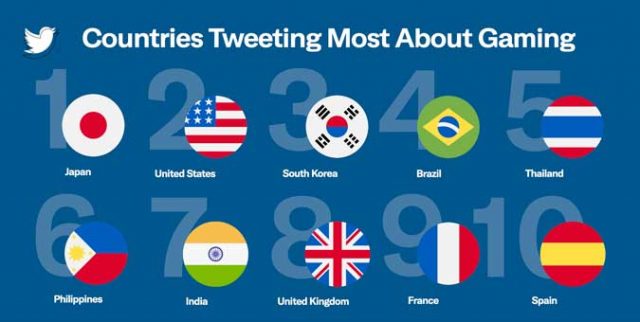
In recent data released by Twitter Gaming Insights, the Philippines ranks sixth among countries that have Tweeted about gaming most often this year so far.

It is an improvement from the ninth spot it was at in 2020.

As per the data shared, the Philippines is bested only by Japan, United States, South Korea, Brazil and Thailand in countries that Tweeted most about gaming in the first of the year.

India, United Kingdom, France and Spain ranked seventh to 10th, in that order.

Mainstay games remain in the hearts and discussion of Filipinos, Twitter said, but Filipino gamers also showed their support for their favorite teams and players.

Most Tweeted about games in the Philippines in the first half of 2021 are Genshin Impact, Valorant, Roblox, Minecraft and Among Us.

Genshin Impact is an action role-playing game developed and published by miHoYo and released in 2020. The game features an open-world environment and action-based battle system using elemental and character-switching.

“The game (Genshin Impact) was well received by the Pinoy gaming society due to its easy to play and open-world environment. What made it more fun was the wish system where you have a chance to get characters that would help you with the challenges in-game,” said Pio Garcia, local gamer and former esports PR manager, in an interview with BusinessWorld.

“I think another factor that helped its popularity was that not only are the characters visualized very well in its JRPG (Japan role playing game) style, but also because of the immersive storyline it is set in and the overall world design… There is also the co-op mode where you can play with friends to be able to clear high-level dungeons and earn more rewards. Great art, cool world exploration, not much of a hit on the wallet, it’s definitely one of the games to relax with,” he added.

Twitter data also show DotA 2 team T1 is the most Tweeted about esports team in the Philippines, followed by Sentinels, OG, Team Secret and Cloud9.

Mr. Garcia shared that it is not at all surprising, considering the Philippine connection in T1.

“T1 received quite the Pinoy Pride boost as the DotA 2 team formerly known as SK Telecom 1 has employed the services of Carlo Palad and Karl Baldovino, who are more popularly known as KuKu and Karl, respectively. KuKu currently serves as T1’s captain and has helped the team earn a gold finish in this year’s ESL ONE Summer 2021 major. With no TNC and Mineski in the field, KuKu and Karl are carrying the flag high and mighty in what we can consider, the granddaddy of all esports in the country,” he said.

Twitter noted how the steady resiliency of the esports industry has served it well amid the pandemic with online play and plenty of leagues ramping up since the beginning of 2021. It is a situation it sees being maintained for the rest of the year. — Michael Angelo S. Murillo

Substitutes spare Italy’s blushes in 2-1 win over Austria

LONDON — Italy survived a huge scare as they scrambled past outsiders Austria into the quarter-finals of Euro 2020 with substitutes Federico Chiesa and Matteo Pessina scoring extra-time goals to earn them a 2-1 win at Wembley on Saturday.

The Azzurri were the standout team during a perfect group phase but Roberto Mancini’s side misfired badly as they left their Roman fortress for the first time in the tournament and looked in danger of a shock exit.

In the end, the old adage that good teams find a way even when below their best was apt as Italy extended their unbeaten run to a national record of 31 games, setting up a quarterfinal clash against Belgium or Portugal.

Austria, playing in the knockout phase at the Euros for the first time, rocked the Italians in the second half and Marco Arnautovic headed past Gianluigi Donnarumma but his joy was cut short when a VAR check for offside saved Italy.

Mancini reacted by sending on four attacking substitutes late in the second half and Italy’s depth proved decisive in the end as Juventus winger Chiesa and Atalanta midfielder Pessina got them out of jail with quality finishes.

Chiesa drove an angled shot past Daniel Bachmann in the 95th minute after showing great control to bring down a pass by Leonardo Spinazzola. Pessina, who also scored against Wales, gave Italy breathing space 10 minutes later with a clinical left-foot strike.

But a courageous Austria were not done.

Substitute Sasa Kalajdzic scored with a stooping header with six minutes left and Italy’s nerves were well and truly frazzled by the time the final whistle sounded.

Mancini has used all but one of his 26-man squad in guiding Italy to the quarterfinals — the stage they reached in 2016 only to lose to Germany on penalties.

Having players like Chiesa and Pessina in reserve when Plan A is not working will fuel belief that Italy, despite Saturday’s stutter, can claim the title for the first time since 1968.

“We knew we had to suffer because Austria are the typical side who do not allow you to play well,” Mancini said.

“The substitutes made the difference for us, but everybody gave their best tonight. I’m happy because the lads gave everything to win even when we were tired.”

SLICK START
The Azzurri had swaggered their way through their group games in Rome, scoring seven unanswered goals, and Mancini’s side began in slick fashion on a perfect night for football.

With powerhouse wing back Spinazzola marauding at will down the left flank, Austria manager Franco Foda’s pre-match assertion that his side had a 10% chance of stopping the Azzurri machine looked about right.

Spinazzola lashed one shot wide before cutting a dangerous ball back for Nicolo Barella whose sweet strike was saved by the outstretched foot of Bachmann.

Ciro Immobile, back after being rested along with the rest of Mancini’s first-choice attack for the final group game against Wales, then sent a dipping right-foot effort thudding against the post from 25 meters.

But it was not all one-way traffic as Austria exploited space in behind Italy’s defense and on one such occasion, Arnautovic blazed a shot over the crossbar.

Foda would have been the more satisfied manager at half time and, as his side’s confidence grew after the break, Italy’s strangely oozed away as their fans went quiet.

Austria skipper David Alaba curled a free kick just over the bar and it all began to get a little fraught for Italy when Xaver Schlager and Arnautovic both went close.

Arnautovic then thought he had broken the deadlock with a close-range header from a tight angle in the 65th minute but a VAR check ruled he had been fractionally offside.

Mancini looked stone-faced in the technical area and acted immediately, hauling off the disappointing Marco Verratti and Barella, replacing them with Manuel Locatelli and Pessina.

Next, he threw on Chiesa and Andrea Belotti as extra time loomed. The changes eventually paid off to crack the Austrian resistance and get the job done, but only just.

“It’s hard for me to find the words,” Arnautovic said. “If luck goes our way, we win the game in 90 minutes.” — Reuters

Djokovic looking to peak at Grand Slams with eye on 20th at Wimbledon

LONDON — Novak Djokovic arrives at Wimbledon looking to join Roger Federer and Rafa Nadal on 20 Grand Slam titles and the world number one said he has changed his calendar to ensure his focus is on peaking at the majors at this stage of his career.

Djokovic has participated mainly in Grand Slams and Masters tournaments this year — winning both the Australian Open and French Open — and the 34-year-old said he was fortunate to play his best tennis when it mattered the most.

“Grand Slams are the biggest motivation I have right now at this stage of my career… I want to try to make the most out of Grand Slams as I possibly can. I’m trying to peak at the majors,” Djokovic told reporters.

“Nowadays, I have to adjust my schedule a bit more with the quality time with family that means a lot to me, reducing the number of tournaments, trying to adjust everything so that I could be at my top level on slams.

“That’s how my last year and a half looked like, and that’s how probably the rest of my career will look like in terms of scheduling the tournaments.”

Djokovic said he did not have time to celebrate his Roland Garros triumph earlier this month as he was back on court four days later but he was looking forward to making it three titles in a row at Wimbledon after wins in 2018 and 2019.

Last year’s tournament was canceled due to the COVID-19 pandemic.

“I didn’t have too much time really to reflect on what has happened in Paris. That’s how it is, that’s the tennis season and tennis schedule, I turn the next page,” the five-time Wimbledon champion added.

“I’ve been on a run on these courts. I love being here, it has always been a dream tournament for me when I was a seven-year-old, dreaming to win the Wimbledon.”

Djokovic said he loved Wimbledon’s tradition where the defending champion kicks things off on the “virgin grass” at center court, but admitted he did not know too much about his first round opponent — British wildcard Jack Draper.

“I’ve seen him play a little bit in Queen’s where he beat (Jannik) Sinner. I actually practiced with Sinner yesterday so I asked him couple questions about Draper’s game,” he said of his 19-year-old opponent.

“I know he’s a lefty, I’ve seen him practice today a little bit. I have to do my homework… He’s a home player. I’m sure there’s going to be lot of support, a lot of people behind him.” — Reuters

Kemba Walker may be on the move again

AN NBA source is saying a Kemba Walker trade is “imminent,” following the four-time All-Star’s trade from Boston to Oklahoma City earlier this month, per a report from the New York Daily News.

It is unclear if “imminent” means right away or just that it’s inevitable. The latter would be less of a surprise for a Thunder team that went 22-50 in 2020-21 and is in full rebuild mode, but either way, per the report, Walker may not be in Oklahoma City long.

Walker, 31, was traded along with the 16th pick in this draft and a 2025 second-rounder to OKC for Al Horford, Moses Brown and a 2023 second-round pick on June 18.

The UConn product, who was drafted No. 9 overall by Charlotte in 2011, had an injury-plagued season in 2020-21, playing in just 43 games and averaging 19.3 points per game — his lowest scoring average since 2014-15. — Reuters

Isolation play

Albert Einstein is supposed to have once defined insanity as “doing the same thing over and over again and expecting a different result.” Noted quarters have disputed the origin of the phrase, to be sure, but there can be no doubting its veracity all the same. As arguably the most overused cliché in the history of the English language, it boasts of unfailing logic, even in sports. Yesterday, for instance, the Clippers prepped for isolation play after isolation play in the pivotal fourth quarter even though the misses kept coming. When the final buzzer sounded, they managed to make only three of their 20 field goal attempts in the payoff period — due in large measure to their utter lack of variety on offense.

It can be argued that the Clippers lost Game Four of the Western Conference Finals in the first half, when they could do no better than put up 36 points off woeful shooting. And, since yesterday’s proved to be a typical playoff set-to, with loose officiating and players allowed to bump and hold, spotting the opposition 14 points through 24 minutes was akin to Sisyphus rolling a boulder up the mountain with weights on his ankles. They did make a spirited run in the penultimate quarter, but it wound up being an outlier because, well, they wound up reverting to the same old, same old. There’s a reason they finished with only 13 assists all told, and it isn’t because of a willingness to keep moving the ball until an ideal shot is found.

Once again, the Clippers are showing they’re too snakebitten to escape their past. They lost Kawhi Leonard, their (and the National Basketball Association’s) best player by far; before a knee injury downed him in Game Four of the Conference Semifinals, he had been norming 30 points off a remarkable 57% shooting from the field. Then again, it’s fair to argue that they still have enough talent to hurdles the obstacles before them. It’s why they overcame the top-seeded Jazz, and why they should be giving the Suns fits. Instead, they’re facing extremely confident competition capable of winning any which way.

There remains time, of course, for the Clippers to claw back in, and ultimately claim, the series. They need only look to the Cavaliers in 2016 to keep their chins up. And for all their frailties, they have more than enough to upend the Suns. To do so, however, they first need to convince themselves they can — an iffy proposition at best with how things are going. The good news: they have head coach Tyronn Lue on their side. The bad news: Paul George is not LeBron James. Which is to say they have their work cut out for them.


Anthony L. Cuaycong has been writing Courtside since BusinessWorld introduced a Sports section in 1994. He is a consultant on strategic planning, operations and Human Resources management, corporate communications, and business development.

Former president Benigno Aquino laid to rest

Former President Benigno S.C. Aquino III died due to renal failure as a result of diabetes on Thursday. Photo by Michael Varcas, The Philippine Star

Former President Benigno S.C. Aquino III on Saturday was laid to rest at the Manila Memorial Park, next to his parents former President Corazon C. Aquino and former Senator Benigno S. Aquino Jr.

Full military honors were given as the urn carrying Mr. Aquino’s ashes arrived at the cemetery in Parañaque City. The urn was placed on a funeral carriage filled with yellow flowers as it was brought to the gravesite.

Mr. Aquino’s youngest sister Kris placed the urn inside the white tomb.
Due to restrictions on mass gatherings, the funeral of the Philippines’ 15th president was attended only by family members, close friends and a few supporters.

However, hundreds of Filipinos — many wearing yellow and waving yellow ribbons — lined the streets as the funeral convoy passed en route to the cemetery.

Earlier on Saturday, a funeral mass was held at the Church of the Gesu at Mr. Aquino’s alma mater Ateneo de Manila University in Quezon City.

In his homily, Lingayen-Dagupan Archbishop Socrates Villegas described Mr. Aquino as a “brave, headstrong visionary.”

“The best eulogy tribute that we can pay to our President Noy is to bring back, recover, preserve, safeguard, and never again to compromise our dignity as a people and the decency of our leaders as servants, not bosses,” he said.

“Maybe, and I do hope, his death will spark another fire within us to resurrect his example of decency and integrity. The sincerest form of tribute to dear President Noy is to relive his life lessons of decency and ethical leadership, recover honor and dignity in our public and private lives among us private citizens and our leaders. His mortal remains are now ashes, but his integrity and decency must resurrect through us and in the leaders we choose.”

Mr. Aquino, 61, was president of the Philippines from 2010 to 2016. He died peacefully in his sleep on Thursday due to renal failure as a result of diabetes. He is survived by his four sisters. – Cathy Rose A. Garcia

Philippines added to FATF grey list anew

REUTERS

The Philippines has been included in a global dirty money watchdog’s “grey list” of countries that will be subjected to increased monitoring to prove its progress against money-laundering and terrorist financing.

The Financial Action Task Force (FATF) on Friday released its
grey list or jurisdictions that will be under increased monitoring and actively working to “address strategic deficiencies in their regimes to counter money laundering, terrorist financing, and proliferation financing.”

In addition to the Philippines, the FATF added Haiti, Malta, and South Sudan to the grey list.

This comes 16 years after the Philippines was removed from the FATF’s blacklist in February 2005. The Philippines was previously included in the FATF’s blacklist in 2000.

“When the FATF places a jurisdiction under increased monitoring, it means the country has committed to resolve swiftly the identified strategic deficiencies within agreed timeframes and is subject to increased monitoring,” the FATF said.

With its inclusion in the grey list, the Philippines now needs to submit progress reports to the FATF thrice a year.

“Given the recent identification of the Philippines as ‘Jurisdiction under Increased Monitoring’ with serious anti-money laundering/counter-terrorism financing (AML/CTF) deficiencies, the relevant government and law enforcement agencies’ sustained pledge to implement the 18 action plans within the prescribed timelines will be essential to the country’s removal from such list,” the Anti-Money Laundering Council (AMLC) said in a statement released on Saturday morning.

The AMLC emphasized that the Philippines will not yet be subjected to countermeasures.
“It is only when the country fails to meet the deadlines will the FATF call on countries to impose countermeasures against the Philippines. Hence, all government agencies involved should deliver expected outputs on the action plans pertaining to them,” the AMLC said.

The FATF said the Philippines needs to implement its action plan to demonstrate the effectivity of the risk-based supervision of covered non-financial businesses and professions.

To recall, Republic Act 11521 which tightened the country’s Anti-Money Laundering Law was legislated into law by Jan. 29, only days ahead of the Feb. 1 deadline set by the FATF for the country to show tangible progress that it has imposed tighter AML/CTF. The law included new covered persons such as real estate brokers and developers following earlier findings that some dirty money proceeds went into the industry.

The FATF will also be monitoring local authorities’ use of AML/CTF controls to mitigate risks associated with casino junkets or travels granted to prominent players; implementation of new registration requirements for money service businesses, including imposing sanctions for unregistered and illegal remittance operators.

The dirty money watchdog will also assess the streamlining of beneficial ownership information by various law enforcement agencies and ensuring information accuracy, and the increase in the use of financial intelligence and heightened money laundering investigations and prosecutions.

AMLC will likewise monitor whether the Philippines will step up the identification, investigation, and prosecution of terrorism financing cases. They will also gauge the country’s monitoring of non-profit sector activities to ensure they operate within framework against terrorism and proliferation financing.

In July last year, Republic Act 11479 or the controversial Anti-Terror Act of 2020 was legislated to boost measures against terrorism and proliferation financing.

U.S. UFO report does not rule out extraterrestrial origin

A U.S. government report on UFOs issued on Friday said defense and intelligence analysts lack sufficient data to determine the nature of mysterious flying objects observed by American military pilots including whether they are advanced earthly technologies, atmospherics or of an extraterrestrial origin.

The unclassified nine-page report, released to Congress and the public, encompasses 144 observations – mostly from U.S. Navy personnel – of what the government officially calls “unidentified aerial phenomenon,” or UAP, dating back to 2004.

Labeled a preliminary assessment, it was compiled by the Office of the Director of National Intelligence in conjunction with a Navy-led task force created by the Pentagon last year.

“UAP clearly pose a safety of flight issue and may pose a challenge to U.S. national security,” the report stated, adding that the phenomena “probably lack a single explanation.”

The report marked a turning point for the U.S. government after the military spent decades deflecting, debunking and discrediting observations of unidentified flying objects and “flying saucers” dating back to the 1940s.

The report includes some UAP cases that previously came to light in the Pentagon’s release of video from naval aviators showing enigmatic aircraft off the U.S. East and West Coasts exhibiting speed and maneuverability exceeding known aviation technologies and lacking any visible means of propulsion or flight-control surfaces.

All but one of the listed sightings – an instance attributed to a large, deflating balloon – remain unexplained, subject to further analysis, the report said. For the other 143 cases, the report found that too little data exists to conclude whether they represent some exotic aerial system developed either by a U.S. government or commercial entity, or by a foreign power such as China or Russia.

In some observations, UAP appeared to exhibit “unusual patterns or flight characteristics,” but those may stem from sensor glitches or witness misperceptions and “require additional rigorous analysis,” the report said.

Analysts have yet to rule out an extraterrestrial origin, senior U.S. officials told reporters, speaking on condition of anonymity. The report’s language avoided explicit mentions of such possibilities.

Asked about potential alien explanations, one of the officials said: “That’s not the purpose of the task force, to evaluate any sort of search for extraterrestrial life. … That’s not what we were charged with doing.”

“Of the 144 reports we are dealing with here, we have no clear indications that there is any non-terrestrial explanation for them – but we will go wherever the data takes us,” the senior official added.


NEAR MISSES

The study documented 11 UAP near-misses reported by pilots and a small number of cases in which military aircraft “processed radio frequency energy associated with UAP sightings.” Most reports also described objects that interrupted training or other U.S. military exercises, it stated.

The task force focused on phenomena witnessed first-hand by military aviators, with 80 reports involving detection by multiple sensors, the report said. Most were from the past few years.

The report established five potential explanatory categories: airborne clutter, natural atmospheric phenomena, U.S. government or American industry developmental programs, foreign adversary systems and a catch-all “other” category.

The senior official said the findings did not provide any “clear indications” that the UAP are part of a foreign intelligence-collection program or a major technological advancement by a potential adversary.

The government in recent years has adopted UAP as its term for what commonly are known as “unidentified flying objects,” or UFOs, long associated with the notion of alien spacecraft.

U.S. Senator Marco Rubio was instrumental in commissioning the report, ordered by Congress six months ago as part of broader intelligence legislation.

“For years, the men and women we trust to defend our country reported encounters with unidentified aircraft that had superior capabilities, and for years their concerns were often ignored and ridiculed,” Rubio said. “This report is an important first step in cataloging these incidents, but it is just a first step.”

After the report’s release, the Pentagon announced plans to “formalize” its UAP investigation mission currently handled by the task force.

Mick West, a UFO skeptic and researcher, said the “report points largely at boring explanations, even including birds and balloons, and identified some areas where we need to improve our data gathering.”

It is not the first official U.S. report on UFOs. The U.S. Air Force conducted a previous investigation called Project Blue Book, ended in 1969, that compiled a list of 12,618 sightings, 701 of which involved objects that officially remained “unidentified.”

In 1994, the Air Force said it completed a study to locate records relating to the 1947 “Roswell incident” in New Mexico. It said materials recovered near Roswell were consistent with a crashed balloon, the military’s long-standing explanation, and that no records indicated that there had been the recovery of alien bodies or extraterrestrial materials. – Reuters


El Salvador offers $30 of Bitcoin to citizens

El Salvador President Nayib Bukele doubled down on the country’s new law making Bitcoin legal tender and offered $30 worth of the cryptocurrency to any citizen who signs up for a digital wallet.

The government will create its own Bitcoin wallet called Chivo, which is slang for “cool” in El Salvador, Bukele said during a national address on Thursday night. The funds will be deposited into the account of any citizen who downloads it and registers as a user with their phone number and ID number, he said.

The law making Bitcoin legal tender will enter into force on Sept. 7, he said.
Bukele, 39, reiterated his arguments that using the cryptocurrency will help attract investment, boost consumption and cut the cost of sending remittances for millions of Salvadorans working abroad. But bank accounts in dollars will remain in dollars, and salaries and pensions will continue to be paid in dollars, he said.

“Why create this law? Because Bitcoin has a $600 billion market capitalization globally and if we do this, investors and tourists who own Bitcoin will come to the country and benefit Salvadorans and the economy,” Bukele said.

Consumers can pay businesses with Bitcoins from their wallets for items listed in dollars. But if business owners want to receive payment in dollars, they can press a button in the Chivo application to convert the Bitcoins immediately to dollars, according to Bukele. “It will be totally optional. The dollar will continue to be legal tender,” he said.

The Chivo wallet will be available to download in September and it will be compatible with other Bitcoin wallets, Bukele said.

The government will provide training for businesses on Bitcoin transactions and seek to improve Internet and mobile phone penetration to encourage the cryptocurrency’s use, he said. Businesses that are technologically unable to receive e-payments will be excluded from the law, he added.


RISK POTENTIAL

Not everyone shares Bukele’s enthusiasm for the plan. Fitch Ratings said in a report Thursday that the legislation establishing Bitcoin as legal tender would increase regulatory risks for financial institutions, including the potential of violating international anti-money laundering and terrorist financing standards.

The shipment of AstraZeneca vaccines arrived from India as El Salvador reports over 58,023 infections and 1,758 deaths.

“A rushed implementation of the new alternative payment system platform will affect financial institutions’ management framework for operational, cyber/ransomware, currency and liquidity risks,” Fitch analysts including Rolando Martinez wrote.
The International Monetary Fund has also criticized the move, while the World Bank rejected a request from the government to assist with Bitcoin implementation.

Bitcoin weakened 4.4% to $33,338 at 10:11 a.m. in New York, according to data compiled by Bloomberg. – Bloomberg

Global dirty money watchdog adds Philippines, Malta to ‘grey list’

PARIS – A global dirty money watchdog said on Friday it had added Haiti, the Philippines, Malta and South Sudan to its “grey list” of countries under increased monitoring, and kept Pakistan on the list despite progress on tackling terrorism financing.

The Financial Action Task Force (FATF) also said Ghana had been removed after the country had made progress.

The Maltese government had already flagged its inclusion on the list, which indicates deficiencies but has no legal repercussions, in a move that Prime Minister Robert Abela called “unjust”.

FATF made its move after years of international criticism of Maltese policymaking, including the sale of national passports, as well as a lack of legal action against government officials who were mentioned in the Panama Papers as having set up secret offshore companies.

“There remains serious weaknesses and areas of work that Malta must address,” FATF president Marcus Pleyer told a news conference. “It is crucial for Malta to make sure that there are systems in place that are strong enough to prevent money laundering and terrorism financing.”

Pleyer said that Pakistan remained under increased monitoring despite substantial progress addressing everything on a 2018 action plan except a last item concerning the investigation and prosecution of senior leaders and commanders of U.N.-designated terrorist groups.

He added that Pakistan was still failing to put global anti-money-laundering standards into place.

“This means the risks of money laundering remain high, which can in turn fuel corruption and organised crime”. – Reuters

Duterte has not had 2nd jab – spokesman

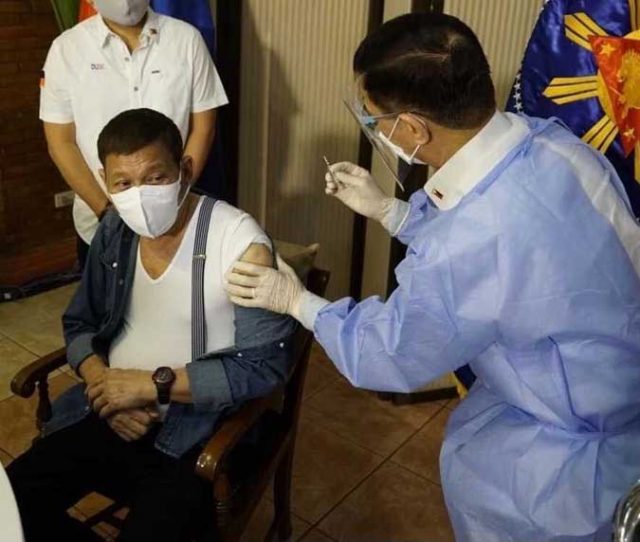
Health Secretary Francisco Duque III administers President Rodrigo Duterte’s first shot of Sinopharm vaccine in this photo taken on May 3. -- Photo credit: Philippine Star c/o Sen. Bong Go Facebook page

President Rodrigo R. Duterte is yet to be fully vaccinated, his spokesman clarified on Friday night, after it had been earlier announced that the president had received his second jab against COVID-19.

Palace spokesman Herminio L. Roque, Jr. issued the clarification hours after he had said that Presidential Security Group (PSG) commander Brig. Gen. Jesus P. Durante III was correct when he told the state-run People’s Television Network that Mr. Duterte had already received his second dose of the COVID-19 vaccine made by Sinopharm Group Co., Ltd..

Mr. Durante “was mistakenly informed by his medical staff that a second dose was already administered to the President,” Mr. Roque said in a statement. Mr. Dureza has apologized for his pronouncement, he added.

Earlier in the day, Mr. Durante said the President had been inoculated with the second dose of the Sinopharm vaccine two weeks after he got his first shot on May 3.

Mr. Roque initially concurred with Mr. Durante’s claim, saying he “has personal knowledge of the second shot.”

Authorities had earlier said that the first dose received by the 76-year-old President on May 3 came from a batch of 1,000 doses of the Sinopharm vaccine that Beijing had donated to the Philippines. At that time, the donated Sinopharm vaccines had not yet been allowed for emergency use in the country. After a public outcry over his vaccination with an unauthorized vaccine, Mr. Duterte said he was giving the unused shots back to China.

The World Health Organization recommends an interval of three to four weeks between the first and second dose.

The Food and Drug Administration (FDA) cleared the Sinopharm vaccine for emergency use on June 7, weeks after the President received his first dose.

The use of Sinopharm has been controversial since last year when the president announced that the PSG had been vaccinated with smuggled Sinopharm vaccine. The FDA has been trying to investigate the smuggling, but has faced a “blank wall.” — Kyle Aristophere Atienza

ADVERTISEMENT
ADVERTISEMENT