Home Blog Page 7763

Independent directors: How can they create value?

THE Management Association of the Philippine sponsored a webinar on “Governance Champions: How Can Independent Directors Create Value?” It was my privilege to be a panelist together with Fred Pascual, lead independent director of SM Investments Corp., Atty. Nenet Lavares, independent director of Metrobank, and IFC’s Roman Zyla, ably moderated by ICD Trustee JJ Moreno.

My journey as a board director started when I joined government service as Undersecretary of Finance. Coming from Citibank, I was alternate director of then Finance Secretary Jose Pardo in the boards of LANDBANK, PDIC and the BSP Monetary Board. It was in BSP that I became “fully” aware of the board member’s role when Institute of Corporate Directors (ICD) Jess Estanislao and ADB’s Arvind Mathur presented about corporate governance and the board members’ responsibilities. I realized that a board member cannot just be a “wallpaper” or a plant box in the room, but rather should be active and ask questions especially on critical issues, given the heavy responsibilities involved. A director’s loyalty is to the company and should always act according to the company’s best interest to enhance shareholder value.

I joined as a PNB director in 2001 as a government nominee, and, five years later was approved by the BSP as an independent director (ID), meaning I am independent of management, free from any business or other relationships, and not part of the day-to-day management of PNB. I was an independent director/ chairman for the next 15 years and I stepped down in April this year, with the BSP nine-year term limit for IDs counting from 2012.

Independent directors are critical in boards and play an important role, especially in banks, where IDs chair the Risk, Audit and Compliance, Corporate Governance and Related Party committees. Independent directors with their detached judgment, outside experience and objective view are expected to improve corporate credibility and governance standards.

What are tips for IDs? Here’s a few:

A. Know your role, which is mainly to be involved in the policies and general direction of the company and to leave the day-to-day operations to management.

B. Prepare and know the agenda and topics to be discussed. Ask questions to clarify issues. It is very important to have good knowledge of the company’s operations to make decisions on Board issues.

Provide time and energy. No matter how competent, if you have no time or don’t speak up, you will not be effective. Very critical in banks as IDs are working directors with committees they chair and members of.

C. Continuous learning and improvement — “reskill, upskill.” Know latest developments and trends. There are webinars going on and many are even free.

Network. Hold memberships in associations. FINEX, MAP, BAIPHIL, PCCI, and if you’re a woman, FCC, Business Women, Women in Finance, etc.

D. Be an advocate or a champion for ESG (Environment, Sustainability, Governance). For example, to make a mark in corporate governance, what better way for publicly listed companies to show this than through the ASEAN Scorecard? Happy that PNB was recognized with three Golden Arrow Awards in the 2019 ASEAN Scorecard.

Can one ID create value? It’s very challenging. This was a topic among the panelists. An ID can initiate the idea and follow through, but still you need the support of the rest of the board and of course the  management to implement. Communication is important to have everyone on same page for the value you’re trying to create and teamwork is key.

Indeed, the ID’s role is critical in this volatile, uncertain, complex and ambiguous “new normal” world, especially for an ID without any agenda other than the company’s interest and who wants to make a difference!

On another note, Weedibles Weedicinals Plus Edible Flowers and More, a book collaboration between the Agricultural Training Institute (ATI) and Flor’s Garden, was recently launched with Agriculture Secretary William Dar, former Health Secretary Jaime Galvez Tan, ATI Director Alfredo Aton, Deputy Director Ana Mula, ATI 4A Director Pia Cosico, Doc Olan Maningas and Planters Products’ President Mat Maderazo, among others. The book aims to help familiarize everyone with weeds that are useful, edible and have health benefits. Copies may be requested from ATI’s QC information office and the e-book is available on the ATI 4A website.

(The views expressed herein do not necessarily reflect the opinion of these institutions.)


Flor G. Tarriela was the first chairwoman of the Philippine National Bank. She was the first and only independent director chairwoman in the commercial banking industry. She is a former Undersecretary of Finance and the first Filipina vice-president of Citibank N.A.  She is a trustee of FINEX and an Institute of Corporate Directors fellow. A gardener and an environmentalist, she established Flor’s Garden in Antipolo, an ATI Accredited National Extension Service Provider and a DoT Accredited Agri Tourism Site.


Entertainment News (07/23/21)

BTS, YouTube launch dance challenge

Pop icons BTS and YouTube have officially announced the “Permission to Dance Challenge” starting today through Aug. 14, exclusively on YouTube Shorts. This is the first-ever worldwide dance challenge on YouTube Shorts, following its global expansion. Anyone from across the globe can create a 15-second YouTube Short right from the YouTube mobile app, replicating the core dance moves from the music video of BTS’ new track, “Permission to Dance.” As part of the challenge, BTS will be spotlighting some of their favorite Shorts in a compilation video, so participants should use the hashtags #PermissiontoDance and #Shorts for their creations to be considered.

Docu looks at child labor during the pandemic

On July 25, Atom Araullo gets to know the working children of the pandemic on The Atom Araullo Specials: Munting Bisig. He tries out compressor diving in Paracale, Camarines Norte with 15-year-old “Pancho”, the youngest compressor diver in their barangay. As the pandemic spread throughout the country, many children just like “Pancho” opted to use their time to find work and earn a few pesos to help their family survive. In Cordillera, Araullo discovers why the province has the lowest cases of child labor in the country. In Pasay City, Araullo meets Joshua, a bread winner of his family at the age of 12. Joshua is part of the “lockdown generation” as he finds himself “stranded” in Metro Manila while his ailing father is left behind in Cavite. Joshua sells snacks to his neighbors so that he can bring home earnings to his family. In June 2021, the International Labour Organization released new findings that after a two-decade decline, child labor cases have once again risen all over the world.  Atom tries to find out if this is true here in the Philippines. Watch The Atom Araullo Specials: Munting Bisig on July 25, 2 p.m., on GMA Network. Viewers abroad can catch it via GMA Pinoy TV.

SB19 releases EP, Pagsibol 

Filipino boy band SB19 has released its six-track EP Pagsibol (germination), a metaphorical reference to the band’s journey in the music industry. “In that context, we want our EP to symbolize our beginnings, origins, or simply our roots,” SB19 said in a statement. The EP contains the empowering song “What?,” an inspiration ballad “MAPA,” a new version of its early ballad “Ikako,” electro-pop and R&B track “Mana,” reggaeton and hip-hop song “Bazinga,” and pop track “SLMT.” Pagsibol is out now on Spotify via Sony Music. The boyband will be performing the songs off the EP for the first time live in an online concert, Back In The Zone, on Aug. 1, 7:30 p.m. Tickets are available at https://www.ktx.ph/events/31606/sb19-back-in-the-zone

Legal Wives on GMA

GMA Network’s new romance drama Legal Wives premieres on July 26. Directed by Zig Dulay, the show follows a member of Maranao Muslim royalty Ismael Makadatu (played by Dennis Trillo) and his relationship with his three wives (played by Alice Dixson, Bianca Umali, and Andrea Torres).

Hometown Cha-Cha-Cha on Netflix

The new romance series Hometown Cha-Cha-Cha depicts the lives and romantic stories of two residents in a seaside village: Yoon Hye-jin who opens up a dental clinic, and Hong Du-sik who is technically unemployed but takes on odd jobs and helps everyone in the village. Directed by Yu Je-won and written by Shin Ha-eun, the show stars Shin Min-a and Kim Seon-ho. Hometown Cha-Cha-Cha premieres worldwide on Aug. 28 on Netflix.

AC Health breaks ground for specialty cancer hospital

AC Health, the healthcare unit of Ayala Corp., broke ground for the country’s first specialty cancer hospital on Thursday.

“With cancer persisting as a critical public health problem with its tremendous impact on patients, the families, and the healthcare system at large, there is an urgent need to develop sustainable solutions” Fernando Zobel de Ayala, board chairman of AC Health, said in his opening remarks.

Located at the FTI Complex in Taguig City, the Healthway Cancer Care Center is aimed to be completed by July 2023. The 100-bed facility will offer its patients services such as screening, diagnosis, and treatment to post-cancer care.

AC Health said it partnered with Cancer Treatment Services International, Inc., which is an oncology services provider under Varian Medical Systems, Inc., to ensure affordable quality cancer care.

Republic Act No. 11215 or the National Integrated Cancer Control Act (NICCA) allows the private sector to create cancer specialty hospitals and clinics.

“Now more than ever, there is a need to provide better avenues for cancer patients to seek consultation and treatment. We are delighted that AC Health will be establishing the first specialized hospital for cancer in the Philippines,” Department of Health Secretary Francisco T. Duque III said.

The Healthway Cancer Care center will be part of AC Health’s healthcare portfolio, which includes: Healthway Clinics, Qualimed Hospitals, Generika Drugstores, IE Medica and MedEthix, and the HealthNow mobile app.

Parent firm Ayala Corp. and AC Health also donated over 1,000 doses of a flu vaccine to Taguig City during the groundbreaking ceremony. Taguig City Mayor Lino Edgardo S. Cayetano said these will be used to vaccinate members of the Philippine National Police, Traffic Management Office, barangay health workers, members of the Bureau of Fire Protection, and other city frontliners.

“The Ayala Group is delighted to support the City of Taguig in its efforts to protect the health of its constituents,” AC Health President and Chief Executive Officer Paolo Maximo F. Borromeo said.

AC Health has also collaborated with Taguig City to vaccinate their constituents across the A1 to A5 priority groups against the coronavirus disease 2019 (COVID-19).

As of July 13, AC Health has administered over 193,000 COVID-19 jabs across local government units, the Ayala group, and its partner companies.

Meanwhile, shares of Ayala Corp. at the local bourse closed unchanged at P754 each on Thursday. — Keren Concepcion G. Valmonte

How to solve unequal worker pay

I’m 34 years old, a pioneer regular rank-and-file employee at a small enterprise established five years ago. Recently, my colleague, a 28-year-old man, passed his probationary employment and became regular as well. I felt disappointed when I learned we’re both being paid P650 a day for doing exactly the same job. Clearly, I’m senior and more experienced on the job. Isn’t unfair to receive the same rate as the new guy? — Brown Horse.

You and your colleagues are receiving the same amount of money for doing the same job. The truth of the matter is — you’re not being treated unfairly. Matthew 20:1-16 explains this in the parable of the workers in the vineyard. Perhaps you know this Bible story. The one who worked for only a few hours in the vineyard got the same pay compared to those who worked the whole day.

You can’t complain because we don’t have a law similar to the Equal Pay Act in other countries to ensure that workers who are performing equal tasks are paid uniformly while trying to avoid discrimination. But not in this country.

Technically, it’s about “pay equity,” as the issue is known among human resource (HR) professionals. The thing is — the HR department head and your boss have missed something. Managers worth their salt should be proactive enough to know all the possible things that could demotivate their people.

For one, your management should have made an attempt to give you higher pay in deference to your seniority and experience. If it cannot afford it, at least pay the new worker P537 per day, which is the mandated rate in the National Capital Region.

TWO CHALLENGES
So, what are your remedies? There’s no avoiding bringing the matter to the attention of your direct boss. Your boss should be the first to know of your predicament before you bring the matter to HR. Explore all the possibilities of how your boss could help you. It’s important to do it that way as there are managers who don’t want to be ignored or bypassed, even if they’re partly to blame for it.  

More importantly, both of you would have a unified and powerful voice in bringing the matter up with HR. Now, assuming your boss supports you in your case, then what are the possible responses HR may have for you?

One, absence of a formal salary structure. It’s the first thing that comes to mind in your case. If they had a pay structure, you would not be in this situation. A pay structure means having a system with job descriptions and their corresponding grade levels stated clearly alongside with the minimum, midpoint, and maximum pay for each level.

If that’s the case, then such a structure would have to be established first by HR doing a job analysis with the help of all department managers, among others. It requires writing the job descriptions, defining the standards for each job, listing down the qualifications of people to be hired, and other factors. Further, your management must decide on the number of job classifications according to the required professional level and technical skills required.

Second, absence of a formal performance management system. This means creating a method by which all workers are measured by their actual performance and not only by their physical presence in the office. Why is that important? To create, maintain, and improve competitive advantage in the industry. It ensures that everyone’s efforts are measured objectively and rewarded properly.

In addition, it is equally important to motivate people who are indispensable. You may have a clearly worded employment contract that spells out mutual expectations, but if there is no evaluation system, your problem will be repeated with other workers.

MANAGEMENT PREROGATIVE
These are difficult tasks for HR and other department managers. Imagine the time, effort, and expertise required. The development and creation of these basic and important policies need professional attention. HR needs a minimum of six months to one year, depending on the company’s headcount, job complexity, and other requirements to draft these policies.

To fast-track the creation of those policies, you will need an external consultant to do the job for you. This requires spending significant amounts as the consultant may have to do some investigation to determine whether salary rates are within industry standards.

 If I’m your management, I would increase your salary by an average of 2.5% a year representing an inflation adjustment for five years. It’s the prerogative of management, anyway. But first things first, your HR department must also investigate if there are other workers who are similarly situated so that the pay inequity is resolved in one sweep.

Note, however, that it’s also a management prerogative not to give any adjustment as your current pay is over and above the statutory requirements.


Have a consulting chat with Rey Elbo on Facebook, LinkedIn, or Twitter or you can send anonymous questions to elbonomics@gmail.com or via https://reyelbo.consulting

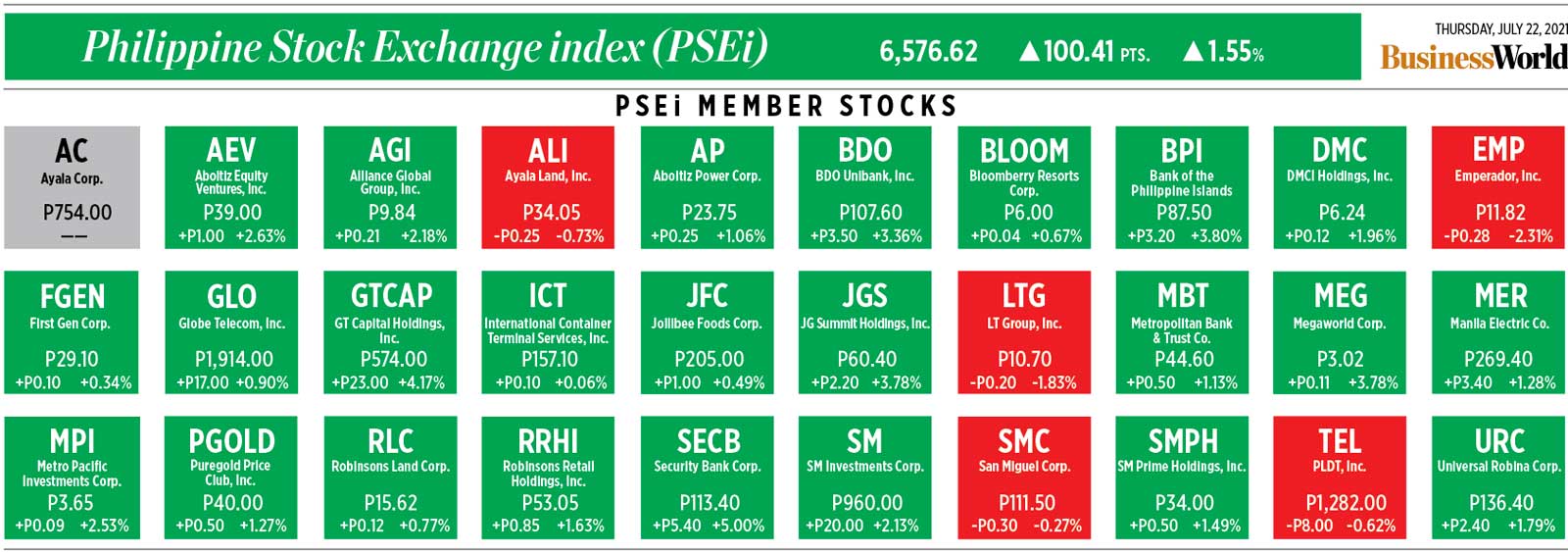
How PSEi member stocks performed — July 22, 2021

Here’s a quick glance at how PSEi stocks fared on Thursday, July 22, 2021.


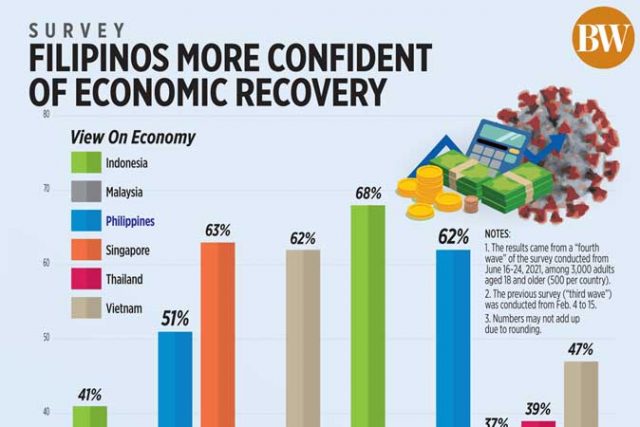
Filipinos more confident of economic recovery

Filipinos more confident of economic recovery

DoH reports more cases of coronavirus variants

PHILIPPINE STAR/ MICHAEL VARCAS

By Kyle Aristophere T. Atienza, Reporter

PHILIPPINE health authorities on Thursday reported 12 more cases of the more contagious Delta coronavirus variant that is ravaging several Southeast Asian countries, bringing the total to 47.

All patients have recovered, the Department of Health (DoH) said in a statement. Of the 12 cases, six were detected in Central Luzon, three in Metro Manila, two in Southern Tagalog, and one in the Bicol Region, it added.

Of the 47 Delta cases — said to be 60% more contagious than the Alpha variant — in the country, eight were active and 23 were local cases, it said.

DoH said enhanced response was needed in areas where the coronavirus variant was detected and in nearby local governments. Areas with infection spikes are assumed to be experiencing local transmission of the Delta variant, it added.

The Health department said 187 more people have been infected with the Alpha variant of the coronavirus, which was first detected in the United Kingdom, bringing the total to 1,668.

It also said 142 more people have been infected with the Beta variant that was first detected in South Africa, bringing the total to 1,827.

Twelve more people have acquired the Theta variant of the coronavirus, bringing the total to 233, it added.

There were 18 active cases of the Alpha variant, 17 cases of the Beta variant and a case of the Theta variant in the country. The Philippine Genome Center has sequenced 8,930 samples, it said.

DoH reported 5,828 coronavirus infections on Thursday, bringing the total to 1.53 million. The death toll rose to 26,891 after 17 more patients died, while recoveries increased by 3,257 to 1.45 million, it said in a bulletin.

There were 50,562 active cases, 92.7% of which were mild, 1.6% were asymptomatic, 2.5% were severe, 1.74% were moderate and 1.5% were critical.

DoH said 11 duplicates had been removed from the tally, eight of which were tagged as recoveries. Fifteen recoveries were reclassified as deaths. Five laboratories failed to submit data on July 20.

Meanwhile, a group of health experts flagged an increase in the coronavirus reproduction rate in Manila, the capital and nearby cities.

The reproduction rate in the National Capital Region increased by 0.24 to 1.15 from a week earlier, the OCTA Research Group from the University of the Philippines said in a report.

The average daily coronavirus infections in the region increased by 27% to 813 from July 15 to 21, it added.

“The trend in the reproduction rate over the past week shows a similar pattern with the trend from Feb. 13 to 19, when the reproduction number increased from 1.06 to 1.30,” it said. “That period signified the start of the surge in NCR (National Capital Region).”

OCTA said the government should enforce stricter quarantine rules, expand testing, contact tracing, and localized lockdowns.

The increase in coronavirus cases should not be underestimated because it may be driven by the Delta variant, Fredegusto P. David, an OCTA research fellow, said in a Facebook Messenger chat.

The National Government should place Metro Manila under a stricter lockdown or impose more restrictions to prevent a surge in cases, he said.

President Rodrigo R. Duterte this week said he might reimpose a stricter lockdown to curb the Indian coronavirus variant.

He said rising cases of the variant were a cause for alarm, adding that stricter quarantines would prevent its spread.

Metro Manila mayors have been urging the country’s pandemic task force to recall a decision allowing children as young as five years to go outdoors.

Anthony C. Leachon, a former pandemic official, earlier said local transmission of the Delta variant might have been underreported in the absence of genome surveillance studies particularly in hotspots outside the National Capital Region.

Philippine Genome Center Executive Director Cynthia P. Saloma had said the agency could only sequence 750 samples weekly.

Ms. Vergeire earlier said the agency could test 1,500 samples weekly once it gets more machines. The center would extend its capacity to its networks in the Visayas and Mindanao, she said.

China not exploring for oil in South China Sea, says Malacañang

PHILSTAR

THE PRESIDENTIAL PALACE on Thursday dismissed reports that China was conducting oil exploration in Philippine-claimed areas in the South China Sea.

“We’re confident that there’s no exploration happening at Scarborough Shoal,” presidential spokesman Herminio L. Roque, Jr. told a televised news briefing in mixed English and Filipino.

The government would only seek an explanation from China once the country’s maritime security forces, who have been patrolling the area, confirm the report, he added.

Filipino fishermen from Infanta, Pangasinan in northern Philippines supposedly found an oil exploration device at sea within the country’s exclusive economic zone. The equipment bore Chinese characters, they said.

The ocean bottom seismometer found by local fishermen is widely used for oil exploration and detecting earthquakes, the People’s Development Institute earlier said.

The group said the device could have been washed away from the resource-rich Scarborough Shoal, which the Philippines calls Panatag.

The Philippine Coast Guard on Monday said it had driven away a Chinese warship in the South China Sea, in another sign of tension between the two nations.

The Coast Guard had sent a verbal challenge to a Chinese warship spotted at Marie Louise Bank, it said, citing a July 13 report. The Chinese vessel eventually moved away from the area.

The foreign vessel sent a radio message identifying itself as “Chinese Navy Warship 189” and asked the Philippine ship tailing it to keep distance, the Coast Guard said.

The two nations’ vessels have been locked in a standoff in the South China Sea for months after hundreds of Chinese ships swarmed the disputed territory earlier this year.

The Philippines has repeatedly protested the ships’ presence and has been backed by the US, while Beijing has said its actions were normal and legitimate.

The Philippines under the late President Benigno S.C. Aquino III sued China before the arbitration court in the Hague given its island-building and military activities in the South China Sea. The court in 2016 favored the Philippines in a decision that China has ignored.

President Rodrigo R. Duterte, who has sought closer trade and investment ties with China since he became President in 2016, in March belittled the legal victory, saying it was just a piece of paper that could end up in a trash bin.

“I pursued it but nothing happened,” he said in a televised speech in Filipino on May 5. He added that between scalawags, one could always say that “it’s just a piece of paper and I would throw it in the waste basket.”

Philippine legislators have been urging Mr. Duterte to boost Philippine alliance with the US. The tough-talking leader had criticized the US for what he claimed was its ill treatment of its former colony.

Under Mr. Aquino’s watch, the Philippines signed an enhanced defense cooperation pact with the US, the country’s key western ally.

Mr. Duterte had not decided whether to keep a visiting forces agreement with the US, his spokesman earlier said.

The President in February last year said he would end the deal on the deployment of troops for war games after the US Embassy canceled the visa of his ally Senator Ronald M. de la Rosa, his former police chief who led his deadly war on drugs.

US-based geospatial imagery firm Simularity, Inc. has said Chinese ships could also be dumping human wastes in other parts of the South China Sea claimed by the Philippines. — Kyle Aristophere T. Atienza

Recovery from coronavirus impact is top of mind for Mindanao 

BUSINESS leaders in Mindanao still see the overall infrastructure program as the biggest achievement of the Duterte government, along with investor interest in Mindanao that he fostered.   

By Maya M. Padillo, Correspondent  

THE POSSIBILITY of President Rodrigo R. Duterte taking a historic first ride on the Mindanao train, one of the big ticket projects he listed in his first State of the Nation Address (SONA), is slim.  

The 102-kilometer first segment of the railway project, which would pass through Mr. Duterte’s hometown Davao City, was approved as early as June 2017 by the National Economic and Development Authority’s Investment Coordination Committee. It was set for a two-year construction starting 2018. 

But finalizing the track’s alignment and settling right of way, particularly in Davao City being the most urbanized area in the route, have proven to be the biggest hurdle to what could have been the jewel of the Duterte administration in Mindanao.  

As things stand, the target completion of just the site acquisition for the China-funded project is on Dec. 2021, said Christense Denise Geonzon, public communications officer for the Mindanao Railway-Project Management Office, during a forum in late-March.  

But local business leaders are not making a big fuss over such showpiece.  

They still see the overall infrastructure program — with roads, irrigation systems, and renovated airports, among others — as the biggest achievement of the Duterte government, along with the investor interest in Mindanao that he fostered.   

“There is more optimism now among the people of Mindanao of greater things to come but temporarily halted by the pandemic,” Philippine Chamber of Commerce and Industry-Southeastern Mindanao Regional Governor Arturo M. Milan said. 

Vicente T. Lao, chairman of the Mindanao Business Council, said he wants to see continued infrastructure development and enhanced policies to attract more foreign investments in the south as the country slowly tries to recover from the coronavirus crisis.   

“I hope he will be able to convince the next president of the Philippines to maintain the momentum for growth in Mindanao. He was able to improve the share of Mindanao in terms of the benefits it’s receiving from the national government,” Mr. Lao said.  

In the last State of the Nation Address on July 26, Mr. Milan said he hopes to hear the President outline concrete plans on addressing the health crisis and reopening the economy.  

“For me, these are the two more pressing issues confronting us,” Mr. Milan said. 

“When I say COVID-19 (coronavirus disease 2019) and the re-opening of the economy, include financial assistance to those affected by the pandemic like ayuda (financial assistance) to micro, small, and medium enterprises, overseas Filipino workers, and those who lost their jobs,” he said. 

The youth, especially in restive parts of Mindanao where the pandemic’s disruption has further complicated efforts to address lingering peace and security issues, needs assurance and direction towards a better quality of life in the foreseeable future.  

Kier S. Aventurado, program coordinator for the European Union-funded Extremely Together-Philippines under the Kofi Annan Foundation that aims to prevent violent extremism, said economic recovery and education are key areas that the administration should focus on during its last year.  

“The State of the Nation Address is a major occasion where the President has the eyes and ears of the nation all to himself,” he said, “What I want is for the President to tell us how he will get us out of this economic crisis, and address the issues of unemployment and education, especially among the youth.” — with Marifi S. Jara 

Tourism dep’t reminds quarantine hotels: Returning families can share a room

@COASTGUARDPH

THE DEPARTMENT of Tourism (DoT) on Wednesday reminded hotels and resorts accredited as quarantine facilities that room sharing is allowed for travelers from the same household, especially families with minors and persons needing assistance.   

“We have received reports that some DoT-Accredited Accommodation Establishments operating as Quarantine Hotels have been implementing a one-room-one-person policy even for travelers coming from the same household,”  Tourism Secretary Bernadette Romulo-Puyat said in a statement. 

“While the Department is aware of the downturns that the pandemic brought to the tourism industry, particularly the accommodation sector, we would like to reiterate that all DoT-accredited establishments must strictly follow the guidelines released by the Department to avoid confusion among travelers who need to quarantine,” she said. 

The DoT guidelines, contained in Administrative Order No. 2021-004-A, were approved by the national task force managing the coronavirus response, Department of Health, and the Bureau of Quarantine.   

The rules require single occupancy for quarantine guests from different households, while room sharing is encouraged for those belonging to the same household and guests requiring a companion such as minors, persons with disability, or senior citizens.  

“We all share the same struggles but it is imperative that we implement the right policies to help our kababayans who want to return to the country,” the tourism chief said.

Peso up on stock market’s rebound, profit taking

BW FILE PHOTO

THE PESO appreciated versus the greenback on Thursday as local stocks rebounded and as players booked their gains.

The local unit closed at P50.135 per dollar yesterday, gaining 21.5 centavos from its P50.35 finish on Wednesday, data from the Bankers Association of the Philippines showed.

The peso opened Thursday’s session at P50.25 versus the dollar. Its weakest showing was at P50.32, while its intraday best was at P50.11 against the greenback.

Dollars traded declined to $948.95 million on Thursday from $1.007 billion on Wednesday.

The peso climbed as the stock market rebounded after days of decline, Rizal Commercial Banking Corp. Chief Economist Michael L. Ricafort said.

The Philippine Stock Exchange index gained 100.41 points or 1.55% to close at 6,576.62 on Thursday, while the all shares index went up by 43.94 points or 1.09% to finish at 4,074.94.

Meanwhile, a trader attributed the peso’s strength to “profit-taking by market participants from the recent strength of the greenback”.

For today, Mr. Ricafort gave a forecast range of P50 to P50.20 versus the dollar, while the trader expects the local unit to move within P50 to P50.30. — LWTN

PHL stocks climb as investors pick up bargains

COURTESY OF PHILIPPINE STOCK EXCHANGE, INC.

PHILIPPINE shares closed higher on Thursday as investors went bargain hunting after four days of decline, although trading remained lackluster on fears over the spread of the Delta variant of the coronavirus disease 2019 (COVID-19).

The Philippine Stock Exchange index (PSEi) gained 100.41 points or 1.55% to close at 6,576.62 on Thursday, while the all shares index went up by 43.94 points or 1.09% to finish at 4,074.94.

“With Asian markets on the upside after solid US company earnings, local market followed on bargain hunting after four straight days down,” Diversified Securities, Inc. Equity Trader Aniceto K. Pangan said in a text message.

MSCI’s broadest index of Asia-Pacific shares outside Japan followed Wall Street higher and rose 1% with broad gains from Sydney to Seoul and Hong Kong, Reuters reported. Japanese markets are closed until Monday.

“The index took a breather today after plunging from the 6,900 level to the 6,400 level in less than two weeks. However, the rebound was not backed by heavy volume, and foreigners remained net sellers for the 13th consecutive session,” AB Capital Securities, Inc. Junior Equity Analyst Lance U. Soledad said in a Viber message on Thursday.

“The lackluster trading despite the significant decline of the index suggests investors remain very cautious of the downside risks given the presence of the Delta variant,” Mr. Soledad said.

Value turnover declined to P3.69 billion with 1.4 billion issues traded on Thursday, from the P5.9 billion with 1.60 billion issues recorded on Wednesday.

Meanwhile, net foreign selling decreased to P338.64 million on Thursday from the P572.26 million seen on Wednesday.

The Health department yesterday reported 12 new local cases of the Delta variant of COVID-19, bringing total infections to 47. Six of the new cases are from Central Luzon, while Metro Manila recorded three cases of the Delta variant, Calabarzon reported two cases, and one case was logged in Bicol.

All 12 new cases are said to have recovered, but the status is still being validated by regional and local health offices.

There are currently eight active cases of the Delta variant in the country, half of which are in Cagayan de Oro. Authorities from Cagayan de Oro on Thursday said four of the five Delta variant cases there reported last week were traced to a birthday party.

All sectoral indices posted gains on Thursday. Financials climbed by 40.39 points or 2.9% to 1,433.38; holding firms improved by 124.05 points or 1.92% to 6,583.74; mining and oil went up by 146.30 points or 1.54% to close at 9,599.07; industrials rose by 107.46 points or 1.17% to 9,253.26; property added 21.27 points or 0.68% to end at 3,107; and services inched up by 7.43 points or 0.48% to 1,551.10.

Advancers beat decliners, 136 versus 56, while 52 names closed unchanged. — Keren Concepcion G. Valmonte with Reuters

ADVERTISEMENT
ADVERTISEMENT