Home Blog Page 774

Robin Hood returns to screens with new gen ‘origin story’ series

Robin Hood (2025)
Robin Hood (2025)

LONDON — New TV series Robin Hood explores the legendary outlaw’s origins with a personal take and previously unseen historical authenticity, the show’s creators say.

The latest reimagining tells the tale of how Robin Hood came to be the medieval English folk hero who robbed the rich to feed the poor. Known simply as “Rob,” it sees the Saxon forester’s son and skilled archer transform into a rebel after experiencing devastating losses and injustices.

Australian newcomer Jack Patten follows in the footsteps of several Hollywood stars to portray the hero of Sherwood Forest. But while Mr. Patten found his first lead role somewhat daunting, the 28-year-old did not feel weighed down by previous interpretations — he had not seen any of them.

“It’s a weird thing, because I feel like a lot of people have heard of Robin Hood. I was one of those people. I’d heard of Robin Hood, but I’d never seen it,” Mr. Patten said at the show’s London premiere on Tuesday.

“Every generation deserves a Robin Hood, and the fact that we get to be this gen’s Robin Hood is pretty awesome,” he said.

The 10-episode first season is set in 12th century post-Norman invasion England and also centers on Rob’s love story with Marian (Lauren McQueen), the daughter of a Norman lord, who has taken over the ancestral home of Rob’s ousted Saxon family.

The series is brought to the screen by co-creators John Glenn and Jonathan English, who set out to offer a modern and more intimate depiction of the events and the time period.

“It was the idea of doing an origin story, which we’ve never really seen before, how Robin becomes an outlaw, what happens to him, what happens to his parents,” said Mr. English.

“It’s about the Norman conquest of England. It’s about class. We’ve never really seen a Robin Hood story that’s really about class, but it is. Robin, from the rich giving to the poor is in itself about class. So I think it’s very topical, very relevant today,” he said.

The show’s ensemble cast also features actors Sean Bean as the Sheriff of Nottingham and Connie Nielsen in the role of Queen Eleanor of Aquitaine.

Robin Hood starts streaming on MGM+ on Nov. 2. — Reuters

Forget gold. Aluminum is the real metal of the moment

STOCK PHOTO | Image from Freepik

By Javier Blas

IT LACKS the effervescence of copper and the geopolitical allure of rare earths — yet aluminum is the metal of the moment. Key to modern life and everywhere in the global economy, it’s entering a make-or-break phase: Either the world is sleepwalking into a supply crisis or further into the hands of China. Or, more worryingly, both.

The background is unsettling: Aluminum is trading at a three-year high, near $2,900 per metric ton. Although still far from the record, the current price is historically elevated, in the 5% top end of the 1990 to 2025 price range. Look at annual averages, and this year is heading to the fourth-highest ever.

With political leaders’ attention firmly on copper and the likes of germanium and rare earths, aluminum hardly attracts headlines. Still, it’s truly crucial for the global economy. Planes and iPhones, window frames and soda cans, electric cars and appliances all depend on it. One can hardly imagine any further electrification without the greyish metal. With an annual consumption value of nearly $300 billion, it’s the largest of all non-ferrous metals. Only steel, a ferrous metal, is more widely used.

Compared to other commodities, aluminum compounds such as bauxite are copious in the Earth’s crust. But producing the metal in its pure form used to be such so complex and expensive process that until a century ago it was considered a precious metal. Napoleon reserved aluminum cutlery for his most important guests. When the Washington Monument was completed in 1884 in the US capital, it was capped with a 100-ounce aluminum pyramid; at that time, the metal was more expensive than silver. Only two years later, a new refining system was invented, and aluminum became commonplace.

Still, there’s a catch. Producing aluminum is a massively energy intensive process, so much that the metal is often known as “solid electricity.” To produce a ton of aluminum, smelters require the same amount of electricity that five German homes would consume in a year.

Enter China. Thanks to its coal-fired power stations, the Asian giant has the cheap electricity needed to produce enormous amounts of aluminum. Thus, for the last 25 years, Beijing has single handedly supplied the world’s incremental demand for the metal, which now runs just above 100 million tons. Last year, China produced just over 43 million tons of primary aluminum, up from 6 million two and a half decades ago. But its expansion is ending. A few years ago, the Communist Party capped its domestic smelter production at 45 million tons, and in 2025 local output is bouncing against the ceiling for the first time. By next year, it will hit it. What comes next is key.

The setting has all the elements for a squeeze. First, demand remains robust, rising every year by about 2-3 million tons. Second, production — notably in Europe — is struggling due to expensive electricity. Despite high aluminum prices, smelters are shutting down in many countries as long-term cheap electricity contracts end. Third, global inventories are historically low. And fourth, with copper prices at an all-time high, there’s a clear incentive to substitute the red metal with aluminum wherever possible.

Unless incremental supply comes from somewhere or an economic crisis cuts consumption, something will have to give. The market is bitterly divided. The bulls see aluminum sleepwalking into structural shortage, with prices climbing toward a record high of $4,000 in a couple of years; the bears anticipate that Chinese companies would manage to produce more, and aluminum would ultimately trade lower.

The key is Indonesia, where top Chinese companies are now erecting the smelters they can’t build at home due to the cap. With plentiful coal, cheap labor, copious aluminum feedstock, and little regard for climate policies, Indonesia is now a construction site for the likes of Tsingshan Holding Group Co., China Hongqiao Group Ltd., and Shandong Nanshan Aluminum Co. It echoes a similar Chinese move in the nickel market a decade ago and that transformed Indonesia into a top producer.

If all the new smelters come into production, Indonesian output may rise fivefold by 2030, transforming the country into the world’s fourth-largest producer, behind only China, India, and Russia, and keeping the global market well supplied. On top, Chinese companies are also building aluminum smelters in Angola, using hydropower as their electricity source. But past performance in nickel does not guarantee future results in aluminum.

For one, the cost of building an aluminum smelter in Indonesia appears to be higher than in China, slowing down the expansion. And the Chinese companies aren’t bringing into Indonesia a technological advance that would change the metallurgy of aluminum in the same way they did for nickel. Indonesia clearly would become an important supplier — but it’s far from certain that alone it can replace the role that China has played since 2000 balancing the market.

For the bulls, the bigger risk is that Beijing caves and lifts the cap — or creates enough loopholes. For example, China could exclude smelters running on green electricity, including those using hydropower, from the ceiling. Or it can allow existing plants to run harder, pushing up electricity flows without physically expanding the production lines.
The world faces a binary outcome: Either higher aluminum prices, spilling over the global economy, or a higher reliance on Chinese companies. Perhaps there’s a third outcome — and one that I think is most likely: We get higher aluminum prices but perhaps not as exuberant as the bulls are betting on, while Chinese output, via Indonesia, also increases, but not as much as the bears hope.

BLOOMBERG OPINION

Ilocos, W. Visayas wage boards approve pay hikes

PHILSTAR FILE PHOTO

By Chloe Mari A. Hufana, Reporter

REGIONAL WAGE BOARDS in Ilocos and the Western Visayas approved minimum wage increases, Labor Secretary Bienvenido E. Laguesma said on Thursday.

The National Wages and Productivity Commission approved pay hikes for Region I (Ilocos) and Region VI (Western Visayas) on Wednesday. Both will take effect in November, Mr. Laguesma said via Viber.

In the Ilocos Region, non-agricultural workers employed in firms with at least 10 employees will get a P37 increase, bringing their minimum daily wage to P505.

Non-agricultural workers with firms of less than 10 employees and agricultural workers will receive a P45 hike, bringing their minimum daily pay to P480.

Meanwhile, Western Visayas workers in non-agricultural, industrial, and commercial employment with firms of more than 10 workers will receive a P37 increase, raising their daily minimum wage to P550.

For establishments with fewer than 10 employees, the daily minimum wage will rise by P45 to P530 from P485.

For agricultural jobs, a P40 adjustment will bring the daily minimum wage to P520.

The new wage rates for Region VI take effect on Nov. 19, 2025.

According to Mr. Laguesma, at least four more regions will release new wage orders to adjust minimum daily pay.

These regional boards are due to conduct public hearings next month, with the corresponding wage orders expected by December, he added.

These regions are the Cordillera Administrative Region, Mimaropa, the Eastern Visayas and the Zamboanga Peninsula.

Minimum wages adjustments for workers in Region IV-A (Calabarzon) also took effect on Thursday under Wage Order No. IV-A22.

The regional board earlier approved a P25 to P100 daily minimum wage increase.

The daily minimum pay was raised to P600 for non-agricultural workers, P525 for agriculture, and P508 for retail and service establishments with 10 or fewer employees.

Headline inflation rose to a six-month high of 1.7% in September from 1.5% in August, driven mainly by higher fuel and vegetable prices, the Philippine Statistics Authority reported earlier this month.

Inflation remained within the 2-4% target range set by the Bangko Sentral ng Pilipinas target range. The latest reading remained below the year-earlier level of 1.9%.

Core inflation — which strips out volatile food and fuel prices — eased to 2.6% in September from 2.7% in August, though it remained higher than the 2.4% year-earlier level.

In the first nine months of 2025, core inflation averaged 2.4%, down from the 3.1% booked a year earlier.

The Federation of Free Workers (FFW) said the wage hike in the Western Visayas was helpful but insufficient to meet workers’ basic needs.

FFW Women Network President Ma. Victoria G. Bellosillo said disparities in regional wages create uneven relief.

FFW continues to support a national living wage and a P200 across-the-board wage hike.

“An increase in wages is a help, but not yet justice. The true goal is a salary sufficient for decent living,” she said in a statement.

The Philippines adjusts wages through regional boards, but labor groups support a legislated wage hike that would standardize pay across the country and ensure a living wage.

Labor leaders argue that regional wage-setting often leaves workers in poorer provinces behind, while the cost of basic goods continues to rise nationwide.

Mastercard rolls out payment threat intelligence solution in APAC

MASTERCARD has launched an intelligence solution in the Asia-Pacific (APAC) region to detect fraud and other cyberthreats targeting card transactions.

Mastercard Threat Intelligence combines the company’s global fraud insights with cyberthreat intelligence from Recorded Future, which it acquired less than a year ago. It allows financial institutions across APAC to detect, prevent, and respond to cyber-enabled fraud.

“Payment fraud is no longer just a payment system issue — it’s a cybersecurity challenge that directly impacts an organization’s bottom line. Mastercard Threat Intelligence bridges communication gaps, enabling fraud and security teams to work together seamlessly to stop fraud before it happens,” Matthew Driver, executive vice-president of Services, Asia Pacific at Mastercard, said in a statement.

Financial institutions will get real-time alerts of fraudulent test transactions which will be proactively declined, helping protect cardholders.

Card issuers and acquirers also get access to quantitative data to assess skimmer impacts and prevent card-related malware, and targeted insights to assess merchant risk and enable faster incident response.

They will also receive weekly reports on emerging threats and vulnerabilities across the global payments landscape, as well as case studies and fraud trend analysis.

Mastercard said conducted market testing of the solution over six months, with the data provided able to help them identify and take down malicious domains tied to payment card data theft that affected nearly 9,500 e-commerce sites and were linked to an estimated $120 million in fraud losses.

“Asia Pacific is seeing a surge in cyber-enabled fraud, and the need for integrated intelligence has never been more urgent,” said Aditi Sawhney, senior vice-president of Security Solutions, Asia Pacific at Mastercard. “We’re helping our customers move from fragmented responses to unified, intelligence-led defense strategies that strengthen resilience across the payments ecosystem.” — AMCS

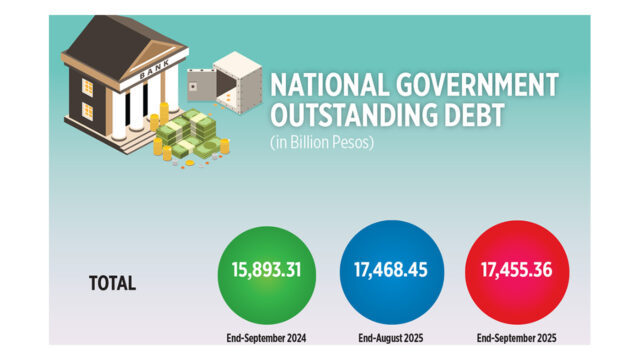
National Government outstanding debt

THE NATIONAL GOVERNMENT’S (NG) outstanding debt slid to P17.46 trillion at the end of September, but remained above the full-year projection, data from the Bureau of the Treasury (BTr) showed. Read the full story.

National Government outstanding debt

Grab Philippines eyes more local investments, says IPO not a priority

GRAB.COM

By Ashley Erika O. Jose, Reporter

GRAB PHILIPPINES is exploring additional investments in the country to expand its operations, although a local initial public offering (IPO) is not currently on the table, according to its top executive.

“Right now, we are a New York stock listed company. I think it is an internal discussion on whether we can IPO in a specific country. We will have to check,” Grab Philippines Country Managing Director Ronald Roda told reporters on the sidelines of the launch of its Asenso Center livelihood hub on Thursday.

Information and Communications Technology (ICT) Secretary Henry Rhoel R. Aguda encouraged technology firms, including Grab Philippines, to consider going public to help deepen and energize the local capital market.

“We need action in the capital market. I encourage Grab Philippines to do an IPO, maybe it is possible for you to become a unicorn here in the Philippines and drive growth in the industry,” Mr. Aguda said.

Mr. Roda said any plan to list locally would depend on multiple considerations and is not among the company’s immediate priorities.

“Typically, you do an IPO to raise funds or increase your profile. Grab Philippines is local, but we are part of a bigger company — Grab. Ultimately, our performance is viewed from a global standpoint,” he said.

The ICT chief said the government has implemented policies that make the Philippine market attractive for technology listings.

“I understand the context is to bring confidence to the public. But I think the other side of it is we are serious investors. There are other ways in which we can contribute to the Philippines. And we’re not going anywhere,” Mr. Roda said.

Mr. Aguda, however, said developing the country’s capital market requires active participation from the private sector, especially technology startups.

“It is high time that we move to a situation wherein if there is a startup or new tech company they can IPO. I’m a big advocate of that because if a country’s capital market is mature, the economic development is much faster,” he said.

For Globalinks Securities and Stocks, Inc. Head of Sales Trading Toby Allan C. Arce, the Department of Information and Communications Technology’s (DICT) call for Grab to go public reflects the administration’s intent to strengthen the domestic capital market by attracting digital economy players to list locally.

“A Grab Philippines IPO would be highly significant at this stage of the market’s evolution — it would not only inject fresh momentum into the Philippine Stock Exchange but also symbolize the growing maturity of the country’s digital and tech-driven sectors,” he said.

He added that a local listing could allow Grab Philippines to raise domestic capital while reinforcing its long-term commitment to the ride-hailing, logistics, and digital payments ecosystem.

ASENSO CENTER
Grab Philippines, together with its motorcycle taxi unit Move It and the DICT, on Thursday inaugurated the Asenso Center — the first livelihood hub of its kind in Grab’s Southeast Asian network.

The center serves as a one-stop facility for onboarding, training, skills assessment, and upskilling of Grab’s driver-partners.

“Grab is one of the Philippines’ most mature platform-work ecosystems, and that gives us a precise, ground-level understanding of what Filipino platform workers and micro-entrepreneurs truly need to thrive. The Asenso Center turns that insight into action. It opens dignified, digitally powered livelihoods, equips our partners with practical AI co-pilots, and helps families convert opportunity into income at scale,” Mr. Roda said.

Grab said the center is part of its ambition to generate 500,000 livelihood opportunities in the Philippines.

The company is also set to roll out its group rides feature by December, allowing multiple passengers to share a trip under a single booking — similar to the group order function on GrabFood.

“I think one of the things we are pushing this Christmas is our new version of group rides,” Mr. Roda said. “We have not fully advertised this but we are now at a point where we think it’s finally ready for the market with good experience.”

Drake appeals defamation loss against UMG over Lamar’s ‘Not Like Us’

RAPPER Drake arrives on the red carpet for the film The Carter Effect at the Toronto International Film Festival (TIFF), in Toronto, Canada, Sept. 9, 2017. — REUTERS

NEW YORK — The superstar rapper Drake is appealing the dismissal of his defamation lawsuit against Universal Music Group over Kendrick Lamar’s Grammy-winning diss track “Not Like Us,” according to a court filing on Wednesday.

Drake will ask the 2nd US Circuit Court of Appeals in Manhattan to overturn the Oct. 9 dismissal by US District Judge Jeannette Vargas.

UMG releases Drake’s and Lamar’s music. It did not immediately respond to a request for comment on Drake’s appeal, but has said it was pleased with the dismissal.

Drake, whose given name is Aubrey Drake Graham, sued UMG in January over its promotion of “Not Like Us,” saying the song deceives listeners into believing the false accusation that he is a pedophile.

The lawsuit follows a decade-long feud in which Drake and Lamar released diss tracks said to target each other. Lamar is not a defendant.

In dismissing the case, Ms. Vargas said Lamar’s lyrics were not defamatory because they amounted to opinion.

“Although the accusation that Plaintiff is a pedophile is certainly a serious one, the broader context of a heated rap battle, with incendiary language and offensive accusations hurled by both participants, would not incline the reasonable listener to believe that ‘Not Like Us’ imparts verifiable facts,” Ms. Vargas wrote.

The appeals process could last at least several months.

“Not Like Us” won Grammy Awards in February for record and song of the year, and spent three weeks atop Billboard’s Hot 100. Lamar performed it at this year’s Super Bowl halftime show. — Reuters

Zombies, jiangshi, draugrs, revenants — monster lore is filled with metaphors for public health

A SCENE from the 2010 film The Walking Dead.

Imagine a city street at dusk, silent save for the rising sound of a collective guttural moan. Suddenly, a horde of ragged, bloodied creatures appear, their feet shuffling along the pavement, their hollow eyes locked on fleeing figures ahead.

A classic movie monster, the zombie surged in popularity in the 21st century during a time of global anxiety — the Great Recession, the specter of climate change, the lingering trauma of the 9/11 terrorist attacks, and the COVID-19 pandemic.

The zombie apocalypse became a way for people to explore the terrifying concept of societal collapse, a step removed from real threats such as nuclear war or global financial disaster.

As a public health epidemiologist and an amateur zombie historian, I couldn’t help but notice the striking parallels between what epidemiologists do to stop infectious disease outbreaks and what horror movie heroes do to stop zombies. The key questions posed in any zombie narrative — how did this start, how many are infected, how to contain it — are the identical questions that epidemiologists ask during a real infectious disease outbreak or pandemic.

In 2011, in fact, the Centers for Disease Control and Prevention published a zombie apocalypse preparedness guide that explained how readying oneself for a zombie apocalypse can prepare people for any large-scale disaster. The zombie is more than just a monster; it is a powerful, public health teaching tool.

ZOMBIES IN ANCIENT HISTORY
The idea of the reanimated dead has been part of human history for millennia, showing up across cultures and long before modern germ theory or epidemiology existed. These creatures were often a way for societies to understand and explain the natural world and disease transmission in the absence of scientific knowledge.

The oldest written reference to creatures similar to modern zombies is found in The Epic of Gilgamesh, which was etched on stone tablets sometime between 2000 and 1100 BCE, Enraged after Gilgamesh rejects her marriage proposal, the goddess Ishtar tells him, “I shall bring up the dead to consume the living, I shall the make the dead outnumber the living.” This ancient terror — the dead overwhelming the living — has a direct parallel to the concept of an out-of-control epidemic in which the sick quickly overwhelm the healthy. Hollywood has readily adopted this concept in many zombie movies.

The origins of the flesh-eating corpse on screen date back to George Romero’s 1968 classic The Night of the Living Dead. You won’t hear the word “zombie” in Romero’s film, however — in the script, he called the creatures “flesh eaters.” Similarly, in Danny Boyle’s 2002 film 28 Days Later, the terrifying creatures were called the “infected.” Both these terms, “flesh eaters” and “infected,” directly echo public health concerns — specifically, the spread of disease via a bacteria or virus and the need for quarantine to contain the afflicted.

The roots of the word zombie are from the Haitian variety, thought to stretch back to West Africa and to words such as “nzambi,” which means “creator” in African Kongo, or “ndzumbi,” which means “corpse” in the Mitsogo language of Gabon. However, it was in Haitian Vodou, a religion that draws from the West African spiritual traditions among people who were enslaved on Haiti’s plantations, that the concept took its most terrifying form.

According to Vodou, when a person experiences an unnatural, early death, priests can capture and co-opt their soul. Slave owners capitalized on this belief to prevent suicide among the enslaved. To become a zombie — dead yet still a slave — was the ultimate nightmare. This cultural concept speaks not just to disease but to societal trauma and the public health crisis of forced labor.

ZOMBIE-LIKE CREATURES AROUND THE WORLD
Across the globe, other reanimated corpses crop up in local folklore, often reflecting fears of improper burial, violent death, or moral wickedness. Many tales about these eerie creatures don’t just convey how to avoid becoming one of them, but also detail how to stop or prevent them from taking over. This focus on prevention and control is at the heart of public health.

During the expansion of China’s Qing dynasty, which took place between 1644 and 1911, a creature known as the jiangshi, or “hopping zombie,” emerged amid widespread unrest and integration of non-Chinese minorities. The jiangshi were corpses suffering from rigor mortis and decomposition, reanimated when a soul couldn’t leave after a violent death. Instead of staggering, these mythological creatures would hop, and their method of attack was to steal a person’s lifeforce, or qi.

Fear of a lonely, restless afterlife led families who lost a loved one far from home to hire a Taoist priest to retrieve the body for proper burial with ancestors.

In Scandinavia, the draugr — meaning “again walker” or “ghost” — was a creature bent on revenge. According to lore, draugrs typically emerged from mean-spirited people or improperly buried corpses. Like zombies, they could turn regular people into draugrs by infecting them. They would attack their victims by devouring flesh, drinking blood, or driving victims insane. Draugrs’ contagious nature is a model for disease transmission. What’s more, their seasonal activity — they most often appear at night in winter months — is similar to seasonal trends in infectious disease transmission.

In medieval times, meanwhile, legend had it that creatures called revenants — corpses that came out of their graves — stalked northern and western Europe. According to 12th century English historian William of Newburgh, these creatures emerged from the lingering life force of people who had committed evil deeds during their lives or who experienced a sudden death. Clerics fueled people’s fears of becoming a revenant by claiming these creatures were created by Satan. The recommended but gruesome prevention method for this fate was to capture and dismember these creatures and to burn the body parts, especially the head.

Archaeological evidence from a medieval village in England suggests that communities heeded this advice. Archaeologists excavated the village’s burial grounds, and among human remains from the 11th to 13th centuries they found broken and burned bones with knife marks. They show how a community may have taken extreme measures to control a perceived contagion or threat to public safety, mirroring a modern-day quarantine or eradication protocols.

Perhaps the most striking similarity between these historical monsters and Hollywood zombies is that so many of them are created by an infectious agent of some kind. After an outbreak occurs, control is difficult to regain, underscoring the necessity of a rapid public health response.

THE CONVERSATION VIA REUTERS CONNECT


Tom Duszynski is a clinical assistant professor of Epidemiology at Indiana University.

Are office uniforms outdated?

Our Chief Executive Officer (CEO) is very much concerned about the image of our organization that he’s thinking of requiring all employees to wear a prescribed uniform every day. He set an annual budget for all 500 workers. What do you think? — May Flower.

Office uniforms were once a symbol of professionalism and corporate unity. That was the time when an “office” meant a fixed place with typewriters, filing cabinets, and rigid hierarchies. Today, work happens anywhere: at home, in cafés, or in co-working spaces where everyone can be productive.

In knowledge-based jobs, creativity, not physical appearance, is the main driver of performance. That’s why I don’t agree with a perfect attendance award for employees. But, that’s another story.

Further, uniforms do not allow for individual taste, even if you let them choose the uniform style through a committee, which may not succeed in capturing the majority’s fashion taste.

In today’s workplace, it’s difficult to champion diversity while asking everyone to look like photocopies of each other.

And let’s face it. At times, the “uniform budget” often ends up quite profitable for someone’s cousin’s garment business or the service provider recommended by the employees’ union.

Given those, let me qualify my advice by saying — it depends on your industry, which plays an important role in determining whether to have a company uniform or not.

Just the same, it doesn’t have to apply to all workers, but to the chosen few frontliners like bank tellers or hotel front desks. This is where visual branding builds trust. Another example is when people work in highly ranked cultures like those in government service, the military, and airlines where uniformity is part of an overall brand.

Also, uniforms are important for health, security, and safety in settings like hospitals, laboratories, pharmaceuticals, and manufacturing.

CLOTHING ALLOWANCE
In recent years, I’ve seen company uniforms being replaced with a cash clothing allowance that reflects management’s recognition of their employees’ maturity and sense of self-expression. It also extends a practical benefit to people who dislike wearing uniforms, which can be uncomfortable, poorly fitted, and require costly dry cleaning.

Giving cash can actually reduce the administrative hassle, except when your organization requires the liquidation of such allowances for tax purposes. Also, there’s no need for a time-consuming bidding process, managing suppliers, tailor fittings, and in some cases, stockpiling for the eventual destruction of resigned employees’ old uniforms for security reasons.

So yes, office uniforms can be eliminated and replaced with a well-thought-out cash allowance, provided employees understand that freedom comes with accountability. After all, it’s easier to inspire loyalty with respect than with matching outfits.

With an allowance, employees can choose clothes that are comfortable and cost-efficient. And more importantly, clothes they actually like wearing. The result? Happier employees who look good and feel respected. When people feel trusted to make small decisions — like how to dress — they tend to reciprocate with better performance at work.

For organizations that value hierarchy or tradition, some companies are adjusting to give clear guidelines on design matters as in the case where the prescribed wear is smart casual polo shirts, jackets, or coordinated color schemes that are professional but not suffocating.

This policy respects both professionalism and practicality. It acknowledges that some days require formal polish, while others simply require focus. It also saves employees from the dreadful moment of realizing that the uniform shirt didn’t dry over the weekend.

THE RIGHT DRESS CODE
Today, many workers feel like corporate uniforms are symbols of distrust. After all, leadership isn’t about dictating fabric choices — it’s about fostering an environment of accountability, trust, and respect.

A well-dressed employee isn’t necessarily a productive one, just as a uniformed worker isn’t automatically loyal. The right dress code fosters a shared sense of purpose, values, and performance standards that everyone commits to “wearing” daily.

If employees feel engaged and valued, they’ll dress the part naturally. If they don’t, no amount of embroidery on their polo shirt or jacket can hide the disengagement in their eyes.

Therefore, replacing office uniforms with a cash allowance is not just a perk — it’s a quiet signal of trust. It says, “We believe you’re professional enough to represent the company with the right judgment, not just matching fabric.”

It’s also an investment in morale. Employees who feel respected are less likely to leave — and more likely to go the extra mile. It’s hard to go above and beyond when you can’t even breathe properly in your uniform.

In conclusion, perhaps it’s time to retire the era of identical outfits and embrace individuality with responsibility. The future of professionalism isn’t sewn in thread — it’s woven in trust.

In the end, a truly modern workplace doesn’t need everyone to look alike. It needs everyone to work alike — with enough competence and style to keep HR from issuing a memo to repeat offenders.

Your next challenge, therefore, is to convince your CEO to accept all this.


Have a free consultation of your workplace issues with Rey Elbo. E-mail elbonomics@gmail.com or DM him on Facebook, LinkedIn, or X. Anonymity is guaranteed.


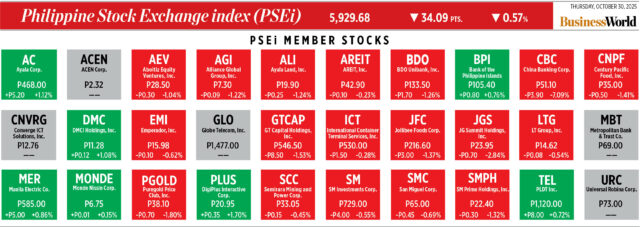
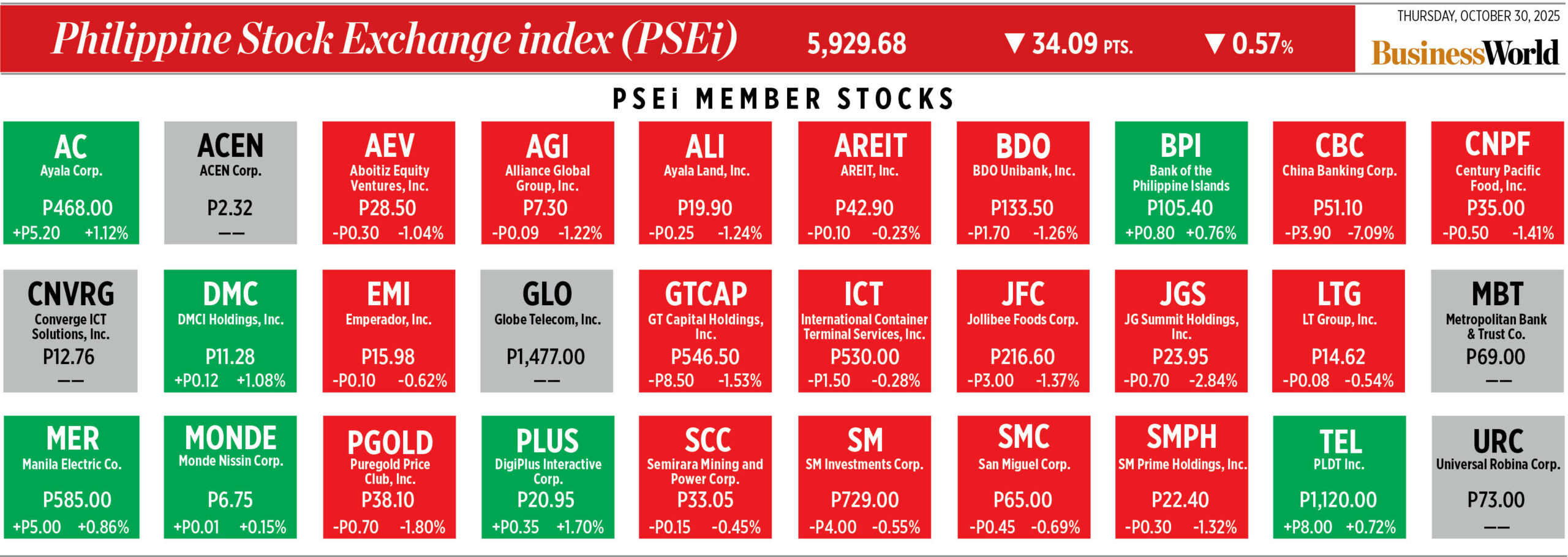
How PSEi member stocks performed — October 30, 2025

Here’s a quick glance at how PSEi stocks fared on Thursday, October 30, 2025.


PHL agencies map strategy to recover wealth linked to flood control scandal

PHILIPPINE STAR/MIGUEL DE GUZMAN

By Erika Mae P. Sinaking

THE Independent Commission for Infrastructure (ICI) convened key government agencies on Thursday to coordinate efforts to recover public funds lost to anomalous infrastructure projects, marking a major step in the Marcos administration’s anti-corruption drive.

“The purpose of our meeting today is to finalize the framework for inter-agency coordination, information sharing and legal procedures related to the recovery of public funds and assets from irregular infrastructure projects,” ICI Chairman Andres B. Reyes, Jr. said at the meeting.

Officials from the Anti-Money Laundering Council (AMLC), Department of Justice, Department of Public Works and Highways (DPWH), Office of the Ombudsman and National Bureau of Investigation joined the technical working group session.

Mr. Reyes said the group would establish operational guidelines and timelines to support national asset recovery and accountability initiatives. He noted that every peso stolen is a peso taken away from public service.

Assistant Ombudsman Jose Dominic Clavano IV said the government would invoke Republic Act No. 1379 or the Forfeiture Law to pursue civil cases against officials with unexplained wealth.

“When there’s a disproportion between the amount declared in the SALN and the actual wealth that you see in a lifestyle check, then you can forfeit whatever is over and excessive,” he told reporters. “That’s what we will use to enforce action against the assets.”

He added that forfeiture proceedings could proceed independently of criminal cases.

Public Works Secretary Vivencio B. Dizon said the Office of the Solicitor General may file these civil forfeiture cases before regional trial courts, which he said are “easier and faster” than criminal cases.

“You only need to prove that [their] income is smaller than the money or assets [they] hold,” he told reporters.

In September, the ICI recommended graft, malversation and falsification charges against officials linked to a P289.5-million road dike project in Naujan, Oriental Mindoro. On Wednesday, it also sought plunder and bribery charges against current and former lawmakers allegedly involved in kickback schemes tied to projects in Bulacan, Pampanga and Quezon City.

During the same meeting, the Bureau of Customs (BoC) announced plans to auction seven luxury vehicles linked to government contractors Pacifico F. Discaya II and Cezarah Rowena C. Discaya on Nov. 15.

The vehicles — including a Rolls-Royce “with the infamous umbrella” — were among 30 luxury cars seized from the couple, with 13 units valued at roughly P200 million, Customs Deputy Chief of Staff Chris Noel Bendijo said. Seven had no import entries or certificates of payment and were automatically forfeited.

The vehicles were discovered during a raid at the St. Gerrard Construction compound in Pasig City and have since been transferred to the Port of Manila. The auction will be livestreamed “for transparency,” Mr. Bendijo said, noting that Customs officials, importers and brokers involved in the original transactions are barred from participating.

The bureau has issued more than 15 show-cause orders to personnel — ranging from appraisers to a deputy collector — implicated in the illegal importations. Penalties could include suspension or dismissal, depending on the findings.

Mr. Bendijo said the Bureau of Internal Revenue is handling potential tax evasion cases, as Customs jurisdiction covers only import legality and duties.

Meanwhile, Mr. Dizon said the government would move to confiscate the air assets of former lawmaker Elizaldy S. Co, including two AgustaWestland helicopters and a Gulfstream jet. He said the aircraft, flown to Malaysia and Singapore, had not been frozen by the AMLC before their departure but remain under watch.

“No matter where they are, they can still be seized once a confiscation order is issued,” Mr. Dizon said.

Meanwhile, a taxpayer from Las Pinas City has asked the Supreme Court to nullify President Ferdinand R. Marcos, Jr.’s Executive Order (EO) No. 94, which created the ICI.

In a petition, John Barry T. Tayam said the ICI mirrors the defunct Philippine Truth Commission earlier declared unconstitutional.

He urged the high court to strike down the order, saying it violates the separation of powers and duplicates the mandates of existing anti-corruption agencies such as the Office of the Ombudsman and Department of Justice.

Mr. Tayam said the ICI’s powers to investigate, subpoena and recommend prosecution encroach upon the authority of constitutionally independent bodies. He also said its creation “involved the unlawful disbursement of public funds.”

The ICI was formed on Sept. 11 under EO 94 to investigate anomalies in flood control and other infrastructure projects, following reports of substandard and “ghost” works involving district engineers, contractors and lawmakers.

The plaintiff likened the ICI to the Philippine Truth Commission, formed in 2010 under the late President Benigno S.C. Aquino III. The tribunal struck down the body’s legality for singling out the Arroyo administration and duplicating the powers of existing agencies.

“The Independent Commission for Infrastructure, although framed differently, suffers from the same constitutional infirmities,” Mr. Tayam said. “It centralizes investigatory powers under the Executive, blurring the checks and balances among branches of government.”

He also warned that the ICI could delay accountability by creating bureaucratic overlap and slowing the resolution of corruption cases.

The ICI is empowered to initiate investigations on its own and recommend criminal, civil or administrative charges to the appropriate agencies. It may also issue subpoenas, request asset freezes and coordinate with law enforcement authorities.

Marcos expands austerity drive before leaving for APEC Summit in Korea

PRESIDENT Ferdinand R. Marcos, Jr. and First Lady Liza Araneta-Marcos left from Villamor Air Base in Pasay City for South Korea for the 32nd Asia-Pacific Economic Cooperation Economic Leaders’ Meeting from Oct. 30 to Nov. 2. — PHILIPPINE STAR/NOEL B. PABALATE

PRESIDENT Ferdinand R. Marcos, Jr. ordered all Philippine government agencies to adopt a cost-reduction system modeled after the Department of Public Works and Highways (DPWH), as part of a broader push to curb corruption and redirect savings to social programs.

“It will not be limited to public works, but shall be the norm across all of government,” Mr. Marcos said before departing for the Asia-Pacific Economic Cooperation (APEC) Summit in Gyeongju, South Korea. The summit runs from Oct. 30 to Nov. 2.

The directive covers the Departments of Education, Agriculture, Health, Transportation, and other agencies, which must now follow the DPWH’s pricing reforms aimed at aligning project costs with market rates. Mr. Marcos said the policy could cut the 2026 costs of farm-to-market roads, classrooms, hospitals and irrigation systems by up to 50%.

“The quality of what we build will not be compromised. The only thing weakened will be corruption,” he said. Funds saved will be reallocated to programs that “uplift families, support livelihoods, and strengthen communities,” he added.

The move follows revelations during his July state of the nation address about a multibillion-peso public works scam involving kickbacks from substandard or nonexistent projects. Mr. Marcos earlier directed DPWH Secretary Vivencio B. Dizon to slash construction material costs to market levels, a step expected to save the government up to P45 billion.

APEC AGENDA
Mr. Marcos flew to South Korea on Thursday for the 32nd APEC Summit, hosted by President Lee Jae-Myung. This year’s theme, “Building a Sustainable Tomorrow: Connect. Innovate. Prosper,” aligns with the Philippines’ agenda to boost digital connectivity and investment flows.

The President said he will push for “greater digital and physical connectivity, supply chain resilience, and investment facilitation” to promote inclusive growth. He is also set to address the APEC CEO Summit to pitch the Philippines as a hub for innovation and investment.

“The Philippines is not merely ready. We are a reliable, forward-looking partner in the Asia-Pacific. Invest in the Filipino,” he said. Mr. Marcos will also meet with Korean business leaders in Busan to strengthen trade and investment ties, and with members of the Filipino community there.

The APEC meeting takes place amid heightened global trade uncertainty as US President Donald J. Trump and Chinese President Xi Jinping hold talks that could shape the economic outlook. “The world is watching because the agreements made between two of the largest economies in the world will certainly affect every single citizen of the world,” he said. 

APEC’s 21-member economies account for almost half of global trade and more than 60% of world gross domestic product. The Philippine Department of Foreign Affairs said the summit will tackle artificial intelligence, demographic shifts and creative industries, while bilateral meetings with other leaders are still being finalized. The South China Sea dispute will not be discussed, it added, as it falls outside APEC’s mandate.

FREEDOM OF INFORMATION
Meanwhile, political analysts said Mr. Marcos should strengthen transparency and anti-corruption measures by pushing for a Freedom of Information (FOI) law and ensuring regular disclosure of officials’ wealth, amid renewed scrutiny of public accountability in the wake of a major infrastructure scandal.

Hansley A. Juliano, a political science lecturer at the Ateneo de Manila University, said the President could “claim moral ascendancy” by supporting FOI legislation and enforcing transparency within his administration.

“Mr. Marcos can enable not only the Ombudsman but also push for FOI reforms himself,” he said in a Facebook Messenger chat.

All 24 senators this week released their statements of assets, liabilities, and net worth (SALN) after the Office of the Ombudsman eased restrictions on public access to the records. The policy reversed a ban imposed under former President Rodrigo R. Duterte that had limited disclosure to protect officials’ privacy.

Senator Mark A. Villar remained the richest lawmaker with a net worth of P1.26 billion, followed by Senator Rafael T. Tulfo and his wife, Party-list Rep. Jocelyn Pua-Tulfo, with P1.05 billion, according to Senate data.

Senator Erwin T. Tulfo ranked third with P497 million. Senators Francis “Chiz” G. Escudero, Ana Theresia Hontiveros-Baraquel and Francis Pancratius N. Pangilinan reported the lowest net worth, ranging from P18.8 million to P28.7 million.

Several bills have been filed in Congress seeking to institutionalize an FOI system that would require all government branches to disclose key records, including SALNs, procurement documents and audit reports.

Michael Henry Ll. Yusingco, a fellow at the Ateneo Policy Center, said the release of the senators’ wealth statements was a positive step, but warned that public accessibility should be continuous rather than reactionary.

“Public access to SALNs must be guaranteed at all times. No exceptions,” he said via Messenger chat, adding that the President should issue an executive order requiring all executive officials to make their net worth public.

If the President is “really serious” about leaving an anti-corruption legacy, he should mandate full compliance with the Ombudsman’s transparency rules, Mr. Yusingco said. Blocking access to SALNs, he added, only “deepens public distrust in government.”

Gary D. Ador Dionisio, dean of De La Salle–College of St. Benilde’s School of Diplomacy and Governance, said previous SALN reports from 2016 to 2023 should also be disclosed for public scrutiny.

The academe and civil society should be allowed to examine past SALNs to understand how lawmakers’ wealth evolved, he said via Messenger chat.

Calls for greater transparency have intensified as the Marcos administration investigates a multibillion-peso flood control scam allegedly involving lawmakers, government engineers and private contractors accused of siphoning public funds. — Chloe Mari A. Hufana and Adrian H. Halili

ADVERTISEMENT
ADVERTISEMENT