Home Blog Page 7710

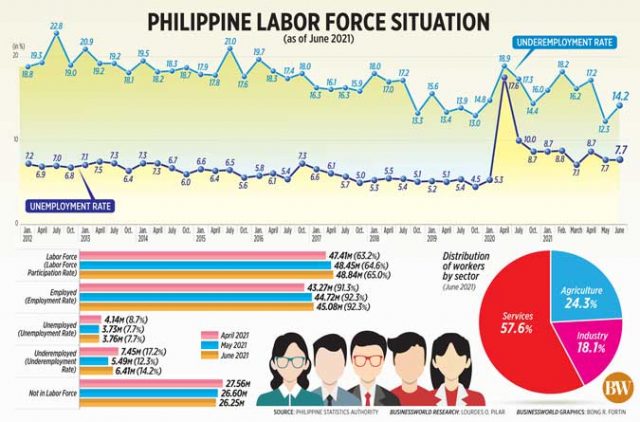
Philippine Labor Force Situation (as of June 2021)

THE RANKS of jobless Filipinos and those employed but wanting more work increased in June, government data showed on Tuesday, reflecting the impact of ongoing quarantine restrictions amid the pandemic. Read the full story.

Philippine labor force situation (as of June 2021)

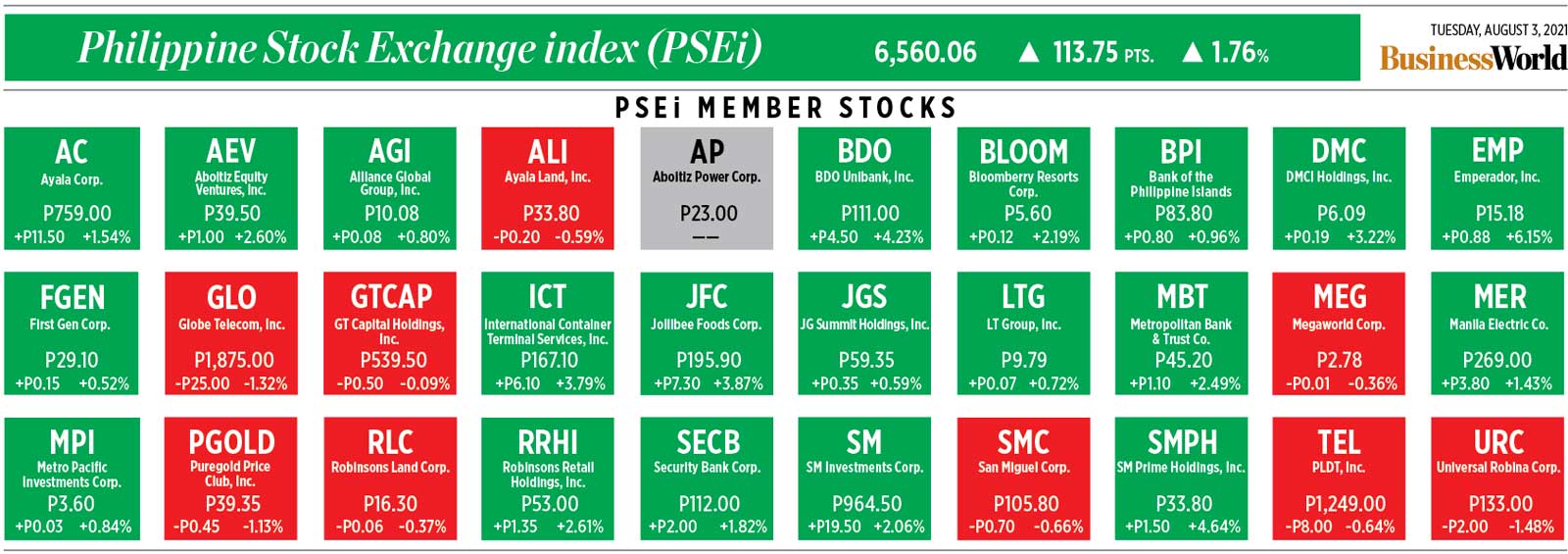
How PSEi member stocks performed — August 3, 2021

Here’s a quick glance at how PSEi stocks fared on Tuesday, August 3, 2021.


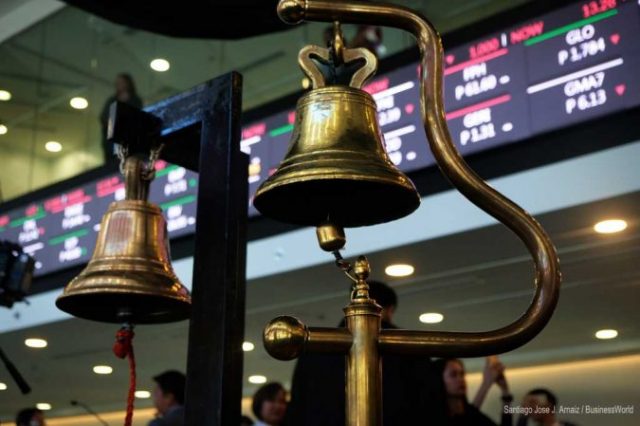
Shares advance on positive Q2 earnings results

BW FILE PHOTO

By Keren Concepcion G. Valmonte

PHILIPPINE stocks gained on Tuesday as investor sentiment improved, with more listed companies releasing better-than-expected profit results for the second quarter.

The 30-member Philippine Stock Exchange index (PSEi) climbed by 113.75 points or 1.76% to close at 6,560.06. The broader all-share index added 55.55 points or 1.39% to finish at 4,040.82.

“The market rallied by more than 100 points for the second straight session in anticipation of strong second-quarter earnings results,” Lance U. Soledad, an equity analyst at AB Capital Securities, Inc. said in a Viber message.

Solaire Resort & Casino Operator Bloomberry Resorts Corp. produced “respectable results” during the quarter, Chief Executive Officer Enrique K. Razon, Jr. said in a statement. The company trimmed its net loss to P1.2 billion from P4.7 billion a year earlier.

Ayala Land, Inc. made P3.3 billion in net income last quarter from P426 million a year earlier. Earnings of unit AyalaLand Logistics Holdings, Corp. rose by 59% to P247 million from a year earlier.

Semirara Mining and Power Corp.’s consolidated net income improved by nearly four times to P3.98 billion as its coal sales improved.

“Trading volumes were also higher, which tells us that investors are willing to come in at current prices, although volumes are still below the daily average of around P6 billion,” Christopher John Mangun, research head at AAA Southeast Equities, Inc. said in an e-mail.

Value turnover increased to P4.89 billion, with 799.68 million shares switching hands. This was higher than 1.55 billion shares worth P3.54 billion traded on Monday.

“Fears of an uncontrollable coronavirus disease 2019 (COVID-19) outbreak were calmed by the increasingly tighter restrictions that the government is slowly implementing,” Mr. Mangun said.

“This is in line with the notion that the temporary imposition of tighter restrictions is positive on investor sentiment, as the long-term benefits will outweigh the short-term economic weakness,” he added.

All sectoral indices closed higher on Tuesday. Mining and oil improved by 229.21 points or 2.4% to 9,756.41, financials went up by 31.48 points or 2.25% to 1,428.01, property increased by 61.93 points or 2.05% to 3,081.41, holding companies gained 100.05 points or 1.55% to 6,551.62, industrials rose by 136.60 points or 1.5% to close at 9,228.50, and services climbed by 18.38 points or 1.18% to 1,566.19.

Advancers outnumbered decliners 126 to 57, while 54 stocks were unchanged.

Net foreign buying decreased to P108.49 million from P135.03 million in net purchases on Monday.

Analysts expect the index to trade up to 6,600 for the rest of the week.

“As the market is currently in the 6,500 levels, we›ll have to see this week if the 6,270 support area holds,” Darren Blaine T. Pangan, an analyst at Timson Securities, Inc. said in a Viber message.

Peso appreciates vs dollar as oil retreat spurs market optimism

BW FILE PHOTO

THE PESO strengthened against the dollar on Tuesday due to market optimism after global oil prices fell.

The currency closed 29 centavos stronger at P49.61 a dollar from a day earlier, according to data from the Bankers Association of the Philippines.

The peso opened at P49.90 a dollar and weakened to as much as P49.98 before closing at its intraday high. Dollars exchanged climbed to $1.098 billion from $776.52 million on Monday.

The peso was backed by positive market sentiment due to falling oil price, said Michael L. Ricafort, chief economist at Rizal Commercial Banking Corp.

Oil prices fell by more than 3% on Monday as increased production from major oil exporters stoked fears of weakness in oil demand and oversupply, Reuters reported.

Brent crude oil futures dropped by $2.52 or 3.3% to $72.89 a barrel, while US West Texas Intermediate crude ended $2.69 or 3.6% lower at $71.26.

Meanwhile, a trader said the peso’s appreciation was also due to positive investor sentiment after the relatively steady unemployment level in June.

The jobless rate in June was unchanged at 7.7% from May, the Philippine Statistics Authority reported on Tuesday. Jobless Filipinos rose to 3.764 million from 3.73 million in May.

Mr. Ricafort said the peso was likely to trade at P49.45 to P49.75 on Wednesday. — Luz Wendy T. Noble with Reuters

Paalam punches way to semis, assured of an Olympic medal

FILIPINO boxer Carlo Paalam advanced to the semifinals of the Tokyo Games flyweight boxing tournament on Tuesday, assuring the Philippines will get another Olympic medal. — REUTERS

FILIPINO boxer Carlo Paalam advanced to the semifinals of the Tokyo Games flyweight boxing tournament on Tuesday, assuring the Philippines will get another Olympic medal.

The 23-year-old Bukidnon native secured his spot in the final four after defeating defending Olympic flyweight champion Shakhobidin Zoirov of Uzbekistan by split decision on points, 4-0, in their quarterfinal clash at the Kokugikan Arena in Tokyo.

Mr. Paalam came out aggressive and took the fight to his opponent right at the opening bell, connecting with solid blows to the head and body en route to claiming the opening round.

In the second, action continued to be frenetic with both fighters tagging one another with clear shots.

Unfortunately, midway into the round both absorbed cuts after a head collision.

Ukrainian referee Pablo Vasylynchuk called for a halt to the play to have the two fighters checked by the ring physician.

With both fighters deemed unfit to continue because of the slight gash in their heads, the fight was halted and awarded to Mr. Paalam, who was ahead on points at the time of stoppage, 20-19, on four judges and a tied 19-19 score in the fifth official for a 4-0 win.

“We really wanted to take the opening round to put pressure on my opponent. Thankfully, we were able to do that and it affected how the fight went,” Mr. Paalam said in Filipino after his win.

Ricky P. Vargas, president of the Association of Boxing Alliances of the Philippines, lauded the efforts of Mr. Paalam to make his way to the medal rounds.

“He’s (Paalam) ready… More than just the preparation physically, it is his mental focus that has brought him where he is now. Look at his eyes, he really wants it,” Mr. Vargas said in an interview with TV5.

Mr. Paalam’s victory assured the Philippines will get a fourth medal in the Tokyo Olympics after the gold won by weightlifter Hidilyn F. Diaz and those of boxers Nesthy A. Petecio (silver) and Eumir Felix D. Marcial (at least bronze).

In the semifinals set for Aug. 5, Mr. Paalam will face Ryomei Tanaka of Japan. — Michael Angelo S. Murillo

Petecio settles for silver after close defeat to Irie

SENA Irie (JPN) in blue celebrates her victory in the Women’s Featherweight gold medal match during the Tokyo 2020 Olympic Summer Games at Kokugikan Arena. Nesthy Petecio (PHL) in red wins the silver medal. — REUTERS

FILIPINO boxer Nesthy A. Petecio settled for silver in the Tokyo Games after bowing to Japanese Sena Irie by unanimous decision in the gold medal match of the women’s featherweight boxing tournament at the Kokugikan Arena in Tokyo, Tuesday.

Ms. Petecio, 29, tried hard to get the gold with a more authoritative showing in the last two rounds but just could not get the nod of the judges in the end to lose, 5-0.

The Philippine bet was frustrated in the first round by the continued holding and clinching of the Japanese to stop Ms. Petecio from gaining any momentum.

In the second and third rounds, Ms. Petecio did a better job landing more punches despite Ms. Irie’s attempts to slow down the contest.

On the scorecard, Ms. Irie won 29-28 in four judges while one scored it 30-27.

“Like most of us, we felt the Japanese, Irie, employed some one-upmanship by a lot of holding tactics, and she got the benefit of the doubt from the referee and it was allowed to go on several times in the fight, which should not have been the case. It was her fight plan, I guess, and it worked,” said a disappointed Ed Picson, secretary-general of the Association of Boxing Alliances of the Philippines, in an interview with TV5.

“But we’re still proud of Nesthy and her achievements here makes her a gem more in Philippine boxing and an inspiration for younger boxers,” he added.

Ms. Petecio’s silver medal finish equals that achieved by Mansueto Velasco in 1996 in Atlanta and Anthony Villanueva in 1964 in Tokyo.

Two more Filipino boxers in Eumir Felix D. Marcial (middleweight) and Carlo Paalam (flyweight) are in still contention for a possible gold medal.

For her silver, Ms. Petecio is set to receive cash incentives from both the government and the private sector amounting to at least P17 million.

She is also to get a residential condominium unit in her hometown of Davao City worth P10 million from tycoon Dr. Andrew L. Tan and Suntrust Properties, Inc.

Philippine Airlines (PAL) and AirAsia Philippines, too, are rewarding Ms. Petecio for her impressive run in the Olympics.

PAL is gifting the silver medallist 60,000 Mabuhay Miles per year for life.

AirAsia, for its part, is giving Ms. Petecio five years of unlimited flights.

“We hope the free flights would motivate our athletes to always go all the way … and never stop dreaming big,” it said in a statement. Michael Angelo S. Murillo

Saso, Pagdanganan get Olympic campaigns going

PHILIPPINE bets Yuka Saso (left) and Bianca Pagdanganan begin their Tokyo Olympic Games campaigns on Wednesday at the Kasumigaseki Country Club. — NATIONAL GOLF ASSOCIATION OF THE PHILIPPINES

YUKA Saso and Bianca Pagdanganan, the last two Filipino athletes to see action in the Tokyo Olympic Games, begin their campaigns in the women’s individual stroke play event on Wednesday.

The two will tee off at the Kasumigaseki Country Club for their four-round campaign, lasting until Aug. 7, where they hope to land a podium finish, particularly winning the gold for the Philippines.

US Women’s Open champion Ms. Saso, 20, starts off at 7:25 a.m.

She is grouped in the first round with American Lexi Thompson and Canadian Brooke Henderson.

While she is packing momentum with her US Open win heading into the Olympics, San Ildefonso, Bulacan native Ms. Saso expects the competition in the Games to be a totally different challenge.

“I think it will be a different experience compared to majors…” Ms. Saso said in an interview with lpga.com.

“But I think it’s a good chance to meet different athletes from different countries and learn from them, too.”

For Ms. Pagdanganan, 23, the Olympics is something she was angling for when the sport was brought back for the Games in 2016, and she feels honored and privileged to be able to compete in it.

“I don’t know how much more excited I could be than very excited” Ms. Pagdanganan, too, shared with the Ladies Professional Golf Association (LPGA) website.

“I made it a goal of mine to represent the Philippines when they brought golf back in 2016. I just didn’t think I’d be able to reach it this quick…”

Ms. Pagdanganan tees off at 6:52 a.m. along with Leona Maguire of Ireland and Matilda Castren of Finland. — Michael Angelo S. Murillo

Obiena crashes out in men’s pole vault finals

Filipino pole-vaulter EJ Obiena

Ernest John U. Obiena fell short on his push to land a podium finish in the finals of the men’s pole vault of the Tokyo Games at the Olympic Stadium, Tuesday night.

Mr. Obiena fouled on his three attempts at 5.80 meters, which sent him crashing early in the competition.

On his last try, he caught a break when he was given another attempt after complaining to officials about the time. But he could still not capitalize on it as he touched the bar on his way down after getting the height he needed.

Mr. Obiena cleared 5.55m and 5.70m in the finals.

As of this writing, only seven athletes were left in the competition, attempting to clear 5.87 meters.

Mr. Obiena was the first Filipino athlete to qualify for the Tokyo Olympics back in 2019 and the only Asian to see action in the finals of the men’s pole vault. — Michael Angelo S. Murillo

FIRB approves perks for housing, cement projects

FINANCE SECRETARY CARLOS G. DOMINGUEZ III

THE FISCAL Incentives Review Board (FIRB) approved on Monday fiscal incentives for housing development and two cement plants located outside Metro Manila, with a combined project cost of P29 billion, to mark its first approvals after the Corporate Recovery and Tax Incentives for Enterprises (CREATE) law gave it more power over tax perks.

The Department of Finance said on Tuesday that the FIRB approved tax incentives for a P24.9-billion cement plant in Calatagan, Batangas; a P3.1-billion cement plant in Porac, Pampanga; and a P1.4-billion mass housing project in Iloilo.

Specifically, the board also a two-year income tax holiday (ITH) and duty exemptions on imported materials and five years’ worth of enhanced deductions to the operator of the cement plant in Pampanga.

The project will significantly augment the factory’s current capacity, adding 898,560 metric tons (MT) to its current maximum output of 687,473 MT of cement each year, Finance Assistant Secretary Juvy C. Danofrata said, citing Board of Investments estimates.

Meanwhile, the Batangas cement factory, which is planning to install clinkering facilities, was given a six-year ITH, five years of enhanced deductions and exemptions from paying duty on imports.

Socioeconomic Planning Secretary Karl Kendrick T. Chua said the perks granted to the two facilities should help them adopt new technology to boost production and reduce costs.

The expansion will raise the plant’s capacity to 2.5 million MT a year and is expected to result in P866 million in annual savings to the economy on import costs since this will augment the local supply of the material and meet demand from the construction industry, Ms. Danofrata said.

“The projected net benefits of the investment are driven by the locally-sourced capital equipment and raw materials as well as the income taxes that the government will potentially collect from the estimated jobs created by the project,” she added.

Trade Undersecretary Ceferino S. Rodolfo said the Batangas project needs more investment than the Pampanga plant because it will also produce clinker, raising the cost.

“[Granting tax perks to the two cement manufacturers should] lessen the country’s import dependence, increase our local capacity, and encourage competitiveness in the industry,” Trade Secretary Ramon M. Lopez said.

The Iloilo housing project was granted a four-year ITH and exemption from duties on the import of capital equipment and raw materials.

Ms. Danofrata said the project will build more than 3,000 low-cost housing units equivalent to about 1% of the housing backlog in the Western Visayas.

The perks should encourage the private sector to help the government build low-cost homes and address the housing shortage, according to Mr. Lopez.

Republic Act No. 11534 or the CREATE Act lowered the corporate income tax to 25% this year and reformed the tax incentive system.

It expanded the oversight power of the FIRB to monitor whether the fiscal incentives are given to deserving companies. It adheres to the Strategic Investment Priorities Plan in determining the type and duration of incentives given to key industries, which were ranked based on their capacity to attract investment, create jobs and boost the country’s competitiveness.

For the hotel industry, which was among the hardest-hit sectors during the pandemic, Finance Secretary and FIRB Chairman Carlos G. Dominguez III said CREATE will also help the sector by reducing corporate income tax, giving companies more flexibility to keep their workers employed and make investments.

“The administration is doing all that it can to support the revival of even more robust hospitality and tourism industries in the post-pandemic era,” Mr. Dominguez said at a forum arranged by the Philippine Hotel Owners Association, Inc. Tuesday.

“What I can assure you of is this government’s readiness to support local businesses through expanded credit, lower interest rates, and by ensuring fiscal prudence in managing our financial resources,” he added.

The DoF has estimated that the government granted P481.7 billion worth of fiscal incentives to favored companies in 2019, down 7% from a year earlier. — Beatrice M. Laforga


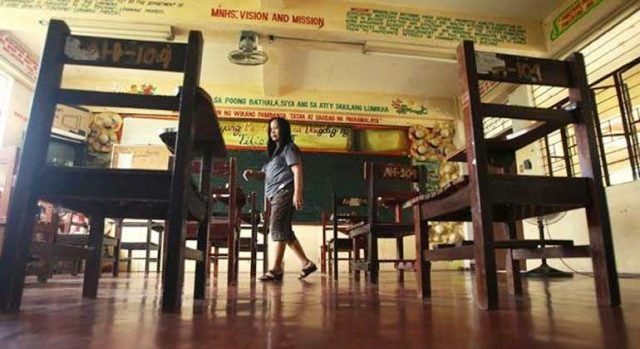
House passes bill granting tax relief specifically to private schools on 2nd reading

PHILSTAR FILE PHOTO

THE HOUSE of Representatives approved on second reading Tuesday a bill that explicitly qualifies private schools for tax relief, which would clear up their tax treatment after the industry disputed the interpretation of the tax relief law put forward by the Bureau of Internal Revenue (BIR). 

House Bill 9913 amends Section 27 (B) of the National Internal Revenue Code (NIRC) of 1997 to apply the 10% preferential tax rate to all proprietary educational institutions and nonprofit hospitals for a limited period to allow them to recover from the economic crisis, which has hurt enrollment.

Private schools will be charged a reduced tax rate of 1% between July 1, 2020 and June 30, 2023, as authorized by Republic Act 11534 or the Corporate Recovery and Tax Incentives for Enterprises (CREATE) law. Once the provision expires, the tax rate will revert to 10%.

The proposed law was passed by the House Committee on Ways and Means Monday.

The Bureau of Internal Revenue (BIR) has withdrawn provisions in Revenue Regulations (RR) No. 5-2021 requiring private educational institutions to be “nonprofit,” effectively increasing the tax rate for private schools to the 25% regular corporate income tax.

Negros Occidental Rep. Francisco B. Benitez said in his sponsorship speech that BIR RR No 5-2021 “contravenes the intent of the CREATE law to provide tax relief to enterprises amidst the pandemic.” 

He added that the “higher tax burden will lead to sharp deductions in investment in school facilities, equipment, curriculum development, teachers’ salary, and scholarships.”

Albay Rep. Jose Ma. Clemente S. Salceda, chairman of the House Ways and Means committee, said in a Viber message Monday that he expected “some amendments” to the measure. However, no amendments were made during its period of deliberation. 

The counterpart measure, Senate Bill 2272, is still pending in committee at the Senate. — Russell Louis C. Ku 

International demand studies seen needed to develop creative industry

TOPDRAWANIMATION.COM

AN ASSESSMENT of international demand will need to be carried out for the Philippine creative industry to compete in those markets, after the sector’s revenue plunged during the pandemic, the Creative Economy Council said.

Paolo Mercado, president of the Creative Economy Council, said the creative industries must invest in global market growth opportunities, prioritizing sectors where they can compete best, and that requires surveying demand.

A competitive creative industry must be provided incentives, investment, and market development support, he said at an event organized by the American Chamber of Commerce of the Philippines (AmCham) Tuesday.

“Whether it’s private sector or public sector, there is a need to invest in international studies to understand what the demand out there is,” he said.

Mr. Mercado said that hardest-hit creative industries during the pandemic were cinema-based films, the performing arts, and heritage sites and museums.

Television and radio also suffered, mostly due to the closure of ABS-CBN Corp.’s broadcast operations.

Traditional advertising revenue fell up to 50%, he said, while software, animation, game development and digital advertising revenue declined between 20-30%.

Mr. Mercado said digital creative services, which experienced less disruption in supply and demand, will require more incentives for investment, while advertising, architecture, and broadcast media should be given some leeway by regulators to reconfigure their business models.

“Sometimes they need a bit more flexibility in terms of some government requirements as they’re trying to adapt their businesses,” he said.

Sectors in “survival mode” — performing arts, visual arts, folk arts, newspapers, and museums — will need government assistance in the form of loans.

“If the government purchases creative goods from these sectors, it would help them get through and survive the impact of the prolonged pandemic,” Mr. Mercado said.

Celina Agaton, MapPH founder, called the situation of creatives precarious even before the pandemic.

“Especially for the creative communities, (Filipino creatives) are living in a life-or-death situation in a period of precarity even before the pandemic, and so we’re looking at how to even provide basic essential services to the communities to allow artists to focus on just the good work that they do. And that’s where you need the data to understand mobility and distances from creative communities to the essential services, funding, finance, training that they need.”

AmCham on Tuesday launched its creative industries committee, which will discuss the Philippine Creative Industries Act and the industry’s largest subsectors, including advertising, animation, design, film, and software. — Jenina P. Ibañez

Over 40 electric cooperatives interested in developing RE standby power projects

PHILSTAR FILE PHOTO

THE NATIONAL Electrification Administration (NEA) said Tuesday that 44 electric cooperatives (ECs) have expressed interest in developing embedded generation facilities powered by renewable energy (RE).

Embedded generation projects are meant to serve as standby power for emergencies during calamities.

“We have about 44 ECs… (which have expressed their) interest (for RE-powered embedded generation),” Ernesto O. Silvano, who heads the NEA Total Electrification and Renewable Energy Development Department (TEREDD), said during a Tuesday webinar hosted by the European Chamber of Commerce of the Philippines.

Of the cooperatives, 24 plan to develop hydro facilities for standby power.

Some 14 ECs plan to build solar photovoltaic or PV projects, while three hope to build off-grid solar hybrid facilities. Meanwhile, two ECs are interested in putting up biomass plants, while one is seeking to develop a waste-to-energy facility.

Mr. Silvano said the embedded generation project was recently launched by the NEA after consulting ECs.

In June, the NEA told ECs to develop, install and operate their own embedded power generation projects for emergencies and add to the supply during periods of peak electricity demand, while addressing power shortages.

NEA Administrator Edgardo R. Masongsong ordered the TEREDD to help ECs develop their own embedded power projects.

He added that ECs must explore the possibility of using RE to meet demand in their respective coverage areas. — Angelica Y. Yang

ADVERTISEMENT
ADVERTISEMENT