Home Blog Page 7706

Tropical depression Gorio grazes through, but monsoon rains persist 

TROPICAL depression Gorio, the 7th typhoon to enter the country this year, just grazed through the northern boundary of the Philippine area on Wednesday, exiting the same day it entered, according to weather agency PAGASA.  

Gorio, initially a low pressure area, developed into a tropical depression Wednesday morning while about 700 kilometers northeast of Itbayat, Batanes.  

The tropical depression did not directly affect the weather condition in the country, but the southwest monsoon continued to bring rains in parts of the northern mainland Luzon, PAGASA reported.   

“Under the influence of the southwest monsoon… rains will be experienced in the next 24 hours over Ilocos Region, Cordillera Administrative Region, Batanes, Babuyan, Zambales, and Bataan,” the state weather bureau said in its 5 p.m. Wednesday bulletin.     

Marcial and Paalam shoot for spots in gold medal matches

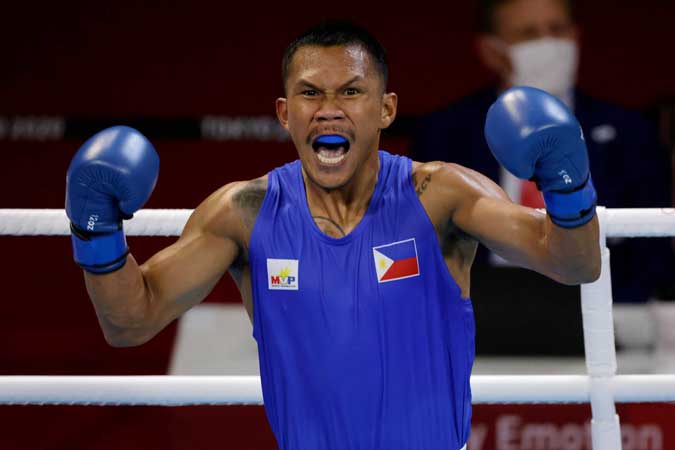
EUMIR FELIX MARCIAL — REUTERS

FILIPINO boxers Eumir Felix D. Marcial and Carlo Paalam shoot for spots in Tokyo Games gold medal matches in their respective divisions at the Kokugikan Arena on Thursday.

Middleweight Mr. Marcial, 25, will take on familiar foe Oleksandr Khyzhniak of Ukraine in the semifinal round set for 2:03 p.m. (Manila time) while flyweight Mr. Paalam, 23, collides with hometown bet Ryomei Tanaka in the semifinals at 1:30 p.m.

Zamboanga native Mr. Marcial has been on a roll in his Olympic debut outing, making short work of his opponents so far and winning in the opening round.

He defeated Algerian Younes Nemouchi in the Round of 16 via a Referee Stopped Contest due to Injury then knocked out Armenian Arman Darchinyan in the quarterfinals to assure the country of another medal.

It is the same form he is looking to sustain when he collides with Mr. Khyzhniak for a spot in the gold medal match.

“I’m ready for this fight. When we first fought, I got injured which was why I lost. Right now, I’m confident of my conditioning and I’m ready heading into the fight,” Mr. Marcial communicated in Filipino to local sports media from Japan.

The Filipino bet lost to Mr. Khyzhniak back in 2018 at the Strandja Memorial in Sofia, Bulgaria.

Meanwhile, Mr. Paalam also has his sights on a shot at a gold medal and has made a strong case for himself.

Mr. Paalam has hurdled every challenge put in front of him in the ongoing tournament, the latest of which was world number one and erstwhile defending Olympic champion Shakhobidin Zoirov of Uzbekistan in the quarterfinals of the flyweight division on Tuesday.

He punched his way into the semifinals by winning on points by split decision in the second round.

Mr. Paalam came out aggressive in his last fight and took it to his opponent right at the opening bell, connecting with solid blows to the head and body en route to claiming the opening round.

In the second, action continued to be frenetic with both fighters tagging one another with clear shots.

Unfortunately, midway into the round both absorbed cuts after a head collision.

Ukrainian referee Pablo Vasylynchuk called for a halt to the play to have the two fighters checked by the ring physician.

With both fighters deemed unfit to continue because of the slight gash in their heads, the fight was halted and awarded to Mr. Paalam, who was ahead on points at the time of stoppage, 20-19, on four judges and a tied 19-19 score in the fifth official for a 4-0 win.

“We really wanted to take the opening round to put pressure on my opponent. Thankfully, we were able to do that and it affected how the fight went,” Mr. Paalam said in Filipino after his win.

He now channels his focus on Japanese Mr. Tanaka, who Mr. Paalam said he is not taking lightly

Messrs. Marcial and Paalam are looking to follow teammate Nesthy A. Petecio who made it to the gold medal match of the women’s featherweight division, but had to settle for silver. — Michael Angelo S. Murillo

No shame in finishing with a silver for Petecio — analyst

NESTHY PETECIO — REUTERS

By Michael Angelo S. Murillo, Senior Reporter

THE women’s featherweight gold medal match in the Tokyo Games boxing tournament on Tuesday ended with Philippine bet Nesthy A. Petecio ending up with the silver medal after bowing to Japanese Sena Irie by unanimous decision.

It was an outcome not a few raised a howl over, particularly in this side of the world, believing that Ms. Petecio was the more active fighter notwithstanding the strategy of Ms. Irie to hold and clinch most of the time to stymie any momentum the Filipino boxer was trying to build.

For boxing analyst Nissi Icasiano, Ms. Petecio has nothing to be ashamed of, or to be sorry for, the silver finish as she did everything she could with the situation she was presented with just as he said the outcome was not totally far off.

“Nesthy has nothing to be ashamed of. It was a tough journey for her. She failed to qualify for the 2016 Rio Olympics. She fell short in the qualifiers for Tokyo, but because of her ranking she was able to make it. This was just her first try in the Olympics and she won the silver medal,” said Mr. Icasiano in an interview with BusinessWorld following the women’s featherweight gold medal match.

“Look at her resume now. She’s both a world champion and an Olympic silver medalist. If there’s a Mt. Rushmore of Philippine boxing, Nesthy Petecio should be up there,” he added.

The analyst went on to say that the fight lived up to the expectations as being more than a clash for the gold medal, but a continuation of a rivalry.

“It was a rivalry between two of the best women’s amateur featherweight boxers. And in boxing, facing the same opponent over and over again is something that is perceived as a double-edged sword. As the old saying goes, familiarity breeds contempt. It can work in your favor or it can work against you… They knew each other’s strengths and weaknesses. It was neck-and-neck from start to finish, and that part is not surprising,” Mr. Icasiano said.

With the win, Ms. Irie extended her lead in her head-to-head matchup with Ms. Petecio to date, 3-1.

As to Ms. Irie being a recipient of a “hometown decision” after completing a unanimous decision victory — four judges scoring it, 29-28, and one having it, 30-27 — Mr. Icasiano said it is hard to speculate and that he is giving the judges the benefit of the doubt.

“A lot of people would argue or ask if there’s a hometown decision involved in the gold medal match. We have to remember that these judges follow four important points as to how to score a bout. First is effective aggression. Though Nesthy was pressing the action, she became hittable and predictable, allowing Sena to create angles and catch Nesthy in awkward angles,” he said.

“Second is ring generalship. For the majority of the fight, Sena was dictating the pace. The Japanese forced Nesthy to approach the fight differently, especially in the second round. Nesthy is a technical boxer, and in this bout, she decided to be the aggressor in order to cut the distance between her and Sena Irie due to the height of the Japanese and stop Sena from landing her jabs. But fighting a different fight proved to be detrimental for Nesthy.”

Then there is defense.

“Third and fourth are defense and clean punches. Nesthy was on the receiving end of big blows,” Mr. Icasiano continued.

Despite settling for silver, Ms. Petecio still made history by becoming the first Filipino female boxer to get a medal in the Olympics. It was also the first medal for Philippine boxing in 25 years in the Summer Games after Mansueto Velasco won silver in Atlanta in 1996.

Pagdanganan in strong start in first round; Saso struggles

BIANCA Pagdanganan (PHL) tees off on the ninth hole during the first round of the women’s individual stroke play of the Tokyo 2020 Olympic Summer Games at Kasumigaseki Country Club. — REUTERS

BIANCA Pagdanganan had a strong showing while Yuka Saso struggled in the opening round of the women’s individual stroke play of the golf competition in the Tokyo Games at the Kasimugaseki Golf Club on Wednesday.

Ms. Pagdanangan, 23, fired a two-under par 69 to be in the mix at the top of the leaderboard at joint seventh place after the first 18 holes while Ms. Saso, 20, scored 3-over par 74, good for 47th place.

Ladies Professional Golf Association (LPGA) Pagdanganan padded her push with back-to-back birdies in the first two holes while holding steady the rest of the way.

She is making her Olympic debut and made it known that she is looking to do well and give the Philippines a good representation.

United States Women’s Open champion Ms. Saso, meanwhile, did not have a good day, with a performance which saw her with five bogeys and just two birdies.

Sweden’s Madelene Sagström topped the opening round with a 5-under par 66, followed by Nelly Korda of the United States and Aditi Ashok of India with a 4-under 67.

Mses. Pagdanganan and Saso resume their Olympic bid in the second round on Thursday with tee-off set for 6:30 a.m. — Michael Angelo S. Murillo

Filipino teen Alex Eala off to winning start in maiden WTA 250 tournament

FILIPINO teen tennis ace Alex M. Eala

FILIPINO teen tennis ace Alex M. Eala got her maiden Women’s Tennis Association (WTA) 250 tournament campaign to a strong start, winning her Round of 32 assignment in impressive fashion on Tuesday night.

Rafa Nadal Academy scholar Ms. Eala, 16, defeated Paula Ormaechea of Argentina in straight sets, 7-5, 6-2, in the opening round of the 2021 Winners Open in Cluj-Napoca, Romania.

Ms. Eala, ranked 639th in the WTA, struggled early against 28-year-old Ormaechea (310th) in the first frame, dropping to a 0-4 hole, but was able to pick up her game as action proceeded.

She managed to level the count at 4-4, and continued to put on the pressure on her opponent before eventually claiming the win in the extended set.

In the second, propelled by the come-from-behind win she had in the opening set, Ms. Eala came out on a better footing, racing to a 5-1 lead and never allowing Ms. Ormaechea to gain any headway after.

“So happy to have won my debut match at a WTA 250 Tournament, The Winners Open,” wrote Ms. Eala in a Facebook post after her victory.

Long-time Globe ambassador Ms. Eala next plays 25-year-old Egyptian Mayar Sherif (187th) in the Round of 16.

Ms. Sherif beat Alize Cornet of France in the previous round in straight sets, 6-2, 6-4.

In the Winners Open, Ms. Eala, the world’s number two juniors player, is looking to build on the gains she has had for the year, which also include winning the girls’ doubles title at the French Open and claiming twin titles in an International Tennis Federation Juniors tournament in Milan in July. — Michael Angelo S. Murillo

Sta. Lucia Lady Realtors, Petro Gazz Angels in important PVL Open Conference match

THE Sta. Lucia Lady Realtors take on the Petro Gazz Angels in a key PVL Conference match, carrying playoff implications, on Thursday. — PVL MEDIA BUREAU

THE Sta. Lucia Lady Realtors and Petro Gazz Angels collide in a key Premier Volleyball League (PVL) Open Conference match, carrying playoff implications, at the PCV Socio-Civic & Cultural Center in Bacarra, Ilocos Norte, on Thursday.

The teams, currently having an inside track at a semifinal berth, face off at 7 p.m. where they hope to solidify their push for a spot in the next round.

Sta. Lucia is at fifth place with a 5-3 record while Petro Gazz is at joint third with a 5-2 card.

A win would assure them of at least a playoff for a semifinal spot if not direct entry to the final four of the ongoing tournament.

The Lady Realtors padded their push with a straight sets win, 25-13, 25-18, 25-16, over the Perlas Spikers on Aug. 3.

MJ Phillips and Jovielyn Prado showed the way for Sta. Lucia in the victory, finishing with 16 and 10 points, respectively. Mika Reyes and Jonah Sabete added nine each.

“It will be do-or-die for us in the next game as it will determine if we will get a chance to enter the playoffs or not. We will try to take our fate in our own hands and let’s see what happens,” said Ms. Reyes of their crucial match against Petro Gazz.

The Angels, for their part, defeated the Balipure Water Defenders in straight sets, 25-20, 26-24, 25-23, also on Tuesday to stay within the top four in the standings heading into the homestretch of elimination play.

Grethcel Soltones led the balanced attack by Petro Gazz in the shutout win, finishing with 14 points, nine coming off attacks.

Ria Meneses had eight points for the Angels while Myla Pablo and Jerrilli Malabanan added seven apiece.

Also playing on Thursday are Balipure (2-5) and PLDT Home Fibr Power Hitters (1-6) at 1 p.m. and Black Mamba Army (2-4) against Perlas (1-5) at 4 p.m. — Michael Angelo S. Murillo

Lakers to land Carmelo Anthony, add Kendrick Nunn, Malik Monk

CARMELO Anthony is joining close friend LeBron James with the Los Angeles Lakers, according to multiple reports.

Anthony agreed to a one-year deal according to his manager, Bay Frazier, and is set to join a rebuilt roster expected to include Dwight Howard, Trevor Ariza, Wayne Ellington, Kendrick Nunn and Malik Monk.

Monk agreed to a deal with the Lakers on Tuesday, per ESPN, before the team reached a two-year, $10-million deal with Kendrick Nunn.

ESPN reported Nunn, whose qualifying offer from the Miami Heat was rescinded, declined more money elsewhere to join the Lakers.

In addition, restricted free agent Talen Horton-Tucker has agreed to a three-year, $32-million deal to stay with the team according to multiple reports.

Anthony came out of retirement to play a meaningful role with the Portland Trail Blazers the past two seasons. At 37, the 10-time All-Star can still score — and shoot. In 2020-21, he averaged 13.4 points per game and shot over 40 percent from 3-point range for the second time in his 18 NBA seasons.

The Lakers are also in agreement on a trade for Russell Westbrook that can become official on Thursday. In that swap, Montrezl Harrell, Kentavious Caldwell-Pope and Kyle Kuzma would relocate to the Washington Wizards.

Given the massive salary figures for Westbrook, James and Anthony Davis — $120 million combined with Westbrook’s $44-million figure added to the scrolls — general manager Rob Pelinka has been shopping for short-term bargains to round out the roster.

Backup point guard Alex Caruso agreed to join the Chicago Bulls on a four-year deal on Monday. — Reuters

McLaughlin breaks world record to win 400 hurdles; Muhammad gets silver

TOKYO — Sydney McLaughlin shattered her own 400 metres hurdles world record to win gold in 51.46 seconds on Wednesday, getting the better of fellow American Dalilah Muhammad in a thrilling Tokyo Olympics final that lived up to all expectations.

The 21-year-old stuttered on the penultimate barrier and trailed Muhammad coming off the last hurdle but carried the momentum into the sprint to the line to cross first and beat her previous record of 51.90 set at the US trials in June.

Muhammad, the 2016 Olympic champion, ran the race of her life to take silver, coming home in a personal best 51.58, while Femke Bol of the Netherlands took bronze in a European record 52.03.

“I’m absolutely delighted. What a great race. I’m just grateful to be out here celebrating that extraordinary race and representing my country,” said McLaughlin. “I saw Dalilah ahead of me with one to go. I just thought, ‘Run your race.’

“The race doesn’t really start until hurdle seven. I just wanted to go out there and give it everything I had.”

The showdown between McLaughlin and Muhammad, 31, was among the most highly anticipated of the athletics program at the Tokyo Games and came a day after Norway’s Karsten Warholm destroyed his own world record in the men’s event.

While silver was not the medal she had been hoping for, Muhammad was thrilled to have set a personal best of 52.16 and said she was proud of her team mate.

“Just like the men’s race, all three of our times would have won any Olympics, any other year,” she added. “I’m so proud to be part of that history and even more proud of my teammate, Sydney.”

It was McLaughlin’s latest blockbuster performance since joining forces in 2020 with famed coach Bob Kersee, whom she credits with taking her to the next level after failing to reach the final at the 2016 Olympics.

Linking up with Kersee also turned her idol — six-time Olympic gold medalist Allyson Felix — into her training partner.

“(Kersee) just changed my perspective on how I approach the race, so yeah, I owe it all to him,” she said. “I knew he saw something different in me than a lot of people did. He knew how to get me there.

“We practise the last 40m so many times,” she added. “I knew I had to go and give it everything I had and dip at the line. Bobby was prepared for that kind of situation.”

Bol, who beat fourth-place finisher Janieve Russell of Jamaica by more than a second for her first Olympic medal, said she knew she had to bring her “A-game” to stand a chance of getting on the podium.

“Those other girls are so strong,” said Bol.

“I felt that I was super-fit. I thought, ‘I’m going to go in hard and see where I finish.’ I knew I was fast and I think I proved that to myself.” — Reuters

Young Japanese skaters win gold and silver in park

TOKYO — Young skaters from Japan and Britain soared to victory in the women’s park competition on Wednesday, with hometown heroes Sakura Yosozumi and Kokona Hiraki cinching gold and silver, while Britain’s Sky Brown took bronze.

In the gripping finals, Yosozumi, 19, landed two 540s in her impressive first run, earning the highest score of 60.09 to vault to top place.

Hiraki, 12, consistently showed smooth runs throughout Wednesday’s competition and took second place with her best score of 59.04.

Britain’s Brown, 13, was the favorite to win the women’s event but stumbled in her first two runs, with her final display of 540 spins and flip indies failing to vault her to a higher spot on the podium.

Far from the empty swimming pools of 1970s Southern California where this type of skating was born, skateboarding’s Olympic debut in Tokyo marks a turning point for the sport.

At times, the young skaters looked impossibly small against the giant grey and purple ramps and bowls at the Ariake Urban Sports Park that is emblazoned with the five Olympic rings. — Reuters

Put your money where your heart is: Sustainable investing is (almost) here!

PCH.VECTOR-FREEPIK

I write this column with so much excitement, simply because it is the first time I am writing something current, real, and about the Philippines, instead of the research I had done in the past decade. There is good reason for this: almost 12 years since I began dipping my feet into understanding Responsible Investing and Impact investments, they are finally taking shape here in the country. Last Friday, I had the privilege of hosting a Philippine Star event entitled, “Green REIT: Investing in the Future,” which was in partnership with Filinvest Land’s upcoming REIT (real estate investment trust), FILREIT. I had expected a webinar meant to market the new product in the market but was pleasantly surprised that it had focused on where we are in the sustainability agenda.

Just to backtrack, Responsible Investment has been present in developed parts of the world, particularly in the United States and in Europe, but has had such little traction domestically. That is not that surprising considering the environmental, governance, and sustainability standards for companies here are much less developed and regulation is largely weak in comparison. Indeed, research has highlighted the “virtuous” cycle of sustainability in that, the more money a corporation has, the higher the likelihood it can use the extra cash to fund sustainable practices, which in turn contribute to — in the best case — better performance, and in a base case, to lower risks. We have relatively small firms, most of which are still in a growth phase wherein resources are being used to simply recover initial equity and attract investors with high returns. The idea of investing in the long-term, in possibly foregoing short-term profit for long-term gains, not simply economically but for our future generations, is something that ends up on the backburner in countries like ours, and more so in a pandemic situation. I mean, would you really cut out “sin” stocks from your investment portfolio, if those are the ones defensive at the moment?

And yet we had a talk with Yayu Javier, the chairperson of the UN’s Global compact network in the Philippines, which illustrates how we now have our own specific country point-person to encourage our local Asset Managers to sign up to the Principles for Responsible Investment (PRI). In another life, I had spent a decade going back and forth to the PRI offices in Shoreditch, London, as part of their Academic network; I had received grants to examine not just Responsible Investment, but the PRI Regulatory and Assessment Framework, talking to more than 80 Asset Managers in Europe. I hoped but never expected it would ever make waves in my own country, and now the possibility is imminent. Interestingly, she mentioned that 40% of high-net-worth individuals currently own or are considering using impact investments, led by 77% millennials and 46% women! Seventy percent of those who have invested are satisfied with the financial performance of their investments.

Enrique Florencio, the Secretary General of the Association of Development Financing Institutions in Asia and the Pacific, came next. From Asset Management to Development and green finance, he explained the different already existing investments in the space, funded by multilaterals and NGOs. The highlight of his presentation was that these are well-established opportunities with deep pockets of funding, and a burgeoning interest from financiers.

We then had Thomas Baudlot, CEO of Engie Southeast Asia who showed photos of their projects in the Philippines such district cooling systems. With 349MW in green power in Southeast Asia, the green revolution in everyday places like malls and townships is just beginning.

And finally, we had Maricel Brion-Lirio who discussed the upcoming REIT of Filinvest Land. I had been covering this and all the other upcoming REITs very closely on BusinessWorld Live and it was the first time that the sustainability-focused angle instead of the yield play was truly brought to the fore. With the parent company now having actual sustainability standards in place (albeit evolving), buying into the REIT is effectively owning a piece of commercial properties who are held to a higher-than-normal sustainability standard. We were excited enough to have REITs finally come into the market after decades in the making, imagine having a Green REIT: two birds with one stone.

Ultimately, we all determine our investment choices based on our risk appetite and research. But one of the best pieces of advice you will hear repeatedly from analysts and seasoned investors is this: invest in companies you love and believe in; imagine that you will effectively own a part of the company and imagine you should believe in their products and services so much that you will risk putting your hard-earned money in its growth. Some people love food and will invest in the food industry for products they love; some people believe that technology is the future and will put their money there; and yet others — like myself, will have only one dream: to put their money where their heart is, and that is in companies that commit to a sustainable future. No excuses now.


Daniela “Danie” Luz Laurel is a business journalist and anchor-producer of BusinessWorld Live on One News, formerly Bloomberg TV Philippines. Prior to this, she was a permanent professor of Finance at IÉSEG School of Management in Paris and maintains teaching affiliations at IÉSEG and the Ateneo School of Government. She has also worked as an investment banker in The Netherlands. Ms. Laurel holds a Ph.D. in Management Engineering with concentrations in Finance and Accounting from the Politecnico di Milano in Italy and an MBA from the Universidad Carlos III de Madrid.

Mandatory vaccination: Science vs law?

PHILIPPINE STAR/ MICHAEL VARCAS

I am on the fence about House Bill No. 9252, which intends to practically make compulsory the vaccination of the public as protection against COVID-19 through a process of what I deem to be selective exclusion. Authored by Cavite Rep. Elpidio Barzaga, Jr., the bill is to be tackled by the House Committee on Health in August or September, according to the lawmaker.

Under the proposed measure, to be known as the Mandatory COVID-19 Immunization Act of 2021, the COVID-19 Vaccination Program will be “mandatory for persons as may be determined by the DoH (Department of Health) and shall be given for free at any government hospital or health center, and as provided in Republic Act No. 11525, provided, that inoculation must, at all times, be science and evidence based.”

Where it gets unclear is in its provision that “no persons who are covered by this Act, as determined by the DoH, shall be allowed to enter, convene or occupy public places, whether or not government or privately owned.” This appears to imply that public places will be only for vaccinated individuals, selectively excluding the unvaccinated majority — including children — from public places.

The bill also provides for the issuance of vaccine cards, making such “as an additional mandatory requirement for educational, employment and other similar government transaction purposes.” Does this mean the proposed law will have the effect of temporarily suspending the civil rights of those unvaccinated against COVID-19? Just like those in detention or in prison?

Moreover, the Barzaga bill provides that “any person who violates any provision of this Act, or any of its rules and regulations or without permission of the quarantine officer in charge, shall be punished by a fine of not more than P50,000, or by imprisonment for not more than one year, or both.”

Mr. Barzaga perceives the need for a “drastic” measure to counter vaccine hesitancy, with urgency prompted by the 2022 polls. “In order to safely achieve herd immunity, a substantial proportion of a population would need to be vaccinated,” he was quoted in a news report. “We hope that we will be able to finish this before the end of the 18th Congress because our problem is elections is just around the corner, and we might run out of time.”

In persuading more people to get vaccinated as protection against disease, would we rather have them persuaded by science or by law? Science, or course, can make compelling arguments for or against, but the choice to act remains personal and free. Law, on the other hand, compels one to act under duress, or through some form of pressure, regardless of science.

In March, I called on legal and medical experts to chime in on whether COVID-19 vaccination should be mandatory or compulsory — an interesting case for Bioethics. This was after I noted that while pandemics were not unprecedented, COVID-19 is, and the same goes for the extraordinary havoc it continues to wreak on lives and the global economy.

With the Barzaga bill filed in late April and now seemingly under way, now is the time for the legal and medical community to be heard. The public will surely benefit from expert opinion on the matter, and I am sure lawmakers cannot claim a monopoly on ideas. Making experts’ opinions, backed by data, publicly available will benefit the public and policy makers alike.

The Barzaga bill has an unintended political dimension, and that is the possible selective exclusion of the unvaccinated majority from public places like polling precincts. If the bill passes before the end of the year, imagine the implication on the 2022 presidential, senatorial, and local elections? When in fact COVID-19 should not be an issue. The United States successfully held presidential elections in 2020 without making vaccination mandatory.

One compelling argument in favor of mandatory vaccination is that vaccine hesitancy may prevent herd immunity, and that unless a critical mass or people will get the vaccine, the infection and death toll from COVID-19 will continue to rise. If only 10 out of 100 will favor vaccination, then the overall inoculation process may be for naught.

On the other hand, experience also shows that mandatory vaccination is not a cure all. In a Feb. 16 report in The Straits Times by Indonesian Correspondent Wahyudi Soeriaatmadja, he wrote that “Indonesia has made coronavirus vaccination for citizens compulsory,” and that “people who are eligible for vaccination but refuse a jab can be penalized” with fines, delays or suspension of social aids, or delays or suspension of access to public services. That was in February. Since then, six months after, Indonesia is still struggling with the Delta variant.

In the US, which is also struggling against the Delta variant now, the 1905 US Supreme Court case of Jacobson v. Massachusetts already affirmed the authority of the state to compel vaccination, noting that “the rights of the individual may at times, under the pressure of great dangers, be subjected to such restraint to be enforced by reasonable regulations as the safety of the general public may demand.”

Even the US Equal Employment Opportunity Commission, last December, reportedly issued guidance stating that employers were legally allowed to require employees to be vaccinated before they return to offices. In a way, vaccination can also indirectly address the concern that further easing of quarantine restrictions or allowing greater capacity for businesses and transportation can lead to more deaths.

But this brings me to the point that if the state’s regulation of healthcare is intended to ensure the protection of lives and the promotion of the greatest public good, but at the same time acknowledging that COVID-19 vaccines are generally “experimental,” can we morally make inoculation compulsory for all? Can we deny people the right to vote in a public polling place? Can we suspend the civil rights of those who chose to skip vaccination? Can the Barzaga bill settle the constitutional and moral issues?


Marvin Tort is a former managing editor of BusinessWorld, and a former chairman of the Philippine Press Council

matort@yahoo.com

Transparency to strengthen consent of the governed

MACROVECTOR-FREEPIK

For the last several months, political parties and groups have been doing the rounds. Their operatives regularly exchange notes, some of which are mere red herrings to confuse and mislead.

There are self-styled political analysts, businessmen, academics, public relations and advertising agencies, potential financiers, vote security experts, IT practitioners, characters claiming inside connections within the election commission agency, pollsters of all stripes and biases, both independent and “captured,” and others who may claim to have some political insight and savvy to qualify as seasoned advisers.

The intensity of these groups’ activities mirrors the complexity of political and electoral intelligence gathering, maneuvering, and psy war. As all of these are being undertaken, another group sifts through and analyzes the data gathered. Preliminary “what if” scenarios are formulated and non-quantitative and rudimentary gaming theory is conducted with quite a number of assumptions on decisions and moves to be made by certain parties in the equation. All these are being conducted at this time of the year — in the midst of the pandemic — to achieve the sole objective of coming up with a presidential candidate. The rest of the slate, starting with the vice-president, is adjustable as some kind of wild cards and subjects of hard bargaining and negotiations that sometimes affect local slates.

As the slate talks are conducted, an unavoidable but critical subject, especially for a divided and underfunded opposition, becomes the main item on the agenda: “We may have a popular and powerful slate, but what about the conduct of the counting?”

This question was the main point of discussion in two presentations made by Namfrel National Chairman Augusto Lagman and Automated Election System Watch (AES Watch) spokesman, Dr. Nelson Celis. Both Celis and Lagman are veteran IT practitioners and academicians who have called the attention of the public and the Commission on Elections (Comelec) to various issues on the conduct of elections, including staging demonstrations in front of the Comelec office in Intramuros. Their latest crusade is for the return of the manual count at the precinct level and the use of automation going to the canvassing. In short, a hybrid election system. In addition, they point out the lack of compliance by Comelec with certain basic legal requirements.

In his paper, “Understanding the Automated Election System for Transparency,” Lagman details his proposal for a manual count, a proposal he has been advocating for many years. So far, Lagman and Celis have been ignored by all sectors, including the legislative branch and by the weary public itself.

In his presentation, Lagman points out that a number of mature democracies have abandoned e-voting. Germany did away with electronic voting on the grounds of lack of transparency — “the voter could not see what actually happened to his vote inside the computer and was required to exercise ‘blind faith’ in the technology.” In the Netherlands, e-voting was suspended after 20 years of use when activists showed that the system could, under certain circumstances, endanger the secrecy of the vote. Other countries have abandoned total e-voting for various reasons: lack of transparency; nobody witnesses the counting; any time precinct counting is automated, transparency is lost; it is very vulnerable to tampering by an insider.

The proposed manual count at the precinct level uses the same procedure employed in the past. The chairman of the Board of Election Inspectors (BEIs), reads each ballot. In the old system, the votes were read by the chairman of the BEI and were tallied on preprinted and Comelec-supplied sheets that were posted on a tally board. The votes cast for each candidate were written across the candidate’s name, while another BEI member did a separate manual tally.

In Lagman’s proposal, the second BEI types the vote received by a candidate into a laptop which is connected to a giant screen. The screen shows the public the votes recorded as they are read in each precinct. This transparent system will obviate the need of watchers crowding around the tally board and the election inspectors. Manual counting advocates stress that by displaying the votes on a screen, you solve the problem of voters and watchers crowding around the election officials without observing social distancing. No danger of the vote counting being another super spreader event. Technology therefore has a remedy for this potential problem of people not observing social distancing.

Advocates of total automated voting point out that the Precinct Count Optical Scan (PCOS) machine automated the precinct-counting thus saving five to 12 hours of counting at a cost to government of P10 billion. PC servers and laptops automated the canvassing thus saving over 40 days of work at a cost of P300 million. Lagman and his fellow IT practitioners however stress that since 2008, “the obvious approach of automating only the canvassing, transmitting the election returns (ER) electronically, while keeping precinct-counting manual has been recommended to Comelec but the recommendation has remained unheeded.”

Lagman caps his argument for a manual count at the precinct level by stating his key points: all steps of the election process are transparent; tallying is done under the watchful eyes of the voters; accuracy of the count is high since manual counts are the basis of accuracy; and cost is much less than direct recording electronic (DRE) and OMR or optical scan machine reader which will cost P4 billion. Ballots too will be more expensive under automated elections.

If Gus Lagman’s presentation was both instructive and informative, Dr. Nelson Celis’s talk was not only informative and instructive, it was also breathtaking for its insights. To begin with, Celis’s topic title said it all: “Will the automated polls deliver a clean, accurate and credible election in 2022?”

It was indeed a pointed question and Celis obliged with specific answers which he had been uttering since the introduction of automated elections.

Celis, other IT practitioners, and civil society groups have raised a number of issues and concerns: non-compliance with the Automated Election System (AES) Law or RA 8456 (1997), as amended by RA 9369 (2007), specifically, the non-promulgation of the law’s implementing rules and regulations (IRR), a standard legal requirement before a law can be enforced; unsecure communication channels; non-authentication of Board of Election Inspectors and Board of Canvassers through their digital signatures; non-generation of a voter’s receipt in the 2010 and 2013 elections; disregard of the Comelec Advisory Council; no source code reviews or limited access to the said code; no continuity plan which has resulted in no clear and legal explanation of the seven-hour glitch or delay during the counting of votes in the 2019 senatorial and local elections.

Celis has a compelling case. He cites Section 37 of the Automation Law: “The commission shall promulgate rules and regulations for the implementation and enforcement of this act.” Celis claims that the completion of this important document has been pending for 24 years, since 1997. The non-promulgation of the IRR has led to a lawyers’ delight as various misinterpretations have been made of the law, Celis claims.

After having raised these concerns for the nth time with about nine months to go before election day on May 9, 2022, what do we do now? What is government, that provides the funds for the elections, and the judiciary, supposed to do?

In 2004, the Supreme Court stopped what could have been the first automated election. The high court ordered Comelec to implement instead manual elections. Are we headed for the same direction?

To repeat: will the automated polls deliver clean, accurate and credible 2022 elections?


Philip Ella Juico’s areas of interest include the protection and promotion of democracy, free markets, sustainable development, social responsibility and sports as a tool for social development. He obtained his doctorate in business at De La Salle University. Dr. Juico served as Secretary of Agrarian Reform during the Corazon C. Aquino administration.


ADVERTISEMENT
ADVERTISEMENT