Home Blog Page 7698

McDonald’s US makes masks mandatory for all customers, staff

MCDONALD’S Corp. on Monday confirmed that all its customers and staff will need to start wearing masks again inside its US restaurants in areas with high or substantial transmission, regardless of whether they are vaccinated or not.

The resurgence of coronavirus disease 2019 (COVID-19) cases in the United States due to the Delta variant and the new guidance from the US Centers for Disease Control and Prevention (CDC) that requires fully vaccinated individuals to wear masks have led companies to change their plans on vaccinations and masking.

Last week, major companies including Alphabet, Inc.’s Google, Uber Technologies, Inc. and Facebook, Inc. said all their US employees must get vaccinated to step into offices.

McDonald’s also said that masks were always mandatory for staff and customers who were not vaccinated. The Associated Press first reported on the move. — Reuters

CNPF books P1.4-B income in second quarter

PROCESSED food maker Century Pacific Food, Inc. (CNPF) earned a total comprehensive income of P1.43 billion in the second quarter, nearly 19% higher than the P1.21-billion income logged year on year.

The listed company, which manufactures and distributes processed marine, meat, milk, and coconut products, saw its topline for the quarter go up by 4.7% to P13.62 billion from P13.01 billion.

In the first six months, CNPF’s net income grew by 21% to P2.7 billion because of “strong export sales, resilient local demand, and favorable tax rates.” Its exports business posted a 29% growth as global markets reopened.

The company said it benefited from tax rates following the implementation of the Corporate Recovery and Tax Incentives for Enterprises (CREATE) law on top of the income tax holiday on its new tuna plant, lowering its income tax rate to 16%.

CNPF Chief Financial Officer Richard S. Manapat said in a statement on Wednesday that the company plans to reinvest the profits in capacity expansion programs and other sustainability initiatives.

The company is expanding its coconut production facility, aiming for a 50% boost in the plant’s capacity. It targets to generate 500 manufacturing jobs by the third quarter.

Meanwhile, CNPF commissioned a 5.2-megawatt solar photovoltaic plant to power its General Santos-based tuna and coconut manufacturing facilities.

Its consolidated revenues went up by eight percent to P27 billion, with branded revenues inching up by three percent year on year.

“We are grateful for this revenue growth following the surge in sales we saw last year,” Mr. Manapat said.

“We see this as a reflection of organic demand, given that pantry loading hasn’t occurred in the same magnitude as 2020,” he added.

The company said that in preparation for the next round of stringent lockdown measures, it “beefed up its inventory covers to ensure food security and business continuity.”

“As we ease into the second half of the year, we acknowledge that we are still very much in uncertain times,” Mr. Manapat said. “We continue to monitor key risks, such as inflationary pressures and forex fluctuations, and we have plans in place to mitigate and hedge ourselves against the potential impact.”

The company will continue to aim for double-digit growth, he added.

“We believe this will be supported by the resilient demand for essentials and consumer staples, continuous growth in our OEM (original equipment manufacturer) exports business, and innovations underway,” Mr. Manapat said.

CNPF shares at the stock exchange declined by 2.72% or 70 centavos to close at P25 each. — Keren Concepcion G. Valmonte

Google’s new Pixel phones feature a processor designed in-house

REUTERS

GOOGLE is making a bigger bet on smartphones by joining rivals Apple, Inc. and Samsung Electronics Co. in designing the device’s most critical component in-house: the main processor.

The Alphabet, Inc. company said on Monday that its upcoming flagship phones, the Pixel 6 and Pixel 6 Pro, will include new Tensor chips when they go on sale later this year. Google had previously used Qualcomm, Inc. processors in all of its Pixel phones since the first models launched in 2016. The new chip is designed to bolster artificial-intelligence technology and improve both speech recognition and the processing of photos and video.

The new component will be Google’s first system-on-a-chip — technology that integrates the device’s key elements. Designing these kinds of processors takes years and is a massive investment, financially and in terms of resources. In order for such an undertaking to yield returns, Google’s future Pixel phones will likely have to sell better than previous models.

Apple has been making chips for its iPhones since 2010, but the company sells over 100 million units per year. Samsung also handles massive volume. It’s the world’s second-largest chipmaker and sells more phones than Apple.

Google’s Android operating system is the most popular smartphone software, used by companies such as Samsung to run their devices. But Google’s own phones haven’t had as big an impact, even while earning praise for their designs and features.

The Pixel sales were lackluster for their first few years, before increasing in 2019 when the company focused more attention on lower-end handsets. But that growth sputtered. In the first half of 2021, Pixel market share decreased 7% year over year, according to Counterpoint Research. OnePlus, another small phone maker, saw sales increase over 400%. Motorola, Apple, Nokia and Samsung also grew.

Google plans to launch a new low-end 5a phone this month, but that device is expected to continue using a Qualcomm processor.

Google didn’t provide technical specifications for its new processor, but the company developed the component with several former Apple chip engineers on staff. It’s unclear how it will ultimately perform in its first iteration against more seasoned offerings from Qualcomm, Apple and others. The chip relies on an Arm Holdings instruction set; the same underlying technology used by most of the industry.

In a statement, Google Chief Executive Officer Sundar Pichai said the chip was in development for four years and called it the “biggest innovation in Pixel we’ve made to date.” Rick Osterloh, the company’s head of devices and services, said in an interview that the phones will formally debut in October and go on sale later this year.

Beyond the new chip, the new Pixel phones will have redesigned exteriors. Both phones now have edge-to-edge screens with metal edges, as well as a hole-punch-sized camera hole at the top of the display. They also trade in a rear-facing fingerprint sensor with a scanner built in to the display.

The standard Pixel 6 has a slightly smaller display than the Pixel 6 Pro, which also has shinier metal edges and an extra camera. Both phones have a standard camera sensor, an ultrawide-angle lens and a time-of-flight sensor for measuring distance. The Pro model adds a telephoto lens for a wider range of zoom.

Google is also using the Pixel 6 line to debut its new Material You design system as part of Android 12. The new approach changes button and interface colors to better match the phone’s chosen wallpaper. — Bloomberg

Term deposits fetch mixed yields ahead of NCR lockdown, inflation

BW FILE PHOTO

YIELDS ON THE central bank’s term deposit facility were mixed on Wednesday prior to a two-week lockdown in the National Capital Region (NCR) and amid market expectations of slower inflation in July.

Total bids for the term deposit facility (TDF) of the Bangko Sentral ng Pilipinas (BSP) amounted to P643.58 billion on Wednesday, above the P560-billion offer and also surpassing the P613.267 billion in tenders seen during last week’s auction.

Broken down, demand for the seven-day papers amounted to P185.592 billion, going beyond the P160 billion auctioned off by the BSP as well as the P181.371 billion in tenders logged last week.

Accepted yields for the tenor ranged from 1.675% to 2.02%, a slightly narrower band compared with the 1.65% to 2.05% seen previously. This caused the average rate of the one-week deposits to rise by 2.21 basis points (bps) to 1.7375% from 1.7154% on July 28.

Meanwhile, the two-week papers fetched bids worth P457.988 billion, surpassing the P400-billion offer and the P431.896 billion in tenders seen at last week’s auction.

Banks asked for yields ranging from 1.719% to 1.759%, a smaller margin compared with the 1.72% to 1.7695% band seen in the previous auction. With this, the average rate for the 14-day term deposits dipped by 0.38 bp to 1.7448% from 1.7486% previously.

The central bank did not offer 28-day term deposits for the 41st straight auction to give way to its weekly offerings of bills with the same tenor.

The BSP uses the TDF and its short-term bills to mop up excess liquidity in the financial system and to better guide market rates.

TDF yields were mixed this week as investors priced in the impact of the upcoming lockdown in Metro Manila, Rizal Commercial Banking Corp. Chief Economist Michael L. Ricafort said.

“This may have to do with preparations for the enhanced community quarantine as investors increase their arsenal of peso funds to tide them over the lockdown that could reduce economic activities and may necessitate drawing of funds from savings,” Mr. Ricafort said in a text message.

Metro Manila, where more than a third of the country’s economic activities happen, will be under the strictest lockdown classification again from Aug. 6 to 20 as the government aims to prevent the spread of the more infectious Delta variant of the coronavirus disease 2019.

Market expectations of slower inflation in July also affected the movement of TDF yields this week, Mr. Ricafort added.

The Philippine Statistics Authority will release the July inflation report on Thursday, Aug. 5.

A BusinessWorld poll last week of 15 analysts yielded a median estimate of 4% for July headline inflation. If realized, this would be slower than the 4.1% print in June and will be the first time inflation is within the BSP’s 2-4% target since the 3.5% in December 2020.

Analysts said inflation likely eased last month due to lower meat prices, which is seen to offset higher costs of oil and other food items.

This year, the central bank expects inflation to average 4%. The CPI reading in the first half of the year was still above target at 4.4%. — Luz Wendy T. Noble

Dining In/Out (08/05/21)

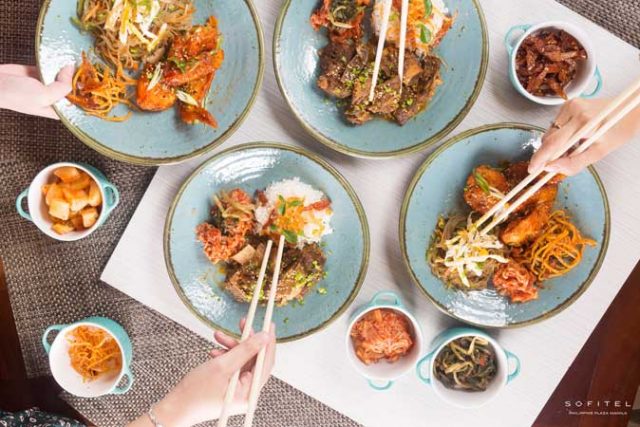
Korean Signature

Experience Spiral at home

SPIRAL buffet restaurant presents Spiral at Home, a specially chosen menu of signature dishes from across its 21 dining ateliers. Sofitel Philippine Plaza Manila’s flagship restaurant offers diners to a variety of regional favorites from around the world, taking them to a culinary journey from the comforts of home. The Spiral at Home specialties include a wide variety of options such as DIY Kits, Ready-to-Eat dishes, Cakes and Pastries, a Premium Feast selection, Deli, and Corporate Lunch Boxes. Leading the line-up is the DIY Kit Menu, comprised of Spiral’s most popular dishes such as Laksa, Indian Thali, Designer Cronuts, Spiral Burger Royale with foie gras, and more. Spiral’s pièce de résistance, the L’Epicerie, more popularly known as the Cheese Room, is now a click away and diners curate their own grazing platter with a wide variety of artisan cheeses, cold cuts, and signature homemade breads. Butchery items such as prime rib, rib eye, and Hungarian sausages are also available, as well as pantry items such as truffle oil and jams. Ready-to-Eat Dishes include rice bowls and noodle bowls of Thai, Japanese, Korean, Indonesian, and Vietnamese cuisines. Menu highlights include Pad Krapow Moo, Chicken Katsudon, Hiyashi Chuka Ramen, and Pad Thai to name a few. For the health buff, salad bowls such as Keto Bowl, Superfood Bowl, and Buddha Bowl are likewise available. Cakes and pastries from Spiral’s La Patisserie present creations such as Praline Salted Caramel Cake, Banana Nutella, Strawberry and Vanilla Shortcake, Chocolate Decadent Cake, and Kapeng Barako Mud Pie prepared by its pastry artisans. Spiral at Home’s Premium Feast Menu include the Japanese Sushi Platter, Omakase Set, and Churrasco Box just to name a few, good for four to six persons.  Spiral’s Corporate Lunch Boxes featuring international set menus for remote or hybrid events. Japanese, Asian, and Western sets are available for lunch and dinner, as well as a line-up of Japanese Wanpaku Sandwiches for heavy snacks. Last but not the least, a wide range of select Old World and New World wines are not to be missed, straight from Spiral’s famed wine cellar. Varieties of champagne, red, white, and sweet wines from France, Italy, Germany, Chile, South Africa, and Argentina represent Sofitel’s signature flair for fine wines. Spiral at Home is available for pick-up and delivery at www.spiralathome.com. DIY Kits, Cakes and Pastries, and Premium Feast menus are available for pre-order 72 hours prior to scheduled pick-up. Ready-to-Eat, Corporate Lunch Box, and Deli items are available following Spiral restaurant’s operating hours. For inquiries, contact Spiral Reservations at H6308-FB12@sofitel.com or 8-832-6988. Follow Spiral Manila’s Facebook and Instagram pages for more updates and fresh promotions.

Tim Hortons now has new app

TIM HORTONS Philippines officially introduced its new app, on Aug. 3, to provide guests with rewards, perks, and special offers that can only be redeemed through the app for pick-up transactions. Coming soon will be a delivery option, as well. Through the new Tim Hortons Philippines app, favorites such as the best-selling Tim Hortons iced coffee, Farmers Breakfast wrap, Artisan Grilled cheese, and many more can be ordered in a single mobile platform. In addition to the exclusive offers, the app also allows guests to schedule pick-up orders, share customer feedback, earn and redeem rewards points, enjoy monthly exclusive promos, learn about the brand and its locations, and much more. Customers need to download the Tim Hortons Philippines app on their iOS or Android device and register an account. Once registered, app-exclusive rewards will appear in the “Loyalty” section and guests can select the reward that they want to redeem and tap “use in mobile” to activate and proceed with their pick-up order. To stay updated with the latest Tim Hortons news and information for takeout and delivery options, follow Tim Hortons Philippines on Facebook at www.facebook.com/TimhortonsPhilippines, Instagram @timhortonsphl, Twitter @timhortonsph or visit the website www.timhortons.ph.

Nespresso offers deals for coffee at home

RUNNING until Aug. 31, take advantage of Nespresso’s biggest limited-time offer to upgrade your pantry and stock up on coffee to carry you through the next months. Coffee drinkers can get their hands on Nespresso machines at 20% off when they purchase stand-alone units (except Creatista) with three coffee sleeves. Choose from Essenza Mini, Essenza Plus, Inissia, Pixie, or Citiz for compact machines that easily integrate with work spaces, home offices, common areas, and more. For those who prefer machines with built-in milk frothers for their daily lattes, flat whites, and creamy cappuccinos, customers can also opt for the innovative model that allow coffee drinkers to test their skill and creativity when they craft traditional or new recipes: the new Nespresso Atelier. It comes with a technology that allows the user to froth any type of milk and plant-based alternatives, such as almond or soy drink, all directly into a cup. The Nespresso Atelier has a slim, modern shape and brushed stainless-steel finishes. Meanwhilke, for every purchase of 15 coffee sleeves, patrons can avail 30% off on the Aeroccino 3 — a separate milk frother device that makes hot or cold creamy milk recipes possible like lattes or cappuccinos. Choose from its all-time favorites which offer a variety of mild to intense blends: Master Origin, World Explorations, Ispirazione Italiana, or Barista Creations. Meanwhile, from Aug. 7 to 9, the 8.8 online exclusive promo will gift customers a free View espresso cup for every coffee machine purchase transacted online. The promo culminates at the Ultimate Weekend exclusive from Aug. 27 to 31, which lets HSBC, BPI, and BDO cardholders avail of up to six months installment at 0% interest when they buy Nespresso machines either online or in-store. For more information on Nespresso products and offers, visit www.nespresso.ph, or follow @nespresso.ph on Instagram and or @nespresso.phl on Facebook. Nespresso retail stores are located in Power Plant Mall and The Podium, while pop-up stores are located in Greenbelt 5, One BHS, SM Mall of Asia, SM Aura, Alabang Town Center, Shangri-La Mall, Robinson’s Magnolia, and Trinoma.

FamilyMart launches Coffee Creations Caramel Macchiato

FAMILYMART is introducing a new addition to its Coffee Creations line with the Caramel Macchiato, which is now available across stores nationwide. Made with coffee, milk, vanilla syrup, and drizzled with caramel sauce, the new drink is served over ice, retailing for P105 for every 16 oz cup. It can be ordered over-the-counter across FamilyMart stores in the country, including those recently opened in Cebu and Baguio. The Caramel Macchiato is the latest drink to be added to FamilyMart’s coffee line called Coffee Creations. Launched in 2019, it has since introduced different drinks, including the Matcha Series, the Chocolate Series, and the Japanese cherry blossoms-inspired Sakura Series. Aside from specialty drinks, FamilyMart has also expanded its menu of ready-to-eat and “ready-to-heat” items including recently introduced items such as takoyaki and new onigiri variants.

The winner of the Japan-Philippines 65th Anniversary Online Cooking Contest

FOOD and Friendship: The Japan-Philippines 65th Anniversary Online Cooking Contest has found its winner in the dish “Shirashi in Tempura Taco Nori” by Ana Liezl Quibrantar. The online competition featured photo and video submissions from Filipino contestants that focus on Japanese cuisine and/or Filipino-Japanese fusion cooking. The entries were judged on criteria such as presentation, recipe, and photo (first round) or video (second round) quality. “Shirashi in Tempura Taco Nori” is derived from the classic Japanese dish shirashi. This version is prepared with marinated fish (similar to the Filipino kinilaw), mango, avocado, cucumber, and spring onion. It is served in a deep-fried nori shell with sushi rice topped with mayo and wasabi tobiko. The winning entry was determined by chef Suzuki Daisuke, who was awarded with the 2019 Foreign Minister’s Commendation for Excellent Executive Chef. Mr. Suzuki commended the finalists’ creativity in combining elements of Japanese and Filipino cuisine and their interpretation of classic recipes. He also noted the winning dish stood out because of its unique preparation technique and artful presentation. The contest is part of the year-long celebration of the 65th Anniversary of the normalization of bilateral ties between Japan and the Philippines. For the complete list of finalists and entry descriptions,  visit: https://www.ph.emb-japan.go.jp/itpr_en/11_000001_00500.html. To see other events and activities connected to the 65 Years of Japan and the Philippines, visit: https://www.ph.emb-japan.go.jp/itpr_en/11_000001_00426.html     

House clears Manila Water, Maynilad franchise bills

Patrizhialreyes, CC BY-SA 4.0 , via Wikimedia Commons

LAWMAKERS at the House of Representatives have approved on Tuesday measures to grant the franchises of Manila Water Co., Inc. and Maynilad Water Services, Inc. on third and final reading.

Voting 206-7-0 for both bills, they approved House bills 9422 and 9423, which grant separate 25-year congressional franchises to the two companies.

If legislated, these will extend the authority of the water concessionaires to establish, maintain waterworks and sewerage systems in Metro Manila and nearby provinces.

The approval comes after Manila Water and Maynilad signed their revised water concession contracts with the government through the Metropolitan Waterworks and Sewerage System (MWSS) on March 31 and May 18, respectively.

Bayan Muna Party-list Representative Carlos Isagani T. Zarate criticized the approval of the bills, noting the speedy process by the House Committee on Legislative Franchises without scrutinizing and debating on the provisions of the new concession agreements.

“In fact, even the MWSS-Corporate Office itself has expressed issues with the franchise proposals. Moreover, consumers were not consulted [on the proposals],” he said.

He expressed concern over the charges that have been imposed on consumers such as environmental charges, rate rebasing, and unrelated company expenses such as donations and flowers.

Cagayan de Oro City Rep. Rufus B. Rodriguez also urged the House leadership on Wednesday to recall the approval of the measures. He added that he would have debated on whether concessionaires are required to install sewerage system and plants along with the matter on “systems loss.”

“Why should we pay for water or electricity that is pilfered or stolen, that is lost due to leaks, negligence, inefficiency, and other causes beyond the control of the consumer? Like electricity, is wasted water subjected to the 12-percent value added tax,” Mr. Rodriguez said.

Metro Pacific Investments Corp., which has a majority stake in Maynilad, is one of three Philippine units of Hong Kong-based First Pacific Co. Ltd., the others being Philex Mining Corp. and PLDT, Inc.

Hastings Holdings, Inc., a unit of PLDT Beneficial Trust Fund subsidiary MediaQuest Holdings, Inc., has interest in BusinessWorld through the Philippine Star Group, which it controls. — Russell Louis C. Ku

Chinese crypto addresses sent $2.2 billion to scams, darknets in 2019-2021 — report

TRUSTPAIR.COM

NEW YORK — Chinese cryptocurrency addresses sent more than $2.2 billion worth of digital tokens to addresses tied to illegal activity such as scams and darknet operations between April 2019 and June 2021, according to a report from blockchain data platform Chainalysis released on Tuesday.

These addresses received $2 billion in cryptocurrency from illicit sources as well, making China a large player in digital-currency related crime, it added. The report analyzes China’s cryptocurrency activity amid government crackdowns.

However, China’s transaction volume with illicit addresses has fallen drastically over the two-year period in terms of absolute value and relative to other countries, Chainalysis said. The big reason is the absence of large-scale Ponzi schemes such as the 2019 scam involving crypto wallet and exchange PlusToken that originated in China, it noted.

Users and customers lost an estimated $3 billion to $4 billion from the PlusToken scam.

The vast majority of China’s illegal fund movements in crypto has been related to scams, although that has declined as well, the Chainalysis report said.

“This is most likely because of both the awareness raised by PlusToken, as well as the crackdowns in the area,” said Gurvais Grigg, global public sector chief technology officer at Chainalysis, in an e-mail to Reuters.

The report also cited trafficking out of China in fentanyl, a very potent narcotic pain medication prescribed for severe pain or pain after surgery.

Chainalysis described China as the hub of the global fentanyl trade, with many Chinese producers of the drug using cryptocurrency to carry out transactions.

Money laundering is another notable form of crypto-based crime disproportionately carried out in China, Chainalysis said.

Most cryptocurrency-based money laundering involves mainstream digital currency exchanges, often through over-the-counter desks whose businesses are built on top of these platforms.

Chainalysis noted that China appears to be taking action against businesses and individuals facilitating this activity.

It cited Zhao Dong, founder of several Chinese OTC businesses, pleading guilty in May to money laundering charges after being arrested last year. — Reuters

Demand for health, life insurance products grows due to pandemic

VAN TAY/UNSPLASH
THE Philippine American Life and General Insurance Co. said it is seeing increased demand for life insurance products due to the pandemic. — VAN TAY/UNSPLASH

MORE FILIPINOS are now interested in availing insurance products for health and life protection versus investment-linked offerings amid the coronavirus disease 2019 (COVID-19) pandemic, officials from The Philippine American Life and General Insurance Co. (AIA Philam Life) said.

“What we’ve seen is that there was really heightened awareness for protection products: medical, critical illness, even life insurance products that provide something for the family in case someone passes away,” AIA Philam Life Chief Marketing Officer Leonardo T. Tan, Jr. said at an online briefing on Wednesday.

He noted that while they still continue to offer products targeting long-term savings which still sell “quite well,” there have been “product shifts” amid the health crisis.

He said the insurer has paid around P375 million in claims since March last year or when the first lockdown occurred until July 2021. These claims were both hospitalization and death claims attended to by AIA Philam Life, their joint venture bancassurance firm BPI-Philam Life Assurance Corp., as well as their partnership with Citigroup, Inc.

Among the pandemic-related offerings the insurer launched this year is an accommodation feature for their medical plans, which includes coverage for the side effects caused by vaccination versus COVID-19.

“This is also our way of helping the government in achieving herd immunity,” Mr. Tan said.

Another product is the AIA Health Cover, which includes coverage for COVID-19.

AIA Philam Life Chief Executive Officer Kelvin Ang said the company’s learnings from the global financial crisis have helped them through the impact of the pandemic.

“AIA Philam Life has maintained a very strong financial standing because most of our customers buy insurance policies with a commitment for a whole life, they pay for 10 years, 20 years…. It is important to ensure that their insurance company will still be around,” he said.

AIA Philam Life recorded the largest assets among life insurers last year with P291 billion, based on data from the Insurance Commission.

Meanwhile, it ranked second in terms of net income that year with P4.52 billion, and fourth in terms of net premiums, logging P16.77 billion. — L.W.T. Noble

Udenna units seek to extend Malampaya life  

PHILSTAR

The Udenna Corp. subsidiaries that are set to control the Malampaya deepwater gas-to-power project plan to hold drilling activities aimed at increasing reserves and extending the gas field’s lifespan.

In a statement on Wednesday, Malampaya Energy XP Pte. Ltd. and UC38 LLC – collectively the Malampaya Energy Group – said: “At the core of [our] program is the planned drilling campaign in the SC (service contract) 38 license area to add reserves and extend the life of the asset.”  

The group added that it would evaluate well and production enhancement technologies, which could improve recovery from the main Malampaya field.

Belinda C. Racela, the group’s top executive, said the companies would draw on “proven rejuvenation” strategies that successfully increased production and extended the lifespan of mature and divested oil fields in other countries.

“There is a brilliant, highly motivated and experienced team in place at Malampaya that can make this happen when we support them with the right, highly specialized technical experts and contractors,” she said.

Department of Energy estimates show that the Malampaya gas field is set to be completely depleted by the first quarter of 2027.

Malampaya Energy, a unit of Dennis A. Uy-led holding firm Udenna, seeks to fully acquire the stake of the gas field’s operator Shell Philippines Exploration B.V. (SPEx).

His group of companies said they are prepared to ramp up investments in new exploration and production enhancement technologies.

“There are a range of innovative new production enhancement tools and techniques that have emerged in recent years that have never been applied at Malampaya,” Ms. Racela said.

“We now have a window of opportunity to increase production while simultaneously exploring for new resources in the SC38 license area. There is potential to breathe new life into the Malampaya field if we act quickly and decisively,” she added.

Ms. Racela is also the president of UC38 LLC, which owns a 45% stake in the offshore gas field that supplies 20% of the country’s energy needs.

Malampaya Energy Group describes itself as a 100% Filipino-owned business led by a qualified team of energy professionals who have worked with Shell, Chevron and ExxonMobil.

In May, SPEx announced that it had signed an agreement for the sale of 100% of its shareholdings in the project to Malampaya Energy XP. The deal comes after SPEx said in September last year that it was selling the stake.

The base consideration of the SPEx sale is $380 million, with additional payments of up to $80 million from 2022 to 2024 depending on asset performance and commodity prices.

The agreement is projected to be completed by the end of 2021, and is contingent on partner and regulatory consent.

SPEx holds a 45% interest in SC 38. State-led Philippine National Oil Co.-Exploration Corp. holds the remaining 10%. — Angelica Y. Yang

Philippine ranks 52nd in global startup ranking

The Global Startup Ecosystem Index by research center StartupBlink assesses the startup ecosystems of 1000 cities and 100 countries based on the quantity and quality of startups and other supporting organizations, as well as the prevailing business environment*. In the report, StartupBlink said the index is used annually by startups and other stakeholders to “support critical decisions about strategy, relocation, and investment.” Moreover, StartupBlink is using the index and related datasets in their analyses and policy advising projects related to the development of startup ecosystems for governments and international organizations. Results of the 2021 index** show the Philippines ranking 52nd out of 100 countries, up one spot from the previous year. The report noted the Philippines is making strides toward becoming a “formidable startup ecosystem” in the Asia-Pacific region, and that it has a promising future in terms of startup development given the interest from both international and local venture capitalists. However, it noted some challenges that limited the country from developing into a fully mature startup ecosystem such as the lack of infrastructure and “slow regulatory support” faced by entrepreneurs for their startups. Beside the country rankings, there are five Philippine cities included in the top 1,000 cities list: the Manila Area (87th overall), Cebu City (268th), Cagayan de Oro City (493rd), Davao City (786th), and Baguio City (944th).

PHL ranks 52<sup>nd</sup> in global startup ranking

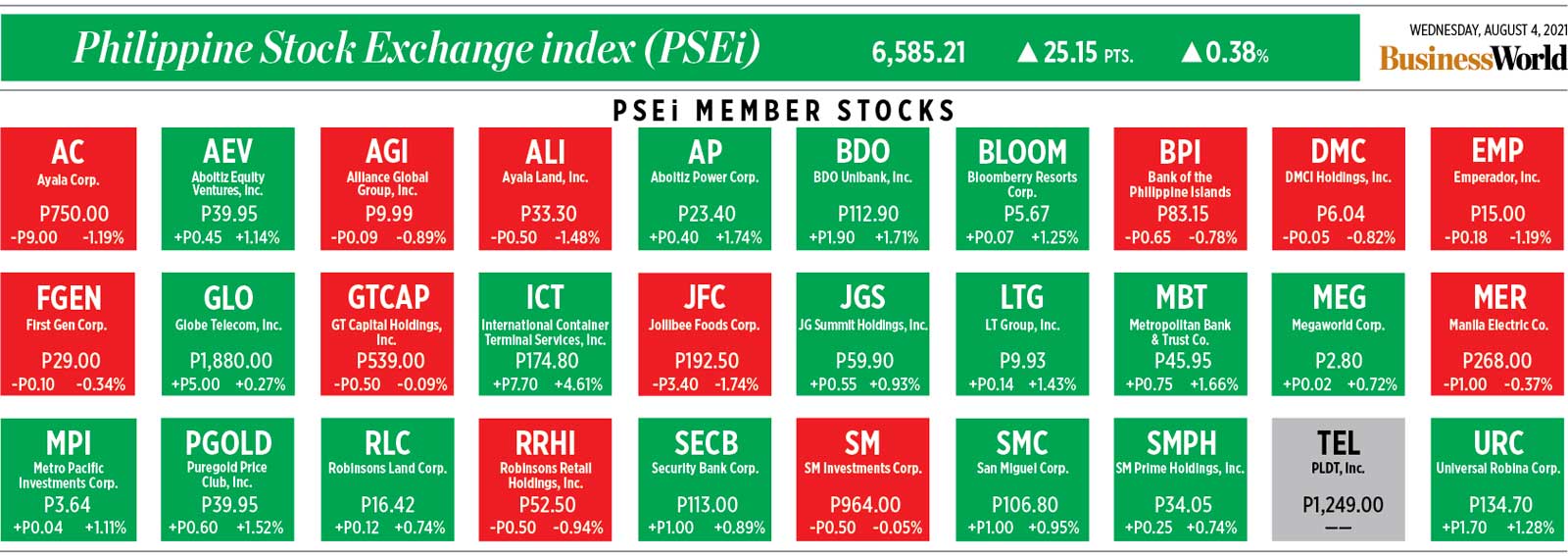
How PSEi member stocks performed — August 4, 2021

Here’s a quick glance at how PSEi stocks fared on Wednesday, August 4, 2021.


Peso weakens anew vs dollar as gov’t cuts outlook for agriculture sector

BW FILE PHOTO

THE PESO retreated versus the greenback on Wednesday due to risk-off sentiment as the government lowered its target for the agriculture sector’s growth.

The local unit closed at P49.75 per dollar, weaker by 14 centavos from its P49.61 close on Tuesday, based on data from the Bankers Association of the Philippines.

The peso opened Wednesday’s session at P49.85 per dollar, which was also its weakest showing for the day. Meanwhile, its intraday best was at P49.59 versus the greenback.

Dollars exchanged slipped to $1.041 billion on Wednesday from the $1.098 billion recorded on Tuesday.

The revision of the growth target for the agriculture sector and its resulting impact on the economy caused risk-off sentiment, Rizal Commercial Banking Corp. Chief Economist Michael L. Ricafort said.

The Department of Agriculture on Wednesday said it trimmed its 2021 growth target for the farm sector to 2% from 2.5% previously, citing the impact of the African Swine Fever and the lockdowns.

Meanwhile, a trader attributed the peso’s weakness to safe-haven demand amid reports of the US Treasury department taking steps to prevent hitting their debt ceiling.

US Treasury Secretary Janet Yellen on Monday through a letter to House Speaker Nancy Pelosi and other congress leaders said she was suspending investments in the Civil Service Retirement and Disability Fund and the Postal Service Retiree Health Benefits Fund that are not immediately required to pay beneficiaries, Reuters reported.

The move was seen as a step to keep the federal government’s borrowing capacity under a reinstated debt limit. A two-year debt-ceiling suspension expired on Saturday, which means the effectivity of the cap at the current debt level of about $28.5 trillion.

Ms. Yellen warned Congress in late July that a critical date could be Oct. 1, when the government faces $150 billion in mandatory payments as the 2022 fiscal year starts.

For today, Mr. Ricafort gave a forecast range of P49.60 to P49.80 per dollar, while the trader expects the local unit to move between P49.65 to P49.90. — L.W.T. Noble with Reuters

ADVERTISEMENT
ADVERTISEMENT