Home Blog Page 766

The mouth speaks, the peso sinks

STOCK PHOTO | Image by Jcomp from Freepik

It seems the peso is no longer sinking merely because of market forces but also because of what some public policy and officials say. Indeed, it is no less than the open-mouth operations of many in government that continue to drive the peso down.

The other day, every major broadsheet bannered the Philippine currency’s latest fall: “slump” (BusinessWorld), “record low” (Philippine Star, Inquirer, Manila Times), “historic low” (Manila Bulletin), and “breaches P59” (Malaya Business Insight, Business Mirror).

We doubt the peso has reached bottom. The torrent of careless commentary on the nation’s prospects reflects the deeper malaise of governance: weak leadership, muddled policy, and the erosion of public trust. Poor leadership begets poor policy; bad policy leads to weak execution and stagnant innovation throughout the bureaucracy. The repeated plunder of public funds signals a steady decline in both public spending and productive investment. And the neglect of health and education reveals a poverty not merely of resources but of foresight — a failure to prepare the next generation for political and economic leadership.

For a potential investor conducting due diligence, such signals are disheartening. Why would anyone choose to place or keep money in a country that continually undermines its own credibility?

THE BSP’S MEASURED EXPLANATION
To its credit, the Bangko Sentral ng Pilipinas (BSP) has offered a calm and reasonable explanation for the peso’s weakness. It traced the slump to market concerns over weak economic prospects — aggravated by irregularities in flood control projects — and to expectations of sustained monetary easing.

The BSP also emphasized that it maintains ample foreign exchange (FX) reserves and allows the peso to seek its market level, intervening only to temper excessive volatility that could stoke inflationary pressures. It remains confident that “resilient OFW remittances, relatively fast economic growth, low inflation, and ongoing structural reforms” will support the peso. FX inflows from business process outsourcing (BPO), tourism, and overseas employment are cited as further buffers against external shocks.

These statements are fair. Yet they also gloss over a fundamental reality: the trade deficit remains enormous. Even when combined, BPO receipts, remittances, and tourism revenues cannot offset the shortfall. The current account deficit — a measure of our reliance on foreign savings — reached $18.3 billion last year, with another $9.2 billion shortfall in the first half of this year.

While the balance of payments (BoP) showed small surpluses in 2023 and 2024, due to substantial foreign borrowings, the first nine months of 2025 have already posted a $5.3-billion deficit. This structural gap in our external accounts lies at the core of the peso’s weakness — though not the only factor behind it.

WHEN FUNDAMENTALS FALTER
Even during years of modest BoP surpluses, the peso slid steadily — averaging P55.63 in 2023 and P57.29 in 2024. Economic growth flattened around 5.5%, inflation eased to 3.2% in 2024 after hitting 6% in 2023, and fiscal deficits remained stubbornly high at P1.5 trillion in both years. Consequently, National Government debt ballooned from P14.6 trillion in 2023 to P16.1 trillion in 2024.

With a larger share of the budget devoted to debt servicing, fewer resources remain for inclusive and sustainable growth. A weak fiscal position should have compelled our leaders to act responsibly, with integrity and prudence. Instead, we have witnessed the opposite: congressional insertions, budgetary diversions, and the alleged theft of 30-40% of infrastructure funds.

Perhaps it is worth recalling that many decades ago, Filipino children studied “Good Manners and Right Conduct.” The subject’s quiet disappearance from our classrooms may have left us vulnerable to the twin culture of greed and impunity now evident in public life. Or perhaps we failed to adhere to the Scripture which was more than clear in Proverbs 22:6 that we should train a child in the way he should go; and when he is old, he will not depart from it?

THE PESO AS A MIRROR
What, then, should we expect of the peso?

In a recent dialogue, eminent economists Maurice Obstfeld and Paul Krugman reaffirmed that exchange rates behave like asset prices — reflecting not just fundamentals but also confidence, risk, and credibility. When markets lose faith in a government’s ability to sustain growth, control inflation, and manage its finances, the currency has only one direction to go: down. Capital flight and investment hesitation follow swiftly.

The peso, in this light, is not merely a unit of exchange but a mirror of our national condition. It measures not only our trade position or fiscal balance but also our political will and institutional coherence.

GLOBAL HEADWINDS
External pressures add to the strain. The full effects of recent US tariff hikes have yet to be felt, while new trade tensions and protectionist moves cloud the global outlook. The International Monetary Fund itself warns that such developments could dampen investment and sentiment more than expected, tightening financial conditions worldwide and amplifying existing vulnerabilities.

For the Philippines, this means both monetary and fiscal policy must tread carefully. We cannot respond to slower growth with unrestrained easing; we must conserve credibility for when genuine shocks strike.

THE US FACTOR
Former US Treasury Secretary Larry Summers warned earlier this year that the US dollar faces risks such as volatile policy shifts under Trump, the politicization of the Federal Reserve, and potential erosion of global confidence. Yet even he concedes that the dollar’s dominance remains intact, given doubts over the Chinese renminbi’s viability and America’s enduring strategic influence.

This implies continued strength of the US economy and currency which, in turn, pressures the peso. Should the BSP persist with an easing bias, or even hint at it, market unease may deepen. The peso’s breach of P59 could be only the first hurdle in a longer slide.

To arrest further decline, should the BSP need to send a decisive signal? One as strong as Mario Draghi’s now-legendary 2012 declaration: “Within our mandate, the European Central Bank is ready to do whatever it takes to preserve the euro. And believe me, it will be enough.” Or simply allow market forces to collect tuition fees from those who take inappropriate positions in the foreign exchange market?

DEFENDING CONFIDENCE
Summers has also noted that inflation risks in the US remain real, and that Federal Reserve Chair Jerome Powell’s cautious stance, marked by flexibility and humility, is justified. Even after the recent rate cuts, a resurgence of inflation could push the Fed to tighten again. A firm Fed and a strong dollar will keep emerging-market currencies, including the peso, under pressure.

But our vulnerability is not inevitable. What weakens the peso most is not the strength of the dollar but the fragility of our institutions and the noise emanating from the incoherence of public policy and unscrupulous officialdom. When those in power speak without discipline, dismiss accountability, or trivialize corruption, they invite skepticism from investors and citizens alike.

Markets, like people, can tell the difference between serious leadership and mere performance. The more talk diverges from action, the deeper the credibility gap and the lower the peso sinks.

FINAL WORD
The peso’s decline is thus both a financial and moral story. It reflects not only deficits in our trade and fiscal accounts but also deficits of trust, competence, and integrity in governance.

Every careless statement from a public official reverberates through markets already strained by weak fundamentals. Every scandal left unpunished deepens the perception that reform is impossible.

Until our leaders learn to match words with deeds, the peso will continue to suffer the consequences of their rhetoric. For as long as the mouth keeps speaking but the hand refuses to act, the peso will keep sinking, not merely against the dollar, but against the weight of our own failures.


Diwa C. Guinigundo is the former deputy governor for the Monetary and Economics Sector, the Bangko Sentral ng Pilipinas (BSP). He served the BSP for 41 years. In 2001-2003, he was alternate executive director at the International Monetary Fund in Washington, DC. He is the senior pastor of the Fullness of Christ International Ministries in Mandaluyong.


Peso slumps anew on Fed’s hawkish tilt

BW FILE PHOTO

THE PESO weakened anew against the dollar on Thursday after the US Federal Reserve chief said their latest rate cut could be the last for the year amid a mixed economic picture.

The local unit closed at P58.85 versus the greenback, dropping by 16 centavos from its P58.69 finish on Wednesday, Bankers Association of the Philippines data showed.

The peso opened Thursday’s session slightly weaker at P58.73 versus the dollar. It logged an intraday high of P58.58, while its weakest showing was at P58.98 against the greenback.

Dollars traded rose to $2.23 billion from $2.01 billion on Wednesday.

“The dollar was generally stronger on Thursday after Fed Chair Jerome H. Powell said a December rate cut was not certain,” Rizal Commercial Banking Corp. Chief Economist Michael L. Ricafort said in a Viber message.

“The dollar-peso closed higher, tracking other currencies after the Fed cut rates but gave a hawkish tone. Fed Chair Powell questioned whether a December rate cut was needed,” a trader said in a phone interview.

A policy divide within the US central bank and a lack of federal government data may put another interest rate cut out of reach this year, Mr. Powell said on Wednesday, as he acknowledged the threats that officials see to the job market but also the risky nature of making further rate moves without a fuller picture of the economy, Reuters reported.

The Fed on Wednesday cut interest rates by a quarter of a percentage point, as expected, as a way to temper any further weakening of the job market. But the central bank’s new policy statement included several references to the lack of official data during a federal government shutdown, and Mr. Powell told reporters later that policymakers are likely to become more cautious if it deprives them of further job and inflation reports.

“We’re going to collect every scrap of data we can find, evaluate it and think carefully about it. And that’s our job,” Mr. Powell said in a press conference after a two-day policy meeting, as he ticked off private data the Fed can use, along with its own in-house surveys of business executives and less formal interviews with a range of contacts around the country.

“If you asked me could it affect… the December meeting, I’m not saying it’s going to, but yeah, you could imagine that. You know, what do you do if you’re driving in the fog? You slow down.”

His comments show the developing dilemma for the Fed as a budget dispute between the Trump administration and Democrats in Congress extends into a second month, with the government unable to carry out surveys and produce reports that are key to central bankers’ policy decisions — in this case possibly delaying rate cuts that President Donald J. Trump himself wants.

Beyond the data issues, Mr. Powell said there were “strongly differing views” among his Fed colleagues about the appropriate path for monetary policy moving forward, with “a growing chorus now… feeling like maybe this is where we should at least wait a cycle” before cutting rates again.

Financial markets responded to Mr. Powell’s remarks by reducing bets on another rate cut at the Fed’s Dec. 9-10 meeting, a prospect now given roughly two-to-one odds.

Mr. Powell still called the Fed’s 10-2 vote in favor of lowering the benchmark interest rate to the 3.75%-4% range a “solid” endorsement of easing policy to help support a gradually cooling labor market.

But “there were strongly differing views about how to proceed in December,” Mr. Powell said, an unusually blunt comment about an upcoming meeting, something Fed chiefs usually shy away from.

“A further reduction in the policy rate at the December meeting is not a foregone conclusion. Far from it, policy is not on a preset course,” he said.

PESO SUPPORT
Still, the Fed’s latest rate cut could help stabilize the peso against the dollar in the near term after the local unit hit a new record low of P59.13 on Tuesday, analysts said.

This is as the reduction effectively widened the differential between the US central bank and the Bangko Sentral ng Pilipinas’ (BSP) key rates to 75 basis points (bps). Earlier this month, the BSP likewise lowered benchmark interest rates by 25 bps for a fourth consecutive meeting to bring its policy rate to 4.75%.

The wider rate gap “points to additional support for the Philippine peso, all else constant,” Metropolitan Bank & Trust Co. Chief Economist Nicholas Antonio T. Mapa said in a Viber message.

“[With] seasonal inflows on the way, we could see the Philippine peso enjoy a modest appreciation before yearend.”

Michael L. Ricafort, chief economist at Rizal Commercial Banking Corp., also said the bigger differential “should help stabilize the peso for now,” but noted that other factors like domestic corruption concerns have also contributed to the peso’s recent slide.

The Fed’s latest move and cautious policy outlook, as well as the weak peso, are unlikely to affect the BSP’s own easing path, the analysts said.

Unlike the Fed, BSP policymakers have said that another 25-bp cut is possible at the Monetary Board’s Dec. 11 meeting, with more reductions beyond that also on the table amid benign inflation and a softening growth outlook as they expect a widening graft scandal involving state flood control and infrastructure projects to affect both public and private investments.

“The BSP will take into account the full range of data on domestic inflation, financial conditions and growth outlook at its upcoming policy meeting,” Mr. Mapa said.

“The BSP-Fed policy rate differential is not a major concern, despite differing views on monetary policy. This is because the US is also facing its own issues such as Fed independence, tariff-induced inflation, and political issues that may impact confidence on the US dollar. Thus, we may see the BSP monetary policy easing path to remain intact despite the exchange rate reaching P59 this week,” Reinielle Matt M. Erece, an economist at Oikonomia Advisory and Research, Inc., said in a Viber message. — A.M.C. Sy and K.K. Chan with Reuters

Regulator clears Ever-Gotesco capital stock cut, name change

STOCK PHOTO | Image by Pressfoto from Freepik

THE SECURITIES and Exchange Commission (SEC) has approved the decrease in Ever-Gotesco Resources and Holdings, Inc.’s authorized capital stock and amendments to its articles of incorporation, including a corporate name change as the company shifts its business focus.

“We were informed by the SEC that the decrease in the authorized capital stock of the corporation and the amended articles of incorporation (AOI) pertaining to the amendments made to Articles I, III, and VII have been approved by the SEC on Oct. 28, 2025,” the company said in a disclosure on Thursday.

The SEC approval covers the change of the company’s name to Everwoods Green Resources & Holdings, Inc., reflecting its planned venture into the agri-tourism and bamboo industries.

In 2021, the listed firm entered the agri-eco-tourism segment by acquiring Everwoods Management and Development, Inc. (formerly 3-J Development Corp.) and Agriwave, Inc., which are involved in eco-tourism, agricultural production, and the cultivation of high-value crops. Everwoods Management operates resorts integrating leisure and environmental conservation, including the Forest Crest Nature Hotel and Resort in Batangas.

In 2022, the company announced plans to start bamboo farming and production on its Cebu property and engaged experts to conduct master planning and pre-feasibility studies. The master plan was completed in December 2023.

According to information on its website, Ever-Gotesco has recently shifted its focus to the attractions and immersive entertainment sector in line with the recovery of the tourism industry.

Under the SEC-approved amendments, the company’s authorized capital stock has been reduced to P2.5 billion from P5 billion, while the par value per share was lowered to 10 centavos from P1. Despite the lower par value, the number of authorized shares rose to 25 billion from 5 billion. “The increase… aims to attract more investors and raise capital for its new business ventures: agri-tourism and bamboo industry,” the company said.

The SEC also approved the change in the company’s principal office address.

On Thursday, the Philippine Stock Exchange (PSE) suspended trading of the company’s shares following the capital stock reduction and the amendments to its articles of incorporation. The suspension will remain until the company submits the required documents to the PSE as part of its ongoing quasi-reorganization process.

Ever-Gotesco ended its mall and cinema operations in 2017, while its subsidiary, Gotesco Tyan Ming Development, Inc., ceased operations in June 2015. — Alexandria Grace C. Magno

BTS rapper calls for ‘no borders, no limitations’ at Asia-Pacific trade forum

GYEONGJU, South Korea — The leader of South Korean boyband BTS, RM, said diversity without borders was the source of creativity behind the group’s worldwide success, as Asia-Pacific leaders gathered in his home country for a trade forum overshadowed by protectionist worries.

“I am just an artist. I am not a business leader, so today, I want to speak to you as a creator and an artist,” said RM, a 31-year-old rapper, as he addressed a business event held on the sidelines of the annual summit of the Asia-Pacific Economic Cooperation grouping.

“When cultural barriers come down and different voices harmonize together, there’s an explosion of creative energy,” he said.

“This is why K-pop is loved everywhere,” he said, adding the group’s ARMY global fan club spanning millions of loyal followers is “crossing borders and breaking down barriers through the pure power of cultural solidarity.”

BTS has been reunited with all of its seven members having completed their mandatory military service this year and is now preparing for a big return with a new album next year ahead of a world tour.

RM, in his speech on Korean soft power, compared culture to a river flowing freely, and K-pop to bibimbap, a traditional Korean dish of various ingredients mixed with rice.

Earlier in the day, the forum was addressed by US President Donald J. Trump and South Korean President Lee Jae Myung, who then met nearby for tariff talks.

South Korea is betting on cultural exports to support its economy at a time when traditional manufacturers face growing protectionist barriers. President Lee has pledged support for the K-pop industry to make his nation a global cultural powerhouse.

“K-pop’s shiny success is proof that cultural diversity and creativity are the greatest human potential. Of course, no borders, no limitations,” RM said. — Reuters

Political Dynasties: To ban or not to ban?

STOCK PHOTO | Image by Katemangostar from Freepik

By Nicomedes Alviar

EVEN in democratic societies, power eventually ends up in the hands of a few, leading inevitably to a dominant elite rule. With absolute certainty, Robert Michels, a German-born social scientist, declared this claim as the “iron law of oligarchy.” Moreover, these oligarchs — according to Michels — will use all the means necessary to preserve and to further expand their power. Such a bold theoretical assertion is actually a stark reality in our country as we seem to have accepted as given the proliferation of political dynasties at both the national and local levels of government. And in such a state of politics, the opportunities for corruption abound. For example, we are now seeing how political dynasties connive with Department of Public Works and Highways (DPWH) engineers so that infrastructure projects are awarded to construction companies they own.

While we are all disgusted witnessing the evils of political dynasties, the damage they inflict on our democratic institutions and processes, and how they exacerbate social inequalities and poverty, we have to admit that we will have to contend with political dynasties for a very long time. Sad to say, political dynasties which thrive due to distorted cultural values, particularly the patronage system, have entrenched themselves deeply in a combination of political and economic structures developed throughout several decades to protect their interests and consolidate their power.

The quick solution is clearly stated in Article 2, section 26 of the current Constitution which “prohibits political dynasties as may be defined by law.” But we all know that implementing this provision is wishful thinking because our political dynasty-infested Congress will never pass that enabling law. It is naive to imagine our legislators signing their death sentence. Besides, if we ban political dynasties outrightly through a piece of legislation, it will not be easy to find alternatives who can take over their rule right away. Who will replace them in the various localities all over the country? Do we have enough people now with the right dispositions who are ready and competent to run government in lieu of political dynasties?

I believe the practical approach — given our current circumstances — is to engage with political dynasties and to reform them from within. And here, various sectors have different roles to play, not necessarily coordinated, but which must be exercised with genuine and sustained commitment. In the first place, the business sector can be more consistent in upholding professional and ethical standards when transacting with government and politicians. I’m sure the big conglomerates as well as the small enterprises would agree that business is more sustainable and meaningfully profitable if done in this manner. And in relation to this, it is worth noting that the progressive leadership of the Makati Business Club has committed itself to leading top corporations to do their share in strengthening the country’s democratic institutions, promote integrity, and fight corruption.

Then, religious institutions can take a more active role in instilling morals, love for the truth, and service to society among the political dynasties. In the case of the Catholic Church particularly, the bishops of the dioceses all over the country can make it a point to cultivate close relationships with political dynasties instead of taking a confrontational stance, in order to win them over in practicing Catholic social teachings, especially solidarity, common good, and a preferential option for the poor.

Universities must take to heart the education of individuals belonging to political dynasties as their paramount mission. Many members of the ruling families went through the Big Four, and are sending their scions to these same schools. With the aim of fostering patriotism, integrity, and genuine public service, these institutions can still exert influence through various ways on both their alumni, and the children of these alumni. While students in their schools, they can be involved actively in organizations and activities to be trained — and even be individually mentored — in ethical and selfless leadership.

Finally, civil society organizations conducting diverse projects in the fields of poverty alleviation, environmental protection, livelihood provision, health and sanitation, citizenship education, human rights, etc. can get political dynasties in LGUs involved and, in the process, immerse them to be truly identified with their causes. With integrity as one of its core values, CODE-NGO for instance, through its wide national network representing 1,600 NGOs, people’s organizations, and cooperatives can be in a good position to take the lead in engaging political dynasties towards this end.

These, of course, are easier said than done, but any little effort by these actors, if carried out consistently, can yield tangible results. Confronting political dynasties head-on can be costly and dangerous; engaging with them can open opportunities to reform them.

The good news is that there are actually enlightened politicians belonging to political dynasties who have started implementing effective and meaningful reforms in their localities. We find them in Mayors for Good Governance (M4GG), a movement of city executives “committed to fighting corruption and building resilient communities through empowered local governments that put people’s welfare above politics.” Many of these politicians have been recognized for being models of good governance through the annual Galing Pook awards which have been going on for more than three decades. Here, programs by LGU leaders, after a rigorous screening process, are evaluated on the basis of positive impact, promotion of people’s empowerment, sustainability, and efficient service delivery.

To ban political dynasties is a long shot; reforming political dynasties is doable, and is actually happening.


Nicomedes Alviar is a PhD Political Science graduate of the University of the Philippines, Diliman, and is currently the dean of the School of Politics and Governance at the University of Asia and the Pacific (UA&P).

Nonbanks’ domestic claims climb at end-June

BW FILE PHOTO

DOMESTIC CLAIMS of nonbank financial firms grew by 16.7% year on year as of June, the Bangko Sentral ng Pilipinas (BSP) said on Thursday.

Based on the BSP’s Other Financial Corporations Survey (OFCS), domestic claims of nonbanks climbed to P10.746 trillion as of June from P9.212 trillion a year ago.

Quarter on quarter, claims inched up by 0.1% from P10.733 trillion at end-March.

“The quarter-on-quarter increase in the sector’s claims was mainly driven by its larger investment in equity shares issued by other nonfinancial corporations, higher holdings of government securities, and a rise in loans extended to households,” the BSP said in a statement.

“However, the growth in the sector’s domestic claims was slightly tempered by the decline in its holdings of bank-issued debt securities.”

The OFCS is an analytical survey that covers data on non-money market investment funds, other financial intermediaries, financial auxiliaries, captive financial institutions and money lenders, insurance corporations, and pension funds.

Bulk of nonbanks’ domestic claims during the quarter were claims on other sectors, followed by claims on depository corporations and the central government, BSP data showed.

Broken down, claims on other sectors grew by 9.5% to P4.934 trillion as of June from P4.507 trillion a year ago. This was also up by 1.9% from the P4.865 trillion seen at end-March.

Other sectors include the state and local government, public nonfinancial corporations, and the private sector.

Meanwhile, claims on depository corporations jumped by 28.9% year on year to P3.004 trillion from P2.331 trillion the previous year but declined by 3.3% from P3.107 trillion in the first quarter.

OFCs’ net claims on the central government also rose by 18.2% annually to P2.808 trillion at end-June from P2.375 trillion in 2024. Quarter on quarter, it edged up by 1.7% from P2.761 trillion.

On the other hand, nonbanks’ liabilities climbed by 18% year on year to P11.431 trillion from P9.689 trillion as of June by 0.6% from the P11.369 trillion recorded as of March.

The BSP said this was “primarily due to the increase in its issued shares of stocks and higher insurance technical reserves.”

OFCs’ net foreign assets surged by 43.5% to P685.376 billion as of June from P477.603 billion last year. It was also 7.9% higher than P635.265 billion in the prior quarter.

This came amid an increase in claims on nonresidents, which stood at P838.466 billion, rising by 32.1% from P634.499 billion a year prior.

Meanwhile, liabilities to nonresidents went down by 2.4% to P153.091 billion from P156.896 billion a year ago. — Katherine K. Chan

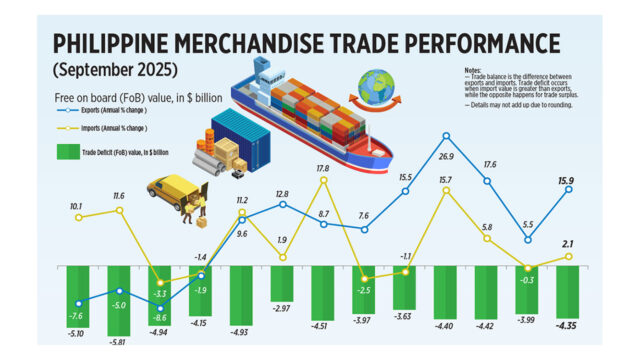
Philippine Merchandise Trade Performance (September 2025)

THE PHILIPPINES’ trade deficit in goods narrowed in September, as exports posted double-digit growth, the Philippine Statistics Authority (PSA) reported on Thursday.  Read the full story.

Philippine Merchandise Trade Performance (September 2025)

NPC: Probe finds no sufficient basis to conclude data breach within GCash platform

BW FILE PHOTO

THE NATIONAL Privacy Commission (NPC) said it has found no data breach in the system of G-Xchange, Inc., the operator of electronic wallet platform GCash, following its investigation into reports of user data being sold online.

In a statement on Thursday, the NPC said it found “no sufficient basis to conclude that a personal data breach occurred involving GCash.”

“Independent validation by the NPC’s Complaints and Investigation Division (NPC-CID) confirmed that the dataset circulating online was inconsistent with GCash’s verified data structures. Several of the listed accounts were found to be invalid or inactive, and no indicators of unauthorized access, infiltration, or data exfiltration were detected within GCash’s monitored environments,” the NPC said.

The NPC launched the probe earlier this week after reports circulated that GCash user data were being sold on the dark web. GCash has since denied the allegations, saying there has been “no breach, leak, or compromise” in its systems.

The Department of Information and Communications Technology (DICT), through its Cybercrime Investigation and Coordinating Center (CICC), said its monitoring showed that the alleged data leak “did not originate from the company’s systems.”

The NPC said it will continue monitoring reports of threats to personal data and coordinate with relevant entities to ensure compliance with the Data Privacy Act (DPA) of 2012.

“The NPC also warns individuals and groups engaging in the unauthorized access, sale, or distribution of personal data that such acts constitute clear violations of the DPA and are punishable under the law,” it said. — Ashley Erika O. Jose

Robin Hood returns to screens with new gen ‘origin story’ series

Robin Hood (2025)
Robin Hood (2025)

LONDON — New TV series Robin Hood explores the legendary outlaw’s origins with a personal take and previously unseen historical authenticity, the show’s creators say.

The latest reimagining tells the tale of how Robin Hood came to be the medieval English folk hero who robbed the rich to feed the poor. Known simply as “Rob,” it sees the Saxon forester’s son and skilled archer transform into a rebel after experiencing devastating losses and injustices.

Australian newcomer Jack Patten follows in the footsteps of several Hollywood stars to portray the hero of Sherwood Forest. But while Mr. Patten found his first lead role somewhat daunting, the 28-year-old did not feel weighed down by previous interpretations — he had not seen any of them.

“It’s a weird thing, because I feel like a lot of people have heard of Robin Hood. I was one of those people. I’d heard of Robin Hood, but I’d never seen it,” Mr. Patten said at the show’s London premiere on Tuesday.

“Every generation deserves a Robin Hood, and the fact that we get to be this gen’s Robin Hood is pretty awesome,” he said.

The 10-episode first season is set in 12th century post-Norman invasion England and also centers on Rob’s love story with Marian (Lauren McQueen), the daughter of a Norman lord, who has taken over the ancestral home of Rob’s ousted Saxon family.

The series is brought to the screen by co-creators John Glenn and Jonathan English, who set out to offer a modern and more intimate depiction of the events and the time period.

“It was the idea of doing an origin story, which we’ve never really seen before, how Robin becomes an outlaw, what happens to him, what happens to his parents,” said Mr. English.

“It’s about the Norman conquest of England. It’s about class. We’ve never really seen a Robin Hood story that’s really about class, but it is. Robin, from the rich giving to the poor is in itself about class. So I think it’s very topical, very relevant today,” he said.

The show’s ensemble cast also features actors Sean Bean as the Sheriff of Nottingham and Connie Nielsen in the role of Queen Eleanor of Aquitaine.

Robin Hood starts streaming on MGM+ on Nov. 2. — Reuters

Forget gold. Aluminum is the real metal of the moment

STOCK PHOTO | Image from Freepik

By Javier Blas

IT LACKS the effervescence of copper and the geopolitical allure of rare earths — yet aluminum is the metal of the moment. Key to modern life and everywhere in the global economy, it’s entering a make-or-break phase: Either the world is sleepwalking into a supply crisis or further into the hands of China. Or, more worryingly, both.

The background is unsettling: Aluminum is trading at a three-year high, near $2,900 per metric ton. Although still far from the record, the current price is historically elevated, in the 5% top end of the 1990 to 2025 price range. Look at annual averages, and this year is heading to the fourth-highest ever.

With political leaders’ attention firmly on copper and the likes of germanium and rare earths, aluminum hardly attracts headlines. Still, it’s truly crucial for the global economy. Planes and iPhones, window frames and soda cans, electric cars and appliances all depend on it. One can hardly imagine any further electrification without the greyish metal. With an annual consumption value of nearly $300 billion, it’s the largest of all non-ferrous metals. Only steel, a ferrous metal, is more widely used.

Compared to other commodities, aluminum compounds such as bauxite are copious in the Earth’s crust. But producing the metal in its pure form used to be such so complex and expensive process that until a century ago it was considered a precious metal. Napoleon reserved aluminum cutlery for his most important guests. When the Washington Monument was completed in 1884 in the US capital, it was capped with a 100-ounce aluminum pyramid; at that time, the metal was more expensive than silver. Only two years later, a new refining system was invented, and aluminum became commonplace.

Still, there’s a catch. Producing aluminum is a massively energy intensive process, so much that the metal is often known as “solid electricity.” To produce a ton of aluminum, smelters require the same amount of electricity that five German homes would consume in a year.

Enter China. Thanks to its coal-fired power stations, the Asian giant has the cheap electricity needed to produce enormous amounts of aluminum. Thus, for the last 25 years, Beijing has single handedly supplied the world’s incremental demand for the metal, which now runs just above 100 million tons. Last year, China produced just over 43 million tons of primary aluminum, up from 6 million two and a half decades ago. But its expansion is ending. A few years ago, the Communist Party capped its domestic smelter production at 45 million tons, and in 2025 local output is bouncing against the ceiling for the first time. By next year, it will hit it. What comes next is key.

The setting has all the elements for a squeeze. First, demand remains robust, rising every year by about 2-3 million tons. Second, production — notably in Europe — is struggling due to expensive electricity. Despite high aluminum prices, smelters are shutting down in many countries as long-term cheap electricity contracts end. Third, global inventories are historically low. And fourth, with copper prices at an all-time high, there’s a clear incentive to substitute the red metal with aluminum wherever possible.

Unless incremental supply comes from somewhere or an economic crisis cuts consumption, something will have to give. The market is bitterly divided. The bulls see aluminum sleepwalking into structural shortage, with prices climbing toward a record high of $4,000 in a couple of years; the bears anticipate that Chinese companies would manage to produce more, and aluminum would ultimately trade lower.

The key is Indonesia, where top Chinese companies are now erecting the smelters they can’t build at home due to the cap. With plentiful coal, cheap labor, copious aluminum feedstock, and little regard for climate policies, Indonesia is now a construction site for the likes of Tsingshan Holding Group Co., China Hongqiao Group Ltd., and Shandong Nanshan Aluminum Co. It echoes a similar Chinese move in the nickel market a decade ago and that transformed Indonesia into a top producer.

If all the new smelters come into production, Indonesian output may rise fivefold by 2030, transforming the country into the world’s fourth-largest producer, behind only China, India, and Russia, and keeping the global market well supplied. On top, Chinese companies are also building aluminum smelters in Angola, using hydropower as their electricity source. But past performance in nickel does not guarantee future results in aluminum.

For one, the cost of building an aluminum smelter in Indonesia appears to be higher than in China, slowing down the expansion. And the Chinese companies aren’t bringing into Indonesia a technological advance that would change the metallurgy of aluminum in the same way they did for nickel. Indonesia clearly would become an important supplier — but it’s far from certain that alone it can replace the role that China has played since 2000 balancing the market.

For the bulls, the bigger risk is that Beijing caves and lifts the cap — or creates enough loopholes. For example, China could exclude smelters running on green electricity, including those using hydropower, from the ceiling. Or it can allow existing plants to run harder, pushing up electricity flows without physically expanding the production lines.
The world faces a binary outcome: Either higher aluminum prices, spilling over the global economy, or a higher reliance on Chinese companies. Perhaps there’s a third outcome — and one that I think is most likely: We get higher aluminum prices but perhaps not as exuberant as the bulls are betting on, while Chinese output, via Indonesia, also increases, but not as much as the bears hope.

BLOOMBERG OPINION

Ilocos, W. Visayas wage boards approve pay hikes

PHILSTAR FILE PHOTO

By Chloe Mari A. Hufana, Reporter

REGIONAL WAGE BOARDS in Ilocos and the Western Visayas approved minimum wage increases, Labor Secretary Bienvenido E. Laguesma said on Thursday.

The National Wages and Productivity Commission approved pay hikes for Region I (Ilocos) and Region VI (Western Visayas) on Wednesday. Both will take effect in November, Mr. Laguesma said via Viber.

In the Ilocos Region, non-agricultural workers employed in firms with at least 10 employees will get a P37 increase, bringing their minimum daily wage to P505.

Non-agricultural workers with firms of less than 10 employees and agricultural workers will receive a P45 hike, bringing their minimum daily pay to P480.

Meanwhile, Western Visayas workers in non-agricultural, industrial, and commercial employment with firms of more than 10 workers will receive a P37 increase, raising their daily minimum wage to P550.

For establishments with fewer than 10 employees, the daily minimum wage will rise by P45 to P530 from P485.

For agricultural jobs, a P40 adjustment will bring the daily minimum wage to P520.

The new wage rates for Region VI take effect on Nov. 19, 2025.

According to Mr. Laguesma, at least four more regions will release new wage orders to adjust minimum daily pay.

These regional boards are due to conduct public hearings next month, with the corresponding wage orders expected by December, he added.

These regions are the Cordillera Administrative Region, Mimaropa, the Eastern Visayas and the Zamboanga Peninsula.

Minimum wages adjustments for workers in Region IV-A (Calabarzon) also took effect on Thursday under Wage Order No. IV-A22.

The regional board earlier approved a P25 to P100 daily minimum wage increase.

The daily minimum pay was raised to P600 for non-agricultural workers, P525 for agriculture, and P508 for retail and service establishments with 10 or fewer employees.

Headline inflation rose to a six-month high of 1.7% in September from 1.5% in August, driven mainly by higher fuel and vegetable prices, the Philippine Statistics Authority reported earlier this month.

Inflation remained within the 2-4% target range set by the Bangko Sentral ng Pilipinas target range. The latest reading remained below the year-earlier level of 1.9%.

Core inflation — which strips out volatile food and fuel prices — eased to 2.6% in September from 2.7% in August, though it remained higher than the 2.4% year-earlier level.

In the first nine months of 2025, core inflation averaged 2.4%, down from the 3.1% booked a year earlier.

The Federation of Free Workers (FFW) said the wage hike in the Western Visayas was helpful but insufficient to meet workers’ basic needs.

FFW Women Network President Ma. Victoria G. Bellosillo said disparities in regional wages create uneven relief.

FFW continues to support a national living wage and a P200 across-the-board wage hike.

“An increase in wages is a help, but not yet justice. The true goal is a salary sufficient for decent living,” she said in a statement.

The Philippines adjusts wages through regional boards, but labor groups support a legislated wage hike that would standardize pay across the country and ensure a living wage.

Labor leaders argue that regional wage-setting often leaves workers in poorer provinces behind, while the cost of basic goods continues to rise nationwide.

Mastercard rolls out payment threat intelligence solution in APAC

MASTERCARD has launched an intelligence solution in the Asia-Pacific (APAC) region to detect fraud and other cyberthreats targeting card transactions.

Mastercard Threat Intelligence combines the company’s global fraud insights with cyberthreat intelligence from Recorded Future, which it acquired less than a year ago. It allows financial institutions across APAC to detect, prevent, and respond to cyber-enabled fraud.

“Payment fraud is no longer just a payment system issue — it’s a cybersecurity challenge that directly impacts an organization’s bottom line. Mastercard Threat Intelligence bridges communication gaps, enabling fraud and security teams to work together seamlessly to stop fraud before it happens,” Matthew Driver, executive vice-president of Services, Asia Pacific at Mastercard, said in a statement.

Financial institutions will get real-time alerts of fraudulent test transactions which will be proactively declined, helping protect cardholders.

Card issuers and acquirers also get access to quantitative data to assess skimmer impacts and prevent card-related malware, and targeted insights to assess merchant risk and enable faster incident response.

They will also receive weekly reports on emerging threats and vulnerabilities across the global payments landscape, as well as case studies and fraud trend analysis.

Mastercard said conducted market testing of the solution over six months, with the data provided able to help them identify and take down malicious domains tied to payment card data theft that affected nearly 9,500 e-commerce sites and were linked to an estimated $120 million in fraud losses.

“Asia Pacific is seeing a surge in cyber-enabled fraud, and the need for integrated intelligence has never been more urgent,” said Aditi Sawhney, senior vice-president of Security Solutions, Asia Pacific at Mastercard. “We’re helping our customers move from fragmented responses to unified, intelligence-led defense strategies that strengthen resilience across the payments ecosystem.” — AMCS