Home Blog Page 7657

Storied franchises

The two winningest franchises in National Basketball Association history took drastic turns yesterday. On one end stood the Lakers, deserved recipients of a shocking on-court shellacking that put into question their immediate future and, just as crucially, prospects in the medium term. On the other stood the Celtics, instigators of a needed off-court changing of the guard that, they wish, figures to change their fortunes for the better. The former is on the precipice of being just the sixth defending champions in league annals to be ousted in the first round. The latter is at a crossroads, crossing their fingers the path they aim to take will quickly take them out of mediocrity and justify their hope.

The NBA will be 75 years old in two days, and the Lakers and Celtics have encountered unparalleled success since its inception. In fact, it’s precisely because of their proud past that expectations run high every single season. They have fan bases that are extremely loyal, but likewise injected with irrational beliefs. For these diehards, there are no excuses; excellence should be a given regardless of circumstance. Which was why they have been catching no small measure of criticism for their far-from-stellar showing in recent memory.

For heralds of the green and white and purple and gold, no excuses can be accepted. It didn’t matter that the Celtics were handicapped from the get-go, and, even at full strength, intrinsically unable to upend the powerhouse Nets. Forget that the Lakers have ailing superstars let down by a severely underperforming supporting cast against the higher-seeded Suns. The bottom line cannot be denied. And second-guessing will, no doubt, continue to be the favorite pastime of those within and outside directly concerned circles. For the departed Danny Ainge and the promoted Brad Stevens, there is no warm sendoff and honeymoon period. Rob Pelinka and Frank Vogel’s bona fides are so last year, and don’t stand up to scrutiny in the here and now.

For the Celtics, the rebuilding of the brand — yes, the same one former stalwart Kyrie Irving saw fit to stomp on — starts now. For the Lakers, it isn’t that there remains fighting to be done in the 2021 Playoffs; it’s that there will always be fighting to be done. That’s what being part of storied franchises entails. That’s also why shoulders are “built for a reason,” as James described his, ultimately buckle under unreasonable pressure.


Anthony L. Cuaycong has been writing Courtside since BusinessWorld introduced a Sports section in 1994. He is a consultant on strategic planning, operations and Human Resources management, corporate communications, and business development.

Villar Group to hold first virtual property expo

Manuel B. Villar, Jr., chairman of Vista Land & Lifescapes, Inc.

THE Villar Group of Companies is launching its first virtual property expo, which will feature its real estate brands. 

“It has always been the group’s passion to contribute in the improvement of the lives of the Filipinos by not just providing them with homes to comfortably live in or as investment across the country but also implementing creations to make necessities within their reach,” Manuel B. Villar, Jr., chairman of Vista Land & Lifescapes, Inc., said in a statement on Thursday.  

The Villar Group Convention or “ViCon” will run from June 24 to 25. Those interested to join the event may register through www.vportal.ph

Aside from Vista Land, the event will feature brands under Golden MV Holdings, Inc, namely: Bria Homes, Inc., Lumina Homes, Camella Homes, Inc., Crown Asia Properties, Inc., Brittany Corp., Camella Manors, and Vista Residences, Inc. 

The group’s death care property developer Golden Haven Memorial Park and commercial developer Vistamalls, Inc. will also join the virtual exhibit. — Keren Concepcion G. Valmonte 

Eye-catching details could blindside us

PHILIPPINE STAR/ MICHAEL VARCAS

We all rejoiced when Standard and Poor’s (S&P) global ratings on May 27 maintained the Philippines’ BBB+ rating and assigned it a “stable” outlook on expectations of a healthy economic recovery. S&P announced in its formal statement that it “affirmed the ratings because we believe the Philippines will continue to have good economic recovery prospects once the COVID-19 pandemic is contained, and that the government’s fiscal performance will strengthen accordingly.”

Anchoring this steady rating action are what S&P described as “signs of recovery” following the Government’s ability to contain the pandemic through more decisive sourcing and rollout of the COVID-19 vaccines. For S&P, three other factors are critical: strong external payments position, fiscal reforms, and strong infrastructure support.

S&P trusts that the Philippine economy could grow by 7.9% in 2021 from last year’s 9.6% recession, even surpassing the official target of 6-7%. With an actual contraction of 4.2% in Q1 2021, we need to grow by an average of at least 9.4% for the last three quarters to deliver on the low end of the output target. To meet S&P’s forecast, real GDP should grow by nearly 12% average for three quarters. Base effects will be overworked.

Moody’s Analytics takes a different view on the growth prospects and we should combine its insight in our whole of nation efforts to manage the risks on the ground. Moody’s raises the issue of our weak pandemic management, that based on today’s pace, it might take another two years to achieve massive vaccination and ensure mass protection. Income inequality could also be a hindrance to a more bullish performance.

We all realize that this pandemic is indeed like no other crisis, so every bit of understanding should be precious. But what happens if we fail the growth standard of S&P?

Growth is the logical outcome of successful pandemic mitigation through sustained observance of health protocols as we aim for a more massive administration of the vaccines.

Taming the pandemic remains a big problem. Worldometer reports that as of June 2, the Philippines’ infections totaled 1.24 million while deaths stood at 21,158. For perspective, the world as a whole has vaccinated more than 1.9 billion out of the global population of nearly 7.9 billion. In absolute number, the US topped the list with 295 million doses administered, translating into 41.29% coverage. The Philippines managed to complete 4.3 million doses covering about 0.93% of its over 110 million population.

In one of the interviews with Vaccine Czar Carlito Galvez, Jr., he cited a rollout speed of about one million vaccines per week! With some 31 weeks to go before the end of 2021, we would have around 35 million doses, or roughly 17.5 million people of two doses each. This is good progress, but still a far cry from what herd resilience is all about.

Some jurisdictions with higher vaccination rates than the Philippines have recently experienced a resurgence of some variants and re-imposed restrictions on mobility and business activities. In an earlier estimate, The Economist presented a timeline showing the country will achieve some 60% vaccination only by Q4 2023. We should prove it wrong and minimize this downside risk to economic growth.

In previous columns, we had commented on the three planks of S&P’s confidence in our economic prospects. On the balance of payments, it looked good in 2020 because the economy was in four quarters of economic contraction. Thus, the decline in imports and outward investments combined with strong inflows of foreign loans produced a significant balance of payments surplus, a strong peso, and a sharp accumulation of gross international reserves. Recent data on foreign investments continue to indicate weak flows and confidence of the foreign investment community in our short-term economic prospects. Once we see some stronger signs of economic recovery, a reversal is unavoidable.

For instance, Oxford Economics reported that the “Philippines remains a laggard in the ASEAN-6 economies… even as exports are likely to rebound from a dismal 2020 performance.” This think tank also observed that the Philippines’ economic scars from the pandemic were the deepest and most serious. For this reason, it is believed our economic recovery will be protracted.

On fiscal reforms, the recent enactment of the Corporate Recovery and Tax Incentives for Enterprises (CREATE) Act should be able to provide businesses, especially micro, small and medium enterprises (MSMEs), with sharp cuts in corporate income taxes (CIT) and a redesigned fiscal incentives system to attract investments and create jobs in a big way. Of course, this is negative for revenues. More tax reform measures are pending in Congress but it is heroic to assume they can be legislated in time for this year and the next to produce quick results.

In addition, two game-changing developments should be managed by Congress. The demand for limited public revenues has risen with, one, the increase in the military and uniformed personnel salaries and pension, and, two, the Supreme Court ruling on the Mandanas-Garcia case which expands the revenue base of local government units’ (LGUs) share of internal revenue allotment.

The fiscal challenge is not only on the revenue and expenditure sides. Financing will be equally thorny. It is possible the National Government (NG) would probably attempt a budget realignment to achieve a deficit-neutral budget next year. This is impossible because revenues are scarce during recession and 2022 is an election year. Instead, the NG could ramp up borrowings, sell public assets, and require more dividends from government-owned and -controlled corporations and financial institutions.

How these interconnected fiscal dynamics would play out this year and the next to support growth while maintaining fiscal sustainability will certainly be a big problem for our hard-working economic managers. Whatever they can accomplish today should be an important springboard for the next government.

On infrastructure, the challenge is the timely implementation of Build, Build, Build flagship projects to fuel economic recovery. A few months back, it was reported that some 104 projects worth P4.1 trillion had been identified since 2017. These projects cover the gaps in transport and mobility, water, power and energy, information and technology, urban development and renewal, as well as health. Four had already been completed and 42 were on-going construction.

In his confirmation the other day at the Senate, Socioeconomic Planning Secretary Karl Chua updated the legislature that 112 projects have been identified, 80% have already been approved and 51 projects are in the construction stage, and 31 are under pre-construction or awaiting implementation.

Funding holds the destiny of these projects, and with competing demands on the budget in the light of the pandemic, prioritization becomes key. The next administration will hopefully inherit a good set of projects that, according to Secretary Chua, are “well designed and are financially capable and they will not add to future burden to the people in terms of payment or liabilities.”

Nobody can deny that a host of uncertainties remain out there. It is always wise to process important pieces of the macroeconomic puzzle rather than be mesmerized by the more salient information. The data on corporate distress as highlighted by the Financial Stability Committee last year indicates a possible slow burn contagion. The Bangko Sentral ng Pilipinas data on non-performing loans indicates a slow but invariably rising trend of corporate distress and bank difficulty. Mobility indicators are somewhat picking up pace but still lower than normal. Domestic liquidity and bank loans are pointing south. Oil prices could jump up and upset inflation forecasts. Power outage hinders growth.

With good governance, these are not insurmountable.

We can always admire Trade and Industry Secretary Ramon Lopez’s singular optimism that “the domestic economy is still on track for a V-shaped recovery with improved investment climate this year.”


Diwa C. Guinigundo is the former Deputy Governor for the Monetary and Economics Sector, the Bangko Sentral ng Pilipinas (BSP). He served the BSP for 41 years. In 2001-2003, he was Alternate Executive Director at the International Monetary Fund in Washington, DC. He is the senior pastor of the Fullness of Christ International Ministries in Mandaluyong.


Threat and opportunity

KURIOUS/PIXABAY-FREEPIK

Vice-President Maria Leonor “Leni” Robredo has reiterated former Supreme Court Associate Justice Antonio Carpio’s warning during the March 18 launch of the 1Sambayan coalition that unless “the opposition” fields only one candidate for President in 2022, the results of those elections are likely to replicate what happened in 2016.

Although one of the least qualified among five candidates, and without ever having been previously elected to a national post, Davao City Mayor Rodrigo Duterte won the presidency then with some 16 million votes, or about 33% of the total, with the remaining 67% being divided among his four rivals.

Despite the depths of corruption, incompetence, lawlessness and brutality into which Philippine governance has since fallen, through various means fair and foul, Mr. Duterte and company, say the public opinion polls, have managed to retain substantial support among the population.

Whether regime mismanagement of the economy, its pandering to China, and its failure to contain the COVID-19 pandemic will affect the chances of the Duterte candidate next year remains uncertain, due to, among other subterfuges, the administration’s continuing disinformation campaign via its keyboard army of trolls, its hacks in print and broadcast media, and its overpaid bureaucrats in the State media system.

Although there are signs that a number of its allies, apologists, and cronies are eyeing the presidency despite Mr. Duterte’s own daughter’s ambitions for that post, it is too early to tell if the Duterte camp will be divided enough to encourage more than one candidate from its own ranks to run next year.

“The opposition,” however, would do well to assume that it will face only one Duterte candidate, whoever that may be come May 9, 2022. But in its search for the viable candidate who can win next year over the likes of Christopher “Bong” Go, Ferdinand Marcos, Jr., Manuel Pacquiao, or Sara Duterte, the forces opposed to the present regime will have to expand “opposition” ranks beyond the Liberal Party of Manuel Roxas II and the so-called “yellows” of the Aquinos, the Magdalo of Antonio Trillanes IV, the United Nationalist Alliance (UNA) of Jejomar Binay, and other political formations outside the Duterte clique.

The 1Sambayan coalition of pro-democracy individuals and groups convened by Justice Carpio is an effort to create a broad, multi-sectoral alliance of anti-authoritarian forces that could put an end to the current nightmare. The usual online and old media partisans of the Duterte regime attacked it as a group of “strange bedfellows.” They could not comprehend the fact that its ideologically mixed membership is indicative of how broadly resistance to despotic and incompetent rule has become during their patron’s troubled reign. Composed of right-wing, centrist and left-wing groups and individuals, 1Sambayan is united by its shared resistance to the lawless tyranny that hijacked and has since been ravaging the Philippine Constitutional order.

That unity, however is not enough. The Nobel Prize laureate Albert Camus noted in his The Rebel: An Essay on Man in Revolt, that the man or woman opposed to the evils of the times — the individual who says “no” to “the ignorance that claims for itself the right to kill” — at the same time also implicitly says “yes” to certain values.

In the Philippine context, opposition to autocracy and tyranny —the term “anti-Duterte” doesn’t quite do it justice — is premised on the affirmation of, and support for, the enduring need to restore and nurture the democratization and development process, the values of honesty, competence, and respect for the Constitution, the rule of law, and human rights in governance.

But it is nevertheless still necessary to put together the specifics of a platform of governance the alliance of pro-democracy forces can offer the electorate and the country come 2022 as an alternative to the terrors of the present.

The specifics should start with a comprehensive analysis and critique of the current state of the country and its impact on the people’s lives and fortunes. Equally needed is a hard look at the roots of the legions of problems that despite decades of independence continue to besiege this country and its people that have visibly multiplied and worsened during the last five years, and are threatening to drive Philippine society back to the Stone Age.

From that critique and analysis can a short- and long-term program of government be drafted. Because of the Duterte regime’s failure to contain the COVID-19 pandemic, it is likely to remain among the country’s leading public health problems even by mid-2022. A coherent national policy to address it, which will assure the citizenry enough vaccines and accelerate their administration towards achieving herd immunity should be among the immediate focus of a new administration as the necessary condition for reviving the economy and lowering the unemployment rate.

But there is also the urgency of restoring and expanding the democratic space that the current regime has severely constricted. Ending State violence against its own citizens and human rights violations by government forces should be a priority. A declaration that a new administration will hold offenders accountable, together with the filing of cases in court against the most egregious violators of the right to life and due process, will send to the police and military the message that the reign of impunity has ended. To help the return to the rule of law, a Truth Commission will have to be created to hold to account those responsible for the thousands of extrajudicial killings that have attended the Duterte regime’s “war on drugs” and its campaign against human rights defenders and activists.

As complex as a viable short-term program of government will be, the long-term part will be even more complicated. It will have to cover the political and economic reforms needed to prevent the return of autocratic rule, and to bring the country into the 21st century.

The adoption of the land reform and industrialization program that enabled the Philippines’ neighbors to prosper is the foundation on which economic and social reforms should be based, even as such political reforms as the encouragement of the truly disempowered and marginalized sectors to organize themselves into party-list groups so as to democratize governance becomes State policy, in contrast to their demonization, red-tagging, and exclusion during the current regime.

The long and the short of it is that to win in 2022, “the opposition” will have to craft a program of government that will not only address the immediate concerns of much of the population. The Duterte regime is also demonstrating daily how vulnerable the political system is to the most brazen forms of manipulation. That system therefore needs to be reformed, and, together with it, the unjust economic and social structures that sustain it.

The 2022 elections are a historic opportunity to address the decades-long fundamentals of existence in the country of our sorrows that have condemned millions to short, brutish lives and that have long been in need of the changes that self-rule promised.

As huge a threat as the Duterte episode has been to human rights and to the health, well-being, and the very lives of the Filipino millions, its passing is also a rare opportunity to correct the political and economic aberrations that made it possible. For “the opposition” to squander that opportunity by being focused on winning power solely to be rid of the Duterte autocracy would make it no better than the grotesque regime it seeks to replace.


Luis V. Teodoro is on Facebook and Twitter (@luisteodoro).

www.luisteodoro.com

The Mandanas Ruling, Bayanihan III, and the pandemic: Imperative for devolution

VECTORJUICE-FREEPIK

ONE of the vital issues confronting the nation that apparently passed the public eye is the public fiscal policy repercussion to the National Government of the implementation of the Mandanas Ruling, which is set to take effect next year, 2022. There are very few discussions in the public sphere that raise the issue of how the National Government will mitigate the effects of the said ruling. Last week, during the sponsorship speech of the neophyte Senator Bong Go to his hospital bills that sparked a heated debate with Senator Franklin Drilon, the issue had been once again brought into the forefront. This was tackled in line with the discussions about the source of funding of Go’s proposed hospital bills.

The Mandanas Ruling pertains to the Supreme Court decision in Mandanas et.al. vs. Ochoa that assailed and clarified to the High Tribunal the manner in which the “just share” in the national taxes of Local Government Units (LGUs) has been computed. Some of the petitioners cited Article 10, Section 6 of the 1987 Constitution that should provide as the basis of such computation. It has been contended that computation of Local Government Units’ share in national collections should not just be limited to internal revenue, particularly cited in Local Government Code, but should be based on all collections of national taxes including, among others, those that are collected by the Bureau of Customs. In the 2018 Ruling that had been affirmed with finality in 2019, the Supreme Court declared that indeed, as surmised by the petitioners, the basis of computation of LGUs’ just share must be from “all collections of the National Taxes except those that are accruing to special purpose funds and special allotments for the utilization and development of the national wealth.”

Clearly, this decision will greatly affect the national budget for the next fiscal year. Initially, the Department of Finance computed an increase of 27.61% to the budget that has to be given as share to LGUs. This is equivalent to a P234.39 billion increase to the funds that will be redistributed to all LGUs in the country. Instead of only having P848.44 billion based on the current computation, the share of LGUs in 2022 has been computed with a sum of P1.083 trillion as a result of the Supreme Court decision. The amount that will be devolved will heavily affect the budget of the National Government next year. Adding to the current challenge to the national fiscal planners are the effects of the pandemic in revenue computation and collection as a result of the weakening of the country’s economy due to the lockdown restrictions.

With all these challenges brought about by the aforementioned ruling in crafting the proposed 2022 budget, and in the absence of certificate of availability of funds, the House of Representatives passed last Tuesday, May 25, on second reading the Bayanihan to Arise as One Bill or Bayanihan III Stimulus package, with a budget requirement of P401 billion. The bill aims to mitigate both the health and economic implications of the pandemic by providing cash assistance to every Filipino (more than 25% of the budget requirement will be for this purpose), injecting an additional budget for the Department of Social Welfare and Development’s Aid for Individuals in Crisis Situation (AICS), assistance to micro, small, and medium enterprises through a wage subsidy program, making available standby funds (amounting to P30 billion) for the agriculture and agri-fishery sectors for food security, and livelihood assistance projects under the TUPAD (Tulong Panghanapbuhay sa Ating Disadvantaged/Displaced Workers) program, among other things. Indeed, these kinds of measures are among the strategies being implemented by most countries in the world to mitigate the effects of the pandemic. In principle, it will not just help individuals and families affected by the pandemic through the ayuda (assistance) program (coined as AYUDA FOR ALL) but it definitely will aid the economy by increasing government spending and injecting huge amount of its budget into it.

As alluded, the main problem with Bayanihan III is the source of funds. The House of Representatives leadership identified at least three sources of funds for the measure. These are: 1. additional advances from Bangko Sentral ng Pilipinas, 2. increased mandatory dividend remittances from Government-Owned and -Controlled Corporations (GOCCs), and, 3. funding coming from savings of the government (which is highly unlikely given the current fiscal demands).

With the amount of funding needed for the measure and the seeming ambivalence of the Finance Department in looking for possible sources, one approach that can be considered by Congress to make the funding of this bill more sustainable and more efficient, considering the fiscal repercussions of the Mandanas Ruling, is to devolve certain provisions or aspects of the measure to local government units. As a result of the said Ruling, LGUs’ share from the national taxes is expected to increase significantly.

It is comprehensible in the basic principles of decentralization in the Philippines as embedded in the Local Government Code of 1991 that certain functions of the National Government have been devolved to LGUs. Particularly noticeable in the proposed Bayanihan III are certain programs that can be shared by the National Government and the local governments in terms of funding. Since there are considerable portions of the measure specifically addressing social welfare, agriculture, and health aspects, which are among the devolved functions in Philippine decentralization, Congress might want to consider shared funding for these aspects. The National Government can instead focus on the ayuda package in full and certain aspects of the bill that cannot be devolved, instead of solely taking charge of the source of funds for the entire measure. In so doing, the proposed bill attains the aim it pushes for while simultaneously mitigating the fiscal effects of the Supreme Court Ruling to the National Government.

The challenges set forth by the current situation including the different, albeit complex, conditions it fashioned magnified the need for efficient and responsive, if not innovative, fiscal administration. It is imperative for government institutions to include fiscal sustainability and efficiency in their crisis response framework due to the extent and severity of the effects of the current pandemic to National Government financial standing, coupled with the fiscal challenges brought about by the 2018 SC Decision. The uncertainties brought about by contemporary circumstances that apparently do not offer any universal response template necessitate an innovative public administration approach; policies are tentative, responses need to be constantly revisited, and approaches provisional.


Luisito V. Dela Cruz is a faculty member of the Departments of Social Sciences and Political Science of San Beda University teaching Local Governance and Ethics and Accountability of Public Officials.

louie_dlc@yahoo.com

China may be the answer to Janet Yellen’s ‘mystery’

TREASURY SECRETARY Janet Yellen’s “mystery” may be moving toward resolution.

When she led the Federal Reserve, Yellen puzzled over inflation’s failure to fire despite low unemployment, years of shallow interest rates and several rounds of quantitative easing. Claudio Borio, a top official at the Bank for International Settlements, likened the situation to peering through a looking glass: Central banks that once strove to quash inflation subsequently found themselves trying to lift it. Both he and Mark Carney, then governor of the Bank of England, also spent some time sleuthing. At least part of the answer, they thought, lay in the globalization of labor markets. It no longer mattered much what the factory next door paid workers or charged for their products; the key was what the competitor or supplier on the other side of the world was doing.

When people like Borio and Carney spoke about the entry of more than a billion workers into the labor force since the Cold War, they were essentially talking about China. The country’s economy had become so big, so great an exporter, and so huge a manufacturer that it held prices down from Sydney to Seattle. China became a powerful disinflationary current in the global economy.

That force is now dissipating. China’s labor market is shrinking, according to the latest census. Beijing is endeavoring to boost its population and said Monday it will further relax restrictions on family size, allowing couples to have three kids. Domestic inflation is picking up and there are signs that companies are absorbing high raw material costs rather than passing them along to customers, the kind of pressure Western firms grappled with when dealing with low-cost competitors in Asia. Officials are also tying themselves in knots over how to deal with an appreciating currency. A stronger yuan would tend to counter inflation, but the central bank is reluctant to allow too much of an advance too soon, for fear of creating asset bubbles.

China’s factory-gate prices jumped 6.8% in April from a year earlier, the biggest gain in more than three years. Consumer prices rose 0.9%, a touch less than anticipated, but the largest increase since September. Beijing insists the impact of commodity prices on the domestic economy will be limited and that price growth remains manageable. Still, officials have pledged to strengthen controls on the raw-materials market to curb costs to companies.

Policy makers are right to be concerned. Firms aren’t passing along the full impact of price increases and some profit margins are being squeezed, according to Bloomberg Economics’ David Qu. “If commodity prices start to cool, the cycle could pass without China transmitting the full impact of higher input costs to the rest of the world,” he wrote recently. “If the boom persists, the shock absorber could break.”

In some ways, the concerns of Chinese officials are similar to those at the Fed, European Central Bank, and the BOE. They are trying to look through recent moves and determine how much reflects a natural rebound from the slide in activity wrought by the COVID-19 pandemic. Last year was the worst for the global economy since the 1930s, and while China recovered faster than the other major players, its contraction in the first three months of 2020 was the first in decades. The Fed says much of the jump in inflation is likely to be “transitory,”  an opinion echoed by leaders of many central banks. If they are wrong, interest rates may have to be jacked up faster than anticipated, roiling markets and potentially retarding the recovery.   

At the People’s Bank of China, officials are leery of overheating and exacerbating financial imbalances, yet probably recognize that economic growth will slow after reaching about 8% this year. The central bank is also chastened by experience after the global financial crisis, when Beijing spent lavishly on public works. The stimulus helped steady growth at home and abroad, but left an overhang of debt that firms contended with for years.

China is no longer easily caricatured as a place with a limitless supply of cheap labor churning out bargain-basement stuff for consumers and businesses around the world. Does this mean inflation is about to seriously take off and scale the economy-threatening heights of the late 1970s? Unlikely. But it’s no longer an insane proposition, either. When current Fed Chair Jerome Powell — or the person who succeeds him — maps out the path to higher interest rates, he may not find himself struggling with the same whodunit as Yellen.

And for those companies in the American Midwest or northern England that complained for years about being undercut by China, the idea that Beijing finds itself contending with climbing costs and rust belts of its own might be met with some degree of schadenfreude.

BLOOMBERG OPINION

‘COVID-19 zero’ brings maximum travel pain for Asia

AN AMERICAN AIRLINES passenger jet glides in under the moon as it lands at LaGuardia airport in New York, Aug. 28, 2012. — REUTERS

FRESH coronavirus disease 2019 (COVID-19) outbreaks and lockdowns have further delayed an international travel revival in Asia, where movement remains tightly restricted even in places where the virus has been contained.

While Hong Kong has brought new cases down to practically zero, its draconian quarantine regime makes travel unappealing for the masses. A plan for quarantine-free travel with Singapore was shelved after an outbreak there. Malaysia went into a two-week lockdown from June 1 following a jump in infections. Low vaccination rates haven’t helped get things moving.

“The slow rollout combined with a commendable but equally near impossible desire for a zero-based level of infections has resulted in authorities being ultra-cautious in their market reopening,” said Mayur Patel, head of Asia Pacific at OAG Aviation. “In Europe and North America, there is a much wider acceptance that we will have to learn to live with Covid as much as we live with other common diseases and viruses.”

Like Taiwan, Singapore has long been lauded as one of the best places to be during the pandemic, only for infections to flare recently. Prime Minister Lee Hsien Loong said Monday that school children would be inoculated and every adult who wants a shot would have one by early August, pledging to not get left behind as the world begins to reemerge from the pandemic.

“We will have to learn to carry on with our lives even with the virus in our mindset,” Mr. Lee said in an address to the nation. Singapore is under tight social-distancing measures until June 13 following a recent outbreak. About 40% of the population has received at least a first vaccine dose.

Almost 2 billion vaccines have been administered globally, with the US and UK among those leading the way. China has given out more than 680 million doses, but rates are much lower in other parts of Asia, including tourist destinations Thailand and Vietnam, where enough shots have been given to cover only 2.6% and 0.6% of the populations, respectively.

With summer holidays approaching in the northern hemisphere, global aviation capacity rose to almost 60% of 2019 levels — a 3 percentage-point jump in a single week, the most in at least a month, according to Bloomberg’s weekly flight tracker, which uses OAG data to monitor the pulse of the comeback.

Some markets even managed to claw back modest gains: Capacity in Russia has almost returned to 2019 levels, while Nigeria is up 7.3% from that year. The US recovery picked up speed — it’s now down 23% from 2019 levels.

INCREMENTAL PROGRESS
Memorial Day gave the US a significant bounce, with airlines carrying the most passengers in almost 15 months on the Friday before the long weekend.

By contrast, Asia — long the leader in the global aviation recovery — slipped again in recent weeks, falling behind the US rebound, the data show.

With an envious eye on vaccine progress and borders opening in other parts of the world, some businesses in Asia are rolling out unusual incentives to encourage people to get inoculated. Among them, a brand new, $1.4 million, 42-square-meter Hong Kong apartment is up for grabs in a lucky draw for vaccinated residents, while Australia’s Qantas Airways Ltd. is offering “mega prizes” including unlimited flights for a year.

“The relatively slow pace of vaccinations continues to undermine the region’s economic recovery, in particular, the travel and tourism sectors,” Subhas Menon, director general of the Association of Asia Pacific Airlines, said Monday as data showed international air passenger volume in the region in April was 3.5% of the level reported in the same month in 2019.

A Collinson survey of 46,830 people globally found about 78% of respondents would travel as long as more people get vaccinated, though it didn’t specify a number. People were also willing to use vaccine passports and take pre-departure tests if it meant they could travel. Quarantine was easily the biggest deterrent for respondents everywhere.

SUMMER WASHOUT
Flights within Asia to popular beach and cultural destinations are still way off pre-pandemic levels, and in some cases have slid further since the start of 2021. Hong Kong-to-Bangkok flights have fallen by about 85% from their level this time two years ago. Singapore to the tropical Thai island of Phuket is even lower, though the route has picked up from the start of the year when there were no flights at all, Cirium data show. Bali routes have flatlined as the Indonesian island remains shut off to international arrivals.

Thailand has been battling to overcome virus outbreaks and revive tourism, a critical part of the Southeast Asian nation’s economy. Phuket is due to reopen to fully-vaccinated foreign visitors on July 1 — Qatar Airways for one said it will resume four weekly flights there — followed by other destinations in October. Even so, Thai authorities have warned it could take another five years for tourism to fully recover in the country.

Cargo services out of Asia are proving more resilient thanks to continued demand for products from major exporters such as China and Japan.

As Asia’s tourism recovery has stalled, restrictions are easing in places like Europe. That will bring challenges, with passenger traffic in the region set to almost triple from 47 million in May to 125 million in August, Airports Council International Europe said Monday.

Managing the increase will “amount to an unprecedented operational challenge” due to factors including space constraints from physical distancing measures, longer passenger processing times and multiple Covid checks.

While airlines and airports are grappling with the problems of too little service, for others there are concerns of being overwhelmed.

“The level of both uncertainty and complexity in planning for the restart is just mind blowing for now,” ACI Europe Director General Olivier Jankovec said. “With each passing day, the prospect of travelers enduring widespread chaos at airports this summer is becoming more real.” — Bloomberg

Russian media outlet shuts down after being labelled ‘foreign agent’

MOSCOW — Russian news website VTimes said on Thursday it was closing after being designated a “foreign agent” by the authorities last month in a widening crackdown on media critical of the Kremlin.

VTimes said the designation had scared away its partners, ruined its business and made it harder to report news.

Russia uses the “foreign agent” designation to label foreign-funded organizations that it says are engaged in political activity. The term carries negative Soviet-era connotations and subjects those designated to extra bureaucratic scrutiny.

The designation requires outlets to publish a 24-word disclaimer saying their publications are distributed by a media outlet “fulfilling the function of a foreign agent.”

VTimes was set up last year by a group of journalists who quit Vedomosti, a top Russian business newspaper, after accusing their new editor-in-chief of introducing pro-Kremlin censorship.

“The ‘foreign agent’ label… has ruined VTimes’ business model — and we set up this outlet as a business,” VTimes said in a statement. “Advertisers and partners do not understand how to work with a ‘foreign agent’ — and we cannot judge them for that.” —  Reuters

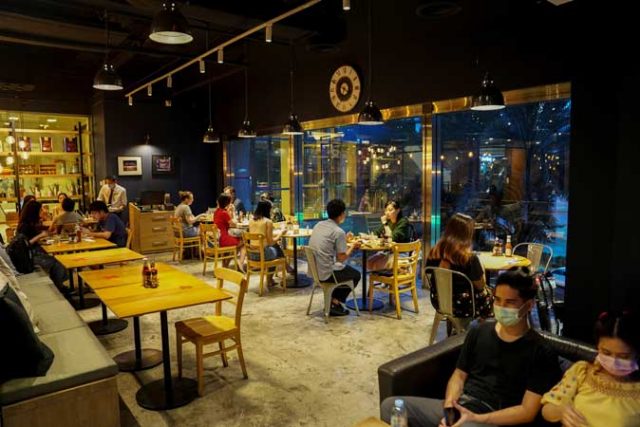
Coronavirus restrictions shutter thousands of Bangkok restaurants

CUSTOMERS eat food inside Chu Chocolate Bar & Cafe before being closed permanently due to the pandemic in Bangkok, Thailand, May 29. — REUTERS

BANGKOK — When restaurant owner Chirayu Na Ranong heard the Thai government announce new coronavirus restrictions in Bangkok in April, he burst into tears.

The latest curbs were the final straw for his Chu Chocolate Bar & Cafe in the center of the city. The cafe, popular with both tourists and locals for the past decade, closed its doors for the last time this week.

“I knew that it was over, because we were already just barely surviving, and then with one more lockdown, we wouldn’t have enough money to pay,” Mr. Chirayu, 36, told Reuters as his staff cleared out the restaurant.

“I followed the government’s order, I did what they told me to do, and then I couldn’t survive. I couldn’t make a living.”

The cafe’s chairs were stacked neatly near a big glass window that overlooked the empty city street, while several trash bags were lined up in front of what used to be a display of mouth-watering desserts.

Thailand’s food and beverage industry has been hit hard by restrictions on dine-in restaurants and the closures of pubs and bars, with sales falling drastically as people worked from home and tourist numbers dwindled to record lows.

The Thai Restaurant Association has estimated the industry is losing up to 1.4 billion baht ($44.97 million) per day under the current restrictions and about 500,000 workers have lost their jobs.

Around 50,000 restaurants have shut down over the past two months, either temporarily or permanently, the association said. It expects at least 10,000 to go out of business completely by the end of the outbreak.

“The government told us to stop our businesses, but no help has arrived,” Taniwan Koonmongkon, the association’s president, told Reuters. “It has never been this bad. We’re hanging by a thread.”

In late May, the government eased some restrictions on restaurants, allowing them to reopen for dine-ins but at a limited capacity of 25% and only until 9 p.m.

Industry groups have said that is not enough for many operators who have run out of cash to keep their staff and pay rent in the absence of financial assistance from the government.

The capital and surrounding provinces are the epicenter of the two-month-old outbreak, during which the vast majority of Thailand’s coronavirus cases and deaths have been recorded.

Thailand is reporting almost 4,000 new infections on average each day. It has recorded a total of around 165,000 cases and 1,100 deaths since the start of the pandemic.

The restaurant association and another industry group, Fire & Ice, have called for urgent financial support and caution on any further restrictions.

“The food and beverage industry is also one of the main attractions for Thailand’s tourism,” said Choltanutkun Tun-atiruj of Fire & Ice.

“What will be left of it once the country reopens, if the government doesn’t see the importance of this industry?” — Reuters

Taiwan health ministry to get $2.9 billion boost to fight COVID-19

TAIPEI – Taiwan’s health ministry will receive an extra T$79.2 billion ($2.87 billion) in spending to fight the COVID-19 pandemic, including buying vaccines, the government said on Thursday, detailing a stimulus package approved this week.

Taiwan’s parliament approved on Monday an extra T$420 billion in spending to help the economy deal with the virus’ impact, as the island curbs business activity to counter a spike in domestic infections.

The new money is in addition to previous stimulus spending worth T$420 billion, and the funding will run until June 30 of next year.

Taiwan’s Cabinet said the money for the health ministry would go toward buying and testing vaccines, medicines and to help improve monitoring and testing for the virus.

Taiwan has millions of vaccines on order, but has so far only vaccinated about 3% of its 23.5 million people, mostly with just the first shot.

“This wave of the pandemic came quickly and urgently, affecting many families and industries,” Premier Su Tseng-chang told a news conference.

The Economy Ministry will get T$58.4 billion in extra money to help companies with salaries and loan financing, while other departments will get cash to help children studying at home, hotels and other affected companies and people.

The central bank is also running a separate T$400 billion programme to provide preferential loans to small and medium-sized businesses.

Taiwan’s government has repeatedly sought to allay fears that the current outbreak of domestic infections will affect the export-dependent economy, a major global supplier of semiconductors.

Taiwan’s stock market has largely shaken off concerns about the coronavirus impact after initially swooning.

Infections have been heavily concentrated in Taipei and its nearby cities, and although the numbers have not exploded they are also not falling dramatically.

Taiwan has reported 9,389 infections since the pandemic began, including 149 deaths. – Reuters

App inspired by Wowowin game show fuses TV and mobile game entertainment

Wil to Play, a suite of mobile games inspired by TV game show Wowowin hosted by Filipino celebrity Willie Revillame, integrates with its TV counterpart and allows fans to win real-world prizes such as gadgets and food items despite not being in the studio. 

Developed by Big Crunch Digital Pte. Ltd., the Android app is part of a larger gaming platform called Perya Perya (derived from the Filipino word for amusement park).  

“The company has always aimed to develop a highly disruptive mass-market mobile entertainment offering for Southeast Asia,” said Jackeline Chua, managing director for Big Crunch Digital, in a press release. The company has experience in content, anime, and game production and development, working with big gaming studios such as Microsoft’s first-party studio The Coalition and Synergy 88 Digital, Inc. 

“With Wil to Play and other currently developing mobile gaming platforms, we’ve achieved distribution to more than 10 million users within the 2021 calendar year alone. We expect those numbers to increase exponentially in the coming years,” Big Crunch Digital said, adding that Mr. Revillame’s popularity and reach will be the main driver of Wil to Play’s success. 

In the Philippines, mobile gaming has been projected to grow in the coming years. Big Crunch Digital cites recent Statista.com reports that say Philippine mobile gaming revenues will reach $1,032 million in 2021 and go up to $1,522 million by 2025.  

Through the gaming platform Perya Perya, the company plans to further drive the mobile gaming market. Its interest is tapping into the average revenue per user of $33.69 from the same report. 

Acknowledging that games like Mobile LegendsFortnite, and PUBG as more responsible for the success of the mobile gaming market than Perya Perya’s casual games, Big Crunch Digital aims “to show the world that it can compete at that same level with the Filipino market, by giving the audience a game and ‘ecosystem’ that is uniquely Filipino.”  

The mini games will also be easy to play, known as “hyper-casual” in the gaming industry. They will include a memory game, a box-jumping game called Wow Girl, and a spin-off of the iconic Filipino game tumbang preso called Tumbang Premyo. The minimum specifications to run them will be Android OS 5.0, or Lollipop, and an internet speed of 2 to 3 megabits per second. 

Wil to Play is set to have its open beta release this June. For more information, visit wiltoplay.com or wiltoplay.ph— Brontë H. Lacsamana 

Illegal fishing, lack of training are major concerns of fisherfolk, says policy paper 

PHILIPPINE STAR/ MICHAEL VARCAS

Fisherfolk need to be trained and guided more closely by local and national government agencies to properly enforce sea patrols, manage protected areas, and implement harvest control, according to a policy paper. Findings showed that lack of training and coordination made it hard to address issues like illegal, unreported, and unregulated (IUU) fishing. 

“If they’re not given proper training and understanding of coastal resource management, they won’t be able to participate and recommend policies,” said Dr. Noemi S.B. Lanzuela, national stock assessment program coordinator of the Bureau of Fisheries and Aquatic Resources (BFAR) in Region V, in a virtual congress for Fisheries and Aquatic Resource Management Councils (FARMCs). 

Another issue was a lack of representation from small-scale fisherfolk. Martha E. Cadano, a national FARMC member from Region VIII in the Visayas, said there were gaps from unrepresented municipalities, since there were only a few members from every region. She added that there is a need for better integration and organization on municipal, city, and national levels. 

This is especially relevant in light of Supreme Court’s (SC) Mandanas-Garcia ruling, which allocates about P234.6 billion of additional funds to local government units (LGUs). 

“We can study how to utilize these funds for FARMCs, like enforcing fishery laws and training FARMC members,” said Ernesto G. Lim, Jr., policy and communications officer of NGOs for Fisheries Reform, who also suggested amending sections of the Fisheries Code, to allow each municipal coastal area to coordinate better with agencies. 

The consensus among attendees was to focus on empowering small-scale fisherfolk. Rollan C. Geronimo, an IUU fishing specialist for the United States Agency for International Development’s (USAID) Fish Right, suggested clearer measures for reporting cases of IUU fishing, like a simple monthly tracking in each barangay.  

It would be easier to have frequent reporting of observations, he said, since the area being patrolled is small. The practice could also be normalized by encouraging fisherfolk to discuss these observations during monthly barangay meetings. 

Meanwhile, on a policy level, Senator Risa N. Hontiveros-Baraquel, a guest speaker at the event, pledged to push bills that address the issues that were raised. One of these is Senate Bill No. 168, which seeks to create and implement a comprehensive fisheries management and protection plan for the country’s fisheries and aquatic resources. 

“While the bills are not yet implemented, FARMCs remain important in their influence,” she said, doubling down on the need to continue conversations.  

Of the 945 municipal and city FARMCs, 890 are active while 55 are inactive. The national advisory body for these councils recommended 51 Fisheries Administrative Orders (FAOs) over the past 10 years.  

The most recent of these FAOS is 266, which BFAR issued in 2020 to enable Philippine catcher vessels weighing 3.1 to under 30 gross tons to install vessel monitoring measures and an electronic reporting system. This was an effort to intensify surveillance of Philippine waters against IUU fishing.  

The virtual congress was organized by the World Wide Fund for Nature (WWF) Philippines in time for National Fisherfolk Day on May 31. — Brontë H. Lacsamana