
How PSEi member stocks performed — April 30, 2021

Here’s a quick glance at how PSEi stocks fared on Friday, April 30, 2021.


Here’s a quick glance at how PSEi stocks fared on Friday, April 30, 2021.

By Vann Marlo M. Villegas and Kyle Aristophere T. Atienza, Reporters
PRESIDENT Rodrigo R. Duterte should abandon his friendly stance toward China because the tide has turned, political analysts said at the weekend.
“We miss the point if we just try to look at Duterte’s tortured language and contradictory statement,” said Richard H. Heydarian, a professorial chairholder on geopolitics at the Polytechnic University of the Philippines.
“The Philippines does not have a coherent foreign policy when it comes to dealing with China,” he said by telephone. “It’s interesting to see why Duterte is so tortured in terms of his language; it’s precisely because he realizes that the tide is turning against his China policy.”
Mr. Duterte last week said he would not withdraw navy and coast guard vessels patrolling the South China Sea, which China claims in almost its entirety, even as he reiterated his desire for the Philippines to maintain friendly ties with its “good friend.”
The President’s order for continued patrols stood in contrast with his insistence that standing up for rights would risk war against China, which had been proven “to be a false choice,” said Jay L. Batongbacal, who heads the University of the Philippines Institute for Maritime Affairs and Law of the Sea.
“He can still pursue further relations with China, but that doesn’t have to come at the expense of our rights and interest in the West Philippine Sea,” he said in a telephone interview, referring to areas of the South China Sea within the country’s exclusive economic zone. “It doesn’t have to be a choice between one or the other.”
The presidential palace on Sunday said the Philippines must pursue its claims, manage and resolve disputes through peaceful and legal means under international law.
“All of these means start and end with negotiation,” presidential spokesman Herminio “Harry” L. Roque, Jr. said in a statement. “Even when countries implement decisions under the United Nations Convention on the Law of the Sea, they must negotiate.”
“That is why the President’s policy has been careful, calculated, calibrated. He has never renounced our claims and entitlements, and in fact he and his administration has asserted them in bilateral talks with China and in multilateral fora like the United Nations.”
Mr. Duterte has always struck a calmer tone toward its neighbor, which he considers to be central to his government’s ambitious infrastructure, trade and investment plans.
‘NOT WORKING’
He seems to be trying to win both China’s side and public approval, said Dennis C. Coronacion, who heads the University of Santo Tomas Political Science department.
“He wants China to continue to trust him,” he said. “At the same time, he wants to reassure the Filipino public that he is protecting our territorial integrity.”
Mr. Heydarian said the Philippines lacks a coherent foreign policy on China. “Without a question, Whitsun Reef, as in other major crises in the foreign policy over the past few years, has exposed fault lines within the administration’s response.”
Mr. Duterte has always been friendly with China so his pivot there is not undermined by its island-building activities in the South China Sea, but his top Cabinet members are taking a stronger stance, the analyst said.
The President’s “appeasement policy” to moderate Chinese behavior is not working, said Renato C. de Castro, an international studies professor at the De La Salle University.
“China couldn’t care less about the concessions that we offer them. China’s goal is simply subjugation. So Duterte is caught in a dilemma,” he said by telephone. Mr. Duterte could not challenge China “because that will mean he has been wrong all this time; he could not accept it.”
Mr. Heydarian said China has yet to deliver its infrastructure promise even as its militarization in the South China Sea worsened under Mr. Duterte’s administration.
“There is absolutely no evidence that Duterte’s ‘meekness policy’ toward China has produced any kind of tangible concessions in favor of the Philippines,” he said, adding that the incident at Whitsun Reef had undermined his position and credibility.
The Philippines has fired off several diplomatic protests against China after authorities spotted a swarm of Chinese vessels, including six war ships within its waters in the South China Sea.
A Philippine task force said more than 200 Chinese ships were scattered in waters within its exclusive economic zone. About 15 vessels either manned by Chinese militia, the People’s Liberation Army Navy or Chinese Coast Guard had also been spotted at Scarborough Shoal.
Meanwhile, about 240 Chinese vessels that China claims are ordinary fishing vessels have spread out to a wider area in the South China Sea, the agency said. The ships allegedly manned by Chinese maritime forces were scattered across the Spratlys, about 175 nautical miles west of Palawan province, it added.
FISH SOURCE
Meanwhile, Filipino marine scientists asked the government to stop downplaying the importance of the South China Sea as a major fishing ground for the Philippines.
In a statement, the scientists said about 55% of global marine fishing vessels operate in the waterway and as much as a fifth of annual global marine fish catch worth at least $21.8 billion comes from the area.
A third of Philippine fish catch comes from the Spratly Islands alone, they pointed out. The scientists said the whole shoal can provide as many as 91,000 metric tons (MT) of fish yearly, which can supply the fish needs of as many as 2.3 million Filipinos a year.
They added that the Scarborough Shoal alone can produce as many as 31 MT of fish per square kilometer of coral reef area yearly.
“These reefs show strong ecological connections with reefs near mainland Palawan and are potential sources of fish larvae to these reefs and those as far as the Sulu and Celebes Seas,” they said.
Given that 30% of Filipinos’ total protein intake and 70% of their animal protein intake comes from fish, “it is important that our fishers have continued access to the producing fishing grounds in the West Philippine Sea,” the scientists said.
The area also provides employment to about 1.8 million people, mostly from the small-scale fishing sector.
Mr. Duterte had said he would not quarrel with China over fish since there is not enough in the area. His spokesman earlier said the area is described in the map as “dangerous ground” since it is rocky.
But the marine experts said the area is poorly mapped and the name only serves as a warning to seafarers.
“Besides being host to rich marine biodiversity, coral reefs are considered to be one of the most productive marine ecosystems,” they said. “Perceiving coral reefs as rocks is a common misconception.”

THE DEPARTMENT of Health (DoH) reported 8,346 coronavirus infections on Sunday, bringing the total to more than 1.05 million.
The death toll rose by 77 to 17,431, while recoveries increased by 9,072 to 966,080, it said in a bulletin.
There were 71,472 active cases, 1.1% of which were critical, 94.7% were mild, 1.9% did not show symptoms, 1.4% were severe and 0.9% were moderate.
The agency said 16 duplicates had been removed from the tally, 11 of which were tagged as recoveries. Thirty-two recoveries were reclassified as deaths.
Seven laboratories failed to submit data on April 30.
About 11.1 million Filipinos have been tested for the coronavirus as of April 30, according to DoH’s tracker website.
The coronavirus has sickened about 152.9 million and killed 3.2 million people worldwide, according to the Worldometers website, citing various sources including data from the World Health Organization.
About 130.1 million people have recovered, it said.
The Philippines on Saturday received its first batch of 15,000 doses of Russia’s Sputnik V COVID-19 vaccine, which it would use in four cities in the capital region.
The Philippines is negotiating to buy 20 million doses of the vaccine as it tries to vaccinate as many as 70 million Filipino adults this year.
The government has received 4.04 million vaccine doses, more than 86% of which were from China’s Sinovac Biotech Ltd. and the rest from AstraZeneca Plc under a global initiative for equal access.
More than 1.8 million doses have been given as of April 27.
The Philippines last week took delivery of about 500,000 more doses of Sinovac’s CoronaVac. About 1.5 million more doses of CoronaVac would arrive on May 7, presidential spokesman Herminio “Harry” L. Roque, Jr. said.
The country expects to receive 500,000 more doses of CoronaVac this month, vaccine czar Carlito G. Galvez, Jr. said. About 4.5 million doses of CoronaVac will arrive in June, he added. The Philippines has received 3.5 million doses of CoronaVac, including one million doses donated by China.
Mr. Galvez earlier said the government expects to take delivery of as many as 10 million coronavirus vaccines starting June.
About 2.3 million doses of the vaccine developed by Pfizer, Inc. will arrive not later than June.
Mr. Galvez said the shipment already includes the 117,000 doses of Pfizer vials that were supposed to arrive in February.
About 94,000 doses of the vaccine developed by Moderna, Inc. and two million doses of Sputnik V are also expected to arrive in June.
At least 1.3 million doses of the vaccine developed by AstraZeneca, which were paid for by the private sector, will arrive in the second half.
Mr. Galvez said the government expects to vaccine 500,000 Filipinos daily in the third quarter.
The government has extended the modified strict lockdown in Metro Manila — the country’s coronavirus hotspot — and nearby provinces until May 14.
Defense Secretary Delfin N. Lorenzana last week said pandemic response would become a top national security priority and would be included in the country’s national security plan.
He said the coronavirus had shown that health should be a major government concern. — Vann Marlo M. Villegas


THE Department of Public Works and Highways (DPWH) said it ended the month of April with the completion of 662 units of health facilities with 24,513 beds nationwide, as coronavirus cases in the country continue to increase.
The added bed capacity should help meet the country’s healthcare demand amid a pandemic crisis, the department said in a statement issued over the weekend.
It also said the capacity of the Lung Center of the Philippines in Quezon City is currently being expanded.
The hospital needs to “cope with the increase in the number of patients brought by the climb of cases for people infected with COVID-19 (coronavirus disease 2019),” the department noted.
It said the project covers the construction of “four typical (modular units) with 88 beds and one intensive care unit (ICU) type modular hospital with 22 beds or a total of 110-bed capacity.”
The DPWH also reported that it had completed 10 modular hospital projects with a total capacity of 252 beds for coronavirus treatment and 60 units of off-site dormitories as temporary shelter for approximately 1,456 healthcare workers.
President Rodrigo R. Duterte announced last week the extension of the second strictest lockdown level — or modified enhanced community quarantine (MECQ) — in Metro Manila and the provinces of Bulacan, Cavite, Laguna and Rizal until May 14 as the country continues to have one of the worst COVID-19 outbreaks in the region.
Health Undersecretary Maria Rosario S. Vergeire told an online news briefing on May 1 that the two-week extension of MECQ will help decongest hospitals.
“Gusto ho natin palakasin pa iyong ating (We want to strengthen our) health system capacity, makapagdagdag pa ng (have) additional beds, makapag-decongest ng ospital at mas maiayos po natin ang sitwasyon dito po sa ating mga lugar (decongest the hospitals and further improve the situation in these areas),” she said.
Trade Secretary Ramon M. Lopez has said that increased hospital bed and ICU capacity and an improved contact-tracing system are necessary before Metro Manila and nearby provinces can be placed under the more relaxed general community quarantine. — Arjay L. Balinbin
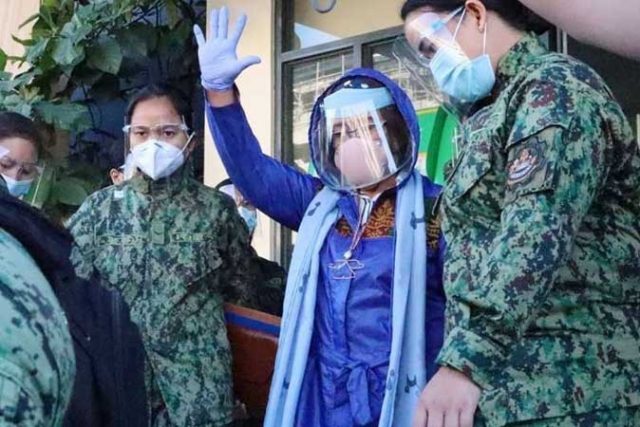
OPPOSITION Senator Leila M. de Lima filed a measure seeking to grant a 10-day paid leave for workers who will get coronavirus infection.
Ms. De Lima last week filed Senate Bill No. 2148 mandating pandemic leave credits for employees who test positive for the coronavirus disease 2019 (COVID-19), including those who are asymptomatic but cannot work from home or in isolation facilities.
“Filipinos valiantly choose to work, to provide for their families and to save the economy, despite the danger this pandemic poses,” the explanatory note of the bill read. “Thus, it is only right that these employees be provided with the incentive of having paid leaves when they are confirmed to be COVID-19 positive and they need to undergo quarantine or isolation,” the senator wrote.
Ms. De Lima said the pandemic has forced employees to stay in their low paying jobs despite the health hazards, while many others lost their jobs due to the pandemic.
The measure “ensures occupational safety and health in workplaces, further spread of the virus in the workplace and at the same time protects the welfare of our employees and their families.”
Under the proposed law, the employee must submit medical records to avail of the paid pandemic leave. It shall be deemed approved if not acted upon within five days.
The Social Security System for the private sector and the Government Service Insurance System for government workers will reimburse the paid coronavirus leaves to the employers.
The unused leaves under the bill shall not be cumulative and converted to cash.
Further, availing the paid leave shall not be used as reason for “misconduct, demotion, or termination in employment, or for any form of unsatisfactory performance,” it read.
The COVID-19 leave credits will be on top of existing sick leaves and other benefits. Employers who will refuse to grant the leaves will be fined ranging from P20,000 to P200,000, according to the bill.
The Civil Service Commission and the Labor department, in consultation with labor, trade, and employers groups, will review the conduct of the paid leaves within a month after the implementation. Concerned government agencies shall issue rules and regulations a month after the effectivity of the law, the bill read. — Vann Marlo M. Villegas


THE Commission on Population and Development (POPCOM) called on health workers to tap community pantries as a venue for the distribution of family planning items such as condoms and contraceptive pills.
“POPCOM is very much supportive of community pantries as a form of collective action in alleviating the need for sustenance of our less privileged. We believe that they will welcome the addition of condoms and pills among the goods they will source — with the help of their local healthcare personnel,” Undersecretary for Population and Development Juan Antonio Perez III said in a statement on Sunday.
The doctor said the dispensation of family planning services and commodities to help prevent unplanned and teenage pregnancies are essential amid the public health emergency.
“The presence of these modern methods of contraception in community pantries should also be seen as filling a void in the rollout of family planning activities, which are greatly disrupted by the pandemic,” he said.
Community pantries, originally a give-and-take food bank concept, have sprouted across the country after the first such initiative was launched using a small bamboo cart by citizen Ana Patricia Non in mid-April.
POPCOM said it has also directed its regional offices to coordinate with community pantry organizers for goods contribution as well as for the distribution of family planning information materials. Mr. Perez cited a recent study of the University of the Philippines-Population Institute and the United Nations Population Fund indicating that the number of women with unmet need for family planning has been exacerbated by the coronavirus-prompted restrictions. — MSJ

VIRTUAL assistance firm Xilium Professional Services (XPS), which mainly provides assistance to medical professionals, is opening a third office in the Western Visayas Region by June and will be hiring up to 150 workers in the first year of operations.
The business process outsourcing (BPO) firm’s president and chief executive officer, Vanessa E. Belleza, said the new branch will be located in Bacolod City.
“Since 2017, we have been hiring people from Bacolod. We are still offering opportunities.
The fact that our workers can work from home is actually a big thing for the pandemic,” she said during an online meeting last week with Bacolod Mayor Evelio R. Leonardia and other officials. XPS’ main office is in Iloilo City and has a branch in Roxas City, Capiz.
City Development Council Vice Chairman George Zulueta, who also joined the virtual meeting, said the Bacolod Business Development and Promotions Center can assist Xilium in processing their business and building permits.
“We have the investment incentive law, and you might be able to qualify,” Mr. Zulueta said.
XPS offers both voice and non-voice services, including administrative and back-office operations, and patient care support, among others. — MSJ

THE Supreme Court denied the petition of former Quezon, Bukidnon mayor Stewart G. Leonardo for a review of the anti-graft court’s 2018 decision convicting him of corruption over the purchase of trucks.
The country’s high court upheld the Sandiganbayan’s ruling that Mr. Leonardo is “guilty beyond reasonable doubt.”
In the Supreme Court’s decision dated Feb. 3 and made public on March 19, the former mayor was found in violation of Section 3(e) of Republic Act No. 3019, the Anti Graft and Corrupt Practices Act, and “accordingly, sentenced to suffer the indeterminate penalty of imprisonment for six years and one month, as minimum, to 10 years, as maximum.”
He has also been permanently disqualified from holding public office.
‘BAD FAITH’
In May 2010, Mr. Leonardo, then-mayor of Quezon, represented the town in an auction for five trucks for a total cost of P6,387,500.
In the same auction, he made a personal bid for two other small equipment costing P1.67 million.
However, the bid deposit of P100,000 for the purchase of the town’s trucks was deducted from Mr. Leonardo’s personal purchase, and his personal equipment were delivered together with the trucks, with the transportation expenses paid for by the town’s funds.
Mr. Leonardo subsequently paid the P100,000 bid deposit in two installments five months after the purchase, “after the repeated demands of the municipal accountant.”
Despite paying back the amount, the Supreme Court ruled that the former mayor still acted in “bad faith.”
Section 3(e) of the anti-graft law states that “(1) the accused must be a public officer discharging administrative, judicial, or official functions; (2) he or she must have acted with manifest partiality, evident bad faith, or inexcusable negligence; and (3) his or her action caused injury to any party, including the government, or (gave) any party unwarranted benefits, advantage, or preference in the discharge of his or her official functions.” — Bianca Angelica D. Añago

THE BUREAU of Fisheries and Aquatic Resources (BFAR) warned consumers from eating shellfish harvested from Bislig Bay, Surigao del Sur after the area tested positive for paralytic shellfish poison or red tide contamination.
BFAR said in its 13th bulletin that Bislig Bay joins other red tide positive zones across the country such as Puerto Princesa Bay, Palawan; Dauis and Tagbilaran City, Bohol; Tambobo Bay, Negros Oriental; Calubian, Leyte; Balite Bay, Davao Oriental; and Lianga Bay and Hinatuan, Surigao del Sur.
All types of shellfish and Acetes sp. or alamang harvested in red tide areas are unsafe for human consumption. However, other marine species from the contaminated waters can still be eaten with proper handling.
Red tide occurs as a result of high concentrations of algae in the water. Human consumption of contaminated shellfish may result in paralytic shellfish poisoning, which affects the nervous system.
Typical symptoms of paralytic shellfish poisoning are headaches, dizziness, and nausea. Severe cases may include muscular paralysis and respiratory issues. — Revin Mikhael D. Ochave
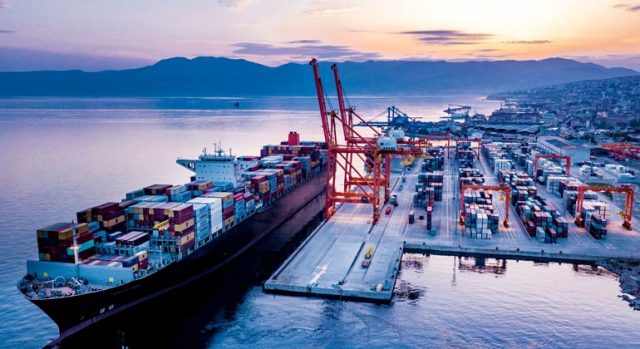
THE HOUSE Transportation Committee started discussing on Friday two proposed measures seeking to regulate the charges imposed by international shipping lines.
Transportation Committee Chairman Edgar Mary S. Sarmiento said it was “urgent” to hear the two bills filed with his committee because of rising shipping costs.
House Bill No. 4316 filed by Bagong Henerasyon Party-list Rep. Bernadette Herrera-Dy seeks to regulate the application of fees charged at origin and destination by shipping companies.
House Bill No. 4462 filed by Ang Probinsyano Party-list Rep. Ronnie L. Ong seeks to empower the Maritime Industry Authority (MARINA) to ensure fairness and transparency in shipping charges levied by forwarders and agents of international shipping lines.
Mr. Sarmiento, citing a report by Enrico L. Basilio, chairman of the Export Development Council’s networking committee on transport and logistics, said the Philippines has the highest shipping cost of $592 per 20-foot container at full container load in Asia. The average for other countries such as Japan, China, Singapore, South Korea, Thailand, Indonesia, Vietnam, Malaysia, and Bangladesh is $202.
“I wonder why the Philippines seems to be topping costs, hindi naman po tayo mayaman (We’re not exactly wealthy) … every time we jack up the price, there is no other way to address it but to pass it to consumers,” Mr. Sarmiento said.
Ms. Herrera-Dy’s bill prohibits origin and destination charges… by international shipping lines to local consignees or importers “without a contractual relationship.”
“Quoted rates shall be transparent and inclusive of all charges; and the Department of Trade (DTI), Bureau of Customs (BoC), Department of Justice (DoJ), and Philippine Competition Commission (PCC) (will) primarily implement the provisions of the law.”
Mr. Ong’s bill wants MARINA to supervise the rate-fixing mechanism of forwarders and agents of international shipping lines.
Association of International Shipping Lines, Inc. (AISL) General Manager Maximino T. Cruz said during the hearing when asked if AISL supports the bills: “There are provisions wherein we have to comment on, specifically on the provisions on the jurisdiction of the Bureau of Customs to regulate the destination charges…”
“They are not in a position to be the regulatory body as far as the imposition of destination charges of shipping lines is concerned. We are more inclined to give this authority to MARINA,” he added.
According to shipping industry officials who requested not to be identified, freight rates are still above pre-pandemic levels of about $2,000 per box for long-haul routes like Europe and the US.
They said there is now a downtrend in freight rates and do not expect freight rates to return to pre-pandemic levels in the foreseeable future “due to trade-related pressure coming from China,” which is still the world’s manufacturing center.
“The growth of the volume from China has been very dramatic. The stores in America and Europe are now restocking and therefore cargo has moved without let up. The Philippines imports a lot from China and (goods from there are) now 60% to 70% of cargo coming to major ports in the country,” one of the officials said.
“Export boxes further decreased due to the recent quarantine classification imposed within and along the country’s trade corridors. Imports, however, posted minimal increases.”
The United Nations Conference on Trade and Development (UNCTAD) released a policy brief on container shipping last week, which noted that containers and container ships are in short supply.
“The increase in demand was stronger than expected and not met with a sufficient supply of shipping capacity,” it said. “The container crisis is also a reflection of a slowdown in and delays across the maritime supply chain due to strains caused by the pandemic.”
UNCTAD said policymakers should therefore focus on trade facilitation and digitalization for resilient supply chains, tracking and tracing, and competition in maritime transport.
Asked to comment on April 28, the PCC said via e-mail that it “has an ongoing investigation of potentially abusive behavior in the industry.”
“The Competition Unit of UNCTAD has been facilitating cooperation and sharing of experiences among national competition authorities, especially benefiting young competition authorities, such as PCC, in developing countries,” it said.
“Logistics, including shipping, is one of PCC’s sector priorities, considering that this sector is vital during the pandemic and to economic recovery. We have been coordinating with DTI on the issue of high freight rates,” the PCC added.
Philippine Exporters Confederation, Inc. (Philexport) Assistant Vice-President Flordeliza C. Leong said via e-mail on April 29 that the increasing freight rates by shipping lines have “long been an issue and considered one of the impediments to export growth.”
“Addressing this will help lessen trade costs and make us more competitive,” she added.
Philexport’s suggestion, she said, is for the PCC “to unbundle the freight cost and check each item if valid.”
“I know there are fees such as cleaning fee, congestion fee, container deposit fee, imbalance fee, etc. Brokers and freight forwarders have long ago been complaining that their container deposit fees have not been refunded or slow to be refunded. They estimate this to be in the billions already,” she explained.
“Maybe the PCC can also look at which agency, if possible at all as benchmarked with other countries, to regulate international shipping lines to avoid or lessen such issues,” she added.
Also sought for comment, Chelsea Logistics and Infrastructure Holdings Corp. President and Chief Executive Officer Chryss Alfonsus V. Damuy said in a phone message April 27 that the three recommendations of UNCTAD “can help.”
However, on the competition item, it is “not much of a concern in the Philippines as there is too much competition already, which also drives the prices low actually,” he noted. — Arjay L. Balinbin

GILAS Pilipinas 3×3 team’s busy journey to the FIBA Olympic Qualifying Tournament (OQT) has begun after it entered its training “bubble” at the weekend at the INSPIRE Sports Academy in Calamba, Laguna.
For at least eight days, the three-a-side national team, composed of the country’s top players in the sport and Philippine Basketball Association (PBA) stalwarts, will try to work on their collective game for their OQT campaign happening from May 26 to 30 in Graz, Austria.
In the qualifiers, the nationals will try to notch one of the three tickets up for grabs for the Tokyo Olympics, where 3×3 basketball will make its debut.
The team said much work lies ahead for it since the pandemic greatly affected its preparation but it remains optimistic, banking on the members’ similar mind-set of doing well in the competition.
“We all have the same goals of making it to the Olympics. Once we’re on the court, we know what is expected of us and we’re going to do everything we can for the team and the country,” said incoming PBA rookie Alvin Pasaol of the Meralco Bolts in Filipino during their session on the radio program Power & Play on Saturday.
Mr. Pasaol and fellow rookies Joshua Munzon (Terrafirma) and Santi Santillan (Rain or Shine) are among the top 3×3 players in the country and played a big role in the Philippines securing a spot in the OQT, being part of teams which saw action and gained qualifying points in various International Basketball Federation (FIBA) tournaments.
They now aim to take what they have built to another level in the OQT, along with teammates CJ Perez and Mo Tautuaa of San Miguel, who are members of the gold medal-winning team in the 2019 Southeast Asian Games.
Also part of the OQT-bound squad is PBA free-agent Karl Dehesa.
While no longer strangers to one another, having had a chance to practice and train together right before the pandemic hit last year, still the 3×3 team members admit they have their work cut out at INSPIRE as they prepare a game plan to what is expected to be a tough OQT campaign.
“Most of the teams seeing action in the OQT have been playing for a long time now so we have a lot of room to make up for,” said Mr. Dehesa.
Mr. Munzon, for his part, said they will use the time given to them for training to get their feel for one another on the court and perfect the chemistry needed.
“It may take a little adjustment at first for some of us, but it is about the team and going for our goal,” the country’s top 3×3 player said.
While initially pegged to last for eight days, the Samahang Basketbol ng Pilipinas (SBP) is looking to extend the Ronnie Magsanoc-coached 3×3 team’s training for several days more if conditions permit before it flies out to the OQT.
The nationals play in the tough Pool C, which also has Slovenia (Europe Cup 2016 winner), France (second at Europe Cup 2019), Qatar (2014 World Champ), and the Dominican Republic.
OQT format calls for each team playing the other four in their respective pools. The top two teams from each pool qualify for the crossover quarterfinals and then play knockout games all the way to the semifinals.
The semifinals and the third-place games will be known in the FIBA 3×3 OQT as the Olympic Ticket games.
Gilas Pilipinas 3×3 will first play Qatar on May 26 at 8 p.m. (Manila time) to be followed by the game against Slovenia at 9:45 p.m.
It will take a break the following day before resuming its campaign on May 28 against the Dominican Republic at 6 p.m. and France at 8 p.m.
If Gilas Pilipinas 3×3 succeeds in booking a spot in the Tokyo Games, it will become the first basketball squad from the Philippines to qualify for the Olympics since the 5-on-5 team which featured the likes of Bogs Adornado, Jimmy Mariano and Freddie Webb in 1972 in Munich, Germany. — Michael Angelo S. Murillo


NATIONAL POWER CORP. (NPC) said it hopes to build 5 megawatts (MW) worth of capacity in the form of minigrids and renewable energy (RE) systems this year, part of a broader goal of adding 45 MW in power capacity in remote islands and communities.
“For 2021, NPC plans to install around 45.31 MW in new capacity. This include(s) 4.17 MW minigrids capacity for new areas and 1.1853 MWp (megawatts-peak) renewable energy, (such as) diesel-solar hybridization and PV (photovoltaic) mainstreaming through the use of solar home systems,” the NPC’s Corporate Communications Division told BusinessWorld in an e-mail Wednesday.
PV mainstreaming is an energy department program which aims to standardize the provision of solar home systems as a utility service offering for electric cooperatives and regulated electricity suppliers.
The NPC is authorized to carry out missionary electrification in remote islands and communities through its small power utilities group (SPUG). The missionary electrification program for 2021 to 2025 called for capacity upgrades at established SPUG power plants and delivering power services to more unserved areas.
The NPC said however that the 45-MW target covers projects to be built in “new SPUG areas and existing areas.” Some of these began last year, but the public health emergency pushed back their timetables.
It added that it plans to complete four transmission and substation projects this year: the 69 kilovolt Roxas to Taytay transmission line in Palawan; upgrading of the 20 MVA (megavolt ampere) Mobo Substation in Masbate, transfer of the 5 MVA substation from Narra to Brookes Point in Palawan, and the construction of the 20 MVA Mogpog substation in Marinduque.
Asked for updates about the Agus-Pulangi Hydropower Plants rehabilitation, the NPC said it is currently in the preparatory stage. NPC said that engineering consultant Tractebel-Engie is conducting multiple options pending compilation of an environmental and social impact assessment.
The NPC added: “The rehabilitation project aims to extend the operational lives of the facility, restore its rated capacities, improved safety, upgrade operational performance and strengthen its resilience against climate change and natural disasters.”
The project involves seven hydroelectric plants with a combined capacity of 932.1 MW at the Agus-Pulangi Hydropower Complex in Mindanao.
In a separate statement issued Wednesday, NPC announced that it is planning to build four more solar hybrid facilities in its SPUG plants. The plants will have a total capacity of 595 kilowatts-peak (kWp).
NPC President and Chief Executive Officer Pio J. Benavidez was quoted as saying that the facilities will be located in Cuaming, Bohol (55 kWp), Palumbanes in Catanduanes (40 kWp), Sabtang in Batanes (250 kWp), and Itbayat in Batanes (250 kWp).
NPC separately told BusinessWorld that the estimated cost for these four projects is around P132 million.
NPC currently operates 276 SPUG plants in 189 municipalities across 35 provinces. In March, the finance department said that NPC and the National Transmission Corp. hoped to bring power to 30,000 more households through their expansion activities this year. — Angelica Y. Yang
