Home Blog Page 7580

Pieces of paper

PRESIDENTIAL PHOTO/ JOEY DALUMPINES

President Rodrigo Duterte’s spokesperson’s insistence that no one should take seriously what the current occupant of Malacañang says during “informal” occasions again provokes the question of when an occasion qualifies as “formal” — and if his claims, declarations, threats, and other issuances even matter at all. But the reality is that, whoever he or she may be, what the President of the Republic says, whatever the place, time, or occasion, does matter once uttered in the public sphere.

In Mr. Duterte’s particular case, what he says matters most to the corrupt bureaucracy, the police, the military, the regime’s print and broadcast media hacks, and its keyboard trolls, who in fact hang on to his every word to guide them in such daily enterprises as looting the public treasury, violating human rights, spreading false information, and demonizing dissenters and regime critics.

It therefore matters as well to the rest of the population, which has had to contend with the consequences — the extrajudicial killings, the arbitrary arrests, the massacres, and the unaccountable abuse of power by the pettiest bureaucrat — of his “informal” utterances.

Mr. Duterte does contradict himself often; he says one thing and does another, and even denies having said what is already on record. But there is also the obvious fact that he has been fairly consistent not only in his inconsistencies but also on such issues as the immunity from prosecution — the impunity — of the police and military, and on human rights, the drug problem, the pandemic, and China.

In his persistent but futile attempts to defend his policy of cozying up to that country at the expense of Philippine sovereignty and interests, he was in fact again saying last week that only war — “guerra lang” — could stop Chinese aggression in the West Philippine Sea (WPS). It has done far worse over the past five years, but the most recent sign of China’s continuing assault on the country is the occupation of the WPS by 200 Chinese sea craft since March 20.

In reaction to citizen outrage and criticism, Mr. Duterte again dragged out his usual excuses for not doing anything about it. He blamed the past administration that had secured the 2016 UN Arbitral Tribunal ruling rather than China for the latter’s occupation of Philippine territorial waters; claimed that the country owes so much to China for its donation of some 600,000-plus doses of Sinovac vaccine; threatened to punch former Foreign Affairs Secretary Albert del Rosario; and challenged former Supreme Court Associate Justice Antonio Carpio to a debate on the issue. Although it was evident even as he said it that he was bluffing, it became even more obvious the next day: he backed off when Justice Carpio accepted the challenge, and the Philippine Bar Association volunteered to host the occasion.

However, his saying that the UN Arbitral Tribunal ruling on the WPS in favor of the Philippines is “just a piece of paper” seemed to some observers to be a departure from his past utterances. But it was also consistent with his five-year policy of appeasement and surrender, and was even more tellingly supportive of China’s own views and policies and its occupation of the WPS. It also suggested that the 78 protests against Chinese intrusions the current Secretary of the Department of Foreign Affairs (DFA) has filed, and whatever else it will do, are similar gestures of meaninglessness and futility.

At one and the same time he denied what he had previously said while defending the indefensible, he thus also undermined the efforts of an agency of his own administration that has been trying to assure the citizenry that it is doing something to address the problem.

Like his other ramblings, the “piece of paper” dictum is as old as much of human history. It dismisses the value of any compact, agreement, or code without force or the threat of its use behind it. It recalls “his” police and “his” military’s dismissing as of no consequence objections that arbitrary arrests, red-tagging, and violently dispersing peaceful gatherings are illegal and unconstitutional, because such protests are based on mere “scraps of paper.”

It resonates most among the cynical, who think might and violence the only arbiters of human behavior, and that only the strongest have the right and capacity to rule. The more knowledgeable among them could, of course, always point out that only by defeating King John’s armies in the Battle of Runnymede did the English barons compel him in the 13th century to sign the Magna Carta that recognized their rights and those of the Church’s. France’s 1789 Declaration of the Rights of Man and of the Citizen was made possible only by the triumph in arms of the French Revolution. Almost all the former colonies of the Western powers in Asia, Africa, and Latin America gained and declared their independence during the end of the colonial era only through victorious wars of national liberation.

But it is precisely to correct the dominance of force in human affairs and to protect the weak that the international community has since put together the many pacts, codes, declarations, treaties and other agreements that can protect the helpless from violence.

Among the characteristics that most distinguish the second half of the 20th century from past ages was the consensus among the many countries that had suffered the devastating consequences of the centuries-long rule of force that measures have to be put in place to create a global order premised on the civilizing power of reason. The time was long past for the world to transition to the rule of law and rationality from the reign of violence and madness exemplified by the Nazi and fascist contagion that had killed 50 million men, women, and children in Europe alone.

As part of that process, the United Nations Organization was founded in the aftermath of the Second World War to make sense rather than violence govern the relations not only between nations but also between the State and its citizens. It sanctions the use of force in the resolution of international disputes only when all other options fail, and when, in the eyes of the world community, its object is unwilling to negotiate and has become a threat to others. Its Arbitral Tribunal is one of the institutional expressions of the primary UN commitment to the peaceful conclusion of the contention over territory, resources, technology, or whatever else between nations.

The Philippine Constitution protects the weak from the strong. That much should be evident in the Bill of Rights’ guaranteeing the rights to free speech, free expression, press freedom, and freedom of assembly, and in its many other provisions that protect the individual citizen from the State’s arbitrary denial of his or her rights to life and liberty.

To dismiss the UN Arbitral Tribunal’s decision recognizing Philippine rights to the West Philippine Sea solely on the basis of the Stone Age view that only violence can enforce it is to say the same thing about international law, and the pacts, agreements, and other documents that uphold the rights of the weaker countries from the intimidation and violence of the more powerful. It is also to suggest that only the coercive powers of the State rather than reason can enforce the provisions of the Philippine Constitution, and that not the Charter, but their control over the police and the military, that empowers government officials. That mindset explains why the current regime denies the rest of the citizenry its protection.


Luis V. Teodoro is on Facebook and Twitter (@luisteodoro).

www.luisteodoro.com

Want more babies? Care for mothers first

RUI XU/UNSPLASH

CHINA’S once-in-a-decade census shows what most have long suspected: Efforts to encourage more births after decades of restricting families to one child are falling on deaf ears. It’s not a unique problem: South Korea, with the world’s lowest fertility rate, saw its population decline for the first time on record in 2020. Even the United States, comparatively young, saw its birth rate drop yet again last year.

Nudging citizens to procreate is easier in theory than in practice and approaches abound — most of them unsuccessful. Financial help for would-be parents, whether in the form of one-off payments, subsidized childcare, tuition, and even housing support, is necessary.  It’s just not always sufficient when it comes to securing a more sustainable birth rate over time. Beijing and much of fertility-challenged East Asia may well have to tackle something less tangible: Reducing the price women pay for opting into matrimony and maternity. That means encouraging divided labor at home and fostering equal opportunities after marriage and children, as well as before.

Share that burden, or find women dodging it altogether — in China and beyond.

Shrinking populations are not in and of themselves problematic, as I’ve written before. The issue for China, and for many others, is the speed at which it is happening. China’s total fertility rate is now 1.3 births per woman — heading toward Singapore’s 1.1 and even South Korea’s dire official rate of 0.8.

Pro-natalist policies, especially those promoted by populist or authoritarian states with their eye on idealized traditional families, rarely promote women’s rights and ambitions. In countries like Hungary, Poland, and even Russia, where demographic concerns are front of mind, equality is not benefiting. China, keen to avoid too many single men for political as well as demographic reasons, has sought to stigmatize late marriage by referring to unmarried professional women — many of whom are only children, raised with plenty of opportunities — as “leftover.”

That’s not just poor judgement, it’s also bad policy. Tackle the motherhood curse instead.

Consider that since the one-child policy began to ease, there has been only a blip in birth rates. Clearly, shaming women by referring to them as unwanted when they are single — a phenomenon which Leta Hong Fincher, author of Leftover Women: The Resurgence of Gender Inequality in China, dates back to at least 2007 — isn’t working. Tuesday’s census figures show that last year the number of children born in the country fell to 12 million, the lowest since 1961, when China was coming out of a devastating famine that killed tens of millions.

Economic help is clearly vital, and officials have already singled out education and other costs for support. We know one-off payments tend to bring forward births, making little difference to overall fertility, but broad support, in parental leave, social and fiscal policies can work. That’s underpinned France’s relative success, compared to the rest of aging Europe.

But China, and indeed Japan, Korea and others, need to tackle the burden of the unseen costs of motherhood too. In China, women are not infrequently asked about plans for marriage and children in job interviews, implying a penalty. The painful wealth gap widens after the wedding day, when wives are not encouraged to put their name on property deeds even if they have contributed, leaving valuable real estate concentrated in male hands. And after birth, it is still mothers, overwhelmingly, who handle society’s fear of failure and unrealistic demands of perfection from their offspring, with all the homework, tutoring, and heartache that entails.

It’s a grim picture in the most chronically baby-free nations. Japanese and Korean men do fewer hours of unpaid household chores and childcare than counterparts in any other wealthy nation. China does only a little better. According to a study cited by the New York Times in 2019, Japanese women who work more than 49 hours a week do close to 25 hours of housework over that time. Their husbands do an average of less than five. Seoul has pumped billions into improving its birth rate over the past decade or so, with subsidized childcare, nurseries, and more — but come the pandemic job cuts, mothers still got hit first. Little wonder fewer are choosing this path.

And that’s before even considering the stigma (and bureaucratic pain) for Chinese mothers having children out of wedlock.

Beijing’s population crunch will no doubt prompt the removal of remaining restrictions on family sizes, drawing a line under decades of meddling to prevent a Malthusian crisis. That shouldn’t start a period of meddling to obtain the reverse. Improve the lot of women instead.

BLOOMBERG OPINION

IBM exec advocates ‘zero trust’ approach to security 

PIXABAY

Companies that employ “zero trust”  an approach to security that relies on continuously verifying the trustworthiness of every device, user, and application in an enterprise — had a smoother transition to working from home than those that didn’t, according to a study by Enterprise Strategy Group (ESG), an IT analyst, research, validation, and strategy firm. 

According to the study, released in April, 45% of organizations who were more mature in their zero trust strategies adjusted better to telework as compared to 8% of those that were less mature. 

“We have many applications in the cloud, and we manage many devices especially in IoT (Internet of Things). Zero trust helps us manage this new environment and protect Dow’s information,” said Mauricio Guerra, chief information security officer of plastics manufacturer Dow Chemical Company, at IBM’s Think Conference 2021, a two-day virtual conference that ran May 11–12. 

With their users, data, and resources spread around the world, companies have to prioritize securing potentially sensitive or confidential data at every layer of the organization.  

KEEP YOUR OWN KEY
At the same conference, IBM Systems senior vice-president Tom Rosamilia said that there are three core principles to the zero-trust approach: least privilege access; never trust, always verify; and assume breach.  

Open security, he added, is critical to the success of zero trust. Open-source software is code that is designed to be publicly accessible — anyone can see, modify, and distribute the code. IBM has been betting on open source for a long time, said Mr. Rosamilia, with its subsidiary Red Hat enabling community-driven innovation. Benefits of using open-source software, according to Red Hat, include lower cost, transparency (which reduces software bugs), and collaboration (which accelerates innovation). 

Mr. Rosamilia also warned against relying on a single provider. “Customers have key control [of their data],” he said. “It’s called keep your own key. Don’t entrust your data to anyone  not us, not anyone else.” 

TIPS FOR IMPLEMENTATION
Although zero trust offers improved security, it is not easy to put in place, according to a 2020 Forrester Research paper. It’s a gradual process requiring security teams to coordinate and understand the context behind all the connections occurring in the business: data, users, devices, applications, and workloads. Four tenets can be considered to be successful with zero trust, said the paper: 

  • Define context-organizations need to understand what users, data, and resources are connecting across the business to create coordinated security policies aligned with business goals 
  • Verify and enforce- organizations need to continuously verify that each and every connection is acceptable and trustworthy at that moment 
  • Resolve incidents- organizations need to always plan for anomalies such as new business situations or incidents stemming from unknown threats 
  • Analyze and improve- organizations need to realize that security is never “done” and continually improve their security posture by adjusting policies to make faster, more informed decisions 

“My advice would be to start by developing a growth map,” said Dow Chemical’s Mr. Guerra. “Where do you want to be? How will you get there? This will change over time, but you need a road map to make sure you’re heading in the right direction.” — Patricia B. Mirasol 

Wealthy nations’ vaccine spree obscures global pandemic misery

REUTERS

MASS VACCINATIONS, falling case counts and waning coronavirus deaths in a few wealthy countries threaten to obscure ongoing worldwide suffering from the pandemic that’s likely to last for months, and perhaps years, to come.

That’s Carl Bildt’s worry as the new special envoy to the World Health Organization-backed effort set up last year to dispatch vaccines and other weapons against coronavirus disease 2019 (COVID-19). Suppressing the virus that’s advancing in India and beyond depends on persuading rich nations to share excess doses and help close a $19-billion funding gap, Mr. Bildt said in an interview.

An independent review of the international COVID-19 response echoed Mr. Bildt’s concerns Wednesday, calling for Group of Seven countries to commit 60% of the money needed this year. The report urged high-income nations to provide more than 2 billion doses to poorer regions by the middle of 2022.

“The risk is that if people in the UK, EU or US think the worst is over, the attention will shift,” he said. “The worst isn’t over.”

No stranger to high-stakes diplomatic efforts, Mr. Bildt was co-chair of the 1995 Dayton peace talks that ended the war in Bosnia. He earlier led Sweden as prime minister when the government negotiated its entry into the EU. Now he finds himself in the middle of an urgent campaign to galvanize support for the WHO’s Access to Covid-19 Tools Accelerator and push leaders to contribute more to the global fight.

For a few fortunate countries, optimism is on the rise. The US is preparing to vaccinate middle- and high-school students, a relatively low-risk group, before the start of summer camps and the next school year. Covid deaths could drop to as low as 1,500 per week by June 5, according to a Centers for Disease Control and Prevention (CDC) forecast; the weekly toll was more than 8,000 in mid-March.

The UK reported zero COVID deaths in its Tuesday update, and the government is clearing the way for people to hug and meet indoors at pubs and restaurants. Officials in Europe, including Germany’s health minister, also expressed hope for decreasing cases.

INEQUITABLE
But as India grapples with a deadly surge among its population of 1.4 billion, worries are growing for many other spots all over the planet. Despite declines in the developed world, more than 600,000 new COVID cases are reported globally each day, as stubborn epidemics in countries like Colombia, Brazil and Malaysia burn on. Waiving patents on vaccines, a proposal the Biden administration supports, is promising but won’t address immediate needs for supply, said Ellen ‘t Hoen, director of Medicines Law & Policy, a research group based in the Netherlands.

“Anything that exists today should really go to places where the crisis is the most serious,” she said. “Maybe vaccinating teenagers in California shouldn’t be the priority at this point.”

Covax, the vaccine initiative that’s part of the ACT-Accelerator, has shipped just 60 million doses — less than a quarter of the number already administered in the US alone. In their report on the pandemic response, the independent experts recommended a review of the Accelerator, citing shortcomings in the effort to ensure global access to shots, drugs and other supplies.

More international coordination is required to fix the inefficiencies and inequities, according to Robert Yates, executive director of the Centre for Universal Health at Chatham House, a London-based think tank.

“We’re not in good shape here,” Mr. Yates said. “Vaccines should be going to the countries and the age groups most in need, but that’s not happening.”

Global health officials stress that everyone is vulnerable if the virus keeps advancing, increasing the risk of concerning variants and prolonging the pandemic. Getting health workers immunized in developing nations should be the focus, said Mr. Bildt, who was named to the post at the end of March.

“As long as this is a pandemic that is spreading like wildfire in parts of the world, we’re not safe,” Mr. Bildt said.

Some wealthy countries have obtained far more vaccine than they need, and advocates say more should be shared. High-income countries have purchased almost 5 billion doses, middle-income nations have secured about 2.2 billion doses and poorer regions hold about 270 million, according to the Duke Global Health Innovation Center in Durham, North Carolina.

PALTRY DONATIONS
Many pledged donations have yet to be fulfilled and some are paltry in the face of the crisis. Sweden promised to donate 1 million doses of AstraZeneca Plc’s vaccine and France intends to share half a million by the middle of June. The US plans to give away just 60 million Astra shots.

“Both Europeans and Americans have ordered, wisely so, quantities that are very substantially in excess of what they need immediately,” Mr. Bildt said. “That means there is room to start to share when they get their situations more under control, and we’re approaching that now. The EU and US have been talking about it. But we need to go from talking to actually doing it.”

Mr. Bildt, Sweden’s prime minister from 1991 to 1994, emphasized the importance of sharing doses fairly through Covax. “Otherwise there is a risk of handing out to friends only, and that I don’t think would be helpful.”

The former Balkans mediator also said he’s concerned about a lack of life-saving oxygen and some regions “flying blind” without sufficient access to testing. While the ACT-Accelerator has attracted more than $14 billion so far, led by the US, Germany and Britain, there’s a risk it won’t hit its fundraising goal this year, a shortfall that could extend the pandemic, he said.

More money will likely be required next year.

“The rich countries through the likes of the G-7 and G-20 must come up with this money,” said Chatham House’s Mr. Yates. “That’s a no-brainer. By vaccinating the world we potentially save the economy trillions of dollars.”

For 10 high-income countries — including Canada, Germany, Japan, Qatar, South Korea, the UK and the US — investing the $19 billion required would produce more than $466 billion in economic benefits over five years, according to an ACT-Accelerator report last month.

“All governments are very much aware of the pandemic and aware of what’s happening in their own countries,” Mr. Bildt said, “but is there sufficient attention to the global scale of it, and the ramifications for everyone of not getting it under control globally? We have substantial work ahead of us.” — Bloomberg

Asian cities face greatest environmental risks

REUTERS

ASIAN CITIES face the greatest risk from environmental issues including air pollution and natural disasters, according to a report by research firm Verisk Maplecroft.

Of the 100 most vulnerable cities, 99 are in Asia, according to the report released on Thursday. Of those, 37 are in China and 43 are in India, the world’s first and third biggest emitters of greenhouse gases respectively. Globally, 1.5 billion people live in 414 cities that are at high risk from pollution, water shortages, extreme heat, natural hazards and the physical impacts of climate change.

Jakarta, the capital of Indonesia, topped the list of combined risk based on all nine factors analyzed by Verisk Maplecroft. India is home to 13 of the 20 riskiest cities in the world, a result of its extreme levels of air and water pollution. China’s flood-prone Guangzhou and Dongguan topped the list of cities facing threats from natural hazards, followed by Japan’s Osaka and Tokyo for being vulnerable to earthquakes and typhoons. Lima is the only city outside Asia among the top 100 most at-risk cities overall.

A significant danger for many cities is how climate change will amplify weather-related risks, said Will Nichols, Verisk Maplecroft’s Head of Environment and Climate Change. “Higher temperatures and the increasing severity and frequency of extreme events will change the quality of living and economic growth prospects of many cities across the globe,” he said.

African cities face some of the worst risks from climate change and have the least ability to mitigate those impacts. Glasgow was ranked the safest among the 576 cities examined for that factor.

“Environmental risk needs to be a central consideration when it comes to making your business, investments or real estate portfolio more resilient,” said Mr. Nichols. The hope is that identifying these risks and stressing strategies for future climate scenarios will help investors  “gain a clearer view of the costs and benefits of investment decisions.” — Bloomberg

More than 4,000 Indians die of COVID-19 for second straight day

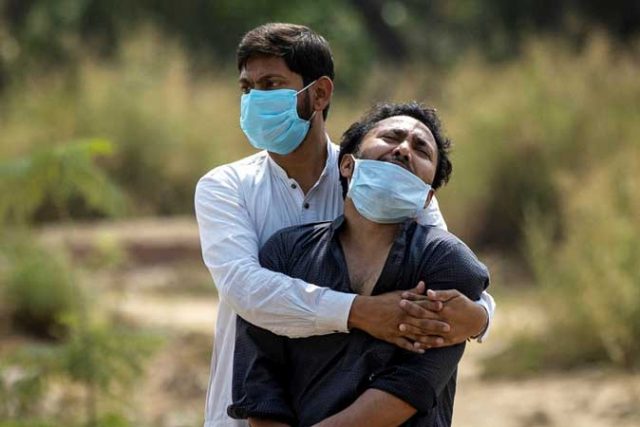
A MAN is consoled by his relative as he sees the body of his father, who died from the coronavirus disease 2019 (COVID-19), before his burial at a graveyard in New Delhi, India, April 16. — REUTERS

BENGALURU/NEW DELHI — India recorded more than 4,000 COVID-19 deaths for a second straight day on Thursday, while infections stayed below 400,000 for a fourth day, though the virus has become rampant in rural areas where cases can go unreported due to a lack of testing.

Experts remain unsure when numbers will peak and concern is growing about the transmissibility of the variant that is driving infections in India and spreading worldwide.

Bhramar Mukherjee, a professor of epidemiology at the University of Michigan, said most models had predicted a peak this week and that the country could be seeing signs of that trend.

Still, the number of new cases each day is large enough to overwhelm hospitals, she said on Twitter. “The key word is cautious optimism.”

The situation is particularly bad in rural areas of Uttar Pradesh, India’s most populous state with a population of over 230 million. Television pictures have shown families weeping over the dead in rural hospitals or camping in wards to tend the sick.

Bodies have washed up in the Ganges, the river that flows through the state, as crematoriums are overwhelmed and wood for funeral pyres is in short supply.

“Official statistics give you no idea of the devastating pandemic that is raging through rural UP,” wrote well-known activist and opposition politician Yogendra Yadav in The Print.

“Widespread ignorance, lack of nearby or adequate testing facilities, official and unofficial cap on testing and inordinate delays in test reports have meant that in village after village, virtually no one has been tested, while scores of people complain of a ‘strange fever’.”

According to health ministry data, India had 362,727 new coronavirus disease 2019 (COVID-19) infections over the last 24 hours while deaths climbed by 4,120.

The surge in infections has been accompanied by a slowdown in vaccinations, although Prime Minister Narendra Modi announced that vaccinations would be open to all adults from May 1.

Two states — Karnataka, which includes tech hub Bengaluru, and Maharashtra, which includes Mumbai — have announced they will temporarily suspend vaccination for people aged 18-44 years as they prioritize those over 45 who need their second dose.

India is the world’s largest vaccine producer, but has run low on stocks in the face of the huge demand. As of Thursday, it had fully vaccinated just over 38.2 million people, or about 2.8% of a population of about 1.35 billion, government data shows. — Reuters

Hamas launches rockets at Israel, which vows to keep pummeling Gaza

REUTERS/MOHAMMED SALEM
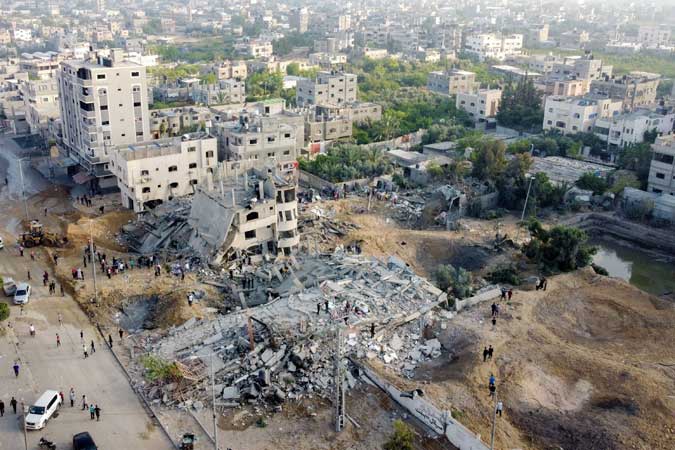
A picture taken with a drone shows the ruins of buildings which were destroyed in Israeli air strikes amid a flare-up of Israeli-Palestinian violence, in the northern Gaza Strip May 13, 2021. — REUTERS/MOHAMMED SALEM

GAZA/JERUSALEM  — Hamas launched rockets at Tel Aviv and toward Jerusalem early on Thursday and Israel vowed to keep pummelling the Islamist faction in Gaza despite a prediction by US President Joseph R. Biden that their fiercest hostilities in years might end soon.

There was no immediate word of casualties from the pre-dawn salvo, which set off sirens as far as northern Nahalal, 100 km (62 miles) from Gaza, sending thousands of Israelis to shelters.

At least 67 people have been killed in Gaza since violence escalated on Monday, according to the enclave’s health ministry. Seven people have been killed in Israel, medical officials said.

With world powers demanding de-escalation of a conflict beginning to recall the Gaza war of 2014, Washington planned to send an envoy, Hady Amr, for talks with Israel and Palestinians.

“My expectation and hope is this will be closing down sooner than later, but Israel has a right to defend itself,” Mr. Biden said on Wednesday after speaking to Mr. Netanyahu.

Mr. Biden did not explain the reasons behind his optimism. Mr. Netanyahu’s office said he told the US president that Israel would “continue acting to strike at the military capabilities of Hamas and the other terrorist groups active in the Gaza Strip.”

On Wednesday, Israeli forces killed a senior Hamas commander and bombed several buildings, including high-rises and a bank, which Israel said was linked to the faction’s activities.

Hamas signaled defiance, with its leader, Ismail Haniyeh, saying: “The confrontation with the enemy is open-ended.”

Israel launched its offensive after Hamas fired rockets at Jerusalem and Tel Aviv in retaliation for Israeli police clashes with Palestinians near al-Aqsa mosque in East Jerusalem during the fasting month of Ramadan.

These escalated ahead of a court hearing — now postponed — that could lead to the eviction of Palestinian families from East Jerusalem homes claimed by Jewish settlers.

For Israel, the targeting of the two major cities posed a new challenge in the confrontation with Hamas, regarded as a terrorist group by Israel and the United States.

A Palestinian source said truce efforts by Egypt, Qatar and the United Nations made no progress to end the violence.

US Secretary of State Antony Blinken phoned Palestinian President Mahmoud Abbas and said Washington “was exerting efforts with all relevant parties to reach calm,” the official Palestinian news agency WAFA said. Abbas is a Hamas rival whose authority is limited to the Israeli-occupied West Bank.

STRIFE WITHIN ISRAEL
The fighting has touched off strife within Israel, where some in the Arab minority mounted violent pro-Palestinian protests. Media reported spreading street attacks by Jews on Arab passersby in ethnically mixed areas on Wednesday.

In Gaza, two multi-storey residential buildings and a tower housing media outlets, including one linked to Hamas, collapsed after Israel urged occupants to evacuate in advance of its air strikes, and another structure was heavily damaged.

“Israel has gone crazy,” said a man on a Gaza street, where people ran out of their homes as explosions rocked buildings.

Many in Israel also holed up in shelters as waves of rockets hit its heartland, some blown out of the sky by Iron Dome interceptors.

“All of Israel is under attack. It’s a very scary situation to be in,” said Margo Aronovic, a 26-year-old student, in Tel Aviv.

The fatalities in Israel include a soldier killed while patrolling the Gaza border and five or six civilians, including two children and an Indian worker, medical authorities said.

US energy corporation Chevron said it had shut down the Tamar natural gas platform off the Israeli coast as a precaution. Israel said its energy needs would continue to be met.

At least two US airlines canceled flights from the United States to Tel Aviv on Wednesday and Thursday.

Israel, whose Ben Gurion Airport briefly suspended operations on Monday after a rocket barrage on Tel Aviv, said national airline El Al stood ready to provide supplemental flights.

Thursday’s barrage on Tel Aviv prompted Israel to reroute an El Al flight from Brussels away from Ben Gurion, its intended destination, to Ramon Airport in the south. It appeared to be the first time Israel had used Ramon as a wartime alternative to Ben Gurion. A flight was previously diverted there due to bad weather, according to aviation tracker Avi Scharf.

The conflict has led to the freezing of talks by Netanyahu’s opponents on forming a governing coalition to unseat him after Israel’s inconclusive March 23 election.

Gaza’s health ministry said 17 of the people killed in the enclave were children and six were women. The Israeli military said on Thursday that some 350 of 1,500 rockets fired by Gaza factions had fallen short, potentially causing some Palestinian civilian casualties.

Although the latest problems in Jerusalem were the immediate trigger for hostilities, Palestinians have been frustrated as their aspirations for an independent state have suffered setbacks in recent years.

These include Washington’s recognition of disputed Jerusalem as Israel’s capital, a US plan to end the conflict that they saw as favourable to Israel, and continued settlement building. — Reuters

Munzon, Tautuaa to play in 3×3 Olympic qualifier in major break

GILAS Pilipinas 3x3 members Joshua Munzon (26) and Mo Tautuaa (39) feel privileged and are basking in the opportunity given to them to make it to the Olympic Games. — GILAS PILIPINAS 3X3

By Michael Angelo S. Murillo, Senior Reporter

RECOGNIZING that not many are given the chance to participate in the Olympic Games, Joshua Munzon and Mo Tautuaa feel privileged and are basking in the opportunity given to them through 3×3 basketball.

Part of Gilas Pilipinas 3×3 which will banner the country’s campaign in the International Basketball Federation (FIBA) Olympic Qualifying Tournament in Austria later this month, Messrs. Munzon and Tautuaa shared what on their plate is something big and that they are working hard in training to have the best representation possibly come the competition.

“This is very big,” said Mr. Munzon. “I can say that this is the biggest opportunity I have had in my career. Truly, a huge honor and the possibility of being in the Olympics is something that I never thought I would be in.”

Mr. Munzon, the country’s number one-ranked 3×3 player and an incoming Philippine Basketball Association (PBA) rookie, played a big part in the Philippines securing a spot in the OQT, being part of numerous teams which earned qualifying points in FIBA tournaments.

It is the same success he wants to have with Gilas Pilipinas 3×3 as they go for one of the three Olympic tickets up for grabs in the qualifiers in Graz.

Former PBA most improved player of the year Tautuaa, for his part, is high as well in representing the country, which is why when he was asked anew to don the national colors he did not have second thoughts.

“I received a two-part text message to invite me to the team. But even before I received the second part of the invitation, I already replied that I wanted to come,” he said.

Mr. Tautuaa, who plays for San Miguel in the PBA, represented the country in 3×3 basketball at the 2019 Southeast Asian Games and helped his team win a gold medal.

To gear up for the expected competition at the OQT, Gilas Pilipinas 3×3, which also includes CJ Perez (San Miguel), Alvin Pasaol (Meralco), Leonard Santillan (Rain or Shine) and Karl Dehesa, went into “bubble” training at the INSPIRE Sports Academy in Calamba, Laguna.

The team temporarily broke camp last weekend to work on the necessary documents for the qualifiers, but is set to reenter the bubble for the last stretch of its preparation before flying to Austria.

While training amid the prevailing conditions with the pandemic has been challenging, Mr. Munzon said the team is satisfied with the progress it has made and is optimistic of what lies ahead.

“I definitely can say that it felt natural. Just going out there was like riding a bike. I can’t say it was easy, but we were able to shake off some rust,” said Mr. Munzon, underscoring the camaraderie within the team.

“It was very productive and we were able to accomplish a lot. Good to be around a lot of people after being locked out for so long… [We have] an idea [now] on what our offense and defense will be.”

He went on to laud the efforts of the Samahang Basketbol ng Pilipinas (SBP) for making things happen for the team and its Olympic push.

“I’m very grateful to SBP and our coaches for keeping this OQT dream alive. We all know how hard it is to train in this pandemic, but they were able to do it.”

Zeroing in on their OQT campaign, Mr. Tautuaa said a difficult road awaits them, but they are coming in looking to represent the Philippines well and go for that Olympic spot.

“This is going to be the first time we played against this caliber, this level [as a group]. But we want to win and we got that Filipino brand. We’re not going to back down to anybody. We’re going to go there and see where we go.”

In the OQT, which happens from May 26 to 30, the Ronnie Magsanoc-coached nationals play in the tough Pool C, which also has Slovenia (Europe Cup 2016 winner), France (second at Europe Cup 2019), Qatar (2014 World Champ), and the Dominican Republic.

Tournament format calls for each team playing the other four in their respective pools. The top two teams from each pool qualify for the crossover quarterfinals and then play knockout games all the way to the semifinals.

The semifinals and the third-place games will be known in the FIBA 3×3 OQT as the Olympic Ticket games.

Nets get better of Spurs in James Harden’s return; Hawks rally past Wizards

ALL-STAR guard James Harden returned after missing 18 games (strained right hamstring) to beat the San Antonio Spurs (128-116) on Wednesday. — JAMES HARDEN FB PAGE

JAMES Harden collected 18 points, 11 assists and seven rebounds in his return from a strained right hamstring as the Brooklyn Nets posted a 128-116 victory over the San Antonio Spurs on Wednesday night in New York.

Harden came off the bench for the first time since April 22, 2012, when he was a member of the Oklahoma City Thunder. Harden played under a minutes restriction after missing the previous 18 games. He played 25:44 in his first game since April 5.

After spending most of the game facilitating others, Harden scored 10 points in the fourth quarter, including a 3-pointer with 1:53 left that gave the Nets a 122-108 lead that essentially sealed it.

The Nets (46-24) won their third straight and moved within 1 1/2 games of the top-seeded Philadelphia 76ers. Brooklyn also inched 1 1/2 games ahead of the Milwaukee Bucks in the race for the No. 2 seed.

Landry Shamet led the Nets with 21 points on a night when Kyrie Irving sat out after sustaining a facial contusion in Tuesday’s win at Chicago.

Nicolas Claxton contributed a career-high 18 points, Jeff Green added 16 and Kevin Durant and Bruce Brown chipped in 14 apiece as the Nets shot 60.8% from the floor and handed out 33 assists. Brown added 11 rebounds.

DeMar DeRozan scored 21 points, but San Antonio (33-36) dropped three games behind ninth-place Memphis and lost for the seventh time in nine games. Dejounte Murray and Patty Mills added 15 apiece for the Spurs, who shot 42.6% and made only 8 of 31 three-point attempts. Murray also collected 11 rebounds.

Brooklyn shot 65.2% and held a 35-20 lead through the first quarter. San Antonio got within 44-42 on a layup by DeRozan with 5:13 remaining in the second quarter, and Brooklyn held a 57-51 lead at half time.

The Nets gradually pulled away in the third as Harden’s three-pointer made it 95-78 with 2:33 left, and Brooklyn led 96-81 entering the fourth.

HAWKS OVER WIZARDS
Meanwhile, John Collins drilled a go-ahead three-pointer with 24.8 seconds left to complete an Atlanta Hawks comeback and a 120-116 victory over the visiting Washington Wizards on Wednesday night.

The result had playoff implications for both teams as all of their rivals battling for playoff position had the night off.

The Hawks (39-31) moved a half-game ahead of Miami (38-31) and New York (38-31) in their battle for the No. 4 playoff spot in the Eastern Conference, which carries with it home-court advantage in the first round.

Meanwhile, the loss prevented the Wizards (32-38) from clinching a spot in the East play-in tournament, keeping Chicago (29-40) alive. Washington also lost a half-game to Charlotte (33-36) and Indiana (33-36) in their duel for the eighth, ninth and 10th play-in berths. — Reuters

ONE Championship action back with ‘DANGAL’ event in Singapore this weekend

FILIPINO-AMERICAN ONE world heavyweight champion Brandon Vera (left) headlines “ONE: Dangal” this weekend as he makes his third title defense this time against Indian challenger Arjan Bhullar. — ONE CHAMPIONSHIP

ONE Championship action returns this weekend with “ONE: DANGAL,” a tape-delayed event from the Singapore Indoor Stadium to be broadcast on Saturday.

Filipino-American ONE world heavyweight champion Brandon “The Truth” Vera headlines the event as he makes his third title defense this time against Indian challenger Arjan “Singh” Bhullar.

Forty-three-year-old Vera (16-8) is out to retain his standing as the top fighter in the division and show that he is nowhere done doing mixed martial arts (MMA).

Mr. Vera trained at Sanford MMA in Florida for much of the time for his latest fight. It was a move, he said, that gave him added perspective in what he is doing and reinvigorated him to be on top of his game.

“Out of all the techniques, out of the perfect training schedule at Sanford MMA, coach Henri Hooft, coach Greg [Jones], how they communicate, out of everything that I could tell you, the best part of me moving to Sanford is that I got to become just a student again,” he said of the experience he got in his training camp.

At Sanford MMA, Mr. Vera, who traces his Filipino roots to Quezon Province, got to train with top-level fighters, including fellow ONE campaigners and former champions Aung La N Sang and Martin Nguyen.

Out to cut the reign of Mr. Vera, meanwhile, is champion wrestler Bhullar, who sports a 10-1 MMA record.

Like The Truth, Mr. Bhullar paraded his wares at the Ultimate Fighting Championship before signing up with ONE.

In his ONE debut in October 2019, the Indian fighter beat Mauro Cerilli of Italy by unanimous decision.

Mr. Bhullar said he is looking forward to the contest and vowed to do well as he vies to become India’s first MMA world champion.

“Being a world champion is the most important to me and the fact that I have the ability to make history and be the first (mixed martial arts world champion) in India is very, very important. One, for myself and my legacy, and two, for the next generation to wake up and other wrestlers and martial artists from India to understand that this is possible for them,” he said.

Serving as co-main event for “ONE: DANGAL” is the bantamweight muay thai clash between Tawanchai PK.Saenchai Muaythaigym of Thailand and Sean Clancy of Ireland.

Also on tap is Vietnam-American atomweight Bi Nguyen against India’s Ritu Phogat; Japanese Ayaka Miura versus Rayane Bastos of Brazil in an MMA catchweight (58.3 kg) fight; and Indian-Canadian Gurdarshan Mangat against Roshan Mainam of India in a 65 kg catchweight battle.

“ONE: Dangal” will be broadcast here over One Sports at 6 p.m. and on May 16 at 12 a.m. over TV5. — Michael Angelo S. Murillo

Serena suffers shock loss in 1,000th match

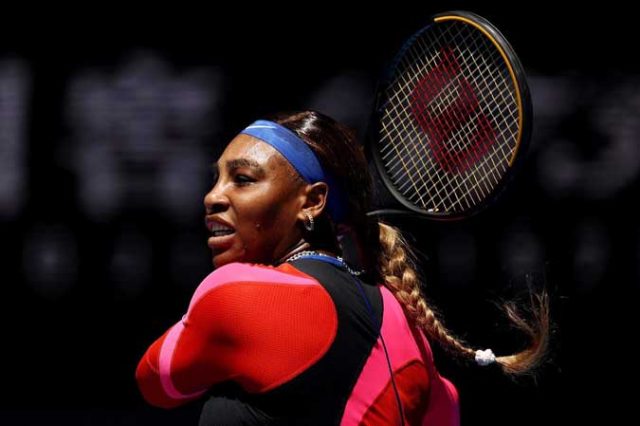
SERENA Williams lost in her 1,000th Tour-level match on Wednesday in Italy. — SERENA WILLIAMS FB PAGE

ROME — Serena Williams, playing the 1,000th Tour-level match of her glittering career, suffered a shock (7-6(6), 7-5) defeat by Argentina’s Nadia Podoroska in the Italian Open second round on Wednesday.

Playing her first competitive match in nearly three months, the 23-time Grand Slam champion twice came back from a break down but struggled on her first serve as Podoroska took the opening set in the tie-break.

Podoroska, who reached the French Open semifinals last year, produced a string of heavy topspin forehands to take control of the match with an early break in the second set.

Although Podoroska was broken to love on her first attempt to serve out the match, she maintained her composure to break again and secure a place in the round of 16.

Defeat for Williams, who received an opening round bye in Rome, was a major blow to her preparations for the French Open, starting on May 30.

It was the American’s 149th defeat in her 1,000 career WTA matches.

World number two Naomi Osaka also crashed out of the tournament, losing (7-6(2), 6-2) to American Jessica Pegula.

Osaka, a four-time Grand Slam winner, has often struggled on clay and her defeat in Rome followed a second-round loss at the Madrid Open this month. — Reuters

MMA fighter McGregor tops Forbes’ highest-paid athletes list

IRISH MMA fighter Conor McGregor (left) was the world’s highest-paid athlete over the last year according to the annual Forbes list released on Wednesday. — MARK J. REBILAS-USA TODAY SPORTS

TORONTO — Irish mixed martial arts (MMA) fighter Conor McGregor was the world’s highest-paid athlete over the last year ahead of soccer players Lionel Messi and Cristiano Ronaldo, according to the annual Forbes list released on Wednesday.

During the 12-month period ending May 1, McGregor earned $180 million, a figure which includes $158 million from endorsements and the recent sale of the majority stake of his whiskey brand, Forbes said.

Barcelona and Argentina forward Messi was second on the list and set a record as the highest-earning soccer player after bringing home $130 million while Portugal and Juventus forward Ronaldo earned $120 million to sit third among the top 10 highest-paid athletes.

National Football League quarterback Dak Prescott ($107.5 million) of the Dallas Cowboys and four-time National Basketball Association champion LeBron James ($96.5 million) rounded out the top five.

Completing the top 10 were Brazilian and Paris Saint-Germain football star Neymar ($95 million), Swiss tennis superstar Roger Federer ($90 million), top Formula One driver Lewis Hamilton ($82 million), NFL Super Bowl champion Tom Brady of the Tampa Bay Buccaneers ($76 million), and NBA All-Star Kevin Durant of the Brooklyn Nets ($75 million).

Forbes said its on-the-field earnings figures include all prize money, salaries and bonuses earned during the 12-month period while off-the-field earnings are an estimate of sponsorship deals, appearance fees and licensing income. — Reuters