Home Blog Page 7563

SBP sees challenging ride for Gilas Pilipinas in opening round of Asian Qualifiers
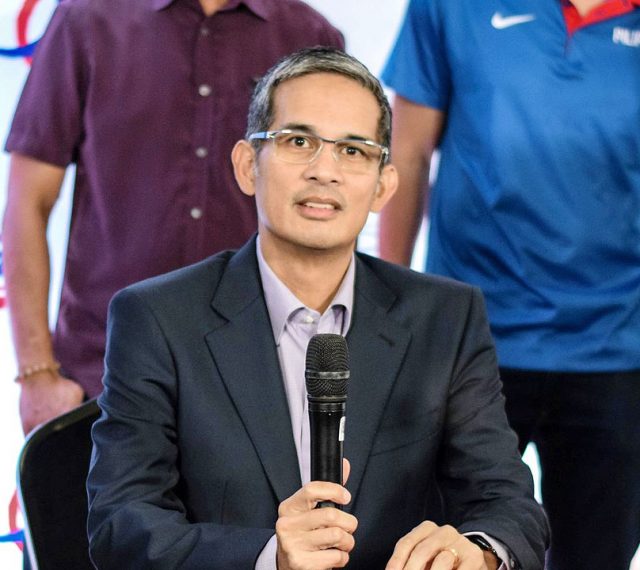
SBP PRESIDENT AL PANLILIO

THE Philippine national men’s basketball team will be in for a challenging ride in the opening round of the World Cup Asian Qualifiers, according to the Samahang Basketbol ng Pilipinas (SBP).

Speaking on the Power & Play program on Saturday, SBP President Alfredo “Al” S. Panlilio said Gilas Pilipinas still has its work cut out for it in the qualifiers despite being lumped in what could be considered an “easier” group.

Gilas is in Group A with New Zealand, Korea and India in the first round of the qualifying phase, with games set to begin in November this year.

Mr. Panlilio said the nationals could easily have been grouped in the tougher Group B with Australia, China, Japan and Chinese Taipei, but with the luck of the draw avoided it.

But the SBP chief asserted that such does not guarantee instant success in the tournament, especially since at World Cup level all teams are capable of holding their own.

“Everybody’s improving, everybody wants to do better in all these competitions so it’s a great challenge ahead and it’s exciting,” he said of what they are expecting come competition time.

New Zealand is the highest (International Basketball Federation) FIBA-ranked team in Group A at number 25, followed by Korea (29th), the Philippines (31st) and India (78th).

The Philippine actually is already assured of a spot in the World Cup, being one of the three host countries along with Japan and Indonesia, but the national team has made it known that it will go in the qualifiers seeking to do well as part of its preparation for the 2023 basketball event.

Gilas is currently in the process of charting the path it will be taking for its World Cup Qualifiers push.

Among the things they are tackling is the composition of the team, lining up meetings with various stakeholders, including the local collegiate leagues and the professional league from which the players will come from. Local players currently playing abroad as well as Filipino-foreign players are also being considered.

Further foreign exposure is also being readied for the national team, seeing how beneficial it has been for the development of the squad.

For Asia/Oceania, six spots are up for grabs in the 32-team field that will see action in the World Cup.

The rest of the groupings have Lebanon, Indonesia and Saudi Arabia in Group C; and Iran, Kazakhstan, Syria and Bahrain in Group D.

As per FIBA schedule, the two-round qualification windows will run until February 2023. The national sides play home and away games across each of these event windows.

FIBA recently released a preliminary schedule of the opening round, with Korea hosting the Philippines on Nov. 25 then Gilas playing the Koreans here on Nov. 28 in the first window.

In the second window, Gilas plays India on Feb. 25 and New Zealand on Feb. 28.

The Philippines ends its assignments in the third window against India on June 30 and New Zealand on July 3. — Michael Angelo S. Murillo


Former UP player Kobe Paras to play in Japan B.League

FORMER University of the Philippines player Kobe Paras will play for Niigata Albirex BB in Division 1 of the Japan B.League. — UAAP

FORMER University of the Philippines (UP) player Kobe F. Paras is the latest local star to suit up for the Japan B.League.

The son of Philippine Basketball Association legend Benjie, Mr. Paras, 23, signed a deal with Niigata Albirex BB, the team announced on Sunday. He will be Niigata’s Asian Player Quota signee and will see action for the 2021-22 season beginning later this month.

Mr. Paras, an athletic forward, joins Thirdy Ravena (San-En NeoPhoenix), Kiefer Ravena (Shiga Lakestars), Javi Gomez de Liaño (Ibaraki Robots), and Ray Parks, Jr. Nagoya Diamond Dolphins’ in Japan B.League Division 1 play for the upcoming season.

Two others, Juan Gomez de Liaño (Earth Friends Tokyo Z) and Kemark Cariño (Aomori Wat’s), meanwhile, are going to see action in Division 2.

“I am very grateful to have this opportunity to be part of such a great organization and basketball league. I look forward to showcasing the love I have for this game on a professional level in front of Niigata fans,” Mr. Paras said in a statement.

Mr. Paras will be joining a Niigata squad which finished with a 13-28 record last season, fourth in the Central Conference.

Prior to making the jump to the Japan league, Mr. Paras played for the UP Fighting Maroons in Season 82 of the University Athletic Association of the Philippines (UAAP), helping the team to a Final Four finish.

In his lone UAAP season, he had averages of 16.1 points, 5.1 rebounds and 1.8 assists.

Early this year, he announced that he will be foregoing his remaining playing years with the Maroons and went to the United States to train. He signed up with Siegel Sports and Entertainment, which transacted for him to play in Japan. — Michael Angelo S. Murillo

Rough ’20 Tokyo Paralympic Games campaign ends for Team Philippines

FROM six, Team Philippines was left with three para-athletes — (clockwise from top left) wheelchair racer Jerrold Mangliwan and para-swimmers Gary Bejino and Ernie Gawilan — to banner its campaign in the just-concluded Tokyo Paralympic Games after the others tested positive for coronavirus disease 2019 (COVID-19) and were not able to compete.

THE 2020 Paralympic Games in Tokyo saw Team Philippines have it rough, with coronavirus disease 2019 (COVID-19) greatly affecting its campaign.

The quadrennial sporting meet for the differently abled officially ended on Sunday, but the country’s reduced athlete contingent wrapped up its bid by Friday sans a medal to show for.

In his assessment of the Filipino para-athletes’ campaign in the just-concluded Games, Philippine Paralympic Committee (PPC) President Michael I. Barredo said a “confluence of events beyond anybody’s control due to the COVID-19 pandemic” took a heavy toll on the country’s campaign.

“While we went through the exercise in participating in the Paralympic Games, we were affected by the circumstances of COVID-19 in the areas of training, preparation and actual participation. We were pretty much hit by it,” Mr. Barredo said in a statement.

Prior to leaving for Japan for the Aug. 24 start of the Paralympics, some members of the team tested positive for the virus, including para-powerlifter Achelle Guion, which immediately ruled her out for her event, and chef de mission Francis B. Diaz.

Then blind discus thrower Jeanette Aceveda and para-athletic coach Bernard Buen, who were fully vaccinated, both tested positive in Tokyo and had to be quarantined, depriving Ms. Aceveda the chance of being the first visually impaired Filipino athlete to compete in the Games.

The last blow was when taekwondo jin Allain Ganapin also tested positive, forcing the athlete and his coach Dindo Simpao to stay in Manila.

“We were all shellshocked (by these developments). So, it is really very hard to give an honest assessment given these difficult conditions and circumstances. This edition is for the books,” said the PPC chief.

The remaining three athletes — wheelchair racer Jerrold Mangliwan and para-swimmers Ernie Gawilan and Gary Bejino — tried their best to give the Philippines something to cheer about despite the tough luck that befell the team, but largely could not get the breakthrough they were angling for.

“[Credit to the three athletes] for giving their best under these trying circumstances. I believe Ernie and Jerrold did pretty well while Gary is still a greenhorn who can strive to do better in future international competitions,” Mr. Barredo said.

Veteran Paralympic athletes Messrs. Gawilan and Mangliwan gave the Philippines its finest moment in Tokyo on Aug. 29 when they posted personal bests to place sixth in the finals of the men’s 400-meter freestyle-S7 event and men’s 1,500-meter-T52 race, respectively.

Moving forward, Mr. Barredo and the rest of the team expressed hope that support continues for Filipino para-athletes despite the results they had in the 2020 Paralympic Games.

The PPC chief cited collaboration between government and the private sector to set up a permanent training facility for differently abled athletes would go a long way in the steady development of their skills.

“We already had a semblance of it at the ULTRA (Philsports Complex) in Pasig City, but it was unfortunate that it was converted into a quarantine facility by the government, so we virtually lost a year’s training in 2020,” Mr. Barredo said.

Just the same, he said work continues for them as they set their sights on the next competitions.

MEDINA PASSES AWAY
Meanwhile, just as Team Philippines was wrapping up its campaign in Tokyo, the paralympic community mourned the passing of one of its noted members in 2016 Rio Paralympics bronze medalist Josephine Medina (para-table tennis) on Thursday at the age of 51.

Ate Jo, as Medina was called, exemplified hard work and dedication to her sport that our national para-athletes can follow and look up to as an inspiration,” Mr. Barredo said. “This is what made her an exceptional athlete and champion and enabled her to win a bronze medal for the country in Rio.”

Ms. Medina, a graduate of the Polytechnic University of the Philippines, broke the country’s 16-year medal dry spell in the Paralympics in Rio, winning the country’s second bronze medal after that of para-powerlifter Adeline Dumapong Ancheta in 2000 in Sydney.

She, too, was dominant on the Southeast Asian level, bagging gold medals in the 2008, 2014, 2015, and 2017 editions of the ASEAN Para Games.

Mr. Medina also brought home silvers in the 2010 Guangzhou and 2018 Jakarta Asian Para Games and a bronze medal in the 2014 Incheon edition. — Michael Angelo S. Murillo

Djokovic dispatches old rival Nishikori to reach fourth round

NEW YORK — After tackling two US Open debutants, Novak Djokovic faced an old foe on Saturday, reaching the fourth round with a (6-7(4), 6-3, 6-3, 6-2) win over Kei Nishikori to stay on course for a record 21st major title that would complete the calendar Grand Slam.

Following first-ever meetings with Denmark’s Holger Rune and Dutchman Tallon Griekspoor, Djokovic faced a seasoned campaigner in Nishikori, who was runner-up at the 2014 US Open having beaten the Serb to move into that year’s final.

Since then it has been one-way traffic in the rivalry with Djokovic sweeping 17 straight contests against the Japanese player, improving his head-to-head record to 18-2.

But after Nishikori’s (6-2, 6-0) quarterfinal thumping at the hands of the world No. 1 at the Tokyo Olympics, the 31-year-old made Djokovic sweat for his victory.

“So far the toughest match of the tournament for me,” said Djokovic. “The opening two rounds obviously felt well, played good.

“But the pace of the ball and the speed of Nishikori’s tennis today was just higher than the opening two rounds’ opponents that I had.”

Usually the headliner under the Arthur Ashe Stadium lights, Djokovic made a matinee appearance on Saturday and appeared unsettled by the conditions as he went to work under a blazing sun.

For the first time this week, New York fans, who have not always embraced Djokovic, got behind the history-hunting Serb, showering him with cheers that had largely gone to his opponents.

While Djokovic did not need the fans to get through the opening week, he knows the path gets harder and at some point will most likely need the energy the crowd can bring to get him through a rough patch.

“Arthur Ashe is the place where you bring the energy,” said Djokovic. “That’s where you feel this kind of electric atmosphere, particularly in the matches like this where it’s decided in a few points.

“Yeah, the crowd was involved. It was loud. It was nice. I thrived on that.”

A tight opening set was snatched by Nishikori in a tie-break before Djokovic began to settle into the contest, breaking the Japanese player twice in the second on his way to leveling the match at a set apiece.

In another workmanlike effort, the top seed took the decisive break in the third to go ahead 5-3, then held serve for a 2-1 lead.

Now in control, Djokovic would leave Nishikori no openings to hope for a comeback, storming through the last four games of the fourth set to close out the contest in style.

Djokovic now awaits the winner of the match between US wild card Jenson Brooksby and Russian Aslan Karatsev. — Reuters

Controversial Zamboanga-Seo fight under formal review

The controversial fight between Filipino Denice Zamboanga and Korean Seo Hee Ham last Friday has been put  at under formal review, ONE Championship Founder and Chairman Chatri Sityodtong said. — ONE Championship

By Michael Angelo S. Murillo, Senior Reporter

The controversial fight between Filipino female fighter Denice Zamboanga and Korean legend Seo Hee Ham at “ONE: Empower” on Friday has been placed under formal review, ONE Championship announced on Sunday.

In a Facebook post, ONE Founder and Chairman Chatri Sityodtong said their competition committee was in the process of reviewing the fight, which was clouded with doubt after the win was given to Ms. Seo by way of split decision even when many thought, including Mr. Sityodtong, that Ms. Zamboanga won the close fight.

The showdown, part of the much-anticipated world atomweight grand prix, was competitive, with Ms. Zamboanga successful in the clinch and fashioning out takedowns and fighting on the ground.

Ms. Seo had her moments, landing clean and heavy punches throughout the three-round contest.

In the third round, Ms. Zamboanga absorbed a nasty cut to the forehead after a head collision with her opponent.

The fight was temporarily halted to allow the ringside doctor to check on the Filipino fighter.

After some time, action resumed, and Ms. Zamboanga did not waste time and charged towards Ms. Seo to take her down and pound on her until the end of the round.

But to the surprise of many, the Korean was declared the winner.

Pundits and observers heavily criticized the decision after, believing that Ms. Zamboanga was the more active fighter and significantly scored better.

“I fully respect the judges’ decision. But I know I won that fight last Friday night. I respectfully request ONE to review the result, for the sake of the integrity of the Grand Prix,” a tearful Ms. Zamboanga said in the virtual post-event press conference.

Other world grand prix quarterfinal winners were Japan’s Itsuki Hirata over American Alyse Anderson (unanimous decision), India’s Ritu Phogat over China’s Meng Bo (UD), and Stamp of Thailand over Alyona Rassohyna of Ukraine (split decision).

The winner of the tournament earns the grand prix title and gets a shot at reigning ONE world atomweight champion Angela Lee of Singapore.

Manila 3×3 team exits Montreal tournament winless

Manila Chooks TM fought hard at the 2021 FIBA 3x3 Montreal Masters but could not catch a break, exiting winless in Pool D on Sunday. (Manila Chooks TM)

Manila Chooks TM fought hard at the 2021 FIBA 3×3 Montreal Masters but could not catch a break, exiting winless in Pool D on Sunday.

The Manila-based club team bowed in its two matches in pool play, losing to world no. 8 Antwerp, 11-21, and, 16-21, to Edmonton in that order.

The Philippine bet bowed out of the competition at 10th place among 12 competing teams, along with United States’ Omaha with identical 0-2 slates with a point average of 13.5 points.

“We have no excuses. We were not able to execute what we practiced,” ,” said Manila Chooks TM head trainer Aldin Ayo in assessing his team’s performance.

“We as coaches are accountable, especially me, with the result of our campaign,” he added.

Manila Chooks TM was composed of Mac Tallo, Zach Huang, Dennis Santos and Mark Yee. – Michael Angelo S. Murillo

Fearless teenagers and hungry qualifiers light up US Open

NEW YORK — With the old names missing, new faces have taken the spotlight at the US Open as fearless teenagers and hungry qualifiers leave their mark on the year’s final Grand Slam.

Injuries have kept the usual headline acts of Roger Federer, Rafa Nadal and Serena Williams off the New York stage this year leaving it to a group of ambitious grinders and newcomers who have had Flushing Meadows buzzing.

“It’s a crazy ride,” said Germany’s Oscar Otte, one of three qualifiers to reach the fourth round of the men’s draw. “Just unbelievable. I didn’t expect that I could come so far.

“Let’s see when this ends.”

On the women’s side of the slam, British 18-year-old Emma Raducanu continued her stunning US Open debut demolishing Spain’s Sara Sorribes Tormo (6-0, 6-1) on Saturday to reach the fourth round.

Raducanu, who burst onto the scene earlier this year by reaching the fourth round at Wimbledon in her first Grand Slam appearance, will next play American Shelby Rogers, who removed a major hurdle on the path to the quarterfinals, taking out world number one Ash Barty.

“I just realize the hunger and determination to be out there,” said Raducanu. “It’s definitely like once you’re out and you just want to keep going and stay as long as possible.

“I think it’s the desire and hunger to just stay.

“I haven’t really played on Tour for the whole entire year. This whole experience is just so new to me.

“I think it’s the enjoyment factor that I’m getting.”

Joining Raducanu in the fourth round is 18-year-old Canadian Leylah Fernandez who sent a jolt through the Billie Jean King National Tennis Center on Friday when she upset third seed and defending champion Naomi Osaka.

What the young Canadian lacks in experience, she more than makes up for with bravado, saying she always expects to win. “I don’t know why finally my game is clicking,” said Fernandez. “My coach, my dad, is saying be patient, have confidence in your game, it will show in matches.

“From a very young age, I knew I was able to beat anyone, anyone who is in front of me.”

On the men’s side, 18-year-old Spaniard Carlos Alcaraz toppled Greek third seed Stefanos Tsitsipas, becoming the youngest player to reach the fourth round of a Grand Slam event since 17-year-old Andrei Medvedev at 1992 Roland Garros.

“I think that to have so many young players coming through is just really great for the game,” said Raducanu. “It just shows how strong this next generation is.

“I think that having so many young players and 18-year-olds, I think we all inspire each other to play better.”

There will be plenty of tennis fans heading for Google or the US Open media guide with a trio of qualifiers popping up in the men’s fourth round, as Otte is joined by compatriot Peter Gojowczyk and Dutchman Botic Van de Zandschulp.

“It feels pretty normal, but for me it’s not normal of course,” said Van de Zandschulp. “I think I have every match a chance to win.” — Reuters

American Rogers defeats number one Barty in shock US Open upset

NEW YORK — American Shelby Rogers staged a comeback for the ages shocking world number one Ash Barty (6-2, 1-6, 7-6(5)) on Saturday in the third round of the US Open.

The 43rd-ranked Rogers recovered from a 5-2 deficit in the third set to push the affair into a tie-break, securing the biggest upset of the tournament thus far in front of an electric New York crowd inside Arthur Ashe Stadium.

“I am stunned. My heart rate is still very much elevated. I’m very excited with that win,” Rogers said, after defeating Barty for the first time in six meetings.

“Going on the court, I told myself I didn’t want to lose the same way I lost the last five times against her. I just tried to do things a little bit differently.”

There were early signs of trouble for heavy favorite Barty, who handed Rogers a break with four double faults in the third game, and got fewer than half of her first serves in as she committed 17 unforced errors during the first set.

The Wimbledon champion found her form in the second set, getting a critical break in the fourth game with a forehand winner and again converting on break point in the sixth as Rogers whacked the ball into the net.

Up two breaks in the final set, Barty appeared poised to walk away with the win, but couldn’t hang on as her stellar 2021 crashed to an end.

An astonished Rogers held her hands to her face as she clinched the match, her mouth agape with surprise, the crowding rising to its feet.

“I was just trying to stay in the point longer than Ash. She was handling my pace really well tonight. I felt like the harder I hit the ball, the better she hit,” said Rogers, the only American woman remaining in the tournament.

It was the second major upset of the women’s tournament at Flushing Meadows, after 18-year-old Leylah Fernandez defeated four-time Grand Slam winner Naomi Osaka on Friday.

In the fourth round, Rogers will face Britain’s teen phenom Emma Raducanu, who hasn’t dropped a set all tournament after reaching the fourth round of Wimbledon as well.

“I’m going to have to do a little bit of scouting I think. But she’s fearless. She is playing very well and she’s inspired. It’s going to be a battle. I am ready for it,” said Rogers.

‘WOULDN’T CHANGE A THING’
Barty appeared to take the loss in stride, telling reporters afterward: “I (will) sleep well tonight knowing I gave everything I could.”

“I played a pretty awful first set in the sense where I was erratic,” she said. “I found a way back into the match, found a way to turn the match back in my favor, have a couple of opportunities to serve it out and be within a couple of points, disappointing not to get it done.”

She said it wouldn’t take long to move on, however, after a stellar 2021 in which she won five titles — including Wimbledon, Miami and Cincinnati — after taking an 11-month break from the tour last year as the coronavirus disease 2019 (COVID-19) pandemic swept across the globe.

She told reporters she planned to compete at Indian Wells next month, despite having been on the road for more than five months.

“I’m proud of myself and my team for all the efforts we’ve put in, in the last six months,” said Barty. “It’s been pretty incredible. I don’t think we could have asked for much more honestly. I wouldn’t change a thing.” — Reuters

France’s winless run continues with Ukraine draw

KIEV — France’s winless streak stretched to five games as Les Bleus were held to a 1-1 draw away to Ukraine in their World Cup qualifier in Group D on Saturday.

The world champions fell behind when Mykola Shaparenko found the back of the net after 44 minutes before Anthony Martial restored parity early in the second half.

France still top the group on nine points from five games after a 1-1 draw against Bosnia on Wednesday and three days before hosting second-placed Finland, who beat Kazakhstan 1-0.

Ukraine are third behind the Finns, who also have five points, but have two games in hand, with Bosnia and Kazakhstan both on two points.

“It was much better in the second half and we have regrets in the first as we conceded the goal just after missing a chance,” said coach Didier Deschamps.

“Playing all these matches in a row is tricky and very demanding, but I’m not looking for excuses.”

Martial, who scored his second international goal and his first since September 2016, said: “It was a tough game for us today, but at least we managed to equalize in a very important game.”

Kingsley Coman deputized in attack for Kylian Mbappe, who left the squad with calf pain, while Karim Benzema and Raphael Varane were on the bench and replaced in the starting lineup by Anthony Martial and Kurt Zouma.

France got off to a lively start, but struggled to find a way past the hosts’ five-man defense and they lacked inspiration throughout.

Antoine Griezmann had a first attempt on 27 minutes, but it was Ukraine who had the first clear chance through Andriy Yarmolenko, whose strike forced Hugo Lloris into a superb save in the 35th.

Martial also had an opportunity just before the break, but Shaparenko opened the scoring on the counter attack with a splendid curled shot into the top corner.

Martial, however, leveled five minutes into the second half from close range after Coman’s cross was deflected by Adrien Rabiot’s header and bounced off a Ukraine defender.

In the 63rd minute, Moussa Diaby replaced Coman and Benzema came on for Martial.

Both substitutes combined nicely in the box with 15 minutes left, but Diaby’s shot hit keeper Andriy Pyatov’s right-hand post.

The visitors, who looked shaky against Ukraine’s quick counter attacks, had another chance in the 85th minute when Rabiot’s fierce, low 25-meter shot was saved by Pyatov. — Reuters

Self-assurance

Leylah Fernandez didn’t exactly have sterling credentials heading into the United States Open. She was just one victory above .500 in 32 matches, first-round exits at the Australian Open and Wimbledon included. Don’t tell that to her, though; for all her seeming lack of experience at 18, she has confidence in abundance. It doesn’t matter who she’s up against; she believes she will win every time she treks to the court. An irrational mind-set? Perhaps not. After all, it’s what led to her first Women’s Tennis Association title at the Monterrey Open last March, and what enabled her to climb to 73rd in the world prior to landing in New York for the last major event of the year.

Fast forward to the aftermath of her third-round set-to at Flushing Meadows, and it’s clear to all and sundry that nothing will keep Fernandez from exuding self-assurance. Not a few quarters will contend that it borders on cockiness. That said, there can be no arguing with the results, the latest of which has her progressing to the Round of 16. And it isn’t simply because she’s still in contention for the hardware; it’s that she upended four-time Grand Slam champion Naomi Osaka in the process. Never mind that she found herself down a set and facing match point.

To be sure, Fernandez’s cause was helped in no small measure by Osaka’s shakiness under pressure. Despite breezing through the first set, the latter did not seem sharp at all; to the contrary, flareups that flirted with code violations marked the ultimately failed stint. Meanwhile, she stuck to her plan; as she noted in her post-mortem, “Honestly, I wasn’t focusing on Naomi. I was only focusing on myself.” And “what I needed to do” was precisely what she did, taking the battle to her far more accomplished, if unsteady, opponent and seizing the moment.

It’s fair to argue that Fernandez’s fortitude came from the fact that she had nothing to lose. She was expected to be yet another statistic in Osaka’s redemption arc. Then again, there can be no discounting the bottom line. She prepared well, consistently increasing the pace of her first serves to the forehand side, and then slicing her way through on the other. It’s why she claimed 16 of 17 service games and managed to dictate the tempo of the match. And it’s why she emerged triumphant as the battlesmoke cleared. Opportunity came knocking, and she was only too ready to answer.


Anthony L. Cuaycong has been writing Courtside since BusinessWorld introduced a Sports section in 1994. He is a consultant on strategic planning, operations and Human Resources management, corporate communications, and business development.

CBMS and evidence-based planning and decision-making 

VECTORJUICE-FREEPIK

It is easy to make a plan but difficult to develop one that addresses a specific concern that is not based on accurate data or information. A case in point is a local government unit (LGU) from Mindanao, which could no longer benefit from programs of a funding organization because the former failed to deliver a vaccination project with at least 1,000 children up to five years old as beneficiaries. Because the target was not based on verifiable data, the LGU could only vaccinate around 600 children, some of whom were not even qualified because they were already seven years old.

To prevent similar incidents from happening, the Philippine Government enacted Republic Act 11315, otherwise known as the Community-Based Monitoring System (CBMS) Act. The law aims to ensure that LGUs will have a concrete and verifiable basis for a comprehensive poverty analysis and needs prioritization. With the CBMS Act, it is expected that data collection, data sharing, and information management will be systematized. CBMS is defined as the “organized technology-based system of collecting, processing and validating necessary disaggregated data that may be used for planning, program implementation and impact monitoring at the local level while empowering communities to participate in the process.”

It is not a new system and has existed since 1994 with the pioneering efforts of Dr. Celia Reyes of the Angelo King Institute of the De la Salle University (AKI-DLSU). Seeing the potential of CBMS to address the need for localized poverty-related data, the Department of the Interior and Local Government (DILG) and the National Anti-Poverty Commission (NAPC) entered into a partnership with AKI-DLSU and became advocates of the system. The partnership was a success and became instrumental to the development of local programs that cost less but produce long-term results.

A case in point is the CBMS implementation in Bongao, Tawi-Tawi which led to the counting of the Badjaos — a group of indigenous people known as sea gypsies, living either in small houseboats or houses on stilts built along the shores. In 2015, the Badjao population in Bongao numbered 3,650 and of this number, only 15% were registered. Because of their non-registration, the Badjaos had difficulty accessing services and programs, particularly those that require a proof of identification. Using this data from the CBMS and knowing the location of the unregistered Badjaos, then Mayor Jasper Que conducted a civil registration program — a simple activity with almost no additional cost to the local government. With birth certificates in their possessions, the Badjaos were able to access local and National Government programs, including the Pantawid Pamilyang Pilipino Program (4Ps) and PhilHealth.

The partnership between the NAPC, the DILG and AKI-DLSU also led to the improvement of the CBMS data collection platform. LGUs now have the option to utilize smartphones or computer tablets, thus eliminating the digitization phase or the encoding of the responses collected through paper-and-pen enumeration. The digitization phase not only delays the whole process but exposes the data collected to encoding errors.

Prior to 2016, there were reports of LGUs not being able to utilize their CBMS data because these were un-encoded. For those LGUs that had encoded their data, data cleaning competed with other tasks, forcing the assigned personnel to set aside CBMS-related functions.

More importantly, the use of smartphones and tablets in data collection allows the enumerator to utilize the gadgets’ global positioning system (GPS) — a navigation system that provides accurate determination of geographical locations. With GPS data, the Municipality of Mulanay in Quezon Province was able to overlay CBMS-enumerated houses with the hazard maps from the National Government. The result: a systematic identification of houses in danger-prone areas and the provision of appropriate interventions prior to and during disasters.

The questions asked by CBMS have also improved over time. From purely socio-economic data to measure poverty, CBMS has been used as a monitoring tool to measure the government’s performance vis-à-vis the Millennium Development Goals and, eventually, the sustainable development goals.

With the Philippine Statistics Authority (PSA) now at the helm of CBMS data collection, more improvements are expected. For this year, the PSA aims to pilot the rollout of CBMS data collection in at least seven LGUs and by 2022 expand the data collection to fifth- and sixth-class cities and municipalities.

CBMS, however, is not just data collection. It also involves data processing and utilization so that decision-makers will be able to utilize relevant information to be able to come up with appropriate and properly designed programs and projects. Hence, it is expected that the PSA will also focus on capacitating the LGUs on how to process and maximize their CBMS and other data. In that way, the plans of the LGUs will be evidence-based and directly address the specific concerns of their constituents.


Jay Carizo is Partnerships Coordinator of Action for Economic Reforms’ COLLABDev Project, and Special Projects Consultant of the Galing Pook Foundation. This column is part of a series on data-driven development.

Liberal Democracy: Is it its own excuse for being?

VECTORJUICE-FREEPIK

The collapse of the Islamic Republic of Afghanistan on Aug. 15 sent a shock wave throughout the world. After two decades of the trappings of democracy, it is gone, together with the hopes of millions of men, women, and children; even as we hope that the “new” Taliban has learned the lesson of its own recent history and steer clear of wanton reprisals. For the few of us old enough to have witnessed the fall of Saigon in 1975, this feels like déjà vu. At that time, it was the Socialist challenge that was riding high. But Uncle Ho proved much wiser than the Khmer Rouge and would eventually steer Vietnam to an economic miracle if along capitalist lines. But for the moment, J. Schumpeter’s categorical “No” to his own rhetorical question, “Can Capitalism survive?” seemed prescient.

The toppling of the Berlin Wall and the collapse of the Socialist challenge in 1989 put paid to all the lost ground to Socialism. “Euphoric” hardly described the swelling mood among those under the sway of the Western worldview and schooled in the fear of a socialist takeover. We knew that something fundamental had ended. The Socialist challenge had not only stalled, it died!

For Francis Fukuyama (1992), what ended was “history,” understood as the clash of competing arrangements for society and economy. When the smoke finally clears, he surmised, the last one standing will be liberal democracy! For every challenge to liberal democracy, there will always be a Berlin Wall moment of reckoning! Many of that persuasion believed that 1989 was as final as the mathematician’s QED. Liberal democracy had become history’s anointed. Fukuyama professed his belief that history is an evolutionary process but rendered evolution strangely eschatological revealing its direction and terminal state. Still and all, euphoric license is generous. The fact that evolution is a process of emergence with irreducible un-predictability in its DNA was lost in the exuberance. Among the acolytes, liberal democracy has the character of an absorbing state in non-linear dynamics — once there you are stuck. Did not Karl Marx of Das Kapital make a similar mistake when he made the classless society the eschatos of his evolving system? The “end of history” thesis was roundly criticized as hopelessly naïve. Huntington (1993) suggested that the “clash of civilizations” with emphasis on the Islamic challenge will quickly replace the “clash of ideologies.” The August 2015 Afghanistan debacle reiterates Huntington’s point; as did the much ballyhooed Arab Spring that sputtered into chaos and dictatorships.

Illiberal democracy is even more of a challenge to the end of history narrative. Venezuela, Turkey, Poland, Hungary, Thailand, Myanmar, and the Philippines have lurched into illiberal democracy. What was once the heartland of liberal values, the USA, seems now irretrievably fractured along the post-truth fault line. Autocratic China and Russia, both intent on driving a wedge between Capitalism and liberal democracy, are in vocal ascendance both politically and economically. Hong Kong, caught in the awkward middle, has been wrenched away from the liberal democratic fold. Meanwhile, the EU, now having to receive even more migrants following Kabul’s collapse, will see an intensification of seemingly irreconcilable clash of cultures which may still result in what D. Murray (2017) calls the “strange death of Europe.” As the Berlin Wall moment recedes farther and farther, liberal democracy is proving to be less and less its own excuse for being!

What seems glossed over in this welter of claims and counterclaims is another and deeper divide: the clash between the individual and the group. Faithful to Emmanuel Kant, liberal democracy views the group as ancillary to the individual; for its rivals, the group seems paramount. This may be partly due to relative affluence and how attained: the North already enjoys what the South aspires for. The affluent North indulges the individual mainly by allowing greater and greater latitude to political and social preferences (what economists called “universal domain” which, in social media lingo, is “my truth is as good as your truth”) and tutors the South to do the same. The South knows that the North attained its affluence not by indulging the individual but by carefully husbanding the scarce economic capital of the group mostly through two pathways: the blind and ruthless discipline of laissez faire and the restriction of social and political preferences among its populace. Another of Ha-Joon Chang’s kicked ladders (2002), in a sense.

The Gilded Age from 1878 to1900, when the USA caught up with, and even overtook, Europe had an abundance of jobs and land but not an abundance of worker and minority rights. It was a living breathing illiberal democracy. Freed slaves were fenced in by Jim Crow laws. As late as the 1930s, the Chinese, Filipinos, and Mexicans in California were treated as dogs, and when they resisted, were hunted down as canids (Bulusan’s America is in the Heart, 1946; or Steinbeck’s Grapes of Wrath, 1939). Thus, when China restricts preferences among its minorities, the Uighurs and the Tibetans and among dissident fellow Han Chinese of Hong Kong, it is just being a good student of history. In the Confucianist tradition, the individual has little meaning outside the group which in China is the 90% Han Chinese majority.

The insistence on the individual’s priority over the group is painfully reflected in modern Western economic thinking which adopted the behavioral type homo economicus as a first principle. Homo economicus, truth be told, is the sociopath in other social sciences, a spectrum of autism devoid of any regard for others though gifted in other ways. Western economics, under the spell of Physics envy over the last three-quarters of a century, has increasingly distanced itself from the study of real humans. That every economic agent is a fallible member of some group and regards others as valuable now begs to be restored at the heart of the hopeful post-Physics envy economics. Homo economicus is now a member of the trivial group with exactly one member, himself. All the vaunted theorems of neoclassical economics are still valid but only for this nested special subspace of humans. Economics can only help itself by embracing Kahnemann-Tversky’s humans as starting position and completing the program started by G. Myrdal (An American Dilemma: The Negro Problem and Modern Democracy, 1944) and H. Simon (Models of Man, 1957). The birth and death of groups, the entry into and exit from groups like Brexit, the decision to migrate or a become suicide bomber become tractable economic problems. Perhaps then Economics can better engage the great debates of our time.


Raul V. Fabella is an Honorary Professor of the Asian Institute of Management (AIM), a member of the National Academy of Science and Technology (NAST) and a retired professor of the University of the Philippines. He gets his dopamine fix from hitting tennis balls with wife Teena and bicycling.

ADVERTISEMENT
ADVERTISEMENT