Home Blog Page 7554

PSC lauds Tokyo Paralympians; Cebu Pacific gifts athletes free flights

The Philippine delegation in the Tokyo Paralympic Games returned to the country on Sunday. — Philippine Sports Commission

The Philippine Sports Commission (PSC) lauded the efforts of Filipino para-athletes who saw action in the just-concluded Tokyo Paralympic Games, highlighting how they competed hard and gave their all despite the myriad of challenges they had to face.

“They were exceptional and dedicated Paralympians caught in a pandemic. Despite this, they carried the flag with pride and honor,” said PSC Chairman Ramirez in a statement. “They were playing against the best Paralympians in the world. To qualify and participate in the Paralympics is a great honor in itself.”

The quadrennial sporting meet for the differently abled officially ended on Sunday with no medals for the Philippines.

The country had it rough during the two-week competition, which saw the athlete contingent reduced no thanks to the pandemic.

Para-powerlifter Achelle Guion, blind discus thrower Jeanette Aceveda and para-taekwondo jin Allain Ganapin tested positive for COVID-19, leaving them with no choice but to pull out from their respective events.

Left to carry the fight for the Philippines were Jerrold Mangliwan of para athletics, and para swimmers Ernie Gawilan and Gary Bejino, who had their struggles but nonetheless showed fire in competing.

Mr. Mangliwan advanced to the finals of his three events. He placed fifth and made his new personal best in the men’s 400m T52 race finals and also broke his own best time in the men’s 1500m T52 competition.

Mr. Gawilan, meanwhile, placed sixth in the men’s 400m freestyle S7 event and became the first Filipino para-swimmer to advance in the Paralympics finals. Mr. Bejino, on the other hand, also showed great potential come the 2024 Paris Games despite being a first-timer in the quadrennial meet.

“In spite of what happened, we take pride in these rare Filipino Paralympians. They inspire the country with their achievement. They are our new heroes today who in spite of their conditions fought well,” said Mr. Ramirez.

The PSC was fully behind the campaign of the Philippine Paralympic team amid the limitations brought about by the pandemic, but acknowledged that more could be done considering the advancement in the competition.

“Together with the Philippine Paralympic Committee, we hope to find training venues for our para-athletes in the national pool,” the PSC chief said.

Adding, “The sacrifices and resiliency of these para-athletes are beyond compare. We will support them in any way we can.”

FREE FLIGHTS
Meanwhile, airline Cebu Pacific is honoring the country’s Paralympians with free flights.

In a statement on Monday, it said Messrs. Gawilan, Bejino, Mangliwan and Ganapin will be awarded free flights, which they may share with their respective teams and support systems.

“Our Paralympic delegation did their best and have proven that they deserve to fly. We recognize their efforts and are grateful to them for representing our country loud and proud,” said Candice Iyog, Vice-President for Marketing & Customer Experience at Cebu Pacific.

Each Paralympian will receive 25 flights for free. The tickets may be used for any domestic and international short-haul destination in the airline’s network. – MASM

ONIC new leader in MPL Season 8 after Week 2

Undefeated ONIC Philippines now leads in the standings in Season 8 of Mobile Legends: Bang Bang Professional League-Philippines at Week 2 at the weekend.

ONIC Philippines took the lead in Season 8 of Mobile Legends: Bang Bang Professional League (MPL) Philippines at the conclusion of Week 2 at the weekend.

The team went 2-0 for the week to take its record to 4-0 and total points to 11, two up over second-running and defending champion Blacklist International (4-0).

ONIC defeated Nexplay EVOS, 2-0, on Friday before topping TNC Pro Team two days later with the same score.

In its last game, ONIC showed patience in its attacks and ground it out with TNC en route to the victory.

Erstwhile leader ECHO (2-3) dropped to third spot with eight points after losing in its two matches against RSG PH and Blacklist in that order with 1-2 scores.

Tied for fourth are Omega Esports (1-4) and TNC (2-2) with six points, followed by RSG (2-1) with four points, Nexplay (1-3) three points, and BREN Esports (0-3) one point.

MPL-PH action returns on the weekend of Sept. 10 to 12.

The regular season takes place until Oct. 10. After that, the top six teams will proceed to the playoffs, which will be played in best-of-five matches. The grand final will be a best-of-seven.

Season 8 proceedings are being held under the guidance of government protocols and in-house measures to ensure the safety of all participants and the successful staging of the event amid the prevailing conditions with the pandemic.

Mobile Legends: Bang Bang is developed and published by Shanghai-based Moonton.

MPL-PH Season 8 has Smart Communications as presenting sponsor. – Michael Angelo S. Murillo

Italy sets record with unbeaten run stretched to 36 matches

BASEL, Switzerland — Italy broke the record for the longest unbeaten run in international matches after they were held to a goalless draw by Switzerland in a World Cup qualifier on Sunday, with Jorginho missing a penalty again.

Italy has not lost for 36 consecutive matches, breaking the 35-match unbeaten run record that had previously been shared by Spain and Brazil. Brazil’s record of 35 was set between 1993 and 1996, while Spain equaled that mark in 2009.

The result could have been more positive had Jorginho converted from the penalty spot in the 52nd minute after Domenico Berardi had been fouled, but the Chelsea midfielder was thwarted by home goalkeeper Yann Sommer.

Italy had further chances to snatch victory, but had to settle for a draw, meaning they remain top of Group C on 11 points from five games, four ahead of the second-placed Swiss, who have two matches in hand.

“Today, we played a great match, better even than the 3-0 win against Switzerland in June (in Euro 2020 group stage), but we just could not score,” defender Giorgio Chiellini told Rai Sport.

“I liked our play a lot today. There were many positives.”

Roberto Mancini’s side came into the match having disappointingly drawn 1-1 with Bulgaria on Thursday in their first match since becoming European champions in July.

But the visitors were much the better side in the first half in Basel and should have taken the lead through good chances for Berardi and Lorenzo Insigne, both of whom were denied by Sommer.

The best chance of the night came seven minutes into the second half after Ricardo Rodriguez, trying to atone for being caught in possession, lunged in on Berardi to concede a penalty.

Jorginho, who missed his spot kick in Italy’s penalty shootout victory over England in the Euro final, stepped up, but placed his effort far too close to Sommer, who made an easy save.

Sommer proved impossible to breach as he denied Insigne again to leave Italy heading home having been frustrated for the second successive qualifier.

“We have had too many chances not to win this match,” Mancini said. “We have to be more ruthless and precise in front of goal.

“A match like this should have been a win 3-0. For sure there will be some changes in the next match.”

There was some confusion about whether Italy had equaled or broken the unbeaten streak record on Sunday as Brazil claimed their run had also stretched to 36 matches, with the South Americans including a 2-2 draw with Romania’s B team in September 1995 in their tally.

As it was not recognized by International Federation of Association Football (FIFA) due to the match being against a reserve team, it is not part of Brazil’s run.

The Azzurri face Lithuania on Wednesday, while Switzerland travel to Northern Ireland. — Reuters

Europe takes two point lead into final day of the Solheim Cup

TEAM Europe’s Mel Reid birdied the 18th hole to draw even with the Americans in the final four-ball match on Sunday to give the visitors a 9-7 lead heading into the final day of the Solheim Cup in Toledo, Ohio.

The American team of Jennifer Kupcho and Lizette Salas looked like they would come out with a full point in the seesaw battle after the rookie Kupcho chipped in for birdie on the 17th to send the throngs of US fans into a frenzy.

But Reid’s approach shot from 136 yards out on the par-four 18th rolled out of the rough lining the green and settled near the cup.

The Englishwoman calmly sank the final putt and celebrated by pounding her chest on a warm and sunny day at the Inverness Club.

“I think it was huge,” Reid said of her momentum-shifting approach shot.

“I didn’t have my best stuff today and they are obviously two great players. They play perfect four-ball, if one was out, the other was making a look at birdie.

“Leona (Maguire) again played great, kept us in the match, and then I saw a wave of yellow and blue, which was all of our team, and I knew I had to pull something off.”

Reid’s shot is sure to energize the European side, which has far fewer fans than it normally would at the competition due to coronavirus disease 2019 (COVID-19) travel restrictions.

“I was sitting right there and was watching it, watching it,” European captain Catriona Matthew said of Reid’s approach shot.

“I saw it coming in and thought it was headed for the bunker, but it got a fortunate bounce to get through the rough.”

In the other three matches, the American rookie pair of Yealimi Noh and Mina Harigae defeated Celine Boutier and Sophia Popov 3-and-2, while European duo Carlota Ciganda and Nanna Koerstz Madsen defeated Jessica Korda and Megan Khang 1-up.

Europe’s Charley Hull and Emily Kristine Pedersen defeated Danielle Kang and Austin Ernst 4-and-2.

The day started promisingly for the Americans, who won three of their four foursomes matches in the morning session to pull within one point of Europe after getting off to a sluggish start on Saturday and falling behind by three points.

But the Europeans kept their composure and Reid’s late heroics limited the American duo to a half point.

“Every half point, I’ve realized over the years, is absolutely crucial,” Matthew said.

“At the start of the afternoon, the momentum was definitely headed toward the US, but we edged back a little bit in the afternoon and that half point really buoyed us up.”

Monday’s singles matches will wrap up the 17th edition the tournament. The Europeans are the defending champions, but the Americans lead the overall series 10-6. — Reuters

Patrick Cantlay edges Jon Rahm to win Tour Championship

PATRICK Cantlay said he enjoys the pressure in golf.

He got a chance to display what he can do in such situations in Sunday’s final round of the Tour Championship.

Cantlay matched Jon Rahm’s birdie on the final hole at East Lake Golf Club in Atlanta to win the Professional Golfers Association (PGA) Tour’s season finale and the 2021 FedEx Cup.

“Felt like a huge win and it was,” Cantlay said. “I played great today. It hasn’t even sunk in yet. I just kept telling myself to focus and lock in and I did a great job of that.”

The birdie gave Cantlay a round of 1-under-par 69 to cap a riveting finishing stretch between the two golfers.

Rahm’s birdie on the hole meant he finished the round with 68, pushing his tournament score to 20 under. Cantlay checked in at 21 under.

Cantlay won back-to-back tournaments to complete the PGA Tour season. He’s the FedEx Cup champion for the first time.

“I enjoy pressure golf because it’s everything I’ve practiced to do,” Cantlay said earlier in the weekend. “And so getting in that moment is exactly why I’ve practiced for all those hours growing up and all those hours my whole life, and so getting to do it when it’s important.”

Cantlay said winning the tournament was more important than the $15-million top prize.

“The internal drive to win golf tournaments is really what drives me, and so the external factors are not as much of a factor for me,” he said.

Under the format the tour has used for three seasons, Cantlay began the tournament at 10 under, putting him four shots clear of fourth-place Rahm. He needed every one of those strokes to hang on.

“It was definitely different than any other week. It was the longest lead I’ve ever held,” Cantlay said. “But I just tried to stay, day after day, in the present, and I did an amazing job of that this week because the last couple days I made some mistakes I don’t usually make and I was able to really center myself and hit a lot of good shots when I needed to.”

Rahm, the US Open champion from Spain and the No. 1-ranked golfer in the world, had 16 pars in the last round. He also birdied the fifth hole.

Rahm didn’t convert enough with his chances.

“That stretch of (Nos.) 10, 11, 12, I was in position to put a little bit of pressure and I just didn’t,” Rahm said. “But at the same time, I shot my lowest score ever for four days on this golf course, which has usually been a challenge for me.”

Cantlay never trailed Sunday, but he sure made it interesting. He was up by two strokes after a birdie on the 16th, but he gave that back with his third bogey of the round on the next hole.

Cantlay notched birdies on both par-5 holes.

Rahm also was contending with a well-disciplined player in Cantlay. On Saturday, Rahm praised his opponent’s well-rounded game, saying he had no weaknesses.

“I think you can say he won this,” Rahm said. “He played amazing golf.”

Rahm opened the tournament with two rounds of 65 before catching up to Cantlay early in Saturday’s round. Rahm ended up with 68 in the third round and entered Sunday’s play two shots back, so the top duo was paired together again.

“I thought it felt very similar to where we had distanced ourselves from the field and it was like a one-on-one match play feel,” Cantlay said. “And I think it will be great practice for the Ryder Cup.”

Kevin Na shot 67 to finish at 16 under for third place. Justin Thomas, the 2017 FedEx Cup champion, was fourth at 15 under after a final-round 70, slipping one spot from the beginning of the round.

“I couldn’t have played any better,” Na said. “I had one bogey for 27 holes, last three rounds bogey-free.”

Xander Schauffele matched Daniel Berger’s 64 for the best round of the day. That put Schauffele tied for fifth place with Norway’s Viktor Hovland (65) at 14 under.

The 64s were the lowest rounds of the tournament.

“Overall, just happy,” Schauffele said. “Birdieing the last four holes is always a good thing.” — Reuters

Chelsea group heightens employee vaccination drive

Good jab, Chelsea Logistics! Over 60% of the Chelsea Group’s employees have been vaccinated already and the vaccination drive continues.

Good “Jab” for the 62% vaccinated employees

Chelsea Logistics and Infrastructure Holdings Corp. (Chelsea Logistics), Udenna Group’s shipping and logistics arm continues to move forward amidst the pandemic as 62% (1,431) of its employees and trainees have been vaccinated.

The COVID-19 virus has been spreading rapidly as new cases increase and new variants arise. To maintain a safer working environment, the Chelsea Group of Companies has created an internal vaccination campaign in June 2021 that conveys the importance of being vaccinated, while also serving as an encouragement to those who are vaccine-hesitant. In partnership with the Local Government Units (LGUs) of the areas where the Group has operations, the progress and impact of the vaccination drive have manifested as data shows that 53% of sea-based and 67% of land-based employees have been fully vaccinated as of 31 August 2021. Alongside the vaccination campaign for its employees, Chelsea Logistics has also reached out to the employees’ dependents for them to be vaccinated too, and Udenna Corporation, Chelsea Logistics’ parent company, has offered to sponsor this endeavor.

“We are grateful to the LGUs for accommodating Chelsea employees who are part of the A4 priority list. Our target to vaccinate 80% of our manpower by the end of September will soon become a reality. We look forward to the smooth vaccination rollout so we can reach 100% by early Q4. We also thank our employees for their courage and willingness to get jabbed as soon as possible. The positive response to the vaccination campaign will build customer confidence, allowing the Group to slowly resume pre-pandemic business operations and eventually help the country return to its full economic activity,” said Chelsea Logistics President & CEO Chryss Alfonsus V. Damuy.

The Chelsea Group boosts its internal vaccination campaign as the Philippines is one of the major providers of maritime manpower. The Group continues to encourage its employees and has provided incentives to employees who do their part in preventing the spread of COVID-19 variants, by getting vaccinated. The Group hopes that all its employees will join the vaccination movement and prioritize everyone’s safety and health which will allow the Group to continuously provide unrivaled customer service. #

_______________________________________________________________________

Spotlight is BusinessWorld’s sponsored section that allows advertisers to amplify their brand and connect with BusinessWorld’s audience by enabling them to publish their stories directly on the BusinessWorld Web site. For more information, send an email to online@bworldonline.com.

Join us on Viber to get more updates from BusinessWorld: https://bit.ly/3hv6bLA

Taliban claim control of Panjshir as evacuation flights await clearance

Photo of Panjshir valley taken on Oct. 21, 2009. Jim Kelly/CC BY 2.0/Flickr

The Taliban claimed victory on Monday over opposition forces in the Panjshir valley northeast of Kabul, completing their takeover of the country following the stunning capture of Kabul last month and the chaotic withdrawal of foreign troops.  

Pictures on social media showed Taliban members standing in front of the gate of the Panjshir provincial governor’s compound after fighting over the weekend with the National Resistance Front of Afghanistan (NRFA), led by Panjshiri leader Ahmad Massoud.  

“Panjshir province completely fell to the Islamic Emirate of Afghanistan,” the Islamist militant group’s spokesman, Zabihullah Mujahid, said in a tweet on Monday, adding that some enemy fighters had been killed in battle and others had fled.  

“With this victory and latest efforts our country has come out of the whirlpool of the war and our people will have a happy life in peace, liberty and freedom in the entire country.”  

The Taliban assured the people of Panjshir, who are ethnically distinct from the Pashtun-dominated Taliban and fought against the Islamists during their 1996–2001 rule, that there would be no “discriminatory act against them.”  

“They are our brothers and would work together for a joint purpose and welfare of the country,” Mr. Mujahid said.  

There was no immediate word from Mr. Massoud, who leads a force made up of remnants of regular Afghan army and special forces units as well as local militia fighters.  

Ali Maisam Nazary, head of foreign relations at NRFA, said the Taliban’s claim of victory was false and opposition forces continued to fight.  

“The NRF forces are present in all strategic positions across the valley to continue the fight,” he said on his Facebook page.  

The Taliban earlier said their forces had made it into the provincial capital, Bazarak, and had captured large quantities of weapons and ammunition.  

As fighting raged in the valley on Sunday, Mr. Massoud said he welcomed proposals from religious scholars for a negotiated settlement. Several attempts at talks were held after clashes erupted about two weeks ago but eventually broke down, with each side blaming the other for their failure.  

The Taliban seized control of the rest of Afghanistan three weeks ago, taking power in Kabul on Aug. 15 after the Western-backed government collapsed and President Ashraf Ghani fled the country.  

Panjshir was the last pocket of armed resistance against the Taliban. It has a history of being difficult for enemies to take. The rugged mountain valley is still littered with the wreckage of tanks destroyed during the long war against the Soviet Union in the 1980s.  

The NRFA said on Sunday its main spokesman, Fahim Dashti, had been killed in the fighting.  

Dashti had survived the suicide attack that killed Mr. Massoud’s father, Ahmad Shah Massoud, on Sept. 9, 2001, just days before the Sept. 11 attacks on the United States.  

The Panjshir fighting has been the most prominent example of resistance to the Taliban.  

But small, isolated protests for women’s rights or in defence of the green, red and black flag of the vanquished Afghan republic have also been held in different cities.  

The Taliban imposed violent punishments and barred women and older girls from school and work when previously in power, but have sought to present a more moderate face this time.  

EVACUATION FLIGHTS 
US-led foreign forces evacuated about 124,000 foreigners and at-risk Afghans in the weeks before the last US troops left Kabul, but tens of thousands who fear Taliban retribution were left behind.  

About 1,000 people, including Americans, have been stuck in northern Afghanistan for days awaiting clearance for their charter flights to leave, an organizer told Reuters, blaming the delay on the US State Department.  

The organizer of the flights said the State Department had failed to tell the Taliban of its approval for flight departures from the international airport in the northern city of Mazar-i-Sharif or validate a landing site.  

“They need to be held accountable for putting these people’s lives in danger,” said the person, who sought anonymity because of the sensitivity of the issue.  

Reuters could not independently verify the details of the account.  

A US official, speaking on condition of anonymity, challenged the idea that Americans were at risk, saying the US government “has not confirmed any Americans are in Mazar-i-Sharif trying to leave from the airport.”  

The United States did not have personnel on the ground and could not confirm the basic details of charter flights, the spokesperson said.  

“We will hold the Taliban to its pledge to let people freely depart Afghanistan,” the spokesperson added.  

Western powers say they are prepared to engage with the Taliban and send humanitarian aid to people displaced by drought and war, but that formal recognition of the government and broader economic assistance will depend on action — not just promises — to safeguard human rights.  

The United Nations (UN) said it will convene an international aid conference on Sept. 13 to help avert what UN Secretary General Antonio Guterres called a looming humanitarian catastrophe. — Reuters

Volkswagen CEO: smart cars, not e-cars, are ‘gamechanger’

VOLKSWAGEN AG

MUNICH — Volkswagen head Herbert Diess on Sunday said autonomous cars, not electric vehicles, were the “real gamechanger” for the auto industry, which is facing the end of combustion engines in Europe by 2035.  

Mr. Diess’ comments signal the pace at which the 62-year old tries to transform Europe’s largest carmaker by basically saying that the shift towards battery-powered electric vehicles (EV), which still needs to be backed up by actual sales, was sealed.  

“Autonomous driving is really going to change our industry like nothing else before,” Mr. Diess said in Munich ahead of the official opening of the IAA car show, adding the shift towards electrified cars was “kind of easy” in comparison.  

“The real gamechanger is software and autonomous driving.”  

Mr. Diess spoke as environmental pressure on the auto sector is ramping up, with the European Commission in July proposing an effective ban on the sale of new petrol and diesel cars from 2035.  

On Friday, Greenpeace and German environmental NGO Deutsche Umwelthilfe (DUH) said they would take legal action against German carmakers, including Volkswagen, if they failed to step up their policies to tackle climate change.  

Mr. Diess, who was confronted by Greenpeace activists before entering the venue on Sunday, is therefore not only aiming to overtake Tesla and turn Volkswagen into the world’s largest seller of electric vehicles by 2025.  

He also wants to make software services for autonomous cars a key pillar of the group’s future business, which is why Volkswagen has bought into self-driving software startup Argo AI, a competitor to Alphabet Inc.’s Waymo.  

Traditional carmakers and tech firms have poured billions of dollars over the past decade to realize the vision of driverless cars, but robotaxis remain elusive due to technical and regulatory hurdles that require continued human presence.  

Volkswagen expects 1.2 trillion euros ($1.43 trillion) of software-enabled sales in the car sector by 2030, accounting for about a quarter of the global mobility market, which is expected to more than double to 5 trillion euros as a result.  

“By 2030 … about 85% of our business is cars, private cars, privately owned, shared rental cars. And about 15% of mobility should be shuttles, mobility as a service,” Mr. Diess said.  

This ties into the group’s recent move to lead a consortium in an acquisition of car rental firm Europcar, a bet on potentially lucrative mobility services that still need to become reality. — Christoph Steitz and Jan Schwartz/Reuters 

Vietnam sets deadline to vaccinate biggest cities’ adults

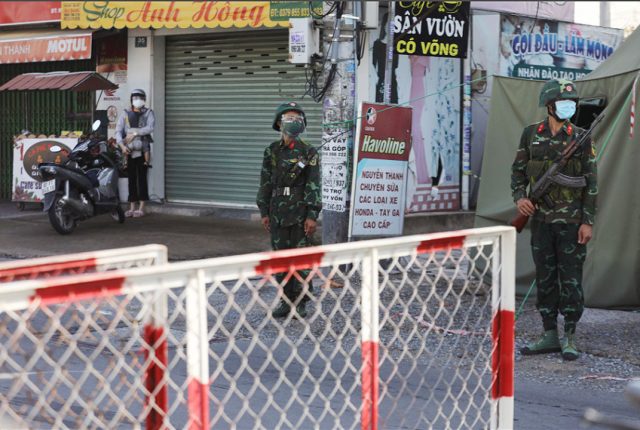
A MILITARY check point is seen during lockdown amid the pandemic in Ho Chi Minh, Vietnam, Aug. 23. — REUTERS/STRINGER

HANOI —  Vietnam’s coronavirus epicenter, Ho Chi Minh City, and capital Hanoi must vaccinate all of their adult residents with at least one shot by Sept. 15, the ministry of health said on Sunday.  

Vietnam has one of the lowest coronavirus vaccination rates in the region, with only 3.3% of the country’s 98 million people fully vaccinated with two shots, and 15.4% with one shot.  

The country is battling a worsening coronavirus disease 2019 (COVID-19) outbreak that has infected more than 520,000 people and killed 13,000, the vast majority in the past few months.  

Ho Chi Minh City, the country’s business hub, accounts for half of the infections and 80% of the fatalities.  

The cities must “mobilize all capable forces including private medical facilities, to vaccinate people at full capacity,” the ministry said in an emergency dispatch.  

Government data showed 88% of Ho Chi Minh City’s adult population of 6.97 million have been inoculated with at least one shot. The rate is 53% for Hanoi’s adult population of 5.75 million.  

The ministry also set the Sept. 15 deadline for the southern industrial provinces of Binh Duong, Dong Nai and Long An to vaccinate all of their adult populations.  

It said Ho Chi Minh City, Binh Duong and Long An have been allocated enough vaccine doses for the vaccination drive.  

Vietnam has so far received 33 million coronavirus vaccine doses, and it expects to receive 17 million more by the end of this month, the government said late on Sunday.  

Vietnam could be facing a lengthy battle against the coronavirus and cannot rely on lockdown and quarantine measures indefinitely, Prime Minister Pham Minh Chinh said last week. — Reuters 

Each COVID-19 surge poses a risk for healthcare workers: PTSD

PHILSTAR

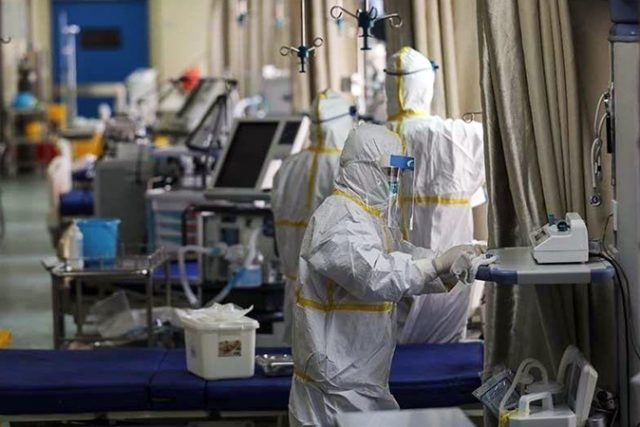
Nurse Chris Prott’s knees jump, his heart races, his mouth goes dry, and his mind floods with dark memories when he talks about working in the Milwaukee VA Medical Center’s intensive care unit (ICU) during pandemic surges.  

Mr. Prott shares a struggle common to many of the military veterans for whom he has cared for years: symptoms of post-traumatic stress disorder (PTSD).  

Mr. Prott was among a half dozen ICU staffers who told Reuters of symptoms such as waking from nightmares bathed in sweat; flashbacks to dying patients during the pandemic’s fear-filled early days; flaring anger; and panic at the sound of medical alarms. Those whose symptoms last longer than one month and are severe enough to interfere with daily life can be diagnosed with PTSD.  

The surging Delta variant is heaping on fresh trauma as the United States and other nations begin to study PTSD in health workers. Data already showed that US health workers were in crisis before COVID-19.  

While PTSD is associated with combat, it can arise among civilians after natural disasters, abuse or other trauma. Health workers can be reluctant to equate their experience with that of returning soldiers.  

“I feel like a schmuck calling it PTSD,” Mr. Prott said. “It took me a long time to be able to talk to somebody because I see guys with real PTSD. What I’ve got going on, it’s nothing in comparison, so you feel guilty for thinking that.”  

Psychiatrist Dr. Bessel van der Kolk knows better. “On the surface, a nurse at your local hospital will not look like a guy coming back from Afghanistan,” said the author of The Body Keeps the Score: Brain, Mind, and Body in the Healing of Trauma. “But underneath it all, we have these core neurobiology-determined functions that are the same.”  

Pre-pandemic studies showed that rates of PTSD in front-line health workers varied from 10% to 50%. The suicide rate among doctors was more than twice that of the general public.  

The American Medical Association (AMA) has tapped a military psychologist and the Department of Veterans Affairs’ (VA) National Center for PTSD to help it measure the pandemic’s impact.  

Texas Tech University Health Science Center psychiatry resident Dr. Huseyin Bayazit and researchers in his native Turkey surveyed 1,833 Turkish health workers last autumn. The results, presented in May at an American Psychiatric Association meeting, showed a PTSD rate of 49.5% among nonphysicians and 36% for doctors. Rates of suicidal thoughts increased as workers spent more time on COVID-19 units.  

Unions want to mitigate trauma by setting national rules for the number of patients under each nurse’s care. Workers say they should not have to pay for therapy, medication, and other interventions.  

The AMA and other groups want more confidentiality for doctors who seek mental health services. Most ICU staff who discussed PTSD with Reuters requested anonymity for fear of repercussions at work.  

New York’s Mount Sinai Health System and Chicago’s Rush University System for Health provide free, confidential mental health services.  

Mount Sinai’s new Center for Stress, Resilience, and Personal Growth offers a military-inspired “Battle Buddies” peer-support program for nurses. A chaplain  from Rush’s “Road Home” program for veterans runs a “post-traumatic growth” bereavement support group for ICU nurses.  

The VA system provides no-cost, short-term mental health counseling through its employee assistance program. Many local VA facilities supplement those with spiritual counseling and crisis incident response teams, a spokesperson said.  

‘YOU HAVE TO DEAL WITH IT’  

About 5,000 US physicians quit every two years due to burnout, said Dr. Christine Sinsky, an AMA vice president. The annual cost is about $4.6 billion — including lost revenue from vacancies and recruitment expenses, she said.  

Hospital survey results in March led the Department of Health and Human Services to warn “staffing shortages have affected patient care, and that exhaustion and trauma have taken a toll on staff’s mental health.”  

Trauma surgeon Dr. Kari Jerge volunteered to work in a Phoenix COVID-19 ward during last winter’s surge. She turned down substantially more pay to return to the ICU after the Delta variant surge.  

Dr. Jerge encourages others to prioritize “self-preservation,” but worries about the loss of expertise. “There is infinite value in a nurse who’s been working in the ICU for 20 years and just has a gut feeling when something’s going wrong with a patient,” she said.  

Nurse Pascaline Muhindura, 40, who cares for COVID-19 patients in Kansas City, Missouri, has advocated for health worker safety since losing a co-worker to the disease early in the pandemic.  

“It keeps getting worse and worse. We are heading back to that place — that woke up those emotions again,” said Ms. Muhindura, who added that many employers do not offer adequate insurance coverage for therapy.  

An ICU fosters the kind of camaraderie forged in battle. A group of Southern California COVID-19 nurses got matching tattoos. Health workers commiserate over crying their way home after tough shifts, support each other on social media, and push colleagues to seek help.  

“There is nothing wrong with feeling this way,” said VA nurse Prott. “You have to deal with it though.” — Lisa Baertlein/Reuters

Rats, drought and labor shortages eat into global edible oil recovery 

WIKIMEDIA COMMONS

PERAK, Malaysia/SINGAPORE — In a sprawling oil palm plantation in the Malaysian state of Perak, watermelon seedlings are sprouting from freshly plowed earth between palm saplings while rented cows graze in overgrown areas of the estate.  

A coronavirus pandemic-induced labor crunch has forced managers of the 2,000-hectare estate in Slim River to find creative ways to upkeep their fields, even as prices of the world’s most consumed edible oil are near record highs.  

“It is easier to pull out your own teeth than to get new workers now,” said estate manager Ravi, who gave his first name only. “I can’t find the workers to maintain the fields.”  

Malaysia, the world’s second-largest producer of palm oil, is facing a perfect storm of production headwinds that will likely drag global stocks to their lowest level in five years.  

The Southeast Asian country is a microcosm of the difficulties facing producers of various edible oils across several continents, from Canadian canola farmers to Ukrainian sunflower growers, as they struggle to meet strong demand.  

Global food prices have scaled 10-year highs this year — the Food and Agriculture Organization’s (FAO) price index is up more than a third since last summer — due in large part to a surge in the price of vegoils that are vital for both food preparation and as fat in numerous daily staples.  

The FAO’s global edible oils index is up 91% since last June, and is expected to climb further as economies reopen following coronavirus disease 2019 (COVID-19) lockdowns, boosting food and fuel consumption of edible oils.  

But producers have been battling a range of impediments, including labor shortages, heatwaves, and vermin infestation, that is driving collective stocks of the world’s most consumed edible oils — palm, soybean, canola (rapeseed) and sunflower seed — to their lowest levels in a decade.  

MALAYSIAN WOES  

In Malaysia, which accounts for around 33% of global palm oil exports, the average yield of palm fruit bunches in Jan.–June fell to 7.15 tonnes per hectare from 7.85 a year ago. Malaysian Palm Oil Board data shows a drop in average crude palm oil yields to 1.41 tonnes per hectare, from 1.56 tonnes over the same period last year.  

Many plantations were harvesting with two-thirds or less of the required workforce, after government coronavirus restrictions cut off the usual supply of migrant workers from Indonesia and South Asia.  

More than half a dozen plantation owners interviewed by Reuters said the lack of workers had forced them to extend their harvesting window from 14 days to as many as 40 days, a change that compromises the quality of the fruit and risks the loss of some parts of the fruit bunches.  

“It is especially bad in Sarawak. Some companies are seeing production falling by 50% because of the shortage of harvesters,” said a plantation manager, who spoke on condition of anonymity because he was not authorized to speak to the media.  

The Slim River estate has delayed replanting and shut its nursery for the first time in 20 years to redeploy workers for harvesting.  

Another plantation manager, named Chew, said he was forced to increase wages by 10% to retain workers.  

Less manpower to maintain the plantations also means more pests, including rats, moths and bagworms.  

“It has resulted in an environment that is good for rats to nest, feed and breed and natural predators cannot catch up,” said Andrew Cheng Mui Fah, a plantation official in Sarawak.  

At Slim River, Ravi said around a quarter of the estate was facing a bagworm infestation that “will skeletonise the leaves and cause small (fruit) bunch formation.”  

He was referring to the larvae of the bagworm moth that grow and feed on trees.  

INDONESIAN MILLS  

Neighboring Indonesia, the world’s largest producer of palm oil, does not have the same labor shortage issues and output is expected to rise this year as more area has been planted to palm.  

However, operations at palm oil mills, where the palm fruit is converted into crude palm oil, have been impacted by COVID-19 restrictions, said Dorab Mistry, director of Indian consumer goods company and major consumer Godrej International.  

“Shutting down of palm oil mills right across the length and breadth of Malaysia [and] Indonesia has been a huge dampener on the production side,” he said at the annual US Soy Export Council conference on Aug 25.  

Total 2021 output from Indonesia and Malaysia, which together account for roughly 90% of world palm oil, was estimated at 66.2 million tonnes, according to Refinitiv Commodities Research published on Aug. 4.  

That is about flat compared with 2020, but analysts said downward revisions are likely if labour shortages and pest infestations worsen.  

NORTH AMERICAN DRY SPELL  

Meanwhile, farmers in western Canada planted canola into some of the driest soils in a century this spring, sending canola futures to all-time highs in early May.  

A July heatwave then scorched crops throughout the Canadian Prairies, leading the US Department of Agriculture (USDA) to slash its estimate of canola output by 4.2 million tonnes to 16 million tonnes, the lowest since the 2012–13 season.  

“We haven’t had much rain to speak of and the crop is withering,” said Jack Froese, who has farmed canola near Winkler, Manitoba, for nearly 50 years.  

Mr. Froese expects a yield per acre of just a quarter of last year’s level: “It’s very disheartening.”  

US soybeans have also been sapped by drought, with the USDA lowering its production forecast by 1.8 million tonnes in August from the month prior.  

That is expected to cut US soybean oil stocks to eight-year lows and US soy oil exports to decade lows.  

“We’re looking at an average crop because we were lucky enough to have some subsoil moisture,” said Jared Hagert from his North Dakota farm. “But you don’t have to go too far west of here to get into some really rough crops.”  

In some good news for buyers, Brazil’s soybean crop is expected to hit a record 144.06 million tonnes in the 2020/21 season, driven by a 4% rise in the area planted to the crop, agribusiness consultancy Datagro estimated.  

Ukraine, the top sunflower seed producer according to the USDA, is expected to lift output by 18% from a 2020 drought-hit harvest and oil exports are forecast to rise to 6.35 million tonnes from 5.38 million last season, according to its agriculture ministry.  

WORSENING OUTLOOK  

Still, the outlook for edible oils production overall remains poor and stocks are likely to tighten further, leaving the markets tight well into next year and adding to inflationary pressures, according to some analysts.  

In Malaysia, worsening COVID-19 outbreaks will leave plantations starved of workers through the rest of the peak palm production window.  

Canadian farmers continue to face drought conditions, leading official agency StatsCan to peg canola output down 24.3% and yields down 30.1%.  

“We have multiple issues with edible oil supplies worldwide, palm oil in Malaysia, canola in Canada and La Nina curbing soybean output in South America,” Mistry said.  

“We are expecting lower oil content in Canada’s canola crop due to the drought,” he said. “The supply tightness in vegetable oil is expected to continue well into 2022.”  

The pressure on stocks is already feeding through to consumer prices and the upward trend is expected to continue, especially as refiners lift prices to cover the surge in raw material costs.  

Singapore-based Wilmar International said a time lag between the surge in raw material costs and consumer price rises it imposed in the first half of the year had negatively impacted margins.  

Mewah Group, one of the largest refineries in the region, said average sale prices for its bulk goods and consumer packs rose almost 54% and 24% respectively in the first half from a year ago.  

“Everyone along the supply chain is absorbing some of the higher costs,” said Oscar Tjakra, a senior analyst at food and agribusiness research at Rabobank. “The cost push should continue next year.”  

With global consumers already facing general economic uncertainty due to the coronavirus pandemic, further increases in edible oil prices will take a toll on many livelihoods due the inelastic nature of food demand.  

Several countries including Nigeria, Egypt, Turkey and the Philippines have all recorded big jumps in food inflation in recent months. The price pressure may continue as higher edible oil costs are passed on by suppliers, leaving consumers with little choice but to pay up for the staple.  

“Even in poorer regions, such as Sub-Saharan Africa, where consumers suffer greatly from high prices, consumption has only declined very marginally,” said Julian McGill, head of South East Asia at LMC International.  

“There is simply not much flexibility in food use of vegetable oils.” — Mei Mei Chu and Naveen Thukral/Reuters

Easy policy lays out a hard road for underperforming peso, baht

The Thai baht and the Philippine peso have lagged all their Southeast Asian peers this year. This may continue as inflation readings could reinforce their central banks as two of the biggest doves in the region.

Bangko Sentral ng Pilipinas is weighing a reduction in the reserve requirement ratio while some members of the Bank of Thailand’s policy committee see a need for another rate cut. This easy stance is at odds with that of policy makers elsewhere which are preparing to unwind stimulus deployed to counter the fallout from outbreak.

The baht and the peso are among Asia’s most vulnerable currencies given that their nations are highly dependent on cash generated from abroad — tourism for Thailand and remittances for the Philippines. Thailand’s budget and current-account deficits add further pressure on the baht, while in the Philippines the risk of a sovereign rating downgrade, spurred by a spiraling debt-to-growth ratio, is doing the peso no favors.

“Both the PHP and THB have been weighed down by the virus outbreaks which have hit growth and confidence,” says Irene Cheung, FX strategist at Australia & New Zealand Banking Group Ltd. in Singapore. “The external balance in both countries has been negatively impacted. Philippines trade deficit has rewidened, while Thailand’s current account has deteriorated sharply due to the slump in tourism.”

The baht has lost more than 8% against the dollar this year while the peso has weakened almost 4%.

The currencies could extend losses if inflationary data this week offer scope for policy makers to lean further toward accommodation. Thailand is forecast to report on Monday that consumer prices rose just 0.36% year-over-year in August, giving the central bank plenty of room to continue its policy stance, or even cut rates again as two members of its policy committee wanted to do last month.

Data on Tuesday are expected to show that the Philippines’ price growth came in at 4.4% last month — above the central bank’s 2%-4% target — but anything other than a very strong upside surprise is likely to mean BSP tightening remains off the table. At its August meeting, the central bank said it expected CPI to return to the midpoint of the range for 2022 and 2023 — and it has already come down noticeably from February’s 4.7% peak.

With BSP and BoT set on avoiding rate hikes, the peso and baht may be on track to end the year languishing at the bottom of the regional currency rankings table. — Bloomberg

ADVERTISEMENT
ADVERTISEMENT