Home Blog Page 7546

Stocks rise as gov’t opts for targeted lockdowns

BW FILE PHOTO

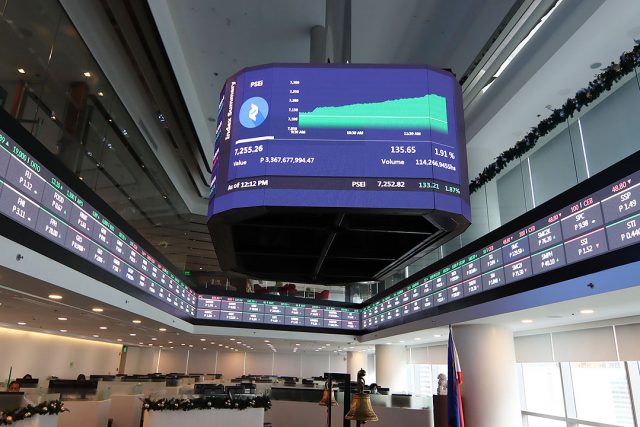
PHILIPPINE shares closed higher on Tuesday after the government eased quarantine restrictions in Metro Manila in favor of targeted lockdowns.

The benchmark Philippine Stock Exchange index (PSEi) gained 35.61 points or 0.51% to close at 6,912.71 on Tuesday, while the broader all shares index climbed 20.03 points or 0.47% to end at 4,275.76.

“This came as investors were cheered by the decision to place the National Capital Region (NCR) under general community quarantine with granular lockdowns beginning Sept. 8,” Philstocks Financial, Inc. Senior Research Analyst Japhet Louis O. Tantiangco said in a Viber message.

“The easing of restrictions in the NCR, which is the biggest contributor to the economy region-wise, is seen to mitigate the country’s overall economic losses,” he added.

Metro Manila will implement granular lockdowns beginning on Wednesday even after the Health department logged a record 22,415 new coronavirus disease 2019 (COVID-19) cases on Monday. Presidential spokesman Herminio “Harry” L. Roque, Jr. said final guidelines will be announced by Tuesday or Wednesday.

“Investors also brushed off the latest inflation print, which showed an acceleration in August of 4.9%,” Regina Capital Development Corp. Head of Sales Luis A. Limlingan said in a separate Viber message.

Preliminary data from the Philippine Statistics Authority showed headline inflation in August picked up to 4.9% from four percent in July.

This is higher than the 4.4% median in a BusinessWorld poll of 16 analysts and was at the high end of the 4.1% to 4.9% estimate given by the Bangko Sentral ng Pilipinas. It also went beyond the central bank’s 2-4% target for 2021.

“Lastly, the Japan Credit Rating Agency (JCR) affirmed the country’s A- rating due to its economic resilience, relatively low debt levels, and unimpaired fiscal soundness,” Mr. Limlingan added.

JCR also kept its “stable” outlook on the rating, meaning the country is expected to maintain the country’s rating in the next 12 to 18 months.

Sectoral indices were split on Tuesday. Services gained 18.19 points or 1.03% to 1,780.93; holding firms went up by 68.77 points or 0.99% to 6,989.85; and property rose by 9.88 points or 0.322% to close at 3,086.71.

Meanwhile, financials lost 9.20 points or 0.63% to 1,448.09; mining and oil shaved off 33.76 points or 0.34% to finish at 9,655.96; and industrials went down by 14.17 points or 0.14% to 10,125.28.

Value turnover inched up to P5.4 billion with 1.96 billion shares switching hands on Tuesday, from the P5.30 billion with 1.8 billion shares traded the previous day.

Advancers beat decliners, 119 versus 76, while 41 names closed unchanged.

Net foreign buying slowed to P108.85 million on Tuesday from P263.06 million on Monday. — Keren Concepcion G. Valmonte

SMC to provide water supply in seven additional Bulacan towns

PPP.GOV.PH

SAN MIGUEL Corp. (SMC) is set to provide water supply to seven more towns in Bulacan under the Bulacan Bulk Water Supply project. 

The company said in a statement on Tuesday that it recently formalized agreements with the water districts of Norzagaray, Hagonoy, Pandi, Baliwag, San Rafael, San Miguel, and San Ildefonso for water supply access in their respective areas. 

SMC President Ramon S. Ang said the company is eyeing to begin operations by January 2023.

“With these agreements signed with the seven water districts, and with the Metropolitan Waterworks and Sewerage System (MWSS) having approved the updated business plan, we can now start preliminary engineering design, and then construction,” Mr. Ang said.

SMC said it hopes to sign agreements with four other water districts in Bulacan, namely: Pulilan, Angat, Dona Remedios Trinidad, and Bustos in the near future.

The bulk water supply project is a public-private partnership project of SMC unit Luzon Clean Water Development Corp. and K-Water Resources Corp. consortium with the MWSS. — Revin Mikhael D. Ochave

Bangsamoro women get boost on governance participation with UK, CRS program 

WOMEN LEADERS and organizations in the Bangsamoro region are getting support to strengthen their participation in governance through a nine-month program backed by the British government and humanitarian agency Catholic Relief Services (CRS).

The program Advancing Inclusion and Political Participation of Women in the Bangsamoro, with a P13.7-million funding and launched on Sept. 7, will provide leadership trainings, research on women’s engagement, and consultations for the inclusion of women concerns in local plans, policies and budgets.

Bangsamoro Parliament Member Bainon G. Karon, who leads the Regional Commission on Bangsamoro Women, said there is a need to increase their sector’s role in the region that is currently undergoing transition.   

“Across the Bangsamoro, there are only 221 women provincial and municipal leaders. Of the 80-member Parliament, only 13 are women. This has to change. We need to bring more women in to help shape policies and decisions. We need to engage more women and involve vulnerable groups,” she said in a statement from CRS.

British Ambassador-Designate to the Philippines Laure Beaufils said the program will support 300 women leaders and 18 women’s associations.

“Addressing gender inequality and promoting women’s participation and representation is a top priority for the UK Government. We strive to ensure that this is embedded in all our projects and policies in the Philippines and across the globe,” he said in the statement.

CRS is implementing the program in partnership with local organizations Integrated Mindanaons Association for Natives (IMAN), Inc. and United Youth for Peace and Development (UNYPAD), Inc. — MSJ

Peso sinks to P50:$1 level on Aug. inflation

BW FILE PHOTO
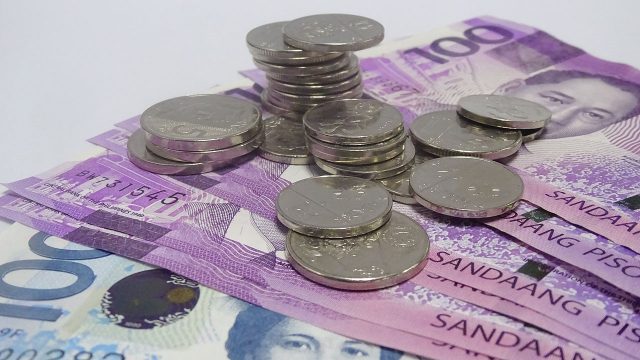
THE PESO dropped against the dollar on Tuesday as inflation picked up in August. — BW FILE PHOTO

THE PESO fell to the P50-per-dollar level anew on Tuesday due to faster-than-expected August inflation.

The local unit closed at P50.025 versus the greenback on Tuesday, shedding 10 centavos from its P49.925 finish on Monday, data from the Bankers Association of the Philippines showed.

The peso opened Tuesday’s session at P49.95 per dollar. Its weakest showing was at P50.04, while its intraday best was at P49.87 versus the greenback.

Dollars exchanged increased to $788.45 million on Tuesday from $717.4 million on Monday.

A trader said the peso weakened following the release of data showing inflation picked up in August.

The consumer price index (CPI) rose 4.9% last month, surpassing the central bank’s 2-4% target and picking up from the 4% print in July. This was the fastest headline inflation pace in more than two years or since the 5.1% logged in December 2018.

Last month’s CPI reading was also quicker than the 4.4% median estimate of 16 analysts in a BusinessWorld poll and fell at the high end of the central bank’s 4.1-4.9% estimate for the month.

Meanwhile, Rizal Commercial Banking Corp. Chief Economist Michael L. Ricafort said the peso dropped against the dollar as coronavirus cases continued to rise.

The Health department reported 18,012 new infections on Tuesday, bringing active cases to 158,637.

For Wednesday, Mr. Ricafort gave a forecast range of P49.90 to P50.10 per dollar, while the trader expects the local unit to move within P49.95 to P50.20. — LWTN

Marawi group calls on Senate to prioritize compensation bill after House approval

DHSUD

A MULTI-STAKEHOLDER group from Marawi appealed to the Senate to hasten action on the bill that will give compensation to residents whose properties were damaged during the 2017 siege following Monday’s final approval of the counterpart measure in the House of Representatives.

“As we countdown to the fifth year since the war, we hope our dear Senators will heed our call and expedite the passage of a Marawi compensation bill as a sign of sincerity and willingness to help us, victims of war, in this long process of recovery,” the Marawi Reconstruction Conflict Watch said in a statement released late Monday.

House Bill 9925 or Marawi Compensation Act, approved on third and final reading by 197 representatives, also institutionalizes the multi-agency Task Force Bangon Marawi that is handling the city’s ongoing reconstruction.

The Senate version is pending at the committee level.

Century Pacific assists Zamboanga fishing communities through adopt-a-farm program 

DOLE REGION 9

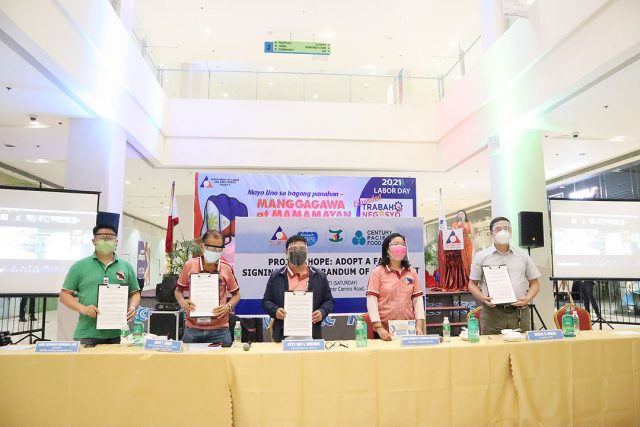
CENTURY PACIFIC Food, Inc. (CNPF) has joined the Labor department’s livelihood program that allows companies to source produce direct from farms tended by workers displaced during the closed fishing season in Zamboanga.   

In a statement disclosed to the exchange on Tuesday, CNPF said it inked an agreement with the Department of Labor and Employment for the Project Hope Adopt-A-Farm program via its nonprofit affiliate, RSPo Foundation, Inc.

“These workers have a sustainable source of income through the farm, their families sell their produce to a ready buyer — us, and we have convenient and reliable access to much needed raw materials for our sardines business,” said Kamille Corpuz, program manager of RSPo Foundation.

Project Hope aims to help communities have alternative income source during the annual closed fishing season in Zamboanga Peninsula from Dec. 1 to March 1.

CNPF said it is the first company to join Project Hope. It has already adopted three greenhouse farms. — Keren Concepcion G. Valmonte   

Clean Air Asia to help Tondo village implement air pollution control measures

MANILA.GOV

INTERNATIONAL NON-GOVERNMENT organization Clean Air Asia said on Tuesday that it will help in the implementation of Manila city’s air pollution control measures in a village in Tondo.

The village Barangay 128 is located close to Smokey Mountain, a former garbage dump that was closed down in the late 1990s.

On Tuesday, Clean Air Asia told BusinessWorld that its partnership with the barangay will focus on providing support to enforce the ban on open burning and reduce emissions from households and small-commercial establishments in line with the city’s Clean Air Action Plan.

“(The air pollution control measures) include working with the barangay government, community groups, and households to continue supporting the barangay’s strong enforcement of banning (the) burning of garbage and materials recovered from garbage as well as improving access to cleaner fuels for cooking used by households and small-commercial establishments,” the group said in an email on Tuesday.

Clean Air Asia said it has also installed an air quality monitor in the Tondo village to raise awareness on air pollution levels. It added that it hopes to establish a community task force which will help in integrating city-level and grassroots decision-making with program implementation. — Angelica Y. Yang

PCOO reduces contractual workers after audit findings, seeks 23% higher 2022 budget

THE PRESIDENTIAL Communications Operations Office (PCOO) said in a House budget hearing on Tuesday that they have reduced the number of contractual workers after state auditors questioned its hiring of 375 temporary personnel.

PCOO Undersecretary Kristian R. Ablan said the office has reduced the number of its contractual workforce to 301 as of Aug. 15 after absorbing some of the workers into regular positions.   

“That number will continue to be reduced as we will be absorbing many of the contracts of service to the plantilla positions recently granted to us by the Department of Budget and Management,” he said.   

Mr. Ablan also said that the short-term contracts entered with some workers assigned for creatives work are currently being closed by the agency as the programs tied to these contracts are already finished.

In its 2020 annual audit report, the Commission on Audit (CoA) questioned PCOO’s basis for hiring 375 contractual workers without a written policy guidelines on availing their services. These workers comprised 71.7% of the total PCOO manpower. 

CoA cited that the accomplishment reports of the contractual employees hired as social media specialists did not reflect their actual duties or tasks.   

“The unrestricted (or) massive hiring of CoS (contract of service) personnel cost the PCOO a total amount of P70,688,830.39 for their salaries during the year, resulting in the depletion of government funds which could have been used for other programs,” CoA reported.

Meanwhile, the PCOO is proposing a P1.91-billion budget for next year, 23.3% higher than this year’s P1.549 billion.

In the 2022 program, P874.1 million would be allotted for personnel services, P721.48 million for maintenance and other operating expenses, and P315.39 million for capital outlays. Subsidies of P178.63 million would also be given to the People’s Television Network, Inc. and Intercontinental Broadcasting Corp. — Russell Louis C. Ku

Comelec calls on more groups to review system source code for 2022 polls 

THE COMMISSION on Elections (Comelec) on Tuesday renewed its call for more groups to participate in the source code review of the automated election system to be used in the 2022 national and local elections. 

“We once again call on election stakeholders to proactively take part in scrutinizing the technology and studying the system that will be used in the May 9, 2022 polls,” Comelec Spokesperson James B. Jimenez said in a statement.

“This activity is a key component of the Commission on Elections’ commitment in promoting transparency and building public confidence and trust in the electoral process,” he said.

The application deadline for reviewers is Sept. 10 based on Comelec Resolution 10712, but Mr. Jimenez said in a Viber message to reporters that “too few” parties have applied so far.

Under the resolution, those qualified to review the local source code are political parties, previously certified organizations, and information technology groups registered and/or accredited by the Comelec.

Republic Act 9369 or the Poll Automation Law mandates that the source code be open and available for review by stakeholders. — Bianca Angelica D. Añago 

Aspiring for high-income status

PCH.VECTOR-FREEPIK

(Part 3)

Some of us economists are incorrigible prophets. We never give up fathoming the future even if we had made some terrible forecasting booboos in the past. Combining our expertise in statistics in analyzing past economic trends and our allied training in the political and other social sciences, we continue to dare to foretell the future not only about specific economic trends such as GDP growth, inflation, stock market prices, oil prices, and exchange rates. We also with a straight face tell governments and business people which countries will succeed in attaining high-income levels and which ones will be stuck in the middle-income trap, or, worse, stagnate as low-income economies.

As I wrote in the first part of this series of articles, at the beginning of the Third Millennium an economist from Goldman Sachs by the name of Jim O’Neill coined the acronym BRIC to announce that Brazil, Russia, India, and China would be the star emerging markets during the first decades of the 21st century. Hardly a decade had passed when Brazil and Russia mismanaged their respective economies and dropped out of the list of attractive emerging markets in which to invest. Among the “Next 11” emerging markets identified by Mr. O’Neill (Egypt, Indonesia, Iran, Mexico, Nigeria, Pakistan, Bangladesh, the Philippines, South Korea, Turkey, and Vietnam) only South Korea and Vietnam can be considered to have lived up to his expectations during the first decade of the 21st century. The others either stagnated as low-income countries such as Nigeria or fell into the middle-income trap such as Mexico and Turkey.

At the beginning of the second decade of this century, another economist tried his luck identifying the nations that would lead the emerging markets in economic growth in the decades ahead. In what became a best seller, Ruchir Sharma, head of Emerging Market Equities and Global Macro at Morgan Stanley Investment Management, identified what he called the “breakout nations.” In a book entitled Breakout Nations: In Pursuit of the Next Economic Miracles, Sharma came out with his own list: the Czech Republic, Indonesia, Nigeria, the Philippines, Poland, South Korea, Sri Lanka, Thailand, and Turkey.

His prognostication about the Philippines hit the mark for the second decade of the 21st century. As we reported in the second part of this series, the Philippines was one of the fastest growing emerging markets during the last decade, averaging an annual GDP growth rate of 6.4% during the period 2011 to 2019, slowing down only as one of the numerous victims of the COVID-19 pandemic in 2020. As mentioned in a review of the book by Katherine Visconti of Rappler (July 3, 2012), Ruchir Sharma expected the Philippines to be transformed from the “sick man of Asia” to become a “breakout nation” in the coming decade — or one that beats expectations and does better than peers in the same income class. Sharma postulated that the Philippines would have to grow at 5% or faster to be a breakout nation. The record shows that the Philippines did even much better at over 6%.

What Sharma cited as reasons for his optimism about the Philippines reminds me of the various eulogies that came out from both business and political leaders after the recent demise of Benigno Aquino III, who was President from 2010 to 2016, precisely at the start of the breaking out of the Philippines from decades of being known as the Asian laggard. The most recent accolade given by an economist to President Nonoy Aquino appeared in this paper on Aug. 25. Economist Andrew Masigan wrote in his column entitled “Good governance is good economics,” that good governance characterized the term of President Noynoy: “On the back of good governance and the judicious use of funds, the Philippines improved in all development indices including economic competitiveness, ease in doing business, economic freedom, corruption perception, innovation, rule of law, and gender equality. The economy experienced an accelerated average GDP growth rate never before seen since our independence.” Being written by an economist, the article was replete with economic data highlighting the accomplishments of President Noynoy.

As Rappler’s Visconti wrote in her review of the book: “Sharma largely credits President Benigno Aquino III with setting the stage for stronger economic growth. He said that when he visited in early 2010 before Aquino was sworn in, ‘the Philippines was still the undisputed laggard of Asia, a nation mired in chronic incompetence. But the country is no longer a joke under Aquino, noted Sharma. In fact, since Aquino assumed office, the country has experienced a series of international credit ratings upgrades, the stock market has become one of the strongest performers in the world, all while inflation has stayed stable and relatively low….”

Sharma balanced praise and criticism, writing that Aquino was originally dismissed in foreign circles as an unimpressive 51-year-old bachelor who had lived most of his life with his mother and had not made much of a mark in a low-profile career as a Philippine senator. Some critics today still bring up the “wimp” criticism against President Noynoy. Sharma in 2012 credited the former President with appointing “competent technocrats” and not letting investors hold him “hostage.” Sharma concluded that the Philippines was poised to resume a period of strong growth, commenting that President Benigno Aquino III probably had just enough support and looked likely to generate just enough reform momentum to get the job done. He did get the job done, with the economy growing at the highest annual average GDP growth rate of all presidential terms since the time of President Marcos.

What Sharma mentioned as a major reason for his predicting success under President Noynoy Aquino is a key to understanding one of the strong fundamentals outside observers perceive about the Philippines that make a good number of international think tanks and financial institutions think highly of the Philippine long-term economic future today. His “appointing competent technocrats” was really a continuation of the long-time practice of presidents even during the time of President Marcos. What slowed down the economy was the practice of many of the previous presidents to give special treatment to cronies, oftentimes in contravention to the advice of the technocrats. This crony capitalism caused the downfall of the Marcos regime in the last year of his Presidency. Rodrigo Duterte may also suffer a similar fate if it can be proven that he gave special treatment to his “Davao cronies” like Senator Bong Go, Chinese national Michael Yang, and others involved in the medical supplies scandal attributed to Pharmally International Holdings Co., Ltd., a company related to Pharmally Pharmaceuticals Corp. which bagged P8.9 billion worth of contracts for “overpriced” pandemic supplies. In great contrast, Noynoy Aquino not only appointed some of the best people to manage the economy but, as Sharma observed, did not allow himself to be hostage to investors.

This long period during which some of the best professionals were appointed to such crucial economic agencies as the Central Bank, the Department of Finance, the National Economic and Development Authority, the Department of Trade and Industry, the Department of Public Works and Highways — the government agencies most involved in delivering economic growth — accounts for the strong institutions that we now have that can guarantee long-term growth. That is why I was not surprised when the prestigious weekly publication, The Economist, at the very height of the ongoing pandemic in May 2020, gave a high ranking to the Philippines in a list of selected emerging economies ranked on four measures of financial strength. In a list of 66 emerging markets, the Philippines was ranked No. 6, besting such countries as Thailand, Saudi Arabia, China, Vietnam, Indonesia, the UAE, India, the Czech Republic, Mexico, Brazil and others among its peers. I was not surprised either when the Japan Credit Rating Agency upgraded the Philippines from BBB+ to A- just before the pandemic.

I can only explain this high esteem that outside observers have for our financial stability to the strong institutions in the monetary, fiscal, and other macroeconomic sectors that we have built over a period of half a century, thanks to very competent technocrats who have been appointed through the decades by the successive political leaders, some of whom left a lot to be desired in their really serving the good of the country. These competent technocrats have painstakingly and slowly built the strong institutions we now have. Among our neighbors, such as Singapore, Taiwan, and even South Korea, this institution building took a much shorter time because crony capitalism was minimized. In a future article in this series, I will discuss the special case of South Korea.

I reckon that The Economist gave a high rating to the Philippines because of the ability of our strong institutions run by technocrats to keep our debt-to-GDP ratio during normal times at a very manageable level of 30-40% and our fiscal deficit at the prudent ratio of 3.5% of GDP. They have also been witness to the Central Bank of the Philippines being led successively by technocrats who were systematically rated as the best Central Bank governors in the Southeast Asian region. Those who look beyond this present Administration are convinced that with this long tradition of the best minds being appointed to head the important economic and financial institutions, the tendency of our democratic society to elect political leaders who are not exactly the best you can find among the aspirants will not be an insurmountable obstacle to our economy growing at least at the 6-7% rate we have experienced in the recent past. It is notable, in this regard, that despite the very evident defects of the present President, the Philippine economy continued to grow from 2016 to 2019 at the same pace as it did during the “breakout” period of Benigno Aquino III. The same explanation can be given: President Duterte appointed some of the most competent professionals to run the economy and did not interfere with how they carried out their respective jobs, which cannot be said of the Department of Health and related agencies.


Bernardo M. Villegas has a Ph.D. in Economics from Harvard, is Professor Emeritus at the University of Asia and the Pacific, and a Visiting Professor at the IESE Business School in Barcelona, Spain. He was a member of the 1986 Constitutional Commission.

bernardo.villegas@uap.asia

Continuity of formal education is critical

PCH.VECTOR-FREEPIK

It’s been about a year and a half since the first hard lockdowns were enforced and the country is still struggling to stop the surging contagion of what is now a multiple number of COVID-19 variants spreading in many regions. Among the sectors hardest hit is the educational system, which is now starting its second academic year in pandemic conditions.

School opening season during pre-pandemic times was always about the perennial problems of insufficient classrooms, the need for more teachers, and other issues burdening the school system because of a student population that, according to Department of Education (DepEd) data, was growing at a rate of 3% per year and was approaching 28 million. “As of this writing, the latest enrollment figures in the DepEd’s “Quick Count” for School Year 2021-2022 as of Sept. 3, was only 16,038,442 which is only just over 61.2% of the 26,227,022 enrollees last year. Comparing last year’s total enrollees with School Year 2019-2020 which was at 27,790,114, that’s an alarming 1,565,092 learners who did not go back to school during the first year of the pandemic. The private education sector on the other hand, already plagued by school shutdowns, was only at 671,660 enrollees.”

This situation presents a bigger dimension in an already gap-ridden education system not just in school facilities but in the quality of education as sadly reflected in the 2019 Trends in International Mathematics and Science Study where Philippine scores (Grade 4 level) were significantly lower than other countries. Amidst all the hardship of the pandemic, we are confronting an educational crisis that may result in an education gap in what others are beginning to call a “pandemic generation.”

More than a million students staying away from classes last year and some predict may even be more this year, is one thing, but the more extensive problem is how our schools, teachers, students, and parents are able to adjust to the sudden shift to studying at home or what the DepEd has called the “Blended Learning” mode of learning. Depending on accessibility and capacity of the school, a combination of printed distance learning modules, online classes, and lessons broadcast in social media and television may be adopted. How will this shift affect the quality of an already sub-par basic education system? Are our higher educational institutions delivering the lessons and are their students able to at least acquire the required competencies with the sudden shift to digital learning platforms?

The prospect is not encouraging as our education ecosystem was simply not ready for the quick shift to e-learning platforms. Access to reliable internet connections, the devices needed, and how to even use the digital technologies was a shock for the schools, teachers, students, and parents. The substantial resources needed to cope with this shift has created an education digital divide in a population already in dire conditions. These resource issues and the health risk has caused dropouts and a kind of learning crisis never seen before.

As a professor, I believe the quality and dynamic interaction in a conducive learning environment where both the student and teacher benefit and grow cannot be cloned by any e-learning platform. The nuances of live feedback where you see the facial expressions, body language, and other physical cues that tell you whether you are making an intellectual connection cannot be experienced through the monitor, speaker, and microphone, even with the best equipment and most stable internet connection which, for the majority, is already a challenge.

The education system must be supported to continue with formal education as these custodians of our country’s future are now the students in this education crisis. For now, harnessing digital technologies for the continuity of our educational institutions is the best option, but the challenges of limited access to technology, connectivity, and skills to effectively benefit from e-learning platforms will need the intervention of the private sector’ digital technology companies.

The DepEd has been engaging in partnerships to build up its organic capacity to deliver the K-12 curriculum through the Blended Learning strategy. One of these is the recently launched GoLearn e-learning platform in partnership with Globe’s tech innovation interventions for education and with the support of Senator Joel Villanueva’s advocacy for continuous education in the pandemic through digital learning.

The private sector has been pro-active in supporting education as it is their enterprises that will need the manpower and management talent trained by our educational institutions. According to data presented during the 2020 Philippine Association of Colleges and Universities, 80% of the Philippine workforce including professionals, managers and technicians were educated in private educational institutions.

This brings up another dimension of the education crisis that was sparked by the onerous tax policy — the 150% income tax increase — that the Bureau of Internal Revenue was about to impose on private schools. After strong opposition from various sectors and even legislators from both Houses of Congress, the ill-conceived revenue regulation has been suspended and legislation is now pending passage to permanently rectify the bad policy.

Education is not just a human right but is an empowering element of society that will directly impact how our nation will evolve in the new digitally powered global ecosystem. It would be best for government to shed its limiting regulatory nature and old bureaucratic ways and learn fast from the private sector’s innovative and developmental drive. We are all stakeholders of education, and we must all rally for the continuity of formal education.


Victor Andres “Dindo” C. Manhit is the President of the Stratbase ADR Institute.

At the 20th anniversary of the 9/11 attacks, ancient Greece and Rome can tell us a lot about the links between collective trauma and going to war

FREEPIK

On the outskirts of Grapevine, Texas, a town about five miles northwest of the Dallas/Fort Worth International Airport, there’s a memorial dedicated to the 33 airline flight crew members who lost their lives in the terrorist attacks on Sept. 11, 2001. When I stumbled upon the monument several years ago with my family, I experienced contrary emotions: sadness inspired by the memorial’s stark figures, mixed with anger over how the attacks quickly became a pretext for US wars in Afghanistan and Iraq.

Now, as US soldiers leave behind uncertainty and violence in Afghanistan, I look back on America’s past 20 years with two sets of eyes.

As the first-year graduate student who stood smoking a cigarette in Washington Square Park at 8:45 a.m. on Sept. 11, 2001 — less than a mile from the World Trade Center’s Twin Towers and where the sound of the jet engines’ final roar mixed in with a Tuesday morning’s bustle — I feel visceral sorrow and remorse.

Today, as a scholar of Greek literature who studies narrative and memory, I see how this collective trauma shaped US actions and has affected Americans’ vision of their identities and shared history — a feedback loop that is reflected in the myths and histories of ancient Greece.

Twenty years is still recent history for many, so memories of the 9/11 attacks may still be too raw to easily reflect on and learn from. That’s why looking for parallels in ancient stories of destruction and loss can help in understanding how shared trauma can shape the stories a nation tells itself, and the decisions that get made in response.

Collective trauma is a term that describes the shared experience of and reactions to a traumatic event by a group of people. That group may be as small as a few people or as large as a whole society.

The 9/11 attacks shattered collective American confidence in its safety and sense of place in the world. America’s collective efforts to learn to live with that trauma partly explain why there is a Sept. 11 memorial in a Texas town thousands of miles from where the attacks took place. It also demonstrates that collective tragedies can shape the world views of individuals who were not present at the event.

The traumatized group may go through shared stages of grief, from disbelief to anger. The further the group gets from the traumatizing event itself, the closer it moves to social memory, a concept historians use to describe how groups of people come to share a consistent story about past events. This narrative can be manipulated to reflect or enforce values in the present.

My studies of ancient Greek history suggest to me that this is what happened in the US after the attacks. There are myths and histories of the ancient world that describe how, in the wake of the destruction of cities, societies created cultural memories that helped them find reasons for rushing into war. These episodes have parallels to the US in the early 21st century.

In the spring of 2002, I attended a New York University conference called “Saving the City,” where speakers were asked to consider such stories. One of the histories we focused on involved Athens after the Persian army invaded Greece — for a second time — in 480 BC and burned the temples, groves, and homes of the Athenians. The attack was in part vengeance for a past military loss, and also a punishment for Athens’ meddling in Persian affairs in Asia Minor. As with New York on Sept. 11, the attackers targeted an icon: the first version of the Athenian Parthenon.

In the wake of this collective trauma, as the scholar Bernd Steinbock argues, narratives of city destruction became popular in Athenian storytelling and art. In some of these stories, cities that had committed offenses against the gods then suffered at the hands of international armies that formed to set them right.

Athenians told one another these stories as they raised troops and a navy to harry the Persians in Asia Minor. Athenian political rhetoric was shaped by the specter of Persian invasion and the threat of re-invasion, the glory of victory and the casting of Athens as a force for freedom and justice in the world. This rhetoric justified imperial expansion, violence, and eventually the murder and enslavement of the city’s own allies.

That led to the Peloponnesian War, a destructive 27-year conflict with Sparta that ended with Athens being conquered again in 404 BC.

In 2001, Americans were still in the early days of their collective trauma when talk pivoted to the rhetoric of war. Analogies were made to shared cultural or national stories from the past: The terrorists were “evil-doers,” President George W. Bush said soon after the attacks, and fighting them was “a new crusade.” Sept. 11 was the “Pearl Harbor” that made it OK to invade Afghanistan.

By early 2002, Bush was telling the nation that Iran, Iraq, and North Korea — the “axis of evil” — were threats to the United States, although they had not been implicated in the Sept. 11 attacks. His administration would soon use its claim that Iraq possessed weapons of mass destruction as a “Gulf of Tonkin” moment to justify the US invasion of Iraq — a reference to the 1964 event that spurred greater American military involvement in the Vietnam War.

As I listened to this sort of political rhetoric at the time, the language of Greek myth and poetry helped me understand how political speech capitalizes on memory to create shared realities and justify use of violence. I spent that first year of graduate school in New York City studying the language and politics in Homer’s epic, the Iliad. The story’s “thousand ships” from different cities sailing east, with a bumbling fool at their head, to punish the Trojans seemed an awful lot like the fractious “coalition of the willing” — Bush’s term for the military alliance he assembled to invade and occupy Iraq.

Rome provides another example from ancient history of the relationship between collective trauma and justifications for imperial pursuits.

The city of Rome fought and won its first war with the powerful city of Carthage — located in what is today Tunisia — between 264-241 BC, and its second between 218-201 BC. Rome then imposed a hefty war indemnity on Carthage, which helped it acquire territories that laid the foundation for a pan-Mediterranean empire.

These two victories ended any significant threat that Carthage may have posed, but Roman culture remained obsessed with war. According to the military leader and author Pliny the Elder, the statesman Cato the Elder used to shout “I think Carthage must be destroyed” at every meeting of the Roman Senate. Rome went on to fight a third war with Carthage, besieging and destroying the city between 149-146 BC.

I can’t think of this anecdote without remembering how Bush agitated for invading Iraq over 10 years after his father’s invasion of the country. Or that just a handful of years after Bush’s 2002 “axis of evil” speech, a presidential candidate sang “bomb bomb Iran” to the tune of a Beach Boys pop hit.

These and other accounts from ancient Greece and Rome suggest that over history, collective trauma has often created an opportunity for leaders to use social memory — a culture’s shared stories — to create justifications for lashing out at the world, careless of any new damage it may cause.

As individuals and nations, we don’t act because of what we suffer, but often because of the stories we tell about it.


Joel Christensen is a Professor of Classical Studies at Brandeis University.    

ADVERTISEMENT
ADVERTISEMENT