Home Blog Page 7477

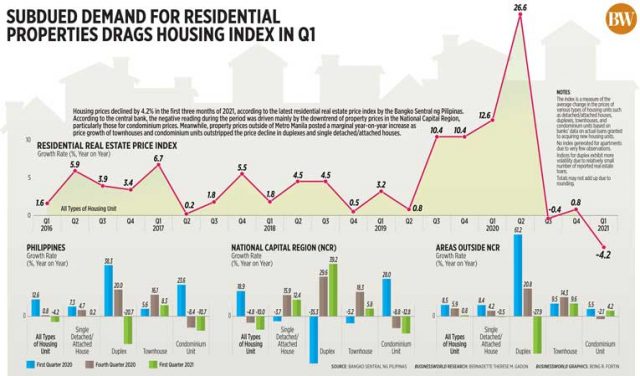
Subdued demand for residential properties drags housing index in Q1 (2021)

RESIDENTIAL PROPERTY prices slumped anew in the first quarter, mainly due to a double-digit decline in prices of condominium units and duplexes in the Philippine capital as demand remained muted due to the pandemic. Read the full story.

Subdued demand for residential properties drags housing index in Q1 (2021)

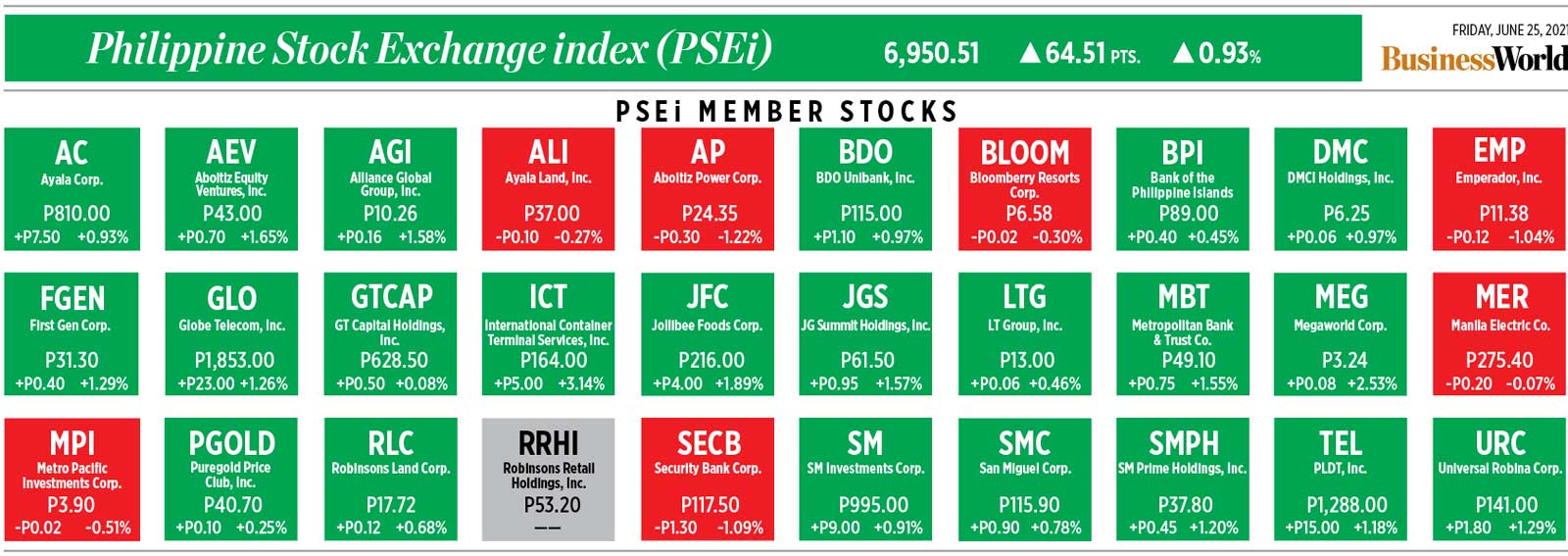
How PSEi member stocks performed — June 25, 2021

Here’s a quick glance at how PSEi stocks fared on Friday, June 25, 2021.


Peso may weaken ahead of key reports

THE PESO could depreciate against the greenback this week ahead of the release of manufacturing and labor data.

The local unit closed at P48.481 per dollar on Friday, strengthening by 25.4 centavos from its P48.735 finish on Thursday, data from the Bankers Association of the Philippines showed.

However, it weakened by 5.1 centavos from its P48.43-per-dollar finish a week earlier.

The peso gained versus the dollar on Friday as data showed “hot money” reverted to a net inflow in May, Rizal Commercial Banking Corp. Chief Economist Michael L. Ricafort said in a text message.

Foreign portfolio investments yielded a net inflow of $416.74 million in May, data released by the central bank on Friday showed. This was a turnaround from the $1.006-billion net outflow logged a year earlier as well as the net $373.95 million that fled the country in April.

Meanwhile, UnionBank of the Philippines, Inc. Chief Economist Ruben Carlo O. Asuncion said month-end corporate demand for the dollar caused the local unit to weaken earlier in the week.

For this week, the market is anticipating the release of the June Philippine Manufacturing Purchasing Managers’ Index (PMI) report on Thursday, July 1, Mr. Ricafort said.

The PMI was at 49.9 in May, IHS Markit reported earlier this month, below the 50 neutral mark that differentiates expansion from contraction but improving from the 49 reading in April.

Manufacturing activity in May contracted at a softer pace due to higher orders and production as restriction measures were relaxed in Metro Manila and nearby provinces, IHS Markit said.

May unemployment data to be released on Thursday, July 1, will also affect peso-dollar trading this week, Mr. Ricafort added.

The jobless rate rose to 8.7% in April from the 7.1% seen in March, latest data from the Philippine Statistics Authority (PSA) showed. This represented 4.138 million unemployed Filipinos versus the 3.441 million seen a month earlier.

The PSA attributed the increase in unemployed individuals in April to lockdown measures imposed that month as infections surged in Metro Manila and nearby provinces.

For his part, UnionBank’s Mr. Asuncion said the upcoming US nonfarm payrolls data to be released on Friday, July 2, will also be monitored by the market.

He said positive data could support the dollar as this could mean the US economy is getting closer to a more solid recovery, which may cause the Federal Reserve to unwind its easy monetary policy sooner rather than later.

For this week, Mr. Ricafort gave a forecast range of P48.30 to P48.70 per dollar, while Mr. Asuncion expects the peso to move within a wider band of P48.45 to P48.95. — L.W.T. Noble

PSEi may test 7,000 as vaccine rollout continues

BW FILE PHOTO

THE main index is expected to test the 7,000 level this week ahead of the release of manufacturing data and as investors continue to monitor the country’s coronavirus disease 2019 (COVID-19) vaccination program.

The Philippine Stock Exchange index (PSEi) went up by 64.51 points or 0.93% to close at 6,950.51 on Friday, while the broader all shares index rose 29.69 points or 0.7% to end at 4,229.58.

The benchmark index gained 99.13 points week on week.

“The market closed higher for the week mainly due to the BSP (Bangko Sentral ng Pilipinas) keeping the policy rate unchanged and reiterating its stance to continue to support the local economy for as long as necessary to ensure sustainable recovery,” AB Capital Securities, Inc. Junior Equity Analyst Lance U. Soledad said in a Viber message on Friday.

“Investor sentiment likely got a boost from news of stabilizing food prices and pronouncements from the BSP chief that [the] upcoming Fed rate hike are less of [a] threat to the country vis-a-vis other economies. The BSP also held its fourth policy meeting for 2021… keeping rates steady,” China Bank Securities Corp. Research Associate Zoren Philip A. Musngi said via e-mail on Friday.

The BSP left the rate on the overnight reverse repurchase facility at 2%, as expected by 14 of 16 analysts in a BusinessWorld poll. Interest rates on the overnight deposit and lending facilities were also kept at 1.5% and 2.5%, respectively.

Meanwhile, BSP Governor Benjamin E. Diokno last week said the US Federal Reserve’s plan to hike rates by 2023 would be less of a threat to the Philippines versus other emerging markets as the country’s economic fundamentals remain sound.

For this week, analysts said continued progress in the country’s vaccination program will boost investor sentiment.

“Latest figures [show] COVID-19 infections remain high at more than 6,000 while [vaccine] rollout [is] still at less than 10% of the population, far from the 70% to reach herd immunity,” Diversified Securities, Inc. Equity Trader Aniceto K. Pangan said in a text message on Friday. “We may continue to see market move on consolidation from 6,800 to 7,000.”

The Philippines has administered around 9.54 million COVID-19 jabs so far, and at least 215,204 doses are administered daily.

“We think the market will retest the 7,000 resistance level [this] week as vaccine rollout continues to improve,” AB Capital Securities’ Mr. Soledad said, adding a major catalyst would be the release of the June Philippine Manufacturing Purchasing Managers’ Index report on Thursday, July 1.

China Bank Securities’ Mr. Musngi said the PSEi’s attempt to climb to 7,000 will likely be met with strong selling pressure.

“There are little catalysts to justify another strong surge at this point,” Mr. Musngi said. “Note that foreign funds, which contribute around half of market turnover and usually [drive] broad-based rallies in equities, are already cashing in on their gains over the past month.” — Keren Concepcion G. Valmonte

Bulk of expanded pork import MAV due between July, October

ABOUT 140,000 metric tons (MT) of pork imports, equivalent to 70% of the adjusted minimum access volume (MAV) allocation under Executive Order (EO) No. 133, will be admitted between July and October, according to a committee overseeing MAV imports. 

MAV Management Committee Resolution No. 1 indicates that the 140,000 MT is open to all interested importers on a “first come-first served” basis, while the remaining 30% or 60,000 MT is scheduled for entry between November and January 2022.

“The MAV Management Committee unanimously approves the calibrated distribution of 70% or 140,000 MT, for July-October and 30% or 60,000 MT for November-January 2022 shall be open to all interested importers on a first come-first served basis,” the resolution said.

“A maximum limit of 50 full container loads, approximately equivalent to 1,250 MT, shall be allowed per application per importer,” it added.

President Rodrigo R. Duterte’s EO No. 133 increased the allocation of pork imports within the MAV quota by 200,000 MT to a total of 254,210 MT “as long as any unavailable balance at the end of the 2021 shall not be carried over to 2022.”  

The order was issued in response to the tight supply of pork supply in the wake of the African Swine Fever outbreak.

The MAV system governs farm commodities that can be imported at favorable tariff rates within a specific quota under the World Trade Organization.

Aside from raising the MAV volume, Mr. Duterte also signed EO 134, which adjusted the tariffs on pork imports for one year.

Under EO 134, MAV pork imports will be charged a 10% tariff over the first three months, rising to 15% tariff in the following nine months. Out-of-quota pork imports pay 20% and 25% over those respective periods.

Meanwhile, the resolution also noted that the MAV Advisory Council had recommended that the additional 200,000 MT MAV quota be distributed equally during the 12-month period or 16,667 MT per month, which was opposed by the Department of Agriculture (DA).

A review conducted by the DA’s legal service concluded that the recommendation to evenly distribute the quota runs counter to the intent of EO 133.

Signatories to the resolution were Agriculture Secretary William D. Dar, Finance Secretary Carlos G. Dominguez III, Socioeconomic Planning Secretary Karl Kendrick T. Chua, Trade Secretary Ramon M. Lopez, Agrarian Reform Secretary John R. Castriciones, and Science and Technology Secretary Fortunato T. dela Peña.  

In a separate announcement, the MAV Management Committee said the application period and submission of requirements for the pork imports will start on July 12.  

Documents needed for the application include a bill of lading, a commercial invoice, and a letter of intent for the specific volume to be applied for. — Revin Mikhael D. Ochave

Indigenous people withdraw consent for 3 Benguet hydro plants

HEDCOR.COM

By Angelica Y. Yang, Reporter

THE National Commission on Indigenous Peoples (NCIP) said indigenous groups withdrew their consent for three hydroelectric plants run by Aboitiz Power Corp. unit Hedcor in Bakun, Benguet in a dispute over royalties.

The NCIP’s regional office in the Cordillera Administrative Region (CAR) had issued a cease-and-desist order (CDO) on Hedcor, requiring it to halt operations at the hydro plants due to the dispute over IP consent. The affected facilities in Bakun are the 2.4-megawatt (MW) Lower Labay, 3.6-MW Lon-oy, and 5.9-MW FLS hydro facilities.

NCIP had ordered Hedcor to shut down the three plants within five days after receiving the order.

The order, obtained by BusinessWorld last week, indicated that indigenous groups “revoked” a memorandum of agreement (MoA) signed in 2019 through a resolution of non-consent issued earlier in April due to “highly disadvantageous conditions in the deal” and the “Hedcor’s alleged use of the memorandum as a tool to unduly exert pressure on the Bakun local government unit officials to yield to (the company’s) demands.”

“On April 22, 2021, the NCIP received the resolution of ICCs (Indigenous Cultural Communities)/IPs (indigenous peoples) requesting issuance of a CDO,” according to the order.

“We issued a CDO as a legal and necessary consequence of a resolution of non-consent,” NCIP-CAR Concurrent Director IV Marlon P. Bosantog told BusinessWorld by phone last week.

He said one of the main disagreements stems from royalty issues following the expiry of an initial deal signed in 1991.

“In the 1991 MoA, (the tribes) were to receive around P5 to P7 million a year in terms of royalty and projects. What Hedcor offered after (the MoA’s) expiry following 25 years is just around P500,000,” he said.

“Convinced of the decision of the ICCs/IPs and the urgency of their request, the NCIP Regional Office sent a letter dated May 3 to Hedcor reminding them of the final decision of the host communities to reject the power plant projects and their obligation to turn over the parcels of land hosting the three power plants to the Bakun ICCs/IPs,” according to the order.

The order, which is now in effect, can only be lifted if Hedcor submits proof that it had secured a certificate precondition (CP) and the free prior informed consent (FPIC) of the tribes in Bakun, Benguet, as required by law.

In a separate disclosure filed on June 23, Hedcor said through its parent firm Aboitiz Power Corp. that it had complied with all the conditions when it sought the FPIC.

“We believe that we have been compliant with all the requirements during the course of the FPIC application process, and have been waiting for the issuance of the CP since the FPIC-MoA was signed,” Hedcor’s Vice-President for Corporate Services Noreen Marie N. Vicencio was quoted as saying.

Hedcor also said it will continue to actively reach out to the community for a customary tongtongan or gathering with the tribes, under the guidance of the NCIP.

NLEX plans to start P2-B QC extension project this year

PHILIPPINE STAR/ WALTER BOLLOZOS

NLEX CORP. announced Sunday its plan to start the construction of a two-kilometer expressway connecting its Mindanao Avenue toll plaza to Quirino Highway in Novaliches, Quezon City by the second half of the year.

“The construction of this new P2-billion expressway section will be welcome news for NLEX commuters who currently face daily traffic gridlock in the congested portions of Mindanao Avenue,” NLEX Corp. President and General Manager J. Luigi L. Bautista said in a statement.

“Eventually, this section will be integrated into the future NLEX expansion to C5/C.P. Garcia near Katipunan Avenue. We foresee an interconnected tollway network that will be accessible to the west, east, north, and south sides of Metro Manila,” he added.

The new project is part of the government’s Build, Build, Build program. It is also part of the 11.5-kilometer NLEX C5 Link between Mindanao Avenue, Quirino Highway, Regalado Avenue, Congressional Avenue and C.P. Garcia Avenue in Quezon City.

“It is expected to contribute to the government’s economic stimulus initiative aimed at generating more jobs and helping revive the economy amidst the pandemic,” Mr. Bautista said.

The extension project will provide an alternate route to the ports of Manila via NLEX Harbor Link all the way to the new Navotas Interchange along Mel Lopez Boulevard, or R-10.

NLEX Corp. said the entire NLEX C5 Link is expected to be used by 45,000 motorists daily and reduce travel time between Mindanao Avenue and Commonwealth Avenue to 10 minutes from the usual 45 minutes.

NLEX Corp. is a unit of Metro Pacific Tollways Corp., itself the tollways unit of Metro Pacific Investments Corp., one of three key Philippine units of Hong Kong-based First Pacific Co. Ltd., the others being Philex Mining Corp. and PLDT, Inc.

Hastings Holdings, Inc., a unit of PLDT Beneficial Trust Fund subsidiary MediaQuest Holdings, Inc., has a majority stake in BusinessWorld through the Philippine Star Group, which it controls.  — Arjay L. Balinbin

Asset registry established to monitor coco levy assets

PHILSTAR

THE GOVERNMENT has set up an asset registry that will ensure up-to-date records on assets related to the coconut levy fund, consistent with audited inventory.

The registry will serve as a “check and balance” on the utilization and management of the Coconut Farmers and Industry Trust Fund, the Department of Finance said in a statement Saturday.

“It is now the task of the Trust Fund Management Committee (TFMC) to properly manage the coconut levy trust fund, which is estimated at P75 billion, so that it serves our strategic development goals,” Finance Secretary and TFMC Chairman Carlos Dominguez III said during the first meeting of the TFMC on June 17.

Republic Act No. 11524 or the Coconut Farmers and Industry Trust Fund Act authorized the creation of the TFMC, an inter-agency body overseeing the coco levy assets. Enacted in February, the law allows coconut farmers to reap the benefits from taxes exacted during the Marcos administration, which were then diverted towards the purchase of corporate assets for the benefit of associates of President Ferdinand E. Marcos. 

As the TFMC’s secretariat, the Bureau of the Treasury (BTr) will be in charge of the Coco Levy Asset Registry.

“We have an asset registry in place. (We) just need to input relevant info on coco levy assets,” National Treasurer Rosalia V. De Leon said in a Viber message.

The registry is expected to include records on both cash and non-cash assets. They will be separated under assets already declared with finality to belong to the government and those continuing to be subject to litigation.

Records will initially be based on the inventory submitted by the Presidential Commission on Good Government (PCGG). The agency estimated coco levy assets to be initially worth P113.88 billion, including cash and shares of stock, holding and trading companies, as well as their subsidiaries.

The BTr, as the TFMC Secretariat, has said some assets in the PCGG are still the subject of dispute in various courts such as the Sandiganbayan, Supreme Court, and the Regional Trial Courts, making the registry subject to regular updates.

The Commission on Audit is expected to submit its audit report to the TFMC within a year after the submission of the PCGG Inventory.

About 3.5 million coconut farmers are expected to benefit from the trust fund created by Republic Act No.11524, Senator Cynthia A. Villar, who chairs the Senate Committee on Agriculture and Food, said in March. — Luz Wendy T. Noble

Moratorium on the accreditation of Halal certification bodies extended

THE MORATORIUM on the required accreditation of Halal certification bodies has been extended, the Department of Trade and Industry (DTI)-Export Marketing Bureau (EMB) announced Sunday.

In an advisory, the EMB said the Philippine Halal Export Development and Promotion Board has approved a resolution for the moratorium on the implementation of Sections 11.6 and 13(b) of the implementing rules and regulations (IRR) of the Philippine Halal Export Development and Promotion Act of 2016 or Republic Act No. 10817, which took effect in August 2017.

Section 11.6 of the IRR states that “[n]o Philippine Halal certification body can certify products, processes and services for export as Halal after one and a half years from the effectivity of the IRR, unless accredited by the Philippine Accreditation Bureau (PAB).”

In its resolution, the Philippine Halal Export Development and Promotion Board said the transition period for Section 11.6 ended in February 2019.

Meanwhile, the transition period for Section 13(b) ended in August 2019. This section states that “[n]o product, processes and services whose outputs or benefits accruing or flowing outside Philippine territory claimed, promoted or branded as Halal can be allowed to be exported after two years from the start of the effectivity of this IRR, unless they have been certified by PAB-accredited Halal certification bodies or PAB-recognized foreign certification bodies.”

The board extended the moratorium on Section 11.6 until December this year and on Section 13(b) until June 30, 2022.

The reason for the extension is that Philippine Halal certification bodies are facing “difficulty” in complying with the requirements of accreditation, according to the board resolution.

“The Philippine National Halal Certification Scheme or the manual, which serves as one of the bases in granting accreditation was only signed and approved on 1 October 2018 and was published on 14 February 2018,” it said.

The board also noted, “The accreditation process will require time and attention.”

It said the moratorium was proposed by Halal certification bodies due to the restriction on the movement of accreditation activities brought about by the pandemic.

The moratorium is applicable to Halal certification bodies with existing international recognition and have already submitted application for accreditation to PAB.

“If after six months, from the receipt of the notice of delinquencies from PAB, the applicant does not make corrective/appropriate action with regard to its application, the moratorium will no longer be applied to products, processes, and services it certified as Halal,” the board said.

Former President Benigno S.C. Aquino III signed Republic Act No. 10817 on May 16, 2016 “to promote the growth and ensure the integrity and quality of Philippine Halal exports.” — Arjay L. Balinbin

Solar Philippines unit to build 225-MW project in Nueva Ecija

SOLARPHILIPPINES.PH

A UNIT of Solar Philippines is preparing to build a 225 megawatt (MW) solar facility in Peñaranda, Nueva Ecija, which the parent firm described as the “largest of its kind” in the country to date.

In a statement Sunday, Solar Philippines said its wholly-owned unit Solar Philippines Nueva Ecija Corp., is undertaking the project, which is expected to provide 5,500 jobs during construction and operations.

“This is representative of the rest of our pipeline of projects, which were not viable historically, but are viable today with the lower cost of solar and storage,” Solar Philippines Founder Leandro L. Leviste said.

“When we began developing this project in 2016, others didn’t believe that large-scale solar would be viable. Because we made this bet then, we now have projects ready to meet the country’s gap in power supply,” he added.

Solar Philippines said it is keeping its off-take options open for the project, adding that the 225-MW facility can sell its output to the wholesale electricity spot market when demand is highest.

It said the project will augment the Luzon grid’s reserves and prevent rotating outages which hit portions of the island earlier this month after a series of red and yellow alerts.

The company, which was founded in 2013, signaled its direction last year to embark on a series of deals with power companies to complete its pipeline of over 10 gigawatts (GW).

In December, Solar Philippines announced plans to build over 1 GW of projects in Batangas, Cavite, Nueva Ecija and Tarlac in 2021. — Angelica Y. Yang

GOCC subsidies rise in May led by PhilHealth

PHILSTAR FILE PHOTO

BUDGETARY SUPPORT for state-owned firms rose 50% to P44.687 billion in May after the government increased its subsidies for the Philippine Health Insurance Corp. (PhilHealth) to help it deal with pandemic payouts, the Bureau of the Treasury (BTr) reported.

According to preliminary data from the BTr, subsidies to government-owned and -controlled corporations (GOCCs) last month rose 87.5% from April.

PhilHealth received 82% of the total or P36.502 billion that month, against the P1 million it was granted in May 2020.

The National Irrigation Administration got P3.394 billion, the National Housing Authority P1.952 billion, and the Philippine Crop Insurance Corp. P1.751 billion.

Other GOCCs that received subsidies were the National Dairy Authority (P205 million), Development Academy of the Philippines (P179 million), the Philippine Heart Center (P147 million), the Lung Center of the Philippines (P109 million) and the National Kidney Transplant Institute (P107 million).

Receiving no subsidies were the Cagayan Economic Zone Authority, National Food Authority, Philippine National Railways, Philippine Postal Corp., Small Business Corp., Subic Bay Metropolitan Authority, and Tourism Infrastructure and Enterprise Zone Authority.

Total subsidies for GOCCs amounted to P79.942 billion in the five months to May, down 7.75% from a year earlier. The five-month tally accounted for 53.95% of the government’s P148.188-billion budget for subsidies for 2021.

PhilHealth has received the most subsidies so far with P45.46 billion.

GOCC subsidies from the government are meant to cover operational expenses not supported by their revenue. — Luz Wendy T. Noble

Lessons from Mr. SyCip

Washington SyCip, Founder of SGV & Co., would have been 100 on June 30 this year. Well into his ’90s, Mr. SyCip stayed vital and many were confident that he would reach his centenary effortlessly because he had remained active — both physically and mentally — throughout his prolific life. When he suddenly died on board an airplane on his way to scheduled meetings in New York City, there was a collective reaction of disbelief, even if he was already 96 years old at the time.

For us in SGV, Oct. 7, 2017 would be “the day the music died” because in so many ways, Mr. SyCip was our rock star. He had a great following, he could command thousands to listen to him, he would get thunderous applause after he spoke, and there would be kilometric lines of people hoping to get selfies with him. However, the analogy ends there because Mr. SyCip’s career was obviously not in music; he was a business icon who contributed immensely to professionalizing Philippine accountancy and to advancing national development.

Mr. SyCip is the only person I know who had met all the Philippine Presidents from Manuel L. Quezon to Rodrigo Duterte. He met President Quezon as a young boy when he accompanied his father on a certain occasion. He had been a witness to milestones in Philippine history for nine decades, which included his active service during the Second World War in India as a cryptographer. He returned in 1946 to Manila, a city in ruins, and immediately set up his accounting firm because he knew that reconstructing the economy would require sound financial services. He was only 25.

A FATHER FIGURE WITH VISION AND PURPOSE
For the next 50 years of his life, Mr. SyCip saw the phenomenal growth of SGV from a one-person office to a multinational entity called The SGV Group, which had member firms in several countries. He helped establish the leading accounting firms in Taiwan, Thailand and Indonesia, among others. In the 1980s, when he saw that IT would heavily influence the office of the future, he made sure that SGV would have the necessary resources by collaborating with a global professional services firm. His mind, it seemed, was at least 20 years ahead of the present time; he had this unique gift of envisioning the world and how to make it a much better place.

With Mr. SyCip’s passing, we were orphaned but not abandoned — because as a father figure, Mr. SyCip had made sure that even without him, SGV would be able to maintain its stature. From the very start, he had already articulated his purpose for SGV and that is for the firm to aid in national development. One of his most frequently quoted statement goes, “SGV can only prosper if the nation prospers.” He instilled a discipline that fostered integrity, excellence and quality work. In turn, these became values that evolved into a culture that also includes meritocracy, inclusiveness and stewardship. Mr. SyCip ingrained in each of us that the firm was not owned by a single person and, for SGV to thrive, its current leaders must take good care of it for generations yet to come.

Propitiously, a year before his demise, SGV had undergone an institutional exercise in revisiting and articulating its purpose in terms that can be better understood by a younger generation. When all had been said and done, we reverted naturally to Mr. SyCip’s vision of contributing positively to national development. The updated 21st century articulation of that vision led to SGV’s Purpose Statement: To nurture leaders and enable businesses for a better Philippines. This is how we continue to carry out Mr. SyCip’s legacy in everything that we do.

However, it is not always an easy task to live that purpose. As simple as it sounds, there are multifarious and complex behaviors, skills, and relationships that impinge upon our Purpose. In trying to live that Purpose, I draw on four life lessons that Mr. SyCip impressed upon us.

The first lesson is to WALK FAST.

In a personal encounter I had with him, he told me to STEP ON THE GAS! The statement connotes speed, which is something that Mr. SyCip emphasized — to work quickly and diligently but with precision and accuracy. Time was valuable to him and wasting even a second was unacceptable. You had to be punctual and he practiced what he preached. Most of the time he would be the very first person in the office and when he called partners in their offices at 8 a.m. (the official start of work hours), they had better be there to personally answer his phone calls.

In the office, he would chide staff members if they took their time entering and exiting the elevators. In a calm but forceful voice he would say, “You are delaying the progress of the nation!” For him, there was never enough time to meet with people and read his issues of The Economist and voluminous reports. He led a frenzied work schedule with his calendar filled up for at least a year and a half; he would even have trips scheduled three years in advance. For Mr. SyCip, time was gold.

The second lesson is to EMBRACE CHANGE.

Needless to say, in his 96 years he had experienced the rise and fall of governments, trends in fashion, the evolution of technology and others. The accounting profession has traditionally been a conservative one but upon his retirement, Mr. SyCip discovered new things that awed him — like denim jeans, for example. He was in his 80s when he was presented his first pair of jeans which he found comfortable and suitable for traveling. In time, he took to wearing them to the office in bright colors too. He likewise owned a pink iPod following the recommendation of a granddaughter and would listen to his playlists of classical and Broadway musicals.

He enjoyed speaking with young people to find out what kept them preoccupied. He went to bars that they frequented and attended the concerts of Madonna and Taylor Swift. Mr. SyCip once dressed up as Jedi Master Yoda for an SGV event but only after he received a mini lecture on Star Wars and what it meant to be one with the Force. He loved the fact that Yoda was over 800 years old and still fighting menacing characters! For Mr. SyCip, one had to accept change in order to thrive in an ever-changing world.

The third lesson is to LISTEN TO OTHERS.

By listening to others, Mr. SyCip didn’t just listen to clients, government officials, diplomats and other business leaders. He also listened to the plight of the poor and uneducated, he listened to the problems of farmers and fishermen who could barely send their children to school, and he listened to struggling women who had difficulty making ends meet. It was in listening to others that Mr. SyCip was able to acquire the knowledge he needed to give sound advice. Hearing from others provided him with the wisdom that people sought.

Mr. SyCip was known to be an excellent speaker and while his voice was soft, I have witnessed how an entire auditorium would be hushed in complete silence once he started. Perhaps he was simply returning the favor of listening when he wasn’t the one doing the talking. For Mr. SyCip, listening was essential to human connectedness and problem solving. It was also basic good manners.

The fourth lesson is to NEVER STOP LEARNING.

The training program in SGV is legendary and it was Mr. SyCip who early on determined the need for continuous learning for staff members to progress in their careers and personal lives. He encouraged potential partners to pursue graduate school and earn MBAs either in foreign universities or at the Asian Institute of Management, which he co-founded. He would test partners of their knowledge of current events and if he found it lacking, the partner would be gifted with a subscription to The Economist. His advocacies later focused on education, particularly in advancing basic public education. He believed that it would be education that would eventually eradicate poverty.

Mr. SyCip had an unquenchable thirst for new knowledge because that kept him in touch with current issues. He would also use the information in giving advice to others. When a staff member’s son contracted dengue fever, he asked questions on its cause, care and recovery to the last detail. Why? So that he would understand its severity and why the staff member had to take a leave to personally care for her child. He found joy in gadgets even if he never learned to send text messages. Why? Because it made his assistants more accessible and saved him time. He relished all knowledge, whether it affected the global economy or a teenager’s fragile health. For Mr. SyCip, learning was a lifelong passion.

A LEGACY THAT GUIDES OUR PURPOSE
On his centenary, I now reflect on the enormous impact Mr. SyCip made on my life, and the lives of thousands who were fortunate to have known him. It is daunting to have been given the responsibility of leading almost 6,000 professionals amid the pandemic in a precarious moment in human history. I am indebted to Mr. SyCip for his lessons and his legacy that serve as guideposts toward our Purpose. It is now our turn to remind the next generation to walk fast, to embrace change, to listen to others and to never stop learning.

Thank you, Mr. SyCip.

This article is for general information only and is not a substitute for professional advice where the facts and circumstances warrant. The views and opinions expressed above are those of the author and do not necessarily represent the views of SGV & Co.


Wilson P. Tan is the Country Managing Partner of SGV & Co.