Home Blog Page 7478

Why ESG matters in the post-COVID world

In photo during the BUSINESSWORLD Insights (clockwise, from top left) are moderator Jenina P. Ibañez of BusinessWorld; and panelists Manuel R. Lozano, senior vice-president and chief financial officer of Aboitiz Equity Ventures; Marla Garin-Alvarez, vice-president for sustainability at BDO Unibank; Timothy Daniels, head of investor relations and consultant at SM Investments Corporation; Melissa V. Vergel De Dios, head for corporate sustainability and investor relations at PLDT; and Yoly Crisanto, senior vice-president for corporate communications and chief sustainability officer at Globe.

By Bjorn Biel M. Beltran

The COVID-19 pandemic has taken the world by surprise, and through its impact revealed many lingering inequalities, social, economic, and environmental issues that plague modern life. The United Nations Secretary-General has even described inequality as the defining challenge of our era — one that the COVID-19 crisis has thrown into even greater relief.

This is the crux of the massive international movement to address these issues that the pandemic has revealed, and seize the opportunity to “Build Back Better.”

Part of this movement is the growing significance of ESG (Environmental, Social, and Governance) criteria in the operations of the private sector, particularly towards the goal of long-term sustainability. This is the theme of the latest session of BusinessWorld Insights, where experts and industry leaders were gathered to talk about the theme, “Boosted Towards Sustainability: How ESG Criteria Guides Leading Companies.”

Manuel R. Lozano, senior vice-president and chief financial officer of Aboitiz Equity Ventures, opened the talk by presenting their three core pillars of sustainability: People, Planet, and Profit, noting that a strong organization that can withstand wide-scale disruptions such as COVID-19 can only be achieved by harmonizing sustainability and economic prosperity as the purpose of business.

“At Aboitiz, we’ve always believed that we do well by doing good. By doing good, this means not just doing corporate social responsibility and other types of similar projects, but also by managing risks and uncovering opportunities across our whole ecosystem,” he said. “If we do this well, hopefully we become top of mind and become the first choice among our stakeholders. As we grow business, our stakeholders grow with us.”

As with most businesses, the COVID-19 pandemic has affected Aboitiz. Mr. Lozano said that its impact to the company’s stakeholders — its employees, customers, and communities — made them rethink their way of doing things. As a result, Aboitiz has doubled down on its environmental sustainability goals, including reducing its carbon emissions, improving resource efficiency, waste management, and making more renewable energy investments.

“Part of the commitment we’re making is a defined governance structure on addressing climate-related risks; defining key strategies, targets, and metrics on our climate actions; and improving disclosures to provide clear and reliable information to our stakeholders. In other words, transparency across all of our activities,” he said.

Tying together purpose and profit

ESG criteria, or the set of standards for a company’s operations that socially conscious investors use to screen potential investments, is intrinsically linked with the core of one’s business.

Marla Garin-Alvarez, vice-president for sustainability at BDO Unibank, said that banks play a critical role in providing the financing and the expertise to businesses for them to achieve new and more sustainable economic business models. As such, much of the focus for BDO’s long-term sustainability is built towards resilience, including environmental resilience.

“If we fail to effectively address and mitigate accelerated climate change now, it could cost us so much more. A cost-intensive quality of life, intensive on our resources, and our very existence in the future. ESG is a journey that BDO Unibank and its subsidiaries has been pursuing for several years now,” she said. “Businesses cannot succeed in a society that fails. You cannot do business on a dead planet.”

Melissa V. Vergel De Dios, head for corporate sustainability and investor relations at PLDT, shared that for PLDT, the company’s various sustainability programs are centered around environmental, societal biodiversity, and financial inclusion goals, targeted towards issues like energy efficiency, cybersecurity, and data privacy for social impact, diversity and inclusion, connectivity for marginalized communities, and using technology for biodiversity.

“Everything starts with one’s purpose. Our approach is to leverage connectivity and technology to support our sustainability initiatives,” she said.

“Sustainability is a journey, a continuing work-in-progress and should be tightly linked to the business. It is not a competition. It is about doing our part to achieve a common objective as stewards of this planet for the next generation. We need to be able to engage with our stakeholders and have a conversation about what these scores mean.”

Similarly, Yoly Crisanto, senior vice-president for corporate communications and chief sustainability officer at Globe, said that Internet connectivity has become such a critical part of society that the long-term sustainability of Globe relies naturally on their infrastructure. Through internet connectivity, the company can provide access to affordable education and health services like Globe’s partnership with telehealth service KonsultaMD, making it possible for Globe subscribers to get unlimited access to licensed medical professionals anytime, anywhere.

She added that that purpose is the core of a company’s long-term impact. The frameworks and reporting standards are not so important compared to it.

“It’s all about the impact. You don’t want barriers to sustainability practices. You want everybody to participate. Sustainability requires the whole of the country, not just corporate and the private sector. The public sector also has its role,” she said.

“At the end of the day, it’s how you take care of your stakeholders, your business, and the planet. This is for us and future generations. Sustainability is not philanthropy. In the end, it all goes back to your business,” Ms. Crisanto added.

Timothy Daniels, head of investor relations and consultant at SM Investments Corporation, said that the SM Group’s sustainability journey grew from a vision of building an ecosystem of businesses that are catalysts for responsible development. He also added that for companies that are thinking of pursuing that journey, the United Nations Sustainable Development Goals is a good place to start.

For instance, SM Group focuses on six of the UN’s Sustainable Development Goals: decent work and economic growth, sustainable cities and communities, climate action, good health and well-being, quality education, and partnerships for the goals.

“Start out by identifying what is material for your business, and that will guide you to where your focus should be. Sustainability is not about frameworks or metrics. It’s what we need to do to be here in a hundred years’ time,” he said.

This session of #BUSINESSWORLDINSIGHTS is made possible by Aboitiz Group, Globe, Meralco, PLDT, and Smart.

Investing in Cebu’s future

SOUTH COAST CITY – SM-AYALA SRP DEVELOPMENT – The 26-hectare waterside development will be home to prime entertainment and commercial concepts and will be complemented by other mixed-uses to serve diverse market needs.

Young Business Maverick Afshin Ghassemi Leads the Way

The ongoing pandemic has been back-breaking for many local businesses. But it has also presented rare opportunities for brave entrepreneurs who embrace change.

“It is pointless to belabor things we can’t control. All crises end, followed by periods of productivity and gain. The secret to staying strong is to quickly adapt, identify opportunities, and reposition your business for future advantages by making farsighted investments.”

These wise words come from Afshin Ghassemi, the 37-year CEO of Core Pacific Group and one of the more seasoned investors in the Cebu property and currency exchange markets. At the height of the pandemic, Afshin decided to invest in District Square in South Coast City — Cebu’s upcoming premier entertainment and central business district.

AFSHIN GHASSEMI–CEO of Core Pacific Group and Core Pacific Land, Inc.

Occupying 26 hectares in South Road Properties, South Coast City represents one of the last remaining prime spaces in Cebu. It is also a unique collaboration between two of the country’s top developers: Ayala Land and SM Prime Holdings.

The fundamentals in investing in District Square and South Coast City are rock solid. But still, why make a significant investment during an economic crisis?

A Family Business Built on Weathering Crises

“My job is to expand our business, which began as Ghassemi’s Persian Carpets and a money exchange hub,” said Afshin. Starting with three branches in Ayala Center Cebu, Afshin has grown their business to 155 branches nationwide and soon to reach 200.

“We’ve also made advances on our real-estate business,” he revealed. “So we invested in Ayala Land’s District Square in South Coast City because it’s a solid investment. And the timing’s right—there’s always great business opportunities to be had during a recession,” explained Afshin.

A refreshing lifestyle is supported at South Coast City’s central park which links the entire park system of the estate and is just a few steps away from the estates’ commercial center, District Square.

The young CEO is speaking from experience. Growing in a budding family business in the 1990s, Afshin saw first-hand how periods of economic downturn can be catalysts for growing an enterprise.“My parents are very traditional, but they wisely capitalized on the economic downturns of the early 1990s and 2008 by investing in prime real estate,” he said.

Indeed, these rough economic patches were followed by dramatic upswings in business and public spending. “Our investments grew significantly after those periods. In fact, after this pandemic, you’ll see — there will be a significant upsurge in economic activity,” said Afshin.

South Coast City: A Clean Slate in a Prime Location

While the Ghassemis have begun investing in Manila and Luzon, Afshin still believes there is a brighter future for businesses in the Visayas-Mindanao region, especially in the region’s capital, Cebu.

“Cebu’s very accessible to the major islands in Vis-Min. And it’s a major global tourist destination. Where else can you find a world-class airport and a host of 5-star resorts, all on one island? Where else do you find business and leisure going perfectly hand in hand?”

“Our only problem is the traffic, said Afshin. “And that’s the unique proposition of South Coast City because it’s meant to decongest traffic with both the CCLEX Bridge and South Coastal Road.”

“South Coast City’s position as the future entertainment district of Cebu City is something that we need for the longest time,” he added. “The upcoming arena and convention center of SM and the adjacent entertainment and gaming facilities will give Cebu’s economy a major boost.”

District Square: In the Pole Position of Cebu’s post-pandemic Growth

“We invested in District Square because of Ayala Land’s track record,” said Afshin. “District Square’s location in the South Road Properties (SRP) is also very prime. There are only 11 lots for sale in the whole estate, and it is at the SRP’s main entrance, right beside the CCLEX Bridge.”

DISTRICT SQUARE – Cebu’s prime commercial waterside offering of Ayala Land fronting Cebu Strait. This 11-lot commercial development will be a progressive district, defined by world-class commercial and mixed-use concepts.

According to Afshin, District Square also represents an opportunity to rethink real-estate and commercial development at a fantastic location. The post-pandemic economy will require new ways of conducting business and new approaches to constructing and managing properties.

“From the way they use spaces to building design and sustainable architecture— Ayala has a clear track record of building in tandem with the environment. Look at Makati and BGC. I believe the way they think is crucial in shaping businesses in the post-pandemic era,” he said.

District Square by Ayala Land is Cebu’s new prime commercial waterside destination fronting Cebu Strait. Located at the northern entrance of South Coast City beside the new Cebu-Cordova Bridge — this 2.7-hectare commercial development is Cebu’s new progressive district, defined by world-class commercial and mixed-use concepts.

For more information and sales inquiries, contact ignacio.deo@ayalaland.com.ph. For Cebu-based inquiries contact commercial.sales@cebuholdings.com.

Stronger support from the private sector urged in addressing the Philippines’ housing gap

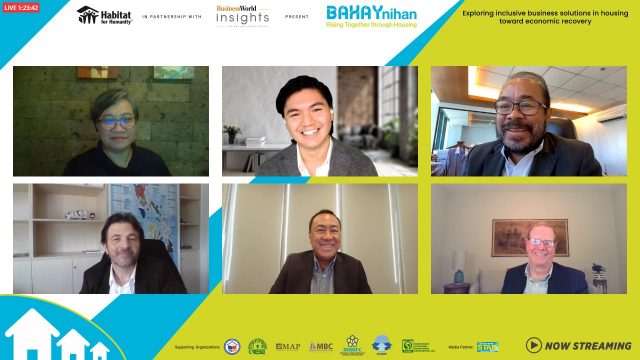
The increasing need to reinforce partnerships between the public and private sectors and other stakeholders and the critical role of the business sector in addressing the country’s housing gap was stressed in the recent BAHAYnihan: Rising Together through Housing, an online forum held by Habitat for Humanity, in partnership with BusinessWorld Insights last June 16.

The online forum on housing gathered representatives from the developer, building material provider, public, and non-government fronts to discuss the solutions to the housing gap and the next steps in moving forward. The event also explored how businesses can benefit and at the same time, contribute to the country’s economic recovery through the US$61B market value opportunity from the socialized and “unserved” housing segments.

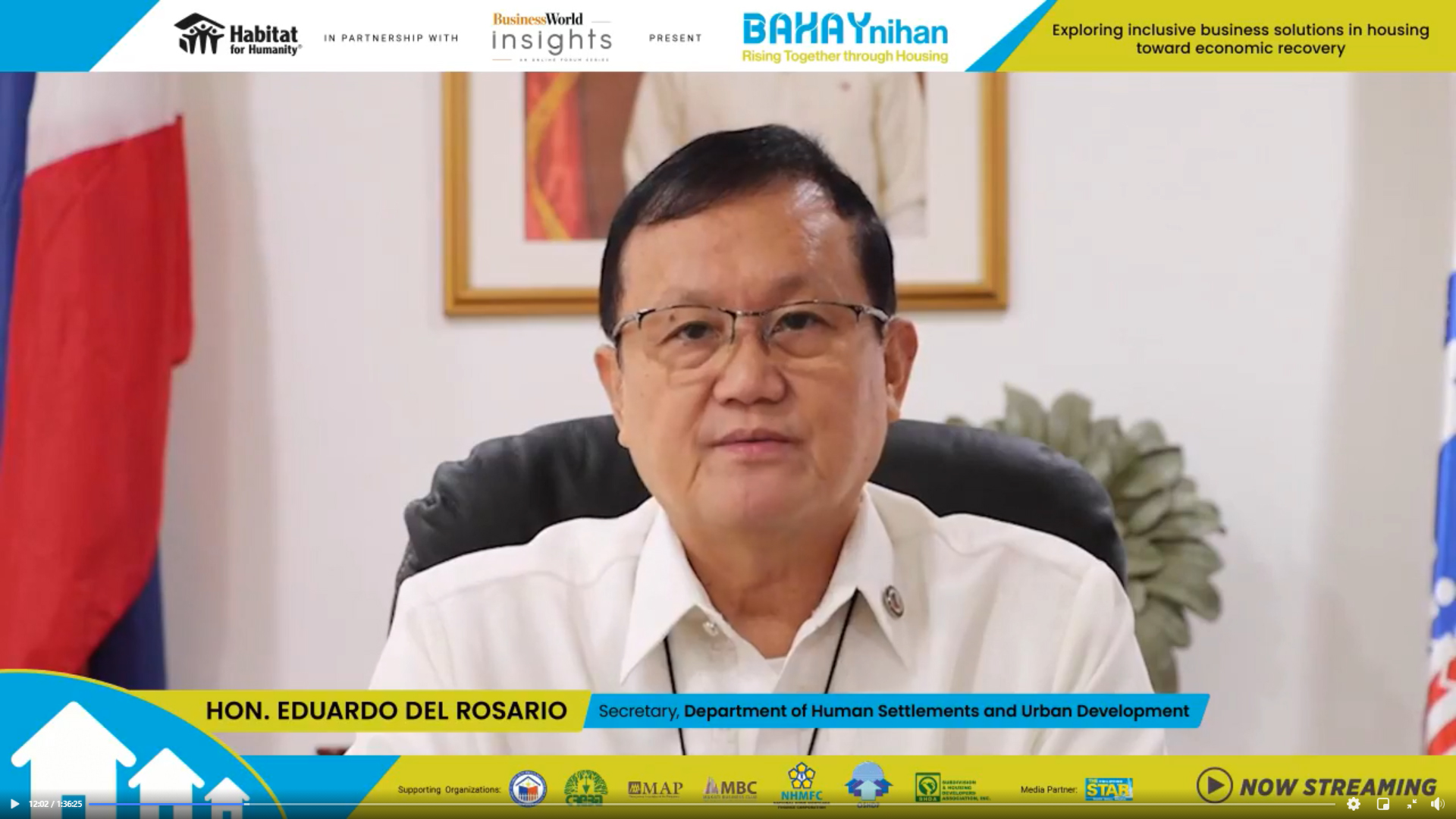
Opening the forum with his keynote, Eduardo Del Rosario, Secretary of the Department of Human Settlements and Urban Development (DHSUD), noted the public sector’s strides in addressing the housing gap.

“DHSUD, along with other agencies, has financed and produced a total of 45,731 housing units during the first three months of 2021, despite the limitations due to COVID-19 (coronavirus disease 2019),” the Secretary said. “This highlights our commitment to assist in realizing the dream of 81% of Filipino families to have a house of their own.”

Sec. Del Rosario added that the recently approved 20-year National Housing and Urban Development Sector Plan would serve as the department’s “strategic platform to synergize and further propel the systematic and overall sectoral development landscape, both in the urban and rural settings.”

Furthermore, he noted that addressing the housing gap will help boost the economy since around 80 industries get involved in constructing a single housing unit, aside from employing workforces in the housing sector.

Holistic approach

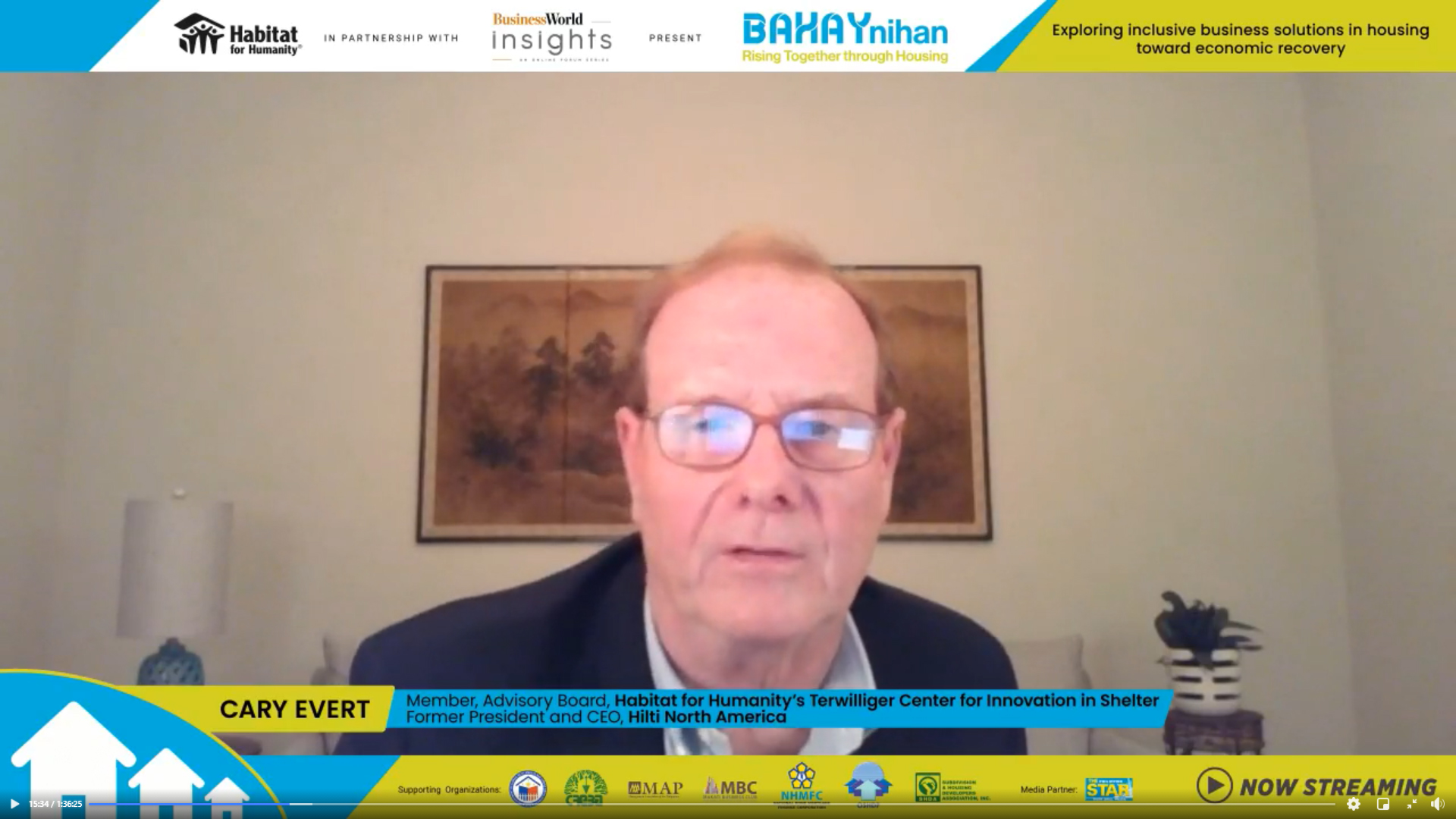
Cary Evert, a member of the advisory board at Habitat for Humanity’s Terwilliger Center for Innovation in Shelter, stressed the importance of a holistic approach to solving the housing gap.

This approach involves financial institutions providing the necessary funding, material builders ensuring resistance of homes against disasters, and other relevant sectors providing technical assistance and efficient land management.

“I gave tremendous emphasis about large developments in the Philippines and the time it takes from start to getting the buildings built. The other issue is all the incremental building that’s going on. You have someone who has this piece of land, has some sort of structure and continues to want to build. So how do you make it easier for them?” Evert added.

Horia Adrian, president and CEO of Holcim Philippines, Inc., emphasized that building materials providers like them play a crucial role in making innovative, affordable solutions more accessible to fast-track house construction at scale.

“Looking at the specifiers, designers, architects of affordable housing, there must be an open mind to embrace new construction solutions and methods,” Mr. Adrian said, emphasizing that new building solutions are among the four core elements of affordable housing, together with microfinancing solutions, technical support, and distribution solutions that bring products available to lower- to middle-income people.

Stakeholder roles

Meanwhile, Noel Cariño, president of the Chamber of Real Estate & Builders’ Associations, Inc. (CREBA), stressed that partners should agree on whether the housing infrastructures currently in place are relevant in addressing the country’s housing deficiencies.

How affordable is “affordable housing” should also be determined, he added, noting that while the informal sector population has grown, housing production has not increased. “Those are the things I think we should take a look at and see where legislation and where other interventions can come into place,” he said.

Mr. Cariño also noted that the current permitting process hampers the closing of the housing gap. “Development permits need to be secured even from the barangay level all the way to the local council level up to the local government unit (LGU) head before it is acted on by other agencies,” he explained.

CREBA, he continued, is thus pushing for the immediate transfer of this power to issue development permits and other requirements for residential subdivisions and vertical developments from the LGUs back to the DHSUD through its regional Housing One-Stop Processing Centers.

Jose Soberano III, chairman, and CEO of Cebu Landmasters, Inc., shared that an opportunity lies for developers to cater to the unserved housing market, mainly what is considered the owner-driven construction segment, or those who build their homes incrementally.

“I’d really like to see that particular segment addressed because when you talk about affordable housing, we’re still falling a lot short. We need more developers [meeting that market]; we need more action,” he said.

Moreover, Mr. Soberano highlighted that developers like them are responsible for addressing the housing gap as this will pave the way to eradicating poverty in the country. Nonetheless, for him, developers should not participate solely for the sake of compliance.

“It should be more of what it could extend in terms of help and lending its expertise in development: concept planning, coming up with the best fit, [and] providing conveniences,” he explained, adding that giving fiscal incentives and tax benefits to developers can further interest on their part to support housing initiatives.

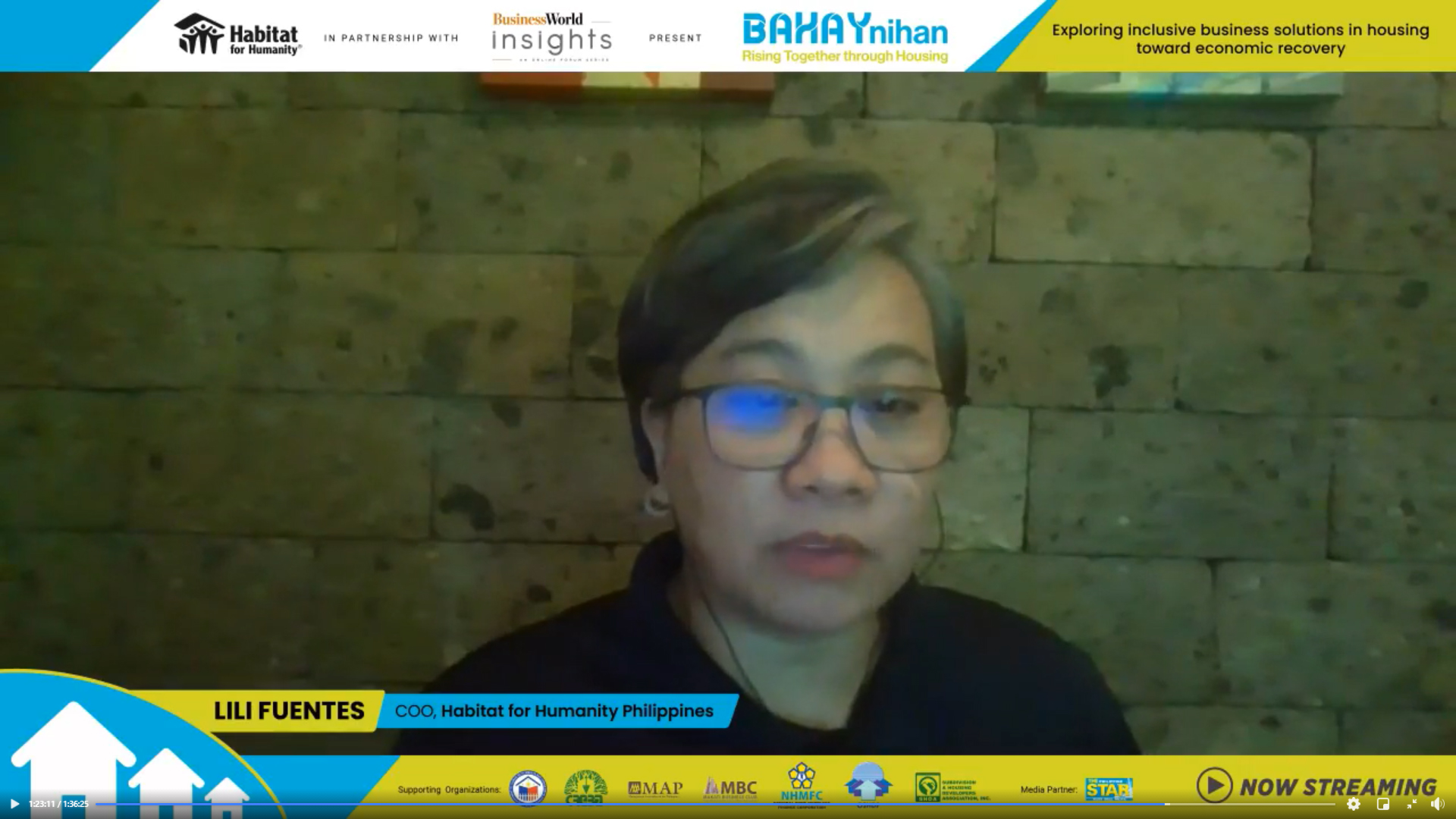
In her remarks, Habitat for Humanity Philippines COO Lili Fuentes also called on the private sector for more robust support and collaboration with Habitat for Humanity, other organizations, local government units, and key shelter agencies to respond and help address housing issues in the country through innovative, scalable, and sustainable solutions.

“Now, more than ever, the private sector should invest more in affordable housing and expand [their] services to the housing sector because it fuels economic development, supports other industries, and, most importantly, helps family break free from poverty,” she said.

Learn more about the work of Habitat for Humanity in the Philippines and how you can support their advocacy by visiting www.habitat.org.ph and https://www.habitat.org/our-work/terwilliger-center-innovation-in-shelter.

Residential property prices slump in Q1

RESIDENTIAL PROPERTY prices slumped anew in the first quarter, mainly due to a double-digit decline in prices of condominium units and duplexes in the Philippine capital as demand remained muted due to the pandemic.

Data from the Bangko Sentral ng Pilipinas (BSP) showed the Residential Real Estate Price Index (RREPI) was down by 4.2% year on year in the January to March period, the steepest decline since the data series started in 2016. Nationwide home prices also shrank by 1.6% quarter on quarter due to “subdued demand” for residential properties as the pandemic continued.

The index looks into the average change in home prices across building types and locations, providing the BSP insights into the property market where bank exposure is regulated.

Subdued demand for residential properties drags housing index in Q1 (2021)

“The negative year-on-year growth in nationwide residential property prices was driven mainly by the downtrend of property prices in the NCR (National Capital Region), which fell by 10% relative to Q1 2020, marking three consecutive quarters of declines since Q3 2020,” the BSP said.

Condominium unit prices nationwide dropped by 10.7% in the January to March period, a reversal from the 23.6% jump during the same period in 2020. This was also the biggest price drop since the -15% in the third quarter last year.

Duplex homes also saw prices fall by 20.7%, the biggest contraction since 2016.

Meanwhile, prices of townhouses and single detached/attached homes picked up by 8.3% and 0.2%, respectively.

In Metro Manila, home prices slid 10% in the first quarter, dragged by the 12.8% decline in condo units. On the other hand, prices of duplex homes rose by 39.2% as well as single detached/attached houses by 12.4%, and townhomes by 5.8%.

Outside the capital, residential property prices inched up by 0.8% as prices of condominium units (4.2%) and townhomes (9.6%) jumped. Duplex homes (-27.9%) and single detached/attached houses (-0.5%) in the provinces saw lower prices in the first three months of the year.

LACKLUSTER DEMAND
Ongoing coronavirus curbs and reimposition of lockdowns continued to dampen demand for new homes.

First-quarter residential home loans declined by 14.7% year on year and by 32% compared with the fourth quarter of 2020.

More than half (52%) of the borrowings were used to buy condominium units, followed by single detached/attached houses (38.6%) and townhouses (8.1%).

“The latest decline in RREPI may still reflect the downward correction in real estate prices largely brought about by the pandemic that reduced economic activities, including the demand for residential real estate,” Rizal Commercial Banking Corp. Chief Economist Michael L. Ricafort said in a text message. 

Mr. Ricafort said the lower home prices were due to the decrease in demand, particularly for condominium units.

The higher unemployment rate, as well as the ongoing repatriation of overseas Filipino workers, reduced demand for residential properties.

Philippine Statistics Authority data showed the unemployment rate stood at 7.1% in March, which translated into 3.44 million jobless Filipinos.

The BSP said earlier this month that it will release a commercial property price index within the year. — Luz Wendy T. Noble

Philippine shipping firms planning Asian operations

BW FILE PHOTO

By Arjay L. Balinbin, Senior Reporter

SOME SHIPOWNERS in the Philippines are considering expanding their operations to Asian destinations, a move seen to augment capacity amid a global shortage in containers and vessels, a Maritime Industry Authority (MARINA) official said.

MARINA has “granted consent” for bareboat chartering by Iris Logistics, Inc. and PNX-Chelsea Shipping Corp., the agency’s Deputy Administrator for Operations Nanette V. Dinopol told BusinessWorld in a phone interview.

The two domestic shipping companies can already “engage in regional operation,” she said.

“I heard that there are other shipowners who are interested, so we are still waiting for them to file their applications. For now, there are only two vessels.”

Ms. Dinopol noted that MARINA does not have an existing policy on bareboat chartering for now. “We already drafted the policy, which will be discussed next week, and we are hoping to submit this to the board for approval by July or within this month. This is to support our domestic shipowners to expand their operation in the ASEAN (Association of Southeast Asian Nations) region.”

She said the consent granted to Iris Logistics and PNX-Chelsea Shipping is valid for only one year.

Citing the agency’s Memorandum Circular No. 2020-01, the official noted that MARINA is also issuing special permits for the temporary utilization of Philippine-registered domestic ships in the Brunei Darussalam-Indonesia-Malaysia-Philippines East ASEAN Growth Area (BIMP-EAGA) routes.

The permit is also valid for one year, but MARINA is currently studying an extension of up to three years, Ms. Dinopol said. “We found out now that we need to amend or review that memorandum circular to allow domestic shipowners to expand their operations in the region.”

The shipping industry is currently facing a global shortage of containers amid the pandemic. This has pushed freight rates higher and caused delays in shipments of goods all over the world. In a phone interview on Monday, Philippine Exporters Confederation, Inc. (Philexport) President Sergio R. Ortiz-Luis, Jr. said the scarcity of container and vessel space is a “serious” problem that requires immediate solutions.

“Some partial remedies are being looked at, like we have domestic ships that can be granted a license so they can at least go to regional destinations. I hope that can be addressed. Chartering is also an option for ships that are not in service,” he said.

As demand for sea cargo surged, rich countries have “a monopoly on ships, as they are able and willing to pay even double in range,” Mr. Ortiz-Luis pointed out.

“It’s the availability of ships which affect importers and exporters, so you can expect that if this does not ease up, it could become a big problem,” he explained.

For Mr. Ortiz-Luis, the worst-case scenarios would mean “Christmas without imported goods, unmet targets, and delayed recovery.”

Ngayon marami nang exporters that are stopping their orders from their suppliers like farmers. This is a big problem,” he said.

Philexport trustee for the textile sector Robert M. Young said recently the garment industry has been experiencing shipping delays due to unavailability of vessels.

The industry group said payments are withheld from vendors unable to transport the finished goods, creating cash flow issues. The delays were estimated at between two weeks and nearly two months

Furniture exporters have also asked their association, the Chamber of Furniture Industries of the Philippines, to help them find slots on vessels as freight rates surge.

Some exporters that are able to get vessels are finding it difficult to pay the “high” charges, Mr. Ortiz-Luis said.

Ang shipping costs nag-i-increase four times, five times. Ang isang hinihingi namin ngayon ay emergency fund para pahiraminyung mga nagbo-book, kasi otherwise, nakakuha nga ng boat, wala namang pambayad sa plete, maski advance man lang.”

MARINA said in a statement on Tuesday that “even prior to the pandemic, the Philippine shipping industry was already facing issues of high freight rates and other shipping charges such as container deposits, demurrage and detention charges.”

Shipping industry officials who requested not to be identified told BusinessWorld last month that freight rates were still above pre-pandemic levels of about $2,000 per box for long-haul routes like Europe and the US.

They said there is now a downtrend in freight rates and do not expect freight rates to return to pre-pandemic levels in the foreseeable future “due to trade-related pressure coming from China,” which is still the world’s manufacturing center.

“The growth of the volume from China has been very dramatic. The stores in America and Europe are now restocking and therefore cargo has moved without let up. The Philippines imports a lot from China and (goods from there are) now 60% to 70% of cargo coming to major ports in the country,” one of the officials said.

PHL to submit first report to FATF in September

REUTERS

By Luz Wendy T. Noble, Reporter

THE PHILIPPINES is hoping it will be able to convince the Financial Action Task Force (FATF) that it is effectively implementing laws against money laundering and counter-terrorism financing in order to avoid possible countermeasures as a result of its inclusion in the latter’s “gray list.”

Anti-Money Laundering Council (AMLC) Executive Director Mel Georgie B. Racela said the Philippines will be submitting its first progress report to the FATF in September. The Philippines is being required to submit progress reports thrice a year.

“The reports will contain the Philippines’ progress in implementing the International Co-operation Review Group (ICRG) action plans, which are to be addressed within the timelines given. These progress reports will be submitted every January, May, and September,” he said in a Viber message on Saturday.

“Adopting compliant laws and regulations is not sufficient. The country would need time to implement them to demonstrate effectiveness [of anti-money laundering and counter-terrorism financing measures],” Mr. Racela added.

The FATF on Friday added the Philippines to a gray list or jurisdictions that will be subjected to increased monitoring to ensure progress is done in implementing stricter anti-money laundering and counter-terrorist financing (AML/CTF) rules.

“When the FATF places a jurisdiction under increased monitoring, it means the country has committed to resolve swiftly the identified strategic deficiencies within agreed timeframes and is subject to increased monitoring,” the Paris-based global “dirty money” watchdog said in a statement. 

Mr. Racela said the country is given a timeline to address the points included in the FATF’s action plan, which are confidential, within 12 to 18 months.

“But since we will be reporting three times a year, we can always invoke effective implementation once we are ready,” the AMLC official said.

In particular, the FATF will assess the effectivity of the supervision of new covered persons including real estate developers and operators; use of controls to mitigate risks from casino junkers or travels for prominent players; regulations for money service businesses; and ensure accuracy of beneficial ownership information and its availability to law enforcement agencies, among others.

The country’s handling of counter-terrorism financing cases in terms of identification, investigation, and prosecution will also be monitored. The Philippines will also have to monitor nonprofit sector activities to ensure they operate within framework against terrorism and proliferation financing.

While the Philippines is now under the gray list, the AMLC said it will not yet be subjected to countermeasures from the FATF. “It is only when the country fails to meet the deadlines will the FATF call on countries to impose countermeasures against the Philippines,” AMLC said on Saturday.

The Philippines was blacklisted by the FATF in 2000 due to its failure to address money laundering issues. This led to the passage of Republic Act 9160 or the Anti-Money Laundering Act (AMLA) in 2001, as well as the subsequent amendment of the same law in 2003. The Philippines was removed from the FATF’s blacklist in February 2005.

Sen. Grace S. Poe-Llamanzares, who chairs the Committee on Banks and Financial Intermediaries, said the action plans identified by the FATF do not necessitate further action from Congress.

“What remains are issues centered on implementation which are operational in nature… We trust that the AMLC and other agencies can resolve the remaining deficiencies within the FATF deadlines so that we can soon get out of the gray list,” she said via Viber.

Quirino Rep. and House Committee on Banks and Financial Intermediaries Chairperson Junie E. Cua noted they have already integrated FATF recommendations such as including tax evasion cases above P25 million as a predicate crime and adding real estate brokers and developers as covered persons under Republic Act 11521.

“The latest measure that we need to pass is allowing the BSP to look into bank accounts of bank officials, directors, executives, and employees, and related persons if there’s sufficient ground to believe that fraud is committed, subject to the approval of the Monetary Board. That will contribute to that issue [on beneficial ownership], but it’s not part of the original recommendations,” he said in a phone call.

Mr. Cua authored House Bill 8991, which is still pending at the committee level.

The Philippines’ gray-listing puts more pressure on the government to ramp up its fight against money laundering and counter-terrorist financing.

“It puts pressure on the government to take action on our laws, particularly, to relax the bank secrecy law. Unless proper measures are implemented, the country may become a haven for money launderers,” Colegio de San Juan de Letran Graduate School Dean Emmanuel J. Lopez said in a Viber message.

A joint assessment report by the International Monetary Fund and the World Bank in April flagged the country’s strict bank secrecy law.

Meanwhile, industry stakeholders are hopeful that the government will be able to show sufficient progress for the country to be able to exit the gray list.

The Bankers Association of the Philippines said it is optimistic that the Philippines will be taken off the gray list “in due time.”

“I am hopeful that all government agencies involved will deliver expected outputs on the action plans pertaining to them, so that countermeasures will not be imposed on the Philippines. The government should ensure that they meet the deadlines,” Chamber of Thrift Banks Executive Director Suzanne I. Felix said in an e-mail on Sunday.

To recall, Republic Act 11521 which tightened the country’s anti-money laundering law was legislated into law by Jan. 29, only days ahead of the Feb. 1 deadline set by the FATF for the country to show tangible progress that it has imposed tighter AML/CTF.

Meanwhile, Republic Act 11479 or the controversial Anti-Terror Act of 2020 was legislated to boost measures against terrorism and proliferation financing in July last year.

The AMLC in May reported that suspicious transaction reports could hit 1.2 million in 2021 and 1.8 million by 2022. Suspicious transaction reports submitted by covered institutions reached 1.01 million in 2020, higher by 63% from a year earlier.

SEC may require submission of corporate governance reports

PUBLIC COMPANIES and registered issuers will soon be required to submit corporate governance reports annually to the Securities and Exchange Commission (SEC).

“The SEC will soon require public companies and registered issuers to submit an Annual Corporate Governance Report (ACGR), as part of efforts to develop a strong corporate governance culture in the country,” the commission said in a statement.

Public companies are those with at least P50 million in assets and have 200 or more stockholders owning at least 100 shares each of equity securities.

Meanwhile, registered issuers are those that issue proprietary and/or nonproprietary shares or certificates, equity securities not listed but are offered to the public, and registered debt securities offered to the public, whether or not listed in an exchange.

The corporate regulator drafted an SEC form for ACGR for public companies and registered users. Reporting will be done through a “comply or explain” approach in accordance with SEC Memorandum Circular (MC) No. 24, series of 2019 or the Code of Corporate Governance and SEC MC No. 19, Series of 2020.

The Code of Corporate Governance puts forward governance responsibilities, disclosure and transparency, Corporate Go control and risk management frameworks, cultivating a synergic relationship with shareholders/members, and duties to stakeholders.

Companies are not required to adopt these principles, instead they are given the “flexibility” in creating corporate governance practices. However, they must state in their reports whether they are compliant with the Code’s provisions and identify areas where they are noncompliant and explain why.

Under the draft rules, ACGRs will cover information from January to December of a given year, regardless of registration date.

Submission of an ACGR will be required on or before May 30 for as long as these companies qualify as public companies or registered users. Newly registered firms should also submit their Manual on Corporate Governance with the commission.

Three copies must be submitted to the SEC main office or the nearest extension office, one of which should be notarized and include the original and manual signatures of the company’s officers. Firms will be fined P5,000 and a monthly penalty of P500 for incomplete or incorrect signatories.

Once the draft circular is approved, these firms may submit their reports covering the January-to-December period of 2021 on or before May 30, 2022. Late submissions and noncompliance may lead to a P20,000 penalty fee and a monthly fee worth P2,000.

Publicly listed companies and registered issuers that are already listed on the Philippine Stock Exchange are exempt from the new guidelines as they already required to submit their ACGRs under a previous circular.

Once the new rules take effect, public companies and registered users will no longer need to submit a certificate of compliance with the Manual of Corporate Governance, as well as a certificate of attendance of directors in board meetings. — K.C.G.Valmonte

Philex to extend Padcal mine’s life for two years

PHILEX MINING Corp. will extend the lifespan of its Padcal mine in Benguet province until 2024 as the listed mining company seeks to optimize the mineral resources in the area, its top official said.

“Padcal will be extending its mine life beyond 2022 for [an] additional two years. This would mean more revenues for the government, more development for our host and neighboring communities, more employment and more benefit for shareholders and all other stakeholders,” Philex President and Chief Executive Officer Eulalio B. Austin, Jr. said during the company’s annual general stockholders’ meeting on June 25.

The company will do “relentless operational and cost improvements to optimize the remaining mineral resources of the Sto. Tomas II ore body,” Mr. Austin said.

“We have completed the technical and financial studies supporting the extension of the life of Padcal for another two years. This was presented to the Philex board and was approved,” he added.

Padcal’s initial mine life was estimated up to 2014 and was originally expected to end by 2022.

According to Philex’s website, the mine has been operating since 1958 and produced copper concentrates, with gold and silver as by-products.

Meanwhile, Mr. Austin also confirmed that the mining company is still looking for financial investors for its Silangan copper and gold project in Surigao del Norte.

“If the $758-million capital investment will be a show-stopper, then a lower capital investment scenario will be recommended to expedite development of the Silangan project,” Mr. Austin said.

To recall, Philex’s Silangan project is one of the big-ticket mining projects seen to help the recovery of the Philippine economy after the issuance of Executive Order (EO) No. 130 that lifted the moratorium on new mineral deals.

The law is expected to generate P21 billion for the government’s coffers, with around 100 mining projects in the pipeline.

In the first quarter, Philex posted an attributable net income of P559.57 million, more than five times higher than the P102.3 million recorded in the same period last year, on the back of higher metal prices.

Realized gold prices for the period rose 11% to $1,781 per ounce while realized copper prices rose 68% to $3.95 per pound.

Philex is one of three Philippine units of Hong Kong-based First Pacific Co. Ltd., the others being Metro Pacific Investments Corp. and PLDT, Inc.

Hastings Holdings, Inc., a unit of PLDT Beneficial Trust Fund subsidiary MediaQuest Holdings, Inc., has interest in BusinessWorld through the Philippine Star Group, which it controls. — Revin Mikhael D. Ochave

8990 Holdings set to launch new project in Cubao

8990 Holdings, Inc. plans to launch a 45-storey project by the second half of the year, which will be located along EDSA southbound corner Mayor Ignacio Santos Diaz St.

It cited this year’s first-quarter sales for its optimism to further build residential units. The company already broke ground for Urban Deca Tower Cubao in February last year.

“This is definitely a positive sign that many Filipino families are still looking at a better future and this inspires us to continue building communities that offer quality living at highly affordable prices,” 8990 Holdings Chairman Mariano D. Martinez, Jr. said in a statement on Sunday.

With a sales value of around P10.4 billion, the project will feature 4,961 studio units. These will be priced at about P1.9 million each, with the company offering buyers affordable payment schemes.

The development will also include a 2,859 square-meter commercial space. It will also be located near the MRT-3 Cubao station, making the central business districts of Makati, Bonifacio Global City, and Ortigas center accessible.

Urban Deca’s sales launch is an “indicator” of the company’s optimistic outlook for the year.

8990 Holdings reported an 18% net-income growth to P1.56 billion from P1.32 billion in the January-to-March period, while consolidated revenues improved by 29% to P4.48 billion from P3.47 billion.

Luzon had the biggest revenue contribution at P2.6 billion, followed by Visayas with P958.5 million, and trailed by Mindanao at P878.3 million.

The company also said it saw a three-percent hike in units sold in the first quarter. 8990 Holdings delivered 2,634 new homes during the quarter, with 1,272 units sold in Luzon, 801 units in Visayas, and 561 units sold in Mindanao.

On Friday, shares of 8990 Holdings at the local bourse declined by 2.03% or 15 centavos to close at P7.25 each. — Keren Concepcion G. Valmonte

‘It’ bags for the pandemic and post-pandemic life

JACKIE 1961 small shoulder bag — GUCCI.COM

VOGUE did a spread on the slouchy shoulder bag a few days ago. Once called the un-PC term “hobo bag,” it had been a staple on the arms of celebrities like Paris Hilton, Britney Spears, and the Olsen twins during the big bag trend of the early 2000s. The Vogue spread praised its softness and slouchiness, as well as its double-duty utility. However, the spread ignored the basic fact of the bag’s convenience.

This reporter has used two shoulder bags of the similar shape for the pandemic’s “it” activity: grocery shopping. The bag’s shape clings close to the body, making sure that it won’t swing about, while keeping the contents usually safe, tucked as they are under the arm. One can take out hand sanitizer, a wallet, and one’s keys with a slight dip of the hand, for the bags’ openings are usually just at chest level. Finally, they give a certain chic convenience that no handbag can claim: the freedom of using both of your hands —  the very same reason why Gabrielle “Coco” Chanel invented the 2.55, though for vastly different circumstances (she needed both hands at parties).

Here are a few bags that predict a post-pandemic silhouette: one that’s pared-down, utilitarian, and keeps those hardworking and hopefully, clean hands free to fix the world.

GUCCI
We’re starting with the bag that started it all: the Gucci Jackie. The Gucci Jackie was named after former American First Lady Jacqueline Kennedy Onassis who started sporting the bag during the more bohemian years of her second marriage, although the bag was invented in 1961. Earlier canvas prototypes had been seen slung on the shoulder of writer Samuel Beckett and actor Peter Sellers. The bag’s androgynous appeal continues today, seen on the shoulder of celebrity Harry Styles.

https://www.gucci.com/us/en/pr/women/handbags/shoulder-bags-for-women/bucket-bags-for-women/jackie-1961-small-shoulder-bag-p-63670910O0G1000

HERMES
On that note, which bag did Jackie actually carry? Prior to the revival of the Jackie, zooming in on Jackie’s photos seem to reveal that her preferred summer bag was the Hermes Trim, which had a similar shape to the Gucci model, but one made with canvas and tan leather, with a similar piston lock. This one was invented in 1958 (a few years before the invention of the Gucci Jackie, then named the G1244 (according to the New York Times).

https://www.hermes.com/us/en/product/trim-31-bag-H080151CK41/

LOUIS VUITTON
Louis Vuitton’s contender for the hobo bag game could be the Neverfull, but we’re a little more inclined to the Graceful PM for its sleeker square appearance. It comes with a magnetic closure and a zipped inside pocket, and ordering from the website allows one to customize the lining to either chic beige or fun pink.

https://eu.louisvuitton.com/eng-e1/products/graceful-pm-monogram-nvprod620350v#M43700

SALVATORE FERRAGAMO
The Ferragamo Gancini bag is the best for discreet chic: the only marker that it’s worth almost $2,000 dollars is the Gancini buckle near the top, but then, part of the pleasure of owning one is knowing that only you can feel and know the value of fondling soft calfskin.

https://www.ferragamo.com/shop/us/en/women/handbags/hobos-shoulder-bags/margot-741200

LONGCHAMP
We’ll always have a soft spot in our heart for this perennial classic, the Longchamp Le Pliage. Made out of easily cleanable nylon, a long-handled model can be tucked under the arm for convenience. —  J.L. Garcia

https://www.longchamp.com/us/en/products/shoulder-bag-l-L1899089001.html

Globe says delayed projects reduced due to automation

BW FILE PHOTO

AUTOMATION through cloud-based software company Salesforce has helped Globe Telecom, Inc. reduce delayed projects to just over 1% from more than half, a company official said.

“With Salesforce, our teams are working on thousands of opportunities at a time. With the visibility and automation, we have reduced neglected initiatives from 57% to 1.8% and reduced delayed projects from 53% to 1.1%,” Peter Maquera, senior vice-president at Globe’s Enterprise Group, told BusinessWorld in a recent e-mail interview.

Salesforce works with Globe to automate the telco’s business-to-business (B2B) sales. Salesforce said Sales Cloud, Service Cloud, and Marketing Cloud are among the tools that help Globe address its challenges, especially during the pandemic crisis.

Customer complaints, according to Globe, have become easier to handle as a result of automation.

“In B2B for example, we use Salesforce Service Cloud to provide after-sales assurance on our wireline circuits. Customers can reach out to us through multiple channels such as voice, e-mail, or chat. And since the assurance managers and account managers are on the same system, they can work together to be more responsive and insightful to customers and their concerns regardless of where they are working,” Mr. Maquera said.

He noted that Globe’s enterprise customers are most concerned about a prolonged pandemic scenario and how to reinvent their business models.

“We saw and continue to experience a surge in demand for higher speeds in connectivity, home broadband, cloud, cybersecurity, and applications development, particularly for e-commerce,” he said.

“The pandemic accelerated the realization of the importance of being digital to be resilient, to be able to work from anywhere, and to continue to stay in touch and serve your customers,” he added.

With the ongoing public health crisis, business leaders now recognize the level of risk that their companies will be exposed to if they do not have a digital strategy in place, Mr. Maquera.

“Whether B2B or B2C, customers need to accelerate their efforts to become digital and build direct, trusted relationships with their customers. For so many companies in the digital economy, it is a matter of survival,” he said. — Arjay L. Balinbin

Colosseum’s visitors finally stand among the ghosts of lions and gladiators

TODSGROUP.COM/

ROME —  “The beating heart of Rome is not the marble of the Senate, it’s the sand of the Colosseum,” the Roman senator Gracchus said in the 2000 Oscar-winning movie Gladiator. The towering 2,000-year-old stone amphitheater, the biggest in the Roman empire, is Italy’s most popular tourist attraction, drawing 7.6 million visitors in 2019.

But its own beating heart, the underground passages, cages and rooms where prisoners, animals and gladiators waited to pass through trapdoors to enter the arena above their heads — itself long gone — only opened to the paying public on Friday after lengthy renovations.

More than 80 archaeologists, architects and engineers worked on the 15,000 sq meter hypogeum for two years to “bring back to the center of the attention a monument that the whole world loves,” according to Diego della Valle, chairman of Tod’s, the Italian fashion group that funded the work.

The circular balconies, long accessible to tourists, used to accommodate up to 70,000 spectators to watch gladiator fights, executions and animal hunts. The arena could also —  before the hypogeum was built —  be filled with water to re-enact sea battles. Now a new 160 meter (525 ft) walkway reveals a part of the monument that has not been accessible to visitors. It is the second part of a three-stage process that started eight years ago, with Tod’s pledging 25 million euros ($30 million) to pay for the project —  one of a number of restorations of Italian landmarks funded by luxury goods firms.

“It is … important for relevant companies to make themselves available to the country, understanding what they can do for the country,” Mr. Della Valle said. “This is about important pieces for Italy, monuments that are well-known all over the world, and tourism, which is not only entertainment but an important business in Italy which, if cared for properly, has no rival anywhere in the world.”

The first phase of the makeover, including a cleanup of the facade, was unveiled in 2016. The final phase involves renewing the galleries and the lighting system and creating a new visitor center. The project is set to be completed in about three years.

Separately, the government has decided to provide the ancient Roman landmark with new hi-tech flooring, which is expected to be in place by 2023.

Mr. Della Valle, who also helps fund Milan’s La Scala opera house, called on fellow entrepreneurs to “take a monument each, restore it, let’s be quick!” —  Reuters