Home Blog Page 7468

DoE endorses plan to import 20,000 electric cars to Board of Investments

REUTERS

THE DEPARTMENT of Energy said it has endorsed a P2.5-billion investment project that would bring in 20,000 imported electric vehicles.

The department endorsed the project to the Board of Investments (BoI). If approved, it would increase the electric vehicle fleet in the Philippines and result in the establishment of up to 5,000 electric vehicle charging stations within five years.

“When completed, the project is expected to help contribute to the reduction of as much 145.02 million liters of fuel. This is equivalent to at most a P7.99 billion reduction from fuel costs,” Energy Secretary Alfonso G. Cusi said at an electric vehicle forum Thursday.

Patrick T. Aquino, Energy Utilization Management Bureau director, said in an e-mail that the project proponent is Century Peak Energy Corp.

The BoI has not disclosed any updated investment data beyond the P2.5 billion stated in the initial project proposal.

Mr. Cusi at the virtual event said the department is looking forward to more projects that will accelerate the shift to electric vehicles.

“Our success depends on a strong public-private collaboration, and I’m confident that together we can make this happen,” he said.

He also suggested that electric vehicles could be used to transport frontline workers.

“Not only would it be a greener transport alternative in terms of zero noise and smoke emissions, but it would also pave the way for sectoral job creation that would definitely help reenergize our economy.”

Electric vehicle registrations fell 35% to 1,015 in 2020 from 1,570 in 2019, Electric Vehicle Association of the Philippines President Edmund A. Araga said at the same event.

A Philippine Institute for Development Studies (PIDS) research specialist said in July that shortcomings in electric vehicle charging infrastructure and manufacturing technology have left the Philippines behind in the regional competition for trade and investment.

The Philippines must prepare for increased investment competition in Asia as the electric vehicle value chain grows larger, PIDS Supervising Research Specialist Maureen D. Rosellon said. — Jenina P. Ibañez

Q4 2020 agriculture PPI rises by 4.1%

PHILIPPINE STAR/ MICHAEL VARCAS

THE PRODUCER price index (PPI) for agriculture rose 4.1% in the fourth quarter of 2020, according to the Philippine Statistics Authority (PSA). 

The PSA said in a report that the fourth quarter growth rate represents a turnaround from the minus 6.8% recorded in the fourth quarter of 2019. The growth rate also exceeds the 0.7% logged in the third quarter of 2020.

“This brings the Philippines’ annual average growth rate of PPI for agriculture for the year 2020 to 0%,” the PSA said.

The agriculture PPI “measures the changes in the average prices received by farmers for their produce relative to a base period,” the PPI said. The base year used in the report was 2018.

The PSA said the highest growth rate in the fourth quarter was posted by Calabarzon (Cavite, Laguna, Batangas, Rizal, and Quezon) with 22.4% while the lowest was by Eastern Visayas with minus 20.3%.  

Crops grew 2.2% during the fourth quarter, with growth rates for fruit and commercial crops at 0.9% and 0.4%, respectively.

It added that the growth rate for cereals was 3.3%, while condiments came in at 40.5%. 

The PSA said the growth rate for livestock and poultry in the fourth quarter was 20.6%, turning around from the minus 6.1% posted a year earlier.

“The uptrend in the PPI for livestock and poultry was due to the 31.7% annual increase in the index for livestock during the quarter,” the PSA said.

The growth rate for fisheries was minus 8.1% in the fourth quarter, against the 0.8% rise a year earlier.

It added that the growth rates for aquaculture and commercial fisheries for the quarter were minus 5.9% and minus 8.4%, respectively.  

“On the other hand, annual declines further accelerated during the quarter in the indices of inland municipal fishery at minus 5.4% and marine municipal fishery at minus 11.4%,” the PSA said. — Revin Mikhael D. Ochave

Customs seizes over 6,000 liters of unmarked fuel

PHILIPPINE STAR/KRIZ JOHN ROSALES

THE BUREAU of Customs (BoC) confiscated 6,357 liters of unmarked fuel earlier this month on suspicion of smuggling, the Department of Finance (DoF) said Thursday.

Citing a report from the agency, the DoF said the unmarked fuel was discovered in one of the retail gas stations of Petromobil Corp. in Arayat, Pampanga during a BoC monitoring exercise.

The BoC office in Clark issued a warrant of seizure and detention after field tests to determine the presence of a marker failed to detect sufficient quantities of the dye, which is injected into tax-compliant fuel.

Customs Commissioner Rey Leonardo B. Guerrero said the bureau conducted further field testing in other Petromobil stations around the National Capital Region, as well as in Northern and Southern Luzon.

The follow-up operations discovered uncompliant stations in Angeles City, Pampanga and several others in Rizal and Bulacan, which carried fuel with marker levels of less than 20%.

“These stations, as well as the identified fuel source is subject to ongoing surveillance,” Mr. Guerrero said.

Republic Act No. 10963 or the Tax Reform for Acceleration and Inclusion (TRAIN) law authorized the fuel marking program in a bid to curb smuggling after the law raised the excise tax rate on fuel products.

The DoF said Finance Secretary Carlos G. Dominguez III told the anti-smuggling task force to go after ocean vessels turning off their automatic identification transponders to unload fuel undetected.

The agency has boarded 50 suspected vessels that were turning off their transponders but no violations of customs or anti-smuggling laws have been recorded so far.

The government collected P289.33 billion in duties and taxes from 29.4 billion liters of marked fuel in the first two years of the fuel marking program. — Beatrice M. Laforga

Vaccine supply enough to cover minors by Oct.

ADULTS line up inside a movie house that has been turned into a vaccination site at a shopping mall in Quezon City on Sept. 23, 2021. Aside from commercial establishments such as malls, local governments have been tapping various venues and schemes for the coronavirus vaccination program, including drive-thru, house-to-house service for the elderly, and village-level delivery. — PHILIPPINE STAR/ MICHAEL VARCAS

THE PHILIPPINES’ vaccine chief is asking the national government to begin the vaccination of children aged 12 to 17 by mid-October.

Priority would be given to minors with comorbidities and children of health workers once President Rodrigo R. Duterte approves the proposal, vaccine czar Carlito G. Galvez, Jr. said at a televised Cabinet meeting on Wednesday night.

“We are experiencing saturation point in National Capital Region and other cities,” Mr. Galvez said.

He explained that demand and supply of vaccines against the coronavirus are now at meeting point, which means sectors other than the four priority groups can be opened.  

The Philippines will have enough supply of coronavirus vaccines to inoculate 12 million children aged 12 to 17, he said.

The country is struggling to vaccinate its entire adult population amid a spike in infections believed to be triggered by the highly contagious Delta coronavirus variant.

The first four priority groups cover healthcare workers, senior citizens, persons with comorbidity, and economic frontliners.

CASES
Philippine health authorities on Thursday reported 17,441 new coronavirus cases, bringing the total to 2.43 million.

The country’s coronavirus death toll rose to 37,405 after 177 more patients died, while recoveries increased by 14,090 to 2.23 million, the Department of Health (DoH) said in a bulletin.

There were 165,790 active cases, 92.1% of which were mild, 3.1% were asymptomatic, 1.5% were severe, 2.73% were moderate and 0.7% were critical.

DoH said 77 duplicates were removed from the tally, 55 of which were reclassified as recoveries. It added that 88 recoveries were reclassified as deaths. Three laboratories failed to submit data on Sept. 21

The country’s drug regulator has already allowed the vaccines developed by Pfizer, Inc. and Moderna, Inc. to be used for children as young as 12 years.

The government, however, had said that health workers, seniors, people with health complications, among other vulnerable people, would still be prioritized due to supply issues.

The Philippines has received about 65.88 million doses of coronavirus vaccines. About 19.38 million people or 25.12% of the adult population had been fully vaccinated against the coronavirus as of Sept. 22.

On Wednesday night, the country took delivery of 940,680 million doses of the Pfizer vaccine. The Philippines was set to receive 34 million vaccine doses this month. — Kyle Aristophere T. Atienza

Comelec willing to hold a week’s extension of voter registration 

PHILIPPINE STAR/ MICHAEL VARCAS

THE COMMISSION on Elections (Comelec) is amenable to a one-week extension of voter registration, which ends on Sept. 30, to be held after the Oct. 1-8 filing of certificates of candidacy, a poll body official said during a Senate hearing on Thursday.   

Election Commissioner Marlon S. Casquejo, however, said they will implement the one-month extension sought by Congess if a law is passed mandating such period.  

“If the bill will be passed as law, then we will comply,” Mr. Casquejo told the hearing.  

The Comelec en banc has previously rejected a petition for a month’s extension filed by several groups.   

Mr. Casquejo reiterated that an extension would be difficult due to other scheduled activities for election preparations and their low manpower, which are affected by the coronavirus pandemic.  

Senator María Imelda “Imee” Josefa R. Marcos, however, said a one-week extension does not constitute a “compromise” to the one-month period being sought by Congress.  

Both the Senate and the House of Representatives have filed bills to extend the voter registration to Oct. 31 from the Sept. 30 deadline, citing the need to address potential voter disenfranchisement given lockdowns and other restrictions since last year.   

The Senate version was approved Tuesday on second reading.   

“Give those under the lockdown a chance,” said Ms. Marcos. “It’s really difficult with all the long lines, there are many waiting for five hours, others six.”  

Cavite Rep. Elpidio F. Barzaga, Jr., meanwhile, said they will now seek a two-week extension for voter registration.  

NO CERTIFICATES
Meanwhile, the Comelec announced Thursday that it will temporarily suspend the issuance of voter’s certification nationwide, except at the agency’s main office in Intramuros, from Sept. 27 to 30 to focus all efforts on voter registration.    

“The Commission anticipates an influx of last-minute registrants as we get closer to the deadline, and given the limited number of field personnel, we must endeavor to make the full use of our limited manpower and resources in catering to applicant for voter registration,” Comelec Spokesperson James B. Jimenez said in a statement.   

The voter’s certification is considered a valid government-issued ID in the Philippines. — Alyssa Nicole O. Tan and Bianca Angelica D. Añago 

Meralco to resume disconnections in NCR next week

PHILSTAR

MANILA ELECTRIC Co. (Meralco) announced that it will resume disconnection activities in Metro Manila next week, but added that it will not be implementing these in areas placed under granular lockdown.

“Disconnection activities in National Capital Region (NCR) will resume with the delivery of disconnection notices for services with unpaid overdue bills next week. The disconnection notices give customers enough time to settle their bills or to reach out for assistance,” Meralco said in a statement issued on Viber Thursday.

NCR, which is now under a general community quarantine or the lowest quarantine level, began implementing targeted lockdowns with new alert level systems last week.

Meanwhile, there will be no disconnections in the provinces of Bulacan, Cavite, Laguna, Rizal, and Lucena City in Quezon until Sept. 30 as these areas were placed under the stricter modified enhanced community quarantine until the end of the month.

“We encourage customers with billing concerns to reach out, so we can assist them and even come up with payment terms if needed,” Meralco First Vice President and Chief Commercial Officer Ferdinand O. Geluz said.

Meralco’s controlling stakeholder, Beacon Electric Asset Holdings, Inc., is partly owned by PLDT, Inc. Hastings Holdings, Inc., a unit of PLDT Beneficial Trust Fund subsidiary MediaQuest Holdings, Inc., which has interest in BusinessWorld through the Philippine Star Group, which it controls. — Angelica Y. Yang

Commercial fishing continues to hurt small fishers in municipal waters — Oceana  

By Revin Mikhael D. Ochave, Reporter 

COMMERCIAL fishing in municipal waters pervades amid the coronavirus pandemic and the government should step up its monitoring and apprehension of violators to protect small fisherfolk, according to marine conservation group Oceana.   

Oceana said in a statement on Thursday that 42,934 commercial vessels were detected within municipal waters in 2020, about 4.7% lower than the 44,952 reported the previous year.    

The figures were sourced from Karagatan Patrol, a digital platform that uses Visible Infrared Imaging Radiometer Suite (VIIRS) and senses lure lights that are likely used by commercial fishing boats.    

“Palawan topped the list of provinces with 6,964 of the 44,952 in 2019 and with 6,202 detected out of the total of 42,934 in 2020. Masbate follows with 5,614 in 2019 and 5,721 in 2020,” Oceana said.    

Other areas with high number of night light detections inside municipal waters include Zamboanga City, Tongkil in Sulu, Milagros and San Pascual in Masbate, and Hadji Muhammad Ajul in Basilan.   

“Illegal commercial fishing has long been the source of misery of artisanal fisherfolk who are counted among the poorest of the poor. The municipal waters are reserved for their preferential use and access under the 1987 Constitution and Republic Act No. 10654 or the Fisheries Code as amended,” Oceana said.   

Municipal waters covers areas 15 kilometers from the shoreline.    

Data from Karagatan Patrol also indicated that 145,094 vessels using super lights were spotted in the country’s municipal waters from 2018 to 2021.    

Of the total, 37,738 were detected in Fisheries Management Areas (FMA) No. 4 which cover Antique, Guimaras, Iloilo, Negros Occidental, and Negros Oriental in the Visayas in central Philippines, and Zamboanga del Norte, Zamboanga del Sur, Zamboanga Sibugay, Zamboanga City, Isabela City, Basilan, Sulu, and Tawi-Tawi in Mindanao in the country’s south.    

For her part, Oceana Vice President Gloria Estenzo-Ramos urged the Bureau of Fisheries and Aquatic Resources (BFAR) to fully implement Fisheries Administrative Order 266 that requires the installation of vessel monitoring measures to avoid illegal behavior within the country’s water.    

“We are urging the BFAR to fully implement (the order) to deter illegal, reckless, and irresponsible behavior in our waters. The data from Karagatan Patrol only serve as leads to law enforcement agencies but tracking of the location, identification of the offenders, arrest and seizure, filing of cases in court and getting the violators penalized are facilitated if the vessel monitoring system is in place,” Ms. Ramos said.    

Meanwhile, Oceana said Karagatan Patrol now has new features such as being able to present specific data on boat detection by using maps of FMA, country’s territorial and internal waters, municipal waters, the Exclusive Economic Zone, the Kalayaan Island Group, and even the protected seascapes. 

Colmenares to run again for senator in 2022 

COLMENARES CAMPAIGN PHOTO VIA-PHILSTAR

HUMAN RIGHTS lawyer Neri J. Colmenares said Wednesday that he will be running for a Senate seat once more in the 2022 national elections. 

“I will run for the Senate seat in 2022 if only to deliver the sharpest message to the candidate of President (Rodrigo R.) Duterte,” he said in an ANC interview. 

His 2022 bid is backed by the Makabayan coalition composed of progressive party-lists, including Bayan Muna which he chairs.  

This would be Mr. Colmenares’ third attempt for a Senate seat after unsuccessful runs in the 2016 and 2019 elections.    

His platform, he said, would include pandemic response, regularization of contractual workers, and increasing the monthly pension of indigent senior citizens to P1,000, among others.    

Mr. Colmenares currently serves as chair of the National Union of Peoples Lawyers. He is also one of the convenors of opposition coalition group 1Sambayan but is now on leave due to his senatorial run.   

“1Sambayan is still discussing who they will support for the senatorial slate… If I’m chosen by 1Sambayan, I would really appreciate that,” he said in a Viber message.  

Mr. Colmenares has represented families of extrajudicial killings before the International Criminal Court and argued in the Supreme Court against the controversial Anti-Terror Law.    

He was a congressman under the Bayan Muna Party-list from 2009 to 2016. He served as senior deputy minority leader in the 16th Congress. — Russell Louis C. Ku 

Vaccinated applicants to get priority hiring in Davao City 

DAVAO CIO

JOB APPLICANTS who are fully vaccinated against coronavirus disease 2019 (COVID-19) will be prioritized for hiring by the Davao City government starting Jan. 2022, based on an order issued by the mayor.  

Executive Order 45-A, which contains the priority hiring provision, is an updated version of the directive released last week requiring all current city workers to be vaccinated or face sanctions, including termination from the job.   

The Civil Service Commission and the Department of Interior and Local Government have yet to reply to a BusinessWorld request for comment on the legality of the vaccination mandate and whether other local governments can replicate the order.   

In March this year, the Department of Labor and Employment issued an advisory for the private sector, in line with laws on labor and vaccination, that a “no vaccine, no work policy shall not be allowed.”  

The Labor department, however, emphasized in the advisory that employers must “encourage” workers to get vaccinated against COVID-19 as part of occupational safety and healthy program.   

“The unreasonable refusal of some personnel to get vaccinated should not be allowed to bring to naught the cooperation of the majority, their effort to achieve herd immunity and their right to a healthy disease-free environment,” Davao Mayor Sara Duterte-Carpio said over the city-run radio station.  

She cited that of the 20,000 city government workers — including permanent, temporary, and under contract — 12,000 have already been vaccinated without any death recorded.   

“If you are a person who feels aggrieved by the EO (executive order) because you are a city government personnel then you go to our City Legal Office,” the mayor said. — MSJ 

House bill seeks to expand sports commission fund source 

A BILL that seeks to increase the funds of the Philippine Sports Commission (PSC) to ensure adequate support for local athletes competing in international competitions was filed at the House of Representatives.  

House Deputy Speaker and Biñan City Rep. Marlyn B. Alonte filed House Bill 10270 or the proposed Sports Finance Act of 2021, which would expand sources for the National Sports Development Fund.  

New sources of funding would include proceeds from the Motor Vehicles Users’ Tax, revenues from gaming operators of online cockfighting or e-sabong, and all taxes collected from imported athletic equipment.  

The National Sports Development Fund currently comes from proceeds from lotto games and sale of stamps.    

“The sweepstakes have become obsolete and is now just a shadow of what it once was,” Ms. Alonte said in her explanatory note. 

The measure would also allow the PSC in coordination with the Department of Budget and Management and the National Economic and Development Authority to explore, negotiate, and secure foreign grants and technical assistance to augment sports funds.    

The bill comes after the historic run of the Philippine delegation at the 2020 Tokyo Olympics, including the country’s first gold medal from weightlifter Hidilyn F. Diaz.  

The House has earlier conferred the Congressional Medal of Excellence to Ms. Diaz and the Congressional Medal of Distinction to boxers NesthyA.Petecio, Carlo Paalam, and Eumir Felix D. Marcial.    

A House bill was also filed on Aug. 26 to establish an Olympian Museum at the New Clark City Sports Complex in Capas, Tarlac, which would be the official public venue for all Olympian records and other memorabilia. — Russell Louis C. Ku 

Fishers to raise DENR dismantling order in global food system summit  

PHILIPPINE STAR/ MICHAEL VARCAS

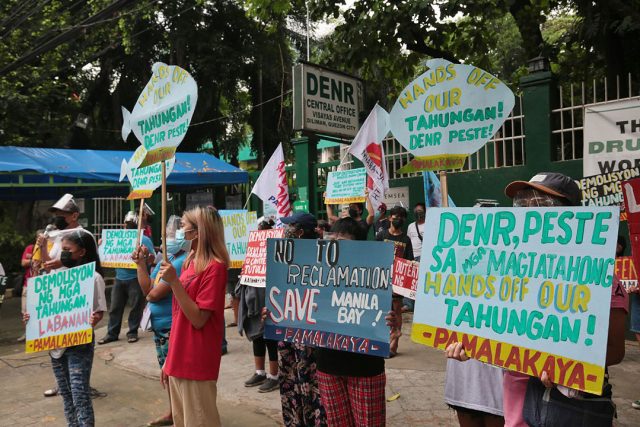
FISHERFOLK and civil society organizations seek to raise the dismantling order of the Department of Environment and Natural Resources (DENR) at the Global People’s Summit on Food Systems.    

Ronnel Arambulo, Pambansang Lakas ng Kilusang Mamamalakaya ng Pilipinas (PAMALAKAYA) spokesman, said the government is destroying the livelihood of the poor sectors with its plan to dismantle fisheries structures situated along the Cavite shore of Manila Bay.    

The Global People’s Summit on Food Systems is an initiative to counter the United Nations Food Systems Summit in New York City held on Sept. 23.    

“The DENR order to dismantle fisheries structures in Cavite should be the kind of policy the United Nations should stop. The fisherfolk and urban poor families are suffering because of the lockdown, and declining household incomes, but the Duterte government is hell-bent in destroying sources of food and livelihood,” Mr. Arambulo said in a statement on Thursday.    

According to PAMALAKAYA, international groups also showed their support to stop the dismantling of the fisheries structures such as Andhra Pradesh Vyavsaya Vruthidarula Union (APVVU), Southeast Asia Sub-Region of the Civil Society and Indigenous Peoples’ Mechanisms (CSM) for Relations with the United Nations Committee on World Food Security (CFS) and International Women’s Alliance.   

The group also disclosed that lawmakers under the Makabayan bloc are set to file a house resolution to check the justification of the DENR’s dismantling order.    

Anakpawis Party-list National President Ariel B. Casilao said the DENR order is a clearing operation for reclamation projects, and urged fisherfolk communities in Manila Bay to unite since it will displace their sources of livelihood.    

“Instead of genuinely cleaning up the waters of Manila Bay, the DENR is busy coordinating with the local government unit to displace more fisherfolk and urban poor families relying on fisheries as livelihood,” Mr. Casilao said.    

The dismantling of fishing structures in Cavite will take place on Sept. 25.    

DENR previously said that the dismantling will be conducted as part of the rehabilitation efforts in Manila Bay and will not cover any mussel farms operating legally. — Revin Mikhael D. Ochave   

Opportunity loss from corruption

Two days ago, this broadsheet reported on Socioeconomic Planning Secretary Karl Chua’s estimate of the total economic cost of the coronavirus pandemic and lockdowns. The National Economic and Development Authority (NEDA) cited a total cost of P41.4 trillion representing foregone growth drivers such as consumption, private investment, and human capital investment for 2020 and the next 40 years at net present value.

Without the pandemic and economic lockdowns, the NEDA report shows what could have happened to the Philippine economy. Instead of gross domestic product (GDP) of P19.5 trillion in 2019 contracting to P17.9 trillion in 2020, it could have grown to P21.4 trillion. With economic scars, the 40-year opportunity cost combined would be equivalent to almost two years of output.

With foregone opportunities, NEDA believes that “it may take 10 years to catch up to pre-COVID-19 trajectory” in terms of financial investments.

Corruption is another source of missed opportunities. This is more sinister because it is committed by those in authority, whether elected or appointed, and most probably supported by those around them.

A pioneering study by Paolo Mauro (“The Effects of Corruption on Growth, Investment, and Government Expenditure”) of the IMF in 1997, nearly a quarter of a century ago, attempted to pin down the reality of public sector corruption.

Mauro argued the obvious, that we should worry about corruption. He traced the seminal research on corruption all the way to the 1960s when economists preferred to call it “rent seeking.” Mauro concluded that quantifying the extent of corruption and putting value to it was rather difficult. Corruption is done in secret unless exposed by those with authority to audit relevant transactions.

Joint annual meetings of the IMF and the World Bank in the 1990s invariably harped on governance and corruption, calling it a “cancer” that must be excised. The only available metrics of corruption were those supplied by private rating agencies based on the responses of locally consultants. No one could fault the results for being subjective because there was hardly any other option.

The context of corruption is very interesting.

Mauro explained, in the Fund’s simplified version, that “since much public corruption can be traced to government intervention in the economy, policies aimed at liberalization, stabilization, deregulation and privatization can sharply reduce the opportunities for rent-seeking behavior and corruption.” This fundamental cause resonates even in the Philippines today when reported cases of corruption involved official interventions that would thwart the tenets of competition and liberal markets.

Liberalized importation of rice, for instance, made a handful of middlemen unhappy but all rice-eating Filipinos rejoiced when rice prices dropped and inflation weakened. Farmers have started to benefit from the support coming from the rice tariff collection.

Sin taxes had an impossible time in Congress because big money was involved in sin products like liquor and cigarettes. Once they were in place, taxes from this source helped promote fiscal sustainability and the Philippine economy turned the corner before the pandemic.

Corruption is indeed rent seeking because those who are bribed are policy makers who can make policies or change the regulations to suit the interests of the corrupting party. Mauro wrote that “throughout the world bureaucrats and people in authority are indefatigably maneuvering to position themselves in a tiny monopoly where they can be bribed for issuing a license, approving an expenditure or allowing a shipment across a border.”

Another good material on corruption focusing on the Philippines is the article by Emmanuel S. Dios and Ricardo D. Ferrer, “Corruption in the Philippines: Framework and Context” published in January 2000. The authors used Susan Rose-Ackerman’s (“Corruption and Development,” 1998) table on types of corrupt states to show the interesting dynamics of corruption. Normally there are few bribers to a few recipients. Since there could be whistleblowers, one could spread the largesse to more recipients and produce a Mafia-dominated state.

Transaction-wise, corruption targets bids, purchases, and auctions as well as sale of policies, laws, and regulations, among others. As example, corruption in public procurement results in bid-rigging, overpricing, or even over-purchasing. Sale of public policy involves changes in ownership rules.

Like the pandemic, corruption has economic consequences. The literature contains instances when corruption could have some constructive use like incentivizing bureaucrats to perform better than without bribe. But its negative impact trumps its efficiency value.

Recipients of public spending could lose what has been earmarked for them. Due to corruption, both investment and economic growth could drop. Like a tax, corruption discourages economic activity in a sense similar to what community quarantines do to business and mobility. Unlike a tax, corruption is unpredictable and unreliable. One of the parties may not deliver on his commitment.

De Dios and Ferrer replicated Mauro’s approach and used his equations for the Philippines but with a great difference: the level of corruption is modified to mimic Singapore. This means if we are able to reduce the extent of this insidious practice, we could expect a 6.6 percentage point increase in the ratio of investment to GDP and a 1.65% increase in annual per capita GDP growth at that point in the past.

In addition, revenues could drop and spending could get bloated resulting in unsustainable fiscal deficits. Under-provisioning of public goods and over-provisioning of something unwanted, or unnecessary, happen.

How does the Philippines compare with other countries in terms of Transparency International’s Corruption Perception Index?

Based on the table compiled by TAKE-PROFIT.ORG, in the last five presidencies, only President Fidel V. Ramos and President Benigno Aquino III managed to increase their scores from the year they started their administration to the end of their terms.

For the year 2020, of the 180 countries assessed, the Philippines scored 34 points that brought it to 115th place. In the ASEAN, those which rated higher include Singapore, Brunei, Malaysia, Indonesia, Thailand, and Vietnam. The Philippines was specially mentioned with these remarks: “with a score of 34, efforts to control corruption in the Philippines appear mostly stagnant since 2012. The government’s response to COVID-19 has been characterized by abusive enforcement, and major violations of human rights and media freedom.”

We recall that in August 2019, before the pandemic, Deputy Ombudsman Cyril Ramos reported his personal calculation that the Philippine government lost around P1.4 trillion in the previous two years, or P700 billion a year, because of corruption. This was about 20% of the annual budget of the Philippine government.

This were estimated as the equivalent of 1.4 million housing for the poor, medical assistance for around 7 million Filipinos, or a rice buffer stock for over a year.

From another angle, somebody estimated that a kilometer of road, 11-meters wide or two-lanes on each side, would cost around P100 million. This means we could have additional 7,000 kilometers of road — that is all the way from Ilocos Norte to Bicol, seven times. Many years ago, the Department of Education estimated an average of about P1 million per classroom in the public school, although Senator Frank Drilon challenged this amount. Without corruption, we would have at least 700,000 classrooms more.

Today, the anomaly in the Pharmally transactions with the Procurement Service-Department of Budget and Management could also involve corruption. Public documents from the Securities and Exchange Commission prove Pharmally is undercapitalized but it managed to win billions worth of contracts. Its deliveries were certified even without inspection. Its pricing was not exactly competitive. Rent seeking was clearly present. With a level playing field, the government would not have to pay more than necessary. Lost from these transactions that produced luxury cars, among others, were more kilometers of road, more classrooms, more medical assistance, or more rice buffer stock for our people. Obviously, following Rose-Ackerman scheme, the pandemic crisis presented an opportunity for corruption.


Diwa C. Guinigundo is the former Deputy Governor for the Monetary and Economics Sector, the Bangko Sentral ng Pilipinas (BSP). He served the BSP for 41 years. In 2001-2003, he was Alternate Executive Director at the International Monetary Fund in Washington, DC. He is the senior pastor of the Fullness of Christ International Ministries in Mandaluyong.


ADVERTISEMENT
ADVERTISEMENT