Home Blog Page 7465

US FDA clears Pfizer COVID-19 booster for older and at-risk Americans
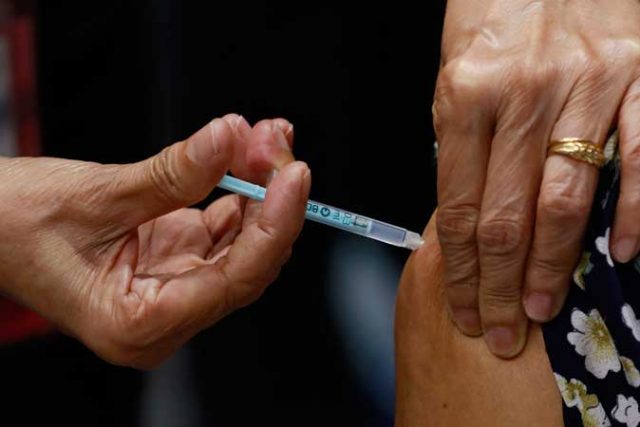
PHILIPPINE STAR/ MICHAEL VARCAS

WASHINGTON – The U.S. Food and Drug Administration on Wednesday authorized a booster dose of the Pfizer Inc and BioNTech COVID-19 vaccine for those 65 and older, all people at high risk of severe disease, and others who are regularly exposed to the virus.

The decision paves the way for a quick rollout of the booster shots as soon as this week for millions of people who had their second dose of the vaccine at least six months ago.

The change to the vaccine’s emergency use authorization will allow boosters for groups such as health-care workers, teachers and day care staff, grocery workers and those in homeless shelters or prisons, FDA acting Commissioner Janet Woodcock said in a statement.

Pfizer had asked the FDA to expand its vaccine approval to include boosters for all people aged 16 and older and presented data last week to an outside FDA panel of advisers that it said showed waning immunity over time.

The panel voted against the proposition that boosters were needed by everyone but said evidence showed they were helpful to older people and those at high risk.

Dr. William Schaffner, medical director of the National Foundation for Infectious Diseases (NFID), said the FDA’s statement was more expansive in who it included as eligible for boosters when compared to the panel’s recommendation.

“Very broad indeed, especially that ‘among others.’ That could essentially give the green light for giving boosters to a very substantial proportion of the previously vaccinated adult population,” said Schaffner, who serves as the NFID’s liaison to the Advisory Committee on Immunization Practices (ACIP) at the U.S. Centers for Disease Control and Prevention (CDC).

ACIP could vote Thursday on the use of a third shot of the vaccine, an agency official said at a public meeting of the panel on Wednesday.

“Tomorrow’s ACIP meeting at the CDC will be focused on turning this into an official recommendation for implementation,” said Dr. Amesh Adalja, senior scholar at the Johns Hopkins University Center for Health Security.

The FDA authorization was “generally in line” with the advisory panel vote, said Dr. Jesse Goodman, an infectious disease expert at Georgetown University in Washington and former chief scientist at the FDA.

“These are pretty broad categories that give a fair amount of latitude to the judgment of healthcare providers and people providing immunizations,” he added.

President Joe Biden and eight top health officials including Woodcock announced in August the government’s intention to roll out booster shots for people aged 16 and older this week, pending approval by the FDA and CDC.

But the advisory panel said there was not enough evidence to support booster shots for that population and also sought more safety data. The FDA does not have to follow the advisory panel’s recommendation, but often does.

The agency could revisit the issue for a broader authorization in the future.

“This first FDA authorization of a COVID-19 vaccine booster is a critical milestone in the ongoing fight against this disease,” said Pfizer chief Albert Bourla. The company had argued that boosters are needed for the general population.

Top FDA members have been split on the need for boosters for the general population, with Woodcock backing them while some of the agency’s senior scientists argued that current evidence does not support them.

Some countries, including Israel and Britain, have already rolled out COVID-19 booster campaigns. The United States authorized extra shots for people with compromised immune systems last month and over 2 million people have already received a third shot, CDC data showed. — Reuters


Atty. Howard Calleja talks about ethical pitfalls in handling high-profile cases on e-platform ACCESS

Atty. Howard M. Calleja, Senior Managing Partner of Calleja Peralta Jimenez San Luis Uy & Ulibas

There is a unique degree of caution that must be observed by lawyers when taking on high-profile cases. This is so that justice is served and that fairness is upheld even when a case goes under intense public scrutiny. A lawyer must always exercise prudence because of the possible influence in making public statements and media coverage that may result in impartiality.

Atty. Howard M. Calleja, Senior Managing Partner of Calleja Peralta Jimenez San Luis Uy & Ulibas firm, shares the ethical pitfalls and considerations when handling such cases in his course on ACCESS groundbreaking e-platform. In this popular and engaging lecture, he tackles the pertinent rules and canons under the Code of Professional Responsibility.

As one of the most respected and sought-after lawyers in the country, Atty. Calleja has handled numerous civil, criminal, commercial, and labor cases. He was instrumental in the successful defense of a large mining company, which was involved in one of the largest mining disasters in the history of the country. An expert in Family Law, he was the first in the country to be granted a Temporary Protection Order under the Anti-Violence Against Women and Their Children Act of 2004.

Atty. Calleja obtained his Juris Doctor’s Degree from the Ateneo de Manila University School of Law and his Master of Law Degree from Duke University in the US. He was then admitted in both the Philippine and the New York State Bars in 1995 and 2005, respectively. He also received a Certificate in International Law from the Hague Academy of International Law, Netherlands. Aside from leading lectures on ACCESS, he currently serves as a professor at the Ateneo de Manila University School of Law and De La Salle University College of Law. 

You can enroll in Ethical Pitfalls and Considerations in Handling High-Profile Cases, and other important MCLE courses provided by ACCESS here.


Spotlight is BusinessWorld’s sponsored section that allows advertisers to amplify their brand and connect with BusinessWorld’s audience by enabling them to publish their stories directly on the BusinessWorld Web site. For more information, send an email to online@bworldonline.com.

Join us on Viber to get more updates from BusinessWorld: https://bit.ly/3hv6bLA.

Globe, Quezon City empower students and residents with digital tools

Globe is working together with the Quezon City (QC) government in providing a suite of internet and digital solutions to support the connectivity needs of local residents and learners and keep them digitally empowered in the new normal.

The partnership includes the expansion of Globe’s GoWiFi and KonekTayo WiFi as well as the activation of Globe Labs’ SMS API, School Bus WiFi, and Load Up services in the city. These offerings are part of Globe’s efforts to provide reliable connectivity and extend educational support to students and teachers while online learning is in place.

1,000 GoWiFi access points will be deployed in several key establishments in the city–an addition to the 2,000 existing and 1,000 newly on-aired access points. These will be located in select hospitals, barangay halls, supermarkets, malls, police and fire stations, and coffee shops for wider access to QC’s E-Services hub. QCitizens can connect to GoWiFi with FREE 30 minutes daily while the QCWiFi will provide an additional daily FREE 1 hour daily. Citizens will just need to register in the QC E-Services to avail of the additional daily FREE WiFi.

QC E-Services is an online access to QC government services, making transactions contactless, easier, and faster.

SMS API by Globe Labs, the company’s innovative developer community, enables the QC Government to send OTP / SMS notifications for its ID registration program and allow electronic payments to the city’s e-services hub.

Meanwhile, KonekTayo WiFi, a fast and secure community WiFi, will be expanded to the following sites: Bistekville 4, Bistekville 15, Sitio Pingkian, Republic Residences, and Bagong Lipunan Pag-asa Condominium.

These offers are geared towards accelerating digital inclusion in the country. Globe acknowledges the need to keep Filipinos connected at a time when several basic services and economic opportunities have shifted online.

“One of the core missions of Globe is to be the leader in building the future of the digital economy in the Philippines. Our long-time partnership with Quezon City and the provision of other reliable Globe services to the city only prove that we are on the right track. We hope that through this partnership, we can contribute in closing the digital gap and help communities tide over the impacts of COVID-19,” said Janis L. Racpan, Globe Director for Business Development and Marketing, Digital Solutions Group.

Ensuring that no student gets left behind by online learning, Globe has deployed school buses equipped with special antennas that will provide internet connectivity to teachers and students from 7:00 AM to 7:00 PM. These buses will be stationed in the following barangays: Sta. Lucia (Aguinaldo Street. cor. Lakandula), Commonwealth (Nokia Street, Dona Nicasia Subdivision), Sauyo, and Pasong Tamo (Marcel Village – Himlayan Road).

Globe has also provided 176,000 data SIM cards for students and 17,582 data SIM cards for elementary school teachers in the city through Load Up, a secure web-based platform that can automatically seed internet prepaid credits to beneficiaries that are part of the Home-Based Learning Program of QC.

Quezon City Mayor Joy Belmonte expressed her appreciation for the partnership with Globe, saying, “As quickly as everything starts to become online–schooling, learning, transacting, and connecting, the local government of Quezon City is fortunate enough to be in partnership with Globe to aid our residents with solutions that can help them access the internet conveniently.”

The mayor added: “We are grateful to partake in Globe’s mission to digitally equip every city in the country.”

In its commitment to keep communities safe from online dangers and threats, Globe is also working with QC in conducting virtual workshops for parents, children, and community leaders through its Digital Thumbprint Program (DTP), which aims to deepen netizens’ knowledge on digital citizenship and cybersafety. To access the DTP e-learning modules, visit https://www.youtube.com/user/GlobeCSR/videos.

Globe supports the United Nations Sustainable Development Goals No. 9 importance of infrastructure and innovation as significant drivers of economic growth and development. Globe has pledged to advocate the 10 United Nations Global Compact principles and 10 UN SDGs.

To know more about Globe, visit www.globe.com.ph.


Spotlight is BusinessWorld’s sponsored section that allows advertisers to amplify their brand and connect with BusinessWorld’s audience by enabling them to publish their stories directly on the BusinessWorld Web site. For more information, send an email to online@bworldonline.com.

Join us on Viber to get more updates from BusinessWorld: https://bit.ly/3hv6bLA

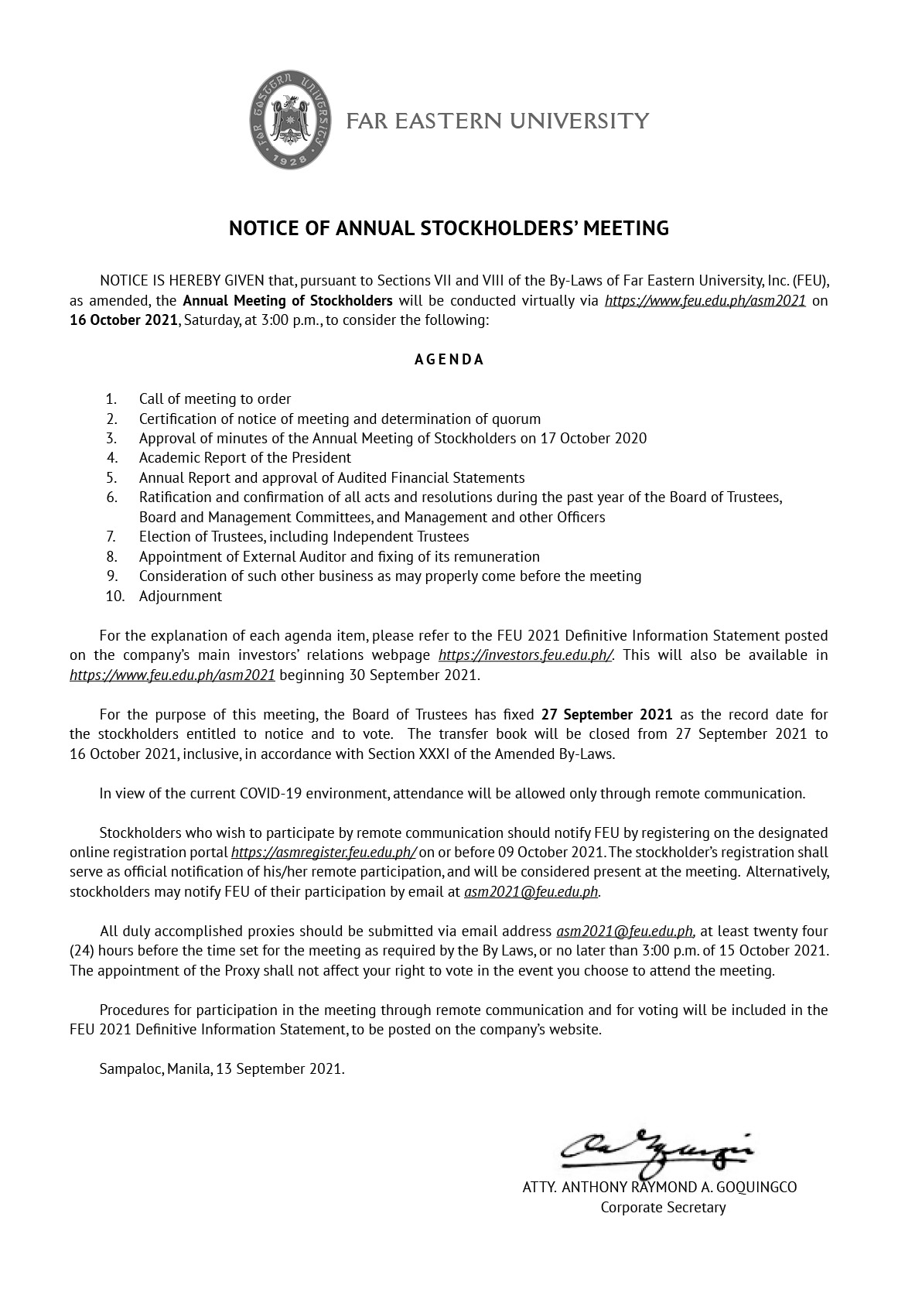
FEU to conduct virtual stockholders’ meet on October 16

The 2021 Annual Stockholders’ Meeting of Far Eastern University, Inc. (FEU) will be conducted virtually on October 16, 2021, at 3 p.m.

House OK’s tax on digital services

REUTERS

By Russell Louis C. Ku

THE HOUSE of Representatives on Tuesday evening approved a bill that would impose a 12% value-added tax (VAT) on digital transactions in the country, which would affect global tech giants such as Facebook, Inc., Netflix, Inc., and Alphabet, Inc.

Voting 167-6 with one abstention, lawmakers approved House Bill No. 7425, which amend sections of the National Internal Revenue Code of 1997, on third and final reading.

The measure would impose a 12% VAT to digital sale of services such as online advertisements, subscription services, and supply of other electronic and online services that can be delivered through the internet such as mobile applications, online marketplaces, online licensing for software, and webcasts, among others.

It would also add a new section in the National Internal Revenue Code of 1997 that would require foreign digital service providers (DSPs) to collect and remit VAT for all transactions that go through their platforms.

However, it exempts books and other printed materials sold online along with online courses and webinars by accredited private schools from the 12% VAT.

Non-resident DSPs would be required to register for VAT if gross sales for the past year from the implementation of the proposed law have exceeded P3 million.

Registered non-resident DSPs providing services to the government would pay a lower VAT at 5% under the bill.

The proposed tax, if signed into law, could generate P10.66 billion in government revenues annually based on initial estimates from the Department of Finance.

The pandemic has accelerated the adoption of e-commerce, online streaming and other digital services in the Philippines.

Filipinos are also avid users of social media, averaging four hours a day, according to Statista Research Department. As of 2020, there are an estimated 78.5 million social media users in the Philippines, and this is expected to reach 91.3 million by 2026.   

Reuters quoted a Google spokesperson as saying: “We comply with the tax laws in every country we operate in around the world including the Philippines, and will continue doing so as tax laws evolve.”

Gabriela Party-list Rep. Arlene D. Brosas voted against the approval of the measure, saying it is a tax burden that would be carried by ordinary Filipinos amid the coronavirus pandemic.

“Why do we insist on imposing these regressive tax measures when we can increase the taxes on rich families and top corporations,” she said.

Ms. Brosas along with legislators from the minority Makabayan bloc filed a bill seeking to slap a “wealth tax” of 1-3% on individuals with taxable assets of over P1 billion.

Finance Secretary Carlos G. Dominguez III said that the proposed wealth tax will drive capital out of the Philippines.

ADB maintains growth outlook for Philippines

PHILIPPINE STAR/ MICHAEL VARCAS
The Philippine economy is showing signs of recovery but faces threats from more contagious coronavirus variants, the Asian Development Bank said. — PHILIPPINE STAR/ MICHAEL VARCAS

By Beatrice M. Laforga, Reporter

THE ASIAN Development Bank (ADB) kept its Philippine growth forecast as more signs of recovery emerged, and warned that a premature withdrawal of support may threaten an already fragile recovery.

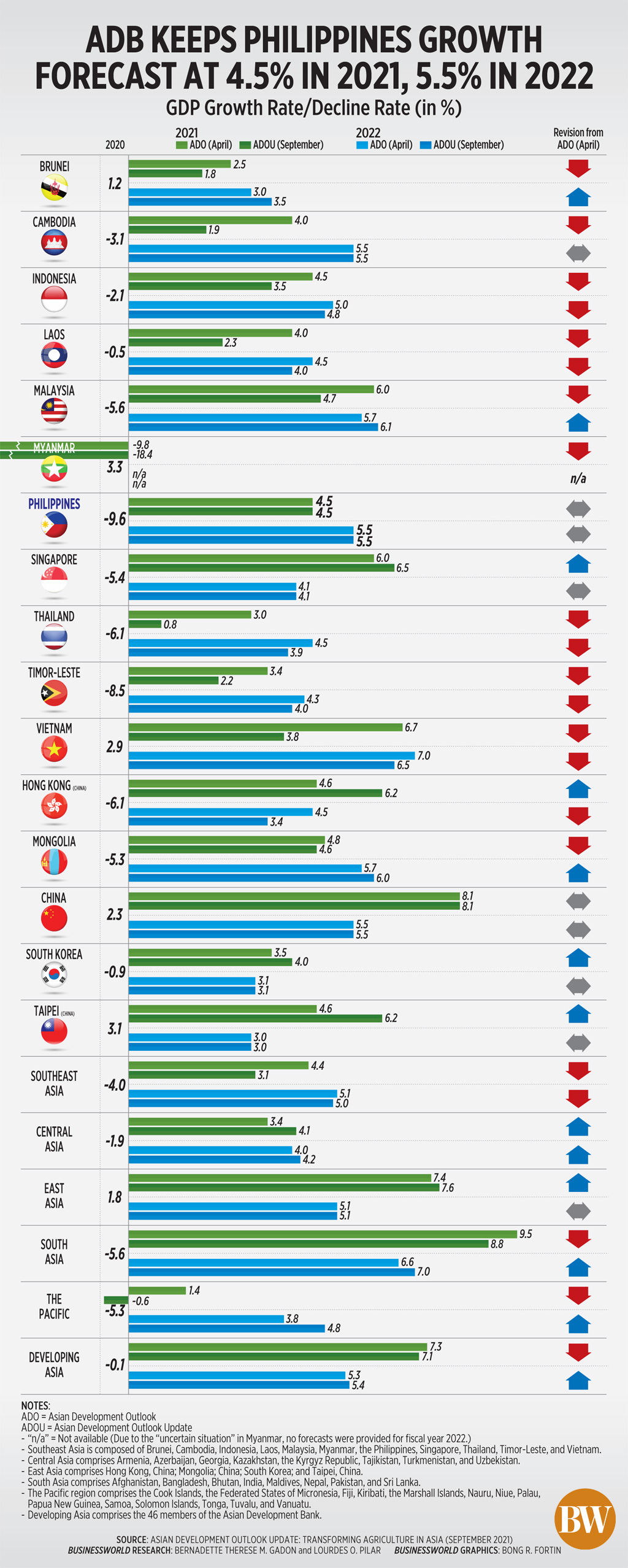
In its Asian Development Outlook (ADO) 2021 Update released on Wednesday, the multilateral bank said its gross domestic product (GDP) growth projections are maintained at 4.5% in 2021 and 5.5% in 2022.

“One of the reasons that we’re not adjusting our forecasts for the Philippines is if you look back to April, we started with a much more conservative view of how the vaccine rollout would come through as well as the removal of containment measures,” Joseph E. Zveglich, Jr., the acting chief economist of the ADB, said at a press briefing on Tuesday.

The ADB’s economic growth forecast for this year is still within the government’s already downgraded 4-5% GDP growth target. Next year’s projection, on the other hand, is well below the 7-9% growth goal set by economic managers.

“The main risk to the outlook is the spread of more contagious COVID-19 (coronavirus disease 2019) variants, leading to the reimposition of strict quarantines and stalling economic recovery,” the ADB said in the report.

The Philippines continues to see a rise in daily new COVID-19 cases, driven by more infectious new variants. As of Wednesday, the Health department reported 15,592 new infections, bringing the active cases to 162,580.

ASIA OUTLOOK
For Asia, the ADB cut its GDP outlook to 7.1% this year, lower than the 7.3% forecast given in April, reflecting the impact of the fresh outbreaks, renewed lockdowns and an uneven vaccine rollout.

“Developing Asia remains vulnerable to the COVID-19 pandemic, as new variants spark outbreaks, leading to renewed restrictions on mobility in some economies,” Mr. Zveglich said.

The ADB also downgraded its outlook for Southeast Asia to 3.1% this year from 4.4% previously, after cutting projections for Indonesia, Malaysia, Thailand and Vietnam.

Its projected growth for the Philippines is likely to be the third fastest in the region, after Malaysia’s 4.7% and Singapore’s 6.5%.

However, the Philippines’ high growth projection compared with most of its neighbors is mainly due to base effects as its GDP shrank by a record 9.6% in 2020, Abdul Abiad, director of ADB’s Macroeconomic Research Division, said at a briefing on Tuesday.

The multilateral bank said the Philippine economy is already seeing signs of recovery following the 11.8% expansion in the second quarter on the back of higher household spending and investments.

However, the ADB noted the economic rebound “remains fragile” as the government continues to place cities and provinces, especially Metro Manila, in and out of lockdowns when local coronavirus infections rise.

The government this month adopted a new “Alert Level” system with granular lockdowns to limit the stringent restrictions in areas with high infections while allowing the rest of the economy to function.

“Given the fragile recovery, it’s actually important that support continues right, so one of the things you do want to avoid is premature withdrawal of fiscal support and monetary support when a recovery is not yet firmly entrenched,” Mr. Abiad said.

“At some point, you will need to consolidate but we’re not there yet. One needs to wait until the recovery is well underway before one discusses that,” he added.

The ADB said fiscal policy will continue to support growth. “A fiscal deficit is planned at the equivalent of 7.5% of GDP for 2022, with budget expenditure 11.5% higher than in 2021 with larger outlays for infrastructure and social programs,” it said.

Across developing Asia, governments will likely remain supportive of economic recovery before a general shift toward fiscal consolidation starts in 2022.

Mr. Abiad said continued adoption of tax reforms, including raising taxes, is a possible approach the government can take to rebuild its public finances as part of its fiscal consolidation program in the next three to six years.

“They will be helpful in… mobilizing domestic resources, strengthening the tax base and giving government more of the resources it needs to spend on priorities, including health and education and infrastructure and the like,” he said.

On the bright side, the ADB said the Philippines’ vaccination rollout has seen “good progress.”

“The government forecasts that around 80% of the target population in Metro Manila will be fully vaccinated by the end of October, which helps improve the conditions for further easing of mobility restrictions that will help restore consumer and business confidence,” it said.

Key reforms such as easing restrictions on foreign investments through amendments of the Public Service Act, the Retail Trade Liberalization Act and the Foreign Investments Act are also needed, the ADB said.

Meanwhile, the ADB maintained its inflation outlook at 4.1% this year and 3.5% next year, which are both at the higher end of the Philippine central bank’s 2-4% annual target range.

Monetary policy will also likely remain accommodative for the time being to further support the economy’s rebound since domestic demand is only recovering modestly.

ADB keeps philippines growth forecast at 4.5% in 2021, 5.5% in 2022

Retail trade measure seen to hurt MSMEs

PHILIPPINE STAR/ MICHAEL VARCAS

By Jenina P. Ibañez, Reporter

THE MEASURE that seeks to lower the minimum investment hurdle for foreign retailers to P25 million would likely bring in the competition that could damage many local small businesses, a retailers group said.

Congress approved the Bicameral Conference Committee report on the conflicting provisions of Senate Bill No. 1840 and House Bill No. 59, which amends the 20-year-old Retail Trade Liberalization Act (RTLA). It will be forwarded to Malacañang for President Rodrigo R. Duterte’s signature.

Under the reconciled version, the minimum paid-up capital requirement for foreign retailers is now set at P25 million or around $500,000, with a per store requirement of P10 million. This is lower than existing law’s minimum paid-up requirement for foreign retailers of P125 million or $2.5 million.

“With the small minimum amounts, our MSME (micro-, small-, and medium-sized enterprises), will be the most affected by foreign competition, from foreigners already in the country, and from small informal retailers from outside the country,” Philippine Retailers Association Vice-Chairman Roberto S. Claudio said in an e-mail on Wednesday.

There were 957,620 business enterprises operating in the country in 2020 of which 952,969 or 99.5% are MSMEs, according to the Philippine Statistics Authority (PSA) survey.

Foreign business groups have been supporting changes to the RTLA in a bid to increase foreign direct investment.

The foreign business groups had supported the House version setting a minimum paid-up capital of $200,000 or P10 million, calling the Senate version which set the minimum at $1 million or P50 million an impediment to new foreign direct investment needed amid the global economic downturn.

Mr. Claudio said that P25 million, or the small investment limit, will mean that the economy will not gain substantial foreign investments, especially while the global health crisis is ongoing.

“But a decision has been (made) and we understand that the liberalization bills are ready for signature by the President,” he said.

“While the Philippine Retailers Association has agreed to the removal of the other limitations of the original bill, we continue to emphasize that the P25-million minimum investment is too low to benefit from any meaningful foreign investment and may just create damage to our micro, small and medium enterprises! We hope our economic managers and legislators will achieve the objectives of liberalization legislations.”

House Deputy Minority Leader and Marikina Rep. Stella Luz A. Quimbo, who was part of the Bicameral Conference Committee, expressed optimism the new version of the RTLA will succeed in boosting foreign investments in retail trade.

In a statement, she said the minimum requirement of P10 million per store is “consistent with the objective to protect the MSMEs and to open up medium and large corporations to foreign competition.”

Ms. Quimbo also noted the measure directs the Trade department, Securities and Exchange Commission and National Economic and Development Authority to review the required minimum paid-up capital which was set at P25 million every three years.

“This is to ensure that the threshold upholds the spirit of liberalizing the retail sector,” she said, noting this will help create more jobs and lead to better quality and more affordable products.

Amendments to the RTLA is one of the priority economic measures being pushed by the government, alongside the amendments of the Public Service Act and the Foreign Investments Act. — with inputs from Russell Louis C. Ku

Senate warned against keeping telecoms as public utility

PHILIPPINE STAR/ MICHAEL VARCAS

LOCAL BUSINESS GROUPS are asking the Senate to refrain from retaining the foreign equity restriction in the transportation and telecommunications sectors, joining foreign chambers in opposing such proposals.

Senate Bill 2094 seeks to amend the Public Service Act (PSA), changing the definition of public utilities to allow more foreign investment in telecoms and transport. The Constitution limits foreign ownership in public utilities to 40%.

The business groups, led by the Philippine Chamber of Commerce and Industry (PCCI), expressed concern over the potential retention of the status of telecoms, transport, and power generation as public utilities.

“We strongly oppose moves to return transportation and telecommunication, as well as power generation back to the definition of Public Utilities, wherein these sectors will continue or revert to the 60-40 Filipino-Foreign Ownership requirements under the 1987 Constitution,” the groups said in a statement on Wednesday.

Aside from the PCCI, the statement was attributed to the Philippine Exporters Confederation, Inc., Employers Confederation of the Philippines, Supply Chain Management Association of the Philippines, and the Export Development Council. They said the position is supported by consultations among exporters, manufacturers, and small businesses.

Amendments to the PSA could help support the manufacturing sector, they said.

“There are four factors to production that are preventing the Philippines from developing the much-needed supply chains and from maximizing the potentials of our industries: high interisland shipping rates, expensive and unreliable internet connection, unreliable power supply, and inadequacy of infrastructure.”

They pointed to a need for a telecommunications upgrade amid constant internet service interruptions that have been disrupting business and government services. They also noted this will help attract more foreign direct investments to support economic recovery.

Foreign business groups had previously noted the same concerns surrounding telecommunications, saying that allowing foreign competition would improve the quality and pricing of internet connectivity.

The local business groups in their statement said that they had also welcomed an Electric Power Industry Reform Act’s (EPIRA) provision to open up the power generation sector to local and 100% foreign private investors.

“(The provision helps) meet the critical power need of our growing economy and support our growing economy, especially the fuel-intensive manufacturing industries,” they said.

Some senators have raised concerns on lifting the foreign ownership restriction, warning that it could threaten national security.

“We know the security and foreign influence concerns of Congress in crafting the law,” the business groups said.

“This is not irremediable. Congress may undertake safeguard measures and strengthen governmental institutions to ensure that our sovereign interests shall be upheld.” — Jenina P. Ibañez

SEC: KingABC Lending’s license revocation final and executory

THE Securities and Exchange Commission (SEC) said its revocation of the Certification of Authority (CA) of KingABC Lending Corp. is “final and executory” after it was found to have had unfair debt collection practices.

In a statement on Wednesday, the commission said its Corporate Governance and Finance Department (CGFD) denied the motion for reconsideration filed by KingABC Lending “for the lack of merit.” The entity also failed to file an appeal within the allowed period.

KingABC Lending operated online lending platforms Pondo Loan, Start Loan, Green Loan, and Loan Club.

In June, the entity was issued a revocation order after it was found committing 15 violations of the SEC Memorandum Circular No. 18, Series of 2019 (MC 18) or the Prohibition on Unfair Debt Collection Practices of Financing Companies and Lending Companies.

This is on top of 53 other complaints filed against the entity for its debt collection practices.

“The CGFD found KingABC to have threatened borrowers with shaming on social media by publishing their names as scammers and contacting people in the borrowers’ contact list despite not being named as co-makers or guarantors,” the SEC said.

It also used obscenities, insults, and profane language whenever it collects debt as well as threatened to sue borrowers on made-up legal basis.

KingABC Lending has already been penalized twice for violating MC 18. With a third violation, it risked the imposition of a monetary fine, suspension, or the revocation of its CA, “depending on the facts, circumstances, and gravity of the case.”

When KingABC Lending filed for a motion of reconsideration, it argued that the 15 complaints filed “merely contained allegations without proof” and that the number of complaints was not enough to justify the revocation of its CA.

However, the CGFD denied the motion in a resolution dated Aug. 2, saying that the pieces of evidence it had on record were enough to warrant the revocation of KingABC Lending’s license.

“A review of all the screenshots of messages submitted by the 15 complainants, including the 53 others who also filed complaints against the respondents reveal commonalities and recurring patterns, including the substance of the threats and sentence construction of the said messages,” the resolution was quoted as saying.

The SEC’s CGFD also said that KingABC Lending also admitted that its agents were “unlawful” and committed “unauthorized and unrighteous misconduct” towards borrowers. — Keren Concepcion G. Valmonte

ASEAN Exchanges to adopt sustainability program

BW FILE PHOTO

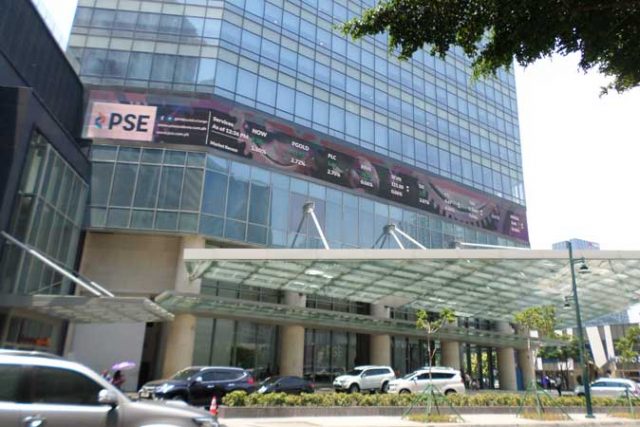
THE ASEAN Exchanges is working on a potential sustainability program to be adopted by its seven member exchanges, the Philippine Stock Exchange (PSE) said in an e-mailed statement on Wednesday.

The PSE hosted on Sept. 21 the 33rd CEOs Meeting, which was participated in by the leaders of the stock exchanges of Indonesia, Malaysia, Singapore, Thailand, and Vietnam — all members of the Association of Southeast Asian Nations (ASEAN).

“With sustainability as an important investment consideration, we are working towards a common sustainability program to attract even more investor interest,” PSE President and CEO Ramon S. Monzon was quoted as saying.

The ASEAN Exchanges aims to promote the capital markets in the region through cross-border collaboration and creating “ASEAN-centric products,” and implementing promotional initiatives.

Member exchanges are the PSE, Bursa Malaysia Berhad, Hanoi Stock Exchange, HoChiMinh Stock Exchange, Indonesia Stock Exchange, Singapore Exchange Ltd., and the Stock Exchange of Thailand.

For its efforts on sustainability, the PSE said the group will be identifying core environmental, social, governance (ESG) metrics for sustainability reports. An ESG working group was formed during the 32nd ASEAN Exchanges CEOs Meeting to lead this initiative.

The ASEAN Exchanges will also continue pursuing its efforts in digital marketing and content creation on social media. It has been featuring broker research reports and the monthly performance of indices on its Twitter account.

“We will aim for a more consistent presence on all available platforms so that the ASEAN Exchanges will be a top-of-mind investment choice among investors,” said Mr. Monzon. — Keren Concepcion G. Valmonte

Chelsea open to PPA’s ‘faster option’ for port project

By Arjay L. Balinbin, Senior Reporter

CHELSEA Logistics and Infrastructure Holdings Corp., which has an unsolicited proposal to develop Davao City’s Sasa Port, is open to exploring the “faster option” offered by the Philippine Ports Authority (PPA) for port development projects, its chief executive officer said.

“We can explore either options depending on how that can be repackaged [in order that] the deal will be beneficial to both the proponent and the PPA (the government side),” Chelsea Logistics President and Chief Executive Officer Chryss Alfonsus V. Damuy told BusinessWorld in a phone message on Tuesday.

PPA General Manager Jay Daniel R. Santiago told reporters at a virtual press briefing on Sept. 13 that the unsolicited proposals from three companies — Chelsea Logistics, International Container Terminal Services, Inc. (ICTSI), and Kudos Trucking Corp. — for port developments in Iloilo, Davao, and General Santos are still being evaluated by the National Economic and Development Authority (NEDA).

“‘Yun ang fear ko (That’s my worry),” Mr. Santiago said, referring to the election ban from March 25 to May 8, 2022.

“We are hopeful that the government [will] be able to approve and award [the contracts for] these three projects later; but, of course, we are all dependent on the actions of NEDA,” he added.

“We are in discussions also with the proponents. They have concerns about the [length of the process and the approaching] election ban, so we are discussing other options.”

One alternative, Mr. Santiago said, is for the PPA to bid out some of its terminals.

“We’ve opened that up to them. That is another option for them, if they so wish. That is a faster option if they really want to get the contract.”

Dennis A. Uy-led Chelsea was awarded original proponent status in 2019 for its unsolicited offer to modernize Davao City’s Sasa Port.

In 2018, Razon-led ICTSI submitted its unsolicited proposal to develop the Iloilo Port Complex and the Port of Dumangas.

Davao-based Kudos Trucking Corp. also submitted in 2018 its unsolicited offer for the General Santos Port.

Century Pacific, 7-Eleven plan meat-free menu

CENTURY Pacific Food, Inc. (CNPF) said its unMEAT brand will be available in convenience stores after partnering with 7-Eleven to launch a meat-free menu.

“Our goal is to democratize plant-based food alternatives by making plant-based eating easy — easy because of its great taste, affordability, and widespread availability,” CNPF Vice-President and General Manager for Refrigerated Food Nikki Dizon said in a statement on Monday.

Customers may avail of a burger and a burger steak rice meal made with CNPF’s unMEAT brand. Meals will be priced at P89 at least, the company said. These will initially be available in 1,900 7-Eleven stores across key Metro Manila cities, Batangas, and Pampanga.

CNPF launched unMEAT last year and it has since been made available in the Philippines, via retail and partnerships with restaurant chains, as well as in international markets.

unMEAT’s production process “requires lower consumption of various natural resources” like water, land, and energy. It is also said to have fewer greenhouse gas emissions compared to the production process of actual meat.

Meanwhile, 7-Eleven is “thrilled” to be the first convenience store chain in the country to launch a 100% meat-free menu.

“We recognize that our customers are always on the lookout for better, healthier products,” said Eilleen Castillo, senior category manager for fresh food at 7-Eleven.

“We hope that, with our new meat-free menu, they get easy access to healthy and delicious food choices,” she added.

Shares of CNPF at the stock exchange on Wednesday went up by 6.42% or P1.75, closing at P29 apiece. — Keren Concepcion G. Valmonte

ADVERTISEMENT
ADVERTISEMENT