Home Blog Page 7409

TLDC expands Batangas project

Tierra Lorenzo Lipa — COURTESY OF TORRE LORENZO DEVELOPMENT CORP.

By Keren Concepcion G. Valmonte, Reporter

TORRE LORENZO Development Corp. (TLDC) launched the second residential tower of its urban lifestyle center and mixed-use development in Lipa City in Batangas, which will now offer studio units.

“Looking at the market and levels of affordability, we decided to introduce a new product line, which are studio units,” Cathy C. Ko, chief operating officer of TLDC, said in a briefing last week.

The Tierra Lorenzo Lipa offers amenities such as a playground, open areas, a fitness center, a pool deck, and multi-purpose pavilion.

The second tower will have 10 residential floors with 28 units per floor, as well as more parking spaces. Turnover is expected by the fourth quarter of 2025.

Unlike the first tower that offered only one-bedroom and two-bedroom units, the second residential tower will feature about 120 studio units spanning around 21 to 24 square meters (sq.m.) each.   

The project will also include 120 one-bedroom units (35.33 sq.m.), and 40 two-bedroom units (52.80 sq.m.).

“Our property owners have the option to upgrade their units, turn them over to our property management team and we will do the rest. We take the headache of unit leasing and maintenance away from those who invest in our properties as vehicles for recurring income,” Ms. Ko said in a statement. 

TLDC said it will start construction for the third tower of the complex, Dusit Princess, upon completion of the second tower. The company plans to open the hotel by 2026.

“We started to invest in Calabarzon (Cavite, Laguna, Batangas, Rizal, and Quezon), particularly in Batangas and its bustling heart, Lipa City, mainly because we saw the potential in the area,” Ms. Ko said, adding that an expansion in Laguna is part of the company’s pipeline. 

Torre Lorenzo also “identified other next wave cities” where it plans to expand beyond Luzon, such as Davao, Bicol, and Iloilo.

“We don’t want to be where everybody else is we want to be pioneering in certain areas,” said Ms. Ko. “We’re actually also looking at low-rise developments, smaller-scale for the future.”

Globe readying standalone 5G network

GLOBE Telecom, Inc. on Tuesday said it would soon be bringing its standalone 5G (fifth generation) technology to its customers.

“5G SA (standalone) goes beyond speed. With its network slicing capabilities, low latency, always-on connectivity, and integration with edge computing, the technology allows the adoption of new concepts and mission critical digital services such as industrial automation, remote surgery, and autonomous vehicles to name a few,” Globe said in an e-mailed statement.

“5G SA on-site testing started in May this year. Today, Globe achieved a new milestone by testing this latest technology in a live setup in its facility in Valero,” it added.

Globe’s current 5G network is deployed via 5G non-standalone (NSA) architecture, which is reliant on the 4G (fourth generation) network.

Globe President and Chief Executive Officer Ernest L. Cu said the 5G SA will allow the company to do more services for multiple industries with new business models.

The technology is seen to become the standard for connectivity across a wide range of industry sectors.

“Globe will soon be bringing this technology to its customers as it embarks upon extending this from the location in Valero to other parts of Metro Manila and beyond,” the company said.

“With network slicing, Globe can tailor fit 5G services to the dynamic requirements of consumers and businesses. Instead of sharing one extensive network, each group can have its own customizable virtual network with its own policies running at the same time without disturbing one another,” the company added. — Arjay L. Balinbin

Key winners at the Tony Awards

PHOTO FROM TONYAWARDS.COM/WINNERS/

THE Tony Awards for Broadway theater were handed out in New York on Sunday after a delay of more than a year caused by the coronavirus pandemic.

Following is a list of winners in key categories.

Best Play — The Inheritance

Best Musical — Moulin Rouge! The Musical

Best Revival of a Play — A Soldier’s Play

Best Actor, Play — Andrew Burnap, The Inheritance

Best Actress, Play — Mary-Louise Parker, The Sound Inside

Best Actor, Musical — Aaron Tveit, Moulin Rouge! The Musical

Best Actress, Musical — Adrienne Warren, Tina – The Tina Turner Musical

Best Original Score — A Christmas Carol

Best Book of a Musical — Jagged Little Pill

Reuters

Palafox: No signed deal with SMC for PAREX

PALAFOX Associates and Palafox Architecture Group, Inc. said they have not signed any contract with San Miguel Corp. (SMC) for the latter’s P95-billion Pasig River Expressway (PAREX) project.

“While it is true that the SMC and [its president], Mr. Ramon S. Ang, have reached out to our principal architect and urban planner Felino ‘Jun’ A. Palafox, Jr. to introduce green architecture and green urbanism principles in SMC infrastructure projects, this has never been formalized specifically for the PAREX project,” they said in a statement.

Last week, SMC said it was tapping Mr. Palafox to help in building the PAREX project.

“Together with Palafox and Associates, we will build what will be the country’s first sustainable infrastructure, one that will not just be ‘green,’ but will have multiple uses and direct environmental, social, and economic benefits to Filipinos,” Mr. Ang said.

Palafox Associates and Palafox Architecture Group said they remain “strong” with their stand that public and private sectors must work together to address the climate crisis through multicultural development.

“This means that all economic, social, health, and environmental aspects must be carefully assessed before proceeding with any project,” they added.

The supplemental toll operations agreement for the 19.37-kilometer PAREX project was signed on Sept. 21.

The project is a six-lane elevated expressway that will run from Radial Road 10 in the city of Manila to Circumferential Road 6, also known as the future South East Metro Manila Expressway, in Taguig. It will run along the banks of the Pasig River. — Arjay L. Balinbin

‘Massively grateful’ Daniel Craig bids farewell to James Bond

LONDON — Daniel Craig thought he had wrapped up his tenure as James Bond with Spectre, but the actor says his final fifth outing as the British secret agent in No Time To Die allowed him to fully complete his 007 journey.

Nearly 60 years after the first Bond film Dr. No premiered, cinema’s favorite spy, known for his love of fast cars and cool gadgets, returns in the highly anticipated 25th Bond movie this week after an 18-month delay due to the COVID-19 pandemic.

Costing an estimated $200 million to produce, No Time To Die sees Bond come out of retirement from an idyllic life in Jamaica to help track down a new villain armed with lethal technology.

“I didn’t think that I was going to do another movie after Spectre. I genuinely thought that I was going to … just pack it in,” Mr. Craig told Reuters.

“But I’m so happy that I got the chance to come and do this one. And we tied up lots of loose ends. We’ve tried to tell one story with all my Bond movies. It’s like they’re all connected in some way and this one just sort of capped it off.”

Running at nearly three hours long, the film, directed by Cary Joji Fukunaga, promises the usual Bond action, car chases and stunts in picturesque locations, including the cave dwellings of the southern Italian city of Matera.

It introduces new character Nomi, played by Black actress Lashana Lynch and described simply as a 00 agent at Bond’s past employer, Britain’s MI6 foreign spy service. She looks just as fierce and skilled as Bond.

“She’s also a real human being. She’s grounded and she’s from a good background and takes every opportunity she gets and really runs with it. She’s really shifted things up at MI6 and will continue to do so,” Lynch said.

“It’s groundbreaking for Black women, for my culture, for the franchise as well that have been pushing the needle forward for a long time now.”

French actress Lea Seydoux reprises her role as Madeleine Swann from 2015’s Spectre.

“Cary wanted to explore a bit more Madeleine’s character … In a way, she’s the heartbeat of the film and the relationship with Bond is much more developed,” Ms. Seydoux said.

Rami Malek joins the franchise, one of Hollywood’s most valuable, as villain Safin.

“I looked at every villain in the history of film almost to prepare for this,” he told the movie’s official podcast.

After being postponed three times since its original April 2020 slot, No Time To Die holds its world premiere on Tuesday in London.

“I enjoyed them all … They’re always a bit of a struggle but anything worthwhile is always a bit of a struggle so this was a joy to make,” said Mr. Craig, who began his Bond journey in 2006’s Casino Royal.

“(I’m) massively grateful to have been given the chance to do it and… all of the memories and all the amazing times… working with just fantastic, amazing people… it’s changed my life… It’s just amazing.” — Reuters

Experts weigh in on post-pandemic design

SPACE FLEXIBILITY and well-being are at the forefront of post-pandemic design trends, according to experts.

“Biophilic design, sustainability, and well-being have become crucial nowadays,” said Steve Leung, founder of Hong Kong-based Steve Leung Design Group Ltd., at the Sept. 23 press conference for the launch of the KOHLER Bold Design Awards (KBDA) 2021.

Mr. Leung is one of the seven judges for the KBDA, which recognizes outstanding design projects and talents in property design in the Asia Pacific region.

Spaces will also need to be flexible to multifunctional needs. “With a lot working from home, post-COVID design will blur traditional homes and conventional workplaces,” he added.

The spread of the coronavirus disease 2019 (COVID-19) also accelerated awareness and sensitivity to cleanliness, Brian Lum, vice-president of Hyatt Hotels Corporation’s Design Services Asia Pacific, said in the same event.

“Cleanliness used to be more discreet… [Now] people want to see what we are doing to look after their safety,” Mr. Lum said.

Andre Fu, founder of André Fu Studio in Hong Kong, said apart from cleanliness he is looking for design entries that create an emotional balance for people as they experience a particular space.

“In the context of hospitality, it’s about balancing the idea of social distancing whilst trying maintain the energy of a space,” he said. “That will be crucial.”

While technology has had an impact in design projects, Chris Godfrey, global principal of HBA Residential in Singapore, believes there is a quest for simplicity at this time. 

“That can be a beautiful view, a nice shaft of light in the space, a sense of the outside,” he said.

Technology’s integration into design is meant to support people in their lives, Mr. Godfrey added.

“We never curate other people’s lives [in our work]. We support it. That’s how I see technology. If technology can support lives [in residences], that can only be a good thing,” he said.

The KBDA will recognize the “boldest” designs for apartments, villas, urban hotels, resorts, restaurants and retail stores. There are also awards for innovation and sustainability, as well as prodigies and influencers.

Eligible projects are those located in the Asia Pacific (Indonesia, Vietnam, Philippines, Singapore, Malaysia, Hong Kong, Taiwan, and Mongolia) and should have been completed between Jan. 1, 2019 to Aug. 31, 2021. Submission of entries ends on Dec. 15, 2021, with the announcement of nominees on Jan. 15, 2022. — Patricia B. Mirasol

Peso at weakest in over a year

BW FILE PHOTO
THIS is the local currency’s weakest close since it finished trading at P51.07 a dollar on March 26, 2020. — BW FILE PHOTO

THE PESO sank to its weakest versus the greenback in more than a year, as investors flocked to the safe-haven dollar due to concerns on the upcoming tapering of asset purchases by the US Federal Reserve as well as higher oil prices.

The local unit closed at P51 per dollar on Monday, weaker by 35 centavos from its P50.65 finish on Friday, based on data from the Bankers Association of the Philippines.

This is the peso’s weakest close since it finished trading at P51.07 a dollar on March 26, 2020, Rizal Commercial Banking Corp. Chief Economist Michael L. Ricafort said.

The peso opened Monday’s session at P50.72 per dollar, which was also its intraday best. Meanwhile, its weakest showing was at its close of P51 versus the greenback.

Dollars traded inched up to $1.261 billion on Monday from $1.185 billion on Friday.

A trader said market participants remained cautious and opted for the safe-haven dollar after US central bank officials hinted on the upcoming reduction of asset purchases.

“Fed officials continue to communicate the case for an asset purchase taper which is expected to be implemented later this year,” the trader said in an e-mail.

Cleveland Fed President Loretta Mester and Kansas City Fed President Esther George on Friday separately said the US economy had shown substantial progress towards reaching maximum employment and its 2% inflation goals, Reuters reported. Both metrics have been gauged by the Fed to assess when it could start reducing its $120-billion monthly asset purchases.

Ms. Mester said she supports beginning the tapering of asset purchases in November and concluding it over the first half of 2022. Meanwhile, Ms. George said “the rationale for continuing to add to our asset holdings each month has waned.”

Peso-dollar trading was also affected by continued increase in global oil prices, Mr. Ricafort said.

Reuters said pump prices inched up for the fifth straight day on Monday amid supply concerns as demand conditions to recover due to easing restrictions.

Brent crude rose 92 cents or 1.2% to $79.01 a barrel by 0208 GMT on Monday. Meanwhile, US oil prices increased 83 cents or 1.1% to $74.81 per barrel.

For Tuesday, the trader gave a forecast range of P50.90 to P51.10, while Mr. Ricafort expects the local unit to move within P50.80 to P51.10 versus the greenback. — Luz Wendy T. Noble with Reuters

Bloomberry names former chief justice as independent director

BLOOMBERRY Resorts Corp. has appointed retired Chief Justice Diosdado M. Peralta as one of its independent directors, the Solaire Resort & Casino operator told the local bourse in a disclosure on Monday.

Bloomberry said the appointment took effect on Sept. 24.

The former Supreme Court chief justice served from Oct. 23, 2019 before retiring on March 27, 2021. He was an associate justice from 2009 to 2019, and a presiding judge of the Sandiganbayan from 2008 to 2009.

Prior to serving in the judiciary, he was an active member of the academe, having been a professor and reviewer in criminal law and criminal procedure at the University of Sto. Tomas, Ateneo De Manila University, San Beda College, University of the East, Philippine Christian University, San Sebastian College, and other review centers.

A month ago, listed ports operator International Container Terminal Services, Inc. (ICTSI) elected Mr. Peralta as an independent director and chairman of its environmental, social and governance subcommittee.

Bloomberry and ICTSI are both chaired by Enrique K. Razon, Jr.

In the second quarter, Bloomberry trimmed its attributable net loss to P1.16 billion, versus the year-on-year loss of P4.7 billion, following the closure of its gaming business between April and mid-May due to the reimposition of quarantine restrictions.

Bloomberry shares at the local bourse shed seven centavos or 1.19% to close at P5.83 apiece on Monday. — Angelica Y. Yang

EU higher education fair goes online again

THE 2021 EUROPEAN Higher Education Fair (EHEF) goes online once again on Oct. 1 and 2.

Carrying the theme “Go Higher with the EU,” the EHEF will give Filipino students, academicians, researchers, and university officials the opportunity to connect directly with world-class higher education institutions from across the European Union (EU).

The Fair will be inaugurated on Oct. 1, 1:30 p.m. with a livestream at https://www.ehefphilippines.com and on the EU Delegation to the Philippines Facebook.

“Early on my dad made clear to me that his support for my education will be my sole inheritance,” Ambassador of the European Union to the Philippines Luc Véron said in an online press conference on Sept. 23.

“Education is a fundamental right. It opens opportunities to better understand the world we live in and at the same time strengthen people to people links. It is also the path to human and economic development,” Mr. Véron added. “The European Union Connectivity Strategy also underscores the importance of establishing connections through students, scholars, and researchers.”

EHEF 2021 consists of 140 European higher education institutions offering MAs and PhDs from this year’s participating EU member states: Belgium, the Czech Republic, Germany, Ireland, Spain, France, Italy, Hungary, the Netherlands, Austria, Poland, Finland, and Sweden.

The two-day fair will have a number of activities, from webinars on specialized courses and programs, to country presentations and live chats with representatives, alumni, and scholars from participating institutions.

“Through this fair, the EU wants to give Filipino students access to information about pursuing their higher education in European universities, institutes, and colleges. We also want to underscore the importance of mobility, innovation, partnerships, and lifelong learning,” said Mr. Véron.

Philippine regional partner institutions for this year are Wesleyan University (Luzon), Silliman University (Visayas), and Xavier University – Ateneo de Cagayan (Mindanao), which will host clustered presentations for students and other members of the academe. University partners for this year are the University of Sto. Tomas, the University of the Cordilleras, the Lyceum of the Philippines University – Batangas, Mabalacat City College, St Louis University, Rizal Technological University, Trinity University of Asia, Ateneo de Manila University, Visayas State University, Jose Rizal Memorial State University, and Mindanao State University’s (Marawi) College of Public Affairs.

The virtual EHEF 2021 is organized by the Delegation of the European Union to the Philippines, together with EU member states’ embassies, education services, and institutes and in collaboration with the Commission on Higher Education.

To join, register at https://www.ehefphilippines.com. For information on the Erasmus Mundus program, visit https://www.eacea.ec.europa.eu/scholarships/emjmd-catalogue_en. —  MAPS

NYC office market revives with tech firms hunting for space

REUTERS

NEW YORK’S battered office market is drawing more interest from tech companies that are hungry for space even as the pandemic upends traditional work.

Roku, Inc. and Microsoft Corp. are among firms in talks for new leases in Manhattan. Amazon.com, Inc. and Facebook, Inc. have explored options to expand their offices. Digital-payments firm Stripe, Inc. is taking a chunk of space in the financial district.

In the year’s biggest office deal, Google agreed earlier this week to buy St. John’s Terminal, a redevelopment project it was already leasing but hasn’t yet occupied, for $2.1 billion. The transaction was a bet on New York’s future as a tech hub that also affirmed the search-engine giant’s commitment to in-person work.

“It’s all great news,” said Bill Rudin, chief executive officer of New York landlord Rudin Management Co. “It’s all part of the tech ecosystem. The big players are coming in but the small-, medium-sized companies are also making deals and expanding and looking for space.”

A year and a half after COVID-19 shut down the city and emptied its skyscrapers, the real estate world is eagerly anticipating a burst of leasing by newcomers to the market as well as established companies looking for a bigger footprint. But the optimism comes at a precarious time as the Delta variant rages, disrupting return-to-office plans for many of Manhattan’s key tenants — particularly in the tech industry.

While Wall Street firms such as Goldman Sachs Group, Inc. and JPMorgan Chase & Co. have called most workers back to their buildings, Facebook and Google have said employees don’t need to be back until next year. Microsoft said it can no longer give a date for a full reopening because the virus is too unpredictable.

Tech companies also have been at the forefront of more-permanent flexible work models. Facebook, which has more than 2 million square feet in New York, said in June that all its employees can request to work remotely full time. Google, the owner of several buildings in the Chelsea neighborhood, has said workers only need to be at its locations for part of the week.

But their interest in new office space shows just how swiftly tech companies are growing and their need to accommodate an ever-expanding workforce. The industry’s deep-seated culture of collaboration also lends itself to in-person work. A study of more than 61,000 Microsoft employees, published this month, showed remote work caused staff networks to “become more static and siloed.”

In the second quarter, tech companies new to the market toured roughly 2.1 million square feet of New York office space, 91% more than in the previous three months, according to commercial-property data firm VTS.

Video-streaming company Roku is in talks to lease more than 100,000 square feet at 5 Times Square in Midtown, and Microsoft is close to a deal for roughly 100,000 square feet in the Flatiron district, according to people familiar with the companies’ plans. Stripe recently took more than 100,000 square feet at a WeWork location in lower Manhattan, people familiar with the transaction said. 

Representatives for Roku, Microsoft and Stripe declined to comment.

While hybrid work may be the norm for now, the tech companies’ interest in offices is a long-term wager on New York’s rebound and the strength of its hiring pool, according to Jim Wenk, a vice-chairman at the brokerage Savills.

“There hasn’t been a tremendous return to office as we’d all like due to Delta, but people are seeing that’ll eventually subside,” Wenk said. “These companies have significant confidence in this marketplace to acquire and retain talent, and part of that is having marquee real estate.” — Bloomberg

More digitalization initiatives underway — BSP

BW FILE PHOTO

INDUSTRY PLAYERS and consumers will have access to more digital payments initiatives by the end of this year and into 2022.

The Bangko Sentral ng Pilipinas (BSP) is collaborating closely with the Philippine Payments Management, Inc. (PPMI), a BSP-accredited payment system management body in the Philippines, to roll out more services related to QR Ph and the PESONet.

The central bank in a statement said the person-to-merchant QR Ph scheme will have its full launch in the coming days.

“I am confident that this initiative will facilitate efficient digital payments to unbanked micro-entrepreneurs such as sari-sari store owners and tricycle drivers,” said BSP Governor Benjamin E. Diokno during a recent PPMI meeting.

The scheme was pilot-launched in April and included select merchants that use InstaPay, the retail electronic fund transfer system that facilitates transactions below P50,000. This also allows consumers with accounts in select banks to perform the person-to-merchant QR payments.

“The BSP will continue to work with the [PPMI] to ensure that every Filipino can have meaningful participation in an increasingly digital Philippine economy,” Mr. Diokno said.

Meanwhile, the BSP and PPMI are also working together to allow multiple batch settlement through PESONet by the end of this year.

“From once a day, multiple batch settlement will increase the frequency of PESONet settlements to two times a day. This will speed up the payment process for high-value transfers and support funding requirements for businesses,” the BSP said.

The PESONet is the electronic fund transfer service handling transactions worth more than P50,000 under the central bank’s National Retail Payment System. The transfers are credited to the receiver by the end of  a banking day, making it suitable for business-to-business dealings and an alternative to the paper-based check system.

Other digitalization initiatives including an interoperable bills payment facility and the request-to-pay facility are expected to be launched early next year and by the second quarter of 2022, respectively, the BSP said.

The interoperable bills payment facility will potentially allow billers to collect from their clients online. This will be possible even if the payment service providers of the billers are different from those of the customers.

Meanwhile, the request to pay facility will enable payment collection by simply sending a request-to-pay to the person who needs to settle their due.

Another initiative currently being developed is the direct debit service, which will enable the payer to send the payee an electronic authority to draw funds directly from the payer’s account on a regular basis. Once operational, the initiative will be ideal for recurring payments such as monthly rentals, periodic loan amortizations, and quarterly insurance premiums, the BSP said.

Also, in a bid to boost digitalization, the PPMI is pushing for more banks and e-money issuers to onboard to the EGov Pay ecosystem, an e-payment facility for taxes, permits, fees and other government obligations.

The central bank hopes to make 50% of payments, both in volume and in value, will be done online by 2023.

Data from the BSP and the United Nations-based Better Than Cash Alliance showed digital payments made up 14% of monthly transactions in 2019, up from 10% in 2018.

The central bank is optimistic digital payments will continue to rise amid the physical distancing measures during the pandemic.

“These challenging times have taught us to adapt, be more agile and to find innovative ways to continue thriving. In a way, the pandemic gave us an invaluable opportunity — and one that we must seize — to build and enhance our capacities for digital transformation,” Mr. Diokno said. — Luz Wendy T. Noble

Why the drive-in motel is safe by design for quarantine

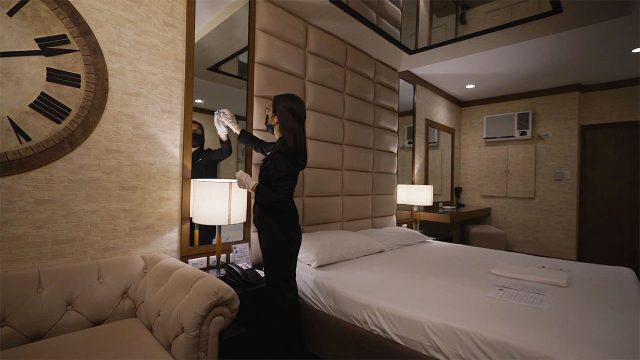
VICTORIA COURT

MOTELS have always been the go-to place for travelers who need somewhere to sleep for a night or anyone who seeks privacy in those very special cases, and the Philippines is no different. However, with the coronavirus disease 2019 (COVID-19) pandemic putting tourism and mobility in general on hold, motels and other types of accommodations moved to reorganize their operations.

In the Philippines, 78% of tourism-related businesses temporarily stopped offering a product or service due to restrictions in domestic and international travels, while 68% suspended operations due to the lack of demand. Many players in the accommodations subsector also mostly cut operations and employee headcount, slashed costs, and prepared a business continuity plan.

With accommodations mainly relying on tourism and travel, it became one of the hardest hit subsectors during the pandemic. But not all shut down or reduced operations and manpower; others moved to find a new purpose — they have proven useful as quarantine facilities.

Many, if not all, countries around the world have partnered with different public accommodations to house essential travelers. In the UK, people who have visited or passed “red list” locations are required to stay in government-approved quarantine hotels for 10 days. The same goes for South Korea, where the pandemic response has been deemed impressive over the past year, except asymptomatic travelers are required to stay in quarantine hotels for 14 days.

While these hotels serve their new purpose, they are still considered public spaces that pose risks to human health in the age of COVID-19. Since hotels have common areas such as the lobby, hallways, and elevators, people may likely run into others who are potentially infectious. Hotels also cater to more people in one building. The spread of highly infectious new COVID-19 strains now begs the question: Are hotels really appropriate places for quarantine?

For a safer and cleaner alternative, governments, organizations, and even individual travelers should look at drive-in motels, hopefully past their reputation as a place for a “quick” getaway. Of course, drive-in motels are structurally different compared to walk-up motels, which have more common areas like lobbies, corridors, and more. Here, guests can simply park their cars either in an open lot in front of the establishment or in designated garages and head straight to their rooms.

Since most drive-in motels have an average of two floors, guests can take the stairs when going to or leaving their units. Even health experts like Dr. John Carlo, CEO of Prism Health North Texas, believe that a motel room that exits directly outside, uses its own ventilation, and does not require the use of an elevator or common space pose lower risks than a multi-floor hotel full of other guests.

A number of drive-in motels in the Philippines have already been converted as quarantine facilities by the government. We, at Victoria Court, for instance, are already operating as such while still giving our guests five-star treatment.

Prior to staying in our rooms, guests are offered contactless methods for booking, payment, and room management. Once they’re set, they can simply drive to the motel and park their vehicle in the garage just below their designated room. This has been our structure even before the pandemic because we wouldn’t want our guests to run into people they know.

We have no common areas like the lobby or reception area, swimming pool, restaurants, and bars. Guests also have no need to use an elevator, where possible transmissions may occur.

All of our units also each have an anteroom, which separates the primary rooms from areas that may be accessed by other people. If guests are worried about how they’ll get their food, our staff can leave their orders in the anteroom so they won’t have to interact with each other. If they’re also worried about the ventilation in their room, our units are each equipped with window-type aircons, eliminating the chances of particles to circulate in shared air vents.

The lack of common areas aligns with our goal of providing guests with complete privacy. By design, Victoria Court is built on people being able to come in, enjoy, and leave, all with the hush-hush implied by our logo. Many Filipinos are familiar with this discretion (though, of course, would shy away from admitting it). But it’s this respect for privacy today that fits well into requirements for isolation and safety. Our staff are also trained to minimize interaction with guests since privacy and discretion have been our core product since the 1980s.

Once guests leave, we then fulfill our promise of quality and safety by following stringent cleaning rules. Our staff have been retrained to use medical-grade cleaning solutions and UV-C disinfection systems to sanitize all our rooms. We also hired staff members who are equipped to conduct black light spot quality inspection — an extra step that some accommodations don’t always do — to detect traces of bacteria undetectable to the naked eye.

Duty managers prepare a room beforehand by marking frequently-touched surfaces with an invisible ink marker. Hotel stewards don’t know where these markings are placed so that they will tend to thoroughly clean the room, paying special attention to critical areas taught to them in training. Duty managers then check afterwards if the surfaces they marked have been cleaned. This step is important considering that COVID-19 is an invisible enemy we cannot fight in simple ways, so simulating it using black light helps us keep our rooms clean and virus-free.

We have been certified under ISO 9002 and 9001:2008 standards, assuring our guests that we are a world-class establishment that’s cleaner than most hotels. We’ve worked to achieve this perception of our brand since motels gained a certain reputation when it comes to sanitation.

As COVID-19 cases continue to increase in the country, hospitals will continue to feel the burden of the pandemic. The government should increase the number of drive-in motels that can serve as safer and cleaner quarantine facilities. Individuals seeking privacy during these times can also rely on drive-in motels to meet their needs without risking their health and comfort. As mental health can be an issue, at least here people can quarantine in themed rooms inspired by Greek islands, popular films, and even K-dramas, which is sure to bring a tongue-in-cheek smile to anyone’s face.

In the age of COVID-19, it definitely pays to take every precaution possible to assure our safety. As Filipinos, we should use our unique trait of resourcefulness or diskarte to look for solutions in unexpected places during the pandemic. In our case, it’s using drive-in motels as quarantine facilities past their pre-pandemic reputation. The structure of drive-in motels fulfills their promise of safety, cleanliness, and more importantly, privacy.

Being resourceful has helped every one of us get through our own problems before, and together, we can use that unique trait to save others today.


Atticus King is the owner and CEO of Victoria Court Group, a family-owned business that is a forerunner in the drive-in motel industry. Mr. King and his wife Kim also co-founded Kim King’s Kitchen, a pioneer in promoting the bone broth lifestyle in the Philippines. Finally, Mr. King is also a serial entrepreneur with investments in various industries.