Home Blog Page 7366

Entertianment News (10/15/21)


TWITTER.COM/SONYMUSICPH

Nobody’s Home releases new single

FILIPINO alternative rock trio Nobody’s Home has released the official music video of their new single “Cigarette Daydreams” — a cover of American rock band Cage the Elephant’s hit from 2014. Directed by Ysa Aranda of Swimming Pictures, the video features the trio on a road trip, performing in front of a warehouse, and running away from reality “to find peace of mind,” as the lyrics suggest. The song was produced by Nobody’s Home and Ely Buendia, and its overall treatment maintains the melodic charm of the original, while incorporating 1990s-sounding guitar-rock affair, pop hooks, and pulsating synths to the mix. Nobody’s Home’s version of Cage the Elephant’s “Cigarette Daydreams” is out now on all digital music platforms worldwide via Sony Music Philippines.

Sarap, ‘Di Ba? returns on GMA Network

SARAP, ‘Di Ba? returns to the studio with new segments and celebrity guests beginning Oct. 16, 10 a.m. Hosted by Carmina Villarroel together with Cassy, Mavy, and Zoren Legaspi, features new segments like “Quiz Mis,” a novelty quiz bee for guests with showbiz questions; and “Pa-Mine! ‘Di Ba?,” a live selling portion where Cassy and Mavy Legaspi sell second-hand items from GMA Network stars. The show will also include a “SarapDiBalympics”  face-to-face edition, and recipes in “Lutong Sarap, ‘Di Ba” with Ms. Villarroel. There are nature trips with Loren Legaspi in “Sarap sa Labas.”  Viewers will get a chance to win cash prizes in “Sarap, ’Di Ba 5k Giveaway” by taking selfies or group photos with the hosts and guests on a specific segment of the show during its actual airing.

Money Heist Part 5 Vol. 2 releases teaser trailer

“IN the last few hours, I have lost some very important people, and I am not going to let anyone else die for this heist,” The Professor (played by Álvaro Morte) says in the video. Tokyo is dead and the enemy, wounded yet more dangerous than ever, is still inside the Bank of Spain. Netflix has released the first look image and teaser for Volume 2 of Money Heist Part 5 (https://www.youtube.com/watch?v=O5RygSxaNAw). The five final episodes will mark the end of the heist.  Netflix’s Money Heist Part 5 Vol. 2 will be released globally on Dec. 3.

Pinoy music takes centerstage at Sonik PH

PINOY Pop takes center stage at this year’s Sonik Philippines on Oct. 21-23. Sonik is a three-day music business conference designed to bring together Filipino music industry communities to discuss current and relevant topics of the industry through panel discussions. Last year, a thousand people had joined to connect with 33 countries and hear from 32 artists and 42 speakers. This year’s Sonik Philippines will focus on embracing diversity of the music space and empowering every role in the industry. Music experts from different companies will talk about elevating Filipino music together, the future of P-Pop, and various more topics. Local and international artists will be performing in the conference. To participated in the free conference, interested participants have to request to join the private Facebook group: Sonik 2021 Philippines Rising. To find out more about Sonik Philippines, the lineup of artists and the specific topics to be discussed, check the official hashtags #SonikPH2021 and #PhilippinesRising and follow Sonik’s official Facebook page and Instagram.

Spooky AirConsole games come with Sky Fiber

FAMILIES with a SKY Fiber subscription can enjoy Halloween-themed games at no extra cost with their free six months access to the AirConsole Hero gaming platform. Existing SKY Fiber subscribers can activate their free access to AirConsole Hero, while new SKY Fiber subscribers this month can avail the freebie right after installation. More than 160 multiplayer games will be unlocked, including a selection of spooky, quirky, and fantasy-filled adventures that are perfect for the Halloween vibe. These include Mega Monster Party, Zombie Attack, BFF or Die, and Space Vikings. Go to www.mysky.com.ph/fiberfreemiums to learn more about the promo. For new SKY Fiber subscribers, this freemium offering is available until Oct. 31. All SKY Fiber subscribers who use their AirConsole Hero access from Oct. 11 to Nov. 30 can also enter the survey raffle promo.


Smart claims lead in 5G network rollout

SMART.COM.PH/CORPORATE

SMART Communications, Inc. is expecting to deliver a triple-digit increase in fifth-generation (5G) users “in the next few years,” citing its lead in the 5G space by providing the fastest speeds and the widest network coverage in the Philippines.

In a statement, the wireless arm of PLDT, Inc., said the outlook is based on the rapid growth of Smart 5G users, which have now reached around 800,000 — a 200% increase from the number in December 2020.

“Smart has also delivered a three-fold increase in 5G data traffic in the first quarter and second quarter of 2021,” it added.

Smart said the growth contributed to its 39.5 million mobile data users as of end-June, the highest in the country, resulting in a double-digit increase in mobile data revenues in the first half of 2021.

“When it comes to 5G, speed and coverage are the most important considerations. This is why since we pioneered the Philippines’ first 5G commercial service last year, our focus has been to lead in both 5G speeds and 5G coverage so as to empower Filipinos with world-class customer experience,” said Alfredo S. Panlilio, PLDT and Smart president and chief executive officer.

Smart said Ookla, the global leader in internet testing and analysis, had recognized the company as the fastest and most reliable 5G mobile network in the Philippines for the first two quarters of 2021, with median download and upload speeds that are twice faster than its closest rival.

“Recently, Smart is also the only Philippine telco services provider included in Opensignal’s 5G Global Leaders for Video Experience, ranked alongside other 5G leaders such as South Korea’s SK Telecom, KT, and LG U+, Thailand’s AIS, and other operators from Croatia, Finland, Hong Kong, Germany, Netherlands, Taiwan, and United Kingdom,” the PLDT unit said.

Smart said it had deployed more than 4,400 5G sites in more than 4,000 locations to date, which it said is the widest 5G network coverage in the country.

Hastings Holdings, Inc., a unit of PLDT Beneficial Trust Fund subsidiary MediaQuest Holdings, Inc., has a majority stake in BusinessWorld through the Philippine Star Group.

Economic reforms in the new frontier

TWO business organizations have joined forces to host the 2022 Presidentiables and Vice Presidentiables Fora with the theme of “Economic Reforms in the New Frontier.” These are the Financial Executives Institute of the Philippines (FINEX) and the Federation of Filipino-Chinese Chambers of Commerce & Industry, Inc. (FFCCCII).

This is the second time for FINEX to organize such an event. The first was held in October 2003 with the theme, “In Search of a Servant Leader.” What’s common between both editions is the format: not a debate but a presentation of candidates’ platforms. The big difference is that this time it will be virtual via multiple online platforms, unlike 18 years ago when it was face-to-face in a hotel venue.

Invited guests for the Vice Presidentiables Forum on Oct. 23, 2021 are candidates Lito Atienza, Bong Go, Willie Ong, Kiko Pangilinan, and Tito Sotto. It will be the turn of candidates Bato Dela Rosa, Ping Lacson, Bongbong Marcos, Isko Moreno, Manny Pacquiao, and Leni Robredo during the Presidentiables Forum on Oct. 30, 2021. They will present their economic platforms including the reforms that they plan to implement should they win in the May 9, 2022 elections.

FINEX President Francis Lim and FFCCCII President Henry Lim Bon Liong will keynote the forums moderated by veteran journalists Tony Lopez and Mike Toledo. Sponsoring these events are the W Group, United Auctioneers, and Grab Philippines as part of their voter’s education programs.

For the first time in the 2022 electoral season, Filipino voters shall witness how each candidate intends to address the worst economic crisis in the country’s postwar history.

Both forums will be aired on two Saturdays starting at 7:30 p.m. over Cignal’s One News and One PH channels with live streaming on Facebook, YouTube, and Daily Motion. Interested parties may contact FINEX Executive Director Michael Vinluan at mbvinluan@finex.org.ph.

SOCIAL AMELIORATION PILFERAGE
While all eyes are on the presidential and vice-presidential candidates, the people of Camarines Sur province have intensified their call for the Department of the Interior and Local Government (DILG) and the Office of the Ombudsman to investigate Iriga City Mayor Madelaine Alfelor regarding at least 16 graft complaints filed against her.

During his last State of the Nation Address (SONA) in July, President Rodrigo R. Duterte underscored the role played by the Presidential Anti-Corruption Commission (PACC) in running after wayward government officials and bringing them to justice. He said corruption “is but another term for stealing people’s money, dashing in its wake a nation’s goals and aspirations.”

With less than eight months to go before the end of Mr. Duterte’s term, the Ombudsman, DILG, and PACC have yet to prove to the public that they are bent on heeding his stern directive to uproot corruption in government. They need not search far and wide, though, to set an example by going after pilferers of public funds occupying elective positions.

Most of the complaints against Ms. Alfelor were lodged before the Ombudsman. Some had been filed by the Criminal Investigation & Detection Group of the Philippine National Police for alleged anomalies in the distribution of ayuda or cash grants to unqualified recipients under the National Government’s social amelioration program (SAP).

Another involved a P275-million loan obtained from the Land Bank of the Philippines to build an amusement park at a time when mobility restrictions continue to be imposed because of the COVID-19 pandemic. Several whistleblowers attended a hearing conducted by the House of Representatives Committee on Good Government last year and testified on the mishandling of SAP disbursements in Iriga City after the passage of the “Bayanihan I” law in 2020.

CamSur’s concerned citizens are wondering why the DILG, the Office of the Ombudsman, and the PACC are not taking immediate action in compliance with the President’s drive against official corruption, especially when there are allegations of ayuda irregularities. Perhaps they should approach the Senate Blue Ribbon Committee, which is presently investigating a bigger irregularity in the spending of pandemic funds.


J. Albert Gamboa is the chief finance officer of Asian Center for Legal Excellence and co-chairman of the FINEX Week Committee. The opinion expressed herein does not necessarily reflect the views of these institutions and BusinessWorld.

Five questions to ask habitually absent workers

I’m a department manager at a small business. Our workers often take emergency leave on Mondays or Fridays. On Monday, six out of 15 workers called in sick. How do I manage this? — Clueless Charlie.

Polish actress Helena Modjeska (1844-1909) was known for playing Shakespearean roles. At a dinner party, she mesmerized an American audience with an address in her native language Polish.

When she finished, many of her listeners were emotional and on the verge of tears. What they didn’t know was that Modjeska simply recited the Polish alphabet.

Understanding a situation including habitual absenteeism is imperative. What does it mean when workers take too many unscheduled absences? There are many reasons, but you need to hear it directly from them. They may not tell you the truth, but at least they know that you’re serious about correcting their attendance record.

FIVE QUESTIONS
You don’t have to overthink it. All you need to do is look at past and current work performance and compare it with attendance records. If they are average or underperforming, chances are the attendance problem has its roots in how you manage them.

Do you tolerate them? Are they clear on work expectations? Why or why not?

They could also be hard workers who view their performance as a license to test your patience. Whatever the reason, you should explore asking the following questions to get an idea of what’s happening:

One, do you have proof of wrongdoing? This will require analyzing attendance records to detect patterns. How often is a worker absent during Mondays or Fridays? What are the reasons? What causes midweek absences if any? Absences that are few and far between might mean no reason to worry.

Two, are they ‘looking for a better manager’ elsewhere? That may be the alternative meaning of the “LBM” cited on the sick leave form. In my more than 30 years of managing human resources (HR), the people courageous enough to be honest during the exit interview do not hesitate to pin the blame on toxic bosses. That’s still true today.

Three, are they happy with their current work assignment? You will not know the answer if you don’t conduct periodic informal meetings to discuss job challenges. Do they have enough resources to do the job well? How about their work stations or their environment? Are their ideas being heard, or even their complaints?

Four, are they being supported in meeting their career goals? Managers must show great interest in developing their workers so they can perform and achieve their professional aspirations. The best approach is to train them. Coaching people may require giving them special projects that allow them to shine.

Last, are they being paid fairly relative to other workers? Even with confidentiality rules, you can’t prevent people from comparing pay slips. This can best be answered by HR, but as a manager, it’s your responsibility to lawyer for your workers. The issue here may include pay inequity, red circle pay or when a worker has exceeded the price limits on their job. Sometimes, the reason is an outdated pay structure.

SOBER REFLECTION
These questions are not complete. You can improve on this list by paying close attention to what your workers are doing without micromanaging them. What is the best way to listen to your workers and when do you heed your gut? A good rule of thumb is not to jump to conclusions right away. Give each and every worker the benefit of the doubt.

Pay attention to what’s not being said. Have your ears on the ground. Compare notes with other department managers. Find out how your department stands in the comparative report on employee attendance. If your absentee rate is favorable compared to other departments, don’t celebrate prematurely. It could be temporary.

The workplace hides many complex issues. Therefore, sober reflection is necessary to understand them all.


Chat your workplace issues with Rey Elbo on Facebook, LinkedIn, or Twitter or send your questions to elbonomics@gmail.com or via https://reyelbo.consulting

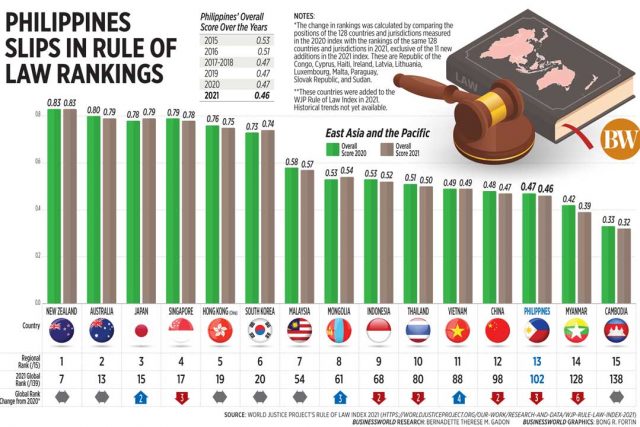
Philippines slips in rule of law rankings

RULE OF LAW in the Philippines remains one of the weakest in East Asia and the Pacific, as the country’s ranking slipped three spots in the World Justice Project (WJP) Rule of Law Index 2021. Read the full story.

Philippines slips in rule of law rankings

How PSEi member stocks performed — October 14, 2021

Here’s a quick glance at how PSEi stocks fared on Thursday, October 14, 2021.


PSEi rebounds as gov’t eases restrictions in NCR

BW FILE PHOTO

SHARES surged on Thursday after the government’s pandemic task force eased mobility restrictions in the National Capital Region (NCR) amid a decline in coronavirus disease 2019 (COVID-19) cases.

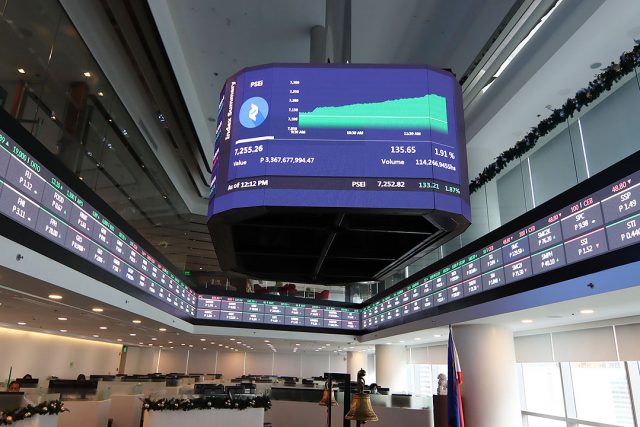
The benchmark Philippine Stock Exchange index (PSEi) climbed 114.19 points or 1.61% to close at 7,183.11 on Thursday, while the broader all shares index went up by 40.69 points or 0.92% to 4,443.95.

This is the PSEi’s highest close since Jan. 21, 2021, when the 30-member index finished at 7,140.29.

“Market went on uptrend today after IATF (Inter-Agency Task Force) decided to ease restrictions by lowering to Alert Level 3 from Level 4 starting Oct. 16 to end this month as infection rates simmer down with NCR to start jabs on [the] general population including minors,” Diversified Securities, Inc. Equity Trader Aniceto K. Pangan said in a text message on Thursday.

“Also, most Asian markets were up on rebound after the US market rebounded last night,” he added.

“Investors bought back into the Philippines market as NCR eased its restriction to Alert Level 3, thus reopening the economy and stimulating more business activity,” Regina Capital Development Corp. Head of Sales Luis A. Limlingan said in a Viber message.

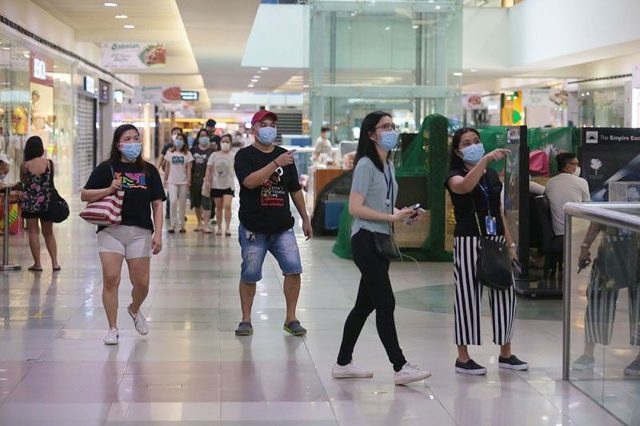
The government’s pandemic task force eased quarantine restrictions in Metro Manila, allowing movie theaters and amusement parks to open, until the end of the month.

“Overseas, investors digested the possibility of the central bank starting the tapering process by mid-November or mid-December, based on the minutes from FOMC’s (Federal Open Market Committee) September meeting,” Mr. Limlingan added.

The Federal Reserve signaled on Wednesday it could start reducing its crisis-era support for the US economy by the middle of next month, with a growing number of its policy makers worried that high inflation could persist longer than previously thought, Reuters reported.

All sectoral indices closed in the green on Thursday. Holding firms gained 158.21 points or 2.28% to 7,083.25; property went up by 65.03 points or 1.99% to 3,321.18; industrials climbed 187.88 points or 1.80% to finish at 10,604.52; services rose 11.44 points or 0.61% to 1,882.84; financials inched up by 5.61 points or 0.36% to 1,563.28; and mining and oil increased by 31.94 points or 0.30% to 10,509.80.

Value turnover decreased to P10.28 billion with 1.01 billion shares switching hands on Thursday, down from the P11.93 billion with 1.33 issues traded on Wednesday.

Advancers beat decliners, 111 versus 86, as 45 names closed unchanged.

Foreigners turned buyers anew, logging P191.09 million in net purchases on Thursday from the P219.72 million in net outflows seen the previous day. — K.C.G. Valmonte with Reuters

Peso rises as gov’t eases Metro Manila restrictions 

THE PESO climbed versus the greenback on Thursday as the government relaxed mobility restrictions in the capital and following the release of data showing the country had ample dollar buffers as of end-September. 

The local unit closed at P50.605 per dollar on Thursday, appreciating by five centavos its P50.655 finish on Wednesday, based on data from the Bankers Association of the Philippines. 

The peso opened Thursday’s session stronger at P50.59 per dollar. It dropped to as low as P50.67, while its intraday best was at P50.525 versus the greenback.  

Dollars traded declined to $936.65 million on Thursday from $1.105 billion on Wednesday. 

The peso closed stronger on Thursday as Metro Manila was placed under Alert Level 3, a trader said. 

Alert Level 3 will be imposed in Metro Manila from Oct. 16 to 31, presidential spokesperson Herminio L. Roque, Jr. said on Wednesday. Under this level, businesses will be allowed to operate at 30% indoor capacity and 50% for outdoors.  

Data on the country’s gross international reserves (GIR) as of end-September also supported the peso, Rizal Commercial Banking Corp. Chief Economist Michael L. Ricafort said. 

The country’s GIR stood at $107.156 billion as of end-September, slipping 0.74% from its $107.964-billion level as of end-August but 6.68% higher than the $100.443 billion logged a year earlier, the central bank reported on Wednesday. 

The Bangko Sentral ng Pilipinas said the decrease in the GIR level from the previous month was due to the national government’s payment of its foreign debt obligations and the lower valuation of its gold holdings. 

At the end-September level, the GIR can cover 10.8 months’ worth of imports of goods and payments of services and primary income. It is also enough to service about 7.6 times the country’s short-term external debt based on original maturity and 5.2 times based on residual maturity. 

For Friday, Mr. Ricafort gave a forecast range of P50.50 to P50.70 per dollar, while the trader expects the local unit to move within P50.45 to P50.70. — L.W.T. Noble 

DTI sees most NCR displaced workers resuming employment

PHILIPPINE STAR/ MICHAEL VARCAS

MOST of the workers in Metro Manila who were displaced by the pandemic are expected to return to the workforce with the reopening of industry and the lowering of the region’s alert level, the Department of Trade and Industry (DTI) said.

It said the displaced workers number about 300,000. It gave no details on exactly how many of them will return.

“With most of the remaining economic sectors, particularly the service sector, to be reopened in Metro Manila, and at higher operating capacities because also of the de-escalation to Alert Level 3, we expect most of the balance (300,000) displaced workers to be back to work,” Trade Secretary Ramon M. Lopez said in a Viber message Thursday.

The government’s pandemic task force has given the green light for Alert Level 3 in Metro Manila between Oct. 16 and 31.

Alert Level 3 is the third-strictest community quarantine classification implemented in places with high coronavirus case counts, with high usage rates of hospital beds and intensive care units.

On Thursday, Mr. Lopez said entertainment and karaoke bars, amusement centers for children, and playgrounds will remain closed during the period, with a “minimal” number of workers — less than 100,000 — to be affected.

Asked to estimate the percentage of closed establishments during the new alert level, he replied: “(We) will need a new survey given these new reopenings, but the base case under GCQ (general community quarantine) before was about 4% closed.”

Last month, Mr. Lopez said he supports allowing most businesses to open regardless of alert level, limiting only their capacity levels when there is a rise in infections. He said this will promote business continuity and head off an “open-close-open” operating cycle. — Angelica Y. Yang

Legislator calls for return of cash-card transport subsidies

PHILSTAR

SENATOR Sherwin T. Gatchalian has urged the government to reactivate a fuel subsidy program to offset the impact of high fuel prices, which have been rising for seven consecutive weeks.

Under the “Pantawid Pasada” program, authorities distributed fuel cards to subsidize the public transportation sector.

“I am calling on the government to protect our public utility drivers and commuters. They can do this by reactivating the Pantawid Pasada where the government will absorb the rising rates of petroleum by providing subsidies to the public,” Mr. Gatchalian, who chairs his chamber’s senate energy committee, said in a statement Thursday.

He said the government needs to spend at least P914.16 million on a three-month subsidy for the 178,244 franchise holders of public utility jeepneys.

He also called on the Energy department to monitor the compliance of oil companies with their inventory requirements.

Under Executive Order 134 signed by President Gloria Macapagal-Arroyo, oil companies must retain a minimum inventory of petroleum products.

The Department of Energy (DoE) implemented the order through a department circular in 2003 which set a minimum inventory equivalent to 15 days’ worth of demand for petroleum products, and seven days’ worth of liquefied petroleum gas.

The DoE and Land Transportation Franchising and Regulatory Board are looking at implementing a fare hike and providing cash assistance to members of the transport industry to offset the impact of higher oil prices.

This week, oil companies raised gasoline prices by P1.30 per liter (/L) this week. Meanwhile, diesel and kerosene prices rose P1.50/L and P1.45/L, respectively.

The Organization of the Petroleum Exporting Countries in a meeting with Russia agreed to stick to a plan of gradually increasing oil output despite rising demand. — Angelica Y. Yang

High meat, poultry production costs blamed on corn tariffs

REUTERS

CORN TARIFFS are driving up the cost of producing livestock and poultry, putting the industry at a disadvantage relative to imports, the Philippine Association of Feed Millers, Inc. (PAFMI) said.

Citing a study by the National Economic and Development Authority (NEDA), the association said in a statement Thursday that over the last decade, the Philippines has paid high tariffs for corn imports, and estimated corn costs at up to $0.44 per kilogram (/kg).

It said comparable prices in China, Vietnam and Thailand are up to $0.38/kg, $0.29/kg and $0.24/kg, respectively.

“Corn is a major ingredient of feed for both swine and poultry, and the Philippines is unable to benefit from the low cost of imported corn owing to high corn tariffs,” PAFMI said, referring to the findings of Philippine Institute for Development Studies Research Fellow Roehlano M. Briones.

According to the NEDA report, pork production costs are P112.40 /kg, the highest among the countries covered. The report also noted that the feed cost for hogs was equivalent to P64/kg, compared to Thailand’s P54.54/kg.

The production cost per broiler chicken was P92.40/kg in the Philippines against the Vietnam cost of P56.04/kg. Feed in the Philippines accounted for 65% of broiler production cost, as opposed to 41% for Vietnam.

“(We) have been reiterating the need for government to review the current high tariff rates on corn at a time when global supply has been tight,” PAFMI said.

It said domestic corn production is “not enough,” and this has forced feed millers to import. According to PAFMI, 80% of domestic corn is taken up by livestock growers.

Yellow corn is a key raw material in animal feed. — Angelica Y. Yang

NGO says RE plants prone to fewer outages than coal-fired facilities

NON-GOVERNMENT organization (NGO) Institute for Climate and Sustainable Cities (ICSC) said Thursday that renewable energy (RE) facilities are more reliable than coal-run plants, citing data on outages from the wholesale electricity spot market.

In a virtual briefing, ICSC Energy Transition Advisor Alberto R. Dalusung III said solar, biomass and wind plants have historically registered fewer outage days compared to coal plants.

The claim was based on an analysis of spot market data collected between 2017 and mid-June 2021, which tallied 41 outage days a year for biomass plants, which are within the allowed level of outages set by the Energy Regulatory Commission (ERC).

The corresponding numbers for solar plants and wind facilities were 13 days each over the same period.

Mr. Dalusung noted that the unavailability rates and duration of outages for biomass, solar and wind power plants are “significantly lower than that of coal plants.”

Meanwhile, coal-fired plants experienced up to 74 outage days a year, he said. This translates to “high unavailability rates” while “historically failing” to hit the ERC’s prescribed outage limits.

“Coal power plants are not reliable. They exceed ERC thresholds every year. On the other hand, RE power plants are reliable… (and) are not intermittent,” Mr. Dalusung said.

In August, coal accounted for more than half of 54.3% of the power generation mix. Renewables, on the other hand, comprised around 23%. — Angelica Y. Yang

ADVERTISEMENT
ADVERTISEMENT