Home Blog Page 736

Magnitude 6.3 earthquake shakes Afghanistan’s Mazar-e Sharif city, casualties feared

US Office of the Chairman of the Joint Chiefs of Staff/Flickr

An earthquake of magnitude 6.3 struck near one of Afghanistan’s largest cities Mazar-e Sharif early on Monday, the US Geological Survey said.

The USGS issued an orange alert in its PAGER system, which is an automated system that produces information on the impact of earthquakes, and indicated that “significant casualties are likely and the disaster is potentially widespread.”

Past events with this alert level have required a regional or national level response, the system’s alert added.

The earthquake hit at a depth of 28 kilometers near Mazar-e Sharif, which has a population of about 523,000, according to USGS.

The country’s national disaster management agency said reports on casualties and damage would be shared later. Reuters could not immediately verify the extent of damage from the earthquake.

Videos of rescue efforts being carried out to save people trapped under rubble and images of fallen debris in buildings were shared on the social media platform X. One video showed rescuers pulling what appeared to be dead bodies from rubble.

Reuters could not immediately verify the footage and the images.

Thousands died and thousands more were injured after an earthquake and a series of aftershocks hit Afghanistan in August, the Taliban administration said.

Afghanistan is especially vulnerable to earthquakes as the country is located on two major active faults that have the potential to rupture and cause extensive damage.

In 2015, an earthquake struck northeastern Afghanistan, killing several hundred people in Afghanistan and nearby northern Pakistan. Another in 2023 killed at least 1,000 people.— Reuters

Poll: Inflation likely picked up in Oct.

Shoppers check Halloween masks and costumes in Divisoria in Manila. — PHILIPPINE STAR/RYAN BALDEMOR

By Katherine K. Chan

PHILIPPINE inflation may have slightly accelerated in October amid elevated prices of food, fuel and electricity as well as a weak peso, analysts said.

A BusinessWorld poll of 17 analysts yielded a median estimate of 1.8% for the consumer price index in October. If realized, October inflation would have slightly picked up from the 1.7% clip in September but slowed from the 2.3% seen in the same month last year.

The median estimate also falls within the Bangko Sentral ng Pilipinas’ (BSP) 1.4-2.2% forecast for October.

Analysts’ October inflation rate estimates

It may also be the fastest clip in eight months or since the 2.1% in February and would match the 1.8% in March.

October could likewise mark the eighth month in a row that inflation undershot the BSP’s 2-4% target.

The Philippine Statistics Authority is set to release the October inflation data on Nov. 5.

Aris D. Dacanay, economist for the Association of Southeast Asian Nations at HSBC Global Investment Research, said inflation likely settled at 1.8% in October as prices of vegetables rose following typhoons.

“Electricity prices also increased as the depreciation of the peso over the US dollar led to higher generation charges,” he added.

The Manila Electric Co. hiked the overall electricity rate by P0.2331 per kilowatt-hour (kWh) to P13.3182 per kWh in October. 

Moody’s Analytics economist Sarah Tan said increased transport and fuel prices may have also contributed to faster inflation in October.

“Higher transport and fuel costs, together with weather-related disruptions affecting some food items, are putting mild upward pressure on prices,” she said in an e-mail.

In October, pump price adjustments stood at a net increase of P1.80 a liter for gasoline, P2.10 per liter for diesel and P1.10 per liter for kerosene.

“Fuel prices also remained stable; global oil prices cooled in October, offsetting any inflationary impact brought by a weaker peso,” Mr. Dacanay said.

In October, the peso performed weaker against the greenback at P58.850 per dollar, slipping by 65.4 centavos from its P58.196 finish at end-September. The peso also hit a new all-time low of P59.13 versus the greenback on Oct. 28.

“Downside price pressures also persisted (in October), the biggest coolant being rice. The price of regular milled rice in Metro Manila remained stable at P39.4 a kilogram despite the ongoing import ban on the grain,” Mr. Dacanay said.

Bank of the Philippine Islands Lead Economist Emilio S. Neri, Jr. said lower prices of meat, fruit and oil could have also prevented further acceleration of inflation.

“Going forward, upside risks to inflation are building as favorable rice base effects fade and the extension of the rice import suspension through yearend adds further pressure,” Mr. Neri said.

President Ferdinand R. Marcos, Jr. had earlier ordered a 60-day suspension of rice imports starting Sept. 1 to support Filipino farmers during harvest season and to stabilize rice prices.

The suspension was originally supposed to end on Nov. 2 but is now expected to be extended until end-2025. The ban applies only to imports of regular milled and well-milled rice.

STICKY CORE INFLATION
Meanwhile, core inflation is expected to remain “sticky,” analysts said.

“That is partly driven by firm inflation expectations and recent wage increases. Further, the peso has weakened broadly since June, feeding through to services and other core components as firms adjust prices to reflect higher costs,” Ms. Tan said.

Core inflation, which excludes volatile prices of food and fuel, slowed to 2.6% in September from 2.7% in August. It averaged 2.4% in the nine-month period, easing from 3.1% in the same period a year ago.

Union Bank of the Philippines Chief Economist Ruben Carlo O. Asuncion said in an e-mail that he expects core inflation to remain near that level in October.

“This stickiness suggests underlying demand-side pressures and second-round effects (e.g., wage adjustments, service costs) are persisting despite low headline inflation. It signals that disinflation is largely driven by volatile items, while structural price components remain firm,” Mr. Asuncion said.

Security Bank Chief Economist Angelo B. Taningco said in an e-mail that core inflation will likely remain elevated in the coming months amid holiday-driven spending.

Meanwhile, Maybank Investment Bank economist Azril Rosli said core inflation may settle between 2.5% and 3% until December.

“(This is due to) holiday season labor market tightening, annual rent adjustment cycles incorporating (year-to-date) inflation expectations, utility cost pass-through to business operating expenses, school year 2025-2026 tuition adjustments continuing to flow through, healthcare cost pressures from pharmaceutical imports affected by peso weakness, and the BSP’s expected continuation of supportive monetary policy,” he said in an e-mailed note.

BELOW 2% INFLATION
Despite emerging risks, analysts still expect full-year inflation to settle below the 2-4% target band of the central bank.

“Looking ahead, inflation is expected to remain manageable, averaging below the BSP’s 2-4% target this year and hovering around the midpoint of the target range next year,” Chinabank Research said in an e-mail.

If the 1.8% median estimate materializes, headline inflation would average 1.7% in the 10-month period, matching the BSP’s goal for the year.

For 2026, the central bank sees inflation accelerating to 3.1%, before slowing to 2.8% in 2027.

“Even with slight upticks in Q4, full-year inflation will likely stay below the BSP’s 2-4% target range, thanks to benign global commodity prices, improved domestic food supply, and policy support and subdued demand conditions,” Mr. Asuncion said.

This expectation gives the central bank room to continue its accommodative monetary policy until yearend and potentially in 2026, analysts said.

“We don’t expect the central bank to deviate much from their planned monetary policy easing path, especially if economic growth remains muted,” Reinielle Matt M. Erece, economist at Oikonomia Advisory & Research, Inc., said in a Viber message.

Last month the Monetary Board cut its benchmark policy rate by 25 basis points (bps) to 4.75%, the lowest in over three years. This brought its cumulative reductions to 175 bps since it began its easing cycle in August 2024.

BSP Governor Eli M. Remolona, Jr. has penciled in another 25-bp cut at the Monetary Board’s last meeting this year on Dec. 11 and potentially more in 2026 as they seek to support the economy amid weak business sentiment due to the flood control scandal.

“Looking beyond December, the BSP could still deliver up to two additional cuts in 1H 2026 if growth continues to run below potential,” BPI’s Mr. Neri said. “The central bank may also align its policy path with that of the Federal Reserve, particularly if markets begin to price in aggressive US rate cuts after Chairman Powell’s term ends in May 2026.”

Last week, the Fed delivered its second 25-bp cut this year, bringing its interest rate to the 3.75-4% range. This brought its cumulative cuts since September 2024 to 150 bps.

However, Fed Chair Jerome H. Powell signaled a pause at their next rate-setting meeting this year, citing risks from the unavailability of economic data due to the ongoing US government shutdown.


Q3 underspending to ‘temporarily’ drag growth — Recto

Unfinished roadworks are seen along a street in Caloocan City, Oct. 11. The Public Works department has indefinitely suspended all road reblocking activities due to allegations of corruption. — PHILIPPINE STAR/MIGUEL DE GUZMAN

By Aubrey Rose A. Inosante, Reporter

GOVERNMENT UNDERSPENDING in the third quarter, mainly due to a corruption crackdown that curbed public disbursements, is expected to temporarily dent economic growth this year, Finance Secretary Ralph G. Recto said.

“This (underspending in the third quarter) is expected to temporarily weigh on government final consumption expenditure and the overall GDP (gross domestic product) growth,” he told BusinessWorld in a Viber message on Oct. 31.

The Marcos administration only disbursed P1.46 trillion in the third quarter, data from the Bureau of the Treasury showed, P141.73 billion less than its P1.6-trillion program for the period. This is mainly due to lower spending by the Department of Public Works and Highways, which is at the center of a corruption scandal involving flood control projects.

“Nevertheless, the government’s swift and decisive action following the recent flood control controversy marks the beginning of a major government cleanup that will lead to stronger institutions, better governance, and faster growth in the medium term,” Mr. Recto said.

President Ferdinand R. Marcos, Jr. had flagged anomalous flood control projects during his State of the Nation Address in late July. This sparked several investigations into alleged corruption involving lawmakers, government officials, and private contractors.

“The controversy has also revealed that not all capital expenditures translate into growth. And now that we’re plugging those leaks and reallocating funds to high-impact investments — such as education, healthcare, agriculture, and digitalization — we will only grow faster,” Mr. Recto said.

As of end-September, the National Government has released P4.48 trillion, equivalent to 73.72% of its P6.08-trillion full-year disbursement program for 2025.

Economic managers, including Mr. Recto, earlier warned that gross domestic product (GDP) growth likely softened in the third quarter. The government is targeting 5.5-6.5% GDP growth this year.

Official GDP data will be released by the Philippine Statistics Authority on Nov. 7.

Mr. Recto also vowed that “catch-up measures” are underway to keep spending on track and fuel growth.

“Although there has been a slowdown in government spending as we continue to address the flood control corruption controversy, this reflects the administration’s commitment to spend only on legitimate programs and projects,” he said.

He noted the “short-term adjustment” will pave the way for more efficient and transparent public expenditures in the future.

“Having identified and removed anomalous projects, we are ensuring that taxpayers’ money goes to genuine initiatives, eliminating waste and paying only for the true cost of government programs,” Mr. Recto said, adding the President has directed government agencies to cut costs by 50%.

Economy Secretary Arsenio M. Balisacan and Budget Secretary and Development Budget Coordination Committee Chairperson Amenah F. Pangandaman has earlier said the 5.5% to 6.5% GDP growth target remains achievable.

However, some economists have lowered their growth forecast for the Philippines, citing the corruption probe that led to lower investor sentiment.

Last week, Nomura Global Markets Research slashed its 2025 growth forecast for the Philippines to 4.7% from 5.3%, noting the mounting downside risks from a corruption scandal tied to flood control projects.

Sought for comment, Mr. Recto said Nomura’s downgrade is “overly conservative.”

“To reach a 4.7% GDP for 2025, this means the economy will grow by just 4% in the second half of the year. This fails to account for progress made in terms of lower inflation and improvements in the labor market, which will boost household spending, recovery in the agriculture sector, continued growth in services, and stronger performance of merchandise exports despite higher US tariffs,” he said.

Meanwhile, Mr. Recto said the Department of Finance (DoF) is regularly assessing the performance of revenue-collecting agencies as revenues are expected to be affected by the corruption scandal.

“The DoF… is open to making the necessary adjustments, when necessary,” he said. “Nevertheless, the economic managers remain committed to fiscal consolidation by closely monitoring the latest developments internally and externally to ensure we attain the set deficit targets.”

Philippines extends rice import ban until end-2025

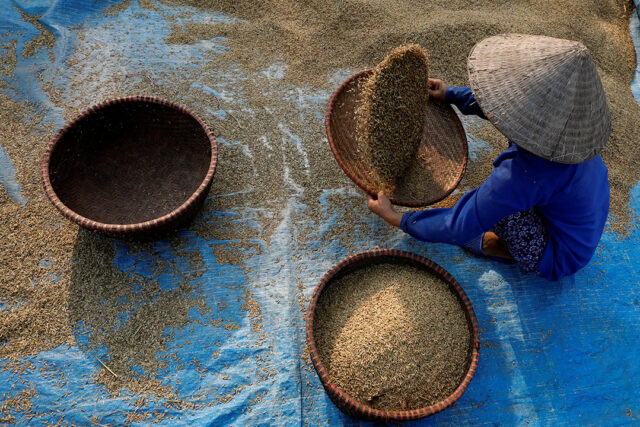
A farmer harvests rice by a paddy field outside Hanoi, Vietnam on June 10, 2019. Vietnam’s rice exporters have raised concern over the impact of the Philippines’ ban on rice imports and urged their trade ministry to contest the measure. — REUTERS/KHAM

PHILIPPINE President Ferdinand R. Marcos, Jr. approved the extension of the country’s rice import ban until yearend to help stabilize farmgate prices for unmilled rice, Agriculture Secretary Francisco P. Tiu Laurel, Jr. said on Sunday.

An executive order formalizing the decision would be issued on Nov. 3, Mr. Laurel said in a statement.

“With the import ban having little impact on retail prices and supply of rice but a significant effect on the farmgate price of palay, President Marcos deemed it necessary to extend the suspension for two more months,” he added.

Palace Press Officer Clarissa A. Castro did not immediately reply to a Viber message when asked for confirmation.

The Marcos administration first imposed the import halt on Sept. 1 to counter falling palay prices ahead of the wet harvest season. 

Prices briefly improved after the suspension but began easing again as the policy neared its Oct. 31 expiry.

The country is the world’s top rice importer, according to the US Department of Agriculture (USDA). However, due to the rice import ban, it lowered its 2025 forecast for Philippine rice imports to 4.9 million metric tons (MT) from 5.4 million MT.

As of August, the Philippines had already imported 2.58 million MT of rice this year, compared with 4.81 million MT in 2024.

Mr. Laurel said the extended ban, coupled with assistance to farmers and fisherfolk and the implementation of a floor price for palay, would provide continued relief to rice farmers.

Mr. Laurel said the extension will allow the government to conduct a better assessment of the ban’s impact on the market while “continuing to protect local producers from the downward pressure of cheaper imports.”

At a Senate hearing last month, the Agriculture chief cited excessive import volume, poor-quality harvest, and adverse weather as factors that drove farmgate prices lower.

The Department of Agriculture (DA) estimated that the national rice supply will remain sufficient even with a four-month import suspension.

Retail rice prices have stayed relatively stable, according to the DA’s Agribusiness and Marketing Assistance Service. By November, well-milled rice is expected to average P42 per kilo, while regular-milled varieties will hover around P40 per kilo.

Sought for comment, Roy S. Kempis, retired agriculture economics professor at the Pampanga State Agricultural University, said he supported the extension of the rice import ban.

“This allows adjustments to align with (1) the desired outcome of higher and stable farmgate prices expected by farmers, (2) the predicted farmer behavior to produce and supply more rice because of the incentive to rake in more revenues and profits at the end of each cropping given a higher and stable farmgate price regime, and (3) the clearer policy regime surrounding trade, prices, production, and supply,” Mr. Kempis said in a Viber message.

Jayson H. Cainglet, executive director of the Samahang Industriya ng Agrikultura, urged the government to restore rice import tariffs to their original levels — 35% for Association of Southeast Asian Nations (ASEAN) countries and 50% for non-ASEAN nations — and to strengthen state participation in the palay market.

He said the current 15% tariff has kept farmgate prices low by encouraging cheaper imports, undermining local producers.

Mr. Cainglet added that the rice import ban and Executive Order (EO) No. 100, which established a floor price for unmilled rice, have failed to lift palay prices to the equitable level of P18 per kilo.

He also noted that limited government procurement, covering only 2-4% of total harvest, leaves most of the market under the control of private traders and millers.

“The institutionalization of a palay floor price is a crucial reform,” he said via Viber.

“However, its success depends on the government’s capacity and commitment to buy directly from farmers at scale, ensuring that state procurement truly sets a price floor rather than a symbolic benchmark.”

On Oct. 25, Mr. Marcos signed EO 100, which established a floor price for unmilled rice to protect farmers from sharply falling farmgate prices and to promote fair returns on production.

The order mandated the DA to determine and regularly adjust the floor price based on production costs, market conditions, and regional disparities. — Chloe Mari A. Hufana

Debt service bill jumps to P328 billion in Sept.

BW FILE PHOTO

THE NATIONAL Government’s (NG) debt service bill more than tripled in September as the government increased both amortization and interest payments, the Bureau of the Treasury (BTr) said.

The latest data from the Treasury showed that the debt service bill surged by 250% to P327.89 billion in September from P93.61 billion in the same month last year.

Month on month, the debt service bill slides by 50.67% from P664.72 billion in August.

Debt service refers to the payments made by the government on domestic and foreign borrowings.

The bulk, or 75.08% of debt payments, was made up of amortization payments, the BTr data showed.

In September, amortization payments soared by 1,146% to P246.19 billion from P19.76 billion in the same month a year ago.

This was mainly composed of principal payments on domestic debt, which sharply grew to P237.93 billion in September from P87 million in the same month last year.

Amortization paid on foreign debt plunged by 57.99% to P8.26 billion in September from P19.67 billion in 2024.

Meanwhile, interest payments stood at P81.7 billion in September, up by 10.63% from P73.85 billion a year ago.

Domestic interest payments also increased by 17.81% to P65.27 billion in September from P55.41 billion in the same month last year.

Broken down, P42 billion went to fixed-rate Treasury bonds, P19.18 billion to retail Treasury bonds, P4.04 billion to Treasury bills (T-bills) and P48 million to others.

Interest payments for foreign borrowings slipped by 10.92% to P16.43 billion in September from P18.45 billion in the same month in 2024.

“This is largely due to the large Treasury bond maturity worth P288 billion in September 2025 in terms of large principal payments of the NG,” Rizal Commercial Banking Corp. Chief Economist Michael L. Ricafort said in a Viber message over the weekend.

NINE-MONTH PERIOD
The NG debt service bill stood at P1.87 trillion in the first nine months of the year, up 13.69% from P1.64 trillion in the same period last year.

The nine-month tally already accounted for 90.97% of the P2.05-trillion debt service program this year.

Amortization payments, which made up the bulk of total payments, rose by 13.43% to P1.2 trillion in the January-to-September period from P1.06 trillion. This was 99.73% of the P1.21-trillion full-year amortization program.

Principal payments on domestic debt increased by 14.4% to P1.01 trillion, while payments on external debt rose by 8.7% to P196.48 billion.

Meanwhile, interest payments grew by 14.15% to P665.85 billion as of end-September from P583.29 billion a year ago. This was 78.52% of the P848.03-billion programmed interest payments for 2025.

Interest payments on domestic debt stood at P494.39 billion, 18.24% higher than P418.13 billion in 2024.

This was made up of P334.14 billion in fixed-rate Treasury bonds, P118.89 billion in retail Treasury bonds, P34.4 billion in T-bills and others (P6.96 billion).

On the other hand, interest payments on external debt rose by 3.81% to P171.46 billion as of end-September from P165.17 billion in the same period a year ago.

In the coming months, Mr. Ricafort said no large Treasury bonds will mature in the fourth quarter, which will likely temper the debt servicing bill.

“Large Treasury bond maturity of at least P200 billion each are scheduled in February 2026 and April 2026,” he said.

The US Federal Reserve and Bangko Sentral ng Pilipinas’ cumulative rate cuts since the later part of 2024 may have helped to trim NG’s interest payments, he said.

However, this may be offset by the peso weakness against the US dollar, which could lead to higher servicing of foreign debt, Mr. Ricafort said.

The peso plunged to a record low of P59.13 per dollar on Oct. 28.

The NG debt stock fell to P17.46 trillion as of end-September but still remained above its projected P17.36-trillion ceiling by end-2025. — Aubrey Rose A. Inosante

Philippine Startup Week 2025 returns to champion Filipino innovation, entrepreneurship

The country’s largest startup gathering, Philippine Startup Week (PHSW) 2025, will take place from Nov. 10 to 14, highlighting efforts to scale Filipino innovation and support startups aiming to expand beyond local markets.

The country’s premier startup gathering, themed “Scaling Filipino Innovation: Start Local, Go Global,” will feature insights on the world-class nature of local startups and how they can seize opportunities to broaden their impact globally.

Now in its sixth year, PHSW is jointly organized by the Department of Science and Technology (DoST), Department of Trade and Industry (DTI), and Department of Information and Communications Technology (DICT). The three agencies also lead the Innovation Startup Act (ISA) Steering Committee, which coordinates national initiatives to strengthen the country’s startup ecosystem.

This year’s edition, organized with the National Development Company (NDC) and the Strategic and Collaborative Alliance for Leveraging Ecosystems of Startups-National Capital Region (SCALE NCR), will be held at the newly opened Philippine Innovation Hub in Marikina. The five-storey venue will host conferences, startup expos, community events, and partner showcases throughout the week.

PHSW 2025 will revolve around five main tracks: Discover, which focuses on exploring technopreneurship and startup creation; Collaborate, which emphasizes partnerships among stakeholders; Develop, which provides mentorship and support for scaling; Showcase, which spotlights tech startups through pitching events; and Invest, which promotes funding for high-impact ventures.

Attendees can also hear from the ISA on upcoming initiatives to strengthen the country’s startup ecosystem, and network with prominent startup enablers, champions, venture capital (VC) firms, and top startups of the country.

Philippine Startup Week 2025 is the country’s largest startup conference, dedicated to showcasing Filipino innovators who create solutions for local and global challenges. It’s the space for collaboration, connection, and inspiration.

Founders, investors, advocates, and anyone interested in exploring the Philippine startup community are invited to come.

Visit www.phstartupweek.com for more information about the event from participant registration to exhibitor, partner, and community event opportunities.


SparkUp is BusinessWorld’s multimedia brand created to inform, inspire, and empower the Philippine startups; micro, small and medium enterprises (MSMEs); and future business leaders. This section will be published every other Monday. For pitches and releases about startups, e-mail to bmbeltran@bworldonline.com (cc: abconoza@bworldonline.com). Materials sent become BW property.

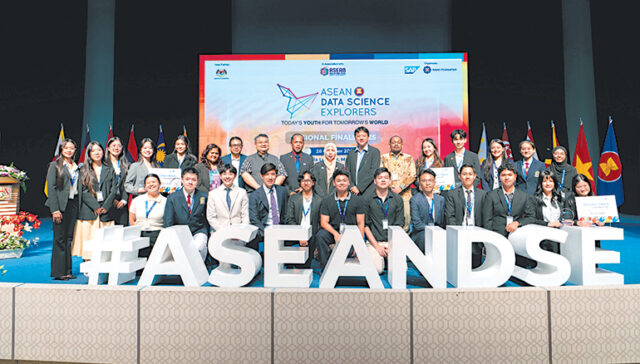
Data-driven ideas take center stage at ASEAN Data Science Explorers 2025 regional finals

The ASEAN Foundation and SAP concluded the ASEAN Data Science Explorers (ASEAN DSE) 2025 Regional Finals in Kuala Lumpur, Malaysia, gathering 22 students from secondary and tertiary institutions across the 10 ASEAN member states to present data-driven solutions to regional socioeconomic challenges.

Now in its ninth year, the program encourages youth to apply data analytics to real-world issues using SAP Analytics Cloud, with this year’s projects aligned with six key Sustainable Development Goals (SDGs): Zero Hunger, Good Health and Well-being, Clean Water and Sanitation, Sustainable Cities and Communities, Responsible Consumption and Production, and Climate Action.

Team DataMinions from Lao PDR was officially named the Regional Winner of ASEAN DSE 2025 for presenting ‘Namjai Smart Water Tank,’ a device that filters and detects harmful substances in water while alerting households, NGOs, and authorities to maintain water quality. The innovation targets clean water challenges in Lao PDR, Cambodia, and the Philippines. Team Mamamamoodeng from Thailand and Team MyKXLab from Malaysia placed first and second runner-up, respectively.

Representing the Philippines, Team Sharksfin, composed of Lizzie Annika Montemayor and Val Allen Eltagonde, presented ‘HydroLink,’ a two-pronged system addressing the water crisis in Southeast Asia. The project combines a field-deployed groundwater monitoring device with a mobile application and centralized dashboards to promote better water management.

According to a 2022 ASEAN Foundation-Google study, 72.2% of underserved youth in the region have low or no advanced digital skills. The ASEAN DSE program seeks to bridge this gap by equipping young people with data literacy and analytical capabilities essential to the future job market.

Supported by the Ministry of Education Malaysia, the regional finals formed part of the ASEAN Chairmanship 2025 events. The Ministry facilitated the participation of high-level delegates from all 10 member states and emphasized the importance of fostering digital readiness among ASEAN youth for sustainable development.

“The ASEAN DSE program is a prime example of how regional collaboration can drive innovation and build critical future skills amongst our youth. Over the past nine years, the program has played a significant role in advancing digital literacy in Malaysia, impacting students and educators,” said Ybhg. Dr. Mohd. Azam Ahmad, director-general, Ministry of Education Malaysia.

Dr. Piti Srisangnam, executive director of the ASEAN Foundation, emphasized the program’s pivotal role, “The ASEAN DSE program is a key initiative to nurture young talents across our region. By providing them with digital tools and data skills they need, we empower them to think critically and innovate solutions to real-world problems, helping both their personal growth and the development of ASEAN as a whole.”

Since its launch in 2017, the ASEAN DSE program has empowered more than 111,000 young people aged 15 to 30, including those from underserved communities, and engaged over 3,300 educators across the region, with women making up 55% of the beneficiaries.


SparkUp is BusinessWorld’s multimedia brand created to inform, inspire, and empower the Philippine startups; micro, small and medium enterprises (MSMEs); and future business leaders. This section will be published every other Monday. For pitches and releases about startups, e-mail to bmbeltran@bworldonline.com (cc: abconoza@bworldonline.com). Materials sent become BW property.

Time traveling in Türkiye

THE THEATER in the ancient city of Hierapolis, which was used for public events and ceremonies, featured columns inscribed with historical events and mythology.

By Anna Isabel C. Sobrepeña

THE WINDOW framed the blush of a new day as the plane descended into Istanbul. Returning to Türkiye for a fourth time did not diminish the enigma and romance of the only country nestled between two continents. Instead, mystery and enchantment were heightened as the itinerary covered a route through a modern skyline into an epoch intimating humanity’s shared past.

Our guide, Huseyin Demir, factored in the transcontinental landmass that contributed to the rich history and cultural heritage. About 3% of Türkiye is located in southeastern Europe while 97% is geographically part of Asia. Waterways separate the small East Thracé or European side from the peninsula of Anatolia which is located in Asia. It was access to these bodies of water as well as the Mediterranean and Aegean seas which supported the development of settlements in the fertile lands. This peninsular country linked Europe and Asia, and even Africa, thereby becoming a crossroads for trade, technologies, and an exchange of cultures.

Besides being a natural resource, the Turkish straits of the Bosporus and Dardanelles were advantageous for naval power. Empires were established and cities flourished. Ruins in Urla, Denizli, Burdur, Antalya, and Side are silent vestiges of the greatness that once was.

ROSE OILS AND TEAS
It was a little over an hour by plane from Istanbul to Izmir, one of the oldest prehistoric cities that flourished through the centuries and remains a thriving metropolis. This was apparent upon arrival at the Izmir Adnan Menderes International Airport, a modern structure with vaulted roofs, indoor gardens, and natural lighting.  The facility served 11.5 million passengers in 2024 and has direct rail transit to the urban center.

The scenery along the way was no different from other places in Europe. It was only when we were taken to Konak, a municipality in Izmir, that it felt like we were in Türkiye. The Kemeralti district where the locals go for their everyday requirements, was lined with shops selling apparel, food, jewelry, rose oils, teas, soap, and houseware. Despite the 14-hour travel time (layover not included), the adrenaline kicked in for a shopping spree. It was, however, the perfect appetite stimulant to the amazing meal that followed.

CULTURE IN A CUP
The Ayşa Boşnak Börekçisi restaurant is tucked in an alley inside the Kemeralti bazaar and offers a tantalizing spread of hot and cold food in the tradition of Bosnian and Ottoman cuisine. Cited in the Michelin guide, the cuisine is a gastronomic experience of home-cooking style. Aysa, the chef-owner, who wears the toque and traditional chef’s white jacket with the Michelin insignia sewn on, explained through an interpreter that the stew served that day was slow cooked using Ottoman ingredients. Many of the dishes stirred in a fusion of Mediterranean and Middle Eastern flavors simmered in their own juices. Turkish food draws largely from its Ottoman heritage, among others, an intertwining of cultures, rituals, and traditions.

One thing that is distinctly Türkiye is Turkish coffee. It was just a short walk to another alley lined with coffee shops. Once settled in Emel Café, the proprietor gave us an education on the art of making the after-meal beverage. Coffee is not grown in Türkiye. Instead, high quality arabica beans are sourced from Central and South America. These are blended and roasted together before being made into a fine ground. A portion is spooned into a cezve, a small metal cup with a handle, where water proportioned to the coffee is poured. This is the point where sugar is added for those who prefer a sweet drink. It is not added after the brew has been boiled. The cezve is placed over a low fire till a foam rises. Once the foam covers the top, the coffee is poured into a small cup that captures the foam. It is served with a glass of water and a Turkish delight.

ANCIENT EXPLORATION
While food is always an interesting way to get to know a country’s culture, the Izmir Culture and Arts Factory provided a deeper insight into Türkiye’s past. The museum, which was a tobacco factory since 1884, enshrines the history of a nation in archeological and ethnographic exhibitions, paintings, and sculpture in halls within the 20,000-square-meter complex. When the facility ceased tobacco production in 2004, the Ministry of Culture and Tourism repurposed the industrial heritage facility into a modern museum with libraries and venues for art workshops and events. It holds an impressive collection of artifacts, carvings, fabric, jewelry, and statues from centuries ago.

While these were impressive testaments to the early civilizations that thrived in the region, visiting the ancient cities themselves was nothing less than phenomenal and astounding.

The ancient Phrygian city of Hierapolis, now known as Pamukkale, is a UNESCO World Heritage site that dates back to 190 BCE. Greco-Roman imprints mark the ruins of what was once a sacred city. It survived until 1334 when it was destroyed by an earthquake and abandoned by the survivors. Archeological work in 1957 uncovered vestiges of temples, baths, and Greek structures, with a theater as the main monument of the site. Restoration work continues to this day with excavations and methodical studies providing evidence of past glories.

Adjacent to the ruins is a series of terraced basins known as the travertines. Mineral-rich water from hot springs created white rock formations over a thousand years as it cooled on the surface. This natural phenomenon is a popular attraction with visitors wading in the flowing water.

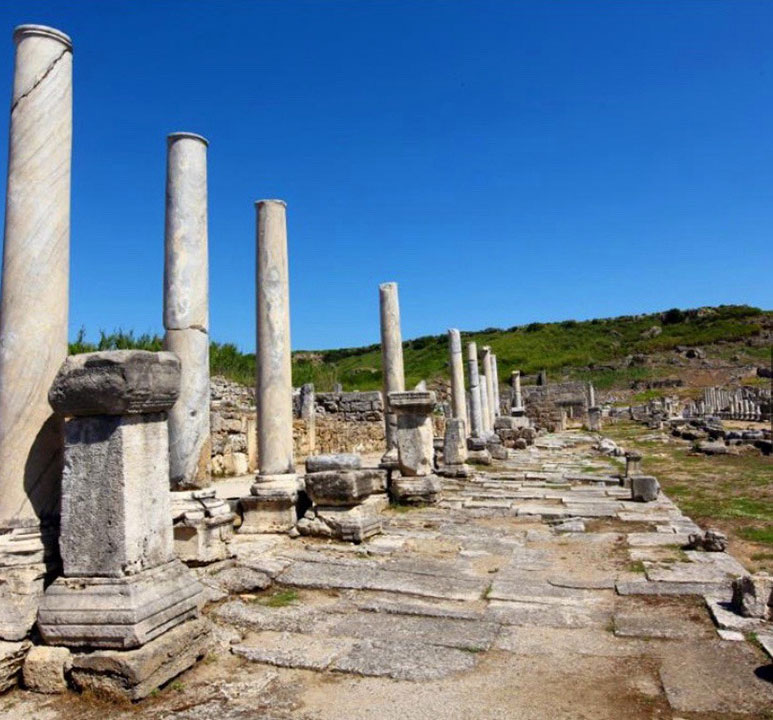
Perge in Antalya was another antique city on our itinerary. We walked under the arched entrance of a Roman gate into a city known as a center for trade. The main attraction was the agora where social life and mercantile activity took place. Daily life happened amidst colonnaded streets and mosaic floors, evidence of the elevated Roman sensibilities. There were baths for cleansing and socializing, and a stadium for sports and entertainment such as gladiator fights.

STORY OF THE ANCIENT STONES
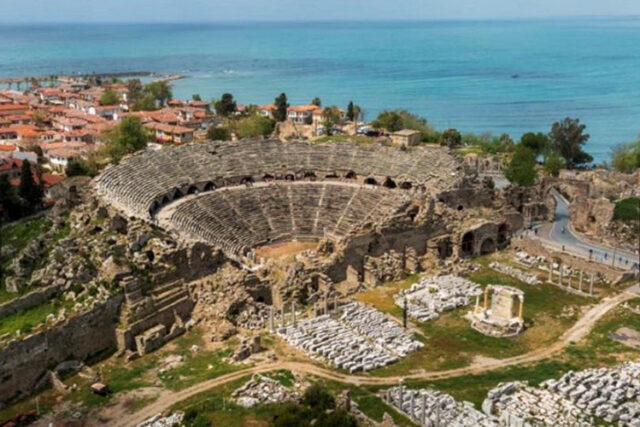
It was, however, among the ruins in Side that allowed a more reflective visit to the past. Running behind schedule and arriving past closing time, Huseyin put in a call that gained us entry at the golden hour. The outdoor museum was practically ours alone. Excavations had unearthed a cultural melting pot of a Hellenic populace living under Roman rule. The combination of Greek artistry and planning with Roman construction skills built a city with a monumental fountain, Roman aqueducts, an odeon, a great bath, streets lined with towering columns and mosaic floors that have remained intact through the centuries.

A setting sun cast an ethereal glow over the landscape of ancient stones. Inscriptions and drawings on marble and limestone told stories of life thousands of years ago. These were remnants of a past yet standing in the midst of what was once Greco-Roman splendor, I wondered if I was looking at our future. No matter how advanced the ancient civilizations had been, all that remains of them now are these stones. Could it be our fate as well?

DMAP calls for ethical data and AI practices at DigiCon 2025

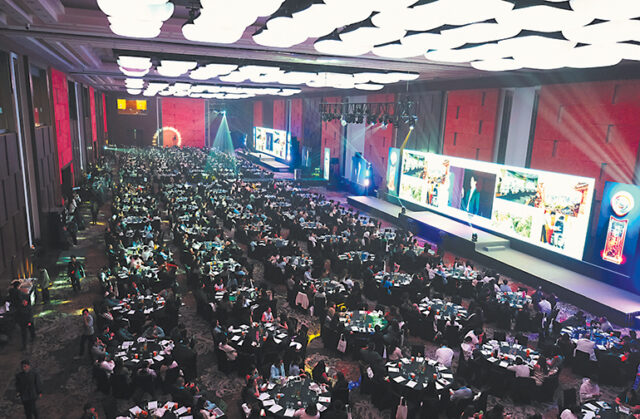
The Digital Marketing Association of the Philippines (DMAP) underscored the importance of responsible and ethical personalization in the digital marketing industry during the tenth Digital Congress (DigiCon) 2025, held on Oct. 16-17 at the Marriott Grand Ballroom in Pasay City.

With the theme “The Age of ‘i’: The Power of Personalization,” this year’s event brought together more than 2,000 delegates from the marketing, advertising, business, academic, and media sectors to discuss emerging technologies and trends shaping customer engagement.

Over two days, participants attended sessions across five tracks — Innovation (AI), Intelligence (Data Science), Immersive (Retail and Activations), Impact (Brand Building), and Integration (Business Transformation). Discussions centered on hyper-personalized customer experiences, ethical data practices, AI governance, content development, and strategies to future-proof businesses in an evolving digital landscape.

In his keynote speech, global emerging technologies expert Dex Hunter-Torricke highlighted the fast-evolving digital landscape and how it’s pushing the industry to keep up with exponentially rising customer expectations.

“The next decade is going to be the most challenging moment in history. We’re entering an era now where AI, as it gets more and more intelligent, opens up the possibilities of hyper-personalization, something that is vastly more bespoke and customized to the needs of every single one of our customers, communities, and stakeholders,” Mr. Hunter-Torricke, who served as a communications executive at Facebook and SpaceX, said.

DigiCon 2025 Chair Alan Fontanilla noted the importance of trust and consent as primary currencies in building a respectful, value-driven customer experience.

“Personalization has been democratized. Everyone, from big brands to small businesses and entrepreneurs, now has access to tools once reserved for the few. However, just because we can personalize, doesn’t mean we always should. Consent, privacy, ethics, and trust are the currencies of modern marketing. People don’t just want relevance, but they want respect. Let’s use personalization not just because we can, but because it truly adds value,” Mr. Fontanilla said.

This year, DigiCon 2025 delegates had the opportunity to earn program certifications upon completing the program tracks in partnership with the Certified Digital Marketer (CDM). This initiative aligns with DMAP’s mission to future-proof the industry by providing crucial insights and skills, empowering marketers to stay ahead of the curve in the digital age amid evolving consumer behaviors and rapid technological shifts.

“The future is connected and powered by AI, but its success hinges on our collective commitment to responsible practices. DigiCon 2025 has not only charted the course toward hyper-personalization but has equipped our industry with the ethical compass needed to navigate it. The conversations started here will ensure DMAP and the whole digital marketing ecosystem remain at the forefront of digital excellence,” DMAP President Miko David said.

DigiCon 2025 is sponsored by DoubleVerify, Hit Productions, Petal Ads by Huawei, Unilever Philippines, Dailymotion, GCash for Business: Partner Solutions, m360 and AdSpark, McDonald’s, Meltwater, Near Creative, Pancake, TikTok, UnionBank of the Philippines, Yazle, Gigil Metama, Google, Inquiro Inc., Investing in Women, Pureprofile, Senco Link Technologies Inc., and Rakuten Viber.

Esteemed media outlets AGC Power Holdings Corp., Cignal TV, GMA 7, MBC Media Group, Rappler, The New Channel, Inquirer, Outcomm, The Pod Network, The RJ Ledesma Podcast, ZBNI, adobo Magazine, BusinessMirror, BusinessWorld, CoinGeek, DiscoverMNL, DOOH, The Philippine STAR, and WhenInManila.com served as media partners.

Meanwhile, Certified Digital Marketer, Uniquecorn Strategies, Devant, Eastern Communications, Havas Ortega, IDEASXMACHINA Hakuhodo, Manila Marriott Hotel at Newport World Resorts, Meta, Plan B, Sinematika, Synergy Market Research + Strategic Consultancy, Creative Collective – Lennon Group, Tony &, and Leron Leron Sinta, a11y media, QR Tiger, Slash by Mineski, Jack ‘n Jill and Granny Goose, APC Events, Arsysmedia, Futech Innovations, Devant, Future Proof PH, Holiday Inn Express Manila Newport World Resorts, One Asia, Chivas Regal, and Enchanted Kingdom served as the event partners with support from L’Oréal Philippines.

To learn more about DigiCon 2025, you may visit https://www.digicon.com.ph or email conference@dmap.com.ph.


SparkUp is BusinessWorld’s multimedia brand created to inform, inspire, and empower the Philippine startups; micro, small and medium enterprises (MSMEs); and future business leaders. This section will be published every other Monday. For pitches and releases about startups, e-mail to bmbeltran@bworldonline.com (cc: abconoza@bworldonline.com). Materials sent become BW property.

SEC eyes higher threshold for audited financial reports to ease MSME burden

PHILIPPINE INFORMATION AGENCY

THE Securities and Exchange Commission (SEC) wants to raise the asset or liability threshold for companies required to submit audited financial statements to reduce compliance costs for micro, small and medium enterprises (MSME).

In a policy paper submitted to the Department of Finance (DoF) on Oct. 28, the corporate regulator recommended that companies with total assets or liabilities of P3 million or less be allowed to file annual financial statements certified under oath by their treasurer or chief financial officer, instead of audited reports.

“We have repeatedly said that MSMEs are the backbone of the Philippine economy, which is why the SEC remains committed to implementing measures that will foster a business environment that is easier to navigate for our budding entrepreneurs,” SEC Chairman Francis Ed. Lim said in a statement on Friday.

At present, corporations with total assets or liabilities of at least P600,000 must submit audited financial statements. Those below the threshold only need certified statements.

Under the proposed rule, the SEC said it would continue to exercise its visitorial powers to maintain oversight, assuring that the policy would not weaken supervision of entities involved in public infrastructure or other regulated sectors that typically exceed the P3-million limit.

If approved, the policy would apply to financial statements for fiscal years ending on or after Dec. 31. The SEC said the change would streamline regulatory requirements and lower operating costs for small firms.

“Our proposed policy will not only improve the ease of doing business, but also cut unnecessary compliance requirements for micro entities, in support of the government’s goal of driving inclusive economic development,” Mr. Lim said.

In October, the SEC reported granting more than P80 million in fee discounts across 40,157 transactions processed under three memorandum circulars issued from July to October, with more than half of the savings benefitting MSMEs.

MSMEs, which account for more than 99% of business establishments and 63% of the workforce in the country, contribute about 40% to the Philippine economy. — Alexandria Grace C. Magno

For Anchor Land’s Elizabeth Ventura, holistic living redefines luxury residences

Anchor Land Property Copeton Baysuites

The next generation of real estate is starting to be defined by the idea of a residential community that engenders a holistic, sustainable lifestyle. This can be seen in wellness-oriented spaces, flexible living terms, as well as living spaces that prioritize fine design, privacy, and amenities.

This can be truly said for higher-income households, as Elizabeth Ventura, president of luxury real estate developer Anchor Land, shared in an interview with BusinessWorld.

 “Today’s high-end investors value tourism-driven developments that seamlessly integrate thoughtful design, privacy, and personalized service with lifestyle-enhancing amenities such as wellness facilities, curated leisure spaces, and tech-enabled living,” Ms. Ventura said in an email.

“For them, true luxury lies not only in the quality of life but also in long-term wealth preservation—owning a tourism-inspired property that balances exclusivity, functionality, and investment stability in a prime, strategic location.”

Digital Lockset

Sustainability, Ms. Ventura noted, has become a mark of true luxury as investors are increasingly drawn to properties that emphasize efficiency, sustainability, and long-term livability.

Modern developments now commonly feature green spaces, natural ventilation, energy-efficient systems, and smart home technologies, reflecting a broader shift toward wellness-oriented and environmentally conscious design.

“We’ve embraced this evolution at Anchor Land. Integrating smart technology is no longer an afterthought but a key principle embedded early in our design process. Our team actively keeps pace with the latest advancements in green architecture and collaborates with regional experts to ensure our developments meet global sustainability standards,” she said.

Aspiro-Therapy System

Fully automated units, according to the executive, are equipped with intelligent lighting and air-conditioning controls to minimize energy consumption. The Aspiro-Therapy System, meanwhile, replaces standard exhausts as a cost-efficient and self-sustaining alternative, while smart digital locksets enhance security and convenience within Anchor Land’s developments.

Complementing these is Anchor Land’s Fiber-Optic infrastructure, which ensures high-speed connectivity and uninterrupted browsing, empowering residents to work, study, and stay connected seamlessly from home.

Smart Property Technology

“We also place great importance on open, breathable spaces—seen across all our projects through offerings that range from resort-style settings to pockets of gardens thoughtfully woven into expansive outdoor amenity floors—promoting a lifestyle centered on wellness, comfort, and balance,” Ms. Ventura said.

Besides sustainability, Ms. Ventura also reiterates how luxury properties finely strike the balance between accessibility to urban essentials and perks and retreat from the urban hustle.

“A luxury property that allows its residents to retreat into a serene, well-curated environment while remaining connected to the city’s dynamic rhythm naturally commands higher demand and long-term value,” she explained. “This balance drives sustained appreciation: prime locations ensure continuous interest and liquidity, while exclusivity safeguards the property’s prestige and desirability.”

Club-in-a-Condo Concept Hanging Glass Lounge at One Legacy Grandsuites

Anchor Land, for its part, further strengthens this balance with its signature Club-in-a-Condo concept, which is embodied by top-of-the-line, vacation-style amenities in its premier developments. These amenities offer residents the privilege of resort-like leisure within the privacy of their own community.

Club-in-a-Condo Concept Indoor Theater at 202 Peaklane

“Designed to be both rare and refined, such amenities are exclusive to select Anchor Land properties, ensuring that each development retains its distinction and lasting market strength,” Ms. Ventura noted. “Together, these elements create a formula for enduring investment performance and a lifestyle defined by understated luxury.”


Spotlight is BusinessWorld’s sponsored section that allows advertisers to amplify their brand and connect with BusinessWorld’s audience by publishing their stories on the BusinessWorld Web site. For more information, send an email to online@bworldonline.com.

Join us on Viber at https://bit.ly/3hv6bLA to get more updates and subscribe to BusinessWorld’s titles and get exclusive content through www.bworld-x.com.

Treasury bills, bonds may fetch mixed rates as Fed view shifts

TREASURY.GOV.PH

RATES of the Treasury bills (T-bills) and Treasury bonds (T-bonds) to be offered this week could end mixed following hawkish signals from the US Federal Reserve.

The Bureau of the Treasury (BTr) will auction off P22 billion in T-bills on Monday, or P7 billion in 91-day securities and P7.5 billion each in 182- and 364-day papers.

On Tuesday, the government will offer P35 billion in a dual-tenor T-bond offering, or P20 billion in reissued seven-year papers with a remaining life of four years and eight months, and P15 billion in reissued 10-year securities with a remaining life of nine years and five months.

T-bill and T-bond rates could follow the mixed week-on-week movements seen at the secondary market after Fed Chair Jerome H. Powell signaled that a December rate cut could be unlikely, Rizal Commercial Banking Corp. Chief Economist Michael L. Ricafort said in a Viber message.

“Yields on government securities traded flat to 2 basis points (bps) higher as players were spooked by the hawkish Fed cut. Bullish sentiment remains intact though, and players are merely playing it safe heading into [this] week’s five-year and 10-year auction,” a trader said in an e-mail.

The trader said the bond offerings will likely be “well received,” with the reissued seven-year papers expected to fetch rates of 5.635% to 5.675% and the reissued 10-year debt seen drawing bid yields of 5.9% to 5.95%.

At the secondary market on Friday, yields on the 91- and 182-day T-bills went down by 3.12 bps and 0.11 bp week on week to end at 4.8951% and 5.0966%, respectively, based on PHP Bloomberg Valuation Service Reference Rates data as of Oct. 30 published on the Philippine Dealing System’s website. On the other hand, the 364-day paper rose by 1.55 bps to close at 5.1781%.

Meanwhile, the seven-year bond increased by 1.14 bps week on week to end at 5.8366%, while the five-year debt, the benchmark tenor closest to the remaining life of the reissued papers to be offered this week, inched up by 0.23 bp to end at 5.7025%.

Lastly, the 10-year bond went down by 4.12 bps week on week to finish at 5.9382%.

On Wednesday, after the Fed’s policy-setting committee voted 10-2 to lower its benchmark interest rate to the 3.75%-4% range, Mr. Powell delivered an unusually clear warning to markets: given “strongly differing views” about how to proceed in December, he said, a rate cut was “not a foregone conclusion, far from it,” Reuters reported.

Financial markets pared what had been near-certain pricing for a December rate cut after Mr. Powell’s remarks, although bets still reflect twice as high a chance of a rate cut as none.

A clutch of Federal Reserve bank presidents on Friday aired their discomfort with the US central bank’s decision to cut interest rates, even as influential Fed Governor Christopher Waller made the case for more policy easing to shore up a weakening labor market.

This yawning divide within the Fed’s policymaking ranks poses a challenge for Mr. Powell in forging a consensus in his final six months as the chair.

While it is not unusual for Fed policymakers to differ on policy, particularly when the economic data is mixed, the frank expression of that disagreement and the explicit focus on what the Fed ought to do at its next meeting, on Dec. 9-10, was striking.

Last week, the BTr raised P25 billion from the T-bills it auctioned off, above the P22-billion plan, as the offer was nearly four times oversubscribed, with total bids reaching P85.365 billion.

Broken down, the Treasury borrowed P7 billion as planned via the 91-day T-bills as total tenders for the tenor reached P29.555 billion. The three-month paper was quoted at an average rate of 4.858%, dropping by 2.6 bps from the previous auction. Yields accepted were from 4.8% to 4.878%.

Meanwhile, the government upsized the award for the 182-day securities to P10.5 billion, above the P7.5-billion plan, as the tenor drew demand amounting to P33.45 billion. The average rate of the six-month T-bill was at 5.044%, down by 1.4 bps from the previous week, with accepted rates ranging from 5% to 5.058%.

Lastly, the Treasury sold the programmed P7.5 billion in 364-day debt as tenders for the tenor totaled P22.36 billion. The average rate of the one-year T-bill inched down by 0.4 bp to 5.093%. Bids awarded carried yields from 5.02% to 5.128%.

Meanwhile, the reissued seven-year bonds to be auctioned off this week were last offered on Sept. 9, where the government raised P30 billion as planned at an average rate of 5.772%, well below the 6.375% coupon rate.

On the other hand, the reissued 10-year bonds were last sold on Oct. 7, where the BTr awarded P20 billion as planned at an average rate of 6.043%, well below the 6.375% coupon rate.

The BTr is looking to raise P158 billion from the domestic market this month, or P88 billion via T-bills and P70 billion through T-bonds.

The government borrows from local and foreign sources to finance its budget deficit, capped at P1.56 trillion or 5.5% of gross domestic product this year. — Aaron Michael C. Sy with Reuters