Home Blog Page 731

Still standing: 22 years of live music at 19 East

FULL HOUSE at the show of Alex Calleja and The Comedy Crew at 19 East in February 2024. — FACEBOOK.COM/19EAST

ONE VENUE immediately comes to mind for those recalling enjoying live music in the southern part of Metro Manila. Standing tall after over two decades of welcoming artists, bands, and music lovers with open arms (and a killer sound system!) is 19 East, which is turning 22 this month.

“We’re passionate about the art of sound,” owner and musician Wowee Posadas told BusinessWorld in a Facebook message. “We constantly find ways to improve our already impressive audio quality.”

This explains 19 East’s stacked lineup every month, showing how the guest performers themselves can never really stay away from the magic of this venue.

October alone saw a number of familiar names grace the stage — MYMP, Side A, Apo Hiking Society, Freestyle, 6cyclemind, Imago, Moonstar88, and Gracenote — the majority of whom will return in November as well. Unbeknownst to many, 19 East also hosts comedy gigs, with Alex Calleja and The Comedy Crew coming over this month.

Located at Km 19, East Service Road, Muntinlupa, the physical space itself is clearly thoughtfully planned. From sound absorbers in the ceiling to acoustic panels on the walls to the impeccable lighting that elevates the atmosphere of every show, it’s easy to see how this venue has stood the test of time.

We asked Mr. Posadas how 19 East has kept itself afloat over the years — notwithstanding the universal challenge that was the pandemic.

Surprisingly, despite the venue’s impressive audio mixer and the well-maintained speaker system, his response focused more on the people behind the equipment rather than the equipment itself.

“It’s the top-of-the-line gear as well as the know-how to use it. Great tools are nothing without the proper skill set,” he said. “Huge thanks to our staff who’ve worked very hard, all the brilliant artists who’ve shared their talent, and, most of all, our beloved customers who’ve patronized 19 East throughout the years. We couldn’t have reached these milestones without them.”

He added that, though bands play in other bars, many customers prefer catching them at 19 East for the “unmatched aural experience.”

“I was a keyboard player for various bands for more than 30 years, and I had the pleasure of performing in a number of bars. In designing 19 East, I learned from those venues’ strengths and weaknesses,” he said.

CHANGES
Since the venue opened in 2003, there have been a lot of changes in the Philippines’ live music culture, especially after the COVID-19 pandemic. Mr. Posadas discussed some of them.

“We’re exerting effort to discover and promote new acts that will cater to a much younger crowd,” he said, referring to the shifting age demographics of music lovers — many of whom are better equipped to spread the word about live gigs online.

“Another is operating hours,” he added.

Thanks to the change in sleeping habits brought about by the pandemic, he observed that guests aren’t willing to stay up too late anymore.

“When we started, shows [would] usually last until 2 a.m. Nowadays, customers tend to go home after midnight,” he said.

This has also led to the opening of 19 Inn, a quaint space by the entrance of the bar’s front lawn. A boutique hotel with three stories and 10 rooms, its location just a few steps from the music venue, allows patrons who come from faraway places to stay the night.

Prices range from P1,300 to P1,800 a night, depending on the room size.

TRY AGAIN
Not all of 19 East’s ventures outside of the music hall have been successful, though. Mr. Posadas said that they tried offering curbside pick-up service during the pandemic, when the quarantines and lockdowns were in place, but it never really took off.

Operations were temporarily stopped, as with all live music bars, and employees had to work elsewhere while 19 East was closed.

“Actually, we survived the pandemic only because we own the lot on which 19 East sits. It would have been impossible to still be here if such was not the case,” he said.

Thankfully, once things eased again, the staff returned, and so did the market — lasting even beyond the “revenge spending” phase.

Just a cursory look at their Facebook page, which boasts nearly a million followers, will reveal how the music hall reaches full capacity at least every few weeks. Whenever this happens, 19 East welcomes guests to stay in the al fresco dining area, where a large video wall is installed so that they can still watch the show going on inside.

Back in 2023, they even expanded the hall to accommodate the crowds when popular acts come on.

‘I’M STILL STANDING’
We talk about the demand for live shows even with the advent of online platforms and digital streaming. “It is definitely there,” he noted.

“We often have sold-out nights. As long as new exciting bands continue to emerge, music venues will thrive,” he said.

“In my long experience in the music industry, I’ve never witnessed a shortage of musical talent in this country. Just browse YouTube and you’ll know what I mean.”

A musician himself when he’s not being a lawyer, Mr. Posadas heaped praise on the younger generation: “The dedication, creativity, and emotion poured by young artists into their craft are just remarkable.”

There’s a 1983 song sung by Elton John called “I’m Still Standing,” which Mr. Posadas cited as an encapsulation of 19 East’s journey over the years. Here, Elton John sings, “Don’t you know that I’m still standin’ better than I ever did? /

Lookin’ like a true survivor, feelin’ like a little kid.”

Like the song says, 19 East has been a true survivor among live music bars, standing tall and proud in the south of Metro Manila, with artists and bands coming back regularly.

“We had our share of struggles. We’re just grateful to be around after 22 years,” said Mr. Posadas who noted: “We’ll celebrate our 22nd anniversary this Nov. 27.” — Brontë H. Lacsamana

19 East is at Km 19, East Service Road, Muntinlupa. Its gigs for the month can be found on its Facebook page, with admission fee details varying per show.

How AI will indulge bosses’ most toxic instincts

THIS RESOURCE WAS GENERATED WITH AI./FREEPIK

By Adrian Wooldridge

THE most important question that companies face in deploying Artificial Intelligence (AI) is not technological but organizational: Should they use AI to increase the power of high-up managers or liberate frontline workers? I suspect that the bulk of them will give the wrong answer to the question — and that we will be dealing with the consequences of their mistakes for decades to come, not just economically, as companies lose their creative flair, but also politically, as professional elites join the ranks of the angry and alienated.

Companies will evolve in radically different directions according to the answer that they give to this question. Choose the first answer and they will evolve into “panopticons.” Managers will use AI’s growing powers to divide jobs into identical units, monitor and measure workers in terms of their ability to fulfill their assigned roles, and get rid of surplus workers. The faster you work, the more you will be rewarded.

This type of organization is hardly new. The father of utilitarianism, Jeremy Bentham, coined the term “panopticon” in 1791 to describe his ideal prison in which a few managers could monitor everything that their inmates did. The father of scientific management, Frederick Taylor, taught employers the importance of standardization and measurement of workflows in the early 20th century. But today’s digital Taylorism takes all this to a new level. It ensures that the managerial eye is all-seeing, enabling employers to monitor not just your every movement but your fleeting emotions. And it hands enormous power to algorithms that are untouched by human emotion.

Choose the second, however, and you will evolve into a human-centric organization. Put the power of AI into the workers’ hands and they will be able to use it to do remarkable things: improve the quality of their jobs by automating routine tasks (organizing their diaries or booking travel) but also improve the quality of their organizations by collaborating with other employees. AI makes it easier for teams to organize themselves by setting collective goals and breaking them down into individual tasks. It also helps senior managers to devolve tasks to frontline workers without losing the power of control and coordination.

The first approach is superficially much more appealing than the second because it provides companies with lots of low-hanging fruit. You can get rid of surplus employees: This week, Amazon.com, Inc., one of the most enthusiastic practitioners of digital Taylorism, announced that it is cutting its corporate workforce by 14,000. You can satisfy your worry that too many workers are skiving by monitoring their comings and goings. You can reward “performance” rather than “presence” by measuring workers’ precise contribution.

Yet these low-hanging fruit will eventually prove to be rotten. Studies of human motivation are remarkably consistent about what people want from organizations: They want to feel that they belong to a community, that their contribution is valued, that they can grow in their jobs, that they have a chance to exercise their creative faculties and that they are not constantly being micro-managed by higher-ups. Most people are willing to sacrifice a certain amount of pay if they can get these things.

There is evidence that these soft values are becoming more important in an age of digital atomization. A survey of Glassdoor LLC entries by Phanish Puranam, of INSEAD Business School, found that the most important thing that employees want is a sense of community (“collegiality” and “relatedness” in the surveys). The World Values Survey found that people of all ages are putting increasing value on autonomy in decision-making (i.e., not being told what to do by distant managers).

But can companies resist plucking low-hanging fruit even if they are rotten? Management gurus predicted that the digital age would lead to the triumph of a new age of entrepreneurial capitalism — challengers would shake up incumbents and incumbents would respond by delayering. In the new edition of Humanocracy, Gary Hamel and Michele Zanini demonstrate that we got the opposite — the triumph of top-down managerialism. The number of people classified as “managers” or “administrators” doubled from 1983 to 2024 even as the rest of the workforce increased by 40%. The proportion of US employees working for companies with more than 5,000 employees increased from 28.8% in 1987 to 36.4% in 2021. The result of growing bureaucratization: 51% of US employees claim that they are not engaged with their work while 16% claim that they are “actively disengaged.”

So far, this pattern is being repeated with AI. The companies that have made the running — platform capitalists such as Uber Technologies, Inc. and digital giants such as Amazon — have invariably used the technology to create panopticons. The platform companies promised that they would give workers more control over their own lives. In reality, workers complain that their every move is monitored by algorithms — and that they lack even the compensation of being able to complain to co-workers.

Amazon has been dogged by accusations of insensitive management despite paying higher than average wages. The pace of activity can be relentless: A 2020 study found that Amazon warehouse workers suffered from almost twice the rate of serious injuries as the industry average. But even more dispiriting is the monitoring of every tiny detail of your daily routine, including the amount of time that you spend in the bathroom.

Similar complaints follow wherever the algorithms are unleashed. Truck drivers complain that their employers use AI-enabled tracking tools to spy on them. Fast-food employees complain that their schedules are being determined by algorithms, which measure demand, rather than by conventions such as regular hours. A 2024 review of 172 academic articles on “algorithm-driven management” found that what employees found most galling is that algorithms know almost everything about them, but they know nothing about the algorithms.

Perhaps there is a limit to how much autonomy you can enjoy in providing taxi services or stacking boxes. But management by algorithm is being introduced into professional services that have traditionally placed a premium on self-management and self-improvement.

The same pattern is being repeated. Companies are exerting ever more minute control over employees: They can measure your keystrokes per minute, figure out how “collegial” you are in Zoom calls, and bundle dozens of different performance measurements to determine your pay. Companies are also extending automation into intimate human judgments. JPMorgan Chase & Co., which is the pacemaker in using AI in the banking sector with an AI budget of $2 billion a year, allows managers to use AI to write performance reviews.

There are some sparks of resistance. Young workers can vote with their feet by choosing companies that use AI to empower them rather than turn them into cogs in a machine. Some companies are recognizing the dangers of, say, automating entry-level jobs that provide you with your future stars. Yet the race to adopt AI is so fast-paced and the FOMO so all-consuming that companies, in their obsession with hitting the metrics, are forgetting about subtle things such as creativity. And AI-driven management is self-reinforcing: The more the smart machines take over, the more skills atrophy and self-direction withers, creating yet more demand for smart machines.

The walls of the Panopticon are closing all around us — and the managerial eye is becoming at once ever more penetrating and ever less discerning.

BLOOMBERG OPINION

Meralco upgrades Laguna substation to raise stability

PHILIPPINE STAR/ MICHAEL VARCAS

MANILA ELECTRIC CO. (Meralco) has upgraded its substation in Laguna to improve the reliability and stability of electricity supply in parts of the province and neighboring Batangas.

The project includes the installation of a third 400-megavolt ampere transformer, along with 115-kilovolt (kV) and 230-kV gas circuit breakers and protection and control panels, the utility said in a statement on Monday.

Meralco said the upgrade would support rising power demand from major establishments such as SM City Calamba, SM City Sto. Tomas, Mariwasa-Siam Ceramics, Inc., Calamba Doctor’s Hospital, Philippine Manufacturing Co. of MURATA, Inc., STMicroelectronics, Inc. and Samsung Electro-Mechanics Philippines Corp., as well as surrounding communities.

“As part of its commitment to delivering high-quality, stable and reliable service, Meralco continues to invest heavily in upgrading and modernizing its electricity distribution system,” the company said.

Meralco spent P281 million in the third quarter for capacity addition and reliability improvement projects across Metro Manila, Laguna, Batangas and Rizal.

Meralco’s majority owner, Beacon Electric Asset Holdings, Inc., is partly owned by PLDT, Inc. Hastings Holdings, Inc., a unit of the PLDT Beneficial Trust Fund subsidiary MediaQuest Holdings, Inc., has an interest in BusinessWorld through the Philippine Star Group, which it controls. — Sheldeen Joy Talavera

BSP bills fetch lower yields on strong demand

BW FILE PHOTO

THE ONE-MONTH securities offered by the Bangko Sentral ng Pilipinas (BSP) fetched a lower average rate on Monday amid strong demand despite the larger offer volume.

The 28-day BSP bills attracted bids amounting to P111 billion on Monday, higher than the P100 billion placed on the auction block and also well above the P49.635 billion in tenders attracted for the tenor for a P35-billion offer on Oct. 24. The BSP made a full P100-billion award.

The central bank did not offer two-month bills this week for the first time since June 2023, which was when it began selling the tenor at its weekly auctions of short-term securities.

At the Oct. 24 auction, the total offer volume including the 56-day papers was at P85 billion, which drew P125.798 billion in bids.

On Monday, accepted rates for the one-month securities were from 4.945% to 5.1%, narrower than the 4.9% to 5.16% margin seen previously. This caused the weighted average accepted rate of the 28-day bills to decline by 4.7 basis points to 5.0714% from 5.1184%.

The central bank uses the BSP securities and its term deposit facility to mop up excess liquidity in the financial system and to better guide short-term market rates towards its policy rate.

The BSP bills also contribute to improved price discovery for debt instruments while supporting monetary policy transmission, the regulator has said.

The central bank started auctioning off short-term securities weekly in 2020, initially offering only a 28-day tenor and adding the 56-day bill in 2023.

Rizal Commercial Banking Corp. Chief Economist Michael L. Ricafort noted that the total volume of the 28-day papers offered on Monday was more than doubled from the previous week to make up for the non-offering of the 56-day tenor.

“Since there is a higher yield over the key BSP overnight rate of 4.75%, more pesos would be invested elsewhere and some of the funds freed up would find their way in other local fixed income or money market instruments and also through more loans by banks,” he said.

In August, BSP Governor Eli M. Remolona, Jr. said they are gradually shifting away from the issuance of short-term papers to manage liquidity as they want to boost activity in the money market.

Data from the central bank showed that around 50% of its market operations are done through its short-term securities. — Katherine K. Chan

Duffer brothers tease big and emotional Stranger Things final season

LUCCA, ITALY — Fans can expect more action and plenty of emotion in the highly anticipated fifth and final season of Stranger Things, which will wrap up the Netflix phenomenon after nine years, its creators said on Friday.

Speaking at the first global promotional event for season five in the Italian city of Lucca, brothers Matt and Ross Duffer said they were anxious and excited for fans to see the final installment after working on it for three years.

“Bringing it out in the world is nerve-wracking, but we’re ready to finally show it,” Ross Duffer told Reuters.

“The scale of it is bigger… it’s more action and more special effects, but it’s also by far the most emotional season because it’s the end of the story for all of these characters,” Matt Duffer added.

SHOW BECAME MASSIVE HIT IN 2016
The Duffer brothers were attending the Lucca Comics & Games convention, taking part in a press conference as well as fan Q&A. The first-ever Stranger Things episode was also scheduled to screen on the convention’s movie section program.

Set in the 1980s in the fictional Indiana town of Hawkins, Stranger Things follows a group of young friends battling supernatural horrors from the Upside Down alternate dimension.

The Emmy Award-winning show became a massive hit upon its release in 2016, gaining a loyal following around the world and spawning video games, merchandise, cosplay, immersive experiences and a Tony Award-winning play.

Starring Winona Ryder and David Harbour, the show catapulted its young cast, led by Millie Bobby Brown who plays a girl called Eleven with psychokinetic powers, into the global spotlight.

“You work on something for a decade and we become a family and saying goodbye to it, it’s full of emotions, it’s not just sad it’s just overwhelming in general,” actor Gaten Matarazzo, who plays Dustin Henderson, said.

“That last day (on set) was certainly a big one. Certainly lots of tears and giggles and hugs.”

Season five will be split into three parts, with the first four episodes airing on Nov. 26, the next three on Dec. 25 and the finale on Dec. 31. The last episode will also screen in select cinemas in the United States and Canada. — Reuters

The dying days of the old world order

THIS RESOURCE WAS GENERATED WITH AI./FREEPIK

The existing world order has been with us for so long that we have grown indifferent, even callous and unappreciative of its beauty and effectiveness. That apathy began to change when America elected Donald J. Trump as President.

During his first term in office, from 2017 to 2021, President Trump was aptly labeled “The Great Disruptor.” His policies and directives were so extreme that observers often wondered whether he was posturing, bluffing, or merely joking.

Barely a year into his second term in 2025, we realized the joke was on us all along. The radical policies he is now dictating are even more aggressive and disruptive — particularly regarding tariffs and international alliances.

Wittingly or unwittingly, President Trump has undermined, if not dismantled, the existing world order. Whether it can still be salvaged after his time in office is anyone’s guess. But for sure, like Humpty Dumpty, it will never be the same again.

What could have motivated President Trump to implement such sweeping changes, even at the risk of alienating US’s long-time allies? Is this the dawn of a Lone Ranger-style leadership?

To answer these questions, we must examine the historical underpinnings of the world order that emerged after World War II — and the latent sentiments of the American people who elevated a figure like Trump to the highest office in the land.

Closely linked to this is the philosophy of isolationism, deeply rooted in the American psyche, which appear to be influencing much of President Trump’s agenda.

Historically, America’s inward-looking tendencies stemmed from the circumstances that attended its birth as a new nation. The American Revolution was justified as a struggle to free the colonies from British control and interference.

Upon achieving independence, Americans became increasingly focused on their own self-interests and cautious about entangling themselves in foreign affairs. Hence, their initial reluctance to join both World Wars, until fate intervened.

In World War I, it was Germany’s unrestricted submarine warfare against commercial shipping that forced the US’s hand. In WWII, it was Japan’s attack on Pearl Harbor.

The end of WWII marked a dramatic shift in the global landscape. The US supplanted Great Britain as the undisputed leader of the Free World, while the Soviet Union emerged as the dominant force of the Communist Bloc.

What followed was a prolonged struggle for global supremacy between these two superpowers — what came to be known as the Cold War. Over time, America’s isolationist instincts gave way to internationalism.

Having fully embraced the mantle of world leadership, the US spearheaded institutions and programs designed to rehabilitate war-torn economies and preserve global peace. Among them were:

1. The World Bank and the International Monetary Fund in 1944;

2. The United Nations in 1945;

3. The General Agreement on Tariffs and Trade in 1947, which later transformed into the World Trade Organization in 1995; and,

4. The Marshall Plan in 1948.

The American-led world order lasted for nearly eight decades with the following key achievements:

1. Preventing the outbreak of WWIII;

2. The eventual defeat of the Soviet Union; and,

3. Unprecedented prosperity in most US-aligned nations.

A pivotal factor in the economic revival of the Free World was access to the American market — the most dynamic and lucrative in the world.

It was not only its allies that benefitted but also the US, which posted consistent economic growth and expansion during the period, avoided the recurrence of another Great Depression, and — following the collapse of the Soviet Union — emerged as the world’s sole superpower.

After their Cold War victory, Americans anticipated a “peace dividend.” They expected a portion of the huge defense budget could be redirected toward social services.

That expectation, however, never fully materialized. Why?

Because global demand for US power has not declined. Moreover, it has expanded. Whether in the Middle East, greater Asia, Africa, and even Europe, the clamor for US support has only grown louder.

Consequently, America’s dormant isolationist instincts began to re-awaken. These found expression in questions like: Why must we be the world’s policeman — at great financial and human cost? Why can’t we enjoy the social benefits that befit the world’s largest economy?

These were difficult questions — ones often swept under the rug. But the sense of unfairness and neglect festered, and eventually made its way into the political mainstream.

George W. Bush, Jr. was the first presidential candidate since WWII to acknowledge this growing discontent. Unlike his opponent, Al Gore, Bush promised a shift toward international disengagement, which resonated with the electorate.

But 9/11 happened and Bush’s plans were shelved. Motivated by revenge, the US doubled down on its role in global affairs, with a renewed focus on combating terrorism. The result was the Afghanistan and Iraq wars.

Meanwhile, America’s liberal trade policies — combined with improvements in the quality of foreign-made goods — produced an unintended consequence: a ballooning trade deficit, which has since swelled to $1.13 trillion in 2024.

Regardless of its root causes, President Trump portrayed the deficit as proof the other countries were exploiting America’s generosity. His response: impose unilateral tariffs to restore the balance. Whether this approach will prove effective remains to be seen, but the magnitude of the problem is undeniable.

Domestically, the US budget deficit reached a staggering $37.3 trillion in 2025 — 124% of its GDP (far above the ideal threshold of 60%). To finance these deficits, the US turned to foreign and local lenders. Alarmingly, the funds required just to service this debt now exceed the entire US defense budget.

Exacerbating the situation is the seemingly insensitive behavior of US allies, particularly in the European Union, where defense spending averages just 2% of GDP (compared to 13% for the US). Yet these nations continue to rely on American security protection, while allocating nearly 50% of global social welfare spending within their own borders.

Though America remains a formidable military and economic power, it is beset with serious concerns that it must resolve soon or be weakened by them. The consequences would be dire — not just for the US, but for the entire world.

The allies of the US must therefore begin to understand its vulnerabilities and support the reforms necessary to address those head-on. It’s time for wealthier allied nations to contribute their equal share in preserving the peace and prosperity that America has shouldered for so long.

To dream of preserving the status quo of the current world order — the very system that led to America’s current predicament — may no longer be tenable.

Something has got to give.

This article reflects the personal opinion of the author and does not reflect the official stand of the Management Association of the Philippines or MAP.


Edgardo “Ed” C. Amistad is a member of the MAP Agribusiness Committee. He is an adviser of the Philippine Disaster Resilience Foundation (PDRF) and former president of the UCPB-CIIF Finance and Development Corp., and UCPB-CIIF Foundation.

map@map.org.ph

edgardo.amistad@yahoo.com

Semirara profit drops 53% as prices decline

PHILSTAR FILE PHOTO

SEMIRARA MINING and Power Corp. posted a 53% year-on-year decline in third-quarter net income to P1.48 billion, as weaker global coal and electricity prices offset higher production and sales volumes.

Consolidated revenues fell 9% to P11.93 billion, with lower selling prices across both coal and power segments despite improved operating performance, the Consunji-led company said in a stock exchange filing on Monday.

Coal revenues slipped 1% to P8.04 billion, as a 27% increase in production to 3.8 million metric tons (MT) helped cushion the impact of lower selling prices. Shipments rose 23% to 3.6 million MT, supported by stronger exports amid steady domestic demand.

The company cited a 23% drop in the Newcastle Index to $108.50 and a 19% decline in the Indonesian Coal Index 4 to $42.10, reflecting weaker benchmark prices for both high- and low-grade thermal coal.

As a result, the average Semirara selling price slid 20% to P2,249 per MT, driven partly by a higher share of lower-grade output.

In the power business, revenues declined 5% to P5.54 billion, as spot market prices softened.

Total energy sales rose 9% to 1,324 gigawatt hours (GWh), but the average selling price of electricity dropped 7% to P4.44 per kilowatt-hour (kWh). Contracted power prices increased 11% to P5.19 per kWh, while spot rates plunged 23% to P3.73 per kWh.

For the nine months to September, Semirara’s net income slid 37% to P9.89 billion, while revenues fell 13% to P43.26 billion, reflecting weaker market prices and higher operating costs.

Capital expenditures are expected to reach P5.9 billion this year, up 11% from 2024, mainly for coal fleet expansion and equipment upgrades under the company’s plan to raise annual mining capacity to 20 million MT.

“This has been a more difficult year operationally, but we continue to adapt,” Semirara President and Chief Operating Officer Maria Cristina C. Gotianun said in a statement. “Our priority is to strengthen reliability, manage costs and preserve financial flexibility to navigate changing market and operating conditions.”

Semirara remains the country’s only vertically integrated power producer, supplying coal to its own plants as well as to cement and industrial facilities in the Philippines and key export markets including China, South Korea and Brunei.

Semirara stocks dropped 3.33% to close at P31.95 on Monday. — Sheldeen Joy Talavera

Peso rises vs dollar before inflation, GDP data

BW FILE PHOTO

THE PESO rose against the dollar on Monday after mostly trading sideways as the market stayed cautious before the release of key economic data this week.

The local unit climbed by six centavos to close at P58.79 versus the greenback from its P58.85 finish on Thursday, Bankers Association of the Philippines data showed. The market was closed for a holiday on Friday.

The peso opened Monday’s session stronger at P58.80 versus the dollar. Its intraday high was at P58.69, while its weakest showing was at P58.83 against the greenback.

Dollars traded fell to $1.33 billion from $2.23 billion on Thursday.

“The peso appreciated amid expectations of an uptick in Philippine inflation,” a trader said in a Viber message.

The peso was broadly stable before the release of Philippine inflation and gross domestic product (GDP) data this week, Rizal Commercial Banking Corp. Chief Economist Michael L. Ricafort said in a Viber message.

A BusinessWorld poll of 17 analysts yielded a median estimate of 1.8% for the October consumer price index (CPI), within the central bank’s 1.4-2.2% forecast for the month.

If realized, this would be up slightly from the 1.7% clip in September but slower than the 2.3% seen in the same month last year. This would also be the fastest print in eight months or since the 2.1% logged in February.

Despite this, it would mark the eighth month in a row that inflation was below the Bangko Sentral ng Pilipinas’ annual 2-4% target.

The Philippine Statistics Authority is set to release October CPI data on Wednesday (Nov. 5) and the third-quarter GDP report on Friday (Nov. 7).

Spending over the long weekend also helped support the peso, Mr. Ricafort added.

“Furthermore, Oct. 29 was last day of the offering for the P34.3-billion Maynilad Water Services, Inc. initial public offering (IPO), so some of the foreign investors are more than happy to sell near the record high for their US dollars to pesos to settle their IPO purchase ahead of the listing date at the Philippine Stock Exchange on Nov. 7, 2025,” he said.

The peso hit a new record low of P59.13 against the greenback on Oct. 28.

For Tuesday, the peso may continue to rise on optimism before the GDP report, the trader said.

Both the trader and Mr. Ricafort expect the peso to move between P58.65 and P58.90 per dollar on Tuesday. — A.M.C. Sy

Q3 GDP growth forecast

THE PHILIPPINE ECONOMY likely cooled in the third quarter as soft government spending, typhoons and corruption scandals weighed on growth momentum, economists said. Read the full story.

Q3 GDP growth forecast

Louvre heist work of petty criminals, not organized crime, prosecutor says

A CROWN worn by French Empress Eugenie, which was targeted by thieves during a heist at Paris’ Louvre Museum on Oct. 19 but was dropped during their escape, on display in this undated still frame from a video. — LOUVRE MUSEUM/HANDOUT VIA REUTERS

PARIS — The audacious daytime robbery of historical jewels worth $102 million from the Paris Louvre museum last month was executed by petty criminals, rather than professionals from the world of organized crime, the Paris prosecutor said on Sunday.

On a Sunday morning two weeks ago, two men parked a movers’ lift outside the Louvre, rode up to the second storey, smashed a window, cracked open display cases with angle grinders, and then fled on the back of scooters driven by two accomplices in a heist lasting less than seven minutes.

With three of the four suspected thieves now believed to be under arrest and the jewels still missing, their profiles do not resemble Ocean’s Eleven-style professional gangsters, but small-time criminals from the hardscrabble northern suburbs of Paris, authorities say.

“This is not quite everyday delinquency… but it is a type of delinquency that we do not generally associate with the upper echelons of organized crime,” Paris prosecutor Laure Beccuau told franceinfo radio.

SUSPECTS ‘CLEARLY LOCAL PEOPLE,’ PROSECUTOR SAYS
She said the profiles of the four people under arrest so far — including the girlfriend of one of the suspected robbers — are not typical of organized crime professionals capable of executing complex operations.

“These are clearly local people. They all live more or less in Seine-Saint-Denis,” she said, referring to a low-income area north of Paris.

French Interior Minister Laurent Nunez told French daily Le Parisien that he believed the one suspect still on the run was probably the organizer of the heist.

French media have speculated that the robbers were amateurs, as they dropped the most precious of the jewels — Empress Eugenie’s crown, made of gold, emerald, and diamonds — during their flight, left tools, a glove and other items at the scene, and failed to set fire to the movers’ truck before fleeing.

A week after the raid, police arrested two men suspected of being the ones who broke into the Louvre — a 34-year-old Algerian who has lived in France since 2010 and was detained by police as he tried to board a flight to Algeria, and a 39-year-old already under judicial supervision for aggravated theft.

Both live in Aubervilliers, in northern Paris, and have “partially admitted” their involvement, Ms. Beccuau said last week.

Two more suspects, a 37-year-old man and a 38-year-old woman, were arrested on Oct. 29 and charged on Saturday.

‘AT LEAST’ ONE PERSON STILL MISSING FROM HEIST GROUP
Ms. Beccuau said the 37-year-old man was believed to be part of the four-man group that carried out the heist, based on DNA found in the moving truck.

She said he had a record of 11 criminal convictions for a range of offenses, including traffic-related offenses, aggravated theft and an attempt to break into an automated teller machine.

She added that he was in a relationship with the 38-year-old woman and that they have children together, and that he and one of the two other men arrested had been convicted of the same robbery in 2015.

Traces of the woman’s DNA were also found in the movers’ truck, but Ms. Beccuau said these seemed to have been transferred into the truck, possibly by a person or an object later put into the vehicle.

The prosecutor’s office said on Saturday that both deny involvement in the heist.

BFM television reported that the woman broke down in tears when she heard she would remain in custody, and cried “I am afraid for my children, and for myself, I am afraid.”

Her lawyer Adrien Sorrentino told BFM she denied all charges and that he would consider appealing her detention.

Asked whether authorities believed that three of the four Louvre robbers were now under arrest, Ms. Beccuau said that “at least one person is still missing.” She did not rule out there being other accomplices.

Three people who had been arrested along with the couple on Oct. 29 have been freed without charge, the prosecutor’s office said on Saturday. — Reuters

The ASEAN Summit and Philippine trade; medium-term fiscal projections

The ASEAN summit in Malaysia ended on Oct. 28, then the APEC (Asia-Pacific Economic Cooperation) Summit in South Korea ended on Nov. 1. Both annual events focused on trade and economic diplomacy. Then the rotating ASEAN chairmanship for 2026 was passed from Kuala Lumpur to Manila starting Jan. 1 next year.

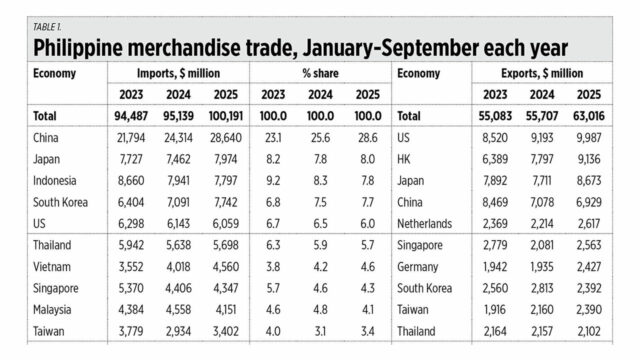
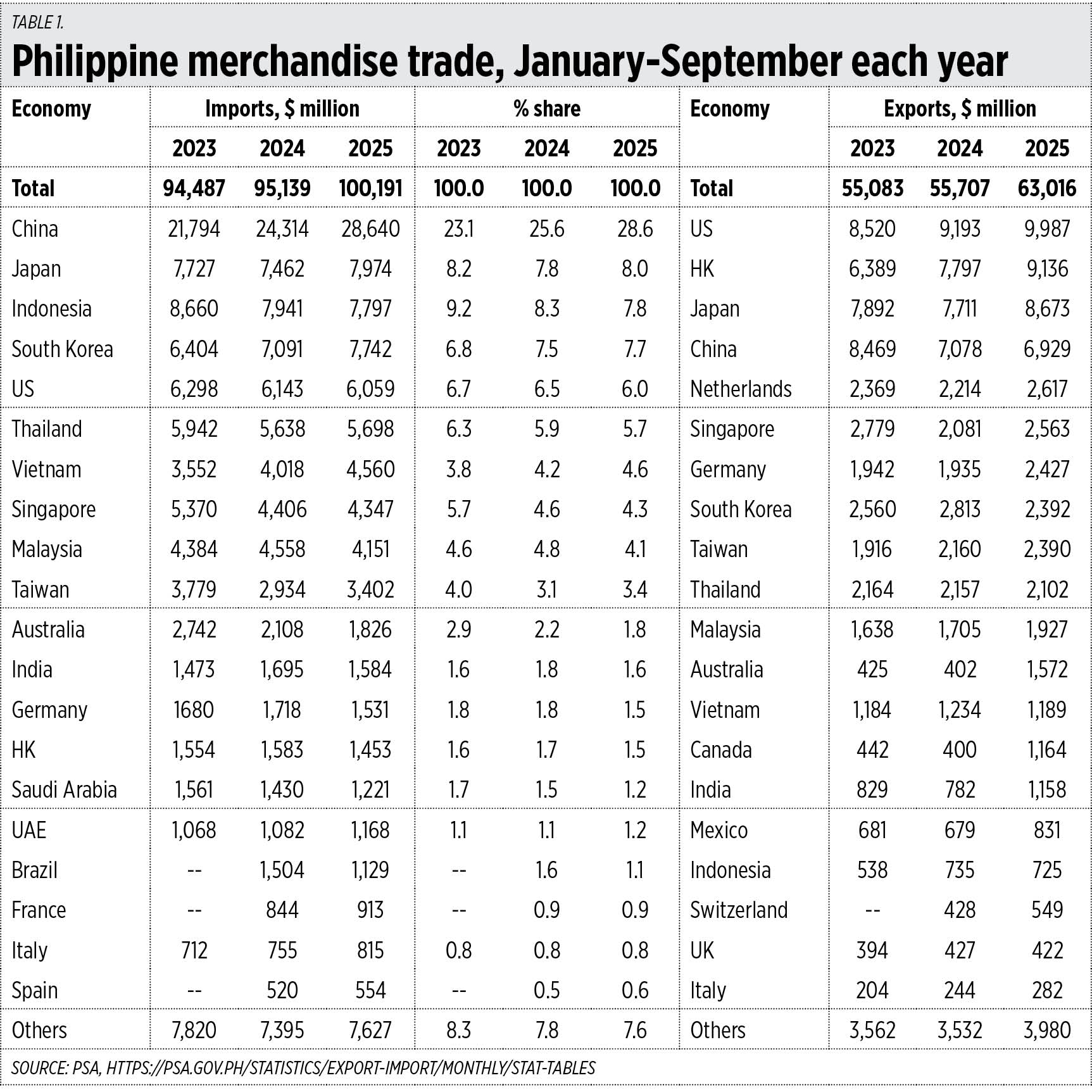
Also last week, the Philippine Statistics Authority (PSA) released the country’s international merchandise trade statistics for September. In this column, I compare our January-September data for the last three years.

Our merchandise or goods imports have breached $100 billion in January-September this year, and the bulk of that came from China whose share in our total imports has been rising fast, from 23% of total imports in 2023 to 28.6% of total in 2025. The shares of Japan, the US, Indonesia, Thailand, Singapore, and Australia are declining.

Our exports have recovered and reached $63 billion. Our main exports market remains the US, followed by Hong Kong, Japan, and China (see Table 1).

Various surveys show that among ASEAN countries, when it comes to foreign policy the Philippines is the most anti-China and pro-US. But in actual trade, like merchandise imports, Philippine businesses and the public favor China and not the US.

The combined share of China and Hong Kong in imports in 2025 was 30.1%, much larger than the combined share of the US, Japan, Taiwan, Korea, Australia, Germany…

China is a good source of useful physical products like trucks and buses, gadgets and computers, clothes and shoes, while the US is a good source of entertainment like Netflix and Hollywood movies, YouTube, UFC, the NBA, Taylor Swift concerts etc. But we cannot industrialize with entertainment.

PERENNIAL DEFICIT
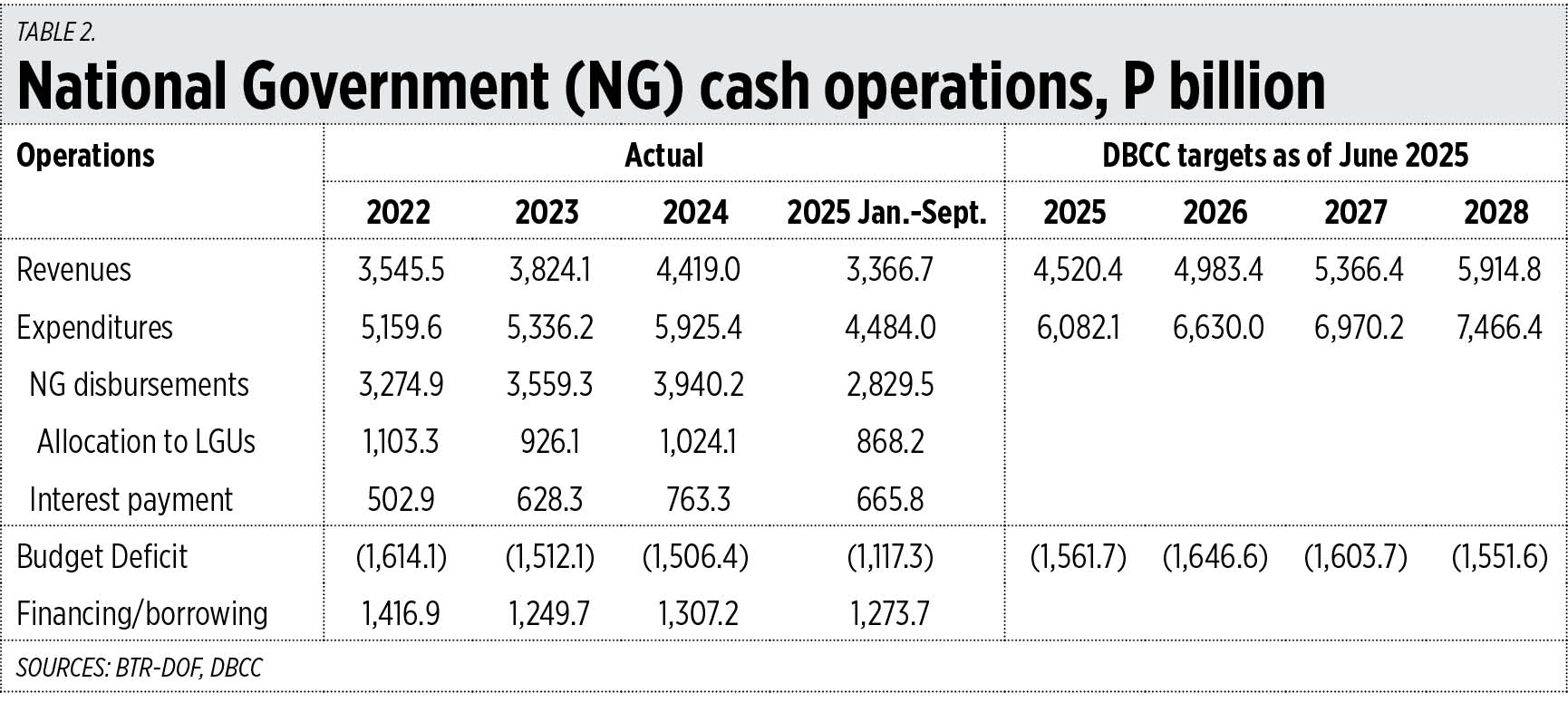
Our current and medium-term fiscal condition remains in perennial deficit. Our expenditures endlessly rise even without an economic or health crisis, and our revenues cannot cope with it. The annual deficit of P1.55 trillion a year in the last three years is expected to remain flat in the next three years (see Table 2).

At current rate of increase in our public debt, even if we have a deficit of zero in 2026, with expenditures cut significantly so that there is a balanced budget (revenues equal to expenditures), our outstanding debt stock of P17.5 trillion at around 6% average interest rate (especially the 10-year government bonds) will still increase to P18.05 trillion next year just on the increase in interest payments alone.

This means that we should aspire not only for a balanced budget but a budget surplus. Many current subsidies and freebies must be discontinued, and privatization of government lands and assets should continue.

Meanwhile, on the continuing corruption scandal in the country, these reports in BusinessWorld are generally good: “PHL gets ‘verbal’ assurances from Fitch, Moody’s on outlook” (Oct. 28), “Unprogrammed allocations cap seen deterring GAA ‘insertions’” (Oct. 29), “Budget seen leaving no room for long-term spending items” (Oct. 30), “Philippine government’s outstanding debt slips to P17.46 trillion” (Oct. 31), and, “Q3 underspending to ‘temporarily’ drag growth — Recto” (Nov. 3).

I can understand the concern of Finance Secretary Ralph Recto. Some important infrastructure projects that can contribute to increased productivity would be affected as public suspicion remains high. The problem, however, is that as the budget of the Department of Public Works and Highways has been cut, other sectors could opportunistically sneak in and raise their budgets for 2026, so that the projected deficit will remain high.


Bienvenido S. Oplas, Jr. is the president of Bienvenido S. Oplas, Jr. Research Consultancy Services, and Minimal Government Thinkers. He is an international fellow of the Tholos Foundation.

minimalgovernment@gmail.com

PHL developers boost disaster resilience amid climate hazards

PHILSTAR FILE PHOTO/THE FREEMAN/ALDO BANAYNAL

By Beatriz Marie D. Cruz, Reporter

PROPERTY DEVELOPERS in the Philippines are increasingly integrating disaster-resilient and sustainable features in their projects, as recent earthquakes and extreme weather highlight the country’s vulnerability to natural hazards.

“Due to the recent natural disasters that have impacted the country, including Cebu and Davao, many, if not all, major developers have likely heightened discussions with their designers and planners on ways to mitigate such risks,” said Roy Amado L. Golez, Jr., director for research, consultancy and valuation at Leechiu Property Consultants.

Developments that incorporate modern systems in power, water, waste, pollution and mobility tend to attract more tenants, he said in an e-mailed reply to questions.

SM Prime Holdings, Inc. and its residential arm SM Development Corp. have made disaster preparedness a key part of their design process.

“We’re finding that a lot of people are concerned about how to keep their assets and families safe,” Jessica Bianca T. Sy, SM Prime head of corporate planning and development, told BusinessWorld on the sidelines of an event last week.

When they design a project, they first look at disaster resilience, then integrate broader sustainability features, she added.

Aboitiz InfraCapital, which operates mixed-use estates in Cebu, Tarlac and Batangas, said resilience and preparedness are central to its developments.

“We integrate disaster risk reduction and climate adaptation measures throughout our masterplans — from elevated roads and advanced drainage systems to reliable utilities with built-in redundancy,” Monica Lorenzana Trajano, Aboitiz InfraCapital economic estates head of commercial strategy, said in an e-mailed reply to questions.

“These are supported by digital monitoring systems that allow rapid response and minimal disruption during natural events,” she added.

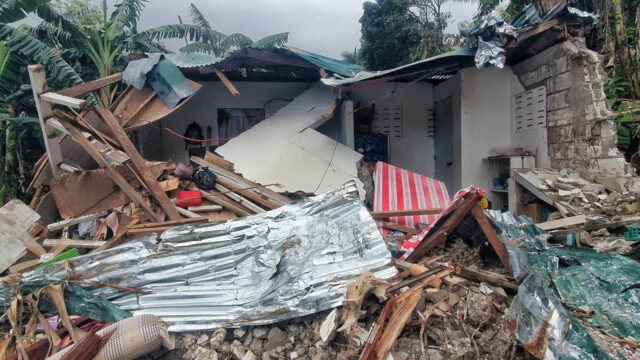
The magnitude 6.9 earthquake that struck Cebu on Sept. 30 damaged at least 80 establishments, according to the Department of Tourism, while the magnitude 7.4 and 6.8 earthquakes in Davao last month damaged more than 2,100 houses across the Davao and Caraga regions, data from the National Disaster Risk Reduction and Management Council showed.

The Cebu earthquake underscored the need to build estates with resilience in mind, Ms. Trajano said. “Across our estates, we’re seeing a growing preference for developments that are not only environmentally responsible, but also designed to promote overall well-being.”

Mr. Golez said developers are likely to avoid areas near fault lines or flood-prone zones, while increasing the adoption of green building certifications such as Leadership in Energy and Environmental Design, Building for Ecologically Responsive Design Excellence and the WELL Building Standard.

He added that developers could further reduce their carbon footprint by using locally sourced materials and energy-efficient technologies.

Ms. Trajano said sustainability features such as renewable energy use, wastewater management, decarbonization programs and green certifications are increasingly valued by investors.

In cases of disruption, Aboitiz InfraCapital implements business continuity plans to ensure essential services and operations remain functional, she added.

Mr. Golez said that the National Building Code could eventually be amended to mandate the use of more sustainable and disaster-resilient designs and technologies, as regulators and industry groups push stronger climate adaptation measures.