Home Blog Page 7299

Peso up on Diokno comments, expectations of weak US data

BW FILE PHOTO

THE PESO strengthened versus the greenback on Wednesday on expectations of weak US goods data.

The local unit closed at P50.72 per dollar on Wednesday, appreciating by 4.1 centavos from its P50.761 finish on Tuesday, based on data from the Bankers Association of the Philippines.

The peso opened Wednesday’s session slightly stronger at P50.725 per dollar. Its weakest showing was at P50.825, while its intraday best was at P50.71 versus the greenback.

Dollars exchanged dropped to $824.84 million on Wednesday from the $956.38 million logged on Tuesday.

A trader said the peso strengthened due to preference for the local unit over the dollar amid expectations of sluggish US durable goods orders in September.

In August, new orders and shipments of key US capital goods saw robust growth, Reuters reported. Orders for durable goods or items that are meant to last three years or more increased 1.8% year on year during the month.

Meanwhile, another trader said the market became bullish after the central bank chief said the economy is “seeing concrete signs of economic rebound.”

“The accelerated vaccination rollouts, granular lockdowns, and the continued implementation of health safety protocols have allowed the Philippine economy to gradually reopen and for workers to regain their jobs,” Bangko Sentral ng Pilipinas Governor Benjamin E. Diokno said in a speech on Wednesday.

Mr. Diokno said appropriate policies will be crucial for the economy’s recovery and to mitigate long-term output losses caused by the pandemic.

For Thursday, the first trader gave a forecast range of P50.60 to P50.80 per dollar, while the second one expects the local unit to move within P50.65 to P50.90.

The US dollar slipped as European markets opened on Wednesday, while the Australian dollar pared gains, having jumped following surprisingly strong inflation data which raised the possibility of sooner-than-planned rate hikes, Reuters reported.

Currency markets have been generally quiet in recent sessions as investors wait for the US Federal Reserve meeting next week.

Investors are also looking to policy announcements this week from the European, Canadian and Japanese central banks for clues on the outlook for rates amid a backdrop of supply-side driven global inflation pressures.

At 0802 GMT, the US dollar index was down less than 0.1% at 93.877.

The US dollar was down around 0.4% against Japan’s yen, with the pair changing hands at 113.745 — still within recent ranges and close to the four-year high of 114.695 the dollar touched against the yen one week ago.

The Bank of Japan meets on Thursday and is widely expected to downgrade its economic assessment, with markets betting on no rate hike in the foreseeable future.

The euro was up around 0.1% at $1.1605. The European Central Bank, which meets on Thursday, is expected to take a dovish stance. — LWTN with Reuters

PSEi tracks Asian shares’ drop on China tech woes

PHILIPPINE STAR/KRIZ JOHN ROSALES

PHILIPPINE shares declined on Wednesday along with Asian markets, which dropped on regulatory worries in China, and as foreign investors sold index heavyweights.

The benchmark Philippine Stock Exchange index (PSEi) shed 21.95 points or 0.30% to close at 7,230.15 on Wednesday, while the broader all shares index lost 2.70 points or 0.06% to finish at 4,453.82.

“With most of the Asian markets downed with Chinese tech stocks big losses, [the] local market went down on profit taking,” Diversified Securities, Inc. Equity Trader Aniceto K. Pangan said in a text message.

“The local bourse dropped… following the Asian peers and weighed down further by the decline of the heavyweights, Globe Telecom, Inc. and SM Investments Corp. due to net foreign selling,” Claire T. Alviar, senior research and engagement officer at Philstocks Financial, Inc., said in a Viber message.

Ms. Alviar said Globe saw net foreign outflows reach P71.48 million, while SM logged P95.90 million. Globe shares also lost 4% or P126 on Wednesday, closing at P3,022 apiece.

Asian stocks slipped on Wednesday with new regulatory worries sparking the steepest sell-off in seven weeks for Chinese tech shares, while short-term Treasury yields spiked as investors wagered on inflation pulling forward interest rate rises, Reuters reported.

MSCI’s broadest index of Asia-Pacific shares outside Japan fell 0.8% led by a 3.5% decline on the Hang Seng tech index after China’s internet watchdog said it plans stricter registration rules for younger net users.

Also, the US Federal Communications Commission on Tuesday voted to revoke the authorization for China Telecom’s US subsidiary to operate in the United States, citing national security concerns.

The decision means China Telecom Americas must now discontinue US services within 60 days. China Telecom, the largest Chinese telecommunications company, has had authorization to provide telecommunications services for nearly 20 years in the United States.

Sectoral indices were split on Wednesday. Industrials gained 194.27 points or 1.80% to 10,945.67; property went up by 19.10 points or 0.59% to 3,251.14; and financials inched up by 3.20 points or 0.20% to 1,567.09.

Meanwhile, holding firms gave up 119.87 points or 1.65% to end at 7,118.98; services declined by 7.56 points or 0.39% to 1,906.48; and mining and oil shaved off 29.05 points or 0.27% to 10,477.42.

Decliners beat advancers, 104 versus 94, while 47 names closed unchanged.

Value turnover went up to P7.75 billion with 746.19 million issues traded on Wednesday, higher than the P6.43 billion with 834.55 million shares on Tuesday.

Net foreign buying climbed to P184.04 million on Wednesday, up from the P127.74 million logged the previous trading day.

“[The] market would continue to move range-bound from 7,000 to 7,450,” Diversified Securities’ Mr. Pangan said. — Keren Concepcion G. Valmonte with Reuters

Vaccination for all minors starts next month

PHILIPPINE STAR/ MICHAEL VARCAS

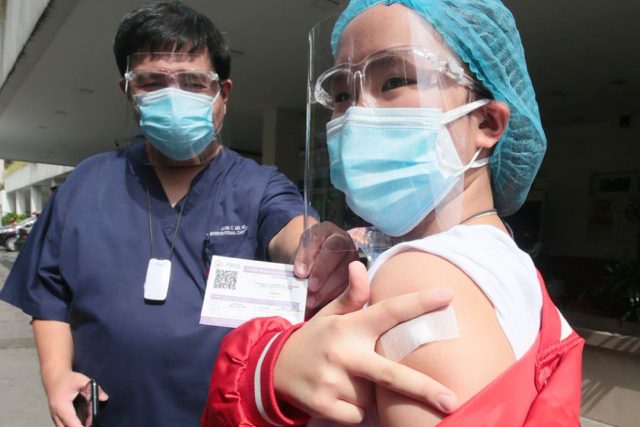
THE PHILIPPINES will start its nationwide coronavirus vaccination for all minors aged 12 to 17 next month, health authorities said on Wednesday.

In a statement, the Health department said it will begin the nationwide rollout of coronavirus disease 2019 (COVID-19) vaccination for children on Nov. 3.

Vaccination for children with comorbidities in that age group started earlier this month in the capital region while other areas are preparing for the rollout by Oct. 29.

The guidelines for the nationwide inoculation of all minors are yet to be finalized, Health Undersecretary Maria Rosario S. Vergeire said.

“Further details and the guidelines with regard to the nationwide expansion of pediatric vaccination will be released once finalized,” she said.

The vaccines made by Pfizer, Inc. and Moderna, Inc. will “still be used among children during the nationwide rollout,” she said.

Citing the country’s statistics agency, the Department of Health (DoH) said the Philippines has around 12.7 million children aged 12 to 17 in 2021.

As of Oct. 26, a total of 18,666 minors with comorbidities received their first dose, the agency said.

The Philippines, which has been seeing a downward trend in new coronavirus infections, targets to inoculate at least 50% of its adult population by yearend.   

The DoH reported 3,218 coronavirus cases on Wednesday, bringing the total to nearly 2.8 million.

The death toll rose to 42,348 after 271 more patients died, while recoveries increased by 6,660 million to nearly 2.7 million, the DoH said in a bulletin.

The agency said there were 50,152 active cases, 73.4% of which were mild, 6.8% were asymptomatic, 6.2% were severe, 11.02% were moderate and 2.6% were critical.

The Health agency said the intensive care unit occupancy rates nationwide and in Metro Manila were at 51% and 42%, respectively.

DoH said 41 duplicates were removed from the tally, 37 of which were reclassified as recoveries. It added that 227 recoveries were reclassified as deaths. One laboratory failed to submit data on Oct. 25.

Meanwhile, Molnupiravir, the first oral antiviral drug for the treatment of coronavirus patients, will be available in the country next month, according to local importer MedEthix, Inc.

The first batches of the Molnupiravir will be used for 300,000 coronavirus patients in the country, MedEthix co-founder Monaliza Balnig Salian told a virtual news briefing.

The drug will be imported under a compassionate special permit (CSP) issued by the Philippine Food and Drug Administration last September, she said.

The market price of Molnupiravir, estimated at P100 to P130 each, will be finalized in early November, JackPharma, Inc. President Meneleo Hernandez said. It will be “quite affordable.”

MedEthix and JackPharma are set to further discuss how Molnupiravir works in the treatment of mild COVID-19 during meetings and webinars with healthcare frontliners next month.

“As the first local importer to be granted CSP as early as September, MedEthix is likely to be the first to distribute the new drug to Filipinos through its partnerships with hospitals,” MedEthix said in a press release.

Molnupiravir works by “introducing copying errors during viral RNA replication,” MedEthix said. The investigational pill enters the COVID-19 virus and alters it to become harmless, it added. “Even if the virus replicates, it is no longer deadly.”

Clinical trials sponsored by MSD licensee Aurobindo Pharma in India showed that 81% of 1,200 mild cases who took Molnupiravir had negative RT-PCR results on the fifth day of treatment, MedEthix said.

“Molnupiravir comes in a 200 mg capsule with a recommended regimen of 800 mg to be taken twice daily for 5 days or as prescribed by a physician,” the drug firm said. — Kyle Aristophere T. Atienza

Tough-talking Duterte takes pacifist stance on sea row, Myanmar 

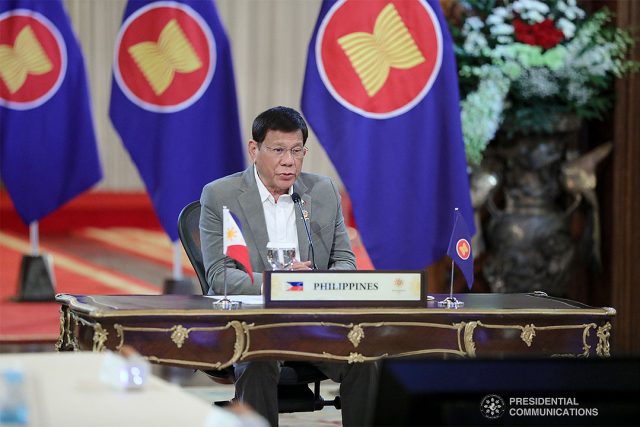
PHILIPPINE President Rodrigo R. Duterte discussed key regional issues — including the South China Sea dispute and Myanmar crisis — in his speech at the summit of southeast Asian leaders, taking a pacifist stance on both concerns.   

The tough-talking leader reiterated his call for peace and stability in the South China Sea in accordance with a 2016 United Nations (UN) arbitral ruling that rejected Beijing’s claim to more than 80% of the sea based on a 1940s map, his office said in a statement released Tuesday night.   

Last month, Foreign Affairs Secretary Teodoro L. Locsin, Jr. said the Philippines was backing a defense pact that allows Australia to build nuclear-powered submarines using technology that the United States had only previously shared with Britain, saying it could keep the balance of power in the Indo-Pacific region.  

“We have come a long way in keeping the peace and promoting prosperity in our region,” Mr. Duterte was quoted as saying. “We must not allow those with diverging interests to make our efforts fail.”  

During the Association of Southeast Asian Nations (ASEAN) Leaders’ Summit, Mr. Duterte also reaffirmed his country’s’ commitment to an “effective and substantive” code of conduct in the disputed waterway. 

In his speech at the 9th ASEAN-US summit, Mr. Duterte emphasized that the trilateral security partnership between America, Australia, and UK, known as AUKUS,  “must complement and not complicate our working methods for cooperation,” the Palace said separately in a statement.

Mr. Duterte reiterated the strategic importance of a peaceful and stable South China Sea and stressed that “all stakeholders must exercise self-restraint to avoid untoward incidents that may further complicate the situation.” 

Citing the rapidly changing regional landscape and seascape, the Philippine leader  emphasized the “importance and need for ASEAN Centrality even as he acknowledged the United States’ “commitment to work with ASEAN, especially on maritime security and domain awareness issues.” 

The South China Sea, which is important for the regional ambitions of China, remains as a main source of tension in the Indo-Pacific as the US and other Western countries continue to assert so-called freedom of navigation operations there. The US, which was set to participate in the summit, has been competing with China in trade.   

When he took office in 2016, Mr. Duterte led a foreign policy pivot to China  

away from the US. Less than a year before he steps down, Mr. Duterte has changed his tone toward the US.  

He recently thanked US President Joseph R. Biden, Jr. for donating coronavirus vaccines to the Philippines. He also restored a visiting forces agreement after suspending it for months. The two nations are set to hold more than 300 joint defense activities next year.  

On Myanmar, Mr. Duterte called on his fellow leaders in the region to stand with the country in solving its crisis, the Palace said.   

Southeast Asian leaders have decided to exclude Myanmar’s junta leader, Min Aung Hlaing, from the summit. Mr. Hlaing led a military coup in February, overthrowing an elected government.  

Mr. Duterte urged all parties in Myanmar to engage in a constructive dialogue and stressed that the region’s special envoy must be allowed to visit the crisis-laden country soon to meet all relevant parties. — Kyle Aristophere T. Atienza 

Comelec asserts vote buying, selling illegal; proposes more severe penalties for nuisance candidates 

BUYING and selling votes — or the act of giving money by a candidate and acceptance by a constituent with the implicit understanding of support on election day — are illegal and should not be encouraged under any circumstance, the Commission on Elections (Comelec) asserted on Wednesday.   

Comelec Spokesperson James B. Jimenez said in a tweet that the public should not accept any money even if they vote with their conscience, as advised by a presidential candidate.    

“Vote buying is an election offense regardless of financial situation or noble intentions. It shouldn’t be done nor it should be suggested to the voters,” he said. 

Vote buying or selling is a prohibited act under the Omnibus Election Code, with penalties of imprisonment for one to six years, disqualification to hold public office, and forfeiture of one’s right to vote.  

Any political party found guilty would also have to pay a fine of not less than P10,000.  

Mr. Jimenez’s remarks come after Vice President Maria Leonor “Leni” G. Robredo, who is running as an independent presidential candidate, said Tuesday that she was against vote-buying but advised to accept the money as it may have come from taxpayers.  

“Don’t vote because you feel that you are indebted to the money that you have received. For me, accept the money but vote according to your conscience,” she said in a forum with household helpers.  

She later clarified in a press conference in Naga City on Wednesday that she does not condone vote-buying and urged stricter enforcement of election laws.  

Ms. Robredo previously filed a vote buying complaint against Nelly F. Villafuerte and the late former Camariñes Sur representative Luis Raymond “LRay” Villafuerte, Jr. when she ran for a House seat in the province’s third district in 2013.  

Meanwhile, Labor leader Leodigario “Ka Leody” Q. de Guzman called for reform in electoral laws to discourage political dynasties and encourage mass participation in governance to prevent vote buying.  

“Vote buying will happen as long as the masses are hungry and they have no choice but to choose candidates who are billionaires and from political dynasties,” Mr. De Guzman, the presidential candidate of Partido Lakas ng Masa (PLM), said in a tweet.  

Manila Mayor Francisco “Isko” M. Domagoso, standard bearer of Aksyon Demokratiko told reporters that Filipinos can’t be blamed if they accept bribes, especially given the difficulties they are facing.  

“However, Filipinos are smart. They know who a true leader who shows compassion to them to who is fake,” he said in Filipino. 

NUISANCE CANDIDATES
At a Senate hearing Wednesday on the Comelec’s budget, Election Commissioner Maria Norina S. Tangaro-Casingal proposed that those who have been declared as nuisance candidates be disqualified from running for any position for two successive elections.  

She also expressed support for House Bill No. 9557, which seeks an efficient procedure for declaring a nuisance candidate.   

Senator Maria Imelda Josefa “Imee” R. Marcos, chair of the Committee on Electoral Reforms and People’s Participation, agreed with the commissioner’s proposal, while Senator Francis N. Tolentino suggested adding a denial to apply for candidate substitution as well.  

The Senate committee is discussing the bill, passed in August on third and final reading by the House of Representatives, which imposes a P100,000 fine on nuisance candidates.   

The proposed measure aims to protect the integrity of the electoral process and promote respect for it as an important facet of Philippine democracy by providing an efficient procedure for declaring a nuisance candidate.  

Under Section 69 of the Omnibus Election Code, a nuisance declaration may be made against a candidate who puts the election process in mockery, causes confusion to voters by similarity in names, or presents no bonafide intention to run for public office. The existing law does not impose any penalty. — Russell Louis C. Ku and Alyssa Nicole O. Tan 

Environmentalists sue gov’t for ‘inaction’ on plastic pollution 

PHILSTAR FILE PHOTO

By Angelica Y. Yang, Reporter  

MORE THAN 50 petitioners from the youth, fisherfolk and waste management sectors have filed a lawsuit against government officials for their alleged inaction on releasing the list of non-environmentally acceptable products (NEAP).  

This comes four months after the groups said they intend to press charges against the National Solid Waste Management Commission (NSWMC) and other government agencies for taking so long in preparing the list of products and packaging considered harmful to the environment.  

Oceana said the petitioners filed the case with the Supreme Court on Wednesday morning.  

“Plastic not only affects our environment but results in a whole gamut of concerns that will ultimately threaten our existence as inhabitants of this planet,” Oceana Vice President Gloria Estenzo Ramos said in a statement.  

“It puts our food security, livelihood and health on the line. And what is so frustrating is the fact that these problems could have been avoided had the NSWMC acted on its mandate,” she said. 

Under the Ecological Solid Waste Management Act of 2000 or Republic Act 9003, the NSWMC is required to prepare a list of non-environmentally acceptable materials within a year of the law’s implementation, and provide updates every year.  

“Through their refusal, the respondents allowed the unabated emission of millions of tons of plastic waste into every nook and cranny of the Philippine archipelago. This in turn exposed an uncountable number of humans and wildlife to hazards that will last for up to thousands of years in the environment,” the petitioners said in their lawsuit.  

Respondents in the case include the NSWMC and its members: Environment Secretary Roy A. Cimatu; Trade Secretary Ramon M. Lopez; Science and Technology Secretary Fortunato T. dela Peña; Health Secretary Francisco T. Duque III; Public Works Secretary Mark S. Villar, who recently resigned as he is running for the Senate in the May 2022 elections; Agriculture Secretary William D. Dar; and Metropolitan Manila Development Authority Chairman Benjamin de Castro Abalos, Jr.; among others.  

Earlier this year, a study published by the American Association for the Advancement of Science showed that 28% of the rivers responsible for global plastic pollution are in the Philippines, with Pasig River as the “world’s most polluting river when it comes to plastic waste.”  

It added that Pasig River accounted for 63,000 tons of plastic entering oceans from rivers every year. 

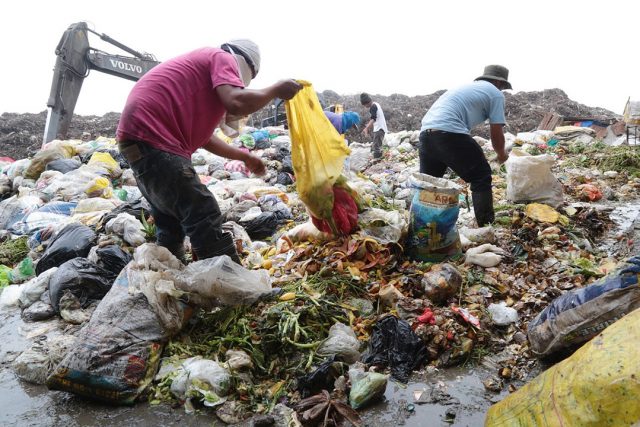
DENR reports successful closure of illegal dumpsites in Central Luzon  

DENR

THE DEPARTMENT of Environment and Natural Resources (DENR) said it has successfully closed all illegal dumpsites in the Central Luzon region, citing close cooperation with local governments.   

“LGUs (Local government units) in Central Luzon played a significant role in the closure of open dumpsites in the region and have been cooperative and supportive with the DENR campaign including implementation of Solid Waste Management Law,” DENR Regional Executive Director Paquito T. Moreno, Jr. said in a news release on Wednesday.   

The presence of an engineered sanitary landfill in Tarlac, according to Mr. Moreno, contributed to the success of the DENR’s campaign to improve the country’s solid waste management “as it ably provided the necessary facilities to accommodate a large number of wastes all over the region.”   

The facility, owned by Metro Clark Waste Management Corp., is the country’s first engineered sanitary landfill certified by the International Standards Organization.  

It accepts 3,500 tons of waste daily, of which 3,000 tons come from cities and municipalities of Central Luzon.   

The Solid Waste Management Law enacted in 2001 mandates the country to “adopt a systematic, comprehensive and ecological solid waste management program.”   

DENR Secretary Benny D. Antiporda had earlier said that the closed illegal dumpsites will undergo a safe closure and rehabilitation plan under the supervision of the Environmental Management Bureau. — Bianca Angelica D. Añago  

Bangsamoro telecom agency offers assistance as DITO aims to set up 166 cell towers in region 

BARMM MOTC

THE BANGSAMORO Ministry of Transportation and Communications (MOTC) said it is ready to assist DITO Telecommunity Corp. as it aims to help improve the region’s connectivity by installing 166 cell sites over the next two years. 

“Actually, we don’t have any control over them… (but) we can suggest locations that they can prioritize for the towers,” Bangsamoro Telecommunications Commission (BTC) Officer-in-Charge Omar Marzoc said in a mix of English and Filipino in a statement from the regional information office on Wednesday.   

Mr. Marzoc and MOTC Minister Dickson P. Hermoso met with DITO Telecommunity Chief Technology Officer Rodolfo D. Santiago and Chief Administrative and Legal Officer Adel A. Tamano in Davao City last week, where they discussed the company’s cell tower rollout plan from 2021 to 2023.    

MOTC and DITO Telecommunity intend to sign an agreement later this year to formalize the public-private sector collaboration.  

“If they will be able to partner with us and we will be able to assist them in securing their permits and licenses, we might be able to hasten their intention to build more towers and invest in the BARMM (Bangsamoro Autonomous Region in Muslim Mindanao),” said Marzoc.  

DITO Telecommunity’s license application for new cell sites is still with the National Telecommunications Commission, but subsequent renewals would already be handled by the BTC.    

This year, the company has already set up 13 cell sites in Maguindanao, including Cotabato City, and two sites in Lanao del Sur, according to Mr. Marzoc. Some of the sites are already operational but not yet officially launched.  

“For next year… they will be increasing the number of sites both for Maguindanao and Lanao del Sur, and for Phase 3, they will be entering the island provinces of Basilan, Sulu, and Tawi-Tawi,” he said.  

DITO Telecommunity, formerly known as Mindanao Islamic Telephone Company, Inc. or Mislatel, is assessing the use of submarine cables to deliver better telecommunication services to the three island provinces. — MSJ 

Appellate court declares Mandaluyong ban on male motorcycle back-riding unconstitutional 

PHILSTAR FILE PHOTO

THE COURT of Appeals has declared as unconstitutional Mandaluyong City’s ordinances banning male back-riders on motorcycles.    

Local authorities are prevented from enforcing and implementing Mandaluyong City’s riding-in-tandem ordinances, the appellate court’s fifth division said in a decision penned by Associate Justice Raymond Reynold Lauigan.  

The constitutionality of the three ordinances were challenged by lawyer Dino De Leon before a Mandaluyong regional trial court after he was sued for violating the rules in March 2019.   

The regional court dismissed the petition in July last year, citing lack of merit.  

Mr. De Leon brought the case before the Court of Appeals, which ruled that the ordinances were discriminatory and oppressive.  

Mr. De Leon, who was riding on the back of a motorcycle taxi when he was apprehended, told the appellate court that the Mandaluyong City government abused its police power with the issuance of the ordinances.  

Under the said ordinances, male back riders who are not relatives of the driver are prohibited. The local laws, however, allowed motorcycle riding-in-tandem where the back rider is a female, a spouse or a relative, or a child between 7-10 years old.  

Members of the Philippine National Police Tactical and Mobile Unit assigned in Mandaluyong were also exempted from the local laws. — Kyle Aristophere T. Atienza 

Pacquiao not open to tandem with Marcos  

SENATOR Emmanuel “Manny” D. Pacquiao, Sr., who is running for president in the May 22 elections, has rejected the possibility of stepping down as vice president in tandem with the late dictator’s son, Ferdinand “Bongbong” R. Marcos Jr., after the latter’s sister hinted their interest on Wednesday.  

During an interview with DZMM Teleradyo, Senator Maria Imelda Josefa “Imee” R. Marcos said that if Mr. Pacquiao is willing to slide down, they would like to have him as their vice-presidential candidate as he is “super popular” in Mindanao and someone they consider a friend.  

She added that their family did not take recent political attacks from the former boxer personally. “We are not thin-skinned, we know it’s because of the elections, it’s okay.”  

Mr. Pacquiao, however, said the only role he is considering is the top seat, together with his running mate, House Deputy Speaker Jose L. Atienza, Jr.  

“While I’m flattered by various camps seeking me to be their VP, it requires the Presidency to fulfill my promises to the poor and those striving from hardships,” he said in English and Filipino via Viber on Wednesday.   

“My fight as president will continue for change and to suppress the worsening corruption in the country.” 

He added that he believes that this is their moment, noting the increasing number of supporters joining his camp.  

Ms. Marcos said their goal is to garner votes both in the north and the south of the country. The Marcos’s bailiwick is Ilocos in the northern part of the country.   

“Our preference is very obvious, we have the so-called ‘Solid North’. We’re strong in the north. Bongbong is also strong in the National Capital Region in one way or another as well as Region 8 (Eastern Visayas in central Philippines),” she said in English and Filipino.  

“But we are a bit scared when it comes to Mindanao, we’re a little blind there,” she added, “so naturally we’re tending towards the Mindanao and VisMin candidates.” — Alyssa Nicole O. Tan

NEDA’s Chua says next gov’t can afford infrastructure spending

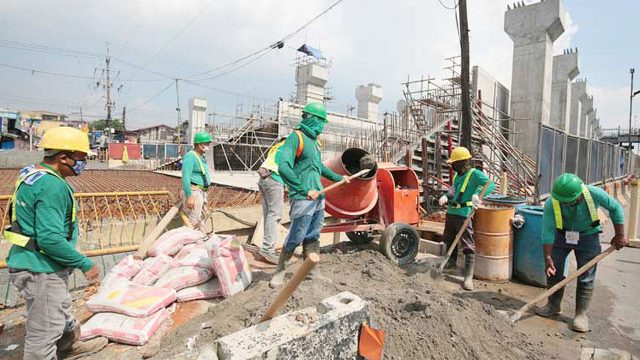
Workers are seen mixing cement at a construction site in Quezon City, May 19, 2020. — PHILIPPINE STAR/ MICHAEL VARCAS

THE NATIONAL Economic and Development Authority (NEDA) expects infrastructure spending to be sustained in the next administration, after tax reform enhanced its ability to finance projects.

“It is sustainable. We have implemented a series of tax reforms before the pandemic and during the pandemic,” Socioeconomic Planning Secretary Karl Kendrick T. Chua said Wednesday.

“I still see the medium-term infrastructure budget to be around 5% (of gross domestic product or GDP). There is still a big infrastructure gap, and as we grow to become an upper middle-income country, we will realize that we need to upgrade some of our infrastructure to be smarter, more technologically aligned with the developments, and more innovative.”

Government spending on infrastructure grew 44.6% to P570.4 billion in the first eight months of the year, according to the Department of Budget and Management.

The government set a P1.02-trillion infrastructure budget for 2021, equivalent to 5.1% of GDP.

The Development Budget Coordination Committee raised the spending cap on the infrastructure program to P1.29 trillion or 5.8% of GDP for 2022.

Noting that the infrastructure program has so far focused on road and transport, Mr. Chua identified digital and information technology as priority infrastructure for the next administration.

“We have an enabler for this, the national ID,” he said, adding that 37-40 million have been registered. — Jenina P. Ibañez

NGCP ordered to procure ‘sufficient’ ancillary services

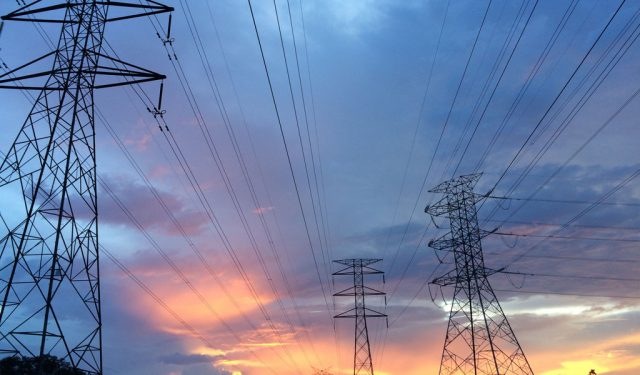
THE DEPARTMENT of Energy (DoE) has ordered the National Grid Corp. of the Philippines (NGCP) to procure ancillary services that are “sufficient” to ensure adequate supply during shortages. 

The DoE formalized the order through a department circular issued Tuesday, though it had advised the NGCP to do so in June in the wake of several yellow alerts, in which the grid’s supply margins thinned, resulting in outages.

Ancillary services are on call to be tapped to supplement the power supply, and are typically higher-cost than baseload supply. The NGCP has warned that raising the level of ancillary coverage will result in higher power costs.

The NGCP was ordered to open up a competitive selection process to qualified companies.

The DoE said NGCP must “ensure sufficient and least-cost provision of the (ancillary services)” in order to protect the public interest.

The NGCP will be held responsible for ensuring that the procurement is carried out in a timely manner, “particularly the capability-testing of generating facilities” and that key documents are promptly issued.

The DoE also required the NGCP to submit an Ancillary Service Agreement Procurement Plan (ASAPP) which contains the grid operator’s projected ancillary service requirements for the next 10 years and a plan for the acquisition of such services on or before March 31 every year.

The outcome of the DoE’s review of the ASAPP will be posted on the NGCP’s website not later than the end of April every year.

The DoE said the auctions must take place six months after the circular takes effect. The contract period for suppliers of ancillary services is capped at five years.

The order will take effect on Friday, 15 days after it was published in two general-circulation newspapers on Oct. 14.

The DoE has recommended the return of control over power grid operations to the government after power outages in Luzon in June, allegedly due to NGCP’s non-compliance with ancillary services coverage standards.

NGCP is privately owned by holding company Synergy Grid and Development Philippines, Inc., which has a 60% stake. The remaining 40% is owned by the State Grid Corp. of China. — Bianca Angelica D. Añago

ADVERTISEMENT
ADVERTISEMENT