



How PSEi member stocks performed — November 15, 2021

Here’s a quick glance at how PSEi stocks fared on Monday, November 15, 2021.




Stocks drop ahead of RTB offering, BSP review
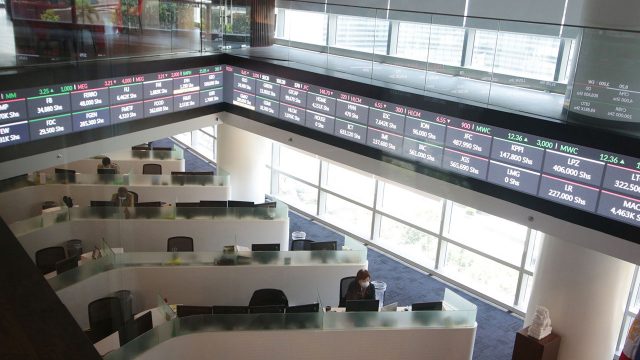
PHILIPPINE shares declined on Monday due to profit taking amid disappointing economic data ahead of the government’s retail Treasury bond offer and the Bangko Sentral ng Pilipinas’ (BSP) policy review.
The 30-member Philippine Stock Exchange index (PSEi) decreased 40.47 points or 0.54% to end at 7,342.37, while the broader all shares index lost 13.15 points or 0.33% to close at 3,951.53 on Monday.
Regina Capital Development Corp. Head of Sales Luis A. Limlingan said in a Viber message that the market closed lower due to profit taking following weak regional and US data.
Investors also chose to stay on the sidelines ahead of the BSP’s policy meeting on Thursday, he said.
Meanwhile, Rizal Commercial Banking Corp. (RCBC) Chief Economist Michael L. Ricafort said in a Viber message that the stock market’s decline was due to “the upcoming RTB (retail Treasury bond) issuance and other various fund-raising by the country’s biggest companies through the stock market and fixed income market, especially for the month of November 2021,” as funds to shift to these instruments.
The BTr will offer 5.5-year RTBs to raise at least P30 billion ($603 million), with a swap offer for bonds falling due in 2022, it said on Friday. The offer period is set to run from Nov. 16 to Nov. 26, unless the BTr closes it early. The papers will be issued on Dec. 2 and will mature by 2027.
Mr. Ricafort added that Manila Electric Co.’s (Meralco) announcement of higher electricity rates for this month could affect inflation, “which eats up on earnings and profit margins.”
In a statement on Friday, Meralco said the overall rate for a typical household jumped by P0.3256 per kilowatt-hour (/kWh) to P9.4630/kWh in November compared to the P9.1374/kWh in October “due to higher generation charge.”
According to Meralco, the generation charge for November increased by P0.2911/kWh to P5.3346/kWh due to the shutdown of the Malampaya natural gas facility.
Sectoral indices declined except for holding firms, which inched up by 0.71 point or 0.01% to 7,107.34.
Meanwhile, mining and oil dropped 313.55 points or 3.23% to 9,370.32; property lost 37.31 points or 1.10% to end at 3,339.77; financials declined by 15.39 points or 0.95% to 1,598.33; industrials gave up 64.25 points or 0.59% to close at 10,761.63; and services went down by 11.35 points or 0.56% to 1,992.77.
Value turnover declined to P7.96 billion with 1.30 billion issues traded on Monday, lower than the P10.42 billion with 1.55 billion shares seen on Friday.
Decliners beat advancers, 124 against 71, as 42 names closed unchanged.
Foreigners turned sellers anew with net outflows worth P342.41 million on Monday from the P306.23 million in net purchases recorded on Friday.
The PSEi’s initial support is at 7,300, “in view of last week’s intra-week low of 7,315,” while the next resistance is at the 7,400 to 7,500 levels, Mr. Ricafort added. — BADA
Peso weakens vs dollar
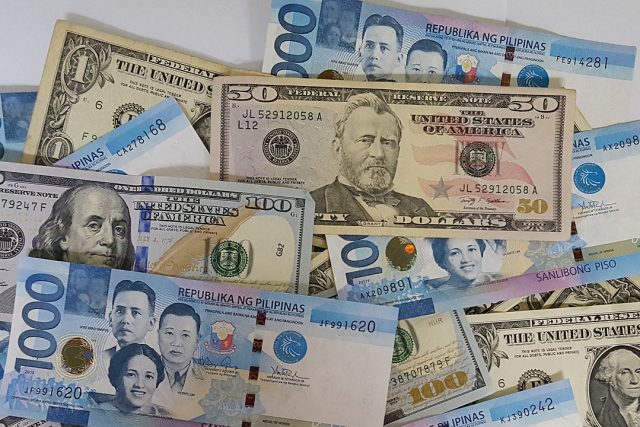
THE PESO weakened versus the greenback on Monday on cautious sentiment amid the last day of substitution or withdrawal of candidates for next year’s national elections.
The local unit ended trading at P50.19 per dollar on Monday, depreciating by 34 centavos from the P49.85 close on Friday, data from the Bankers Association of the Philippines showed.
The peso opened stronger from its previous finish at P49.81 per dollar. Its weakest showing was at P50.19, while its intraday best was at P49.77 versus the greenback.
Dollars exchanged increased to $1.156 billion on Monday from $1.067 billion on Friday.
The peso weakened due to cautious sentiment as Monday was the deadline for substitution of candidates for the 2022 national elections, Rizal Commercial Banking Corp. Chief Economist Michael L. Ricafort said in a Viber message.
President Rodrigo R. Duterte on Monday registered his candidacy for senator through a representative. He earlier said he would run for vice-president and retire from politics.
Meanwhile, on Saturday, Mr. Duterte’s daughter Sara Duterte-Carpio also became a substitute candidate for the vice-presidential race after she withdrew candidacy for another term as the mayor of Davao City.
On the other hand, a trader said in a Viber message that the peso depreciated versus the greenback amid the expected signing of the US bipartisan infrastructure spending bill by President Joseph R. Biden.
A $1-trillion infrastructure bill was passed by Congress earlier this month, Reuters reported. It is the largest US investment in roads, rail lines and other transportation networks in decades.
For Tuesday, Mr. Ricafort gave a forecast range of P50.10 to 50.30 versus the dollar, while the trader expects the local unit to move within P50.05 to P50.30. — L.W.T. Noble with Reuters
Rail ridership seen taking at least 3 years to return to normal levels

By Arjay L. Balinbin, Senior Reporter
Ridership on the four rail networks rose more than 172% year on year to 47.57 million between April and September, well below equivalent levels in 2019, latest data from the Transportation department showed, with analysts estimating that passenger volumes could take at least three years to return to their pre-pandemic levels.
Passenger volumes on Light Rail Transit Lines 1 and 2 (LRT-1 and LRT-2), Metro Rail Transit Line 3 (MRT-3), and the Philippine National Railways (PNR) increased 172.45% this year compared to the April-September period in 2020 , the data showed.
The period was selected to exclude January-to-March data for both 2020 and 2021, which were heavily distorted by lockdowns.
Train ridership for the same period in 2019, or before the pandemic, totaled 161.78 million.
The government imposed a 30% cap on rail passenger capacity during the strictest phases of the community quarantine. It was raised to 70% starting Nov. 4.
“Studies have shown that only 0.2% of traceable outbreaks in Germany were linked to transport; only 1.2% of COVID-19 (coronavirus disease 2019) clusters are linked to transport (land, air, and sea); and that there is only a 0.01% chance of contracting COVID-19 in public transportation, with the probability decreasing to 0.005% risk of infection with face covering,” Transportation Undersecretary for Railways Timothy John R. Batan said in a recent statement.
Transportation expert Rene S. Santiago told BusinessWorld by phone Monday that lockdowns and capacity limits had “curtailed ridership.”
He also noted that the uptick in ridership this year “could reflect relaxation of restrictions.”
“(Ridership) will not get back to pre-pandemic levels for at least three years,” Mr. Santiago added.
Light Rail Manila Corp. (LRMC), the private operator of LRT-1, is hoping that 2022 will be a much better year than 2021.
“The gradual increase and return to pre-pandemic level of our ridership will have to depend on several factors, so it’s hard to give a forecast at this point,” LRMC Spokesperson Jacqueline S. Gorospe told BusinessWorld in a phone message.
“Aside from the resumption of more economic activities, some of the main factors include the government’s policy for ridership capacity, public confidence, opening of schools/universities, and return to physical work in companies,” she added.
LRMC reported a 20% year-on-year decline in nine-month revenue to P799 million due to capacity reductions and lower demand.
LRT-1’s average daily ridership decreased 48% year on year to 116,021 due to the 30% cap.
LRMC is the consortium composed of Ayala Corp., Metro Pacific Light Rail Corp. (a unit of Metro Pacific Investments Corp.) and Macquarie Infrastructure Holdings (Philippines) Pte. Ltd.
Metro Pacific Investments Corp. is one of three Philippine subsidiaries of Hong Kong’s First Pacific Co. Ltd., the others being PLDT, Inc. and Philex Mining Corp. Hastings Holdings, Inc., a unit of PLDT Beneficial Trust Fund subsidiary MediaQuest Holdings, Inc., maintains an interest in BusinessWorld through the Philippine Star Group.
Agriculture interest groups declare opposition to RCEP

FARMERS, nongovernment organizations, and some members of the private sector said they oppose the ratification of the Regional Comprehensive Economic Partnership (RCEP) trade agreement.
In a position paper issued Monday, they also called on the Senate to reject RCEP and withhold the chamber’s concurrence, claiming lack of consultation.
Trade Secretary Ramon M. Lopez has said that the Philippines hopes to ratify RCEP this month. The Senate Foreign Relations Committee is currently in deliberations on the trade deal.
Malacañang approved RCEP in September.
“We have not seen any clear and consistent basis for classifying agricultural tariff lines in the country’s schedule of tariff concessions. A more detailed breakdown and evaluation of our obligations are necessary to ensure that no mistakes have been made, and that sufficient policy space remains to protect sensitive commodities,” the groups said.
“There is no urgency to join RCEP today. We can always join later, when we have adequately understood the treaty’s ramifications and are ready to use RCEP membership to our advantage,” they added.
They said the proposed RCEP rules will hamper the application and effectiveness of trade remedies and noted that the agriculture sector has not generally benefitted from free trade agreements.
“We will never gain from RCEP and similar arrangements unless we establish, fund and implement dedicated and sustained programs to boost the competitiveness and profitability of our farmers, fishers, traders, processors and exporters,” they said.
“It is also nonsensical to push for RCEP membership when the benefits from this ‘good agreement’ are essentially theoretical or imagined, whereas its dangers are real and proven by previous experience,” they added.
RCEP, which is set to be implemented on Jan. 1, 2022, is seen to make trade easier for members of the Association of Southeast Asian Nations (ASEAN) along with China, Japan, South Korea, Australia, and New Zealand. It is also expected to help aid recovering economies that suffered pandemic setbacks.
Signatories to the position paper include the Fair Trade Alliance, Alyansa Agrikultura, Kilusang Magbubukid ng Pilipinas, the United Broiler Raisers Association, the Pork Producers Federation of the Philippines, Inc., and the National Trade Union Center. — Revin Mikhael D. Ochave
SRP scheme being considered for pork; decision due this week
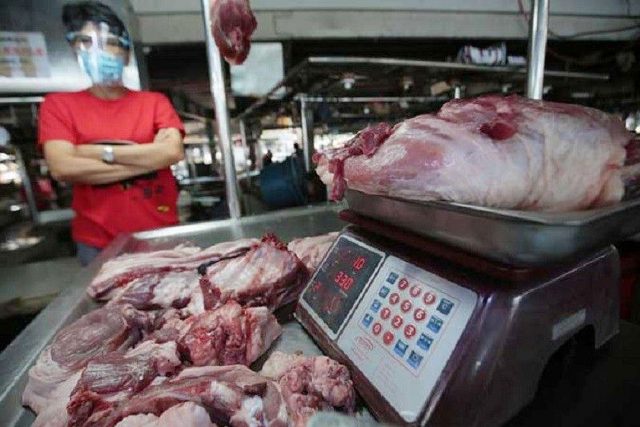
THE Department of Agriculture (DA) is considering a suggested retail price (SRP) scheme for pork products due to the increase in prices accompanying growing demand ahead of the holidays.
Agriculture Secretary William D. Dar said at a virtual briefing Monday that rising prices were observed in Metro Manila wet markets.
Mr. Dar said a decision on the SRP will be released within the week.
He added that the DA has yet to decide on whether the SRP will cover both domestic and imported pork.
“As we approach Christmas, (pork) prices have been slightly increasing. This is one of the reasons why we are (taking another look at the) SRP mechanism. Within the week, there will be a decision,” Mr. Dar said.
“We do not want to project the level of the SRP. We are still doing our homework before we release it,” Mr. Dar added when asked to estimate the price caps.
Agriculture Undersecretary Kristine Y. Evangelista said the DA estimates the price of domestically-grown pork shoulder (kasim) in Metro Manila wet markets at P320 per kilogram (/kg) as of mid-November, up P40 compared to October.
She added that the price of pork belly (liempo) as of mid-November has increased to P360 compared to P340 in October.
Mr. Dar said the government also needs to bring more imported pork products onto the market to address higher prices.
“We need to have these freezers and reefer vans across local government units (LGUs). Once these are already there, the distribution of imported pork will be quicker,” Mr. Dar said.
Asked to comment, Pork Producers Federation of the Philippines, Inc. President Rolando E. Tambago said by phone message that an SRP will not be effective in bringing down pork prices.
According to Mr. Tambago, the increase in the retail price is caused by scarcity in Metro Manila.
“If the DA really wanted to bring down retail price of pork, then they have to help hog farmers of the Visayas and Mindanao bring their products to Luzon. The movement of retail prices is a natural effect of supply and demand,” Mr. Tambago said.
Mr. Dar said at the briefing that two new companies have approached the DA to propose trials for vaccines against African Swine Fever (ASF). He did not identify the companies pending a formal agreement on the trials.
Mr. Dar also confirmed that the DA is still waiting for the results of the ASF vaccine trials conducted earlier in the year.
In April, the DA announced that it started ASF vaccine trials in collaboration with a US vaccine firm and global animal health company Zoetis. Ten Philippine companies participated in the trials. — Revin Mikhael D. Ochave
House approves ODA reform bill on second reading
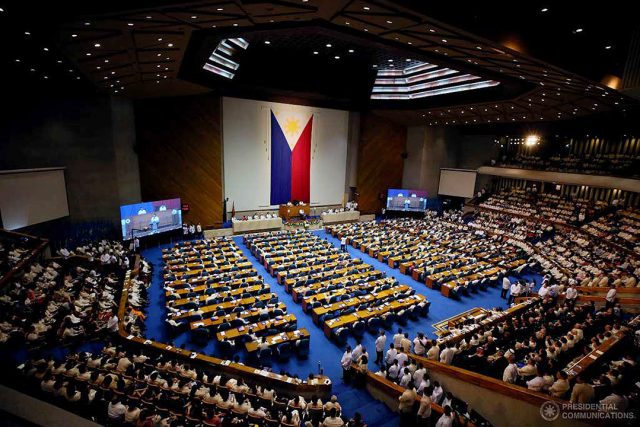
THE HOUSE of Representatives approved a bill on second reading Monday that would reform the process of receiving official development assistance (ODA) to improve transparency in implementing ODA-backed projects.
House Bill 10322 or the proposed ODA Effectiveness Act is seeking to amend Republic Act 8182 or the Official Development Assistance Act of 1996.
ODAs are concessional financing provided by multilateral banks or foreign governments to poorer countries to promote economic development.
The bill allows the yield on recently-issued government bonds to serve as a discount rate benchmark when estimating the present value of debt service on grants, if such yields are lower than the 10% fixed rate set by the National Economic Development Authority (NEDA).
The bill will continue to require that the grant portion of the ODA consist of at least 25% of the aid package.
It will also require that the ODA be administered with the specific objective of achieving sustained reduction of poverty and inequality.
The measure will also require studies on the project’s social and economic impact and the consultation of targeted groups.
A Congressional Oversight Committee will also be created to monitor and ensure proper implementation of the proposed law and review ODA grants and loan agreements entered into by the National Government. It will have the authority to initiate independent impact studies on ODA-funded projects.
No individual or committee amendments were made to the bill prior to its approval.
NEDA reported that the active ODA rose 42% to $30.39 billion in 2020 as the government ramped up foreign borrowing to finance its pandemic response.
Meanwhile, the government’s utilization of ODA — or actual spending relative to target — was 66.69% in 2020, up from 64.28% in 2019. — Russell Louis C. Ku
Meralco, Megaworld tie up to build substation
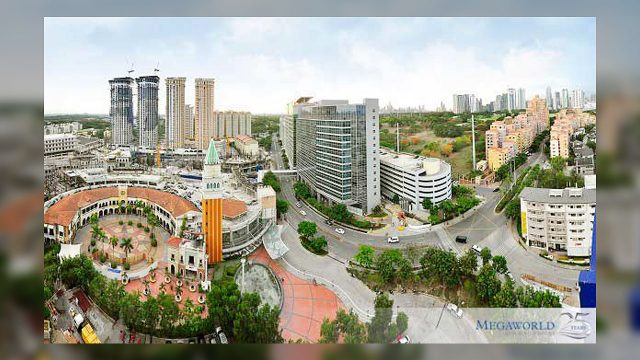
The Manila Electric Co. (Meralco) and Megaworld Corp. said they have agreed to jointly build a 249-megavolt ampere power substation in Taguig City.
The substation will occupy a 1,694-square meter site on the 50-hectare McKinley Hill development in Taguig City. It will be a Gas-Insulated Switchgear (GIS) substation, Meralco said in a statement Monday.
The GIS substation will support the power demands of about 40 residential towers, 23 office towers including international schools, foreign embassies, malls, and other establishments in McKinley Hill such as McKinley Hill Village, McKinley West Village, Venice Grand Canal, McKinley West Campus, Viceroy Residences, Venice Luxury Residences, and Enderun Colleges.
The project will also help load power onto the two Meralco transformer banks at the Malibay substation in Pasay City.
“This initiative will help a variety of sectors and communities prosper and recover from the impact of the pandemic,” Megaworld Senior Vice-President and Head of Operations Management Jennifer L. Romualdez said.
Meralco Senior Vice-President and Head of Networks Ronnie L. Aperocho said Meralco is “one with Megaworld in its goal to develop sustainable and progressive cities, which will complement the local community and national development.”
Construction of the substation will start in February and is scheduled for completion after eight months. — Bianca Angelica D. Añago
Senators back restoration of original budget for DAR land titling project
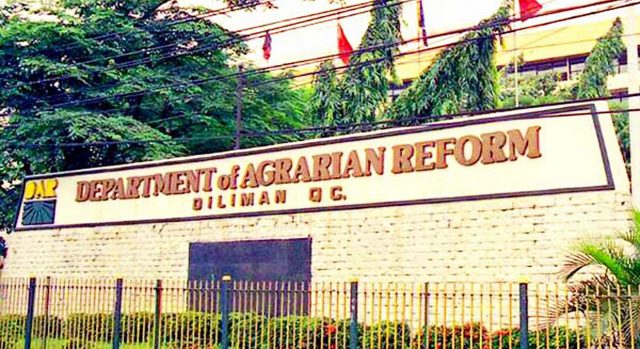
SENATORS on Monday expressed support for calls to restore funding worth P2.6 billion for the Support to Parcelization of Lands for Individual Titling (SPLIT) Project proposed by the lower house in their version of the 2022 proposed General Appropriations Bill.
During the interpellation of the 2022 budget of the Department of Agrarian Reform (DAR), Senator Cynthia A. Villar, who chairs the Senate committee on Agriculture, Food and Agrarian Reform, asked fellow Senators to “deliver what rightfully belongs to our agrarian reform beneficiaries.”
DAR’s P12.3-billion proposed budget was increased by 29% from the original P8 billion. SPLIT had been allocated about P4.5 billion for the titling of 600,000 hectares in 2022, and 708,000 hectares in 2023.
In 2021 delays resulted in the completion of titling for only 60,000 hectares, requiring catch-up efforts over the next few years.
“The loan from the World Bank was finally granted which will provide a P19.24-billion financial support to the project with a P5.38 billion government counterpart, with a total of P24.6 billion,” Ms. Villar said in plenary session Monday.
“We are with you in restoring that budget,” Senator Panfilo M. Lacson, Sr. said in plenary. “We cannot use it (the loan) for any other purpose.”
Senator Maria Imelda Josefa R. Marcos proposed amending the loan agreement to provide for a longer period of implementation “as long as the SPLIT program is not reduced because it is key to a very extended agrarian reform program — I believe 50 years.”
“The SPLIT project is crucial to our goal of improving land security tenure and stabilization of property rights of agrarian reform beneficiaries and achieving poverty reduction,” Ms. Villar said.
She said the project is meant to parcel out collective Certificate of Land Ownership Awards (CLOAs) into individual CLOAs, giving farmers their own identifiable plots.
The SPLIT project covers 1.368 million hectares, benefitting 1.14 million farmers, Ms. Villar said. Some 2.8 million farmers will have individual CLOAs, while the 2 million will have collective CLOAs.
By the end of 2023, the goal is for all agrarian reform beneficiaries to have individual CLOAs.
Separately, Minority Leader Franklin M. Drilon said during the same session that the reduction of the proposed 2022 budget for the Department of Science and Technology (DoST) should be reconsidered.
During his interpellation, he questioned the reduction of the DoST budget by P1.12 billion to P23.79 billion for next year.
He said that while some of the reductions were related to capital outlay, there was also decreased funding for agencies responsible for research and development. “This is a little bit worrisome,” he said, noting that these agencies are crucial to the recovery.
Mr. Drilon called for the review of the department’s budget, which Senator Emmanuel Joel J. Villanueva seconded.
Senator Francis N. Tolentino during the same session also proposed to strengthen the DoST’s legal department, which he said has only three lawyers and a P4-million budget.
Mr. Tolentino said the shortage of lawyers might be behind the delay in drafting Implementing Rules and Regulations (IRR) of Republic Act 11037 or the Masustansyang Pagkain para sa Batang Pilipino Act passed in 2018. “This is a very important law as it institutionalizes a national program for undernourished children.”
“Per records of the DoST, (the IRR) was just promulgated on March 26. This is a very important program, especially as we navigate the post-pandemic era,” he said. — Alyssa Nicole O. Tan
Should I be taxed for showing political support?

And so it begins. The last day for the substitution of candidates for elections was set yesterday, Nov. 15, and we now have a better idea of what the ballot will look like for the May 9, 2022 national elections.
A rise in election campaign spending is anticipated, albeit in more creative ways as we are still coping with the COVID-19 pandemic. According to the Philippine Center for Investigative Journalism (PCIJ), some P5.8 billion was spent during the 2016 polls, with major spending on ad placement in various media platforms — and that is assuming that there were no misstatements in the Statement of Contributions and Expenses submitted by the political candidates to the Commission on Elections (Comelec).
Nevertheless, beyond the tumult of election campaigning and controversies, one thing that is consistent regardless of the season is taxes. Over the years, many discussions have taken place on election contributions; as such, it is equally important to discuss the taxability of election contributions as much as the election itself. Let’s take a glimpse at the history of the tax treatment of campaign funds over the years.
In the case of Abello et al. vs. Commissioner of Internal Revenue (G.R. No. 120721, February 23, 2005), the Supreme Court held that the contributions made by Abello et al. in 1987 for the political campaign of then Senator Edgardo Angara were subject to gift or donor’s tax. While the petitioners asserted that the Bureau of Internal Revenue (BIR) had never attempted to impose donor’s taxes on political contributions since the 1939 Tax Code, the Supreme Court further held that the BIR is not precluded from making a new interpretation of the law, especially when the old interpretation is flawed. Besides, the contribution falls within the purview of donations as per the New Civil Code. It is to be noted, however, that at that time, there was no regulation exempting political contributions from donor’s tax.
The high court ruling may be discouraging to political supporters. Why even bother donating to a cause if the donor is taxed? Fortunately, legislative action has addressed some concerns. For one, the 1997 Tax Code deferred to the Omnibus Election Code and Republic Act (RA) No. 7166 on the tax treatment of campaign contributions and funding. Under Section 13 of RA No. 7166, any contribution in cash or in kind to any candidate, political party, or coalition of parties for campaign purposes, duly reported to the Comelec, shall not be subject to any gift tax.
The BIR further strengthened that provision by issuing Revenue Memorandum Circular Nos. 38-2018 and 31-2019. As clarified, campaign contributions are exempt from donor’s tax only during the exclusive period for campaigning as scheduled by the Comelec. According to the Comelec calendar of activities for the 2022 polls, the campaign period runs from Feb. 8, 2022 to May 7, 2022, with prohibitions on campaigning in force on April 14 and 15 or during the Holy Week break. Therefore, pending further clarification by the BIR, only donations made between Feb. 8, 2022 and May 7, 2022 are exempt from donor’s tax. Donations extended before this period are subject to a donor’s tax of 6% in excess of the P250,000 exempt gift threshold and which are not deductible as donation on the part of the donor.
Furthermore, until 2018, domestic and foreign corporations were prohibited by the 1980 Corporation Code to give donations in aid of any political party or candidate. The Securities and Exchange Commission (SEC) penalizes erring corporations a fine of P1,000 to P30,000 and imprisonment of between 30 days and five years, or both. One may recall that during the 2016 polls, at least two corporate donors were alleged to have funded political campaigns, according to the PCIJ.
With the enactment of the Revised Corporation Code in 2019, only foreign corporations are prohibited from giving such donations. It appears therefore, that a domestic corporation is now allowed to fund political campaigns so long as it is not a prohibited entity under the Omnibus Election Code. These prohibited contributors include those engaged as public or private financial institutions, those engaged in public utilities, those who hold contract or sub-contracts to supply the government, those who were granted franchises, incentives, allocations, or concessions by the government, and entities provided with government loans in excess of P100,000.
For income tax purposes, on the other hand, the eligible campaign contributions may be deducted from the donor’s gross income, subject to a cap of 10% for individual donors and 5% for corporations, based on their computed taxable income before the donations. These may not be deducted in full as these are not donations given to the government or accredited non-government organizations, or to selected foreign organizations.
So, should one be taxed for showing political support? Our election laws say no tax should be imposed on donations, as long as these are within the bounds of and within the timelines provided by law. After all, they say the most tangible way to support your candidate — aside, of course, from actually casting your vote — is to donate tax-free.
Let’s Talk Tax is a weekly newspaper column of P&A Grant Thornton that aims to keep the public informed of various developments in taxation. This article is not intended to be a substitute for competent professional advice.
Joen Jacob G. Ramas is a senior-in-charge of the Tax Advisory & Compliance division at the Cebu office of P&A Grant Thornton, the Philippine member firm of Grant Thornton International Ltd.