Home Blog Page 720

Knight Frank: Manila ranks 3rd cheapest premium office rent in Asia-Pacific in Q3

Manila’s prime office rent was the third cheapest among 23 Asia-Pacific markets in the third quarter, according to the latest Asia-Pacific Office Highlights by real estate consultancy Knight Frank. During the period, Manila’s occupancy cost reached $29.40 per square foot, inching up by 1%, higher than the 1.4% average decline of the region.

Knight Frank: Manila ranks 3<sup>rd</sup> cheapest premium office rent in Asia-Pacific in Q3

Manila eyes drones to boost defense amid tensions in South China Sea

THE PHILIPPINE frigate BRP Jose Rizal, US destroyer USS John Finn and Japanese landing ship JS Osumi during a joint naval drill back in September. — BW FILE PHOTO/ARMED FORCES OF THE PHILIPPINES

THE PHILIPPINES is looking at widely adopting unmanned systems and drones more broadly in its armed forces, a senior Defense department official said on Monday, as tensions with China continue to persist in the South China Sea.

Defense Assistant Secretary August V. Gaite said drones are key to strengthening Manila’s ability to counter threats to its sovereignty, calling them “valuable tools” with wide military applications including surveillance, logistics and maritime awareness.

“Drone technologies enhance our ability to sense, see, design and act with greater precision and speed,” the Defense department’s top official on technology research said in a keynote address at a Philippine Navy summit.

Remotely piloted drones have become a backbone in modern warfare due to their long-range reach and lower cost compared with other advanced weaponry, like missiles and fighter jets, and they have since seen heavy combat use since Russia’s invasion of Ukraine in 2022.

“The rapid evolution of drone systems, whether in the air, on land, at sea, or beneath the waves, has fundamentally changed the way nations prepare for and respond to threats,” Mr. Gaite said.

He said the Philippines requires its armed forces to project presence across multiple domains to uphold its sovereignty, with drones offering a way to help close critical security gaps.

Philippine troops trained with unmanned weapon systems, including the US anti-ship Navy-Marine Expeditionary Ship Interdiction System (NMESIS) and sea drones, during a month-long joint exercise with US forces that began in April.

Unmanned systems are among the “most promising areas” for the domestic defense industry to thrive, Mr. Gaite said, noting that local engineers are already developing prototypes for military use.

“The responsible development and integration of unmanned systems is no longer an option; it is essential,” he said. “The challenge now is to scale these innovations to bridge the gap between the prototype and production in concept and capability.”

Also on Monday, the Armed Forces of the Philippines (AFP) activated a command to bolster coordination with allied nations, including joint exercises and defense engagements.

Military chief General Romeo S. Brawner, Jr. said the strategic command is a “major step” in strengthening the armed forces’ defense posture and “joint force capability.”

“This is not merely the activation of a new command; it is the birth of a strategic vision,” he said in a separate statement.

The AFP said the strategic command would “serve as a strategic hub where intelligence, operations and civil-military functions converge to enable faster decisions and enhanced interoperability.”

“It will oversee and synchronize joint exercises and engagements with allies and partners,” it added.

Competing claims between the Philippines and China in the South China Sea have led to frequent confrontations involving repeated use of water cannons and sideswiping maneuvers by Chinese vessels against Philippine ships.

The waterway has become a regional flashpoint as Beijing asserts sovereignty over almost the entire waterway, defying a 2016 ruling by the Permanent Court of Arbitration in The Hague that voided its sweeping claims.

Security cooperation with allies have been boosted under President Ferdinand R. Marcos, Jr., who has taken a firmer stance against Beijing’s sweeping maritime claims compared with his predecessor.

The Philippines has increasingly leaned on multinational cooperation to shore up its maritime capabilities and boost interoperability with its allies in the waters fraught with tension. — Kenneth Christiane L. Basilio


Marcos calls for restraint, respect for law at summit

PHILIPPINE COAST GUARD PHOTO

KUALA LUMPUR — President Ferdinand R. Marcos, Jr. on Monday underscored the importance of upholding international law and strengthening regional cooperation as he addressed world leaders during the 13th ASEAN-US Summit and the 20th East Asia Summit.

At the ASEAN-US Summit, Mr. Marcos reaffirmed the Philippines’ commitment to deepen ties with Washington and other regional partners, describing the ASEAN-US Joint Vision Statement as a roadmap for advancing cooperation consistent with the Association of Southeast Asian Nations (ASEAN) Outlook on the Indo-Pacific and the ASEAN Community Vision 2045.

The summit, co-chaired by US President Donald J. Trump and Malaysian Prime Minister Anwar Ibrahim, focused on deepening security and economic cooperation in the Indo-Pacific region.

Mr. Marcos expressed concern over continuing incidents in the South China Sea that “endanger the lives of Philippine personnel and compromise the safety of vessels and aircraft.”

He called the reported attempt to designate Bajo de Masinloc (Scarborough Shoal) as a “nature reserve” a violation of Philippine sovereignty and international law, citing the 1982 United Nations Convention on the Law of the Sea (UNCLOS) and 2016 arbitral ruling.

Despite these incidents, Mr. Marcos reiterated that the Philippines remains “firm, calm and resolute” in pursuing a Code of Conduct in the South China Sea that is “effective, substantive and consistent with international law.”

Meanwhile, in Mr. Marcos’ intervention speech at the 20th East Asia Summit later in the day — speaking as incoming ASEAN chairman — he urged member states and partners to pursue “constructive diplomacy, restraint and respect for international law” amid growing geopolitical tensions.

“The rapidly changing times remind us of how tenuous peace and stability is in our global community,” he said, adding that the East Asia Summit remains a vital platform for dialogue on regional and global issues.

Mr. Marcos also welcomed the agreement between Hamas and Israel on the first phase of the Gaza Peace Plan, lauding US efforts and regional coordination that made the deal possible.

He expressed optimism that the plan would pave the way for a two-state solution and “long-term peace and stability in the region where two million Filipinos live and thousands of seafarers sail through.”

In front of Chinese officials during the summit, Mr. Marcos again condemned China’s declaration of a “national nature reserve” at Scarborough Shoal, calling it a violation of Philippine sovereignty and international law.

“The Philippines strongly protested such a declaration,” he said. “Bajo de Masinloc is a longstanding and integral part of the Philippines over which it has sovereignty and jurisdiction.”

The President cited the 10 successful rotation and resupply missions to the BRP Sierra Madre at Second Thomas Shoal since July 2024 as proof that “diplomacy and dialogue can ease tensions, provided that commitments are honored and translated into sincere action.”

Mr. Marcos closed his remarks by reaffirming the Philippines’ commitment to uphold its sovereignty and engage constructively with partners, congratulating the East Asia Summit on its 20th anniversary — a “milestone for continued dialogue and cooperation in critical times.”

The ASEAN-East Asia Summit consists of 19 members: ASEAN member states, Australia, China, India, Japan, New Zealand, South Korea, Russia and the US. — Chloe Mari A. Hufana

DND says foreign actors stoking coup rumors amid flood scandal unrest

GROUPS gathered at the People Power Monument in Quezon City for the Trillion Peso March on Sunday, amid calls for accountability and action against widespread corruption in the government. — PHILIPPINE STAR/RYAN BALDEMOR

THE PHILIPPINES’ Defense department on Monday said foreign actors were amplifying coup-related rumors as public frustration mounted over the government’s response to a multibillion-peso flood control scandal that has gripped the Southeast Asian nation.

It warned that any attempt to incite “military intervention” against the government would fail, citing strong public support for democratic norms and the armed forces’ continued commitment to political neutrality.

The agency did not identify the foreign actors.

“Foreign-backed quarters are parroting rumors of a military intervention for their own benefit in an attempt to subvert our constitutional processes and hijack the people’s call for accountability and transparency for their own personal political agenda,” the Department of National Defense (DND) said in a statement. “Only enemies of the state wish us to fail.”

President Ferdinand R. Marcos, Jr. is facing mounting pressure as his administration continues to be rocked by a widening controversy involving substandard, incomplete or nonexistent flood structures in a country regularly battered by flooding.

There were reports of a coup plot against him that circulated on social media last month as thousands of Filipinos took to the streets in the biggest protests in years over the flood control scandal.

A Philippine Navy spokesman warned last week that public outrage over large-scale corruption in flood control projects could leave the country vulnerable to foreign-backed propaganda seeking to provoke unrest.

An OCTA Research poll released on Sunday showed that seven of 10 Filipinos oppose military coups as a means of settling political disagreements amid rising political tensions borne by a widening scandal that has so far implicated politicians, government engineers and private contractors.

“The public’s clear rejection of any form of military intervention in politics underscores a mature democracy and validates the Armed Forces of the Philippines’ steadfast commitment to remain nonpartisan and focused on defending the nation,” the DND said.

The Philippines has a long history of coup plots, with more than a dozen military mutinies since democracy was restored following a popular street uprising that ousted the late President Ferdinand E. Marcos, Sr. in 1986.

Each succeeding President has seen the threat of a coup by disgruntled troops, with the government of ex-President Rodrigo R. Duterte having dealt with alleged plots to unseat him during his 2016-2022 presidency.

Mr. Duterte had also called for military action against his successor amid a political feud between their families. Troops hold the “solution” to Mr. Marcos’ “fractured government,” he said in November, before his arrest and surrender to the International Criminal Court in The Hague in March.

In January last year, Defense Secretary Gilberto C. Teodoro, Jr. dismissed alleged plots to oust Mr. Marcos, saying the military had become a professional force that respects the chain of command. — Kenneth Christiane L. Basilio

US jet, copter crash in South China Sea

USS NIMITZ — COMMONS.WIKIMEDIA.ORG

A US fighter jet and military helicopter crashed in the South China Sea on Sunday, during what the US Pacific Fleet described as “routine operations” involving the USS Nimitz carrier strike group.

A two-man F-18 fighter jet and an MH-60R multirole helicopter carrying five crew members “went down in the waters” of the disputed waterway in separate incidents during routine drills by the US Navy’s Carrier Strike Group 11, according to the US Pacific Fleet. All personnel were safely recovered.

“The cause of both incidents is currently under investigation,” it said in a Facebook post on Monday.

The crashes, which happened within 30 minutes of each other, took place in one of the world’s most contested waterways, where tensions between the Philippines and China continue to simmer over contesting sea claims.

Beijing continues to lay its sovereignty over the energy-rich waters despite a 2016 ruling by a United Nations-backed court that voided its claims.

The Southeast Asian nation has stepped up efforts to push back against China’s sweeping claims, conducting naval drills with allies including the US as it leans on multinational cooperation to bolster maritime security.

At 1,092 feet, the USS Nimitz is one of the US Navy’s nuclear-powered supercarriers and is built to deploy squadrons of fighter jets on short notice at sea, long-serving as a projection of American military might overseas.

The USS Harry S. Truman, another US aircraft carrier, similarly lost a fighter jet earlier this year when an F-18 slipped off the hangar deck while being towed. It lost another jet days later during a failed landing attempt.

Each F-18 fighter jet costs $67.4 million (P4 billion), according to the US Naval Air Systems Command. — Kenneth Christiane L. Basilio

Price freeze ordered until yearend

PHOTO BY BERNARD HERMANT

KUALA LUMPUR — Philippine President Ferdinand R. Marcos, Jr. on Monday ordered a price freeze on basic and prime commodities until the end of the year, directing the Department of Trade and Industry (DTI) to keep consumer prices stable during the holiday season.

“In line with the President’s order that there should be no price movement ahead of the holiday season, the DTI announced that there will be no price increase on basic and prime commodities in the country until the end of the year,” Palace Press Officer Clarissa A. Castro said in Filipino.

Trade Secretary Ma. Cristina A. Roque has assured the Palace that the private sector is cooperating with the government to stabilize prices and protect consumers from inflationary pressures during the Christmas period.

“All concerned agencies are doing their part to keep prices fair and reasonable for Filipino consumers,” Ms. Castro said.

The order comes as the administration seeks to temper price volatility amid rising consumer demand in the fourth quarter, traditionally one of the busiest retail periods of the year. — Chloe Mari A. Hufana

1.4M air passengers eyed for Nov. 1, 2

REUTERS

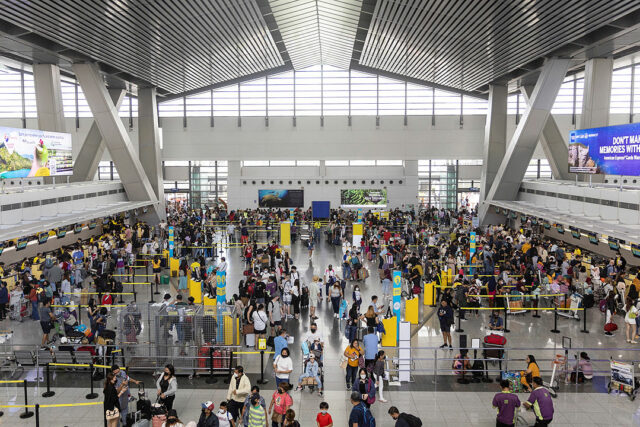
NEW NAIA Infra Corp. (NNIC), the private operator of the country’s main gateway, said it is expecting about 1.4 million passengers for the All Souls’ Day and All Saints’ Day.

“Undas is one of the busiest travel periods for the airport, and we are fully prepared to manage the expected surge. We have deployed additional personnel, strengthened coordination with partner agencies, and activated passenger assistance counters to make travel smoother and safer for everyone,” NNIC President Ramon S. Ang said in a media release on Monday.

NNIC, which operates and manages the Ninoy Aquino International Airport (NAIA), said it anticipates 1.35 million passengers for Oct. 25 to Nov. 3 period from the 1.3 million passengers recorded in the same period last year.

With this, NNIC said it is also working closely with partners in the government including the Manila International Airport Authority (MIAA), Department of Transportation (DoTr), Bureau of Immigration to ensure enough manpower and resources across all terminals.

Since taking over NAIA in September last year, NNIC said NAIA has reported a total of 51.7 million passengers in its first year of operations, marking a 4% increase versus the same period last year.

In a separate press release, the Transportation Department through Philippine Ports Authority (PPA) said it expects 2.2 million port passengers during this period across all seaports. — Ashley Erika O. Jose

Senator questions 946 infra projects 

PRESIDENTIAL COMMUNICATIONS OFFICE

SENATE Finance Committee Chair Senator Sherwin T. Gatchalian on Monday said about 946 projects worth P14.4 billion under the Public Works department were found to be potential red flags.

In a Senate budget hearing, Mr. Gatchalian questioned the Department of Public Works and Highways (DPWH) whether it verified the projects had been duplicated in the 2026 budget.

“Did (the agency) find any projects that were doubled, based on your analysis? Anything that were doubled, or those that have been executed and reappeared in the 2026 budget,” he asked in Filipino.

Public Works Secretary Vivencio “Vince” B. Dizon said that the agency has verified that 798 of the projects, worth P11.6 billion, are continuing infrastructure projects.

“For the remaining 148, we do not know yet,” Mr. Dizon said in Filipino.

Mr. Dizon said that the projects were for continuations of exciting projects that required additional funding.

The senator gave the Department of Public Works and Highways until Oct. 31 to complete its verification of the remaining flagged projects.

“If your initial review did not find any repeated (projects), and in good faith these are all continuations, we will give you until Friday,” Mr. Gatchalian said.

The DPWH budget has been in heightened scrutiny following the discovery the contractors and Public Works officials had siphoned off funds from flood control infrastructure projects. — Adrian H. Halili

Cambodia told: Help end scam hubs

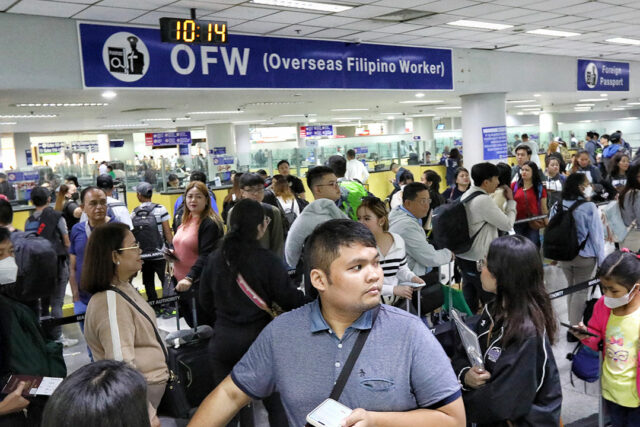
Overseas Filipino workers (OFWs) are seen at the Ninoy Aquino International Airport Terminal 3. — PHILIPPINE STAR/WALTER BOLLOZOS

A SENATOR on Monday called on the Cambodian government to cooperate with the Philippines’ efforts to end scam hubs that continue to lure Filipinos.

In a statement, Senator Rafael T. Tulfo said that he had met with Cambodian First Vice President Ouch Borith and Ty Sokun of the National Assembly of Cambodia to discuss possible cooperation.

“These victims are enticed by deceptive social media posts offering high salaries, but upon arrival, they are either underpaid or, in some cases, even tortured,” he said during a meeting in Geneva, Switzerland. Mr. Tulfo had also asked the Cambodian officials to investigate its own immigration officials to ensure that no local personnel are aiding the human traffickers.

He also requested for Cambodia to fast track the repatriation of Filipinos rescued in scam hubs.

“If you can help us with making repatriation faster because that is the problem we get now. After Filipino workers get rescued, their repatriation takes time. Maybe we can shorten it from one month to two to three days,” he said to the officials.

Mr. Borith said that his county was willing to work closely with the Philippines to address the issue.

He also said that masterminds of scam hubs are foreigners who can easily enter Cambodia due to the lack of visas. — Adrian H. Halili

SC sets 30-day deadline for courts to decide extradition cases

BW FILE PHOTO

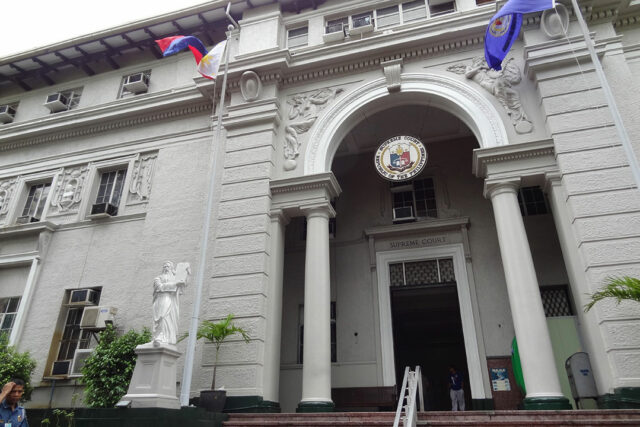
THE Supreme Court (SC) has, for the first time, imposed a fixed 30-day deadline for local courts to decide on extradition cases under the newly approved Rules on Extradition Proceedings, which will take effect next month.

In a resolution dated April 8, 2025, and published on Oct. 25, the SC En Banc said the new rules were designed to make extradition proceedings “consistent, clear, and efficient,” by setting uniform procedures and timelines for warrants, bail, and appeals.

“The extradition court shall render judgment within thirty (30) calendar days after the last witness is presented or from receipt of the last pleading,” the SC said. It added that the change “ensures that extradition cases are resolved without undue delay and in accordance with due process.”

Previously, extradition cases had no fixed timeline for resolution, often dragging on for months or even years.

The new rules also require the Court of Appeals to decide on appeals within 90 days of submission, with its ruling deemed final and immediately executory.

The high court said the new framework aims to make proceedings more efficient by focusing only on the validity of the extradition request, not on the guilt or innocence of the individual sought.

“Extradition proceedings are summary in nature,” it said, emphasizing that courts should rely mainly on pleadings and certified documents unless witness testimony is necessary.

Before issuing an arrest warrant, the extradition court must determine probable cause and verify that the individual named is the same person identified in the foreign indictment or judgment. “If these requirements are met, the court shall issue a warrant of arrest which may be served anywhere in the Philippines,” the SC said.

Extraditees will be detained at National Bureau of Investigation (NBI) facilities or the nearest available jail, while courts may also issue hold departure orders “to prevent the extraditee from leaving the country, except for purposes of extradition.”

Bail may be granted only if the extraditee proves they are not a flight risk. “Bail shall not be allowed if the extraditee is being extradited to serve a sentence or has been convicted but not yet sentenced,” the SC said.

The rules also authorize provisional arrest before a formal extradition request is received, though the extraditee must be released if supporting documents are not filed within 60 days.

An extraditee who voluntarily surrenders waives the right to further proceedings, while any property linked to the case will be turned over to the requesting state. All costs of extradition proceedings will likewise be shouldered by the requesting state, unless provided otherwise in the treaty.

The rules were drafted by a technical working group led by Associate Justice Rodil V. Zalameda and Associate Justice Antonio T. Kho, Jr. — Erika Mae P. Sinaking

Ombudsman Remulla in good health

JESUS CRISPIN C. REMULLA — PHILIPPINE STAR/JOHN RYAN BALDEMOR

OMBUDSMAN Jesus Crispin C. Remulla is in good health and fully capable of performing his duties, his office said on Monday, clarifying that recent remarks about his medical condition had been taken out of context.

“The Ombudsman is in good health and continues to fulfill his responsibilities with full energy and dedication,” his office said in a statement. “He has been cancer-free for one and a half years.”

The clarification followed his televised interview with journalist Luchi Cruz-Valdez on Oct. 24, where Mr. Remulla disclosed that he had been diagnosed with leukemia in 2023 — around the same time he underwent quintuple heart bypass surgery.

Mr. Remulla said he underwent two cycles of chemotherapy, total body irradiation, and a bone marrow transplant before making a full recovery.

“The Ombudsman’s statement on his health referred to his past experience,” the office said. “He was speaking about what he went through before he became Ombudsman.”

Mr. Remulla, who went on medical leave from the Department of Justice in 2023 for personal reasons, was appointed as Ombudsman this year.

The Ombudsman’s office also said that he remains fully committed to carrying out his mandate. “We assure the public that the Ombudsman is determined to hold accountable those responsible for the flood control issue,” the statement read. “His second chance at life has given him a stronger sense of purpose — he has nothing more to fear or delay.” — Erika Mae P. Sinaking

Unified 911 system launched in Cebu

The government, along with the NGA 911 and PLDT Inc., set up the unified 911 system’s second regional hub at the PLDT Smart Experience Hub at Osmeña Boulevard, Cebu, Oct. 25.

THE Department of the Interior and Local Government (DILG), along with the NGA 911, and telecommunications company PLDT Inc., launched the unified 911 system’s second regional hub in Cebu.

DILG Secretary Juanito Victor C. Remulla, Jr. unveiled the new hub last Oct. 25 at the PLDT Smart Experience Hub at Osmeña Boulevard, which will serve as its temporary site. Its permanent site will be built at the Bureau of Fire Protection (BFP) Headquarters in Lapu-Lapu City.

“With the BFP leading the implementation, supported by the DILG, PLDT, and NGA, we are building a future where no Filipino is left without help when it matters most,” Mr. Remulla said.

The hub is powered by technology from NGA 911 and supported by the telecommunications infrastructure of PLDT and ePLDT.

The command center, which will be open 24/7, will connect the public to just one emergency response system when they dial 911. The system can also handle calls in various local languages and dialects, including Tagalog, Cebuano, and Ilocano among others.

The Cebu hub will also be equipped with advanced communication platforms, live video streaming, and centralized data reporting.

It also comes with GPS-based tracking for callers and responders, geofencing, and real-time CCTV integration.

After Cebu, the government will set up six more regional hubs and satellite centers to complete the system.

Hastings Holdings, Inc., a unit of the PLDT Beneficial Trust Fund subsidiary MediaQuest Holdings, Inc., holds a majority stake in BusinessWorld through the Philippine Star Group. — CAT