
How PSEi member stocks performed — August 27, 2021
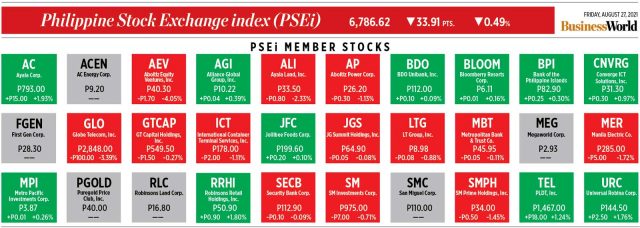
Here’s a quick glance at how PSEi stocks fared on Friday, August 27, 2021.
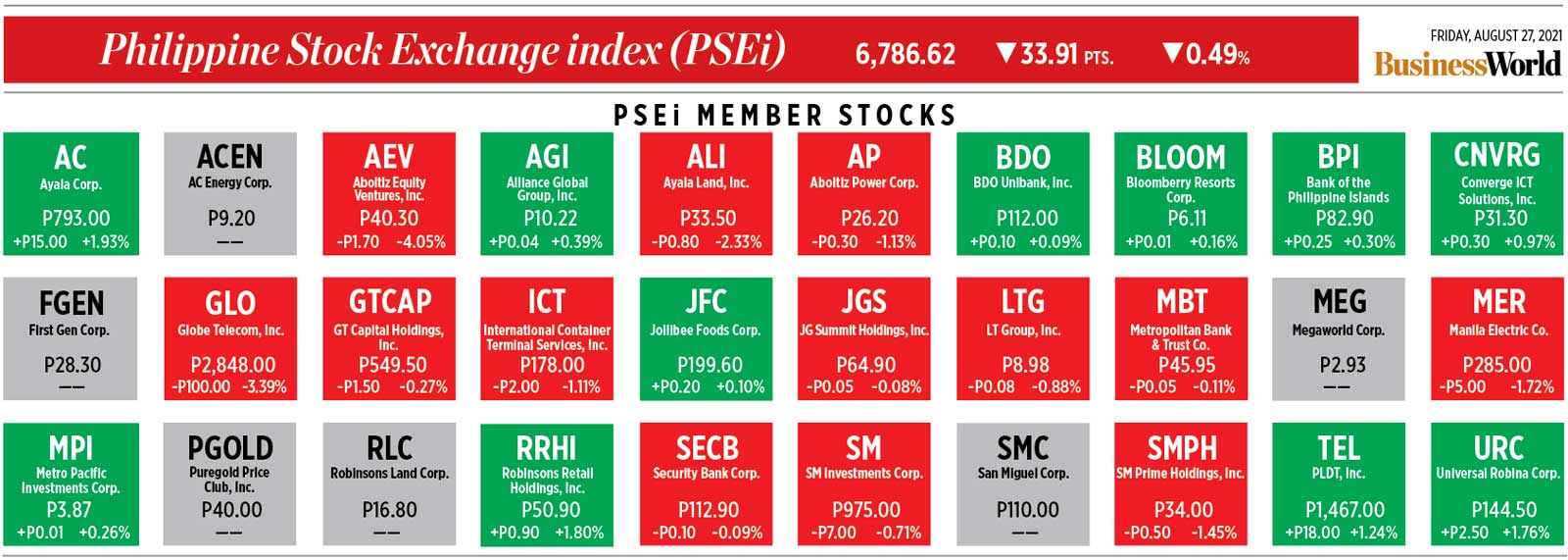

Here’s a quick glance at how PSEi stocks fared on Friday, August 27, 2021.

THE PESO is likely to strengthen versus the dollar this week after the US Federal Reserve said it would continue to support the world’s largest economy.
The local unit finished trading at P49.955 per dollar on Friday, appreciating by 2.5 centavos from its P49.98 close on Thursday, based on data from the Bankers Association of the Philippines. It likewise strengthened by 41.5 centavos from its P50.37-per-dollar close a week earlier.
The peso rose after the country’s balance of payments (BoP) yielded a surplus, reflecting higher dollar buffers than initially reported, UnionBank of the Philippines, Inc. Chief Economist Ruben Carlo O. Asuncion said.
Data released by the Bangko Sentral ng Pilipinas (BSP) on Wednesday showed the country’s BoP position stood at a surplus of $642 million in July, significantly bigger than the $8-million surfeit seen a year earlier. It was also a turnaround from the $312-million gap in June and ended two months of the BoP position in deficit.
The BSP attributed this mainly to the foreign currency deposits of the National Government and its net income from investments abroad.
The July BoP position reflects the country’s final gross international reserves (GIR) level of $107.15 billion as of end-July, higher than the preliminary figure of $106.548 billion and the $105.76 billion seen at end-June.
Meanwhile, Rizal Commercial Banking Corp. Chief Economist Michael L. Ricafort said the peso appreciated as more vaccines arrived in the Philippines, boosting reopening prospects.
Finance Secretary Carlos G. Dominguez III on Thursday said the country has already secured 194.89 million vaccine doses.
Fully vaccinated persons in the country made up 16.71% or 18.061 million of the population, based on latest data from the Johns Hopkins University. This is still far from the 70% the government targets to inoculate by end-2021 to achieve herd immunity.
For this week, Mr. Asuncion said the peso could rise following dovish signals from the US central bank chief at the Fed’s Jackson Hole symposium on Friday.
Fed Chairman Jerome H. Powell said there has been clear progress toward maximum employment and that he was of the view that if the US economy evolved broadly as anticipated, “it could be appropriate to start reducing the pace of asset purchases this year,” Reuters reported.
However, he told the Fed’s annual late-August symposium in Jackson Hole, Wyoming, that the timing and pace of tapering does not involve a signal for when interest rates will begin to rise, a message the market perceived as being dovish.
Meanwhile, Mr. Ricafort said manufacturing data to be released this week could also affect foreign exchange trading.
IHS Markit will release the August Philippine Manufacturing Purchasing Managers’ Index (PMI) on Sept. 1. The country’s PMI stood at 50.4 in July, slipping from the 50.8 reading in June but still above the 50 neutral mark that separates contraction from expansion.
For this week, both Mr. Asuncion and Mr. Ricafort expect the peso to move within P49.70 to P50.20 against the dollar. — LWTN with Reuters
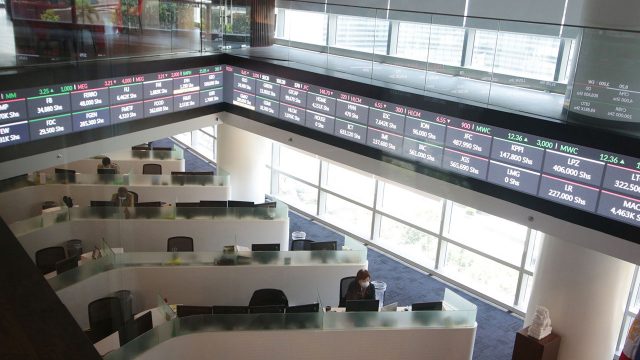
INVESTORS will continue monitoring the coronavirus disease 2019 (COVID-19) situation as the country continues to post record daily tallies, causing the government to extend restrictions.
The benchmark Philippine Stock Exchange index (PSEi) shed 33.91 points or 0.49% to close at 6,786.62 on Friday, while the broader all shares index went down by 0.89 point or 0.02% to 4,204.11.
Still, the PSEi gained 153.40 points from its 6,633.22 finish on Aug. 20.
Financial markets are closed today, Aug. 30, in observance of National Heroes Day.
“The market’s strength for the past sessions is atypical for the season and has rewarded those who were able to buy the dips. Based on our research, August and September are usually down,” PNB Securities, Inc. President Manuel Antonio G. Lisbona said in a text message on Friday.
Timson Securities, Inc. Trader Darren Blaine T. Pangan said the local bourse performed well this month due to positive corporate earnings reports and economic data releases.
“The ascent of the index was, however, tempered by the resurgence of COVID-19 cases in the capital region, which in turn prompted the government to put back strict quarantine measures in Metro Manila and nearby provinces,” Mr. Pangan said in a Viber message on Saturday.
Metro Manila was placed under enhanced community quarantine for two weeks until Aug. 20 to curb rising cases due to the more infectious Delta variant of COVID-19. This has since been eased to a modified enhanced community quarantine, which will be implemented until Sept. 7.
The Health department logged a record 19,441 new infections on Saturday, bringing total cases to 1,935,700. Active cases stood at 142,679.
Mr. Pangan said the market’s performance in the coming months will depend largely on the COVID-19 situation in the Philippines.
“Major catalysts for the rest of the year are inoculation targets being met, enabling looser mobility restrictions, [the] ramp-up in government infrastructure spending, BSP (Bangko Sentral ng Pilipinas) liquidity support, and global economic recovery boosting OFW (overseas Filipino workers), BPO (business process outsourcing) and Philippine exports,” First Metro Investment Corp. Head of Research Cristina S. Ulang said in a separate Viber message on Friday.
Rizal Commercial Banking Corp. Chief Economist Michael L. Ricafort said in an e-mail that the increase in vaccine arrivals “will structurally help better manage or control new COVID-19 cases in a more sustained manner or at least help prevent the more contagious Delta variant from spreading further.”
“Our [outlook] for the rest of the year is positive, the market will probably test 7,000 and beyond as more investors take positions in anticipation of a sustained recovery in the economy,” PNB Securities’ Mr. Lisbona said. — Keren Concepcion G. Valmonte
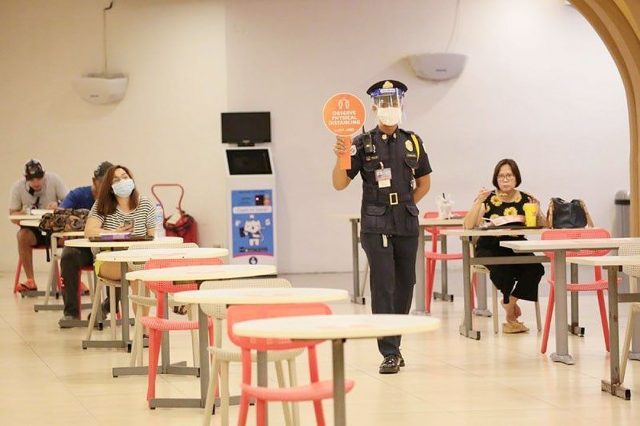
TRADE SECRETARY Ramon M. Lopez is recommending 20% capacity for restaurants and personal care shops for vaccinated customers.
“Just 20% capacity. For vaccinated workers and customers,” he told reporters in a Viber message Sunday.
Mr. Lopez has said that he wants government to allow those who are inoculated against coronavirus disease 2019 (COVID-19) to be allowed into dine-in restaurants and personal care shops during the modified enhanced community quarantine (MECQ).
He added museums and exhibits to the list, after a proposal from the Tourism department.
Such businesses are not allowed to run on-site operations during MECQ, which in Metro Manila has been extended until Sept. 7.
“Once approved, this will be part of new protocol,” he said, referring to guidelines from the interagency task force on the coronavirus.
Mr. Lopez has said that the move would incentivize vaccination and bring back jobs as the sectors reopen. Dine-in restaurants account for around a million jobs, while personal care services employ 200,000, he said.
Public transportation and entry to malls, where essential shops like supermarkets are allowed to operate, are still allowed regardless of vaccination status.
Both vaccinated and unvaccinated would also be allowed into these shops when restrictions are eased.
“If it’s not lockdown, all vaccine status allowed subject to operating capacity,” Mr. Lopez said. — Jenina P. Ibañez

BUDGETARY SUPPORT to government companies declined 66% to P6.079 billion in July, with the National Irrigation Administration (NIA) and the National Housing Authority (NHA) receiving the top allocations, the Bureau of the Treasury (BTr) said.
Preliminary data from the BTr indicate that subsidies to government-owned and -controlled corporations (GOCCs) last month fell 27% from subsidies granted in June.
The NIA remained the top subsidy recipient, having been allocated P2.756 billion, or 45% of the total. The subsidy rose 44% from a year earlier and 4.2% larger than the June subsidy.
The NHA received P1.483 billion, accounting for 23.4% of the total. The agency did not receive financial support from the government in July 2020.
Other GOCCs that received allocations in July were the National Power Corp. with P933 million, the Philippine Heart Center P147 million; the Philippine Postal Corp. P135 million, and the National Kidney Transplant Institute with P107 million.
Others receiving more than P50 million were the Civil Aviation Authority of the Philippines (P98 million), the Philippine Children’s Medical Center (P87 million) and the Light Rail Transit Administration (P85 million).
GOCCs that received no subsidies in July were the: Bases Conversion Development Authority, the Development Academy of the Philippines, the Local Water Utilities Administration, the National Food Authority, the National Home Mortgage Finance Corp., the Philippine Crop Insurance Corp., the Philippine Fisheries Development Authority, the Philippine Health Insurance Corp. (PhilHealth), the Philippine National Railways, the Subic Bay Metropolitan Authority and the Tourism Infrastructure and Enterprise Zone Authority.
In the seven months to July, GOCC subsidies fell 35.6% from a year earlier to P94.361 billion due to base effects after the government coursed through the Social Security System a P50-billion wage subsidy program to help employers retain their workers during the lockdown last year.
PhilHealth got the biggest subsidy worth P45.456 billion during the seven months, followed by the NIA with P19.596 billion.
Subsidies are granted to GOCCs to cover operational expenses not supported by their revenue. — Beatrice M. Laforga

SENATOR Sherwin T. Gatchalian, who chairs the Senate Committee on Energy, said the Energy department’s reassurances of sufficient power supply during the 2022 election season may not hold up in the event of an unplanned outage at a major power plant.
“The DoE clarified through a virtual press conference last Aug. 17, 2021 that the country will have sufficient electric power supply during the election week as the initial outlook shows sufficient supply, and as such no yellow alerts and power interruptions. However, the outlook does not take into consideration forced and unplanned outages and the declining Malampaya supply,” he said in a resolution filed last week.
Mr. Gatchalian’s Senate Resolution 867 seeks to look into the preparations of the Department of Energy (DoE) and energy industry to ensure a continuous supply of power during the May elections.
In the resolution, he pointed out that the dry seasons of 2019 and 2021 were accompanied by power interruptions caused by unplanned outages and derating of power plants. He added that brownouts — the reduction of power supply to various service areas on a rotating basis — took place earlier this year despite earlier pronouncements from the DoE that it was “optimistic that the country will not encounter major challenges or any alerts that may result in insufficiency of supply.”
“We must ensure the credibility and transparency in the conduct of elections as well as the delivery of fast and accurate results reflective of the genuine will of the people,” Mr. Gatchalian said separately in a statement over the weekend.
On Aug. 17, Energy Undersecretary and Spokesperson Felix William B. Fuentebella said he expects a “thinning of reserves” between May and June next year due to higher demand and low water levels at hydro power plants, but called yellow alerts unlikely for the Luzon grid.
Citing the National Grid Corp. of the Philippines’ (NGCP) base case scenario for 2022, Mr. Fuentebella said that available power is expected to stay above the minimum contingency and regulating requirements.
The system operator issues a yellow alert when power reserves fall below ideal levels. When the supply-demand balance worsens, it is downgraded to a red alert.
NGCP Head of Systems and Standards Division and Technical Services Department Ermelindo R. Bugaoisan, Jr. has said that this scenario assumes “no maintenance” for power plants during the dry season.
Meanwhile, the DoE estimates indicate the remaining reserves of the offshore Malampaya gas field will be depleted by the first quarter of 2027. — Angelica Y. Yang
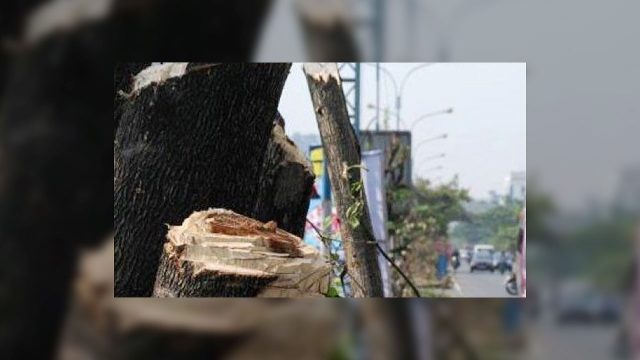
THE DEPARTMENT of Environment and Natural Resources (DENR) transferred the authority to its regional offices to issue permits for tree-cutting and relocation.
The relocation process is known as earth-balling, in which whole trees are dug up from their roots.
In a statement over the weekend, the DENR said Environment Secretary Roy A. Cimatu issued Department Administrative Order (DAO) No. 2021-11 on May 19 which transferred permit authority to the 16 regional executive directors.
Previously, the DENR undersecretary for Field Operations had the authority to issue the permits for tree cutting and earth balling for areas and activities exempted from Executive Order (EO) 23. EO 23 bans the cutting and harvesting of timber from natural and residual forests.
Mr. Cimatu said the order seeks to streamline the process for naturally-grown trees on private land, and on public land covered by tenure agreements such as Forest Land Use Agreements, Forest Land Use Agreements for Tourism purposes, Special Land Use Permits, and Mineral Production and Sharing Agreements with an approved Environmental Protection and Enhancement Program.
“We have simplified the process of applying for cutting permits and made it more accessible to private landowners and holders of DENR-issued land tenurial instruments where there are naturally-growing trees that may not need to be cut but only trimmed,” Mr. Cimatu said.
According to Mr. Cimatu, the order ensures that no natural growing trees, or trees that are grown in a specific area not planted by its owner or occupant, are neglected or unnecessarily cut down.
Environment Assistant Secretary Marcial C. Amaro, Jr. said the order will improve the Forest Management Bureau’s processing of forestry-related permits.
“Other similar orders have already been issued such as the decentralization in the issuance of permits for wood processing plants and importation of wood through DAO No. 2021-05 and DAO 2021-06, respectively, which seek to augment local sources of wood and enable wood-based industries like the furniture-making and trading sectors to generate employment and income,” Mr. Amaro said.
According to DAO 2011-11, an applicant must obtain a certification of no objection (CNO) to the tree cutting activities from the barangay captain whether for private or public land.
The CNO must be issued by the mayor and barangay captains if the trees to be affected stand on more than one barangay. It needs to be obtained from the provincial governor or all mayors involved if the trees to be cut stand on more than one town or city.
DAO 2011-11 also requires CNOs to be issued by the resident agrarian reform officer if the affected trees are in areas covered by a certificate of land ownership award. — Revin Mikhael D. Ochave
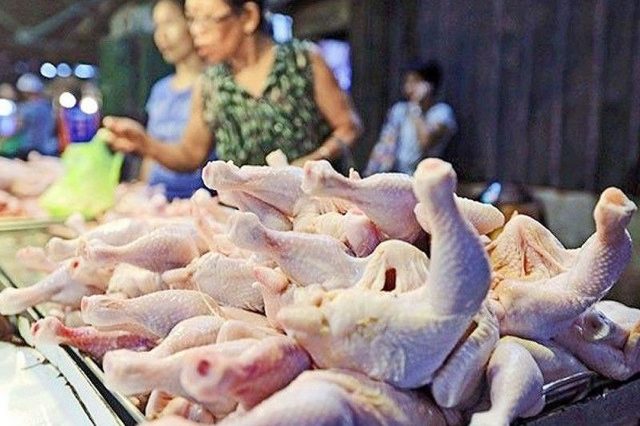
THE PROLONGED lockdown in the National Capital Region is reducing the average farmgate price of broiler chicken, according to the United Broiler Raisers Association (UBRA).
UBRA President Elias Jose M. Inciong told BusinessWorld by phone that the average farmgate prices have collapsed during the strict lockdown over the capital.
UBRA said the average price of off-sized broiler fell 11% from a week earlier to P70.75 per kilogram (/kg) as of Aug. 27.
The average price of regular-sized broiler and prime-sized broiler as of Aug. 27 were at P71.25/kg and P72.67/kg, respectively. The prices were 12% and 10% lower week on week.
“The cost of production is also high, at a range of P78 to P88/kg depending on flock performance. Prices of feed raw materials are at a historical high such as yellow corn with an average price of P21.19/kg as of Aug. 27, compared to P17.16/kg recorded in August last year,” Mr. Inciong said.
Mr. Inciong said some small growers might have to shut down.
“The small players will reduce production or stop while the big players — those who are well financed — are probably able to wait for conditions to turn better, when they have less competition,” Mr. Inciong said.
The President’s Spokesman Herminio L. Roque, Jr. announced Saturday that Metro Manila will remain under modified enhanced community quarantine (MECQ) until Sept. 7.
MECQ in Metro Manila was originally scheduled to end on Aug. 31.
Other areas that are also under MECQ until Sept. 7 are Bulacan, Bataan, Apayao, Ilocos Norte, Cavite, Rizal, Laguna, Lucena City, Aklan, Iloilo province, Iloilo City, Lapu-Lapu City, Cebu City, Mandaue City, and Cagayan de Oro City.
Meanwhile, Mr. Inciong disputed claims by the Department of Agriculture (DA) that the Philippine poultry sector is a “bright spot” for growth, calling it an “empty” PR exercise lacking “substance.”
On Aug. 27, Agriculture Secretary William D. Dar said during the Philippine Poultry and Livestock Virtual Summit that the poultry subsector remains a bright spot for spurring agricultural growth.
The DA has announced that it is aiming to achieve 2% growth for 2021, lower than its previous growth target of 2.5%.
Mr. Dar also highlighted the DA’s investments in the poultry subsector such as the ongoing construction of the P50-million cold storage and meat cutting facility in San Jose, Batangas and the P90-million meat cutting plant and cold storage warehouse in Pampanga State Agricultural University.
“The private sector has been most helpful in the rescue of the entire livestock sector, which suffered negative growth due to African Swine Fever (ASF). We need to involve more of our country’s best entrepreneurs in the effort — because they have a great deal to offer in terms of resources and expertise,” Mr. Dar said. — Revin Mikhael D. Ochave

The S in SGV was a business icon in the person of Washington SyCip. Last June 30, SGV celebrated his centenary which coincides with the Firm’s 75th anniversary.
On August 26th, SGV celebrated another centennial milestone — that of our Co-Founder, Alfredo M. Velayo. They were born just 57 days apart in 1921. The two met when they were five years old on the first day of First Grade in P. Burgos Elementary School. They then remained friends for the rest of their lives — they were the original BFFs even before the term was coined.
Mr. SyCip convinced Mr. Velayo to return to the Philippines after the Second World War. Mr. Velayo had migrated to California with his young family at the time. Seizing the opportunities of post-war reconstruction, Mr. SyCip had started a one-man accounting firm in 1946 and not long after, wrote to Mr. Velayo to join him. That historic correspondence is considered the firm’s first recruitment letter and is now proudly exhibited in the SGV Museum.
Together, Mr. SyCip and Mr. Velayo worked hard to grow the company. They shared the same values of integrity and excellence; the same vision of helping in national development; and above all, they shared the same deep love for the Filipino people. In just two decades under their joint leadership, SGV had grown from 5 people in a one-room office to more than 2,000 professionals in member firms throughout Southeast Asia called The SGV Group.
The growth of SGV was phenomenal and it can be attributed to the balance that Mr. SyCip and Mr. Velayo brought to the practice. Each of them had their roles cut out for them. While both were heavily involved in client work, it was Mr. SyCip who focused on much of the external requirements of the young firm. On the other hand, it was Mr. Velayo who was depended on to take care of the house. He was affable and his winsome ways encouraged a familial work environment. He took very seriously his role as mentor and steward. His legacy in this respect is embodied in SGV’s Purpose to nurture people and leaders. In fact, when people think of Mr. Velayo, the first thing that they recall is the largeness of his heart.
While Mr. Velayo retired from SGV when he was only 50, his presence was larger than life in SGV. He would faithfully attend all our events and he also chaired the SGV Foundation. He was also a client of the firm and that is how I personally got to know him. Two months ago, I had shared in this column some of the life lessons learned from Mr. SyCip. Here are some nuggets of wisdom that Mr. Velayo imparted to us.
The first is to strive for perfection.
Mr. Velayo was a man of precision — he always started and ended every activity on time. He was also a man of accuracy, which can be attributed to his being an accountant. Many who had worked with him in numerous Boards recall how he would come prepared for every Board meeting with questions that demanded exact answers. Being an eloquent person, he was impatient with people who could not articulate themselves properly. Mr. Velayo was also always impeccably dressed and looked like a movie star.
The second lesson is to care for your people.
While Mr. Velayo believed deeply in the value of hard work, he believed even more strongly in the importance of taking care of his people in SGV. He focused on finding ways to bring out the best in people and letting their inner strength shine through. He famously said that SGV does not give people jobs, they are given brighter futures.
Caring for others can also be shown in small acts of kindness. He would tell us that little things matter — a lot. Take, for example, a thank you note to someone who had given you a gift or had done something nice. That short scribble can go a very long way.
The third lesson is to give back or pay forward.
When Mr. Velayo retired from corporate life, he didn’t stop working. Instead, he directed his formidable energies and intellect to finding ways to help and create opportunities for those in need. Not only was he the chair of the SGV Foundation, he also became president of the William J. Shaw Foundation. Both foundations support public educational institutions among many others.
Looking back on his roots, Mr. Velayo was also inspired to support the schools that gave him and Mr. SyCip their educational foundations. At his instigation, they made numerous donations over the years to the P. Burgos Elementary School, the Victorino Mapa High School, and the University of Santo Tomas (UST).
His passion for education shone through both as a student and teacher. During his early years in SGV, he would teach evening classes in UST. Little did he know that more than 60 years after he graduated from UST, the school would honor him with the creation of the University of Santo Tomas — Alfredo M. Velayo College of Accountancy — an institution that now carries on his life’s vision to educate and care for future generations.
The fourth lesson is to have a sense of humor.
This was his trademark — he loved to make people laugh. While he was very serious when it came to business, Mr. Velayo always managed to see the lighter side of things. He never ran out of jokes and anecdotes on any occasion. Of course, some of them were recycled over time but, because of his masterful storytelling, everyone would always end up in stitches. Mr. Velayo enjoyed the company of people. He would host luncheons or dinners for small groups where he would narrate his fascinating life stories peppered with jokes.
The V in SGV is no other than Mr. Alfredo Velayo. The V in SGV stood for his vivaciousness and vitality. The V in SGV represents his values of integrity, excellence and compassion that have endured the test of time. The V in SGV is the vision that our co-founders so carefully crafted and worked for which is to nurture Filipino professionals who can contribute to national development.
Thank you, Mr. Velayo, for your legacy that continues to inspire us in our SGV Purpose to help build a better Philippines.
This article is for general information only and is not a substitute for professional advice where the facts and circumstances warrant. The views and opinions expressed above are those of the author and do not necessarily represent the views of SGV & Co.
Wilson P. Tan is the Chairman and Country Managing Partner of SGV & Co.
By Kyle Aristophere T. Atienza and Russell Louis C. Ku
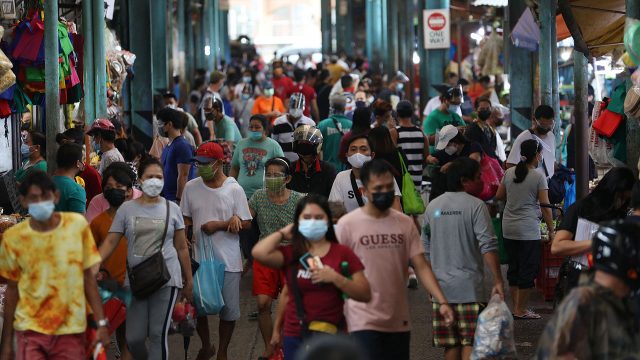
PHILIPPINE health authorities reported 561 coronavirus infections from the Delta variant on Sunday, bringing the total to 1,789.
Of the new cases, 473 were local patients, 31 were returning migrant Filipino workers and 12 were still being verified, the Department of Health (DoH) said in a statement.
The agency said 114 cases had addresses in the National Capital Region, 24 in the Ilocos Region, 32 in Cagayan Valley, 64 in Central Luzon, 79 in Calabarzon, 20 in Mimaropa and 16 in the Bicol Region.
Thirteen were from Western Visayas, 23 from Central Visayas, 12 from the Zamboanga Peninsula, 48 from Northern Mindanao, 22 from the Davao Region and six from the Cordillera Administrative Region.
Six cases were still active, five patients died and 505 recovered, DoH said.
The agency also said 73 more people have been infected with the Alpha coronavirus variant first detected in the United Kingdom, bringing the total to 2,395.
Of the new cases, 71 were local patients and two were returning migrant Filipino workers. All of them have recovered.
The country now had 2,669 cases of the Beta variant after 81 more Filipinos got infected with the strain first detected in South Africa. Forty-one more people have been infected with the P.3 variant first detected in the Philippines.
The Health department reported 18,528 coronavirus infections on Sunday, bringing the total to 1.95 million.
The death toll rose to 33,109 after 101 more patients died, while recoveries increased by 17,922 to 1.78 million, it said in a bulletin.
There were 143,221 active cases, 95.3% of which were mild, 2% did not show symptoms, 1.1% were severe, 1% were moderate and 0.6% were critical.
The agency said 205 duplicates had been removed from the tally, 204 of which were tagged as recoveries while 38 recoveries were reclassified as deaths. Seven laboratories did not submit data on Aug. 27.
Meanwhile, the country’s daily coronavirus tally could hit more than 20,000 by September, the OCTA Research group from the University of the Philippines said.
Cases could peak as early as next week, OCTA Research fellow Fredegusto P. David told ABS-CBN Teleradyo.
The country on Saturday logged more than 19,400 coronavirus infections, the highest daily tally since the pandemic started in March last year.
Mr. David said coronavirus cases in Metro Manila increased by 11% in the past week from 24% a week earlier. Infections could increase further, he added.
OCTA earlier said the Philippines would post 20,000 cases daily amid the spread of the highly contagious Delta variant.
The Health department has said coronavirus infections were expected to peak in the coming weeks. The country had a daily average of 15,537 cases from Aug. 19 to 25, higher than 12,897 cases a week earlier.
The presidential palace on Saturday said Metro Manila, Laguna, and Bataan would remain under a modified enhanced community quarantine until Sept. 7.
Mr. David said localized lockdowns endorsed by Health authorities would be effective only if cases were not as widespread in cities.
OCTA earlier said centralized lockdowns were still needed to stop the spike.
Meanwhile, the Philippine Health Insurance Corp. (PhilHealth) has deferred the suspension of payments of hospital claims under investigation for possible fraud, spokesperson Shirley B. Domingo told DZBB radio on Sunday.
The decision came after a dialogue with healthcare providers brokered by Health Undersecretary Leopoldo J. Vega.
Mr. Vega last week urged PhilHealth to prioritize the payment of claims from private hospitals, which have threatened to cut ties with the state insurer.
Private hospitals find it hard to generate revenue since they have focused on coronavirus patients, he said.
Some private hospitals have threatened to cut ties with PhilHealth after it released a circular suspending payment to health care providers whose claims are under probe.
Philippine Hospital Association President Jaime A. Almora separately told the radio station the move was a “happy culmination” of congressional hearings about the PhilHealth plan.
PhilHealth wanted to suspend payments of claims of healthcare providers with allegations of fraudulent and unethical acts or abuse of authority for up to 210 days.
The circular has come under fire by hospital groups, citing a “feeling of mistrust” by the state insurer against healthcare providers.
PhilHealth President and Chief Executive Officer Dante A. Gierran had told congressmen the state insurer would release 60% of unpaid claims out of P21 billion owed to private hospitals by this week.
Ms. Domingo said that PhilHealth would continue talks with healthcare providers on delayed payments and the temporary suspension of claims to find a compromise.

A PDP-Laban faction led by Senator Emmanuel “Manny” D. Pacquiao has ousted President R. Duterte as chairman, according to a party official.
Mr. Duterte was voted out at a national council held on Sunday, Ronwald F. Munsayac, executive director of the PDP-Laban faction, said in a text message.
He said Senator Aquilino “Koko” L. Pimentel III replaced Mr. Duterte, who has supported the faction led by Energy Secretary Alfonso G. Cusi.
Former Eastern Samar Governor Lutgardo B. Barbo was elected vice chairman, he added.
Mr. Munsayac has yet to confirm media reports that Mr. Pacquiao, who is believed to be running for President next year, had been elected party president.
“It’s a comedy,” Melvin Matibag, secretary-general of the opposing faction, said in a statement.
“Senator Koko Pimentel has no position in PDP-Laban,” he said. “He is irrelevant and he does not represent the party. His group are pretenders and are attention seekers.”
Mr. Duterte is the party chairman and would continue to be so, he added.
Mr. Duterte last week said he would run for vice president next year so he could continue his campaign against illegal drugs, criminality and insurgency.
PDP-Laban earlier said the President, who is barred by law from running for reelection, had agreed to “make the sacrifice and heed the clamor of the people” by running for vice-president.
In the Philippines, the President and vice-president are elected separately and may come from opposing political parties. The vice-president usually becomes powerless unless the President gives him a key post in his Cabinet. — Kyle Aristophere T. Atienza

THE FORMER Budget official accused of awarding a multibillion-peso contract to a local contractor for overpriced face masks and shields probably had a backer, a senator said on Sunday.
Both ex-Budget Undersecretary Lloyd Christopher Lao and Pharmally Pharmaceutical Corp., which bagged the P8.68-billion supply contract despite being new and undercapitalized, both had a backer, Senator Franklin M. Drilon told DZBB radio.
“We will force Lao to tell us who his backer is,” he said. “It’s obvious because from the very beginning, he said no one recommended him for the Department of Budget and Management. From there, you can already observe that he’s covering for someone.”
Mr. Drilon last week cited several warning signs of potential corruption in the procurement of several medical supplies by the Budget department.
He said the plunder had been planned together with other officials. “This is treachery or fraud involving national coffers during a pandemic, when funds are short,” he said in Filipino.
Mr. Drilon earlier cited as anomalous the choice of contractors of questionable qualifications. Pharmally earned P284.9 million in 2020, from zero income in 2019 after bagging P8.68 billion worth of government contracts, he said. He accused the Budget department of having given the contractor “the sure ticket to wealth.”
Senator Panfilo M. Lacson during Friday’s hearing asked Mr. Lao what type of due diligence was done before the agency awarded billions of funds to Pharmally.
Mr. Lao said they did not have a copy of Pharmally’s general information sheet so they did not have an idea about bogus addresses that the company allegedly used in its registration documents.
Mr. Drilon said Mr. Lao faces the risk of contempt by the Senate blue ribbon committee if he refuses to tell the truth.
He also said the former chief of the Budget department’s procurement office was negligent at the very least for allowing the contract to proceed.
Senator Panfilo M. Lacson at the weekend said Mr. Lao, a lawyer had failed to conduct due diligence on Pharmally. — Alyssa Nicole O. Tan
