Home Blog Page 7001

Opening doors to public service

VECTORJUICE-FREEPIK

On Dec. 15, 2021, the Senate passed on third and final reading Senate Bill No. 2094, which seeks to amend Commonwealth Act No. 146, otherwise known as the Public Service Act (PSA). The Senate Bill attempts to streamline and liberalize the current restrictions placed on the ownership, management, and control of public utilities and public services.

By way of background, the 1987 Constitution adopted a Filipino First policy by giving preference to qualified Filipinos in the grant of rights, privileges, and concessions covering the national economy and patrimony. Article XII, Section 11 of the Constitution states that no franchise, certificate, or any other form of authorization for the operation of a public utility shall be granted except to citizens of the Philippines or to corporations or associations organized under the laws of the Philippines at least 60% of whose capital is owned by such citizens. The maximum 40% foreign equity participation in the operation of a public utility has been in place since the 1935 Constitution.

Neither the Constitution nor statutes define what a “public utility” is. Notably, the Supreme Court, citing American jurisprudence, had the occasion to define a public utility as “a business or service engaged in regularly supplying the public with some commodity or service of public consequence such as electricity, gas, water, transportation, telephone or telegraph service.”

The PSA, approved in 1936, has entangled the concept of public utility with “public service.” It considers an entity as being engaged in public service if it “own[s], operate[s], manage[s], or control[s] in the Philippines, for hire or compensation, with general or limited clientele, whether permanent, occasional or accidental, and done for general business purposes, any common carrier, railroad, street railway, traction railway, sub-way motor vehicle, either for freight or passenger, or both with or without fixed route and whatever may be its classification, freight or carrier service of any class, express service, steamboat, or steamship line, pontines, ferries, and water craft, engaged in the transportation of passengers or freight or both, shipyard, marine railway, marine repair shop, wharf or dock, ice plant, ice-refrigeration plant, canal, irrigation system, gas, electric light, heat and power, water supply and power, petroleum, sewerage system, wire or wireless communications system, wire or wireless broadcasting stations and other similar public services.”

The PSA requires those engaged in any public service business to secure a certificate of public convenience or certificate of public convenience and necessity, except grantees of legislative franchises expressly exempting such grantee from the requirement of securing a certificate.

The Senate Bill has seemingly reconciled the entangled concepts by recognizing that a public utility is a subset of public service. In other words, all public utilities are public services; but not all public services are public utilities.

Under the Senate Bill, a public utility refers to a public service that operates, manages, or controls for public use any of the following:

1. Distribution or transmission of electricity

2. Petroleum and petroleum products pipeline transmission or distribution systems

3. Water pipeline distribution systems and wastewater pipeline systems

4. Airports

5. Seaports

6. Public utility vehicles

7. Expressways and tollways

The Senate Bill states that “[a]ll concessioners, joint ventures and other similar entities that wholly operate, manage or control for public use the sectors above are public utilities.” No other person shall be deemed a public utility unless otherwise subsequently provided by law.

In a press release, it was elaborated that those not classified as a public utility shall otherwise be considered as a public service, which will not be bound by the 60-40% nationality requirement. Notably, telecommunications, air carriers, domestic shipping, and railways and subways are considered a public service under the Senate Bill. As a safeguard, the aforementioned services are considered as critical infrastructure, which is subject to a reciprocity clause. Hence, foreign nationals shall not be allowed to own more than 40% of capital in public services engaged in the operation and management of critical infrastructure unless the country of such foreign nationals accords reciprocity to Philippine nationals. Further, an entity controlled by or acting on behalf of the foreign government or foreign state-owned enterprises shall be prohibited from owning capital in any public service classified as critical infrastructure.

Moreover, it shall be unlawful for any public service to sell, alienate or in any manner transfer shares of its capital stock, without prior approval and authorization, to any alien if the result of that sale, alienation, or transfer in itself or in connection with another previous sale shall be the reduction to less than 60% of the capital stock belonging to Philippine citizens in the operation of a public utility as required by the Constitution.

For the operation of the business services, no public service shall operate in the Philippines without possessing a valid and subsisting franchise and/or certificate from Congress and/or the proper administrative agency unless exempted. Operating, managing, or controlling public utilities shall not be interpreted as a requirement for legislative franchise where the law does not require any.

In keeping with the Filipino First policy, the Senate Bill requires a public service to employ a foreign national only after the determination of non-availability of a Philippine national who is competent, able and willing to perform the services for which the foreign national is desired. Understudy/skills development programs will also be enforced to ensure the transfer of technology/skills to Filipinos, with the potential of succeeding the foreign national in the same establishment or its subsidiary.

Notably, the House of Representatives has its own version of the bill amending the PSA. Differences between both versions exist, notably on the definition of a public utility and the terms of the reciprocity clause. In the House version, a public service will be deemed a public utility based on certain criteria, i.e., regularity of the service of public consequence, natural monopoly, necessity, and demand.

The Senate Bill is currently with the Bicameral Conference Committee to reconcile the conflicting provisions of the Senate and House versions. After both houses have given their approval, the enrolled bill shall be presented to the President for approval. The President either signs it into law, or vetoes and sends it back to the Senate with a veto message.

This article is for informational and educational purposes only. It is not offered and does not constitute legal advice or legal opinion.


Juan Miguel C. De La Cruz is an associate of the Corporate and Special Projects Department (CSPD) of the Angara Abello Concepcion Regala & Cruz Law Offices or ACCRALAW.

(632) 8830-8000

jcdelacruz@accralaw.com

Winter storm pounds Washington as it moves across US East Coast

WASHINGTON — A winter storm unleashed heavy snow and strong winds throughout much of the US Southeast and mid-Atlantic on Monday, forcing federal offices and schools to close, grounding airplanes and knocking out power for thousands of people.

Forecasts called for 4-8 inches (12-25 cm) of snow and winds up to 40 miles per hour (64 km per hour) in the region’s first blizzard of the season, according to the National Weather Service. Severe weather warnings were issued from the Carolinas to New Jersey.

As of 4 p.m., the National Weather Service reported that 8.5 inches (21.59 cm) of snow fell in Washington, D.C., 9 inches accumulated (22.86 cm) in eastern Tennessee, 14.6 inches (37 cm) dropped in Virginia and 15.5 inches (39.37 cm) was measured in Maryland.

“This is not a very typical setup for us, especially this time of year for us,” said Austin Mansfield, a weather service meteorologist in Virginia. “When we are talking highly populated areas, increasing accumulation of snow becomes problematic.”

The National Weather Service said the winter storm was easing and would end by Monday evening.

The inclement weather forced federal government offices to close in Washington, while dozens of schools across the region canceled or delayed the start of school.

Even President Joseph R. Biden faced delays as he arrived back in Washington. The president and his staff were stuck on Air Force One for 30 minutes as plows cleared the runway.

The president’s motorcade, which typically darts through Washington’s streets, crawled on its way back to the White House.

The fresh snow did give children a chance to make forts and dogs could be seen diving in and out of the fresh powder.

Close to 200 people, summoned by the Washington D.C. Snowball Fight Association, gathered outside the Smithsonian Castle Monday afternoon where snow was so deep it completely swallowed people’s feet as they walked through it.

“Today we’re letting it all loose against unsuspecting adults,” said Vanessa Starks, a 38-year-old doctor as she threw snowballs toward people at the National Mall.

POWER OUTAGES, ACCIDENTS
Elsewhere, the storm brought a fair amount of misery and problems.

Heavy snow accumulated on roadways and power lines, causing treacherous travel conditions and leaving homes and businesses without electricity.

Some 661,000 electric company customers were without power in Virginia, Maryland, the Carolinas and Georgia, Poweroutages.us reported, down from about 770,000 outages earlier in the day.

Nearly 3,000 flights had been canceled and more than 5,000 had been delayed in the United States, Flightaware.com showed.

Highway officials in Maryland and Virginia said the icy roads caused dozens of accidents and roadway closures.

“Given the high rate at which the snow is falling, we continue to urge Marylanders in affected areas to stay off the roads, and allow the crews to do their jobs” clearing roads, Maryland Governor Larry Hogan wrote on Twitter.

Washington Mayor Muriel Bowser declared a snow emergency as public transportation in and around the city of 700,000 people was operating on a reduced schedule and faced delays due to the rough conditions.

Flood warnings were in effect in the Durham, North Carolina, area where 3 inches (7.6 cm) of rain fell and winds were blowing at 45 mph (72 kph).

Despite the weather, the public school system in North Carolina’s Wake County decided to hold classes for its 150,000 students on Monday. Some questioned that decision.

“I was just in the carpool lane at Wake Forest High school and witnessed a tree fall on a car. Huge pop & sparks from the power line above us,” wrote Twitter user Angela Carter. “This is unacceptable weather to have parents, teens & buses driving on the roads. Make better decisions!” — Reuters

China thermal coal futures surge on supply woes amid Indonesia export ban

BEIJING — China’s thermal coal futures surged by as much as 7.8% to kick off 2022 on concerns of supply disruptions after Indonesia, its biggest overseas supplier, banned exports.

The most-active thermal coal futures contract, for May delivery, on the Zhengzhou Commodity Exchange opened up 7.3% higher and is at 708 yuan ($111.10) a ton, up 5.5%, at 0225 GMT, on track for its biggest daily increase since Nov. 25.

The increase follows Indonesia’s announcement on Saturday banning coal exports in January because of worries that low supplies at its domestic power plants could lead to widespread blackouts.

China sourced 178 million tons of Indonesian coal, mostly thermal coal, in the first 11 months of 2021, accounting for more than 60% of its total coal imports, customs data showed.

The ban comes amid a tumultuous time for the coal market after prices surged to records last year because of falling Chinese supply that caused some regional blackouts. Zhengzhou futures climbed to a record 1,848 yuan on Oct. 19.

“Indonesian coal is mainly shipped to coastal regions in eastern and southern China and accounts for about 20% of the total supply in the region,” said Zhai Kun, an analyst at Guotai Junan Futures in a note.

The Indonesian export ban is expected to tighten coal supply in the Chinese market since China’s domestic coal output is already at a record high, Zhai said.

China churned out a record 370.84 million tons of coal in November to ensure sufficient energy supplies for the winter heating season. But output is forecasted to slip with power plants slowing down their stockpile replenishing while the government carries out crackdowns on illegal mining.

“A supply cut is certain as many Indonesian miners have declared force majeure, but in the meantime China’s domestic supply is ample,” said a Singapore-based coal trader, referring to force majeure, the legal term for when a supplier cannot meet a contract because of forces beyond their control. — Reuters

Five world powers pledge to prevent nuclear war, spread of arms

MOSCOW/WASHINGTON — China, Russia, Britain, the United States and France have agreed that a further spread of nuclear arms and a nuclear war should be avoided, according to a joint statement by the five nuclear powers published by the –Kremlin on Monday.

It said that the five countries — which are the permanent members of the United Nations Security Council — consider it their primary responsibility to avoid war between the nuclear states and to reduce strategic risks, while aiming to work with all countries to create an atmosphere of security.

“We affirm that a nuclear war cannot be won and must never be fought,” the English-language version of the statement read.

“As nuclear use would have far-reaching consequences, we also affirm that nuclear weapons — for as long as they continue to exist — should serve defensive purposes, deter aggression, and prevent war.”

Chinese Vice Foreign Minister Ma Zhaoxu said the joint statement could help increase mutual trust and “replace competition among major powers with coordination and cooperation,” adding that China has a “no first use” policy on nuclear weapons, state news agency Xinhua reported.

France also released the statement, underscoring that the five powers reiterated their determination for nuclear arms control and disarmament. They would continue bilateral and multilateral approaches to nuclear arms control, it said.

The statement from the so-called P5 group comes as bilateral relations between the United States and Moscow have fallen to their lowest point since the end of the Cold War, while relations between Washington and China are also at a low over a range of disagreements.

The Pentagon in November sharply increased its estimate of China’s projected nuclear weapons arsenal over the coming years, saying Beijing could have 700 warheads by 2027 and possibly 1,000 by 2030.

Washington has repeatedly urged China to join it and Russia in a new arms control treaty.

Geopolitical tensions between Moscow and Western countries have increased over concerns about Russia’s military buildup near neighboring Ukraine. Moscow says it can move its army around its own territory as it deems necessary.

Last Thursday US President Joseph R. Biden told his Russian counterpart, Vladimir Putin, that a possible move on Ukraine would draw sanctions and an increased US presence in Europe.

US and Russian officials will hold security talks on Jan. 10 to discuss concerns about their respective military activity and confront rising tensions over Ukraine, the two countries said.

A conference on a major nuclear treaty that was set to begin on Tuesday at the United Nations has been postponed until August due to the coronavirus disease 2019 (COVID-19) pandemic. — Reuters

US schools delay openings as Omicron rages; New York City hits 33%

THOUSANDS of US schools delayed this week’s scheduled return to classrooms following the holiday break or switched to remote learning as the Omicron variant of the coronavirus pushed COVID-19 cases to record levels.

In other school districts, officials pressed on with plans to reopen, including in hard-hit New York City, where one of every three COVID-19 tests over the last week was positive for the virus, according to city data released on Monday.

Nationwide, the country is averaging 18% of tests coming back positive, according to the Mayo Clinic map.

New York City Mayor Eric Adams, who took office over the weekend, vowed to keep the nation’s largest school system open despite the surging virus.

The city’s positivity rate was less than 3% a month ago, and rising infections have hampered the transit system, closed Broadway shows and forced businesses to delay office returns.

“We want to be extremely clear: the safest place for our children is in a school building,” Mr. Adams said during a visit to an elementary school in the Bronx. Only one public school, P.S. 58 in Brooklyn, was closed on Monday due to lack of staff, a spokesperson for the city’s education department said.

The speed of Omicron’s spread has created a broadening sense of chaos in the first few days of 2022. The number of new COVID-19 cases has doubled in the last seven days to a record average of 418,000 a day, according to a Reuters tally.

Cities including Milwaukee, Cleveland and Detroit either implemented online instruction or canceled school altogether this week for tens of thousands of students, citing both staff shortages and Omicron concerns.

In New Jersey, which has seen some of the highest case rates in recent weeks, most urban school districts have implemented virtual classes to start the new year, including Newark, the state’s biggest city.

Anna Beale Smith, a mother of two in Atlanta, said she supports the decision to switch the city’s public schools to remote learning this week. But she said she was frustrated that the district only announced its plans on Saturday, leaving some parents scrambling.

“I’ve been really disappointed and frustrated in the lack of communication and the lack of clear planning,” said Ms. Smith, 41, who works in healthcare.

Nationally, there are more than 2,750 school closures so far this week, according to Burbio, a website that tracks school disruptions.

‘A LOT OF COVID OUT THERE’
The Omicron variant appears to be far more contagious than previous iterations, but data suggests it may be less virulent than Delta, which swamped hospitals last year.

During the last week, the number of hospitalized COVID patients rose 40%, up to 72% of the previous peak seen in January 2021, according to the Reuters tally. US COVID-19 deaths have held fairly steady at 1,300 lives lost on average each day.

Still, the sheer number of cases has alarmed health officials with hospital systems in many states already strained. Maryland, Ohio, Delaware and Washington, D.C., are all at or near record COVID-19 hospitalization rates.

Staffing shortages and a snowstorm moving through the eastern United States created further travel woes, with more than 4,400 flights canceled on Monday worldwide, including nearly 3,000 US flights, according to the tracking website FlightAware.

A number of businesses, including several major US banks, have encouraged staff to work from home during the first few weeks of the year.

In Washington, the Smithsonian said several museums would either close or have reduced hours for at least 12 days starting on Wednesday due to “unprecedented staff shortages.”

Some school systems are using testing to try to stave off further delays. In Washington, D.C., all staff and 51,000 public school students must upload a negative test result to the district’s website before coming to class on Wednesday.

Similar efforts are underway in California, which pledged to provide free home-test kits to all its 6 million K-12 public school students.

“There’s a lot of COVID out there … it’s going to be a bumpy start,” said Michelle Smith McDonald, director of communications for the Alameda County Office of Education.

The full impact of the Omicron surge on the country’s school districts may not be clear until next week, as parents and administrators struggle to implement changing guidance from healthcare officials.

The US Food and Drug Administration on Monday authorized use of a third dose of the Pfizer and BioNTech COVID-19 vaccine for children ages 12 to 15, and narrowed the interval for booster eligibility to five months from six for those who received the Pfizer shots.

In Boston, the school system distributed 55,000 tests to students ahead of the winter break. Schools are still scheduled to open on Tuesday, though the superintendent of schools, Brenda Cassellius, told reporters on Monday she anticipates Omicron-related staff shortages.

“If I have to go out and teach in a classroom, I’m going to do that,” she said. — Reuters

Steelers still in playoff chase after defeating Browns, 26-14

PITTSBURGH Steelers quarterback Ben Roethlisberger (7) throws a pass against the Cleveland Browns during the third quarter at Heinz Field. — REUTERS

BEN Roethlisberger passed for a touchdown in what was likely his final home game in Pittsburgh and the Steelers kept their playoff hopes alive with a 26-14 victory over the visiting Cleveland Browns on Monday night.

T.J. Watt recorded a career-high four of his team’s nine sacks and took over the NFL lead with 21.5 as Pittsburgh (8-7-1) remained in the AFC wild card mix. Watt is one sack off the official all-time record set by Michael Strahan in 2001.

The Steelers are a half-game behind the Indianapolis Colts, Las Vegas Raiders and Los Angeles Chargers entering the final week of the regular season. The Raiders and Chargers face one another.

Najee Harris rushed for a career-best 188 yards on 28 carries and also broke the franchise’s single-season rookie rushing record with 1,172 yards. He surpassed Hall of Famer Franco Harris, who had 1,055 yards in 1972 when the regular season was 14 games long.

Baker Mayfield completed 16 of 38 passes for 185 yards, two touchdowns and two interceptions for the Browns (7-9), who were eliminated from playoff contention on Sunday. David Njoku and Harrison Bryant caught touchdown passes.

Roethlisberger wasn’t sharp and had a season-low 123 yards on 24-of-46 passing while being intercepted once.

Chris Boswell connected on four field goals and Alex Highsmith added two sacks as the Pittsburgh defense limited the Browns to 232 yards. The Steelers gained 299.

Cleveland finally got on the board when Mayfield hit Njoku on a 3-yard touchdown pass with 56 seconds left in the third quarter to cut Pittsburgh’s lead to 13-7.

But Boswell sent a 50-yard field goal through the uprights with 9:46 left in the game and added a 48-yarder with 5:48 to play to give the Steelers a 19-7 advantage.

The Browns pulled within 19-14 with 1:10 left when Mayfield capped a 17-play, 76-yard drive with a 1-yard scoring pass to Bryant. Minkah Fitzpatrick of the Steelers recovered the ensuing onside kick and Harris put the game away with a 37-yard touchdown run with 51 seconds remaining.

Roethlisberger threw his touchdown pass and the Pittsburgh defense held Cleveland to 91 first-half yards en route to a 10-0 lead at the break.

Roethlisberger connected with Diontae Johnson on a 5-yard scoring pass with 10:39 left in the second quarter. Ahkello Witherspoon’s interception of Mayfield at the Browns’ 43 set up Boswell’s 22-yard field goal with 3:02 left in the half.

Boswell kicked a 30-yard field goal to boost the lead to 13-0 with 8:20 left in the third quarter. — Reuters

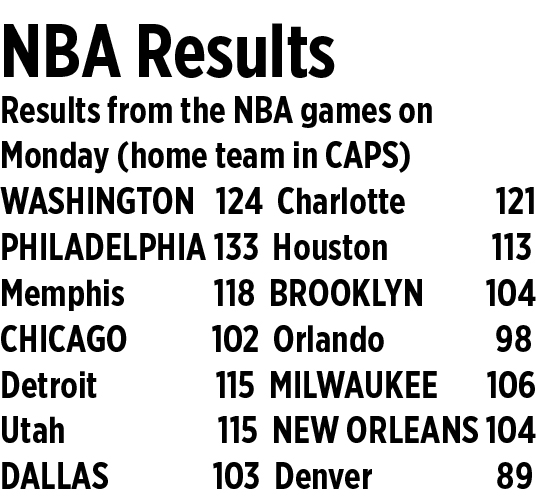
DeMar DeRozan led Bulls for eighth straight win

DEMAR DeRozan scored a game-high 29 points and Zach LaVine added 27 to help the host Chicago Bulls beat the Orlando Magic (102-98) on Monday night for their eighth straight victory.

Chicago led by as many as nine in the second half but was unable to fully pull away, as Franz Wagner led the Magic with 22 points and Wendell Carter, Jr. notched a double-double of 21 points and 10 rebounds.

After Carter was off the mark with a would-be tying 3-pointer with 3:26 to play, the Bulls scored 12 of the game’s next 23 points, sending the Magic to their sixth straight defeat.

Chicago last won eight straight from Feb. 20 to March 7, 2012.

Coby White scored 17 points for the Bulls, while Nikola Vučević logged his sixth straight double-double, tallying 13 points and 17 rebounds.

Gary Harris scored 19 points for the Magic. Terrence Ross followed with 15.

DeRozan has surpassed 20 points in 13 successive games. LaVine notched his 29th game of at least 20 points.

Lonzo Ball had a game-high seven assists for Chicago in his return from coronavirus disease 2019 (COVID-19) protocol. Both teams committed 13 turnovers.

The Bulls shot 43% from the floor, while the Magic finished at 42.4.

Orlando surged to an 11-point lead early in the game before Chicago recovered to take a 45-40 advantage into the break. DeRozan led all scorers with 15 first-half points, five more than Carter.

Chicago shot 38.6% in the first half compared to 36.4% for Orlando.

Bulls coach Billy Donovan returned from a five-game absence in COVID-19 protocol. The Bulls learned on Monday that Javonte Green will miss 2-4 weeks with a groin injury.

Orlando was without nine players, including leading scorer Cole Anthony (right ankle sprain). Moe Wagner was ruled out just before tip-off with a non-COVID illness.

The Bulls improved to 2-0 against the Magic this season. — Reuters

Mbappé hits treble as PSG strolls into French Cup last 16

VANNES, France — Holder Paris Saint-Germain (PSG) eased into the French Cup last 16 after a second-half hat trick from Kylian Mbappe following Presnel Kimpembe’s opener gave them a 4-0 win at fourth-tier Vannes on Monday.

With several regular starters absent, PSG manager Mauricio Pochettino fielded a makeshift side which dominated throughout, although they played at walking pace for much of the contest.

Home goalkeeper Clement Petrel denied Ander Herrera and Georginio Wijnaldum with fine saves before central defender Kimpembe fired the visitors ahead with a diving header from close range in the 28th minute.

Mbappé, who had a quiet first half, doubled the lead in the 59th after he raced clear of his markers from Kimpembe’s pass and beat Petrel, with the keeper unlucky not to keep the ball out after getting his body to it. — Reuters

Fast-spreading Omicron to test Beijing Winter Games bubble

BEIJING — China’s meticulous plans to prevent an Olympics-seeded coronavirus disease 2019 (COVID-19) outbreak by sealing all participants inside a “closed loop” for the upcoming Winter Games will be tested by the emergence of the highly infectious Omicron variant.

The country has reported only a handful of Omicron cases and has largely succeeded in containing COVID-19 since it first emerged in the central city of Wuhan two years ago, thanks to a zero-tolerance policy that includes rigorous contact tracing, strict targeted lockdowns, and travel curbs that have drastically cut international arrivals.

But more than 2,000 international athletes are set to come to China for the Games that start Feb. 4, plus 25,000 other “stakeholders,” a large number from overseas. Organizers did not say how many of those people would be in the closed loop.

Organizers believe their measures “can ensure the Winter Olympic Games and the Winter Paralympic Games can be held safely and on schedule,” Yan Jiarong, a spokesperson for the organising committee, told a news conference last Thursday.

Restrictions at Games venues in Beijing and Zhangjiakou in neighboring Hebei province will be much tighter than those during last summer’s Tokyo Olympics.

Core to the planning is the rigidly-enforced closed loop that physically separates Games-related personnel from the local population, with overseas participants flying directly into and out of the bubble, which includes dedicated transport.

In Tokyo, which took place when Delta was surging globally, a bubble was strictly enforced, although local residents such as journalists and volunteers were able to enter and exit at will and some overseas visitors could leave it after being in the country for 14 days and repeatedly testing negative.

But Omicron, which appears to be much more transmissible than earlier variants, is now driving global COVID-19 infections to record highs and disrupting the sporting calendar.

North America’s National Hockey League, which has postponed 90 games, announced that it will not send its players to the Olympic ice hockey tournament due to COVID-19-induced scheduling problems. The CEO of the Canadian Olympic Committee told a broadcaster on Friday that he is increasingly concerned whether the Games can go ahead as planned.

“It is what I sometimes call a sprinter. It is extremely infectious and it is fast,” Irene Petersen, a professor of epidemiology at University College London, said of Omicron.

She said the UN climate conference in Glasgow this autumn showed a large-scale international event could keep transmissions to a minimum through lots of testing.

“But that was in the Delta era… we haven’t seen anything like the Omicron,” she said.

FEW CASES AT TEST EVENTS
Games organizers say that test events held earlier this year involving some 2,000 overseas participants had shown Beijing’s COVID-19 measures to be effective. Beijing reported only a handful of cases among athletes during test events.

“The system is developed so that the chances of the Chinese people being exposed to the virus is minimized,” said Yanzhong Huang, senior fellow for global health at the Council on Foreign Relations, a US think tank.

Still, the risk will increase with the Olympics, he said, “not just because the Chinese people are largely quite vulnerable to these outbreaks because most people have not been exposed to the virus, but also because the Chinese vaccine has proved not very effective in preventing new infections.”

About 85% of the Chinese population have been vaccinated, mostly with Chinese shots manufactured by Sinopharm and Sinovac. All of the 20,000 or so Chinese volunteers and others who will enter the Olympic closed loop have been vaccinated. Efficacy readings in clinical trials for the Chinese shots ranged between 50% and 83.5% against symptomatic disease, below the 90%-plus figures for shots from Pfizer and Moderna.

Recent studies appear to show antibody responses from vaccines to be weaker against Omicron than earlier strains, but it remains unclear how the variant would affect their overall effectiveness.

BUBBLES AND TESTS
As in Tokyo, no international spectators will be allowed at the Beijing Winter Games, and local attendance at event sites is likely to be curtailed.

Olympic participants must consistently test negative before being allowed to board specially arranged flights to Beijing. On arrival, participants must be vaccinated or face three weeks of quarantine. Everyone will be tested daily.

However, such tests cannot be relied on to detect cases during the virus’ incubation period, and organizers have acknowledged that they expect a “certain number” of COVID-19 cases given the large number of international arrivals.

“If you’re going to use tests to exclude people who are infectious you will have to test them on their doorstep,” said Petersen of University College London.

Michael Baker, professor of public health at the University of Otago in Wellington, said the combination of travel from multiple countries and the concentration of athletes and staff poses difficulties exacerbated by the higher transmissability and shorter incubation of Delta and Omicron.

“Consequently, it will be difficult to contain outbreaks that occur during the Olympics, with the risk of transmission between Games participants and also into the wider community.” — Reuters

Rangnick suffers first defeat as Wolves wins at United

MANCHESTER, England — Manchester United suffered their first defeat under interim manager Ralf Rangnick, falling to a 1-0 loss at home to Wolverhampton Wanderers in the Premier League on Monday.

An 82nd minute strike from Joao Moutinho earned Wolves their first win at Old Trafford since 1980 and moved Bruno Lage’s side up to eighth place.

United, who could have few complaints about the result after a poor performance, remains seventh place on 31 points — four behind Arsenal who currently hold the fourth Champions League spot.

Wolves created a series of chances in the first half but it was not until eight minutes from the end that they made their superiority count when Moutinho pounced on a headed clearance from Phil Jones and fired past David De Gea.

German Rangnick, who is in charge of United until the end of the season after taking over from the sacked Ole Gunnar Solskjær, saw a disjointed display by his team with little sign of the high-energy pressing style he had initially attempted to introduce.

“We didn’t play well at all individually or collectively. In the first half, we had big problems to keep them away from our goal,” said Rangnick.

“The game showed we still have a lot of work to do. We had too many unforced errors. I don’t want to speak about individual performances of players. It’s an issue of the whole team. It doesn’t make sense,” he added.

The injury-plagued Jones made his first Premier League appearance in almost two years with Rangnick turning to the former England central defender in the absence of Harry Maguire, Victor Lindelof and Eric Bailly.

The 29-year-old had delivered a solid performance on his return before his ill-judged header out towards Moutinho which led to the goal.

Wolves could easily have had a comfortable lead by half time with the excellent Daniel Podence, Ruben Neves and Nelson Semedo all bringing United keeper De Gea into action early in the game.

United created little with their best opening of the first half ending with Edinson Cavani blasting a shot off target when he should have played in Mason Greenwood.

Greenwood had been the most creative player for United and there were rare boos from the home crowd when Rangnick chose him to make way for the introduction of Bruno Fernandes.

Fernandes should have put United ahead when he side-footed a low ball across the box from Nemanja Matic against the cross-bar and Ronaldo had the ball in the net, with a header from a Fernandes cross, but the effort was flagged for offside.

Wolves was in no mood to sit back, though, and settle for a draw and they also found the woodwork when Romain Saiss hit the bar with a free-kick.

The visitor’s endeavours were finally rewarded when Moutinho settled the affair with his low shot past the helpless De Gea and set off loud celebrations for the travelling support.

“Winning here at Old Trafford against a big team is amazing for us,” said Moutinho.

“We came here to play football, play with the ball, that’s what we do. We created a lot of shots in the first half. We controlled everything. We only let them create one opportunity,” he added. — Reuters

Medical exemption

The Australian Open is slated to start in one and a half weeks, and, still, it’s anybody’s guess as to whether World Number One Novak Djokovic can suit up. He wants to, of course, and not simply because he’s aiming to break a tie with longtime rivals Roger Federer and Rafael Nadal for the most number of major championships. The first stop on the Grand Slam rota just so happens to be where he has been most successful; it has provided nine of his 20 titles in the sport’s holy grails. Unfortunately, stringent health and safety protocols have put into question his capacity to compete in the country.

Make no mistake. Australian Open organizers are going out of their way to help Djokovic. He’s a top draw, and their dream matchup is one that pits him and Nadal in the men’s singles final. The problem is his vaccination status, and how it restricts his mobility. There’s a reason he’s doing all the requisite preparations in Belgrade, Serbia, and Marbella, Spain, and not in Melbourne, Australia, and it’s not because he wants to make his work harder. Even as other hopefuls are already arriving in Victoria state, he’s still unable to book a chartered flight in the face of a standing ban on the acceptance of unvaccinated visitors.

At this point, Djokovic’s only hope is a medical exemption, for which he seems to have applied. Details remain sketchy, but Tennis Australia chief executive Craig Tiley’s most recent pronouncements seem to indicate that a resolution is imminent. The official has noted that such an exemption for tennis players “is far more rigorous than anyone [else] coming to Australia… There are two medical panels that assess any application, and they assess it in a blind way. They don’t know who the applicant is.”

Which is to say Djokovic’s fate depends on unknown quarters. If it’s any consolation, some players are said to have been given the very dispensation he’s seeking. Given the process, however it’s a small mercy. And if he’s ultimately unable to trek to Melbourne Park, he has no one to turn to but himself for the answers.


Anthony L. Cuaycong has been writing Courtside since BusinessWorld introduced a Sports section in 1994. He is a consultant on strategic planning, operations and Human Resources management, corporate communications, and business development.

Peso weakens vs dollar on rising infections

BW FILE PHOTO

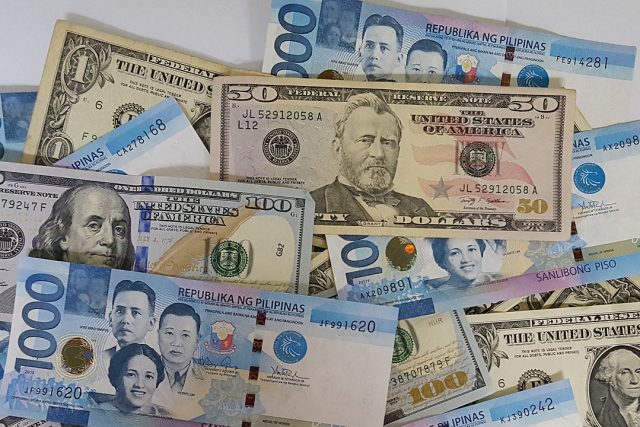
THE Philippine peso on Tuesday weakened further against the dollar as cautious investors waited for signals from the US Federal Reserve and as local coronavirus infections continued to rise.

The local currency closed at P51.30 a dollar, weakening by 30 centavos from Monday’s close, based on data from the Bankers Association of the Philippines.

The peso opened at P51.10 — its intraday best — before closing at P51.30, also its worst showing for the day. Dollars exchanged increased to $1.223 billion from $588.7 million on Monday.

The peso weakened as market participants were expecting hawkish statements from the minutes of the latest policy review of the US Fed to be released on Wednesday, a trader said in an e-mail.

The Fed in its policy review from Dec. 14 to 15 said it would quicken its tapering of asset purchases amid the improving US economy. US central bank officials also said they expect up to three rate increases this year.

Investor worries on rising coronavirus infections had caused the peso to depreciate, Michael L. Ricafort, chief economist at Rizal Commercial Banking Corp., said in a Viber message.

Active cases rose by 5,434 to 29,809 on Tuesday, according to the Health department. The positivity rate rose to 26.5%.

The peso is likely to trade from P51.15 to P51.35 a dollar on Wednesday, Mr. Ricafort said. — Luz Wendy T. Noble

ADVERTISEMENT
ADVERTISEMENT