Home Blog Page 6946

Banks shorten operating hours, temporarily close branches amid virus surge

SOME BANKS are temporarily closing or limiting the operating hours of their branches to curb an ongoing surge in coronavirus cases.

Security Bank Corp. said it is temporarily closing some branches and shortening hours to make way for cleaning and disinfection.

“In response to the recent rise of COVID-19 cases in the Philippines, Security Bank is further enhancing its healthcare protocols to prevent the spread of the virus and protect our customers and employees,” the bank said in a statement Monday.

“For your convenience, we have made sure that there is a nearby branch available for your banking needs.”

The bank is encouraging customers to transact on its website or through its mobile app.

Meanwhile, the Philippine National Bank (PNB) over the weekend said its nationwide branch banking hours will be 9 a.m. to 3 p.m. starting Monday, which means they close an hour earlier than usual.

This applies to all its branches except those in malls and the Ninoy Aquino International Airport.

“We encourage our clients to plan their banking transactions accordingly,” PNB said in a press release.

The bank also asked customers to use web-based and mobile application platforms for their transactions

PNB’s 1,731 automated teller machines and cash accept machines will continue to run.

“PNB’s Bank On Wheels will be rolled out to service areas where there are no ATMs,” the bank said.

China Banking Corp. in an e-mail on Monday said it is also temporarily closing down branches where employees showed COVID-19 symptoms.

The bank said it is using a “buddy branch system” to reduce disruptions in its operations.

“When a branch is closed, its depositors can easily transact with the buddy branch.”

Meanwhile, Philippine Savings Bank in a statement on Monday said most of its branches nationwide will be open from 8:30 a.m. to 3 p.m. from Monday to Friday.

Some of its branches are temporarily closed, while mall-based branches have different banking hours listed on the company’s website.

Metro Manila and nearby provinces are on the stricter Alert Level 3 until Jan. 15 amid a surge in coronavirus disease 2019 (COVID-19) cases after the holidays.

The Bangko Sentral ng Pilipinas said the banking industry will continue to provide services in areas under Alert Level 3. The central bank encouraged the public to use digital payment services.

Meanwhile, the Bankers Association of the Philippines said some member banks are temporarily closing down some branches or shortening operating hours. The organization asked clients to check their banks’ websites and social media channels for announcements. — Jenina P. Ibañez

Entertainment News (01/11/22)

Star City postpones reopening

STAR CITY has had to postpone its reopening amidst the current rise in COVID-19 cases. The amusement park in Pasay City was scheduled to reopen on Jan. 14, two years after a massive fire forced its closure in October 2019. “While the current Alert Level allows the operation of amusement parks or theme parks at reduced capacity level, we feel that given the rising number of COVID-19 cases in the country, postponement is the more prudent thing to do,” park management said in a post on Star City’s official Facebook page on Jan. 9. It also stated that a firm reopening date will be announced “when conditions are more favorable for all.”

Sine Kabataan applications now accepted

THE FILM Development Council of the Philippines (FDCP) is now accepting applications for the 5th edition of the Sine Kabataan. It is open to Filipino filmmakers between the ages of 18 and 30 who have already produced at least one short film. Interested applicants may download the application form at https://bit.ly/SineKab5ApplicationForm. They should send their applications to filmlab.fdcp@gmail.com with the subject “Application for Sine Kabataan 2021” on or before Jan. 15. For the guidelines and full mechanics, visit www.fdcp.ph/sinekabataan5 .

Online screenings for slice-of-life films

TO WELCOME the new year with concern, coming-of-age films will be screened online on Wednesdays of January, hosted by The Museum of Contemporary Art and Design (MCAD) of the De La Salle-College of Saint Benilde. The line-up is headlined by Saint Oniisan (Saint Young Men) (2012), a Japanese comedy by animator and director Noriko Takao. An adaptation of the hit manga series written and illustrated by Hikaru Nakamura, it follows roommates Jesus Christ and Gautama Buddha as they explore and experience, appreciate and understand modern life while on vacation in Tokyo. It will be shown on Jan. 12. Hintayan ng Langit (Heaven’s Waiting) (2018) by Filipino cinematographer and film maker Dan Villegas introduces an overstaying soul in purgatory, who is set to cross over and give her space to her recently deceased ex-boyfriend. Starring veteran and award-winning actress Gina Pareño and the late Eddie Garcia, the film unravels the pains and regrets of two reunited ex-lovers. It is slated for Jan. 19. Ride Your Wave (2019), directed by Japanese screenwriter and animator Maasaki Yuasa, follows the heartfelt journey of the fearless surf-loving college student Hinako. The romantic drama delves on one’s inner purpose, justice, and joy as she navigates her life after tragically losing her boyfriend, the young firefighter Minato. It will be shown on Jan. 26. The free and public online screenings will be conducted via Zoom at noon on the scheduled dates. Interested participants may register through https://forms.gle/PWJF45YR6sBW7xra9. For more information, e-mail mcad@benilde.edu.ph.

Ding-Dong Dantes returns to GMA Telebabad

ACTOR Dingdong Dantes is back on GMA Telebabad as he portrays a dual role for the first time in the latest installment of the hit GMA drama anthology, I Can See You: AlterNate. Directed by Dominic Zapata, the episode narrates the story of a refined man whose marriage is tested when his wife unknowingly cheats with someone who looks just like him and is apparently his long-lost twin brother. Joining the cast are Beauty Gonzalez, Jackie Lou Blanco, Joyce Ching, and Ricky Davao. I Can See You: AlterNate premieres on GMA Telebabad beginning Jan. 10, 8:50 p.m.

Petro Gazz reacquires Cheng, Sabete and libero Cruz

PETRO Gazz reacquired setter Djanel Cheng, outside hitter Jonah Sabete and libero Cienne Cruz as part of its rebuilding process for the Premier Volleyball League Open Conference tentatively set next month in either Paco, Manila or Tagaytay.

“Returning Angels Alert! Reunited and ready to work it out for our #Refueled2022 team roster,” Petro Gazz announced on its Twitter account on Monday.

Mses. Cheng and Sabete have returned to the Angels’ fold after a one-year stint with the Sta. Lucia Realtors, who disbanded a week ago, while Ms. Cruz, the league’s 2018 Open Conference Best Libero, took a yearlong break due to personal reasons.

And there are more expected to come in for Petro Gazz, which let go of Kath Arado, Ria Meneses, Ces Molina, Jerrili Malabanan, Alina Bicar, Mean Mendrez, Jessey de Leon, Ivy Perez and Rica Enclona.

The Angels are seeking to match, if not improve, on their third-place performance in last year’s edition staged in Bacarra, Ilocos Norte. — Joey Villar

How PSEi member stocks performed — January 10, 2022

Here’s a quick glance at how PSEi stocks fared on Monday, January 10, 2022.


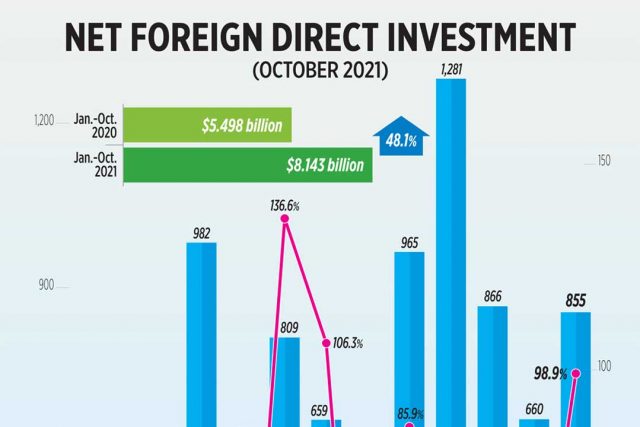
Net Foreign Direct Investment (Oct. 2021)

FOREIGN direct investment (FDI) net inflows almost doubled in October, rising for the fifth straight month after nonresidents’ net investments in debt instruments increased. Read the full story.

Net Foreign Direct Investment (Oct. 2021)

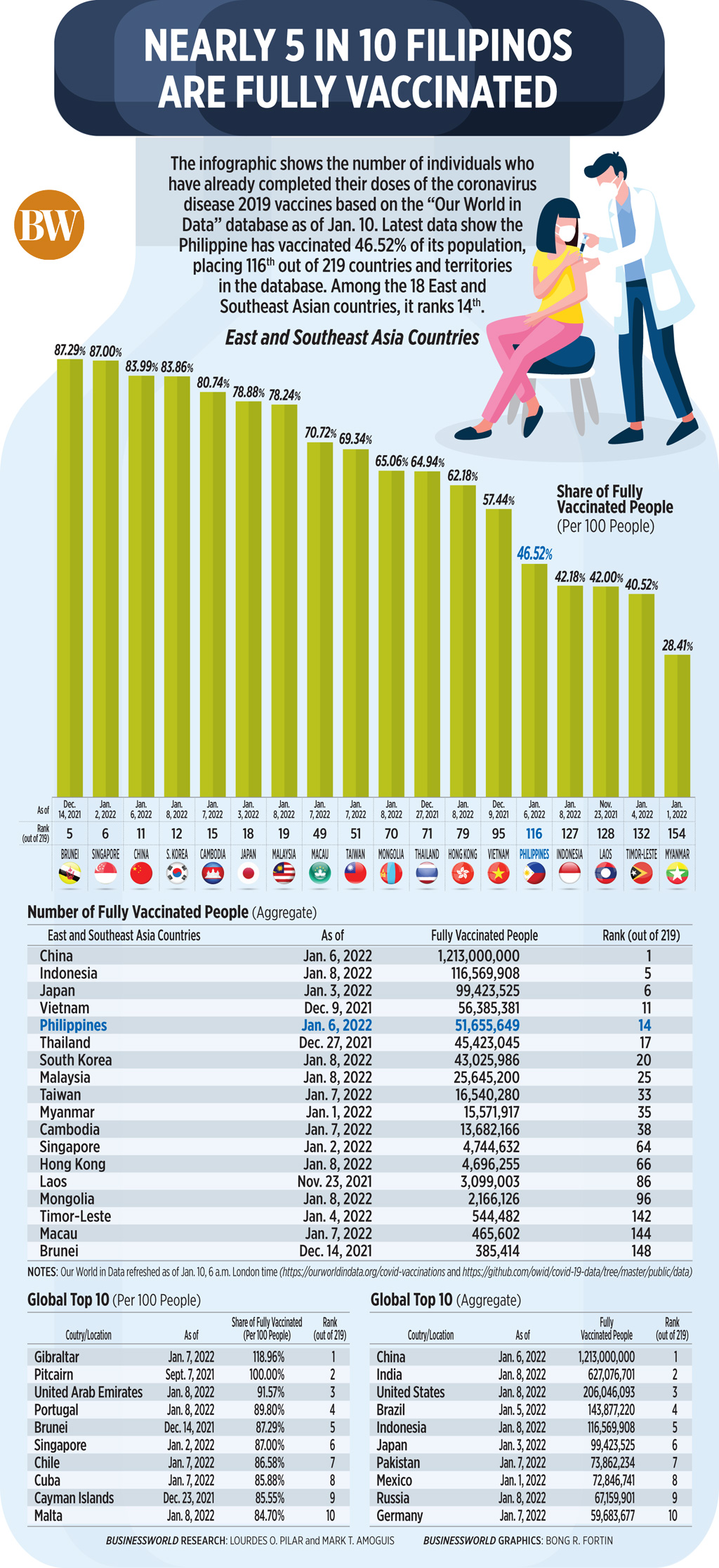
Nearly 5 in 10 Filipinos are fully vaccinated

Nearly 5 in 10 Filipinos are fully vaccinated

Project to locally manufacture oral coronavirus drug approved

REUTERS

THE Board of Investments (BoI) approved an application by Lloyd Laboratories, Inc. to register for incentives to locally manufacture Molnupiravir, an oral drug to treat coronavirus disease 2019 (COVID-19).

The BoI said in a statement on Monday that Lloyd Laboratories will receive technology transfer on how to produce the drug from India’s Optimus Pharma Pvt. Ltd.

“With an estimated cost of P24 million and an annual capacity of one million 400 milligrams (mg) capsules of Molnupiravir, the project is expected to start production in January. The laboratory reported that it intends to make the product available locally at the soonest time,” the BoI said.  

“The suggested retail price of the locally-made Molnupiravir is P65 per pill, which is much lower than its imported counterpart, which sells for around P100 to P150 per pill, providing a COVID-19 patient around P35 to P85 in savings per pill,” it added.

According to the BoI, Lloyd Laboratories makes various medicines and recently expanded its production facility in Malolos, Bulacan to gear up for Molnupiravir production.

It added that the project complied with the eligibility requirement that entitles to incentives “All Qualified Activities Relating to the Fight against the COVID-19 Pandemic – Essential Goods” as stipulated in the 2020 Investments Priorities Plan, which is considered the transitional Strategic Investment Priorities Plan in force for Republic Act No. 11534, or the Corporate Recovery and Tax Incentives for Enterprises Act.

“Amid the steep surge of COVID-19 cases exacerbated by the emergence of new variants, it is a crucial and urgent step to produce oral therapies locally to reduce hospitalization, and for those who will be hospitalized — to lessen the period of hospitalization, and to prevent the death of Filipinos who contracted the virus,” Trade Secretary and BoI Chairman Ramon M. Lopez said.

The BoI said the addition of Molnupiravir to the lineup of treatments resulted in faster clinical improvement in reducing viral load, according to the interim results of Phase 3 clinical trials of Optimus Pharma, performed in India for orally administered capsules on patients with mild symptoms.  

“It also resulted in a significantly higher proportion of patients achieving reverse transcription polymerase chain reaction (RT-PCR) negative results on Days five and 10. In Vietnam, Stella Pharma, which Optimus Pharma also supported in terms of technology transfer, conducted a clinical trial which has also shown promising results with RT-PCR negativity on Day five at 75.4%,” BoI said.  

Following these results, the BoI said the Food and Drug Administration (FDA) issued a compassionate special permit to Lloyd Laboratories, limited to supplying Recuenco General Hospital in Taguig with a total of 20,000 400-milligram capsules for one year on until November 2022.  

Lloyd Laboratories has also applied for a certificate of product registration with the FDA.

“We invite other pharmaceutical companies to look at this model and how we can replicate it in order to further fill in the gaps not only in our fight against the pandemic but also in providing more affordable critical medicines and health products to Filipinos,” Trade Undersecretary and BoI Managing Head Ceferino S. Rodolfo said. — Revin Mikhael D. Ochave

Shell pays P3.5 billion in taxes on alkylate imports under protest

PILIPINAS SHELL Petroleum Corp. (PSPC) has paid in full the P3.49 billion in disputed alkylate import taxes levied against it, but under protest, the Bureau of Customs said.

Customs Assistant Commissioner Vincent Philip C. Maronilla on Monday said the Port of Batangas confirmed receipt of payment.

“I think it was settled last Friday,” he said in a Viber message.

In December, PSPC made a P1.7-billion initial payment also under protest. The Customs bureau instructed the company to pay the balance by Jan. 10.

PSPC had agreed to remit the allegedly unpaid taxes, which were levied on alkylate imports shipped from 2014 to 2016.

Alkylates are blended into gasoline to produce the desired octane characteristics for fuel sold at retail.

The company made the payments under protest pending a court ruling on the tax treatment of alkylates, in order to avert a possible suspension.

The courts would still have to decide on whether or not alkylate is subject to excise tax, the company said.

Customs C ommissioner Rey Leonardo B. Guerrero in a letter to PSPC President Lorelie Q. Osial said the oil company’s accreditation could be suspended if it fails to pay.

He said the potential suspension is not a threat, but a “proper recourse” that can be taken by the bureau after the Supreme Court lifted the temporary restraining order that had restricted the government from collecting the taxes. — Jenina P. Ibañez

Port projects awarded in Mindoro, Quezon and Batangas, PPA says

THE Philippine Ports Authority (PPA) said it recently awarded a number of port projects, including the expansion of Puerto Galera Port in Oriental Mindoro and San Andres Port in Quezon and the construction of an operations area at the Port of Calatagan in Batangas.

The Puerto Galera Port Expansion Project was awarded to Great Swiss Metal Builders Corp., according to a PPA notice of award dated Dec. 6, 2021. The project cost is P147.62 million.

The P176.54-million San Andres Port Expansion Project was awarded on Nov. 11 to RCE Global Construction, Inc.

Meanwhile, the construction of the port operations area at the Port of Calatagan was awarded to J. C. Piñon Construction, Inc. on Dec. 14. The project cost is P102.87 million.

The agency also awarded on Dec. 6 the P241.69-million civil works contract for the Port of Marawi in Lanao del Sur to Mamsar Const. & Industrial Corp. On the same day, MRBII Construction Corp. was awarded the P164.8-million Ambulong Port Expansion Project in Magdiwang, Romblon.

Mamsar was also awarded the contract to construct the wharf and port operations area, featuring a roll-on, roll-off ramp, at the Port of Catagbacan in Loon, Bohol. The project cost is P666.99 million.

On Jan. 4, Transportation Secretary Arthur P. Tugade said that the government managed to complete 13 social and tourism port projects in the Bangsamoro Autonomous Region in Muslim Mindanao or BARMM. The projects include the construction of the Languyan Port and the Mapun Port.

Inaasahan natin na ang mga ito ay maghahatid ng enhanced maritime connectivity at mobility sa kani-kanilang mga lugar, at magbubukas rin ng mas maraming oportunidad sa ating mga kababayan (We are hoping that these will bring enhanced maritime connectivity and mobility in these areas, opening up opportunities to our countrymen),” he said in a statement.

Ang economic growth and development ay hindi dapat limitado sa malalaking lugar lamang. Ang buhay na kumbinyente at komportable ay dapat na umabot sa lahat. Walang tayong lugar na dapat pabayaan o kalimutan (Growth and development are not the preserve of large cities or towns. A life of convenience and comfort must reach everyone. We will not forget about or leave any parts of the country behind),” the official added. — Arjay L. Balinbin

Customs post-clearance audits for 2021 yield P1.5 billion in revenue

THE Bureau of Customs (BoC) collected over P1.5 billion in additional revenue in 2021 from post-clearance audits on importers.

The bureau in a statement on Friday said collections over the course of the year rose 25%.

Collections were generated from the 349 audit notice letters on tax declaration and payment errors issued to importers last year.

The bureau also plans to collect more revenue from pending post-clearance audits from 2019 to 2021.

BoC has filed 55 demand letters representing about P12.5 billion in revenue.

“These are now being referred to the BoC Legal Service for filing of the necessary collection suit,” the bureau said.

Post-clearance audits help generate revenue for the coronavirus disease 2019 (COVID-19) response, the BoC said.

The bureau collected P645.77 billion in total revenue in 2021, higher than the P630.21 billion posted in the last pre-pandemic year of 2019 as international trade rebounded after the 2020 economic downturn.

Collections last year also rose 20% from the P537 billion logged in 2020 and 4.7% above the bureau’s target for 2021.

The BoC attributed the revenue performance to improved valuation, operations against illegal imports, and improved compliance with customs laws.

Gradually improving import volumes and efforts to improve goods transport during the pandemic also contributed to higher collections, the BoC said. — Jenina P. Ibañez

Ceramic shower bases now subject to quality certification

THE Department of Trade and Industry (DTI) said ceramic shower bases will join the list of products required to undergo quality certification.

The DTI said in a statement on Monday that it issued Department Administrative Order (DAO) 21-08 adding the new product category to the certification list. The order took effect on Dec. 22.

Other products that require certification include bidets, lavatories, laboratory sinks, laundry sinks, service sinks, and utility sinks, urinals, and water closets.

These products will be tested for compliance with Philippine National Standard 156:2010, which will entail a structural integrity test. It also prescribes a minimum slope of 1% and maximum slope of 4% to the waste outlet.

“As time passes, the increase in the number of products being subjected (to) mandatory certification reflects the DTI’s continuing effort of upholding Filipinos’ right to safe and high-quality products and its responsibility to guarantee that what consumers utilize inside their homes serve their purpose,” Bureau of Philippine Standards Director Neil P. Catajay said.

The DTI said the shower bases can be certified under either the Philippine Standard (PS) safety certification mark licensing scheme, or the Import Commodity Clearance (ICC) for those imported without a valid PS license.

“To ensure strict compliance for ceramic shower bases, DTI monitoring and enforcement shall be conducted 24 months after the effectivity of DAO 21-08. After which, only ceramic shower bases bearing a valid PS Mark or ICC sticker shall be distributed in the local market,” the DTI said. — Revin Mikhael D. Ochave 

Compliance with the BIR in closing a business

Just when things were starting to feel normal again, 2022 came, and along with it a significant surge in COVID-19 cases. This pandemic has changed our lives in many ways. Lives were put on hold, some were overturned, and many people were lost. In the new normal, however, we have proven time and time again the Filipino’s resiliency and adaptability — always finding new ways to persevere and thrive despite challenges.

While some are still trying to pick up the pieces, others have found new opportunities in new business models that have thrived during the new normal. Living during the pandemic has made people realize that some types of business are not as profitable during the pandemic as others. This has led people to shift careers, start new businesses, and even close old businesses altogether. Some had to cut their losses by closing old unprofitable businesses and shifting to other more thriving ventures. But before moving on, there is still the necessity of closing out the old business with the government agencies for which the business was registered. There is a myriad of requirements when it comes to closing a business and some of the more burdensome ones are those involving Bureau of Internal Revenue (BIR) processes.

One common mistake of some taxpayers is thinking that when their businesses stop operating, they are automatically relieved from the obligation to file tax returns. Some taxpayers are unaware that there is a need to formally close their business with the BIR. Until the taxpayer files its business closure with the BIR, even with zero transactions, the taxpayer is still required to file regular tax returns indicated in the Certificate of Registration. Failure to file the tax returns will result in “Open Cases,” which pertain to the list of tax returns in the BIR’s system that are tagged as not filed or not submitted. Resolving these open cases, which would entail payment of penalties, is required before the old business can be formally cleared and closed with the BIR. It is worth noting that these open cases do not prescribe and will continue to accumulate regardless of the years of non-operation, unless the taxpayer properly applies for business closure with the BIR. Under the current rules, the penalty is P1,000 for every unfiled NIL tax return or attachment, provided that the aggregate amount of penalty does not exceed P25,000 during a calendar year. So, if the business stops operating and is not properly closed for a decade or more, the penalty could reach up to P250,000 and more if the taxpayer has tax deficiencies. Business failure is hard enough as it is, but having to deal with surprise onerous penalties is even worse.

Deregistering a business with the BIR requires the filing of a notice of closure or cessation of business to the RDO where it is registered, by accomplishing the prescribed registration updates form and submitting the required documents. Pursuant to Revenue Memorandum Circular No. 57-2020, the streamlined documentary requirements are as follows:

1. BIR Form 1905 (2 originals);

2. Death certificate, in case of death of an individual (1 photocopy);

3. List of ending inventory of goods, supplies, including capital good (1 original);

4. Inventory of unused sales invoices/official receipts (1 original); and

5. Unused sales invoices/official receipts and all other unutilized accounting forms (e.g., vouchers, debit/credit memos, delivery receipts, purchases orders, etc.) including business notices and permits as well as the Certificate of Registration (BIR Form 2303) subject for destruction to be witnessed by BIR personnel and officials (1 original).

And in case the taxpayer is transacting through a representative, the items below are additional requirements:

For Individual

6. Special Power of Attorney together with a valid government-issued ID of the taxpayer and authorized representative

For Non-Individual

7. Board resolution indicating the purpose and the name of the authorized representative or Secretary’s Certificate, together with a government-issued ID of the authorized representative

Upon submission of the documents, the taxpayer will be provided with a routing sheet and will be asked to go around the different sections of the BIR (i.e., Client Support Section, Compliance Section, Collection Section, and Assessment Section) to get clearance from each section. The taxpayer will be subjected to tax audit by the BIR to identify any unsettled open cases and tax liabilities. Getting the clearance could take months or years depending on the number of findings of the BIR upon audit.

During the process, the BIR needs to perform the following procedures to stop generating more open cases:

a. “End date” the tax types of the taxpayer;

b. Destroy/shred in the presence of the taxpayer or his authorized representative, the unutilized SI/ORs and other accounting forms, ensuring that the same will no longer be used as originally intended;

c. Return to the taxpayer the destroyed/shredded SI/ORs and other accounting forms for burning and/or proper disposition; and

d. Issue a Tax Clearance (to be released by the BIR district office) to the taxpayer applying for cancellation of TIN within 10 days from termination of its investigations and/or full settlement of the taxpayer’s liabilities, if applicable.

Although the BIR streamlined the requirements in line with the Ease of Doing Business Act (Republic Act No. 11032), the business closure process is still a long and tedious one for many taxpayers. Imagine having to endure the long lines at the BIR office and exposing yourself to the risk of COVID-19, and the necessity of coming back multiple times, in case of deficiencies, just for the sake of business closure compliance. Does this not sound dreadful and unsafe given our current circumstances?

With the ongoing pandemic, the uncertainty looming over the economy, and the prevalence of online platforms, maybe it’s time for the BIR to consider adopting a virtual business closure process, where taxpayers can submit requirements, similar to eAFS, eFPS and the like, not only reduce the burden on business owners who have had to endure the devastating effects of the pandemic, but also to reduce the risk of transmission of the virus. Another idea is adopting a program similar to the Information Systems used by schools and banks where the status of the user’s transactions/applications can be monitored online and where taxpayers may submit deficiency requirements from the comfort of their own home. Whether we like it or not, it seems the COVID-19 pandemic is here to stay for the foreseeable future, and our filing processes should be in step with the progress our society has made in learning how to live in the new normal.   

Let’s Talk Tax is a weekly newspaper column of P&A Grant Thornton that aims to keep the public informed of various developments in taxation. This article is not intended to be a substitute for competent professional advice.


Juvy H. De Jesus is a manager from the Tax Advisory & Compliance division of P&A Grant Thornton, the Philippine member firm of Grant Thornton International Ltd.

pagrantthornton@ph.gt.com