Home Blog Page 6922

Sabalenka survives service meltdown to avoid seed exodus

MELBOURNE — World number two Aryna Sabalenka survived a complete service meltdown to rally for a 1-6, 6-4, 6-2 victory over Wang Xinyu and avoid joining an exodus of top women’s seeds early on Thursday at the Australian Open.

Taking to court just after third seed Garbine Muguruza and sixth seed Anett Kontaveit had crashed out of the second round, Sabalenka looked to be going the same way when she double-faulted six times in her opening service game.

Her 12th double fault handed Chinese world number 100 Wang the opening set but even though the services errors continued, the Belarussian battled back to even up the contest on Rod Laver Arena.

Sabalenka had to rely on the rest of her game to keep her out of trouble as the double faults kept coming — there were 19 in all over the match — but ultimately progressed when Wang went long with a forehand.

“I already had a lot of experience playing without the serve so I was just telling myself ‘you have enough shots to still win the match even if you cannot serve,’” Sabalenka said.

“This kind of mentality helped me to stay in the game and actually find my serve.”

Sabalenka, who served up 12 double faults as she came from a set down in her first round match against local wild card Storm Sanders on Tuesday, will face 2019 French Open finalist Marketa Vondrousova in the third round.

“It’s another tough opponent, I’ve played great matches against her,” said Sabalenka.

Iga Świątek will be waiting for Sabalenka in the quarterfinals if they both get that far and she was the only one of the top seeds in early action on Thursday to come through her match without any issues.

The seventh-seeded former French Open champion confirmed her strong form by swatting aside Rebecca Peterson (6-2, 6-2) on John Cain Arena.

“Just starting the match with a confidence was pretty important for me,” the Pole said.

“I felt like I was dominating from the beginning. After getting few breaks, it was much, much easier to go forward.” — Reuters


Atletico Madrid slump continues with Cup loss at Sociedad

LALIGA champion Atletico Madrid was knocked out of the Copa del Rey after a 2-0 defeat at Real Sociedad in the last 16 on Wednesday.

Sociedad took the lead in the 33rd minute from a superb header by Adnan Januzaj, who jumped between three defenders to nod the ball into the bottom-left corner of Jan Oblak’s goal.

The hosts extended their lead after a defensive mistake, when Mikel Oyarzabal robbed the ball from Felipe and freed Alexander Sorloth to run into the box and rifle a shot home from close range.

The Basque side joined Valencia, Real Betis, Rayo Vallecano, Mallorca and Cadiz in the quarter-finals while Real Madrid faces Elche and Athletic Bilbao hosts Barcelona in the last two round-of-16 games on Thursday.

It was the second disappointing loss in a week for Atletico after they fell 2-1 to Athletic Bilbao in the semifinals of the Spanish Super Cup in Saudi Arabia.

Fourth in the LaLiga standings, 16 points behind leader Real Madrid, Atletico is in a slump and pressure is mounting on their manager Diego Simeone.

“This is Atletico and we’re going to give everything that we have to recover. We’ll be back. We’ll keep fighting. It’s a bad situation but we’ll get up for sure,” defender Mario Hermoso told reporters.

It was a frantic first half, with both teams attacking and creating opportunities. Before scoring the opener, Januzaj sent a curling cross-shot against the post. — Reuters

Rangnick slams United first-half display, plays down Ronaldo rant

LONDON — Manchester United interim manager Ralf Rangnick slammed his side’s shoddy first-half performance after a flattering 3-1 victory away to Brentford in the Premier League on Wednesday.

The German also had to deal with a Cristiano Ronaldo tantrum after substituting the Portuguese forward in the second half.

Lackluster United were outplayed by Brentford in the first half and were indebted to keeper David De Gea but goals by Anthony Elanga, Mason Greenwood and Marcus Rashford capped a much-improved second-half display.

It was a vital win for United and keeps them in the thick of the battle for a top-four finish, but Rangnick was not impressed by what he saw in the opening 45 minutes.

“You have to be honest, without David and his brilliant saves it would have been difficult,” Rangnick told reporters.

“We were sloppy in our passing, not strong enough in the tackles, losing the 50-50 challenges and didn’t win a single second ball. When we did counterattack, we were too nervous.

“Brentford were aggressive and brave and they were all the aspects we spoke about at half time.”

Whatever Rangnick said at half time, it clearly worked as United were a different proposition after the break — even if the scoreline was scarcely credible.

Yet the win that lifted United to within two points of fourth-placed West Ham United with a game in hand, was overshadowed by Ronaldo’s reaction to being hauled off and replaced with defender Harry Maguire when the score was 2-0.

Ronaldo, who missed the last two games because of a niggling injury, took an age to walk off the pitch, scowling at United’s coaching staff and throwing his jacket down in anger, before continuing his debate from his seat.

“His reaction was ‘why me?’ … I said to him I have to take a decision in the interests of the club because we had a situation at Villa where we were 2-0 up and drew 2-2 and I was angry at myself for not switching to a back five.

“I decided to switch to a back five with Harry Maguire. He was not happy, he is a goalscorer and wanted to stay on and score a goal himself. But it was important to be compact.

“I said to him I understand, but maybe in a couple of years when you are a head coach you will take the same decision.

“I didn’t expect him to hug me… but I have no issue with him whatsoever.”

His opposite number Thomas Frank was understandably frustrated at the outcome, saying his team had “destroyed” Manchester United in the first half.

Rangnick had some sympathy, praising Brentford’s display and saying his players should learn from them.

“I want us to play like Brentford in the second half, I have great respect for what they have done here,” he said.

“You wouldn’t see that in Germany where a team not in the top five or eight would play that kind of football. We have to develop in that direction and if we do we can play the whole game like that, not just 45 minutes.” — Reuters

Patrick Mahomes, Chiefs look to settle score vs Josh Allen, Bills

THE debate about who is the better American Football Conference (AFC) quarterback, Josh Allen or Patrick Mahomes, plays out on Sunday with another duel in the divisional round of the playoffs.

The Buffalo Bills claimed a convincing 38-20 victory over the Kansas City Chiefs in Week 5 and return to the scene Sunday at Kansas City, Mo., where the Chiefs have won five straight postseason games.

Mahomes ascended quickly to elite status by leading the Chiefs into the AFC championship game each of his first three seasons as a starter and split two Super Bowl outcomes the last two years.

His motivation surfaced in the wild card round last week when Mahomes directed Kansas City on six straight touchdown drives, including five scoring strikes, in toppling Pittsburgh 42-21.

“I really like winning,” Mahomes said when asked if he can summon a special gear. “That’s the end of it.”

His 404-yard passing performance was tops for any National Football League (NFL) quarterback in the wild card round but now he faces a talented Buffalo back end that features Micah Hyde and Jordan Poyer.

“They’ve done everything that we’ve asked and they’ve gone above and beyond, really,” Buffalo coach Sean McDermott said of his talented safeties.

Allen also fired five scoring strikes and drove Buffalo to touchdowns on all seven of its non-kneeling possessions as it walloped New England (47-17). Yet Allen, despite the victory in Kansas City in Week 5, knows what’s at stake in another showdown against Mahomes and the Chiefs.

“They’re what we aspire to be,” Allen said, mindful the Bills fell to the Chiefs, 38-24, in last year’s AFC championship game at Kansas City.

The Kansas City defense Allen opposes has improved dramatically since the Week 5 mismatch, when the Chiefs played without starters Chris Jones and Charvarius Ward and had not nabbed key midseason acquisition Melvin Ingram. Since then, the defense has sparkled.

“I wouldn’t say we owe them one,” Ingram said. “We’re just going to try to win a playoff game and I’m only trying to be a piece to the puzzle.”

After an abysmal start that found the Chiefs ranked 30th or worse against the run and pass during a 3-4 start, they transformed to win 10 of their last 11. They have not been as careless with the ball, though they did allow the Steelers a touchdown return last week by fumbling a sloppy handoff.

Allen poses a complete threat whether throwing the football or taking on tacklers, either by design or improvisation. He completed 21 of 25 passes in the rout of the Patriots while adding 66 yards on just six carries. Yet he understands the Chiefs will offer wrinkles different from Week 5.

“They’re throwing so many looks at quarterbacks right now and bringing pressure from everywhere imaginable,” Allen said.

Allen noted the difficulty in playing on the road before a Kansas City fan base accustomed to postseason success, but the taste of falling short of a Super Bowl bid a year ago remains bitter.

“We don’t want to have that feeling that we had there last year,” Allen said. “We know our season ended there last year and now we have to do everything in our power to put our foot forward and make sure it doesn’t end there this year.”

Buffalo finished as the NFL’s top-rated pass defense while also securing 30 takeaways. Yet the Bills are without Tre’Davious White, who has been out since Week 12. Mario Addison is dealing with a shoulder strain suffered against the Patriots.

Kansas City continues to assess Clyde Edwards-Helaire (shoulder), though he is practicing. Jerick McKinnon stepped up against Pittsburgh and provided 142 yards on 18 touches. McKinnon’s impact could be critical again with Darrel Williams nursing a sore toe. — Reuters

The Shot

Pablo Carreño Busta isn’t one of the favorites in the Australian Open. He isn’t even the best Spaniard on the men’s draw; that distinction belongs to living legend Rafael Nadal. Yet, he wound up hogging headlines Down Under because of a single moment in his second-round match yesterday. At one set all and tied six games into the third set, he found himself needing to execute a remarkable return in order to gain a break of serve. That he did speaks volumes about his unique combination of talent, speed, and anticipation, not to mention make the most of the opportunity before him.

Indeed, Carreño Busta could have simply given up on the point. Opponent Tallon Griekspoor hit an overhead smash, albeit with the racket frame, resulting in the ball barely going over the net, and slowly. Moreover, the errant shot produced such English that the ball reversed direction and traveled back over the net anew. As he himself pointed out in the aftermath, “I tried to run because I could see that it might go in and that it would be difficult for me. I actually had a lot of time because the ball went very high and bounced close to the net. As I was running, I could see that it would bounce back, because when you hit a smash like that with the frame of the racket, it normally does.”

As thing turned out, Carreño Busta produced a highlight-reel return that required him make sure he did not hit the net as he ran past it to flick the ball in play. In hindsight, it proved to be the turning point in the five-set triumph. He noted that he was fortunate to have been in the right place at the right time; “otherwise, I would have had to jump over the net,” he said, “and I’m not [Gael] Monfils.”

Whether Carreño Busta can improve on his third-round showings in the last two years remains to be seen. Up next is Sebastian Korda, whom he will meet for the first time in his career. And while he’s favored against the unseeded competition, there is, as his immediate past experience highlighted, luck to be considered. In any case, he will always have The Shot.


Anthony L. Cuaycong has been writing Courtside since BusinessWorld introduced a Sports section in 1994. He is a consultant on strategic planning, operations and Human Resources management, corporate communications, and business development.

Peso rebounds vs dollar

THE PESO strengthened versus the greenback on Thursday as the central bank said the local unit is seen to remain stable despite its recent depreciation and as coronavirus infections ease slightly.

The local unit closed at P51.34 per dollar on Thursday, appreciating by 16 centavos from its P51.50 finish on Wednesday, data from the Bankers Association of the Philippines showed.

The peso opened Thursday’s session stronger at P51.45 versus the dollar. Its weakest showing was at P51.485, while its intraday best was at its close of P51.34 against the greenback.

Dollars exchanged increased to $858.95 billion on Thursday from $754.2 million on Wednesday.

The peso strengthened versus the greenback on Thursday after the Bangko Sentral ng Pilipinas (BSP) said the local unit is expected to remain stable, a trader said.

The peso was also boosted by profit-taking after consecutive days of depreciation, the trader added.

BSP Governor Benjamin E. Diokno said the peso will continue to be supported by steady inflows from overseas remittances, receipts from business process outsourcing and foreign direct investments.

“The peso will remain to be market driven. We expect it to continue to reflect the economy’s macroeconomic fundamentals, meaning manageable inflation environment, strong and resilient banking system, a prudent fiscal position and an ample level of international reserve buffer,” Mr. Diokno said in an online briefing on Thursday.

Meanwhile, Rizal Commercial Banking Corp. Chief Economist Michael L. Ricafort said the peso appreciated as local infections were relatively lower in the past days.

Active coronavirus disease 2019 infections rose by 31,173 to 275,364 on Thursday, based on data from the Department of Health. In the previous days, infections rose by around 20,000, much lower than the record 39,004 seen on Jan. 15.

For Friday, Mr. Ricafort gave a forecast range of P51.23 to P51.48 per dollar, while the trader expects the local unit to move within P51.15 to P51.40. — L.W.T. Noble

Stocks sink as rising oil prices cause inflation fears

BW FILE PHOTO

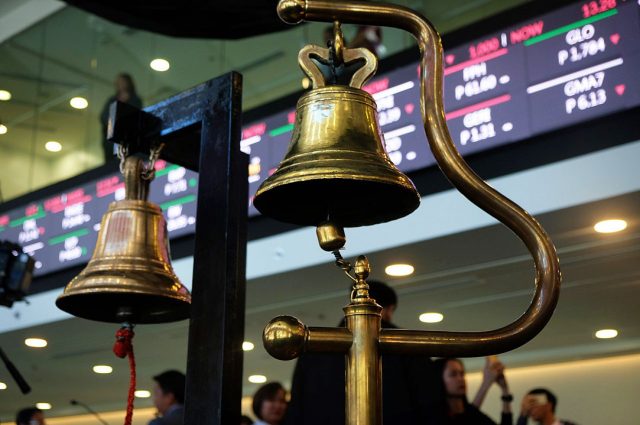
PHILIPPINE STOCKS ended lower on Thursday to track Wall Street amid inflation concerns due to rising oil prices.

The bellwether Philippine Stock Exchange index (PSEi) declined by 22.26 points or 0.30% to end at 7,239.28 on Thursday, while the broader all shares index inched up 0.59 point or 0.01% to close at 3,855.84.

“The local market extended its decline as it continued to take cues from Wall Street’s negative performance,” Philstocks Financial, Inc. Senior Research Analyst Japhet Louis O. Tantiangco said in a Viber message.

Timson Securities, Inc. Trader Darren Blaine T. Pangan said the index moved sideways on renewed inflation fears amid the rise in global oil prices.

Wall Street’s main indexes ended sharply lower on Wednesday, with the tech-heavy Nasdaq confirming it was in a correction, after a diverse set of corporate earnings and as investors continued to worry about higher US Treasury yields and the Federal Reserve tightening monetary policy, Reuters reported.

The Nasdaq ended down 10.7% from its Nov. 19 closing record high, as stocks sold off into the market close. A correction is confirmed when an index closes 10% or more below its record closing level.

Stocks have gotten off to a rocky start in 2022, as a fast rise in Treasury yields amid concerns the Fed will become aggressive in controlling inflation has particularly hit tech and growth shares. The benchmark S&P 500 is down about 5% so far this year.

The Dow Jones Industrial Average fell 339.82 points or 0.96% to 35,028.65; the S&P 500 lost 44.35 points or 0.97% to 4,532.76; and the Nasdaq Composite dropped 166.64 points or 1.15% to 14,340.26.

Oil prices climbed to their highest since 2014. Brent crude futures rose $1.03 or 1.2% to settle at $87.51 a barrel, while US West Texas Intermediate crude futures ended $1.61 or 1.9% higher at $85.43 a barrel.

Back home, the sectoral indices were mixed on Thursday. Property declined by 54.71 points or 1.72% to 3,124.06; services lost 13.60 points or 0.68% to 1,982; and holding firms slid 8.64 points or 0.12% to end at 7,089.85.

Meanwhile, mining and oil jumped 333.63 points or 3.24% to 10,605.14; financials advanced 16.05 points or 0.97% to 1,665.18; and industrials gained 31.43 points or 0.30% to close at 10,434.22.

Philstocks Financial’s Mr. Tantiangco said market activity improved after days of tepid trading.

Value turnover was at P6.15 billion on Thursday with 2.57 billion issues traded, from the P5.3 billion with 859.13 million shares that changed hands the previous day.

Advancing issues outnumbered decliners, 109 against 81, with 44 names closed unchanged.

Net foreign selling increased to P538.95 million from the P143.67 million logged on Wednesday.

Timson Securities’ Mr. Pangan put the PSEi’s support at 6,940 and resistance at 7,450. — MCL with Reuters

World Bank chief takes swipe at Microsoft’s $69B gaming deal as poor countries struggle

PIXABAY

WASHINGTON — World Bank President David Malpass on Wednesday criticized Microsoft’s $69 billion takeover of gaming developer Activision Blizzard as a questionable allocation of capital at a time when poor countries are struggling to restructure debts and fight coronavirus disease 2019 (COVID-19) and poverty.

Mr. Malpass said during a Peterson Institute for International Economics virtual event that more capital needed to flow into poor countries, but these flows have been disrupted by unusually easy monetary policies in developed countries.

He said he was struck by the scale of Microsoft’s acquisition deal for Call of Duty maker Activision Blizzard. This dwarfed the $23.5 billion in cash contributions agreed in December by wealthier donor countries to the International Development Association, the World Bank’s fund for the poorest countries — about $8 billion annually over three years, he said.

“You have to wonder: ‘Wait a minute, is this the best allocation of capital?’” Mr. Malpass said of the Microsoft deal. “This goes to the bond market. You know, a huge amount of [capital] flows are going to the bond market.”

A very small portion of the developing world has access to such bond financing, while too much capital remains bottled up in advanced countries, especially in central bank reserve assets used to back long-term bond purchases, he added.

A spokesperson for Microsoft did not immediately respond to a Reuters request for comment on Malpass’ remarks.

His comments echoed a similar call last week for central banks to cut long-term bond holdings to free up lending capital.

“That gets you into a situation where a huge amount of the capital is being allocated to already capital-intensive parts of the world — the advanced economies — building more and more on top of already heavily built infrastructure and real estate, for example,” Mr. Malpass said.

Meanwhile, a return to more normal global investment returns is needed to bring more financing capacity to small businesses in the developing world,” he said.

“In order to address the refugee flow, that malnutrition that’s going on, and so on, there has to be more money and growth flowing into the developing countries,” Mr. Malpass added. — David Lawder/Reuters

Over 1.2M people died from drug-resistant infections in 2019 — study

Antibiotic resistance tests; the bacteria in the culture on the left are sensitive to the antibiotics contained in the white paper discs. The bacteria on the right are resistant to most of the antibiotics. Image via Dr. Graham Beards/CC BY-SA 4.0/Wikimedia Commons

More than 1.2 million people died in 2019 from infections caused by bacteria resistant to multiple antibiotics, higher than HIV/AIDS or malaria, according to a new report published on Thursday.

Global health officials have repeatedly warned about the rise of drug-resistant bacteria and other microbes due to the misuse and overuse of antibiotics, which encourages microorganisms to evolve into “superbugs.”

The new Global Research on Antimicrobial Resistance report, published in The Lancet, revealed that antimicrobial resistance (AMR) was directly responsible for an estimated 1.27 million deaths and associated with about 4.95 million deaths. The study analyzed data from 204 countries and territories.

“These new data reveal the true scale of antimicrobial resistance worldwide… Previous estimates had predicted 10 million annual deaths from AMR by 2050, but we now know for certain that we are already far closer to that figure than we thought,” said Chris Murray, co-author of the study and a professor at the University of Washington.

Last year, the World Health Organization warned that none of the 43 antibiotics in development or recently approved medicines were enough to combat antimicrobial resistance.

Cornelius Clancy, professor of Medicine at the University of Pittsburgh, said one of the ways to tackle AMR is to look at a new treatment model.

“The traditional antibiotic model that we’ve had for past number of decades since penicillin. I think it is tapped out.”

Most of 2019’s deaths were caused by drug resistance in lower respiratory infections such as pneumonia, followed by bloodstream infections and intra-abdominal infections.

AMR’s impact is now most severe in Sub-Saharan Africa and South Asia, while around one in five deaths is in children aged under five years.

There was limited availability of data for some regions, particularly many low and middle-income countries, which may restrict the accuracy of the study’s estimates.

Mr. Clancy said the focus has been on coronavirus disease 2019 (COVID-19) for the past two years, but AMR is a “long-term kind of challenge.” — Mrinalika Roy/Reuters

US to set ‘common goals’ on Indo-Pacific economic cooperation in early 2022

REUTERS

WASHINGTON — A senior US policy official for China said on Wednesday that Washington aims to establish “common goals” on economic cooperation with Indo-Pacific countries in early 2022, as Washington seeks to counter Beijing’s influence in the region.

US President Joseph R. Biden, Jr., told Asian leaders in October that Washington would launch talks on creating an Indo-Pacific economic framework. But few details have emerged and the administration has avoided moves towards rejoining trade deals critics say threaten US jobs.

White House senior director for China Laura Rosenberger told a webinar that discussions with partners in recent months had helped “crystallize” the administration’s thinking on how to pursue such a framework.

“Our initial ideas on proposed areas of economic cooperation include trade facilitation, digital economy standards, supply-chain resiliency, infrastructure, decarbonization and clean energy, export controls, tax and anti-corruption,” Ms. Rosenberger told the National Bureau of Asian Research think tank event.

“And we will continue to focus on establishing common goals and end states that we would jointly announce in the coming months, early period of 2022,” she said without giving details.

Conversations on different pieces of the framework “will move at different speeds,” she said.

Ms. Rosenberger said she had nothing new to say on the administration’s view of a regional trade framework now known as CPTPP that the Trump administration quit in 2017. But she stressed the importance both of promoting a free and open region and protecting American workers who critics argue would be threatened by US participation in the pact.

US officials “all feel a sense of general urgency” to put the United States in the best position to be able to compete, she said.

US-China relations have sunk to their lowest point in decades as Mr. Biden has sought to leverage ties with allies and partners to counter what Washington sees as Beijing’s increasing economic and military coercion.

The White House has touted its so-called AUKUS pact, under which the United States and Britain have agreed to help Australia acquire nuclear submarines — as well as leader-level summits between the United States, Australia, India and Japan — as evidence that US partnerships are causing China “heartburn.”

But some Indo-Pacific countries, many of which count China as their top trading partner, have lamented what they see as lacking US economic engagement. — Michael Martina and David Brunnstrom/Reuters

UK sees highest inflation since 1992, pressuring BoE and households

PIXABAY

LONDON — Inflation in Britain rose faster than expected to its highest in nearly 30 years in December, intensifying a squeeze on living standards and putting pressure on the Bank of England (BoE) to raise interest rates again.

The annual rate of consumer price inflation (CPI) increased to 5.4% from November’s 5.1%, the highest since March 1992, the Office for National Statistics said. Economists polled by Reuters had expected a rise to 5.2%.

Financial markets now price in a more than 90% chance that the BoE will raise its main interest rate to 0.5% on Feb. 3. Last month it became the world’s first major central bank to tighten policy since the start of the COVID-19 pandemic.

“The Bank of England was already feeling uncomfortable about its monetary policy stance. Today’s upside surprises to both the headline and core inflation readings will certainly not have helped,” said Ambrose Crofton, global market strategist at J.P. Morgan Asset Management.

Two-year British government bond yields, which are sensitive to financial markets’ interest rate expectations, came within a whisker of their highest level since 2011.

Inflation has risen sharply across most advanced economies, reflecting a global rise in energy prices and supply chain difficulties.

But the BoE appears more concerned than the US Federal Reserve or the European Central Bank that labor shortages and wage pressures will cause inflation to be slow to fall back once immediate price pressures have passed.

Speaking to lawmakers on Wednesday, Governor Andrew Bailey said financial markets expected energy prices would take longer to fall than had been the case two months ago, while BoE staff had found tentative signs inflation was pushing up pay settlements.

“Please don’t think we don’t think these are serious pressures. They are,” Mr. Bailey said, when challenged over whether the central bank had been complacent about price risks.

A surge in cases of the Omicron coronavirus variant had negligible impact on inflation, ONS statisticians said.

Instead, prices for food, hospitality, and household goods were the main factors pushing up inflation in December while fuel prices —  the main driver in previous months — remained at recent highs.

“Not only does this provide additional evidence that inflation is becoming endemic rather than transitory, it also bodes ill for households facing multiple rises in the cost of living this spring,” said Kitty Ussher, chief economist at the Institute of Directors.

APRIL PEAK?

British inflation is widely expected to peak in April when regulated household energy bills look set to increase by around 50%. Last month the BoE forecast a peak of around 6%, but now some economists see 7% as more likely.

Inflation was just 0.6% in December 2020, and the BoE repeatedly had to revise up its forecast last year. A new inflation forecast is due on Feb. 3. The last one in November showed inflation staying above its 2% target until mid-2024.

Rising inflation is also turning into a political problem for Prime Minister Boris Johnson’s government, which faces calls from the opposition and charities to offset the rise in energy bills, which comes at the same time as a tax increase on wages to fund higher health and social care spending.

“I understand the pressures people are facing with the cost of living, and we will continue to listen to people’s concerns,” finance minister Rishi Sunak said after the inflation data.

Wednesday’s figures showed that CPI — which excludes more volatile food, energy, alcohol and tobacco prices — rose to a record 4.2% from November’s 3.9%.

Retail price inflation — an older measure that the ONS says is no longer accurate, but which is still widely used by government and businesses — rose to a 30-year high of 7.5% from 7.1%.

Factory price inflation showed tentative signs that cost pressures may have peaked, cooling to 9.3% from 9.4% in November. Inflation for costs paid by producers for material and energy also decreased, to 13.5% from 15.2%. — David Milliken and Andy Bruce/Reuters

With eagles and elephants, Philippines lures public for ‘zoo jabs’

Image via Facebook/Manila Public Information Office

The Philippines opened a zoo on Wednesday as a makeshift vaccination center in the hope its elephants and eagles can attract young and elderly people hesitant about getting inoculated against coronavirus disease 2019 (COVID-19).

Manila Zoo was giving vaccinations to young people age 12–17 and the elderly and allowing recipients of jabs to spend time observing its elephant enclosure, peacocks, and more.

“Aside from being safe and also getting vaccinated, the kids can also enjoy the outdoors, the scenery, and the animals that are here inside,” said Joyce Pablo, mother of one of the children being inoculated.

The Philippines has so far fully inoculated about half of its population, but many areas outside the capital region are lagging far behind, complicating efforts to suppress fresh outbreaks of COVID-19.

Daily coronavirus infections have hit records several times this month, driven by the especially contagious Omicron variant, prompting a tightening of curbs on mobility, including a public transport ban for the unvaccinated.

The Philippines has had problems with vaccine hesitancy that pre-date COVID-19, particularly among children.

For his part, President Rodrigo R. Duterte has even threatened to arrest unvaccinated people.

Ray Salinel, a doctor, said the zoo was a great idea to encourage more people to be inoculated.

“After the vaccination of those aged 12–17 years, seniors, and those with multiple illnesses, they can go around the zoo,” he said. “Even if the zoo isn’t completely open, they can enjoy the sights, the peacocks, eagles, and Mali (elephant). They can relax and forget about their problems.” — Reuters

ADVERTISEMENT
ADVERTISEMENT